This guide is independent and contains no paid placement. If affiliate links are added later, they will be clearly marked and will not change our editorial checks.
Wick works best as a slow, practical base rather than a single attraction. Walk the harbour on a lead, take the cliff paths north to Noss Head or south past the old castle ruins, let your dog run on the wide sands of Sinclair's Bay, then eat and sleep in town before using Wick as your launch point for John o' Groats and the North Coast 500.
Wick at a glance: a working town at the edge of the map
Wick sits on the far north-east coast of Scotland, in Caithness, where the River Wick meets the North Sea. It is one of the most northerly towns on the British mainland, roughly 16 miles south of John o' Groats and about the same distance south-east of Thurso, and it feels like it. The light is wide and low, the wind comes straight off the sea, and the town's history is written into its stone: this was once one of the great herring ports of Europe, and the harbour that made it still works today. For a dog owner, that combination is the whole appeal. Wick is not a polished resort with a dog beach and a row of themed cafes. It is a real working town with a proper harbour, open coastal paths in both directions, big empty beaches a short drive away, and enough shops, vets and fuel stations to make it a sensible base for the far north.
The first thing to understand about Wick is its shape. The town runs along the River Wick, which flows east into the harbour and the sea. The harbour sits at the seaward end, with the old town around it, and the High Street runs back inland from the water. Most visitors arrive by the A99, the main road that runs up the east coast from Inverness through Helmsdale and Lybster, or by the Far North Line railway, which ends at Wick station after a famously slow and scenic journey from Inverness. Wick Airport, a short distance north of the town, has limited scheduled services, so most dog owners arrive by car, which is also the most practical way to explore once you are here. Public transport in Caithness is thin, and the best walks and beaches sit a few miles outside town, so a car changes the trip from a single harbour stroll into a full holiday.
That car matters because Wick's dog walks are spread out rather than stacked on top of each other. The harbour and riverside give you a flat, easy first walk on arrival day. The cliff paths north towards Noss Head and south towards the Castle of Old Wick give you the big coastal scenery. Sinclair's Bay, a few miles south, gives you the off-lead beach. And the North Coast 500, which passes right through town, gives you the day trips: John o' Groats, Duncansby Head, Dunnet Head and Thurso are all within an easy drive. Plan Wick as a two- or three-night stop and it rewards you; try to squeeze it into a single afternoon and you will leave feeling you only saw the car park.
Dogs are welcome in Wick in the ordinary, unshowy way that suits the far north. Nobody makes a fuss, nobody sells you a doggy afternoon tea, and most of the welcome is practical: water bowls outside shops, dogs settled under cafe tables, and fellow walkers who understand that a muddy spaniel is simply part of the landscape. The rules that matter are the ones that protect your dog and other people: leads on the working harbour, leads near livestock and cliff edges, and a bit of extra care around fishing gear, ropes and the stone steps that drop to the water. Get those right and Wick is one of the easiest towns in the Highlands to enjoy with a dog.
The harbour and the river: the heart of the walk
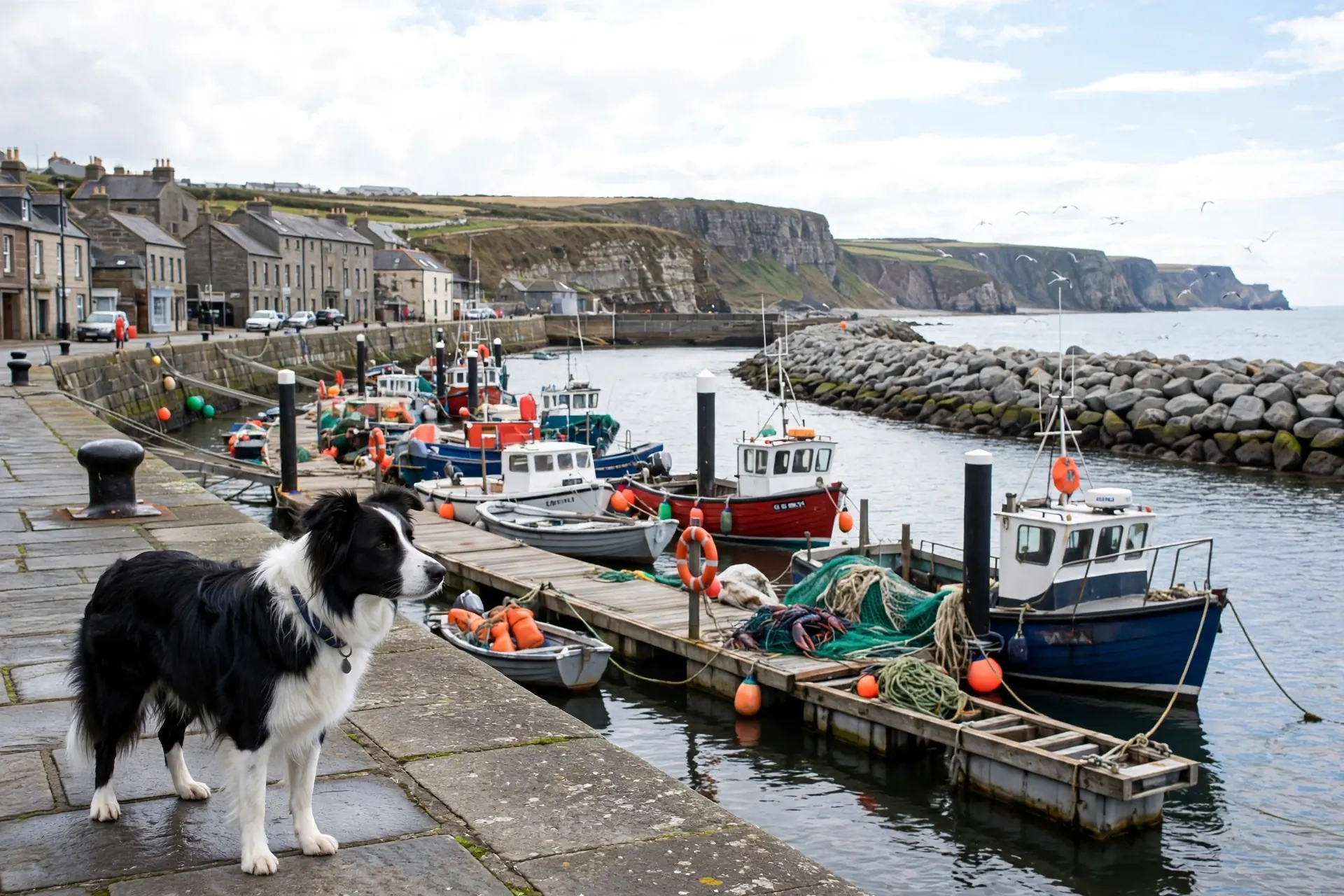
Start at Wick Harbour, because that is where the town explains itself. The harbour was laid out in the early nineteenth century, with the engineer Thomas Telford involved in its design, and it grew with the herring boom into one of the busiest fishing ports in Britain. Today the inner harbour holds fishing boats, pleasure craft and the marina pontoons, while the outer harbour and the great stone breakwaters face the open North Sea. Walk the quayside with your dog and you will pass creels and nets, working boats being loaded and unloaded, and the low stone buildings of the old harbour quarter. It is a working place, not a museum, and that is exactly why dogs need to stay on a lead here: there are moving vehicles, forklifts, ropes underfoot, mooring lines at ankle height and unfenced drops into deep water.
The best harbour circuit is simple and flat, which makes it ideal for an arrival walk, an older dog or a wet morning. Park near the harbour, cross to the quayside and follow the water around the inner basin, past the marina and out towards the breakwater, then loop back along the river. The whole circuit is under two miles if you keep it tight, and the ground is mostly paved or firm, so it suits dogs that struggle with rough paths. Keep your dog close where the quay narrows, and watch for fish hooks, broken glass and the sharp edges of old ironwork near the working areas. If your dog is a scavenger, this is the one walk where a muzzle or a very short lead is worth considering, because discarded bait and fish waste can appear around the fish market and the boat yards.
The riverside walk upstream from the harbour is the quieter half of the same outing. The River Wick runs through the town in a shallow, wooded valley, and the paths along its banks give your dog grass, trees and a change of scent after the salt and diesel of the harbour. Herons and ducks are common along the river, so dogs with a strong chase instinct should stay on a lead until you know how they react. The river path also connects the harbour to the town centre, which makes it a useful route if you are walking from a guesthouse to the shops rather than driving everywhere. In winter, when the light fades early, this is the walk to do in daylight and save the cliff paths for a brighter day.
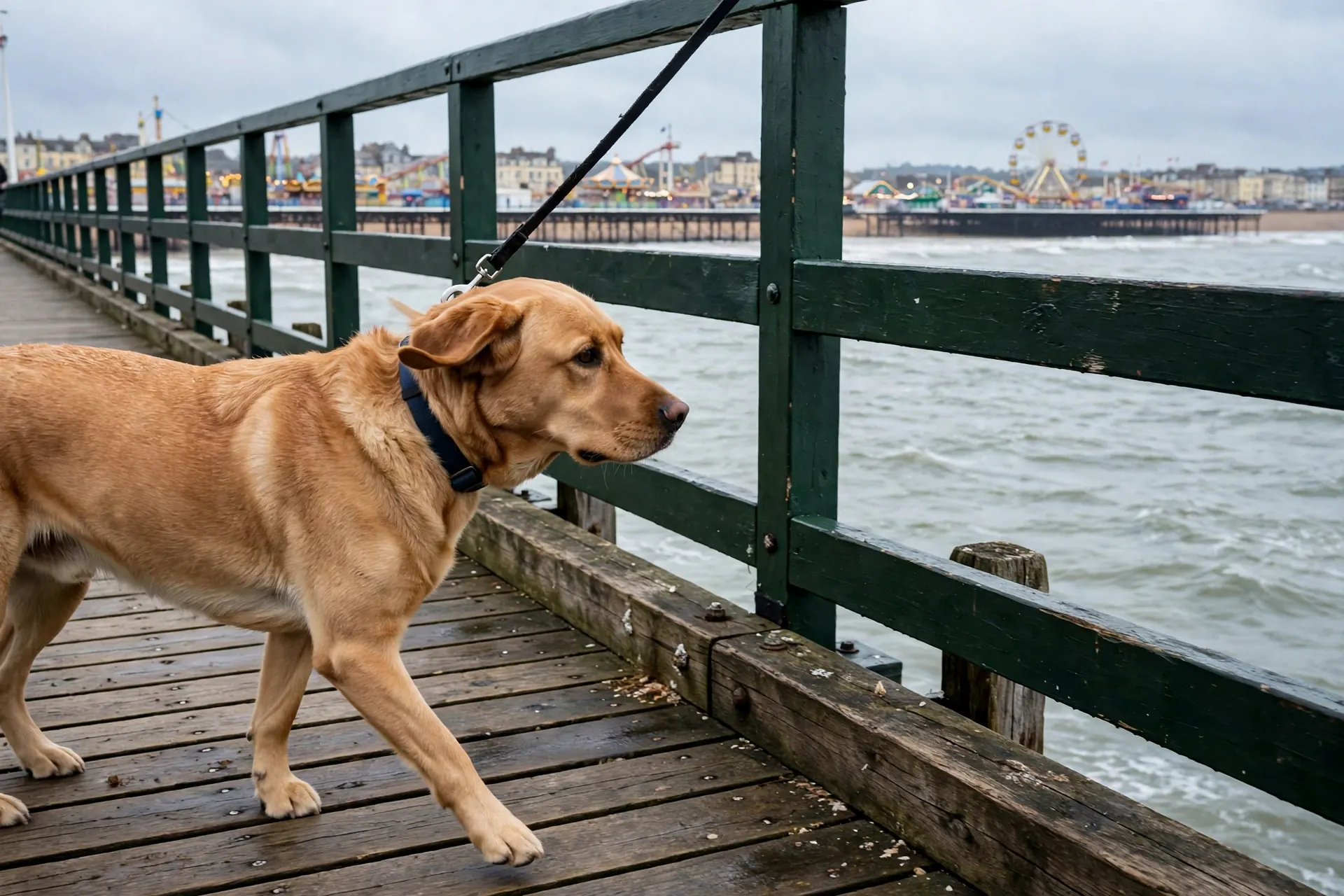
Two harbour details are worth knowing before you go. First, the harbour walls and the breakwater are exposed to the full force of the North Sea, and waves can break over the outer piers in a northerly gale. Do not take your dog out onto the breakwater in rough weather, and keep well back from the edge when the sea is running. Second, the harbour is tidal in feel even though the inner basin is sheltered: water levels, boat movements and the slipway change through the day, so a spot that looked quiet at noon can be busy with a working boat by late afternoon. None of this is a reason to avoid the harbour. It is simply the difference between visiting a working port and visiting a promenade, and a dog owner who respects that difference will have a much better time. Our guide to dogs at piers in the UK covers the same boardwalk gaps, metal grates and fishing-gear hazards in more detail, and most of it applies to a working harbour too.
Cliff walks on the Caithness coast
The coast around Wick is made of Caithness flagstone, the same layered grey stone that paves the town's streets, and it breaks into tall, sheer cliffs with narrow inlets called geos, sea stacks and natural arches. The walks here are not fenced clifftop promenades. They are grassy paths along an unfenced edge, and that changes how you walk them with a dog. Keep your dog on a lead on every clifftop section, stay well back from the edge, and never let a dog chase birds near the drop. The views repay the caution many times over: on a clear day you can see along the coast for miles, watch fulmars and kittiwakes working the cliff face, and look out to sea for seals and, in the right season, passing whales and dolphins.
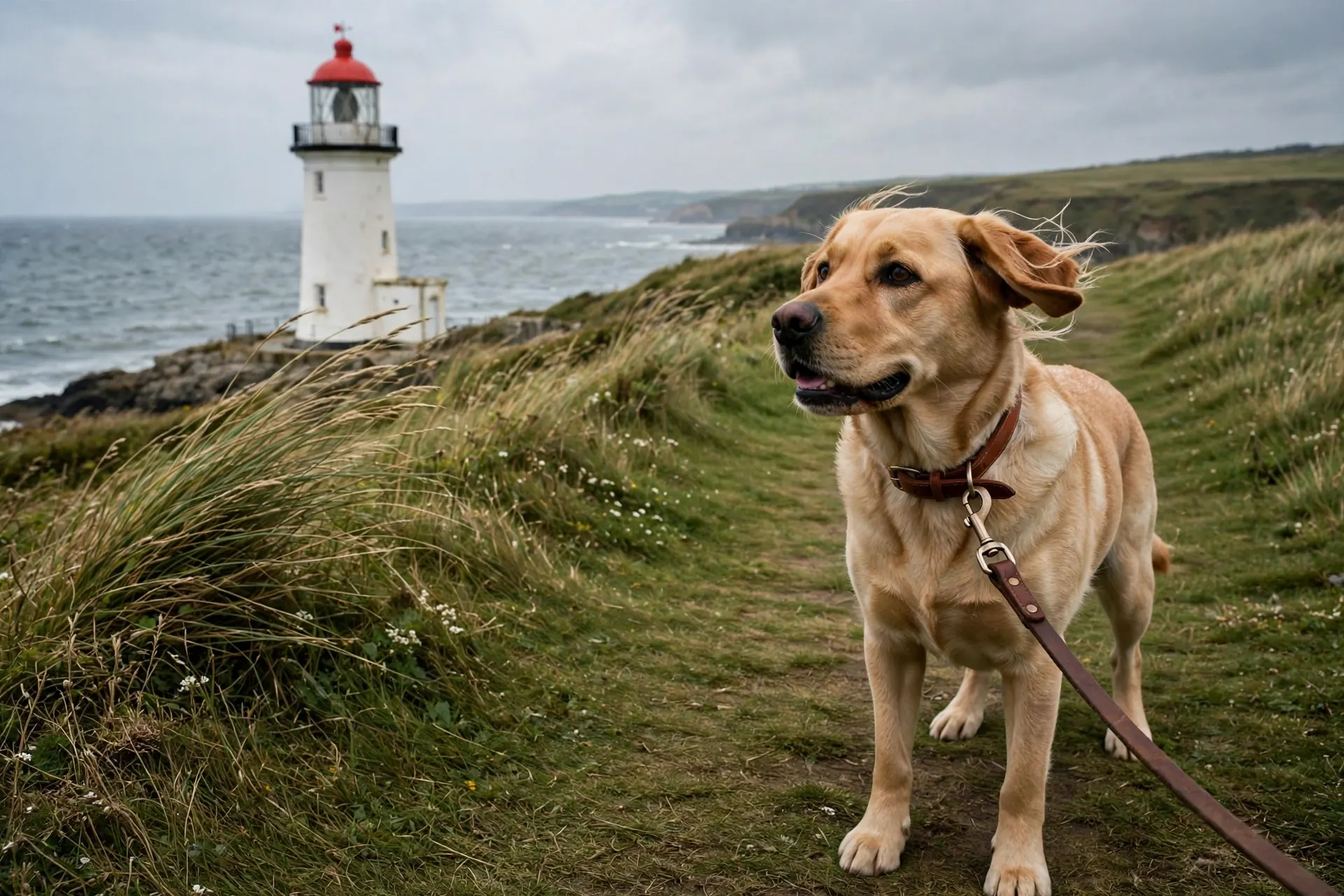
North from Wick, the coast path runs towards Noss Head and its lighthouse, roughly three miles from the town centre. The lighthouse itself is a working aid to navigation and the tower is not open to dogs, but the headland walk is the point of the trip, and the approach across open grass and along the cliff top is one of the best dog walks in Caithness. Give yourself two to three hours for the round trip, carry water for both of you, and wear boots with grip, because the flagstone can be slick when wet and the grass paths turn muddy after rain. If your dog is nervous of heights or pulls hard on the lead, this is a walk to take slowly, with the dog on a short lead and frequent stops. Our guide to dogs at lighthouses in the UK explains the usual tower rules and the cliff safety checks that apply at headlands like Noss Head.
South from Wick, the coast path runs towards the Castle of Old Wick, also known as Castle Sinclair Girnigoe, a ruined clifftop castle on a narrow promontory a short walk from the town. The castle is a dramatic sight: a broken tower on a finger of rock, cut off from the mainland by a deep geo, with the sea crashing below. Dogs can walk the approach path on a lead, but the castle site itself is a ruin with uneven stone, drops and no barriers, so keep your dog close and do not let them scramble over the masonry. Beyond the castle the path continues along the cliffs, and the walking gets wilder and less defined, which is the moment to turn back unless you are confident with navigation and your dog is steady on rough ground.
Whatever direction you choose, a few cliff rules hold everywhere in Caithness. First, check the wind before you set out: a strong onshore wind makes the cliff edge a genuinely dangerous place, and a gust can knock a small dog off balance. Second, keep your dog away from the cliff edge even when the path seems wide, because the grass can overhang an undercut edge that you cannot see. Third, watch for nesting birds in spring and early summer, when many cliff sections ask walkers to keep dogs on leads to protect colonies. Fourth, carry a lead even on the stretches where your dog runs free, because the coast path crosses farmland where sheep graze close to the cliffs, and a dog worrying sheep is a serious matter in Scotland. Finally, tell someone where you are going and when you expect to be back, especially on the longer stretches south of town, where phone signal can be patchy and other walkers are few.
Beaches near Wick
Wick itself does not have a classic town beach, which surprises some visitors, so the beach part of the trip means a short drive. The payoff is Sinclair's Bay, the long sweep of sand south of Wick between the town and the village of Reiss. This is a wide, open, dune-backed beach that feels a world away from the harbour: pale sand, marram grass, and room to run in every direction. Local dog walkers use it all year, and on a weekday morning you may have a long stretch of it to yourself. The sand is firm enough for a good run near the waterline, and the dunes give shelter from the wind, which matters on a Caithness day when the sea breeze is cutting across the open beach.
Before you let your dog off the lead at Sinclair's Bay, run through the usual beach checks. Look at the tide times, because the beach is broad at low tide and the water comes in fast across the flat sand. Keep your dog away from fishing lines and any washed-up debris, and watch for dead seabirds, which can carry disease. The river that runs into the bay can be cold and fast after rain, so do not let a dog swim in it. In summer, the beach can attract adders in the dunes, so keep your dog on the paths through the grass rather than letting them crash through the marram. These are small precautions rather than reasons to stay away, and a dog that can run freely on a beach this size after a long drive is a happy dog.
Reiss Beach, at the southern end of the bay, is the more sheltered, village end of the same stretch of sand, and it suits a shorter, easier outing, especially with an older dog or a puppy. The car park is close to the sand, the walk to the water is short, and the village setting feels calmer than the open bay. Further afield, the beaches at Keiss and Dunnet Bay are both within a half-hour drive, and Dunnet Bay in particular is a long, sandy beach that dog owners rate highly, with the added bonus of being close to Dunnet Head, the most northerly point of the British mainland. If you are staying in Wick for several days, rotate the beaches rather than repeating the same one, because the wind direction changes the feel of each beach completely.
One thing the far north does well is space, and that is the real beach advantage of Wick over busier resorts. There are no dog bans on the main beaches here in the way that southern resorts impose them, and there is no need to arrive at dawn to beat the crowds. Even so, check the official guidance before you travel for any seasonal notices, keep your dog under control around other beach users and horse riders, and always pick up after your dog. The beaches are used by families, birdwatchers and fishermen as well as dog walkers, and the unwritten deal is simple: everyone leaves the sand as they found it.
Dog-friendly cafes and pubs in Wick
Wick is not a town of dog-themed cafes, and that is part of its charm. The welcome here is informal and practical: several cafes and pubs around the harbour, the High Street and the riverside accept dogs, most often at outdoor tables or in a particular corner of the room. The pattern is familiar across the Highlands: a dog that settles quietly under the table is welcome, a dog that barks at every passing customer is not, and the staff will usually tell you straight away where your dog is happiest. Because policies change with ownership and season, treat any list of dog-friendly venues as a starting point rather than a promise, and check the official guidance before you travel or simply ask at the door.
The harbour area is the best place to start looking. The cafes and pubs near the water are used to walkers coming in off the cliff paths with muddy boots and a dog in tow, and several keep water bowls by the door and dog treats behind the counter. Outdoor seating is the most reliable option in summer, and on a still day the harbourfront tables are a fine place to sit with a coffee while your dog watches the boats. Indoors, ask for a table near the door or in the bar area rather than the main dining room, because that is where dogs are usually accepted, and it is also where your dog will be least disturbed by the coming and going of other diners.
The High Street gives you a second cluster of options, and it is worth knowing how the town's cafes work before you plan a long lunch. Many of Wick's cafes are small, family-run places with limited seating, which means a large dog in a crowded room can be a squeeze. Visit outside the lunchtime rush if your dog is large or nervous, bring a mat or a blanket for them to lie on, and order at the counter rather than expecting table service everywhere. If you are travelling with two dogs, call ahead: a single dog under a table is easy, two dogs in a small cafe needs a bit of planning. The same applies to pubs in the evening, when the bar fills up and a dog on a long lead across a busy floor is a trip hazard.
A few habits make the whole cafe and pub experience smoother. Carry a portable water bowl and a small bag of treats so your dog has something to do while you eat. Keep the lead short and tucked under your chair leg so it does not trail across the walkway. Settle your dog before you order, not after the food arrives, because a dog that has already lain down is far less likely to beg. If your dog cannot settle, take the food to go and eat it on a bench by the harbour instead of forcing a long sit. And if a venue says no to dogs on the day, accept it gracefully and move on: the next place along the street will often say yes, and a calm response keeps Wick friendly for the next dog owner who walks through the door.
Where to stay with a dog in Wick
Wick has a practical range of dog-friendly places to stay, and the right choice depends on how your dog behaves indoors. The town has hotels and guesthouses, a good number of self-catering cottages and flats, and caravan and camping options in the surrounding area. Self-catering is often the easiest fit for a dog owner, because it gives you a private front door, a kitchen for preparing your dog's food, and a garden or yard for last thing at night. Hotels and guesthouses in Wick vary: some welcome dogs in selected rooms, some restrict them to ground-floor rooms, and most charge a small nightly or per-stay fee. Always confirm the dog policy in writing before you pay, including the number of dogs allowed, the fee, and whether your dog can be left alone in the room, because the answers differ widely from place to place.
When you compare places to stay, ask the questions that matter for your particular dog rather than the ones on the listing. Is the garden enclosed, and how high is the fence? Is there a ground-floor room or a cottage with direct access outside, so a night-time toilet trip does not mean a staircase and a corridor? Is there hard flooring or washable covers, which make life easier after a wet cliff walk? Is the accommodation near a practical first walk, or will every outing start with a drive? And what is the rule about leaving the dog alone: many places prohibit it entirely, some allow it for a short period if the dog is crated and quiet, and a few do not mind at all. Our guide to dog-friendly holiday parks in the UK covers the same questions about fees, boundaries and small print, and the checklist works just as well for a cottage or a guesthouse in Wick.
Booking ahead is essential in summer. Wick is a natural overnight stop on the North Coast 500, and the town's dog-friendly rooms fill up quickly in June, July and August, when the route is at its busiest. The same is true of the school holidays and the long summer evenings, when the light lasts until late and the cliff walks are at their best. If you are travelling in peak season, book two or three months ahead and confirm the dog policy twice: once at booking and once a week before arrival, because a room that was dog-friendly in May can have changed hands by August. In the quieter months, from October to April, you will have more choice and lower prices, but check that your chosen place is actually open, because some smaller guesthouses and self-catering properties close or reduce their hours in winter.
On arrival, give your dog the same settling routine you would use at home. Walk the boundary of the garden before you unpack, check the gate latch, and look for gaps in fences and hedges. Put your dog's bed, water bowl and a familiar blanket in a quiet corner, and keep the first evening calm: same feeding time, same last outing, same bed. If your dog is crate trained, set the crate up exactly as it is at home rather than improvising. And keep the accommodation's emergency numbers handy, including the nearest vet, because a dog that eats something unusual on a beach walk is the sort of problem that is much easier to solve when you already know where to go.
Parking and practicalities in Wick
Parking in Wick is straightforward compared with most tourist towns, but a little local knowledge still helps. The harbour and riverside car parks put you closest to the main walks, and they are the best choice on arrival day, when you want to stretch your dog's legs straight away. The town centre car parks, near the High Street, suit a shopping stop or a cafe visit, and they are a short walk from the river path back to the harbour. On a fine summer weekend the harbour parking fills early, so arrive before mid-morning or be prepared to park a little further out and walk in along the river. Check the official guidance before you travel for current charges, time limits and any seasonal changes, because the details shift from year to year.
Never leave a dog in a parked car, even for a short stop. A car in the far north can still heat up quickly on a sunny day, and a dog left alone in a vehicle is at risk even with the windows open. If you need to pop into a shop that does not allow dogs, take it in turns, or use the shops that do allow dogs and keep the visit short. The same rule applies in reverse in winter: a car cools fast in a Caithness wind, and a wet dog left in a cold vehicle will chill quickly. Plan your stops so the dog is either with you or being walked, and keep a towel and a drying coat in the car for the walk back.
Beyond parking, Wick is well set up for the practical side of a dog holiday. The town has supermarkets where you can buy dog food, treats and the extra towels you will inevitably need, as well as pet supplies in the larger stores. There are public toilets near the town centre and the harbour, and several of the cafes will let you use their facilities if you are a customer. Rubbish bins and dog waste bins are provided along the main walks, but carry your own bags anyway, because the bins on the longer cliff paths are few and far between. Mobile signal in the town is generally good, but it drops on the coast paths and in the glens, so download your maps before you set out and do not rely on live navigation on a cliff walk.
Fuel and money deserve a mention too, because Caithness is not the place to run either down to empty. Wick has fuel stations and cash machines, but the villages along the coast have neither, so fill up and draw cash before you head out on a day trip. The same goes for your dog's supplies: buy the extra bag of food and the spare lead in Wick, because the next shop that stocks them may be a long drive away. And keep a paper copy of your accommodation address and the vet's number in the car, in case your phone dies at the exact moment you need it.
A North Coast 500 day trip from Wick
Wick sits on the North Coast 500 where the route turns the corner of the far north-east, which makes it one of the most useful bases on the whole circuit. The NC500 is a 516-mile loop around the Highlands, and the stretch from Wick north to John o' Groats and west to Thurso is the part where the road, the sea and the sky all feel at their biggest. From Wick you can do this as a single relaxed day trip with a dog, driving north to the top of the mainland and back, with stops that suit a dog rather than a checklist of photo points.
Start by heading north on the A99 towards John o' Groats. The village itself is small and busy in summer, with a harbour, a few shops and cafes, and the famous signpost, but the real walk is a short drive further on at Duncansby Head. The lighthouse there stands on a wild headland, and the coast path runs along the cliff top to the Duncansby Stacks, three great sea stacks rising out of the water. Keep your dog on a lead throughout, because the cliffs are unfenced and the wind is strong, and allow at least an hour for the out-and-back walk. The stacks are best seen in the morning light, and the headland is exposed, so bring a windproof layer even on a calm day in Wick.
From Duncansby Head, continue west to Dunnet Head, the most northerly point of the British mainland. The road out to the headland is a single-track lane with passing places, so drive slowly and expect sheep on the road. The lighthouse and the viewpoint at Dunnet Head give you a panorama across the Pentland Firth to Orkney, and on a clear day you can see the islands of Hoy and South Ronaldsay across the water. The grassy headland is a good place for a lead-on stroll, but the cliffs are sheer and the wind is fierce, so keep your dog well back from the edge and do not let them chase the rabbits that live in the turf. Dunnet Bay, just below the headland, is a long sandy beach that works well as the off-lead break in the middle of the day, and the village of Dunnet has a small shop and a cafe.
Thurso, the most northerly town on the mainland, is the natural lunch stop on this circuit. The town has a harbour, a riverside walk and a handful of cafes, and the beach at Thurso East is popular with surfers and dog walkers. From Thurso the road back to Wick runs along the coast through the village of Castletown and past the remains of the old flagstone quarries, which is a reminder of how the stone under your feet built half the pavements of Britain. Allow a full day for the loop, drive gently on the single-track sections, and stop often: the far north rewards the driver who pulls over for the view rather than the one who hurries to the next pin on the map. For more ideas on the wider route, our lighthouse and pier guides cover the coastal stops that pair naturally with a Wick base.
Weather, seasons and what to pack
Caithness weather is famously changeable, and Wick gets the full range. The far north is cooler and windier than the rest of Britain, with average summer highs in the mid-teens and winter days that are short, grey and often wet. The wind is the defining feature: it comes off the North Sea with nothing to stop it, and it can turn a pleasant afternoon into a cold one within an hour. Rain is frequent in every season, and the haar, the sea fog that rolls in off the water, can reduce visibility to a few metres without warning. None of this should put you off, but it should change how you pack.
Summer, from June to August, is the most popular time to visit, and for good reason. The days are very long, with daylight lasting until nearly 11pm at midsummer, which means you can walk the cliffs after dinner and still be home before dark. The beaches are at their best, the cafes have their outdoor tables out, and the North Coast 500 is in full swing. The trade-offs are crowds on the route, higher prices, and midges. The biting insects are less of a problem on the windy Caithness coast than they are in the sheltered glens further south, but they appear on still evenings, especially near the river and in the dunes, so pack repellent and a midge net for your own comfort. Dogs are not usually troubled by midges, but a dog with thin fur or a sore ear can attract them, so check your dog's ears after a still evening walk.
Spring and autumn are the connoisseur's seasons in Wick. April and May bring long days, lambs in the fields, nesting seabirds on the cliffs and far fewer visitors, while September and October bring the autumn light, the first storms and the beaches to yourself. The risk in both seasons is the weather turning quickly, so check the forecast every morning and be ready to swap a cliff walk for a harbour stroll if the wind rises. Winter, from November to February, is the quietest and the most demanding season: daylight lasts barely six hours, the wind is at its worst, and some cafes and guesthouses close. But a winter break in Wick has its own rewards, including the chance of seeing the Northern Lights on a clear dark night, and the town feels properly itself when the summer traffic has gone.
Pack for the weather you might get, not the weather you hope for. For your dog, that means a drying coat, two towels, a waterproof lead, a spare lead, poo bags, a portable water bowl, and a blanket for the car. For yourself, it means a windproof and waterproof jacket, layers, walking boots with grip, and a hat that will stay on in a sea wind. Add a basic first-aid kit for the dog, including a tick remover, saline for flushing eyes, and a bandage, because the nearest vet may be a drive away when you are out on the cliffs. And pack a map: the coast paths are not always well signed, and a paper map is the one thing that still works when your phone has no signal and the fog has come down.
Safety, vets and the fine print
Wick has a veterinary practice in the town, which is one of the practical reasons it works so well as a base, but the far north is still a long way from the nearest emergency vet hospital, so a little preparation goes a long way. Before you travel, save the number and the opening hours of the Wick vet in your phone, and check the official guidance before you travel for the nearest out-of-hours service. If your dog is on regular medication, bring more than you need, because a rural pharmacy may not stock it. If your dog has a condition that could flare up on holiday, talk to your own vet before you go and ask what to do if it happens far from home.
Several hazards are specific to the Caithness coast, and most of them are easy to manage once you know about them. Adders live in the dunes and on the heathland, and they are most active on warm, sunny days from spring to autumn. Keep your dog on the paths through the dunes, watch where they put their nose in the grass, and know the signs of a bite: sudden yelping, swelling and lameness. If you suspect a bite, keep your dog calm and still, carry them if you can, and get to a vet immediately. Ticks are also common in the long grass and bracken, so check your dog after every walk, especially around the ears, the armpits and the groin, and remove any ticks promptly with a tick remover.
The sea itself deserves respect. The North Sea off Caithness is cold all year, and the currents around the headlands are strong, so do not let your dog swim off the cliff beaches or near the harbour mouth. The sandy bays are safer for a paddle, but even there, watch for the tide and keep your dog in the shallows. After any swim, rinse your dog with fresh water if you can, because salt water can upset a dog's stomach if they drink it, and dry their ears to reduce the risk of infection. If your dog is a keen swimmer, a buoyancy aid is worth considering for the open beaches, and a long line gives you control without stopping the fun.
Finally, the fine print. Scotland has its own access rules under the Land Reform (Scotland) Act 2003, which gives a right of responsible access to most land, including the coast paths, but that right comes with responsibilities: keep your dog under control, keep them on a lead near livestock, and do not let them disturb wildlife or other people. The Dangerous Dogs Act 1991 applies in Scotland as well, so keep your dog under control in public places and be honest about your dog's behaviour when you book accommodation. And remember that this guide is written for planning, not as a substitute for local advice: if a sign, a landowner or a member of staff asks you to put your dog on a lead, do it, and check the official guidance before you travel for any changes to access, parking or beach rules.
Practical questions
Before you go
Can dogs walk off lead around Wick Harbour?
The harbour itself is a working quayside, so keep your dog on a lead there. The riverside paths and the open ground beyond the harbour are better for off-lead time, but only where there is no livestock, no cliff edge and no local sign asking for leads. Treat the harbour as a lead-on stroll and save the free running for the beaches and the wider coastal paths.
Is there a beach near Wick where dogs can run off lead?
Yes, the wide sandy bay at Sinclair's Bay, a short drive south of Wick, is the most practical off-lead beach in the area, and the sands at Reiss are also popular with local dog walkers. Both are open, exposed beaches, so check the tide times, watch for strong winds and keep your dog away from any fishing gear or washed-up debris. Seasonal restrictions are uncommon here, but check the official guidance before you travel.
Which cafes and pubs in Wick welcome dogs?
Several cafes and pubs around the harbour and the High Street welcome dogs, most often in outdoor seating areas or in a designated dog-friendly corner indoors. Policies change with ownership and season, so ask at the door or call ahead rather than assuming. Bring a mat for your dog to settle on, keep the lead short in busy rooms, and avoid peak meal times if your dog is unsettled by crowds.
Where is the best place to park in Wick with a dog?
The harbour and riverside car parks put you closest to the main walks, while the town centre car parks suit a cafe stop or a shopping break. Arrive early on summer weekends, as the harbour parking fills quickly when the weather is good. Never leave a dog in a parked car on a warm day, even with the windows open, and check the official guidance before you travel for current charges and time limits.
Can I use Wick as a base for the North Coast 500 with a dog?
Yes. Wick sits on the North Coast 500 route where it turns the corner of the far north-east, which makes it a natural overnight stop between the east coast and John o' Groats. From Wick you can reach Duncansby Head, Dunnet Head and Thurso in a single day trip, and the town has supermarkets, a vet and fuel, so you can restock before the quieter west coast stretches. Book dog-friendly accommodation well ahead in summer.