This guide is independent and contains no paid placement. If affiliate links are added later, they will be clearly marked and will not change our editorial checks.
Wigtown is Scotland's National Book Town: a small, quiet market town on the Machars peninsula where bookshops line the square and the wide tidal shore of Wigtown Bay lies a short walk away. It is at its best as a slow break — browse the shops in the morning, walk the bay or the marshes in the afternoon, and let the dog sleep through a long evening. Keep dogs on leads around birds and livestock, check the official guidance before you travel for shop, cafe and reserve rules, and bring a car if you want to explore the wider peninsula.
A book town built for slow browsing
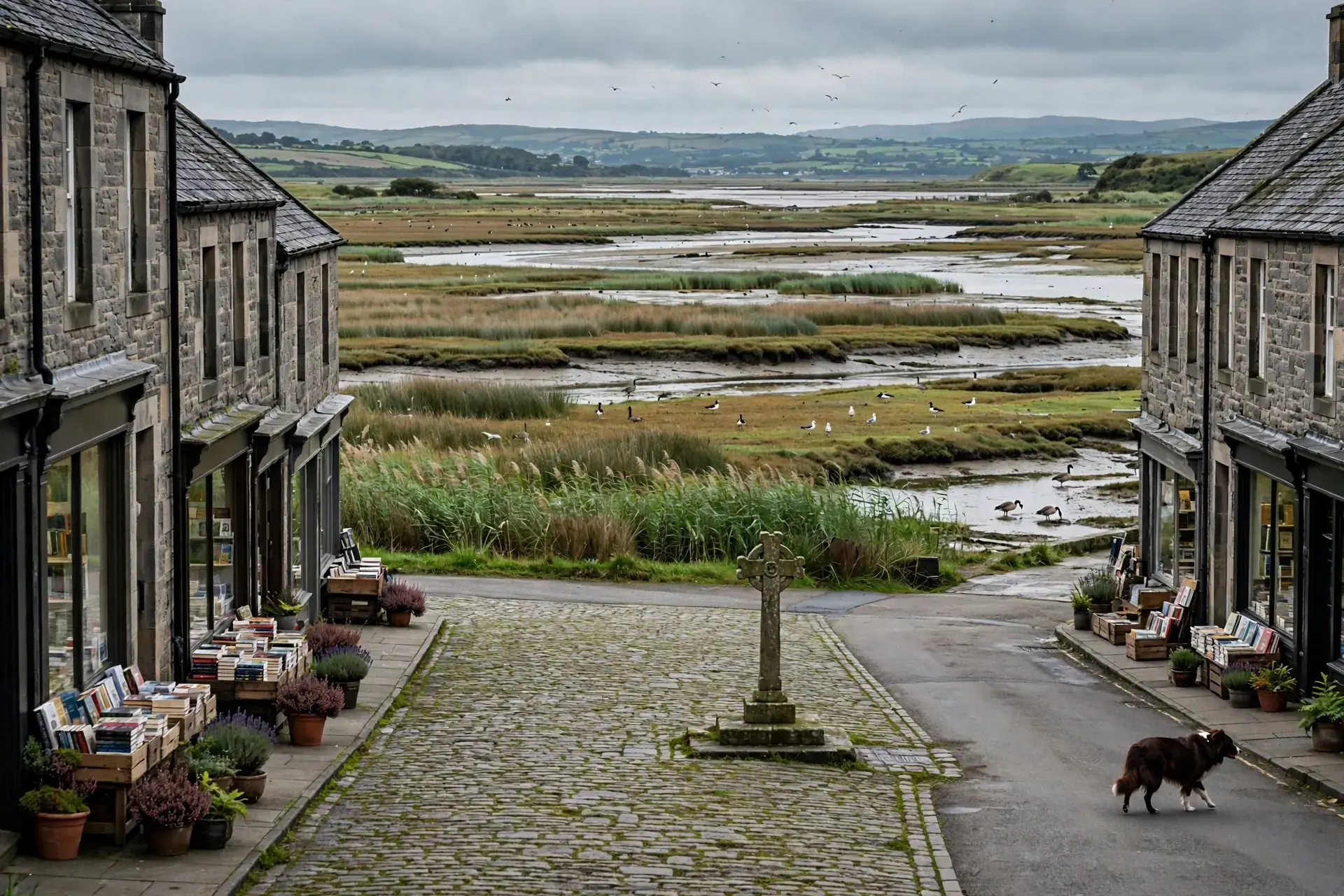
Start in the market square, where the whole idea of Wigtown makes sense at once. This is Scotland's National Book Town, and the square is lined with bookshops rather than chain stores: second-hand shops, specialist sellers, a bookshop that claims to be among the largest of its kind in Scotland, and small premises where the owner is usually behind the counter and happy to talk. The buildings are low and handsome, the pavements are wide enough for a dog to walk comfortably beside you, and the pace of the place is unhurried in a way that suits a browsing dog far better than a busy high street does. There is no rush here, no crowd pushing past, and no need to hurry a dog that wants to sniff every doorway.
The practical way to do the bookshops with a dog is to treat it as a series of short visits rather than one long browse. Many of Wigtown's bookshops welcome dogs, and several keep a water bowl by the door and a resident dog of their own asleep in a sunny spot. Policies differ from shop to shop, however, and they can change with the season, so ask at the door rather than assuming. A short lead matters inside a bookshop: shelves are close together, stock is stacked at dog height, and a wagging tail at the wrong moment can clear a display. If your dog is large, excitable or nervous in tight spaces, take turns — one person browses while the other waits outside with the dog, then swap. The square itself is a pleasant waiting room, with benches and room to stand, and a dog that has just had a walk will usually settle for ten minutes while you finish a shelf.
The town's bookish identity is not just a marketing label. Wigtown hosts an annual book festival in late September and early October that fills the town with authors, readings and visitors, and the festival is the one time of year when the square genuinely gets busy. For many dogs that is a wonderful atmosphere — more people to meet, more smells, more going on — but for a nervous or reactive dog it can be a lot. If you visit during the festival, plan your bookshop browsing for early morning, keep walks to quieter routes, and book accommodation well ahead, because the town's small stock of dog-friendly places fills fast. Outside festival week, Wigtown returns to its normal self: a town where you can browse for an hour, buy nothing, and still feel you have had a proper morning.
Bookshops aside, the square rewards a slow circuit. Look up at the county buildings and the tolbooth, read the plaques, and notice how the town's history as a county town and a market centre still shows in its layout. The Martyrs' Stake, on the shore below the town, marks a much darker chapter — two women were drowned on the sands in 1685 during the religious conflicts of the time — and it is worth a quiet visit with the dog on a lead, both for the history and for the wide view across the bay that opens up from the shore path. Keep the tone of that stop respectful and unhurried; it is a memorial, not a photo opportunity, and the dog will be happier for a calm pause than for a fuss.
One more thing about browsing with a dog in Wigtown: bring a bag. Second-hand bookshops are dangerous for people who like books, and the town has a way of producing exactly the volume you did not know you wanted. A sturdy tote keeps purchases off the lead hand, and a small towel in the bag is useful for wiping muddy paws before you step into a shop after a bay walk. If you are driving home with a car full of books, pack them low and flat so a dog cannot slide them around, and keep the dog's bed clear of the shopping.
The Machars: a peninsula that sets the pace
Wigtown sits on the Machars, the low, rolling peninsula that forms the south-western corner of Dumfries and Galloway, between Wigtown Bay to the east and Luce Bay to the west. The name comes from the Gaelic for a low-lying plain, and that description still fits: this is gentle country, not dramatic mountain country. Fields, hedgerows, small woods and quiet lanes run down to a long, shallow coastline, and the whole peninsula moves at a speed that suits dogs. Traffic is light, villages are small, and the walks tend to be flat or gently undulating rather than steep. For an older dog, a small dog, or a dog recovering from an injury, that flatness is a genuine advantage — you can cover real distance without asking for real climbing.
The peninsula's shape matters for planning. Wigtown stands near the eastern side, above the tidal flats of Wigtown Bay, while the western side faces Luce Bay and the open sea. The two coasts feel different: the eastern shore is all mudflats, salt marsh and wading birds, while the western shore has sandier beaches and a more open, windswept character. A dog that loves to run on sand will be happier on the western side; a dog that loves to sniff along a marsh edge, and an owner who loves birds, will be happier on the eastern side. Most visitors base themselves in Wigtown and drive out to one coast or the other for a walk, which works well because nothing on the peninsula is very far — the whole Machars is only about twenty miles from top to bottom, and the lanes are quiet enough that a twenty-minute drive feels like a proper outing rather than a chore.
The farming landscape is part of the experience, and it sets the rules. The Machars is working farmland: cattle and sheep graze the fields, crops grow in the flatter ground, and farm tracks cross the walking routes. That means leads are not optional in many places, and it means reading the field before you enter it. If there are livestock in a field, keep the dog on a lead or take another route, even if the dog is normally reliable off lead. Scottish access rights are generous, but they come with responsibilities, and the responsibility is heaviest where animals and ground-nesting birds are involved. The same applies to the lanes themselves: there are few pavements outside the towns, so walk on the right-hand side facing oncoming traffic, keep the dog on the inside, and wear something visible in poor light.
Weather on the Machars deserves a paragraph of its own, because it shapes every dog walk here. This is a low, exposed peninsula between two bays, and wind is a constant companion. A still, sunny morning can turn into a sharp, salt-laden wind by lunchtime, and rain can arrive horizontally off the bay. The practical answer is layers and a drying plan: a waterproof coat for you, a drying coat or towel for the dog, and a car or cottage to return to. The wind also has an upside — it keeps the midges down, which is a real blessing in the summer months when other parts of Scotland are thick with them. The Machars is not midge-free, but a breezy day on the bay is a far more comfortable place for a dog than a still, humid woodland.
Finally, understand that the Machars rewards patience rather than ticking off sights. There is no single famous viewpoint to rush towards, no mountain to conquer, no castle to queue for. The pleasure is cumulative: a quiet lane, a field of geese lifting off the marsh, a beach with nobody else on it, a bookshop with a dog asleep in the window. Visitors who try to pack the peninsula into a single frantic day usually leave feeling they have missed it. Visitors who give it two or three slow days, with a long walk in the morning and a quiet afternoon in the town, tend to come back. Plan your days accordingly, and let the dog set the pace — a dog that is allowed to sniff its way along a Machars lane is doing exactly what the place is for.
Birdwatching on Wigtown Bay
Wigtown Bay is the reason many visitors come here with binoculars, and it is one of the finest places in southern Scotland to watch birds with a dog in tow — provided the dog is kept well under control. The bay is a large, shallow, tidal estuary where the River Bladnoch meets the sea, and at low tide it exposes vast mudflats that draw wading birds in huge numbers. The bay is designated as a Local Nature Reserve, and the nearby RSPB Crook of Baldoon reserve, a short drive from the town, protects salt marsh and wet grassland that are especially important in winter. Together they make a birdwatching destination that changes completely with the seasons, and that is worth visiting more than once if you can.
Winter is the headline season. From autumn onwards, pink-footed geese arrive in large flocks to spend the winter on the bay and the surrounding fields, and whooper swans — big, pale, wild swans with a distinctive yellow-and-black bill — join them on the marshes and flooded fields. On a still winter morning, the sound of geese lifting off the marsh in a great, noisy skein is one of the great wildlife experiences of the British winter, and it costs nothing more than being in the right place at dawn with warm clothes and a pair of binoculars. Waders are present all year: curlew with their long curved bills, oystercatchers piping on the shore, redshank and godwits working the mud at low tide. In spring and summer, the marshes and hedgerows fill with warblers and other small birds, and the bay becomes a place for quieter, closer watching rather than big spectacles.
The dog's role in all of this is simple: stay on a lead, stay well back, and stay quiet. Feeding birds burn energy every time they are flushed, and in winter that energy can be the difference between surviving the cold and not surviving it. A dog running across a marsh or a mudflat will scatter a flock that has taken hours to settle, and the damage is done long before the owner realises. The rule is to keep the dog on a lead at all times around the bay, to keep well away from the water's edge where birds are feeding, and to use the hides and viewing points that are provided rather than pushing closer for a better look. Some hides and paths are not suitable for dogs at all, so check the official guidance before you travel, and be ready to leave the dog in the car for a short, shaded, well-ventilated wait while you use a hide — never in a hot car, and never for long.
Practical birdwatching with a dog starts with the tide. The bay at high tide is a sheet of water with birds pushed up to the marsh edges; at low tide it is a vast expanse of mud with birds spread far out. Both are worth seeing, but the best watching is usually on a rising or falling tide, when birds are on the move and relatively close. Check tide times before you set out, and treat the tide with respect: the mudflats are soft, the channels fill quickly, and a dog that chases a bird out onto the mud can get into trouble fast. Never let a dog run onto the mudflats, and never follow one out there. The shore path below the town gives a good, safe view without leaving solid ground, and the viewing points around the bay are designed to keep people — and dogs — where they can watch without disturbing.
What to bring is straightforward: binoculars, a field guide or an identification app, warm layers, waterproof footwear for the shore path, and a lead you can hold comfortably for an hour. A dog that has already had a walk will settle better at a viewpoint than a dog that is bursting with energy, so do the exercise first and the watching second. Bring water for the dog and a small mat for it to lie on if you plan to sit for a while; a cold, damp bank is no place for a dog to lie for an hour. And if the dog will not settle, do not force it — take the hint, walk on, and come back for the birds another day. The geese will still be there tomorrow, and a frustrated dog makes for poor birdwatching anyway.
Walks in and around Wigtown
The best walk in Wigtown itself is the simplest one: a loop from the market square down to the shore and back. Leave the square by the road that drops towards the bay, follow the shore path along the edge of the town, and return by a different lane. The whole circuit is short — well under an hour at a dog's pace — and it gives you the town, the bay and the marsh in a single outing. The shore path is flat and easy underfoot, the views across the bay to the Galloway hills are wide and open, and the dog gets a proper sniffing walk with plenty of new smells. Do it in the morning before the bookshops open and you will have the shore largely to yourself; do it at sunset and you will see why people fall for this place. Keep the dog on a lead along the shore, both for the birds and because the mud at the water's edge is soft and deceptive.
For a longer outing, the lanes and tracks around the town offer several easy extensions. The road towards Bladnoch, the village a couple of miles to the north, follows the river of the same name and makes a pleasant out-and-back walk with the dog, although the road itself carries traffic and has no pavement in places, so a lead and high-visibility clothing are sensible. The old railway line and farm tracks in the area provide quieter alternatives, but routes and access can change, so check the official guidance before you travel and ask locally about the current state of any path you plan to use. A good rule for the Machars is to plan a walk you can shorten: pick a route with a clear turn-back point at the halfway mark, so a tired dog, a sore paw or a sudden shower does not turn a pleasant outing into a forced march.
Torhousekie Stone Circle, a short drive west of Wigtown, is worth combining with a lane walk. The circle is a well-preserved Bronze Age monument — three upright stones in a low, grassy field, with two outlying stones nearby — and it makes a fine, quiet stop for a dog that is happy to sit while you look. The field is grazed, so keep the dog on a lead, and remember that this is a scheduled ancient monument: do not climb on the stones, do not let the dog dig, and leave the place as you found it. The lanes around Torhousekie are quiet and good for a short, sniffy walk, and the whole stop takes less than an hour, which makes it an easy addition to a day that is otherwise built around the town.
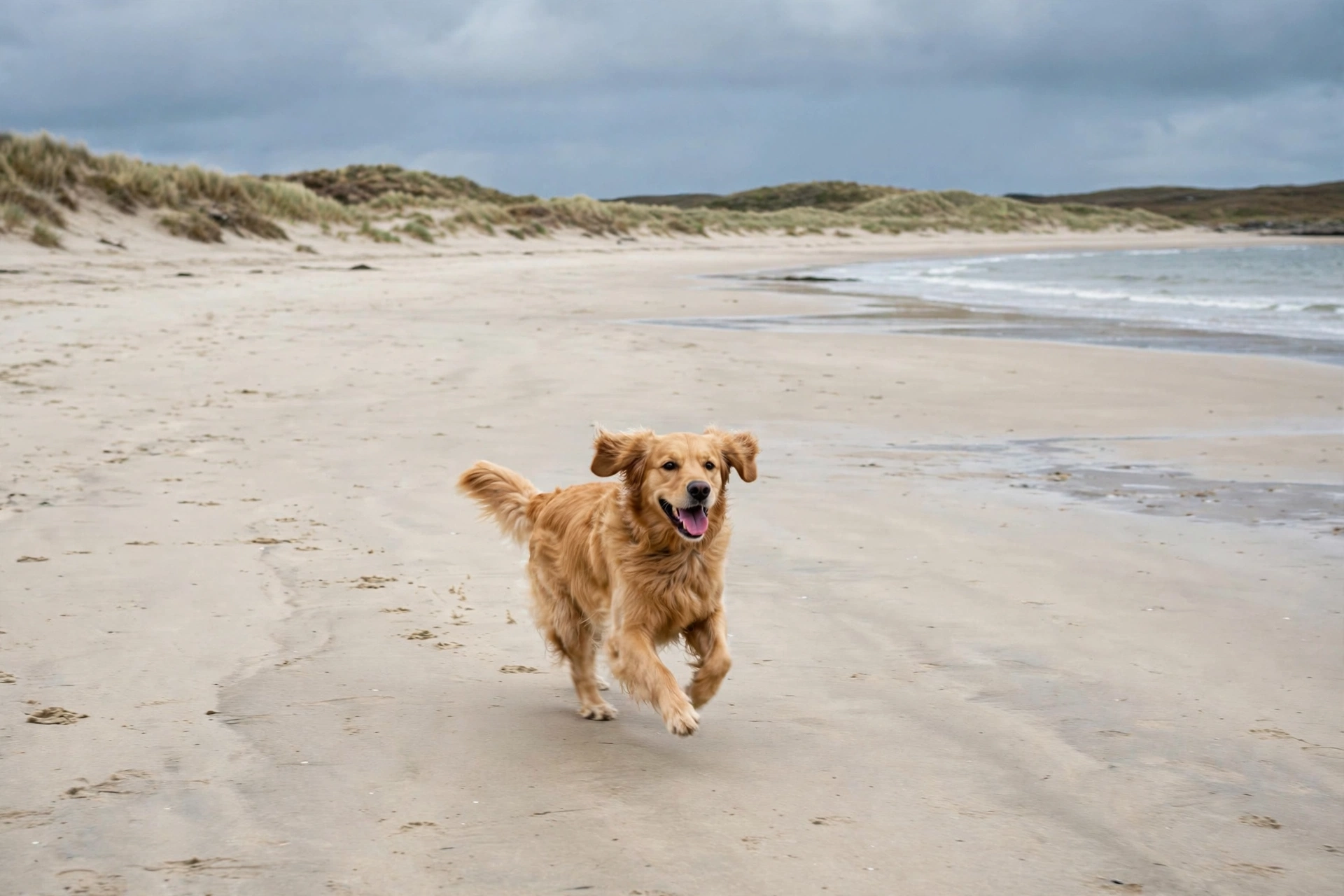
Further afield, the Machars coast offers the bigger walks. The shore at Garlieston, to the south, and the beaches along Luce Bay to the west give dogs the open sand they dream about, and the coastal paths there are generally quiet outside the summer holidays. Our guide to dog-friendly beaches in Scotland covers the seasonal rules, tides and kit list that apply to these shores, and it is worth reading before you head for the sand. The practical points are the same everywhere on this coast: check the tide, check the signs at the access point, keep the dog in sight, and bring fresh water, because salt water and sand are a poor combination for a thirsty dog. A long line is a good compromise on a beach where you are unsure of the rules or the surroundings — the dog gets room to run without being truly loose.
Whatever walk you choose, build in a drying routine for the return. Machars walks are muddy walks, especially after rain, and a dog that has been along a marsh edge or a farm track will come back with wet feet and a wet belly. A towel by the cottage door, a drying coat for the car, and a quick paw wash in a bowl of warm water will save your accommodation deposit and your sanity. Check paws after every walk for cuts, thorns and salt irritation, and check ears after a beach walk for sand. A five-minute routine at the door is the difference between a dog that dries happily and a dog that shakes mud across every soft furnishing you have borrowed for the week.
Where to stay with a dog
Wigtown's accommodation is small-scale, and that is part of its charm — and part of the planning challenge. The town has a handful of bed and breakfasts, guest houses and self-catering cottages, plus a small hotel, and the surrounding villages add farm cottages and rural lets. Dog-friendly places exist, but they are not the majority, and the best ones are booked well ahead for festival week and for the summer. Start looking early, and be specific in your enquiry: how many dogs, what size, what breed, whether the dog can be left alone briefly, and whether there is an enclosed garden. A vague enquiry gets a vague answer; a specific enquiry gets a straight yes or no, and a straight no early on is far better than a surprise on arrival.
Self-catering cottages are usually the best fit for a dog in Wigtown. They give you a kitchen, a door you can open at midnight, and a space where the dog can settle without worrying about other guests. When you compare cottages, look past the photographs and ask the practical questions: is the garden enclosed, and how high is the fence; is there a hard floor the dog can sleep on; is there somewhere to dry a wet dog; and how far is the nearest walk that needs no car? A cottage on the edge of town with a direct lane walk will serve you better than a prettier cottage in the middle of the square where every toilet trip means a lead, a pavement and a road. If the cottage has a garden, ask whether it is shared or private, and whether there are gaps a small dog could slip through — a "fenced garden" photographed from one angle can hide a lot.
Bed and breakfasts and small hotels can work well for a single night or a short stay, but the rules are tighter. Dogs are usually restricted to certain rooms, are not allowed in the dining room, and cannot be left alone in the room. That is manageable if you plan around it — eat out at a dog-friendly pub, or take breakfast in shifts — but it is a poor fit if you want to leave the dog sleeping while you go for a long dinner. Ask for the written dog policy before you book, including any pet charge and any cleaning fee, and get the total in writing. Our wider guide to Dumfries and Galloway with a dog covers the region's forests, dark skies and Solway shore, and it is a useful companion when you are choosing between basing yourself in Wigtown and basing yourself elsewhere in the region.
For longer stays, consider the villages around Wigtown as well as the town itself. A cottage in or near Bladnoch, Kirkinner or Garlieston can offer more space, a bigger garden and a quieter lane for the same money, at the cost of a short drive into town for the bookshops. The trade-off is worth weighing honestly: if your dog needs a garden and a quiet lane more than it needs to be two minutes from a bookshop, the village cottage wins. If you want to walk to breakfast and browse the shops every morning, the town wins. There is no wrong answer, only a wrong assumption — so decide what matters most to your dog and book for that.
Finally, a word about leaving the dog in your accommodation. Many Wigtown places ask that dogs are not left alone at all, and those that allow it usually set a short limit and expect the dog to be quiet and crated. Plan as if the answer is no: choose places to eat where the dog can come, plan your bookshop browsing in turns, and take the dog with you wherever you reasonably can. A dog that is never left alone in a strange cottage is a dog that never barks at a strange noise, never chews a strange chair leg, and never costs you a cleaning fee. It is also a happier dog, and a happier dog is the whole point of the trip.
Eating and drinking with a dog
Wigtown's food scene is small and local, which suits a dog owner very well. The town has a handful of cafes, a bakery, a hotel restaurant and a pub or two, and the pattern is familiar from small towns everywhere: dogs are often welcome in the bar or on a terrace, less often in the main dining room, and almost always welcome if you ask nicely and the dog settles under the table. Policies change, so check the official guidance before you travel and confirm on the day rather than relying on a listing that may be out of date. A dog that lies quietly under a table is welcome almost everywhere; a dog that barks, begs or wanders between tables is welcome almost nowhere, and the difference is training, not luck.
The practical approach is to eat early and eat simply. Lunch in a cafe, with the dog under the table and a walk afterwards, is the easiest meal of the day in Wigtown. Order at the counter where you can, choose a table near the door so the dog has a clear route out, and bring a small mat for the dog to lie on — a familiar mat is a powerful settling cue in a new place. If the weather is kind, the outdoor seating in the square and outside the cafes is the best option of all: fresh air, room for the dog, and no worries about other diners. In winter, when the outdoor seats are empty, the pub bar with a fire is the place to aim for, and a dog asleep by a fire is one of the great pleasures of a Galloway winter.
Self-catering changes the equation entirely, and it is one of the strongest arguments for booking a cottage in Wigtown. The town has a small supermarket and local shops for the basics, and Newton Stewart, a short drive away, has larger supermarkets for a proper weekly shop. Cooking in the cottage means the dog can sleep by the kitchen while you cook, nobody has to be left alone, and the evening is yours. Stock up on arrival, plan one or two meals out during the stay, and keep the rest simple. A dog that eats at its normal time, in its normal place, with its normal food, is a dog that settles — and a settled dog makes for a relaxed evening for everyone.
For a special meal, look to the wider Machars and to Kirkcudbright, the artists' town to the east, where the choice of restaurants and cafes is broader and several places welcome dogs in their bar or garden areas. Book ahead, mention the dog when you book, and ask exactly where the dog will sit — "dog-friendly" can mean the bar, the terrace, the garden or a specific corner, and those are four different evenings. If a restaurant cannot take the dog, do not try to negotiate on the door; thank them, take the dog for a walk, and eat somewhere that wants you both. There are enough good options in Galloway that nobody needs to eat somewhere they are not wanted.
One last practical note: carry water and a collapsible bowl whenever you go out to eat. Small cafes do not always have a dog bowl, and a dog that has walked to lunch will be thirsty. A bowl in your bag costs nothing and saves the awkward business of asking for a soup bowl and a towel. The same bowl does duty on walks, in the car and at viewpoints, and it is the single most useful piece of kit you will carry in Wigtown — after the lead, the towel and the book bag.
Planning the practical side
Getting to Wigtown takes a little planning, and the dog is part of that plan. The town sits in the far south-west of Scotland, reached by the A75 from Dumfries and the east, or from Stranraer and the ferry ports to the west. Newton Stewart, about ten miles to the north, is the nearest larger town, with supermarkets, a petrol station and a veterinary practice; Dumfries, about thirty miles east, is the nearest large town with a full range of services. If you are driving, the last stretch is on quiet rural roads, and the drive itself is part of the pleasure — but check your fuel before you leave the A75, because petrol stations are thin on the ground on the peninsula.
Public transport to Wigtown is limited. Buses run through the town, connecting it with Newton Stewart, Stranraer and Dumfries, but services are infrequent, especially on Sundays, and a dog on a bus is always at the driver's discretion. If you travel without a car, plan your bus times carefully, allow long waits, and base yourself in the town centre so that the bookshops, the shore path and the cafes are all walkable. A taxi from Newton Stewart or Stranraer is possible but should be booked ahead, with the dog mentioned at booking. For most visitors with a dog, a car is not a luxury in the Machars — it is the thing that turns a good trip into an easy one.
Parking in Wigtown is straightforward. There is parking around the square and on the streets nearby, and it is generally free and easy to find outside festival week. During the book festival, parking tightens up and you may need to park a little further out and walk in, which is no hardship with a dog. Never leave a dog in a parked car in warm weather, even for a few minutes, and be cautious in cold weather too — a car cools quickly, and a dog left in a cold car is a dog at risk. If you need to leave the dog briefly, one person stays with the dog while the other runs the errand, and the dog never waits alone.
Veterinary cover is a practical point worth sorting before you travel. The nearest veterinary practices are in Newton Stewart, with more options in Dumfries and Stranraer, and an emergency vet may be a longer drive at night. Save the number of the nearest practice in your phone before you leave home, along with the number of your own vet, and carry the dog's medication and vaccination record with you. If your dog has a health condition, tell the accommodation host in advance and know where the nearest out-of-hours service is. This is five minutes of preparation that you will probably never need — and will be very glad of if you do.
Seasons change the packing list more than the plan. In summer, bring sun protection for a pale-nosed dog, extra water, and a cooling mat for the cottage; the Machars is rarely hot, but a still, sunny day on a beach can catch a dog out. In winter, bring a drying coat, a warm bed, and a towel for every outing, because the bay wind is cold and the rain is persistent. In spring, watch for adders on sunny banks and for ticks in long grass — check the dog after every walk, and carry a tick remover. In autumn, the leaf litter hides mud and the days shorten fast, so carry a torch for the last walk of the day. Whatever the season, pack the dog's normal food, because the small shops in Wigtown may not stock your brand, and a sudden change of diet on holiday is a recipe for an upset stomach.
Day trips from Wigtown
Whithorn, about eight miles south of Wigtown, is the obvious first day trip, and it is a small town with a very large history. Whithorn is known as the cradle of Christianity in Scotland, where St Ninian is said to have built the first Christian church in the country in the fifth century, and the town's priory, museum and ruined buildings repay a slow visit. The town itself is quiet and walkable, with a main street that a dog can stroll comfortably, and the museum and priory have their own access rules, so check the official guidance before you travel and plan to take turns if the dog cannot go inside. The walk from Whithorn to the Isle of Whithorn, the small fishing village on the coast, is a pleasant outing in itself, and the harbour there is a fine place for a dog to watch the boats.
The Isle of Whithorn deserves a paragraph of its own. This is a tiny, working harbour village with whitewashed cottages, fishing boats and a strong sense of being at the edge of things. The harbour wall is a good place to sit with a dog and watch the tide, the lanes are quiet, and the cafe in the village is a welcome stop. The coastal path from the village gives views across to the Isle of Man on a clear day, and the whole place has a calm that makes a dog settle quickly. Keep the dog on a lead around the harbour — there are boats, ropes, fish boxes and other dogs, and a harbour is a working place, not a playground. Check the official guidance before you travel for the cafe's current dog policy.
Kirkcudbright, to the east along the Solway coast, is the artists' town of Galloway, and it makes a good contrast with Wigtown: where Wigtown is books, Kirkcudbright is art, with galleries, a harbour, and a high street that rewards a slow wander. The town is dog-friendly in the usual Galloway way — dogs welcome in many shops and cafes, on leads around the harbour, and on the riverside walks — and the combination of a morning in Kirkcudbright and an afternoon on a Solway beach makes a full and satisfying day. The drive between the two towns follows the coast and is worth taking slowly, with a stop or two for the dog to stretch its legs.
For a wilder day, Galloway Forest Park lies to the north, and it is one of the great dog-walking landscapes of southern Scotland. The forest park has waymarked trails of every length, from short lochside loops to long hill walks, and it is also a Dark Sky Park, which makes it worth an evening visit for the stars. Our wider guide to Dumfries and Galloway with a dog covers the forest trails, the dark skies and the Solway shore in detail, and it is the best companion for planning a forest day from a Wigtown base. The practical points are simple: the forest is big, the weather changes fast, and the walks are longer than they look on a map, so carry water, food and a map, and turn back while the dog still has energy in reserve.
Stranraer, to the west, is the ferry port for Northern Ireland and a useful stop rather than a destination in itself. The harbour and the lochside walks are pleasant with a dog, and the town has supermarkets and services that are handy on the way in or out. If you are arriving by ferry with a dog, Stranraer is the natural gateway to the Machars, and the drive from the port to Wigtown takes well under an hour. Check ferry dog rules in advance — most operators have specific arrangements for dogs, including kennels on board and rules for dogs left in vehicles — and check the official guidance before you travel so there are no surprises at the port.
Dog etiquette on the bay and the farmland
The etiquette of Wigtown is really the etiquette of the whole Machars, and it comes down to one idea: your dog's freedom ends where someone else's livelihood or wildlife begins. The peninsula is farmland, and the bay is a nature reserve, and both are working landscapes rather than dog parks. A dog that chases sheep can cause a ewe to miscarry or a lamb to be separated from its mother, and a farmer is entitled to protect livestock. A dog that flushes a flock of geese in winter can undo hours of feeding. Neither outcome is the fault of a bad dog — it is the fault of a good dog given too much freedom in the wrong place.
The lead rules are simple enough to remember. On the shore and the marshes, keep the dog on a lead at all times. In fields with livestock, keep the dog on a lead, and if cattle approach, let the dog off the lead and move away calmly — a dog on a lead between you and a curious cow is in danger, while a dog that can move away is not. On lanes with no pavement, keep the dog on a short lead on the inside, away from traffic. On beaches, follow the signs at the access point and keep the dog in sight. Ground-nesting birds are a particular concern from spring into summer: skylarks, lapwings and other birds nest on the ground in the fields and on the marsh edges, and a dog running through long grass can destroy a nest without its owner ever knowing. Keep the dog to paths and short grass in the breeding season, and check the official guidance before you travel for any seasonal restrictions.
Cleaning up is non-negotiable, and it matters more here than in a city park. Dog waste on farmland can spread disease to livestock, and waste left on a beach or a path is a health hazard for other dogs and for children. Carry bags on every walk, pick up every time, and take the bag with you — there are bins in the town, but not on the marsh or the shore, so be prepared to carry a used bag for the rest of the walk. A small, sealed pouch or a clip-on bag holder keeps the job tidy, and it is a small price for the privilege of walking in a landscape that other people work in and wildlife depends on.
Meeting other dogs and other people is the last piece of the etiquette puzzle. The Machars is a place where dogs are part of daily life, and most encounters are friendly, but not every dog wants to say hello, and not every walker wants a strange dog jumping up at them. Keep your dog under control when you meet others, ask before letting dogs greet, and recall the dog promptly if it rushes towards someone. A dog that is called back cleanly and put on a lead for a passing walker is a dog that gives its owner a good reputation — and in a small town like Wigtown, reputation travels fast. The reward for good etiquette is simple: you will be welcomed back, and the next visitor with a dog will be welcomed too.
A dog-shaped day in Wigtown
Here is a day that works, built from the pieces above and tested against the rhythms of the town. Start early, before the bookshops open, with the shore loop from the market square down to the bay and back. The light is best in the morning, the birds are active, and the dog gets a proper walk before the day's browsing begins. Take forty-five minutes over it, let the dog sniff, and finish with a drink of water and a short rest. Then breakfast — in the cottage, or in a cafe with the dog under the table — and the first bookshop of the day.
Spend the late morning browsing. Two or three shops, taken slowly, with a pause in the square between them, is about right for most dogs. Buy the books you want, then drive out for the afternoon walk: the marsh edge at the Crook of Baldoon for birdwatching, the lanes around Torhousekie for history and quiet, or a beach on Luce Bay for sand and space. Give the walk a full hour or two, with water and a rest, and be back in town by late afternoon. The dog will be tired by now, and a tired dog is a happy dog.
Finish the day the way the town wants you to finish it: slowly. A late lunch or an early dinner in a dog-friendly pub, a last short walk around the square as the light fades, and an evening in the cottage with a book from the morning's shopping and a dog asleep at your feet. There is no need to fill the evening with plans, and no need to drive anywhere else. Wigtown is a place that rewards the visitor who stays put, and the dog will tell you so by falling asleep before you do. Repeat the pattern the next day with a different walk and a different bookshop, and by the third day you will understand why people come back to this small town on the edge of the bay, year after year, with the same dog and a heavier bag of books.
Practical questions
Before you go
Is Wigtown a good place to visit with a dog?
Yes, for the right kind of trip. Wigtown is small, quiet and walkable, with bookshops to browse at a slow pace, short town walks and the wide open shore of Wigtown Bay a short drive away. It suits dogs that are happy with gentle days, on-lead exploring and long sleeps in a cottage, rather than dogs that need big off-lead runs every morning. Check the official guidance before you travel, as shop and cafe dog policies can change.
Can dogs go into the bookshops in Wigtown?
Many of Wigtown's bookshops welcome dogs, and several keep a water bowl and a resident dog of their own, but policies differ from shop to shop and can change with the season. Ask at the door, keep your dog on a short lead between the shelves, and be ready to wait outside with one person browsing while the other holds the lead if a shop asks for space.
Where is the best birdwatching near Wigtown with a dog?
Wigtown Bay Local Nature Reserve and the nearby RSPB Crook of Baldoon reserve are the two best-known spots. Winter brings large flocks of pink-footed geese and whooper swans to the bay, while waders work the mudflats at low tide all year. Dogs must stay on a lead and well away from feeding birds, and some hides and paths are not suitable for dogs, so check the official guidance before you travel.
Are dogs allowed on the beaches near Wigtown?
The shores around Wigtown Bay and the Machars are generally quiet and dog-friendly outside the busiest summer weeks, but there is no single rule for every stretch of sand. Seasonal restrictions can apply at popular beaches, livestock may graze nearby, and tidal mud can be dangerous. Check local signs at each access point and the official guidance before you travel.
When is the best time of year to visit Wigtown with a dog?
Late spring and early autumn usually offer the best balance: mild weather, quieter roads and long daylight. The Wigtown Book Festival in late September and early October brings crowds and a lively atmosphere, which some dogs love and others find stressful. Winter is the best season for geese and swans on the bay, but days are short and weather can be rough, so plan short outings and warm indoor stops.
Do I need a car to explore the Machars with a dog?
A car makes the Machars much easier. Wigtown itself is walkable, but the peninsula's beaches, birdwatching spots and neighbouring villages such as Whithorn and the Isle of Whithorn are spread out, and public transport is infrequent. If you travel without a car, base yourself in the town centre and plan one or two taxi or bus trips rather than trying to cover the whole peninsula on foot.