This guide is independent and contains no paid placement. If affiliate links are added later, they will be clearly marked and will not change our editorial checks.
Windsor suits dogs that like long, straight walks and town streets in equal measure. Start at the Long Walk, keep your dog on a lead around the deer, then drop down to the Thames at Alexandra Gardens or the Brocas in Eton for a slower riverside loop before a pub on Park Street or in Eton.
A royal town
Windsor is a small town dominated by one enormous fact: Windsor Castle sits on a chalk ridge above the Thames and has been occupied by monarchs for nearly a thousand years. The castle is the oldest and largest occupied castle in the world, and its presence shapes everything about a dog walk here. The streets below it are short and steep, the parks around it are vast, and the whole town runs on a rhythm of guard changes, coach parties and schoolboys from Eton crossing the bridge. For a dog, that adds up to a place with two very different moods within a few minutes of each other: the busy cobbles of Castle Hill and the High Street, and then the open grass of the Great Park or the flat towpath beside the river.
The town is compact enough to cover on foot in a day, which matters when you are travelling with a dog. Windsor & Eton Riverside station, at the foot of the castle hill, puts you straight onto the Thames promenade and Alexandra Gardens. Windsor & Eton Central station, reached from Slough, drops you into Windsor Royal Shopping, a covered arcade built into the old station, a few steps from Castle Hill. Between the two stations, the castle walls and the river, almost everything in this guide sits inside a square half a mile across. The only part that needs a car or a longer walk is the far end of the Great Park, around Virginia Water, which is a separate trip in its own right.
Arrive early if you can. Windsor is one of the busiest day-trip towns in England, and the difference between 9am and 11am is the difference between a quiet castle wall and a pavement full of tour groups. The Changing of the Guard draws crowds to Castle Hill and the High Street on its scheduled days, and the sound of a marching band is a lot for a nervous dog, so check the official guidance before you travel and plan your town-centre walk around it. Weekday mornings outside school holidays are the calmest window, and the Long Walk is at its best in the low winter light or on a summer evening when the crowds have gone home and the deer come out to graze.
Getting here by train is straightforward, and dogs travel free on both routes. South Western Railway runs from London Waterloo to Windsor & Eton Riverside, a journey of just under an hour, while Great Western Railway runs the short shuttle from Slough to Windsor & Eton Central. If you drive, the practical car parks are King Edward VII on the edge of the town centre, River Street beside the Thames, and Alma Road on the far side of the railway. All three fill up on sunny weekends, so aim to arrive before 10am or park at the Great Park and walk in. On-street parking near the castle is limited and expensive, and the narrow streets around Castle Hill are no place to circle with a dog in a hot car.
The Thames is the town's other great feature, and it is the reason Windsor sits where it does. The river bends around the castle hill, passes under Windsor Bridge into Eton, and then runs past the Brocas meadow and on towards Datchet and Runnymede. A dog walk in Windsor is really two walks stitched together: the high, dry, formal avenue of the Long Walk, and the low, flat, muddy towpath beside the river. Do the Long Walk first, while the dog has energy, and save the riverside for the slow hour after lunch, when the swans are out and the trip boats are turning at Romney Lock.
The Long Walk
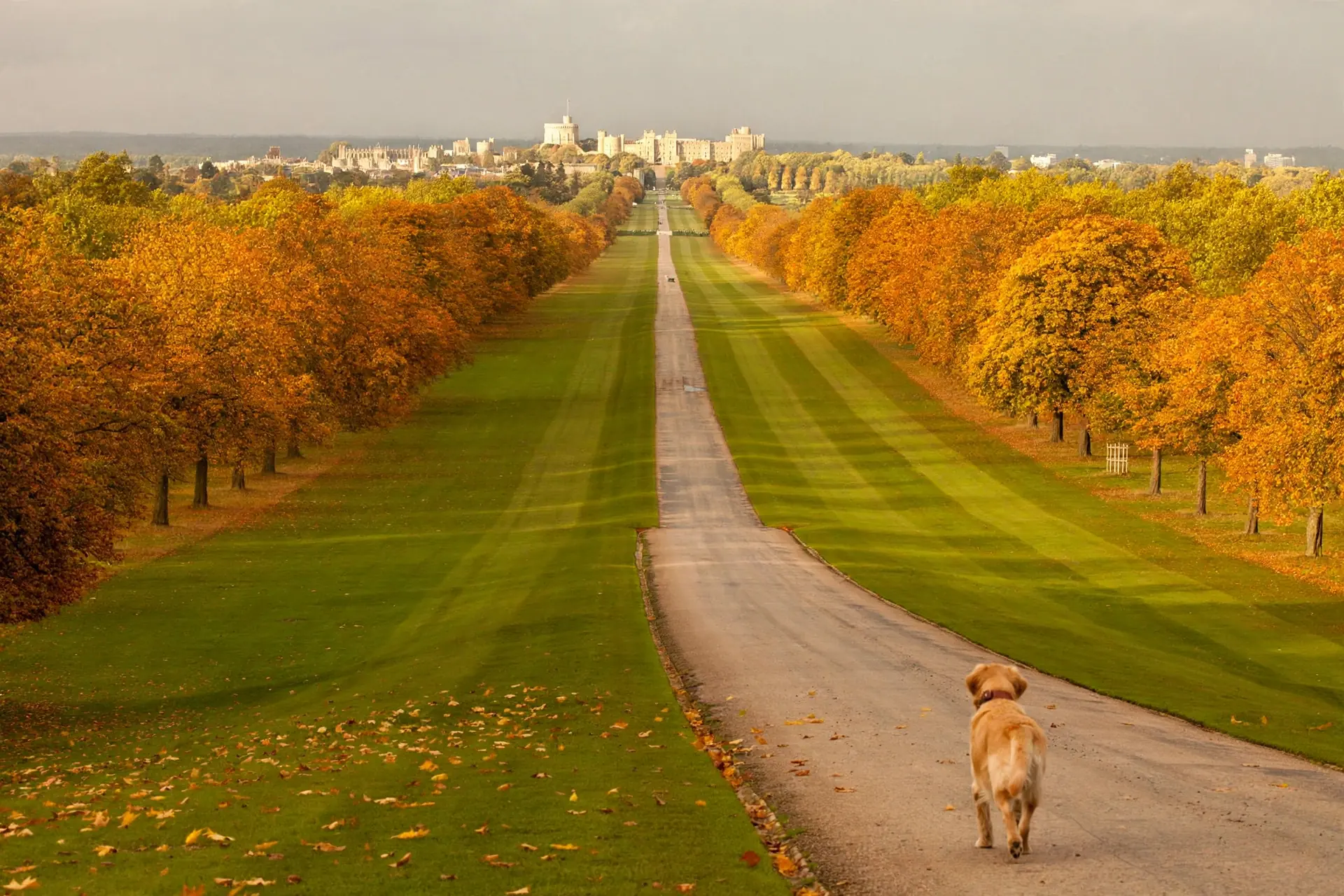
The Long Walk is the single best dog walk in Windsor, and it is also one of the most recognisable views in England. It runs 2.65 miles (about 4.3 kilometres) in a dead straight line from the gates at the foot of Castle Hill to the Copper Horse, the statue of George III on horseback that stands on Snow Hill at the far end. The avenue is flanked by a double row of trees, mostly elms and horse chestnuts, and the castle grows larger behind you as you walk away from it, which makes the return leg, with the castle filling the view ahead, the more rewarding half. On a clear morning the perspective is extraordinary: the road narrows to a point, the trees frame the castle, and the whole town seems to be laid out along a single line.
Start at the gates on Park Street, at the bottom of Castle Hill, where the town ends and the park begins. The first stretch is the busiest, because everyone walks the first few hundred yards, takes a photograph and turns back. Push past that and the avenue empties quickly. The surface is a wide, well-kept gravel track that suits paws in most weather, though it can be dusty in a dry summer and soft after rain. There is no shade in the middle of the avenue, so on hot days walk early or late, and carry water for the dog: the full out-and-back is 5.3 miles, which takes most people and dogs two and a half to three hours at a sniffing pace, and there is nowhere to buy a drink until you are back in town.
Keep your dog on a lead for the whole of the Long Walk. Red deer graze in the Deer Park on both sides of the avenue, often within a few dozen yards of the path, and the rule is enforced by the park rangers for good reason: a dog that chases a deer can be kicked, can run onto the road, and can disturb a herd that is protected here. The deer are most visible at dawn and dusk, and during the autumn rut the stags are unpredictable and best given a very wide berth. If your dog is a chaser, keep the lead short and your attention on the grass rather than the castle view, especially in the first and last stretches where the deer come closest to the path.
Halfway along, the avenue crosses the road at the junction with the B3022, and this is the one point where you need to be careful: cars move fast here and the crossing is not signalised. Beyond it, the walk changes character. The trees thin out, the ground opens up, and the Copper Horse comes into view on its rise. The statue itself, cast in 1831, is worth the walk: George III on horseback, looking back down the avenue towards the castle he loved, with a panorama over the Thames valley behind him. The grass around the statue is a good place for a rest and a drink, and on a windy day it is noticeably colder than the sheltered town end, so bring a layer even in summer.
You do not have to walk the whole avenue to enjoy it. A shorter version, and a sensible one for older dogs or puppies, is to walk out for forty-five minutes and turn back at the road crossing, which still gives you the full castle view and a good stretch of deer-spotting. Fit dogs can add a loop into the Deer Park from the Copper Horse end, following the waymarked paths through the woodland and back along the edge of the park, but check the official guidance before you travel for current path closures, because forestry work and deer management sometimes close sections without much notice.
Windsor Great Park rules
Windsor Great Park covers about 4,800 acres, and the Long Walk is only its front door. The park is Crown Estate land, open to the public, and it is managed for deer, ancient woodland, lakes and public access all at once, which is why the dog rules are more specific than in an ordinary country park. The broad picture is simple: dogs are welcome in most of the park, many areas allow off-lead walking, but there are places and seasons where a lead is compulsory, and knowing which is which before you arrive saves an awkward conversation with a ranger.
Leads are compulsory along the Long Walk, in the Deer Park, around the car parks and near the roads. Off-lead walking is allowed on the open grassland and in the woodland further into the park, away from the deer herds, provided your dog stays under close control and comes back when called. That last condition is not a formality: the park is large enough that a dog that runs off can be out of sight in seconds, and the rangers will ask you to put a dog on a lead if it is harassing wildlife or other visitors. If your dog's recall is unreliable around deer, keep the lead on everywhere and enjoy the walk anyway; the park is generous enough that a lead does not spoil it.
The deer are the reason for most of the rules, and they deserve respect. Around 500 red deer live in the park, and they are wild animals, not park ornaments. During the rut, which runs roughly from September into November, the stags are aggressive and the hinds are protective, and the park asks visitors to keep well back. A dog that gets between a stag and its hinds can be seriously hurt, and every year there are incidents that could have been avoided with a longer lead and more distance. In spring, when the hinds have young calves hidden in the long grass, the same caution applies. If you see deer close to the path, give them the whole width of the avenue and move on quietly rather than stopping for a photograph.
Savill Garden, the fenced and ticketed garden at the southern end of the park, does not admit dogs other than assistance dogs. The same applies to the garden's restaurant and shop. You can still walk your dog through the Great Park around Virginia Water lake, which is a separate and much longer loop, but the garden itself needs a split visit or a dog-free day. Virginia Water itself is a large man-made lake with a lakeside path, a waterfall and the ruins of Leptis Magna, and it is a rewarding walk, but it is a drive from Windsor town rather than a walk, so treat it as a second visit. Check the official guidance before you travel for current opening times and charges, because the garden and the car parks around it change their hours with the seasons.
Practical details for the Great Park: the most useful car parks for dog walkers are Bishops Gate, reached from the B3022 through Old Windsor, which gives direct access to the Long Walk and the Deer Park, and Forest Gate on the southern side for the Virginia Water loops. The car parks fill by mid-morning at weekends, and charges apply at the main ones, so check the official guidance before you travel. There are no bins along most of the paths, so carry bags and take waste with you, and there are limited toilets, mainly near the car parks and at the Savill Building. Cyclists share some of the paths, so keep your dog to one side on the wider tracks, and remember that livestock, including the deer and occasional cattle in the grazing areas, have right of way over a dog's curiosity.
The Thames riverside
The Thames at Windsor is a working river, and the riverside walk has a different texture from the formal park. The Thames Path National Trail passes straight through the town, and the stretch from Windsor to Datchet, Old Windsor and on towards Runnymede is one of the easiest flat walks in the area. Start at Alexandra Gardens, the riverside park below the castle, where the lawns run down to the water and the trip boats moor at Barry Avenue. The gardens are a good place for a slow circuit: flat paths, benches, a cafe in summer, and plenty of swans and ducks for a dog to watch from the bank.
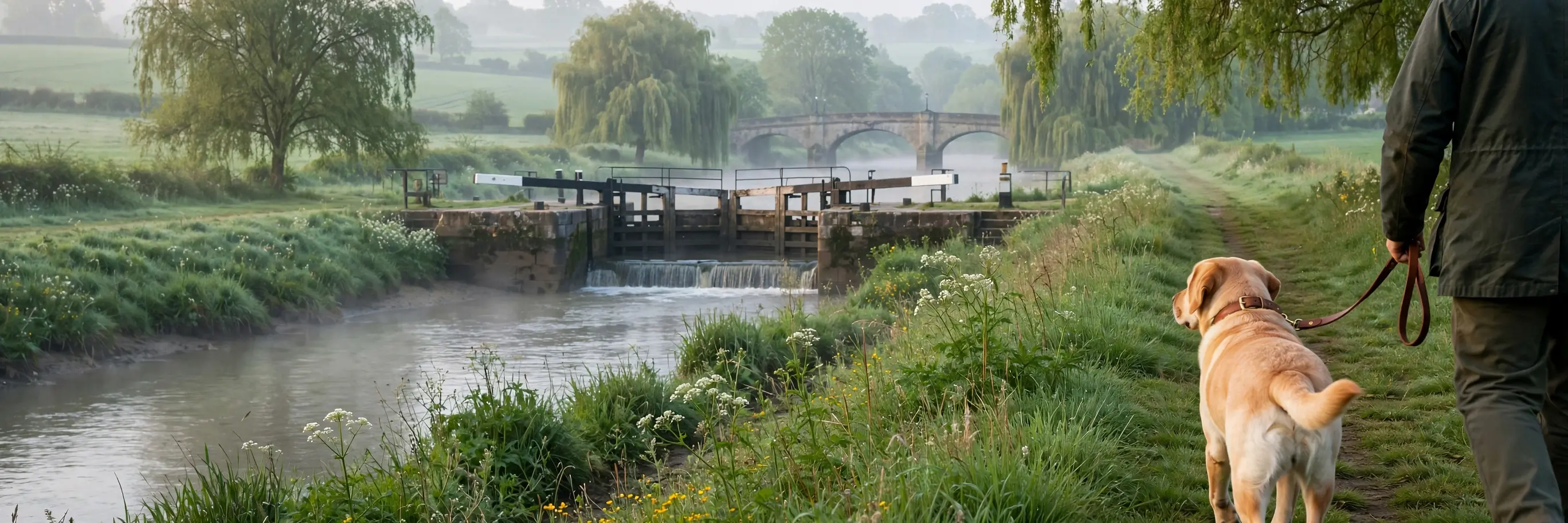
From Alexandra Gardens, follow the towpath downstream past Windsor Bridge and into Eton, where the Brocas meadow opens out on the far bank. The Brocas is a large, flat riverside meadow that has been common land for centuries, and it is the best place in Windsor for a dog to have a proper run close to the water. The ground is level, the grass is short, and the river slides past at walking pace. Dogs can paddle at the gently sloping banks here and at Baths Island, the small island just upstream of the bridge, but keep them away from Romney Lock and the weir, where the water runs fast, and out of the river altogether after heavy rain, when the current strengthens and the water turns murky. The Thames carries silt and, after storms, run-off, so rinse a dog that has been swimming before the drive home.
Upstream from the town, the towpath runs past the racecourse and towards Maidenhead, while downstream it heads to Datchet, a village about two miles away that makes a good out-and-back of four miles in total. Both directions are flat, surfaced for most of their length, and shared with cyclists and joggers, so a lead is sensible on the narrow sections even though the path itself is a public right of way. After wet weather the towpath can be muddy, especially on the stretches where the path leaves the surfaced section and crosses the meadows, so wear boots and expect a muddy dog. In summer the towpath is also one of the busiest places in Windsor, with trip boats, rowing boats and hire boats all using the river, so keep your dog close when boats are mooring.
The bridges are part of the walk. Windsor Bridge, the iron footbridge that links Windsor to Eton, is narrow and can be crowded, with cyclists pushing their bikes and schoolboys hurrying to Eton College, so hold the lead short and keep your dog to the side. The views from the middle of the bridge are worth the squeeze: upstream to the castle and the weir, downstream to the Brocas and the willows. Further upstream, the road bridge at the end of the High Street carries traffic, and the footpath alongside it is the route to the racecourse and the riverside pubs on the far side. If your dog is nervous of crowds, cross the bridge early in the morning, when it is mostly dog walkers and rowers, rather than at midday.
For a longer riverside day, the Thames Path continues to Runnymede, about six miles downstream, where the meadow, the memorials and the National Trust land around them make a full day out. That is a walk to save for a fit dog and a dry day, with a train or a lift back from Egham rather than a twelve-mile round trip. The shorter Windsor to Datchet loop is the realistic version for most visitors, and it pairs well with a pub lunch in Datchet or back in Eton. For more on the river itself, our guide to the Thames Path with a dog covers the full 184 miles from source to sea, including the Windsor stretch, lock crossings and flood-season advice.
The town centre and the castle walls
Windsor town centre is small, steep and crowded, and a dog walk through it needs a plan rather than a wander. Start at the top of Castle Hill, where the castle walls run along the ridge and the view opens over the Thames and Eton. The walls themselves are not a walkway, but the pavement along Castle Hill and the High Street follows them closely enough that you get the scale of the place: towers, battlements and the Round Tower rising above the rooftops. Dogs are welcome on a lead along the streets, but they are not admitted inside the castle, St George's Chapel or the State Apartments, where only assistance dogs are allowed. That means a split visit is the way to see the castle with a dog in the party: one person goes inside while the other walks the dog around the walls, Alexandra Gardens and the riverside, then you swap. Check the official guidance before you travel for current opening times and ticket arrangements, because the castle closes for state occasions and the guard change affects access.
From Castle Hill, the High Street runs down through the old town to Peascod Street, the main shopping street. The pavements are narrow, the cobbles are uneven, and on a Saturday the street is full of shoppers, so keep your dog close and to the inside of the pavement, away from the road. Windsor Royal Shopping, the covered arcade in the old station building, is worth a look for its architecture, but it is crowded and noisy inside, and many of the shops are small, so a large or nervous dog will be happier waiting outside with one of your party. The Guildhall, at the top of the High Street, is one of the town's oldest buildings, and the Crooked House on the corner of the market cross is a useful landmark: a timber-framed house that leans so far it looks as though it might fall into the street, and a good meeting point if your party splits up.
Cross Windsor Bridge into Eton and the mood changes completely. Eton High Street is a single long street of independent shops, cafes and the famous college, and it is quieter than Windsor, with wider pavements and less traffic. Eton College itself, founded in 1440, dominates the far end of the street, and the boys in tail coats are a familiar sight. Dogs are welcome on a lead along the High Street and on the Brocas meadow at its end, and the riverside pubs here are among the best in the area. A loop that works well is to cross the bridge, walk the length of Eton High Street, drop down to the Brocas for a run, and come back over the bridge to Windsor, which takes about an hour at a gentle pace and gives the dog a proper break from the town crowds.
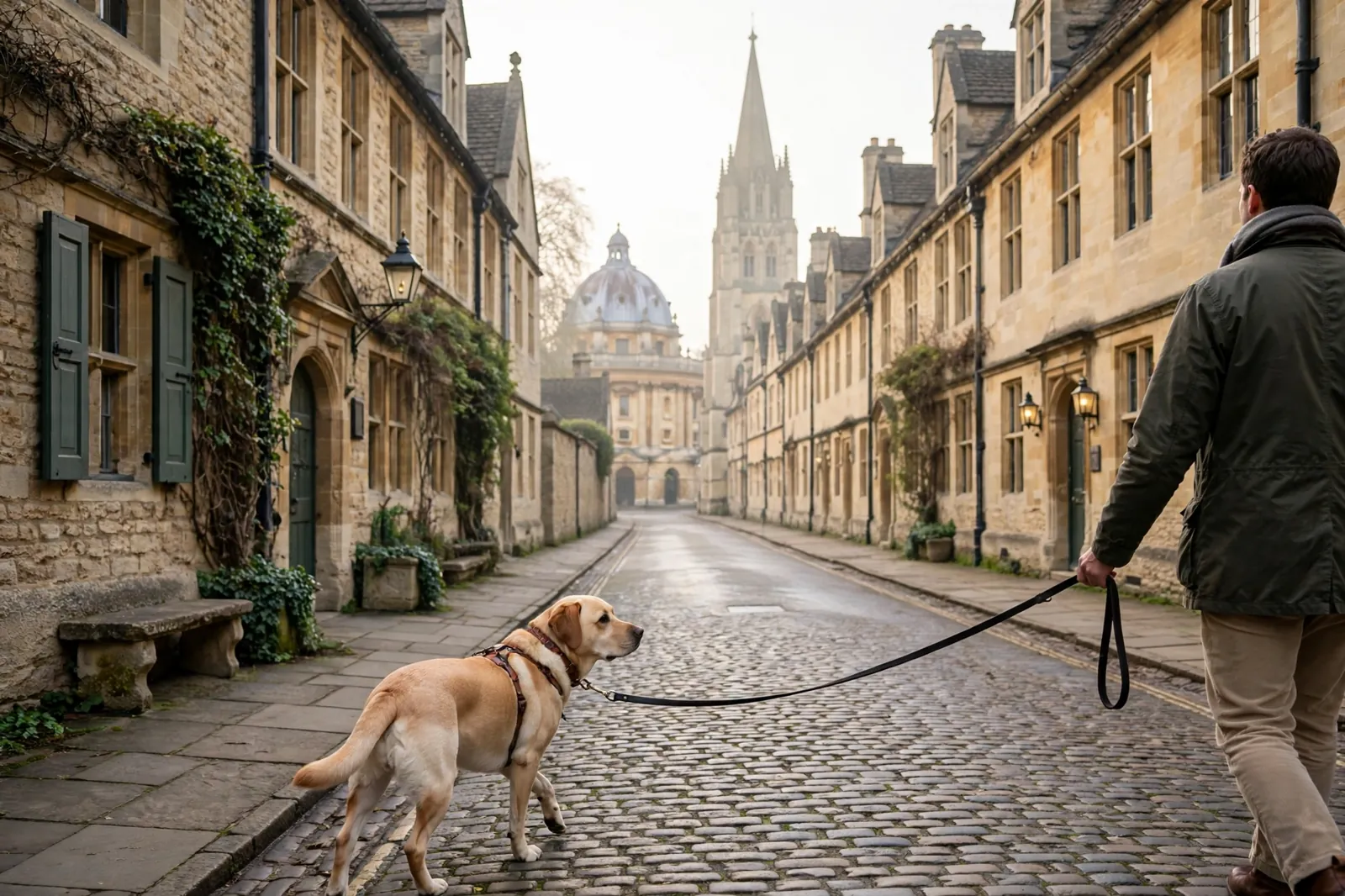
A few practical points for the town centre. The streets are steep around Castle Hill, and the cobbles are hard on paws and slippery when wet, so older dogs and small dogs will appreciate a slower pace and a rest on the benches in Alexandra Gardens. There is no public drinking water for dogs on the High Street, so carry a bottle and a bowl, and use the gardens or the riverside as your rest stops rather than the crowded pavements. The town is also a place where the dog will be petted constantly, especially if it is a friendly breed, so if your dog is reactive or nervous, walk the town centre early, stick to the wider streets, and save the castle walls for the quieter hours. For a different royal town with a similar mix of history and riverside walking, our guide to Oxford with a dog covers college split visits, the Thames and Cherwell walks, and Port Meadow.
Pubs and stays
Windsor's pubs are used to dogs, and the best of them expect muddy paws as a matter of course. The Two Brewers on Park Street, at the foot of the Long Walk, is the natural end to a park walk: a traditional pub with a beer garden, a short walk from the park gates, and a place where a dog can settle under a table after a long avenue. The Carpenters Arms on Market Street, in the heart of the old town, is smaller and livelier, with a compact bar and a reputation for good food, and it is a useful stop if you are walking the town centre rather than the park. The Duchess of Cambridge on the Crescent, a short walk from the castle, is a gastro-pub with a garden, and it is worth booking ahead at weekends because it fills up. In Eton, the George Inn on the High Street and the Waterman's Arms by the river are both dog-friendly and both have riverside tables in summer, which makes them the natural finish to a Brocas walk. In all of them, the usual courtesies apply: keep the dog on a lead, settle it under the table rather than in the walkway, and ask before letting it off the lead in a garden. Check the official guidance before you travel, because pub policies change and some pubs limit dogs to certain areas or certain times.
For an overnight stay, Windsor has several hotels that accept dogs, but the details matter more than the headline. The Harte and Garter, on the High Street opposite the castle, welcomes dogs in selected rooms and has the advantage of being in the middle of everything, though the rooms that take dogs are limited and book out early. The Castle Hotel, on the High Street a few doors down, is a similar story: dog-friendly rooms by prior arrangement, with a bar and restaurant where dogs are welcome in certain areas. The Macdonald Windsor Hotel, on the High Street, also takes dogs in designated rooms. Outside the centre, the hotels and guest houses along the Bath Road and in Old Windsor tend to be quieter, with more space for a dog and easier parking, and they are a better choice if your dog barks or is unsettled by town noise. Wherever you book, ask four questions before you pay: is there a pet fee and how much, are dogs allowed in the bar and restaurant or only in the room, can the dog be left alone in the room, and is there a ground-floor room with easy access to outside. A hotel that answers all four clearly is a hotel that has thought about dogs properly.
If a hotel is not your style, the self-catering cottages and apartments around Windsor and Old Windsor are often a better fit for a dog, because they come with a kitchen, a garden or a courtyard, and no shared corridors to negotiate at midnight. The trade-off is that you will need to check the garden fencing yourself, and that the nearest evening toilet walk may be a street rather than a garden. Whichever you choose, book early for the spring and summer weekends, when Windsor fills up, and be honest about the dog when you book: a hotel that knows it is expecting a large dog will give you a suitable room, while one that discovers it at check-in may not. A practical approach for a first visit is to book one night in the town centre, walk the Long Walk and the riverside on the first day, and use the second day for Virginia Water or Runnymede, which are both easy drives and both give a fit dog a much longer walk than the town can offer.
Practical questions
Before you go
Can my dog walk the Long Walk off the lead?
No. Dogs must stay on a lead along the Long Walk and in the Deer Park, because red deer graze on both sides of the avenue and can be close to the path. The rule is enforced by the park rangers, and it applies even to dogs with reliable recall. Save off-lead time for the open grassland further into the Great Park, where the rules allow it and no deer are in the immediate area, and always check the official guidance before you travel.
Is Windsor Castle dog-friendly?
Only assistance dogs are allowed inside Windsor Castle, St George's Chapel and the State Apartments. Pet dogs cannot go through the ticketed areas, so plan a split visit: one person tours the castle while the other walks the dog around the castle walls, Alexandra Gardens and the riverside, then swap. Dogs are welcome on a lead in the streets around the castle, including Castle Hill and the High Street.
Where can my dog paddle in the Thames at Windsor?
The safest entry points are the gently sloping banks at Baths Island and the Brocas meadow in Eton, away from the boat traffic near the bridges. Avoid the fast water by Romney Lock and the weir, and keep dogs out of the river after heavy rain when the current is strong and the water is murky. Never let a dog swim near moored boats or trip boats, and rinse off afterwards because the Thames carries silt and, after storms, run-off.
Are dogs allowed in Savill Garden?
No. Dogs, other than assistance dogs, are not admitted to Savill Garden, which is a fenced and ticketed garden inside Windsor Great Park. You can still walk a dog through the surrounding Great Park and around Virginia Water lake on a lead. If you want to visit the garden itself, plan a split visit or leave the garden for a dog-free day, and check the official guidance before you travel because access rules can change.
What is the best car park for a dog walk in Windsor Great Park?
Bishops Gate car park, reached from the B3022 through Old Windsor, is the most practical starting point for a dog walk: it gives direct access to the Long Walk, the Deer Park and the paths towards the Copper Horse. Forest Gate and the car parks around Virginia Water suit longer lake loops. Arrive early at weekends, because the popular car parks fill by mid-morning, and check the official guidance before you travel for current charges and opening times.
Can I take my dog on the train to Windsor?
Yes. Dogs travel free on both routes into Windsor: South Western Railway services from London Waterloo to Windsor & Eton Riverside, and Great Western Railway services from Slough to Windsor & Eton Central. Keep your dog on a lead, off the seats, and under control in the station, and avoid the busiest commuter trains if your dog is nervous in crowds. Windsor & Eton Riverside station is the handier of the two for the river and Alexandra Gardens.