This guide is independent and contains no paid placement. If affiliate links are added later, they will be clearly marked and will not change our editorial checks.
Walk the Thames Path and the Cherwell first, use Port Meadow and University Parks for proper exercise, and treat the colleges, the Botanic Garden and the major museums as split visits, because pet dogs stay outside almost all of them. Base yourself within reach of a morning towpath, eat early or late, and check each venue on the official site before you go.
Start with the rivers: Thames Path and the Cherwell
Oxford is two river valleys wearing a university as a coat. The Thames, called the Isis through the city, runs along the western and southern edges, and the smaller Cherwell slides down the east past college gardens and punts. For a visiting dog, these towpaths are the trip. They are level, largely traffic-free, rich in smells and waterbirds, and they connect the neighbourhoods you will actually stay in — Jericho and Osney in the west, Iffley and Cowley in the south, Summertown and Marston in the north — without asking your dog to cross the busy centre at all. Build each day around one river stretch and the city becomes simple.
The most useful central section runs from Folly Bridge, just south of the centre, down the Thames Path toward Iffley Lock and Iffley village. It is a wide, well-surfaced path with meadows on one side and the river on the other, passing the college boathouses where rowing crews train. Go early and you will share it with herons, swans and local dog walkers; by mid-morning the rowing traffic and sightseeing boats pick up. Keep dogs on a lead near the boathouses, the lock and any moored boats, and out of the water at the lock itself, where currents and boat movements make swimming a bad idea. The village of Iffley, with its Norman church and a welcoming pub garden, makes a natural turning point for a half-day walk.
North of Folly Bridge the path continues through Osney toward Port Meadow, and the Cherwell offers the gentler alternative on the other side of the centre. The Cherwell towpath and the paths through the University Parks and Mesopotamia, the narrow island walk between the two arms of the river, give shaded, quieter walking that suits nervous or older dogs. Punts drift past in season, ducks and moorhens nest along the banks, and the pace is set by the water rather than by traffic. Keep a lead on where paths narrow, where punt poles and mooring ropes cross the towpath, and anywhere swans are defending cygnets in spring. In winter both rivers can flood: towpaths close, meadows turn to lakes, and the correct response is to check conditions, use the higher street routes and never wade a flooded path with a dog at heel.
Swimming deserves a plain answer. Many local dogs swim in quieter stretches of both rivers away from locks, weirs and boat traffic, but the Thames carries real hazards — weirs, strong flow after rain, blue-green algae in still warm water and boat wash. Read our guide to dog water safety in the UK before you let a dog off the bank anywhere, choose only calm, shallow entry points you can see clearly, and keep dogs out entirely after heavy rain when the current strengthens and the water quality drops. A long line gives a keen swimmer freedom without giving you a rescue problem.
The colleges: a split-visit city
Here is the fact that shapes every Oxford dog trip: pet dogs do not go inside the colleges. Oxford's colleges are private working institutions, and while visitors are welcomed at many of them during set hours, dogs other than assistance dogs are not admitted to the quads, chapels, halls and gardens. The same pattern holds at the Bodleian Library and the major university museums. Policies can differ in detail and visiting arrangements change by term, so check the official site before you go for any college you particularly want to see, and expect the answer for a pet dog to be no.
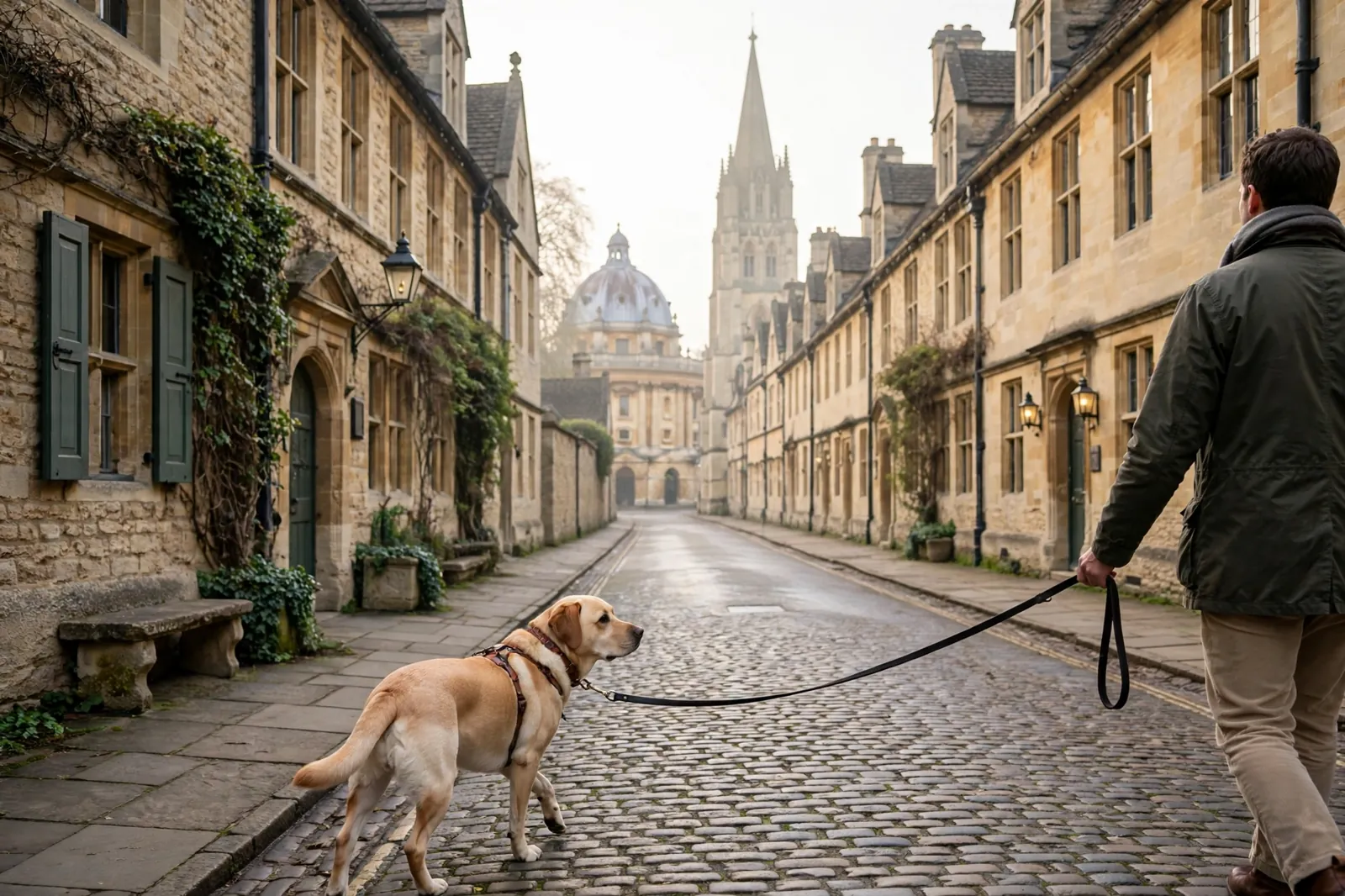
That sounds restrictive until you realise how much of Oxford's beauty is outdoors and free. The exteriors are the postcard: the Radcliffe Camera and its square, the Bridge of Sighs over New College Lane, the long golden wall of Magdalen along the High, and Christ Church Meadow, the large riverside meadow in front of Christ Church, where dogs on leads can walk the broad paths while cattle graze and the spires stand over the trees. A dog-friendly Oxford day is therefore a walking tour punctuated by short solo visits, not a day of dragging a dog between ticket desks. Travelling pairs can split visits — one person spends forty-five minutes inside a college or museum while the other walks Christ Church Meadow or takes a coffee on the High — and then swap. Solo travellers should plan the interiors for another trip, or arrange trusted local dog care for a half day, rather than leaving a dog alone in strange accommodation.
Timing matters as much as tactics. The centre fills from mid-morning with tour groups, school parties in term time and sightseeing coaches, and the narrow pavements of Cornmarket and the High are genuinely hard work with a dog at ankle height. Walk the centre early — before ten — or in the early evening when the stone glows and the crowds thin. Graduation days, university open days, matriculation in October and the May Morning celebrations on 1 May bring exceptional crowds and street closures around Magdalen Bridge; those dates are better spent on the meadows and towpaths. If you are travelling with an assistance dog, our guide to assistance dog access rights in the UK explains how access rights differ from pet policies, and it is still worth contacting a college in advance so porters are expecting you.
Two outdoor exceptions deserve a place in the plan. Many college gardens open to ticketed visitors in season are still no-dog spaces, so do not assume a garden ticket includes the dog; check each one individually. Worcester College, with its lake and orchard, is often cited by visitors as the loveliest garden visit, but the no-pet-dog rule applies there too. Treat every garden as a split visit, enjoy the meadow and towpath walks as the dog's share of the bargain, and the day balances out.
Port Meadow and Binsey: the big-sky walk
If Oxford has a signature dog walk, it is Port Meadow. This vast ancient flood meadow north-west of the centre has never been ploughed, is grazed by horses and cattle, and gives dogs the kind of open, sniff-rich space that city breaks rarely offer. You reach it from Jericho along the Oxford Canal towpath, from Walton Well Road, or across the Thames from Binsey on the far bank. The meadow runs for miles beside the river toward Wolvercote, where pubs with gardens make a well-earned lunch stop, and the whole circuit — canal out, meadow and river back — is one of the finest half-day walks in southern England.
The grazing animals set the rules. Horses and cattle are present for much of the year, and dogs must be kept under close control and on a lead near livestock, without exception: a dog that chases or worries stock can be legally shot by a landowner, and the meadow's animals are used to people but not to being herded by visiting spaniels. Keep to a lead anywhere near the herds, give wide berths to horses with foals and to cattle with calves in spring, and use the river-side and canal-side paths for off-lead play only where the field ahead is genuinely empty and your dog's recall is proof against birds, rabbits and other dogs. Ground-nesting birds in spring are a further reason to keep dogs on paths and leads in the breeding season.
The meadow floods, famously and regularly. In wet winters large parts become a shallow lake that freezes into a famous natural skating ground in hard frosts, and the paths disappear under water. Even in summer, low sections stay soft after rain. Check conditions before you commit to the full Wolvercote circuit, wear boots you do not mind muddying, and expect to rinse paws — and possibly an entire dog — afterwards. On the Binsey side, the lane past the village and its pub is quieter, and the Thames Path back toward Oxford gives a different, more enclosed walk through trees and past moorings.
Pair Port Meadow with the canal for variety. The Oxford Canal towpath from Jericho north to Wolvercote is level, shaded in parts and busy with narrowboats, herons and kingfishers if you are lucky. It suits lead walking rather than off-lead roaming, bridges and moored boats need care, and cyclists share the path, so keep dogs close at blind corners. Together, meadow and canal can fill a dog's exercise needs so completely that the afternoon can be given to a gentle city stroll without anyone feeling short-changed.
University Parks, South Park and the green gaps
The University Parks, seventy acres of lawns, specimen trees and sports pitches between the Cherwell and Norwood Avenue, are the closest thing central Oxford has to a country park. Dogs are welcome, the paths are well surfaced for wet days, and the river frontage along the Cherwell adds a waterside loop. Keep dogs on leads near the cricket and sports areas when matches are in progress, around the pond and its waterfowl, and follow the park's own signage, which is the rule that counts on the day. The parks close at dusk in winter, so plan the last walk accordingly.
South Park, on the hill east of the centre off Headington Road, gives the classic rooftop view over the spires and is a local favourite for a purposeful short walk rather than a full exercise session. It hosts large events on some summer weekends, including food festivals and concerts, when fencing and crowds change the picture entirely — check before you go. Florence Park in Cowley, Bury Knowle Park in Headington and Hinksey Park in the south, with its outdoor pool and lake, each serve their neighbourhoods well, and Cutteslowe Park in the north is the biggest of the suburban parks, with room for a proper run, a miniature railway in season and space to keep distance if your dog needs it.
The Botanic Garden, opposite Magdalen on the High, is the notable no-dog space in this list: pet dogs are not admitted, so treat it as another split visit, with Christ Church Meadow immediately next door providing the dog's alternative. The pattern repeats across Oxford — a no-dog highlight with a superb dog walk beside it — and once you plan for that rhythm, the restrictions stop feeling like a problem.
A word on leads and law. Oxford's parks and meadows operate under local orders that can require dogs on leads in specific areas and seasons, and dog fouling fines apply across the city. Carry bags, use the bins provided, and read the signs at each entrance rather than assuming yesterday's park has today's rules. Our national guide to UK beach and outdoor dog rules explains the wider framework of public spaces protection orders that sits behind these local signs.
Where to stay with a dog in Oxford
Oxford's dog-welcoming accommodation divides into three useful types: central hotels that accept dogs in a limited number of rooms, self-catering flats and houses in the residential districts, and pubs with rooms and guest houses on the roads out toward the meadows. The right choice depends less on thread count than on the morning walk. Jericho and Walton Well Road put Port Meadow and the canal on your doorstep. Summertown offers a villagey high street, vets, cafes and Cutteslowe Park a short walk away. Iffley and the Abingdon Road corridor suit the Thames Path and Christ Church Meadow. East Oxford around St Clement's and the Cowley Road is livelier, better value and well supplied with independent food, with South Park and Florence Park for exercise.
Interrogate the dog policy before you book, in writing where you can: which rooms accept dogs and on which floors, since Oxford's converted townhouses often mean stairs and no lift; the fee per dog per night or per stay; any size, breed or number limits; whether dogs may join you in the bar or breakfast room; and whether a dog may be left alone in the room, a rule that decides your college visiting plan. Our national guide to dog-friendly hotels in the UK lists the full set of booking questions; the Oxford additions are stairs, flood-season towpath access and event pricing.
Prices move sharply with the university calendar. Graduation weeks, open days, the St Giles' Fair in September and major conferences fill the city and lift rates, while the quieter weeks between terms can be noticeably better value. Book dog-accepting rooms early for any summer visit, because the stock of genuinely dog-welcoming central rooms is small and goes first. Bring the settling kit that makes any room work: the dog's own bed or blanket, a chew for the first evening, a towel for towpath paws by the door, and bags in every pocket.
Self-catering usually gives dogs the easiest stay — hard floors, a routine you control and often a small garden — but confirm the garden is genuinely enclosed, check the stair count for older dogs, and ask where the nearest grass is for the late-night walk. A pretty courtyard that is shared or unfenced is not the same thing, and finding out at 10pm helps nobody.
Eating with a dog: pubs, cafes and markets
Oxford feeds dog owners well if you choose the right rooms. The city's traditional pubs are the reliable core: many welcome dogs in the bar area, several of the riverside and meadow-side pubs have gardens made for post-walk pints, and Jericho, Summertown and East Oxford all have clusters of independent cafes where a settled dog under the table is unremarkable. Policies belong to each venue and change with refurbishments and management, so check the venue's own site or phone ahead, and follow the etiquette in our UK dog-friendly cafes guide: walk and toilet first, short lead, no dogs on seats, and a mat or blanket that marks the dog's place.
Covered Market in the centre is a pleasant browse, but individual stalls and the market's own rules decide whether a dog can go in, and it is busy at lunchtimes; Gloucester Green market and the farmers' markets in Wolvercote and Summertown give outdoor alternatives where dogs on leads are part of the scene. The Cowley Road's independent restaurants and cafes are the best bet for varied food with a dog in tow, while the grand central dining rooms are the least likely to welcome pets. Eat early or late in summer, when tour-group lunchtimes pack the centre, and favour gardens and terraces in good weather.
Build one picnic into the trip. Oxford's delis, bakeries and market stalls make it easy, and Christ Church Meadow, the University Parks and Port Meadow all picnic beautifully in season. Keep dogs away from grazing animals while you eat on the meadow, take every scrap home, and remember that swans and ducks have strong opinions about sandwiches — feed nobody, and keep the dog's lead short around hopeful waterfowl.
Carry the small kit that smooths every outing: a portable bowl and water, a long-lasting chew for waits, a lightweight mat and bags. If your dog cannot settle indoors, the riverside pub gardens and picnic plan will still give you the full Oxford food experience without the stress, and a dog asleep under a pub table while the rowing crews go past is, for many owners, the photograph of the whole trip.
Getting there, parking and the seasonal calendar
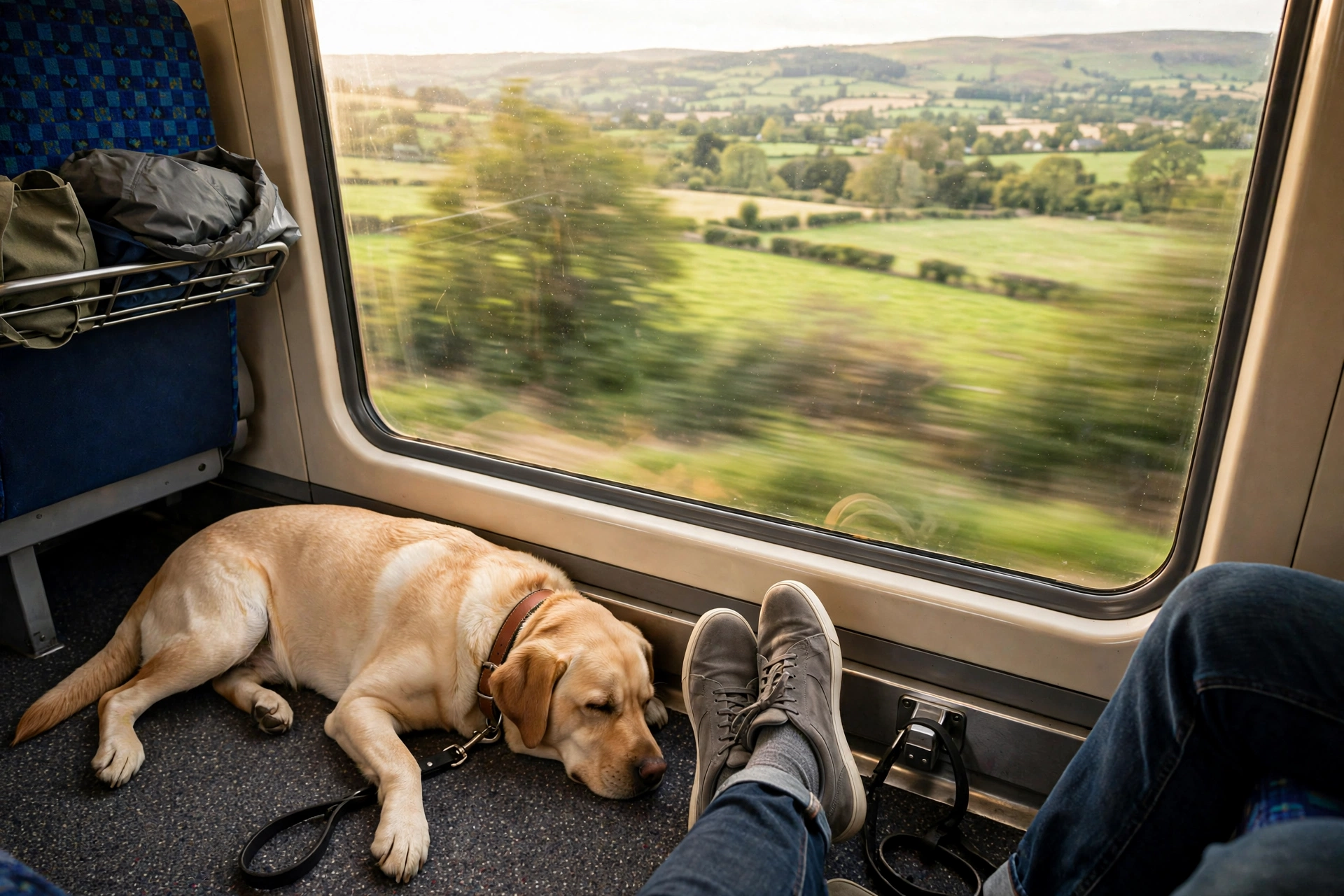
Oxford is one of the easiest British cities to visit without a car, and with a dog the train is usually the better plan. Services from London Paddington and Marylebone take around an hour, and dogs travel free on National Rail services under the standard conditions — on a lead, off the seats, and no more than two dogs per passenger. Our guide to taking a dog on UK trains covers the rules and the calm-journey routine in full. Oxford station is a ten-minute walk from the centre; it is busy at peak hours, so give a nervous dog a pause on the forecourt before tackling the centre. Local buses generally carry dogs at the driver's discretion, on a lead and off the seats — check the operator's latest guidance before you travel.
Drivers should plan around the Park and Ride system rather than aiming for the centre. Oxford restricts central traffic, operates a zero emission zone in the core, and central car parks are expensive and fill early. The Park and Ride sites around the ring road are designed for exactly this trip, but check whether dogs are carried on the connecting buses before you rely on them, and never leave a dog in a car at a Park and Ride site. If you need the car close, accommodation with parking in Summertown, Headington or along the Abingdon Road keeps you outside the worst of it while staying walkable.
Season by season: spring brings Cherwell punts, Port Meadow foals and the May Morning crowds on 1 May; summer brings regatta season on the river, peak tour numbers and hot pavements in the centre, best handled with early walks and shaded towpaths. Autumn is arguably the best all-round season — quieter streets, golden stone, fungi on the meadows and the St Giles' Fair in early September. Winter is atmospheric and cheaper, with Christmas lights and the covered market in full swing, but the meadows flood, towpaths close in sections and daylight is short, so a winter trip needs the flexibility to swap river walks for parks and streets at short notice.
Before you travel, save the details of a veterinary practice near your stay and the out-of-hours provider, carry your own vet's number and insurance details, and check your dog after meadow walks for ticks in season. Take the official-site rule seriously for every booked element of the trip — college visiting hours, museum policies, bus conditions and park closures all change — and the rest of Oxford will look after you.
Practical questions
Before you go
Can dogs go inside Oxford colleges?
Pet dogs are not admitted inside Oxford colleges, their chapels, halls or gardens; only assistance dogs are accepted. Visitors travelling with a pet dog usually split visits, with one person touring a college while the other walks the dog on Christ Church Meadow or the towpaths, then swapping. Visiting hours and arrangements change by term, so check the official site before you go for any college you plan to visit.
Are dogs allowed in University Parks and on Port Meadow?
Yes. Dogs are welcome in the University Parks and on Port Meadow, which are two of the best exercise spaces in the city. On Port Meadow, keep dogs on a lead near the grazing horses and cattle and under close control elsewhere, and in the University Parks keep leads on near sports matches and the pond, following the signage at each entrance on the day.
Can dogs go on punts and boats in Oxford?
Dogs are usually welcome on many self-hire boats and some chauffeured punts and river cruises, but policies belong to each operator and some craft do not accept dogs. Check with the hire company before you book, keep the dog on a lead and off the seats, consider a canine life jacket for keen swimmers, and never let a dog jump in near locks, weirs or moving boats.
Where can dogs go off lead in Oxford?
The best off-lead opportunities are on Port Meadow away from livestock, in Cutteslowe Park, and in quieter sections of the city's larger parks where a dog is under reliable recall and local signage allows it. Towpaths, Christ Church Meadow, the University Parks near sports and waterfowl, and all college and museum spaces call for a lead or close control. Always follow the signs at each entrance.
Are dogs allowed on Oxford buses and Park and Ride services?
Dogs are generally carried on Oxford's local buses at the driver's discretion, provided the dog is on a lead, well behaved and not on the seats. Park and Ride bus conditions follow the same operators, but check the latest official guidance before you travel, as conditions can change, and never leave a dog in a car at a Park and Ride site.