This guide is independent and contains no paid placement. If affiliate links are added later, they will be clearly marked and will not change our editorial checks.
Aberaeron rewards a slow pace: walk the quay first, check the tide before the beach, and treat the coast path as a series of short out-and-back walks rather than one long march. Keep your dog on a lead around the harbour, boats and livestock, carry water on cliff walks, and confirm beach rules and cafe policies before you travel, because both can change by season.
Start at the harbour, not the beach
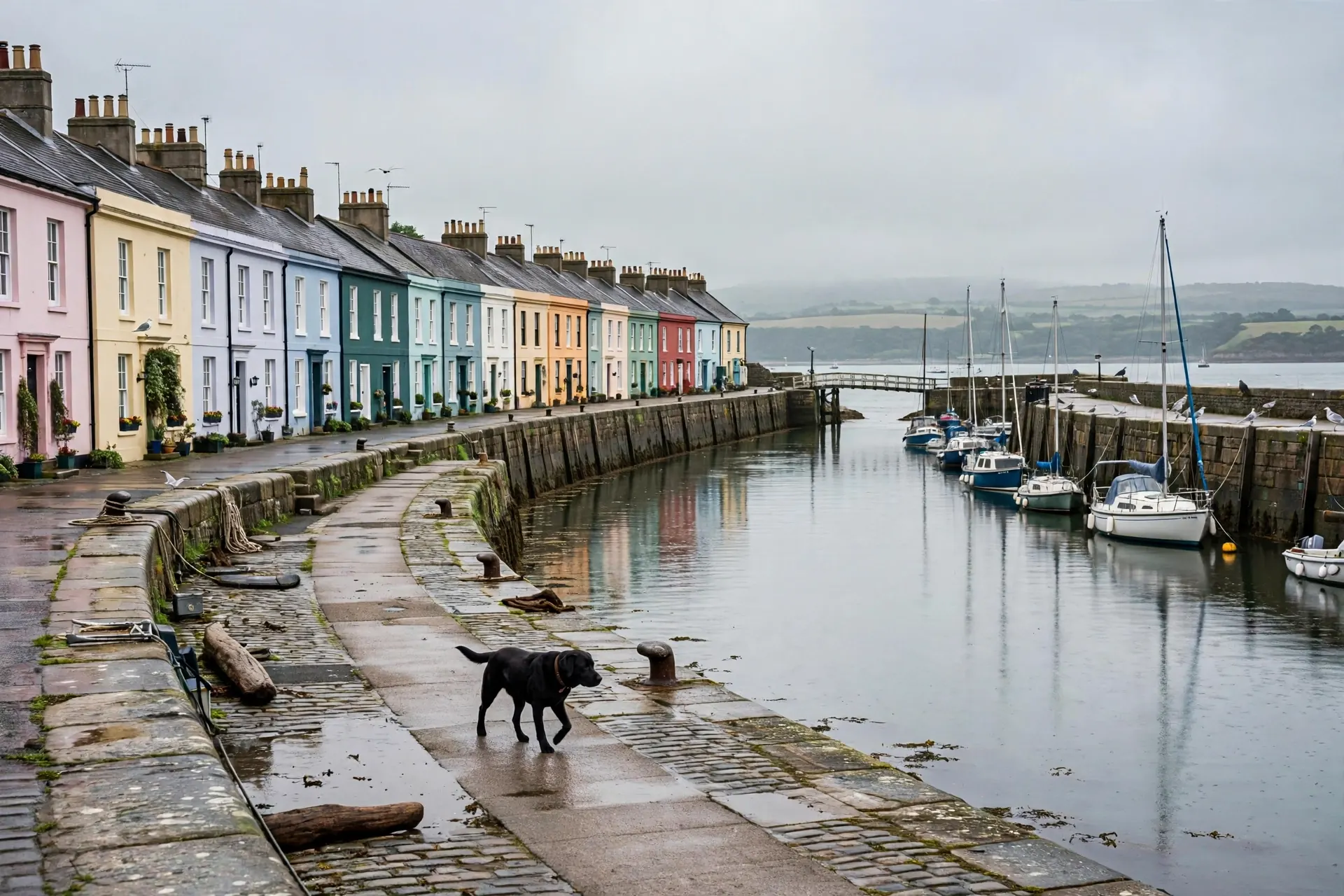
Aberaeron is a Georgian harbour town on the Cardigan Bay coast of Ceredigion, in west Wales, and its character comes from the harbour rather than from a single attraction. The town was planned around the harbour in the early nineteenth century, and the painted houses that line the quay give it a neat, ordered feel that is quite different from the wilder coves further south. For a dog, that order is helpful. The streets are compact, the quay is flat, and a short walk in any direction brings you to water, a bench, or a quieter side street where a nervous dog can pause.
The best first walk is a gentle circuit of the harbour rather than a long expedition. Arrive, let your dog sniff the quay, watch the boats, and learn how the town sounds: gulls, ropes, footsteps on stone, and the occasional engine. Dogs that rush into a new place often settle faster when the first outing is short and predictable, and Aberaeron makes that easy. A twenty-minute loop tells you where the slipway is, where the water is deepest, where other dogs tend to appear, and where you can step aside if your dog needs space.
Think of the harbour as the town's living room. Fishing boats and pleasure craft share the inner harbour, and the outer harbour opens towards Cardigan Bay. The water level changes with the tide, so the same quay can look busy and bright at high water and quiet and muddy at low water. Neither is better for a dog, but each needs a different kind of attention. At high tide, keep your dog away from the edge and from mooring lines. At low tide, keep your dog from scrambling down harbour steps or drinking from puddles near boats.
Season matters too. In summer, the quay fills with visitors, ice-cream queues and boat traffic, and a reactive dog will find the crowds harder work. In spring and autumn, the same walk is calmer and the light over the bay is softer. In winter, Aberaeron can feel almost empty, which suits dogs that prefer space, but the wind off Cardigan Bay is cold and the stone quays can be slippery after rain. Choose your season with your dog in mind, not with the postcard in mind.
Before you travel, check the official guidance for beach access, harbour rules and any temporary closures, because local arrangements can change. A short check before you leave home is worth more than a long argument with a sign on the quay. If you are staying for several days, use the first evening to walk the harbour again at a different tide. The town changes with the water, and a dog that has already seen both versions will be calmer on the second day.
The quay loop and the wooden bridge
The classic Aberaeron walk is a loop around the inner harbour, crossing the River Aeron by the wooden footbridge and returning along the opposite quay. It is short, flat and easy to shorten, which makes it ideal as a morning toilet walk, an evening wind-down, or a first outing for a dog that is still learning a new place. The whole loop takes most people well under an hour at a dog's pace, and you can cut it in half simply by turning back at the bridge.
Start on the main quay, where the painted houses face the water. Keep your dog on a lead here, even if your dog is normally reliable off lead. The quay is a working harbour edge with boats, ropes, bollards and people carrying equipment, and a loose dog can get underfoot quickly. A short lead and a steady pace work better than a long line that tangles around a bollard. If your dog pulls towards the water, hold the lead short near the edge and reward calm walking rather than stopping to negotiate every few steps.
The wooden footbridge over the River Aeron is the centrepiece of the loop. It is narrow, shared with other walkers, and it can feel bouncy or noisy underfoot, so introduce a nervous dog gradually. Let your dog approach, sniff the boards, and cross at your side without rushing. If another dog is coming the other way, step aside before the bridge rather than squeezing past in the middle. Dogs that are unsure about bridges often do better when the crossing is treated as an ordinary part of the walk, with no fuss and no long pause in the middle.
On the far side of the river, the quay is usually quieter. This is a good place for a longer sniffing walk, a sit on a bench, and a chance for your dog to watch the harbour from a different angle. Look back across the water towards the painted houses: the view is the one most visitors remember, and it is also a useful orientation point. If you lose your bearings in the town's small streets, head for the water and the houses, and you will soon find the quay again.
There are a few practical points worth remembering on this loop. Do not let your dog swim in the harbour, where boats, fuel, ropes and tidal currents create risks that are hard to see from the quay. Do not let your dog drink from harbour puddles or from the river near the quay. Carry poo bags and use the bins provided, because a small town notices litter quickly. And if your dog is small, be careful around gaps between the quay edge and moored boats: a curious dog can slip into a space that looks solid from above.
For dogs that need more exercise, the quay loop is a warm-up rather than a day's work. Pair it with a beach walk at low tide or a coast path section, and use the loop again in the evening when the town is quiet. Dogs often enjoy repetition in a new place: the same route, the same smells, the same bench. It builds confidence faster than a new route every time.
The beach, the tide and the sand
Aberaeron has a small beach beside the harbour, with a mix of sand and shingle that changes with the tide and the weather. At low tide, the shore opens out and gives dogs room to walk, sniff and paddle at the water's edge. At high tide, the beach narrows sharply and the walk becomes a short scramble rather than a proper outing. The difference between the two is large, so check the tide times before you plan a beach walk, and do not assume that the beach you saw in the morning will still be there in the afternoon.
Beach rules for dogs can vary by season and by the exact stretch of shore, so check the official guidance before you travel. Some sections may have seasonal restrictions, and signs on the beach are the final word on the day. If a section is restricted, do not try to argue the point or to walk your dog through it on a lead: use another part of the shore or move to a different walk. Ceredigion has many beaches within a short drive, and a flexible plan will serve you better than a fixed one.
On the beach itself, keep your dog under control near other people, children and dogs. A beach that looks empty at one end can be busy at the other, and a dog running at full speed towards a family picnic is not a welcome sight. Use a lead near the harbour end, the slipway and any access steps, and only let your dog off lead where you have a clear view, good recall and no livestock or restricted area nearby. If your dog's recall is unreliable around other dogs, keep the lead on and enjoy the walk at a slower pace.
Sand and salt water bring their own care needs. Rinse your dog's paws after a beach walk, especially if your dog has walked on shingle or through rock pools, and check between the toes for small stones or cuts. Do not let your dog drink sea water, which can cause vomiting and diarrhoea, and watch for dead fish, jellyfish or fishing debris washed up after storms. Bring fresh water for your dog even on a short beach walk, because there may be no tap at the beach end.
The shore also changes after bad weather. Strong winds can leave seaweed, driftwood and fishing gear on the beach, and high tides can move shingle and expose sharp rocks. After a storm, walk the beach yourself first, or keep your dog on a lead until you have checked the ground. Dogs that love to chase waves need a watchful eye: a steep shingle bank and a sudden wave can knock a small dog over, and a dog that chases the water outwards can end up further from shore than you expect.
If the main beach is busy or restricted, the harbour and the coast path offer good alternatives. A short drive north or south along the Ceredigion coast brings you to other beaches with different rules and different crowds, and the variety is part of the pleasure of staying in Aberaeron. Treat the beach as one option among several, not as the only measure of a good day.
Coast path north and south
The Ceredigion Coast Path runs through Aberaeron as part of the Wales Coast Path, and it gives dog walkers a simple choice: head north towards Aberarth and Llanon, or head south towards New Quay. Both directions offer cliff-top walking, sea views and the chance to see dolphins in Cardigan Bay, but they are not identical, and the right choice depends on your dog's fitness, your time and the weather.
Heading north, the path climbs gently out of Aberaeron towards Aberarth, a small village with a shingle beach at the mouth of the River Arth. The walk is a good first coast path outing: it is short enough to do as an out-and-back walk, it stays close to the coast, and it gives you a clear turning point. Beyond Aberarth, the path continues towards Llanon and the coast becomes more open. The ground can be uneven, with steps and narrow sections, so wear proper footwear and keep your dog on a lead near cliff edges and livestock.
Heading south, the path runs towards New Quay, a larger harbour town that is famous for its dolphins. The full walk to New Quay is a substantial day out and should not be attempted as a casual stroll, especially with a dog that is not used to long cliff walks. A shorter out-and-back section from Aberaeron still gives you the cliff-top experience, the sea views and the sense of the coast, without committing you to a long return journey. If you do plan the full walk, arrange transport back or a lift, carry plenty of water, and check the official guidance before you travel for closures or diversions.
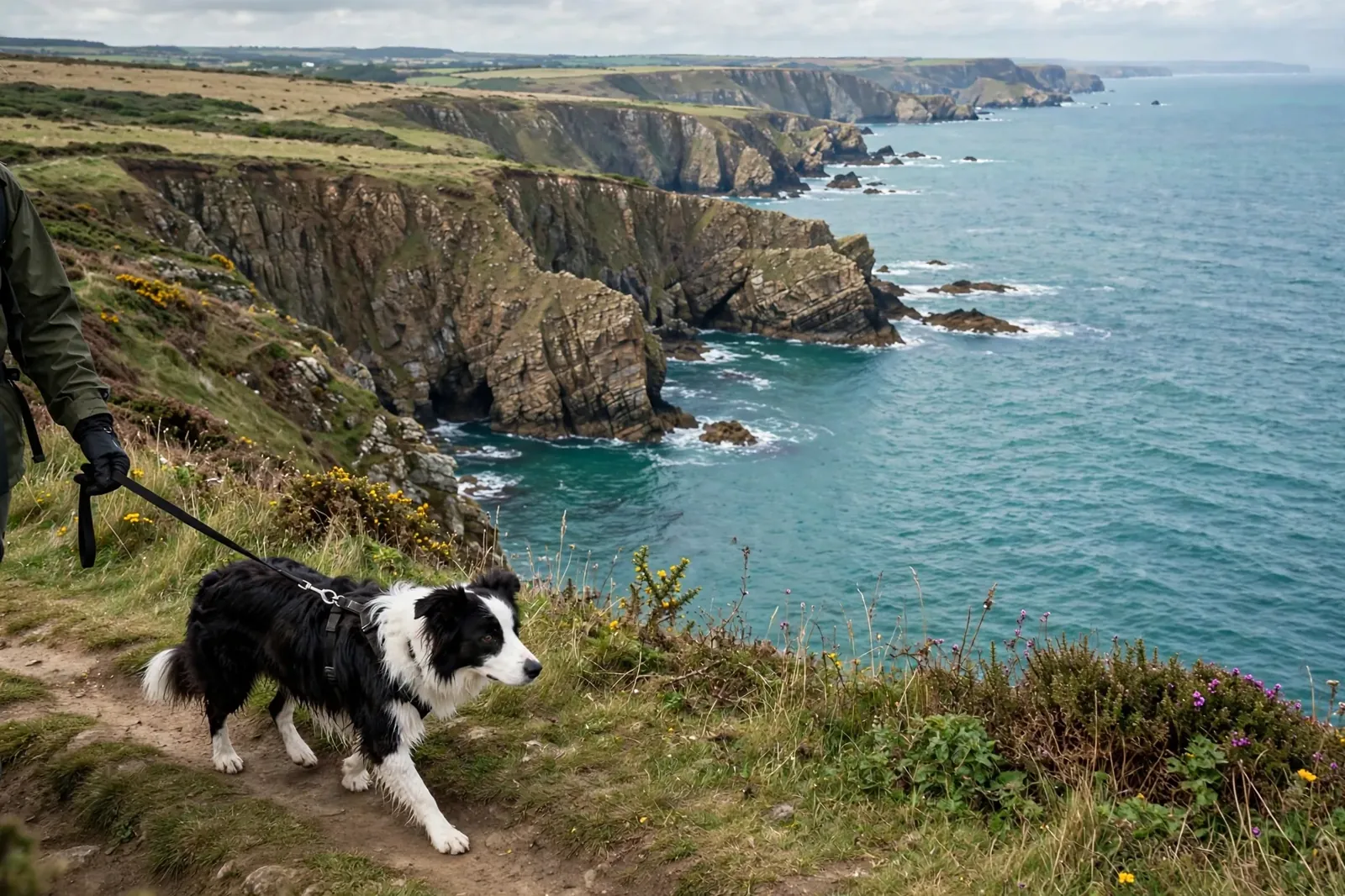
Cliff walking with a dog needs a different set of habits from park walking. Keep your dog on a lead near cliff edges, even if your dog is normally calm, because a rabbit, a bird or a sudden gust can change the situation in seconds. Keep your dog on a short lead near livestock, and give sheep and cattle a wide berth. Do not let your dog approach cliff-top fences or scramble down slopes to the shore: the ground can be loose, and a dog that slips may not be able to climb back.
Water is the most common problem on coast walks. There are few reliable water points on cliff-top sections, and the water you find in streams may not be safe to drink. Carry fresh water for your dog and a collapsible bowl, and offer water regularly rather than waiting for your dog to look thirsty. In warm weather, walk early or late in the day, use shade where you can find it, and watch for signs of overheating: heavy panting, drooling, reluctance to walk, or a dog that seeks shade and will not move.
The coast path is also a place for patience. Dolphins are sometimes seen in Cardigan Bay, especially in summer, but they are wild animals and there is no guarantee. If you are lucky enough to see them, keep your dog calm and on a lead, enjoy the moment, and do not let your dog bark at the water or scramble towards the edge. The same patience applies to seabirds: keep your dog from chasing gulls or disturbing nesting birds on cliff ledges, particularly in spring and early summer.
For a fuller picture of long-distance coastal walking with a dog, our Pembrokeshire Coast Path guide covers section-by-section planning, cliff and livestock safety, water gaps and multi-day logistics in more detail. The lessons transfer well to Ceredigion: plan the return journey first, respect the cliffs, and treat the path as a series of manageable days rather than a single heroic walk.
Up the River Aeron
Not every good walk in Aberaeron faces the sea. The River Aeron runs inland from the harbour through a wooded valley, and the paths along it offer shade, shelter from the coastal wind, and a different kind of walking for dogs that prefer trees to cliffs. The valley is a useful option on a windy day, a hot day, or a day when the coast path feels too exposed for your dog.
The riverside walk starts near the harbour and follows the river upstream, passing under road bridges and through stretches of woodland. The ground is mostly flat, but it can be muddy after rain, and tree roots and uneven surfaces need care for older dogs or dogs with joint problems. Keep your dog on a lead near the riverbank where the bank is steep, and do not let your dog drink from the river without checking that the water is clean and that there is no risk from farm run-off upstream.
The valley rewards a slow pace. Listen for woodland birds, watch for kingfishers if you are lucky, and let your dog sniff the leaf litter and the riverbank smells. This is a walk for noses rather than for distance, and many dogs enjoy it more than a long cliff march. If your dog is reactive to other dogs, the narrower riverside path can be harder work than the open quay, so choose a quiet time of day and be ready to step aside where the path allows.
Inland from Aberaeron, the Aeron valley leads towards the village of Ciliau Aeron and the wider Ceredigion countryside, with lanes, woodland and farmland. These are working landscapes, so expect livestock, farm traffic and gates that must be left as you find them. Close every gate behind you, keep your dog on a lead through farmyards and near livestock, and stay on marked paths rather than cutting across fields. If a path is blocked or a sign asks you to take a diversion, follow it: the diversion is there for a reason, and a dog that follows you through a field of cattle is a risk to everyone.
The valley is also a good wet-weather option, because the trees give some shelter from light rain, even though the path itself will be muddy. Wear waterproof boots, bring a towel for the car, and accept that a riverside walk in winter means a muddy dog. A drying coat and a towel in the car turn a muddy walk from a problem into a routine.
Eating and drinking with a dog
Aberaeron is small enough that you can walk everywhere, and that makes eating out with a dog simpler than in a larger town. Many visitors eat on the quay, where a dog can sit beside the table and watch the harbour, and several cafes and pubs welcome dogs on terraces or in certain indoor areas. Policies vary by business and by season, so check with each place before you arrive rather than assuming that a dog-friendly reputation applies to every table.
When you arrive at a cafe or pub with a dog, ask where dogs are welcome before you sit down. Some places welcome dogs throughout, others only on the terrace, and a few only in a particular room or at particular times. If you are offered a terrace table, check whether it is sheltered from the wind and whether your dog will be comfortable there for the length of a meal. A dog that is cold, wet or exposed to a draught will not settle, and a restless dog makes a meal harder for everyone.
Bring a mat for your dog to lie on, a water bowl, and a small chew or a stuffed toy to keep your dog occupied while you eat. A familiar mat tells your dog where to settle, and it keeps your dog off cold stone or wet decking. Order food that you can eat without needing both hands free, and keep your dog's lead short enough that your dog cannot reach other tables. If your dog barks at other dogs or at people passing with food, choose a quieter table at the edge of the terrace rather than a table in the middle of the action.
Aberaeron is known locally for its food, including fresh fish and seafood, and for the honey ice cream that has become a local speciality. You do not need to share your meal with your dog, and you should not: rich food, bones and ice cream can upset a dog's stomach. Bring your dog's own treats, and keep your dog's head away from the table while you eat. If you want to buy a treat for your dog, ask at a local shop for dog-friendly options rather than improvising with human food.
For takeaway meals, the quay is a practical place to eat with a dog. Buy your food, find a bench with a view of the harbour, and let your dog settle beside you. Clear up all litter, including food wrappers and napkins, because gulls will snatch anything left unattended and a dog that chases a gull across the quay is a hazard. In summer, the quay can be busy at lunchtime, so eat early or late if your dog prefers a quieter spot.
If you are staying in self-catering accommodation, the local shops in Aberaeron cover the basics, and larger supermarkets are a short drive away in Aberystwyth or Cardigan. Plan your shopping so that you are not leaving your dog alone in the car while you shop: take turns if you are travelling with another person, or shop while your dog is settled at your accommodation. Never leave a dog in a car on a warm day, even for a few minutes.
Where to stay in Aberaeron
Aberaeron offers a mix of small hotels, guest houses, self-catering cottages and holiday lets, many of them within a short walk of the harbour. Staying in the town itself is the simplest option for a dog owner: the quay loop is on your doorstep, the beach is close, and you can walk to cafes and shops without using the car. Accommodation on the edge of town or in nearby villages can be quieter and may offer a garden or direct access to a footpath, but check the walk into town before you book, because a lane without a pavement is not a pleasant evening walk with a dog.
When you book, confirm the dog policy in writing before you pay. Ask how many dogs are allowed, whether there is a pet fee, whether dogs are allowed in all rooms or only in selected ones, and whether dogs can be left alone in the room. Some places welcome dogs throughout, others restrict dogs to certain rooms or to ground-floor rooms, and a few charge a fee per dog per night. A clear written answer protects you and the host, and it avoids an awkward conversation at check-in.
Ask about the practical details that matter to a dog. Is there a secure garden or an enclosed area where your dog can stretch its legs? Where is the nearest toilet walk after dark? Is there a hard floor or a washable surface for a wet dog? Is there a place to dry a wet dog, such as a porch, a utility room or an outdoor tap? These questions matter more than the thread count of the bedding, and a host that answers them clearly has usually thought about dogs properly.
For a longer stay, a self-catering cottage or a holiday park in the wider area can work well, especially if you want a garden and a kitchen. Our guide to dog-friendly holiday parks in Wales explains how to compare parks by coast access, livestock rules, secure boundaries and realistic travel time, with booking checks that matter. The same principles apply to any cottage or park near Aberaeron: check the boundary, check the dog rules, and check the distance to the first walk that needs no car.
Whatever you book, arrive with a plan for the first hour. Walk the boundary of the garden before you let your dog off lead, check gates and fences, and set up your dog's bed, water bowl and familiar blanket in a quiet corner. Photograph any existing damage and tell the host about it, so that a muddy paw print is not mistaken for a new stain. Keep the first evening close to your normal home routine: same feeding time, same last walk, same bedtime. A dog that settles on the first night will enjoy the rest of the stay far more.
If your dog is a barker, be honest about it when you book. A host that knows in advance can offer a room away from other guests or a cottage with a garden that gives your dog space. A host that discovers a barking dog at midnight is far less likely to be sympathetic. The same honesty applies to dogs that chew, dogs that are not yet house-trained, and dogs that are nervous around strangers: a good host would rather know than guess.
Parking, water and everyday practicalities
Parking in Aberaeron is straightforward for a small town, with car parks near the harbour and on the edge of the town centre. In summer, the car parks fill up by late morning, so arrive early or park a little further out and walk in. Check the official guidance before you travel for parking charges, time limits and any seasonal changes, because arrangements can vary. Do not leave your dog in the car while you walk around the town, and never leave a dog in a parked car on a warm day.
Water is the practical detail that catches most people out. Carry fresh water and a collapsible bowl on every walk longer than the quay loop, and refill at your accommodation or at a cafe that offers water for dogs. Do not rely on streams, the river or the sea as a water source for your dog. In summer, offer water frequently and watch for signs of heat: a dog that pants heavily, drools, or slows down needs shade, water and rest, not encouragement to keep walking.
Toilets for people are available in the town, but they may be seasonal or have limited opening hours, so plan your walks with that in mind. For your dog, carry more poo bags than you think you need, and use the bins provided around the harbour and the beach. If there is no bin nearby, carry the bag until you find one: leaving a bag on a wall or a fence is littering, and a small town notices.
Know where the nearest vet is before you need one. Save the number of a local vet practice in Aberaeron or in a nearby town, and check its opening hours when you arrive. Rural practices can be some distance away and may close early, so do not assume that a vet will be open late in the evening. If your dog takes medication, bring enough for the whole stay plus a day extra, and keep the medication in its original packaging with the prescription label.
Mobile phone signal in Ceredigion is generally good in towns but can be patchy on cliff-top paths and in valleys, so download offline maps before you set out on a longer walk. A paper map or a downloaded route is a useful backup if your phone loses signal or runs out of battery. Tell someone where you are going and when you expect to be back if you are walking alone on the coast path, especially in winter or in poor weather.
Finally, pack for the weather you might get, not the weather you hope for. Cardigan Bay weather changes quickly: a sunny morning can turn into a windy afternoon, and a calm evening can bring rain overnight. A waterproof coat for you, a drying coat for your dog, a towel in the car, and a spare lead are worth more than an extra outfit. Dogs do not mind rain, but they do mind being cold and wet with nowhere to dry off.
A rainy-day plan that still works
Rain is a normal part of a Ceredigion break, and a rainy day in Aberaeron does not have to mean a day indoors. Start with the quay loop in waterproofs: the harbour looks different in rain, the light is softer, and the town is quieter. A short walk in light rain is often enough for a dog that needs a toilet break and a sniff, and it is better than no walk at all.
After the quay, head inland along the River Aeron, where the trees give some shelter from light rain. The riverside path will be muddy, so wear boots and accept that your dog will get dirty. A towel and a drying coat in the car make the return journey comfortable, and a warm, dry bed at your accommodation makes the rest of the day feel like a reward rather than a punishment.
Use the middle of a rainy day for indoor time that still suits a dog. Some cafes and pubs welcome dogs indoors, and a long lunch in a dog-friendly pub can be the highlight of a wet day. Bring a mat, a chew and a water bowl, and let your dog settle while you eat. If your dog does not settle in pubs, a self-catering cottage with a view of the harbour can be just as pleasant: a window seat, a warm drink, and a dog asleep at your feet.
For dogs that need mental stimulation on a wet day, bring a few enrichment activities: a stuffed toy, a snuffle mat, a lick mat, or a simple training game that you can do indoors. Ten minutes of scent work or training is often more tiring than a long walk in the rain, and it keeps a bored dog from chewing the furniture. Do not try to tire a dog out with endless indoor games: a calm dog is a happy dog, and a rainy day is a good day to practise settling.
If the rain clears in the evening, take a short walk around the harbour again. The town smells different after rain, the light over the bay can be beautiful, and your dog will enjoy a second outing. A rainy day that ends with a dry dog, a warm bed and a quiet evening is a successful day, even if you did not walk ten miles.
Day trips from Aberaeron
Aberaeron sits between two larger coastal towns, Aberystwyth to the north and Cardigan to the south, and both make good day trips with a dog. Aberystwyth is a university town with a promenade, a castle, and a funicular railway, and it offers more shops, cafes and beaches than Aberaeron. Cardigan is a market town on the River Teifi, with a castle, a riverside walk and access to the coast at Poppit Sands and Mwnt. Both are within an easy drive, and both reward a slow visit rather than a rushed tour.
New Quay, a short drive south of Aberaeron, is the best-known day trip for dog owners. It is a harbour town with a beach, a pier and a strong chance of seeing bottlenose dolphins in Cardigan Bay, especially in summer. The town is small enough to walk around with a dog, and the harbour wall is a popular spot for watching the bay. Keep your dog on a lead on the pier and near the harbour edge, and check the official guidance before you travel for beach rules and any seasonal restrictions.
Inland, the market town of Lampeter and the village of Tregaron offer a different side of Ceredigion: rolling farmland, wooded valleys and the Cors Caron nature reserve, a large raised bog with a boardwalk that is popular with walkers. The boardwalk is a good option for dogs that prefer flat, even surfaces, but keep your dog on a lead and stay on the path, because the bog is a sensitive habitat. Check access rules before you travel, because some nature reserves have seasonal restrictions for dogs.
For a longer day out, the Pembrokeshire coast to the south offers dramatic cliffs, sandy beaches and historic towns such as Tenby and St Davids. These are full-day trips from Aberaeron, so plan the driving time carefully and choose one destination rather than trying to see everything. Our Pembrokeshire Coast Path guide and our guide to dog-friendly castles in Wales can help you plan a day that includes a walk, a castle and a dog-friendly place to eat, without overloading your dog with too much driving.
Whatever day trip you choose, keep the dog's needs at the centre of the plan. A day trip that works for a dog has one main activity, a comfortable place to eat, and a clear return time. Two or three short walks are better than one long march, and a car journey broken up with a toilet stop and a stretch of the legs is better than a non-stop drive. If your dog is tired, cut the day short: the coast will still be there tomorrow.
A calm two-day plan
Day one is for the town. Arrive, walk the quay loop, cross the wooden bridge, and let your dog learn the harbour at a slow pace. Have lunch on the quay or in a dog-friendly cafe, then walk the beach at low tide if the rules allow, or follow the River Aeron inland for a shaded afternoon walk. In the evening, walk the quay again at a different tide, eat somewhere your dog can settle, and keep the first night quiet. This is not a wasted day: it is the day your dog learns that Aberaeron is safe.
Day two is for the coast. Choose one direction on the Ceredigion Coast Path and walk a short out-and-back section, either north towards Aberarth or south towards New Quay. Walk in the morning when the light is good and the path is quiet, carry water, keep your dog on a lead near cliffs and livestock, and turn back while your dog still has energy in reserve. In the afternoon, drive to New Quay for a harbour walk and a chance to watch for dolphins, or stay in Aberaeron for a longer beach walk and a slow evening on the quay.
If you have a third day, use it for a day trip: Aberystwyth to the north, Cardigan to the south, or an inland walk in the Aeron valley. Or simply repeat the walks your dog enjoyed most. Dogs do not need novelty every day, and a second walk on a familiar path is often more enjoyable than a first walk on a new one. The best Aberaeron break is not the one with the longest list of places visited, but the one where the dog comes home tired, dry and happy.
Before you leave, walk the quay loop one last time. Check that you have everything you brought, clear up after your dog, and leave the town as you found it. A small harbour town remembers its visitors, and a dog owner who walks quietly, clears up, and respects the harbour rules is welcome back.
Practical questions
Before you go
Can dogs go on Aberaeron beach?
Dogs can use parts of the Aberaeron shore, but access rules can change by season and by the exact stretch of beach, so check the official guidance before you travel. Keep your dog on a lead near the harbour, the slipway and other people, and be ready to move to a quieter section if the main beach is busy. Always clear up after your dog and check the tide times before a long beach walk.
Is Aberaeron a good base for the Ceredigion Coast Path with a dog?
Yes, Aberaeron works well as a base because the Ceredigion Coast Path passes through the town and offers shorter out-and-back walks in both directions. Choose a section that fits your dog's fitness, carry water, keep your dog on a lead near livestock and cliff edges, and plan how you will return, either by walking back or by arranging a lift. Check the official guidance before you travel for any closures or diversions.
Where can dogs walk around Aberaeron harbour?
Dogs can walk with you around the harbour and along the quay on a lead, including the popular loop across the wooden footbridge over the River Aeron. Keep your dog close to you near boats, mooring lines, harbour walls and the water's edge, and do not let your dog swim in the harbour or drink harbour water. The quay is a shared space, so give way to other walkers, cyclists and people working around boats.
Are dogs welcome in Aberaeron cafes and pubs?
Several cafes and pubs in Aberaeron welcome dogs, often on outdoor terraces and in some indoor areas, but policies vary by business and by season. Check with each place before you arrive, ask whether dogs are welcome inside or only outside, and bring a mat and water bowl so your dog can settle quietly. Do not assume that one dog-friendly business means every business nearby has the same policy.
What should I do if my dog meets livestock on a coast walk near Aberaeron?
Put your dog on a short lead as soon as you see livestock, keep calm, and give the animals plenty of space. Walk steadily past them without letting your dog chase, bark at or approach them, and keep your dog on the path rather than cutting across a field. If livestock block the path, wait, retrace your steps or take a signed alternative route rather than pushing through. Check the official guidance before you travel for current advice on dogs and livestock.
When is the best time of year to visit Aberaeron with a dog?
Late spring and early autumn often suit dogs best, with mild weather, quieter paths and fewer crowds than the summer peak. Summer brings longer days and livelier harbour life but also more people, more boats and warmer conditions that need shade and water. Winter can be wonderfully quiet, but expect stronger winds, shorter days and muddy paths, so check the forecast and the official guidance before you travel.