This guide is independent and contains no paid placement. If affiliate links are added later, they will be clearly marked and will not change our editorial checks.
For a first Welsh break with a dog, stay close to one landscape and use it well. The park’s gate, boundary and immediate walking route matter more than a long list of attractions an hour away.
A coastal base rewards early starts
Pembrokeshire, Ceredigion, Gower and the north coast each produce a different trip, but the planning principle is the same: verify beach rules and coast-path access for the exact place. Cliffs, seals, livestock and narrow paths can make a long line safer than off-lead freedom. Pick one reliable morning circuit before adding day trips.
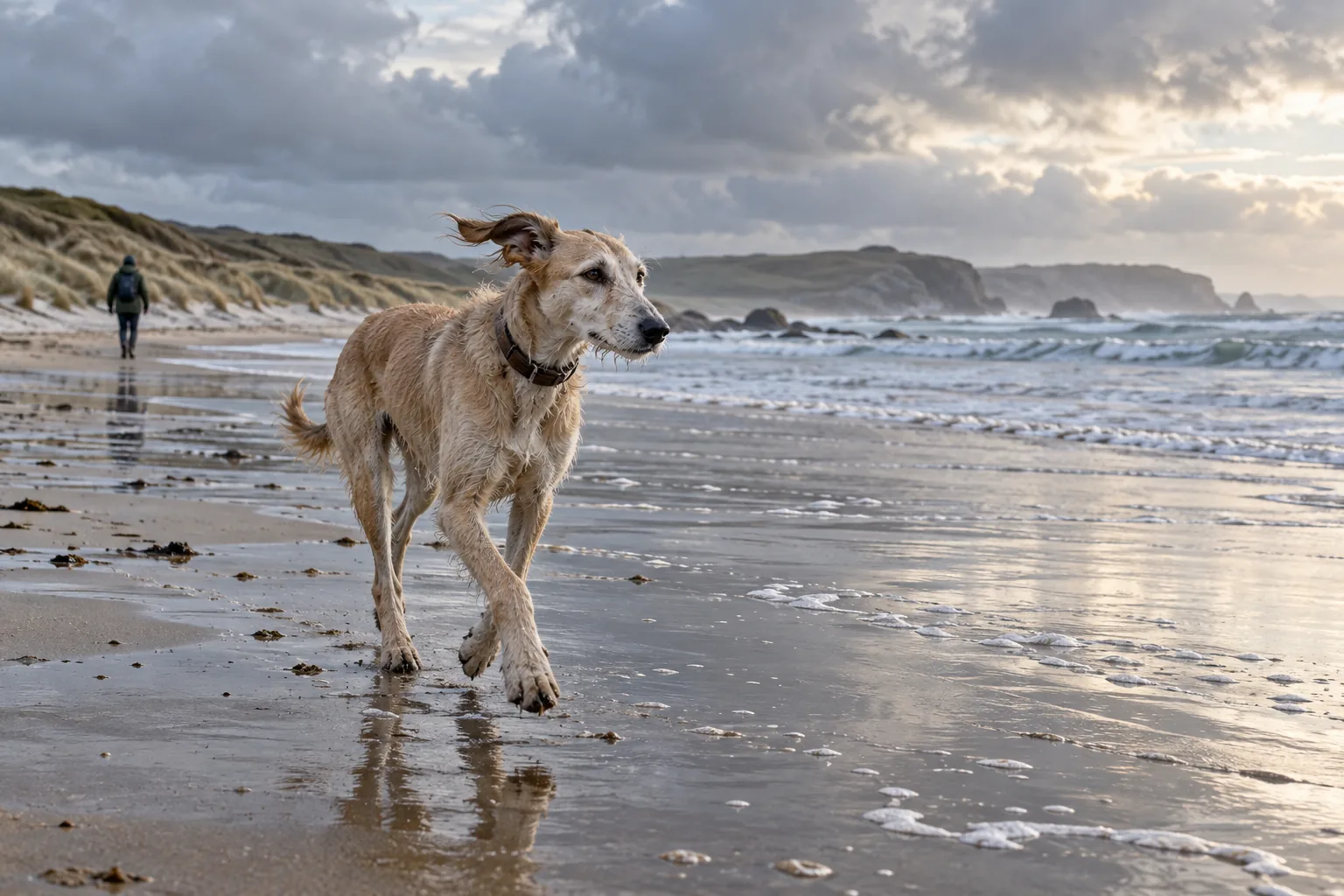
Welsh beach rules are local and seasonal, set by individual councils rather than nationally. Many beaches restrict dogs during the summer daytime — commonly May to September — while welcoming them outside those hours and dates; a smaller number ban dogs year-round. The pattern rewards early risers: a dawn beach walk before the restrictions bite, then breakfast back at the unit, is one of the great Welsh dog-holiday routines. Check the relevant council’s published list for your exact dates, and treat any park’s “dog-friendly beaches nearby” claim as a starting point, not a fact.
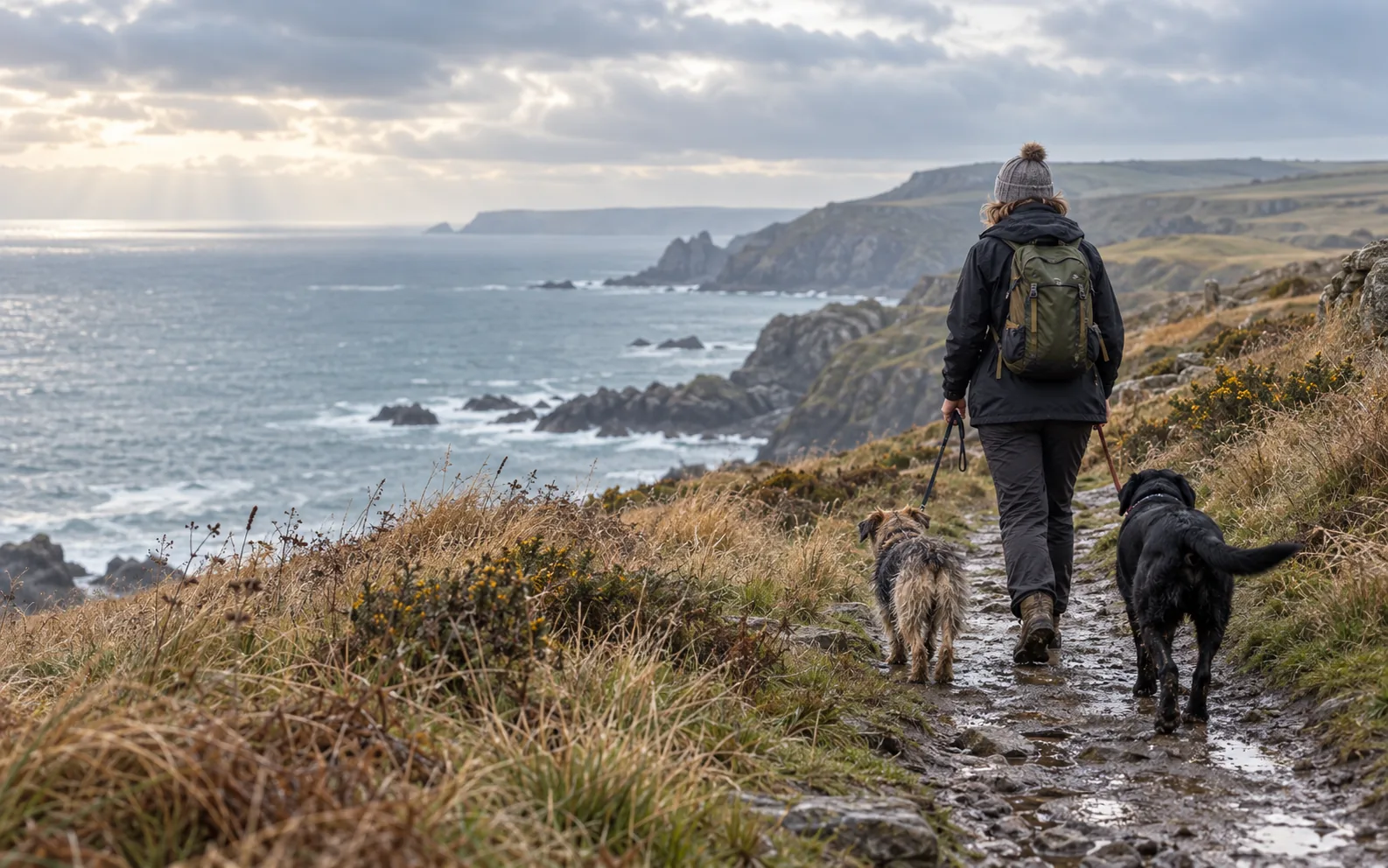
The coast path itself needs honest assessment. The Pembrokeshire Coast Path is spectacular and demanding in turns — cliff sections with unfenced drops where a long line beats off-lead freedom. Autumn brings grey seals pupping on inaccessible coves; the rule is to keep dogs well back and on leads near seal sites, because a disturbed seal pup is a serious matter. Check tide times before committing to a beach walk, since some coves vanish at high water and the alternative is a road walk nobody enjoys twice.
Countryside freedom still needs boundaries
Green surroundings do not guarantee an enclosed exercise area. Sheep may graze beside a park and field gates can open onto roads. Ask where the dog can toilet after dark, whether the boundary is stock fencing, and how close neighbouring units sit. A torch and a fixed-length lead are more dependable than relying on a fenced photo taken from one angle.
Rural Welsh parks often sit inside working farmland, which changes what “countryside location” means in practice. That attractive field beyond the hedge may hold sheep, the footpath from the gate may cross a farmyard, and the lane outside may be a 60mph rat-run with no pavement. Ask the park directly: is there a dedicated dog exercise area, is it fully enclosed, is it shared or bookable, and is it lit? A bookable secure field — increasingly offered by parks and nearby private fields — can be worth more to a reactive dog’s holiday than any number of scenic walks.
The after-dark toilet walk deserves its own question. Rural parks go properly dark, and an unlit route across a sloping field to a distant hedge is a poor end to the day. You want a short, familiar, fenced-or-walled route from the unit door — and a head torch regardless. Neighbouring units sit closer than the photos suggest on many parks, so also ask about spacing if your dog is a barker or a fence-runner; a pitch at the park’s edge is usually calmer.
Choose your corner of Wales
Wales is compact on the map and slow on the road, so pick one region per trip. Pembrokeshire offers the coast path, big beaches and the UK’s only coastal national park — superb for walkers, with the caveat of real distances on foot and genuine remoteness at the western end. The Gower packs beaches, headlands and common land into a small peninsula within easy reach of Swansea, making it the lowest-friction coastal choice for a short break.
Ceredigion’s coast is quieter and less developed, suiting dogs and owners who prefer empty beaches to facilities — but check what is actually open out of season, because cafés and car parks can shut down entirely. North Wales pairs beaches with the mountains of Eryri (Snowdonia): dramatic, weather-exposed, and demanding of a lead routine around sheep on the lower slopes. Inland, the Brecon Beacons offer waterfalls, reservoirs and open hill walking with fewer crowds than the honeypot coasts.
Travel time from England shapes the choice more than people expect. The Gower and the eastern Brecon Beacons sit within three to four hours of the Midlands and the South West, making them realistic for long weekends; Pembrokeshire and Ceredigion add another hour or more, which pays off on a full week but eats a short break. North Wales via the A55 is the natural pick for anyone travelling from the North West or the Midlands. Wherever you base yourself, download offline maps before you go — rural signal is genuinely patchy, and a dead phone in an unfamiliar lane is an avoidable problem.
Match the region to the dog. A dog that needs a daily off-lead run suits the big open beaches of Pembrokeshire or the Gower commons; a reactive dog may do better with Ceredigion’s emptiness or a quiet inland base; an older dog benefits from the level promenades and short loops of the south coast rather than mountain paths. One region, used well, always beats three regions glimpsed through a windscreen.
Protect the first and last day
Longer A-road and rural sections can make the journey tiring. Plan a proper sniff stop away from service-station traffic, carry water in the cabin and keep the arrival walk short. On departure day, leave time to cool and dry the dog before loading the car rather than squeezing in one last muddy hike.
The drive into Wales is part of the trip, not dead time. From the Midlands and the South East, the M4 corridor to the south and the A55 to the north are straightforward, but the final hour into Pembrokeshire, Ceredigion or Eryri is on slower A-roads where progress is measured in patience. Plan a genuine break two-thirds of the way: somewhere the dog can sniff, toilet and drink away from lorry parks — a village green, a layby with a field margin, a service area’s designated dog area used with care.
Rail is worth considering for some routes: dogs travel free on UK trains, and our guide to taking dogs on UK trains covers the practicalities. Wherever you travel from, keep arrival day deliberately light — walk the park boundary, find the toilet route, eat early — and keep departure day lighter still. A calm dog loaded into the car after a short morning walk travels better than one wired from a final epic hike.
Sheep country rules
Wales is sheep country first and holiday country second, and the law reflects it. Dogs must be kept under close control around livestock at all times, and on a lead near sheep is the only safe default. Lambing season, roughly March to May, is the critical period: ewes with lambs are at their most vulnerable, and even a friendly dog running toward sheep can cause fatal panic.
Livestock worrying is a criminal offence, and farmers have the legal right to shoot a dog that is worrying livestock in certain circumstances — this is not theoretical, and it is not aimed at other people’s dogs. The practical routine is unglamorous: lead on before you see the sheep, not after; long line rather than flexi-lead where you want to give running room; and recall treated as an emergency tool, not a daily management strategy. Teach everyone in the party the same routine, including children.
Ask the park where livestock currently graze, because it changes with the season — a field that was empty in June can hold sheep in September. Footpaths through farmland are rights of way, not dog exercise areas; keep to the path, keep the dog close, and close every gate. Get this right and the Welsh countryside is gloriously welcoming; get it wrong and a single incident can sour a whole community’s view of visiting dogs.
A short booking brief
Send the park your dog count, approximate sizes, preferred unit location and any need for step-free access. Ask for the pet policy as a document. If the answer is a generic link, follow up on the one detail that would make you cancel — usually fencing, unattended-dog rules or access to shared areas.
Welsh parks follow the same commercial patterns as elsewhere in Britain, so run the full UK holiday park booking checks: per-dog charges (typically £25–£75 per dog per week), maximum dog numbers per unit, which units actually accept dogs, and the cancellation schedule. Add Wales-specific questions: how exposed is the park in bad weather, what is the mobile signal like (rural signal is genuinely patchy — download offline maps), and where is the nearest vet with out-of-hours cover.
Timing matters more in Wales than its size suggests. Summer school holidays book up early at coastal parks, while spring and autumn offer the sweet spot of open beaches, lamb-free hills and lower prices. Winter breaks can be wonderful — empty coast paths, pub fires — but check what is actually open: some parks close, and some villages effectively hibernate. Get the park’s winter operating details in writing, including heating costs, before you commit.
Practical questions
Before you go
Are all Welsh beaches open to dogs?
No. Restrictions are set locally by each council and are often seasonal, commonly applying during summer daytime hours. Check the relevant council’s published list for your exact dates, and have an unrestricted or out-of-hours alternative beach in mind.
Do rural Welsh parks have secure exercise fields?
Some do, but it should never be assumed. Ask whether the area is fully enclosed, what the fence height and gate situation is, whether it is shared or bookable, and whether it is lit. Green surroundings and grazing sheep are not the same as a secure field.
How strict are the rules about dogs and sheep?
Very. Dogs must be under close control around livestock, and a lead near sheep is the only safe default — especially during lambing season from roughly March to May. Livestock worrying is a criminal offence, so treat the lead routine as non-negotiable for everyone in the party.
Is the drive to Wales difficult with a dog?
The motorways are straightforward; the final hour on rural A-roads is the slow part. Plan a proper sniff stop two-thirds of the way, carry water in the cabin, and keep arrival day light so the dog settles before dark. Never leave a dog in a parked car in warm weather.
When is the best-value season for a Welsh dog break?
Spring and autumn are the sweet spot: beaches reopen as summer restrictions lift, hills are lamb-free, prices drop and crowds thin. Winter can be wonderful for empty coast paths if you confirm what is actually open — some parks and villages effectively hibernate.