This guide is independent and contains no paid placement. If affiliate links are added later, they will be clearly marked and will not change our editorial checks.
Abersoch works brilliantly with a dog outside the summer beach ban — wide sand, coast path in both directions and a village that is used to dogs. In high summer, plan your beach time for early morning or evening, use the Warren and the coast path instead, and treat the sailing harbour with the same respect you would give a working road.
Start with the village, not the beach
Most people arrive in Abersoch with a picture in their head: a golden beach, blue water, a dog sprinting across the sand. That picture is real, and it is also only half the place. Abersoch is a small village on the south coast of the Llŷn Peninsula in Gwynedd, and it is a working sailing village before it is a holiday resort. The harbour, the slipways, the boat park and the sailing club set the rhythm of the place, and the beach sits inside that rhythm rather than apart from it. If you understand that first, almost every decision about your dog gets easier.
The village itself is compact. A main street runs down to the beach, with cafés, a small supermarket, surf and sailing shops, and a handful of pubs and restaurants clustered near the water. Everything is walkable, which is good news for a dog: you can park once, walk to the beach, walk back for lunch, and walk out again along the coast path without moving the car. The trade-off is that the village is small and busy in season, so pavements narrow, queues form outside the popular cafés, and dogs meet a lot of other dogs in a short space. A dog that is calm on a short lead in a crowd will be fine. A dog that lunges at every passing spaniel will find the main street harder work than the beach.
Timing matters more here than in most Welsh seaside villages. Abersoch changes character through the day and through the year. Early morning is quiet: dog walkers, a few sailors checking boats, the beach almost empty. Midday in August is a different place — families, paddleboards, sailing dinghies launching, the car park full, the beach busy. Late afternoon the crowds thin again and the light turns the bay gold. Outside the school holidays, the village relaxes further, and in winter it can feel almost sleepy, with a fraction of the summer footfall. The same dog can have a wonderful trip or a stressful one depending on which version of Abersoch you choose, so pick your dates and your hours deliberately rather than leaving them to chance.
One more thing to settle before you go: Abersoch is Welsh-speaking country, and you will see Welsh on signs, menus and place names throughout the Llŷn Peninsula. Abersoch itself is straightforward to pronounce once you hear it — roughly "ab-er-sock" — but nearby names such as Llanbedrog, Penrhyn and Porth Ceiriad are worth listening to rather than guessing. Nobody expects visitors to speak Welsh, but a friendly "bore da" in the morning goes a long way in a small village where the same faces serve the coffee every day.
Abersoch Main Beach: the seasonal rules in plain English
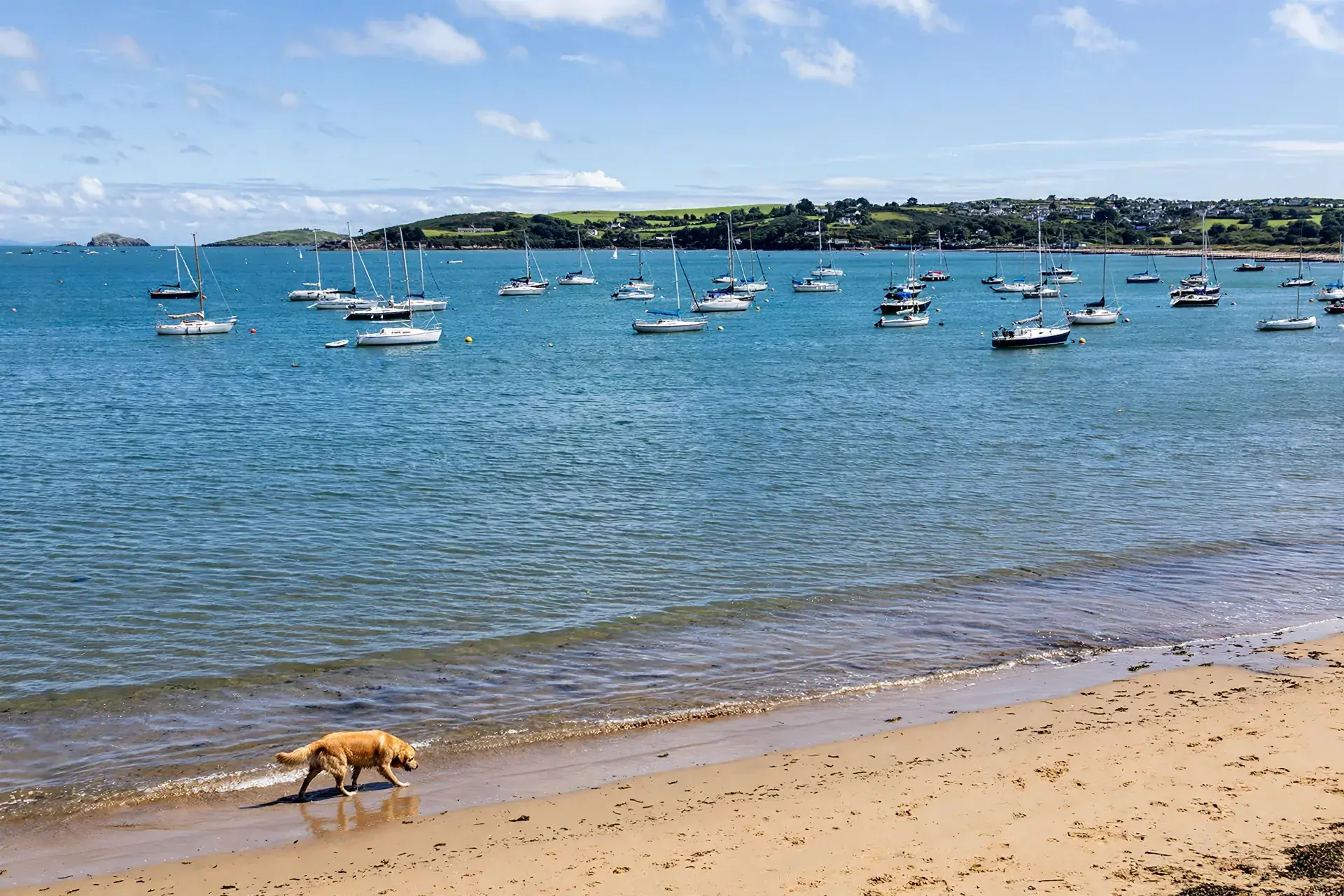
Abersoch Main Beach is the big, gently curving stretch of sand that faces south-west into Cardigan Bay, with the harbour and the sailing club at one end and the headland rising towards Llanbedrog at the other. At low tide it is wide and flat, with firm sand at the waterline that suits dogs who like a long, straight run. At high tide the sand narrows considerably, and the beach can feel crowded even on a moderate day. It is the beach most visitors mean when they say "Abersoch beach", and it is the one with the rules you need to know first.
The key rule is seasonal. Dogs are excluded from the main beach during the summer months, usually from 1 May to 30 September, under a public spaces protection order made by the local council. The exclusion applies to the main beach itself; the exact boundary is shown on signs at the beach entrances, and the dates can change, so check the official guidance before you travel rather than relying on a guidebook or a memory of a previous visit. Outside the exclusion period — roughly October to April — dogs are normally welcome on the beach, and that is when Abersoch is at its best for a dog: long empty sand, cool weather, and room to run without weaving between windbreaks and picnics.
Even when dogs are allowed, a lead is the sensible default in the busiest spots. The area near the slipway and the sailing club is a working zone, not a playground, and dogs running loose among launching dinghies, trolleys and ropes create a genuine hazard. The same applies at the harbour end, where boats are moved on trailers and vehicles reverse towards the water. Further along the beach, away from the slipway, off-lead walking is the norm for dogs with a reliable recall — but "reliable" has to mean reliable around other dogs, children, food and the smell of washed-up fish, all of which are plentiful on a working beach.
The rules for the wider UK are worth understanding alongside the local ones, because the same logic applies at almost every beach you will visit on the Llŷn Peninsula. Our guide to dog-friendly beaches in the UK explains how seasonal bans, public spaces protection orders and fines actually work, including the assistance-dog exceptions that many people get wrong. The short version is this: the ban is a legal order, not a suggestion, and the person who enforces it is a council officer, not a fellow beachgoer. If a sign says dogs are excluded, the argument is over — take the dog elsewhere and enjoy the walk instead of the dispute.
Two practical habits make the main beach work well. First, check the tide before you set out, not when you arrive. A falling tide gives you hours of wide sand; a rising tide can cut the beach in half faster than you expect, and the rocky sections near the headland are the first to become impassable. Second, carry your own water and a bowl. There is no guarantee of fresh water on the beach itself, and a dog that has been running on sand in the sun needs a drink before the walk back to the village. A collapsible bowl weighs nothing and prevents the two most common beach problems — drinking sea water and raiding other people's picnics — simply by being available.
Tides and the harbour: reading the bay
The bay at Abersoch is shallow and wide, which is exactly why it is so good for sailing and so deceptive for walking. At low water, the tide goes out a long way, exposing broad flats and pools that tempt dogs and children alike. At high water, the sea comes right up to the sea wall in places. The difference between the two states is the difference between a beach day and a harbour walk, and it changes every day by roughly an hour. If you plan a whole day around "the beach", plan it around the tide table, not the clock.
The harbour itself sits at the eastern end of the beach, where the Afon Soch meets the sea. It is a tidal harbour, which means boats sit on the mud at low water and float again as the tide returns. Dogs find this fascinating and it is also where the hazards concentrate: soft mud that can trap paws and shoes, slippery stone steps, mooring ropes under tension, and the smell of bait and fish that draws dogs towards the water's edge. Keep a dog on a lead around the harbour walls and the slipway, and do not let a dog swim in the harbour channel itself — boats move in and out with the tide, and a dog in the water is hard to see from a boat deck.
Mud is worth a paragraph of its own, because it catches out visitors every year. The estuary mud near the river mouth looks firm and is not. It is soft, deep and surprisingly sticky, and a dog that charges into it can get stuck badly enough to need help getting out. The rule is simple: if the ground looks like wet, dark mud rather than wet sand, keep the dog on the path. The same caution applies to the rock pools and the weed-covered rocks at the base of the headland, which are slippery even in dry weather and sharp enough to cut paws.
Swimming deserves the same honest treatment. Many dogs love the water here, and the bay is generally sheltered, but it is still the sea. Currents run along the shore, the water is cold even in summer, and the sailing traffic means a swimming dog can drift into a channel used by boats. Let a dog swim where you can see the bottom, where the water is calm, and where you can reach the dog quickly — not at the harbour mouth, not near the slipway, and not when the tide is turning. After a swim, rinse the dog with fresh water if you can; salt water left to dry on a coat causes itching, and a dog that licks salt from its fur will drink more sea water to compensate.
A sailing village, not a dog beach
The single biggest mistake a visitor can make in Abersoch is treating the beach as if it were a dedicated dog beach. It is not. It is a shared space, and the other users are not just sunbathers. Abersoch is one of the best-known sailing centres on the Welsh coast, home to a large sailing club, regular racing, and a fleet of dinghies, keelboats and visiting yachts. On a good sailing day, the beach and the slipway are a workplace: boats launching and recovering, trailers reversing, sailors carrying masts and sails, and children in buoyancy aids running between the clubhouse and the water.
For a dog owner, this means two things. First, the slipway and the boat park are not dog-walking routes. They are vehicle and equipment routes, and a dog on a long line across a slipway is a trip hazard for a sailor carrying a sail. Walk around them, on the sand or the promenade, and keep the lead short until you are clear. Second, the water itself is busy. A dog swimming across a sailing lane, or chasing a dinghy, is in real danger and also a nuisance to the people racing. If your dog is a keen swimmer, choose the quieter end of the beach, away from the club, and keep swims short and close to shore.
There is a positive side to all of this, which is that a sailing village is used to dogs. Sailors bring dogs to the club, dogs wait on the pontoons and in the boat park, and the village's cafés and pubs are accustomed to wet dogs and sandy paws in a way that a city-centre café is not. A well-behaved dog that settles under a table is welcome in far more places here than the signs suggest. The unspoken deal is that the dog is under control and the owner is paying attention — the same deal that makes shared spaces work everywhere, but enforced more visibly in a place where people are handling expensive boats.
If you are a sailor yourself and want to take the dog afloat, ask the specific operator or club about their policy rather than assuming. Some sailing schools and boat trips welcome dogs; many do not, because of insurance, safety equipment and limited space. A dog that is calm on a boat, happy with a buoyancy aid and able to settle for an hour is a different proposition from a dog that has never been on the water. Try a short harbour trip first if one is available, and be ready to leave the dog ashore with a plan for its care rather than forcing a situation that stresses the dog and the crew.
Three walks from the village green
You do not need a car to walk well from Abersoch. Three routes cover the range: a short beach-and-headland loop, a longer coast path stretch, and a quiet inland alternative for bad weather. All three start in the village, all three are on the Wales Coast Path or link to it, and all three are better done with a lead in your pocket even if the dog spends most of the walk off it.
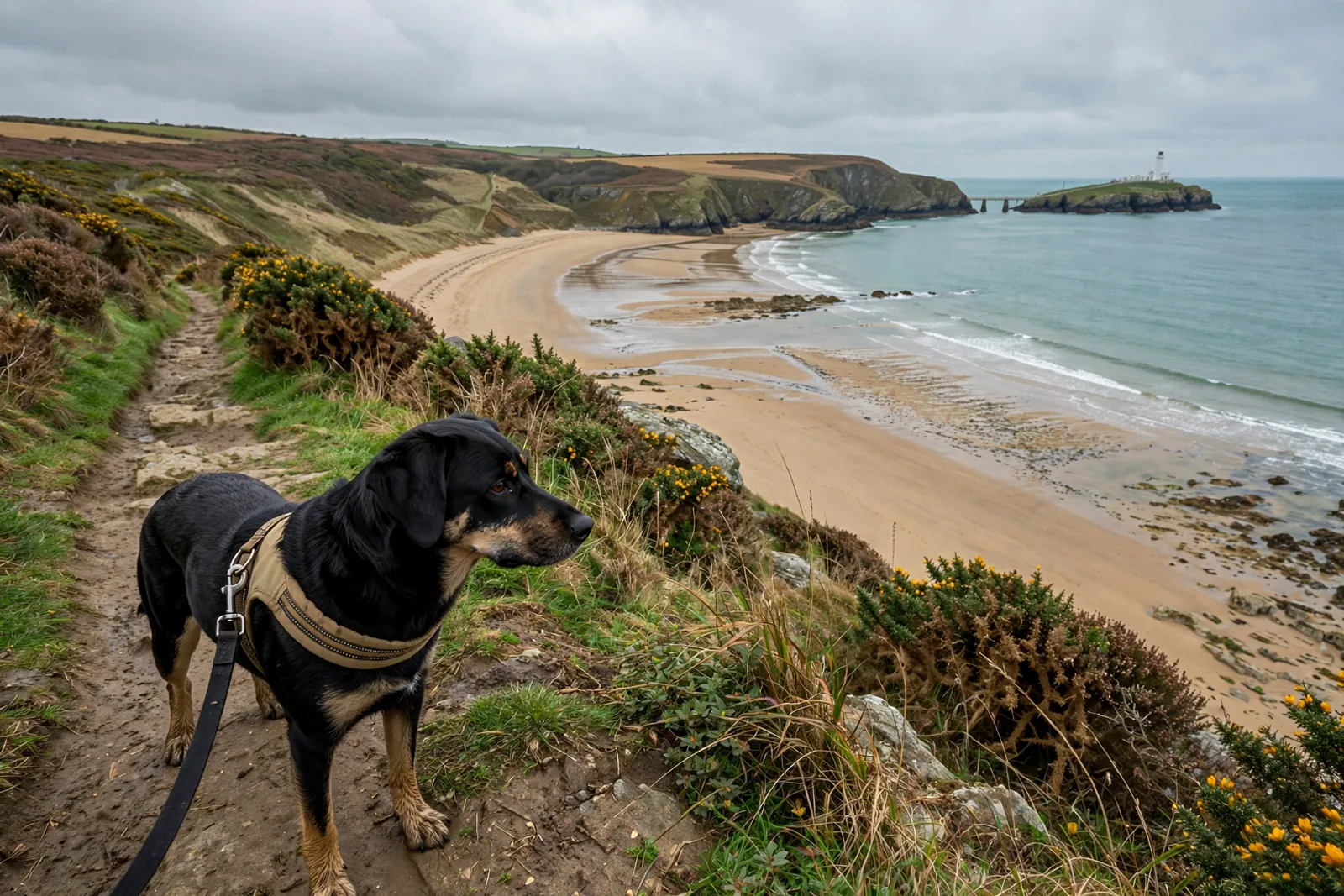
The first walk is the simplest and the one most visitors do without realising it: from the main beach, west along the sand towards Llanbedrog, then back along the coast path. At low tide the beach walk is flat and easy, and the headland at the far end gives a view back across the whole bay. The coast path return runs above the beach, through gorse and low cliffs, and it is here that the lead comes out — the path is narrow in places, the drop is real, and sheep graze the fields beside it. Allow about an hour for the round trip at a dog's pace, longer if your dog stops to investigate every rock pool.
The second walk is the longer one, east from the village towards Porth Ceiriad and the Warren. This is the quieter direction, and it suits dogs that are overwhelmed by the main beach. The Warren beach is a long, curving stretch of sand backed by dunes, and it is noticeably less busy than the main beach even in summer. The coast path here crosses farmland and cliff tops, so livestock and cliff edges are the two things to manage: keep the dog on a lead through fields with sheep or cattle, and keep the dog on the inland side of the path on the cliff sections. The full walk to Porth Ceiriad and back is a half-day outing for most dogs, so take water, and plan a shorter out-and-back version if your dog is older or less fit.
The third walk is the wet-weather fallback, and it is the one that saves a holiday: the lanes and paths inland from the village, towards the golf course and the fields behind the Warren. There is nothing dramatic about it — no sea views, no cliffs — but it is sheltered, it drains better than the coast path after rain, and it gives a dog a proper walk when the wind is driving rain off the bay. A circular route of lanes and field paths of about forty minutes is enough to tire most dogs, and it is also the best option for a dog that is nervous of waves or unsettled by the noise of a busy beach.
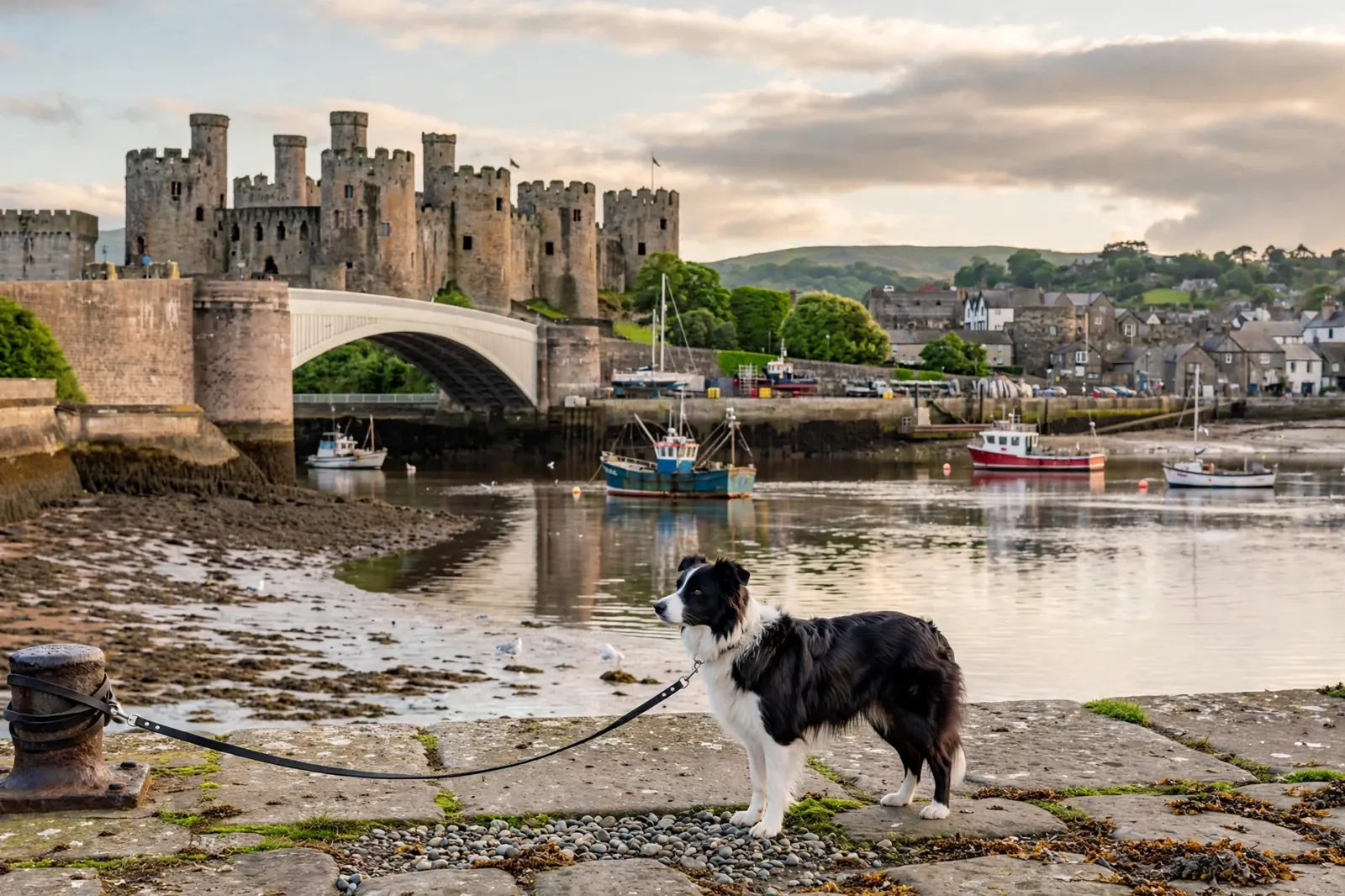
For a longer trip, Abersoch is a useful base for exploring the rest of the Llŷn Peninsula and the coast beyond it. Our Anglesey dog guide covers the beaches, coast path and ferry practicalities across the Menai Strait, and it pairs well with a Llŷn stay because the two peninsulas share the same tidal and seasonal logic. If you are building a longer Welsh coast itinerary, Conwy with a dog covers the walled town, the quay and the harbour walks to the east, and makes a good contrast: a castle town after a sailing village.
Eating out with a dog
Abersoch eats well for a village of its size, and dogs are part of the picture — but the picture changes with the season, and the best approach is to ask rather than assume. Many cafés and pubs welcome dogs in outdoor seating areas and on terraces, and a good number allow dogs inside as well, particularly outside the summer peak. Policies can change between seasons and even between the bar and the restaurant in the same building, so check the sign on the door and ask a member of staff before you settle in. A dog that is refused entry is not being discriminated against; the business is managing food hygiene rules and the comfort of other customers.
The practical test is simple: can your dog settle under a table for forty minutes while you eat? If the answer is yes, Abersoch will be easy. Bring a small mat or blanket so the dog has a defined place to lie, order at the bar or the counter where that is the system, and keep the lead short enough that the dog cannot reach the next table's food or a passing child. If the answer is no — if your dog barks at strangers, begs loudly or cannot settle — then takeaway is the better plan. Abersoch has good takeaway options, and eating fish and chips on the harbour wall with the dog beside you is often a better memory than a stressful meal indoors.
Morning is the easiest time to eat out with a dog. Cafés open early, the village is quiet, and a dog that has already had its beach walk will usually sleep through breakfast. Lunchtime in August is the hardest: queues, full terraces, and dogs meeting dogs in tight spaces. If you are visiting in peak season, eat early or late, or buy food and eat it on the beach or the coast path, where the dog has space. Evening is a middle ground — the village calms down, the pubs fill with sailors rather than families, and a dog that settles is welcome in most bar areas. Always confirm before ordering, and be ready to move outside if the dog becomes restless.
Water is the small detail that separates a good dog-friendly café from a merely tolerant one. A bowl of fresh water without being asked, a dog biscuit with the bill, a hook by the door for a lead — these are the signs of a place that genuinely welcomes dogs rather than tolerating them. Carry your own bowl anyway, because a busy café may not have one spare, and a thirsty dog after a beach walk should not have to wait for a member of staff to notice. And if a place is excellent with your dog, say so: small village businesses remember the customers who are considerate, and a thank-you is the cheapest way to keep a village dog-friendly.
Staying over with a dog
Most visitors to Abersoch stay in a self-catering cottage, a caravan or a campsite, and all three can work well with a dog if you choose with the dog in mind rather than the photographs. The village and the surrounding area have a large number of dog-friendly cottages, many of them within walking distance of the beach, and the key questions are the same ones you would ask anywhere: how many dogs are allowed, is there a pet fee, is the garden enclosed, and how far is the nearest practical toilet walk after dark?
The garden question matters more in Abersoch than in many places, because a cottage near the beach is not automatically a cottage with a secure garden. Ask for the height of the fence or wall, whether the gate latches properly, and whether there are gaps a small dog could slip through. A garden that opens directly onto a road or a lane is not a safe place to leave a dog unattended, even for a few minutes. If the garden is not secure, plan as if the dog is on a lead whenever it is outside, and choose a cottage that is close to a quiet walking route so the early-morning and late-night outings are easy.
Caravan and campsite stays are the other main option, and the Warren area in particular has large parks that welcome dogs. These suit dogs that are comfortable with neighbours, shared facilities and the sounds of a busy site. They are less suited to dogs that bark at every passing footstep or cannot settle in a small space. When you book, ask specifically whether dogs are allowed in the unit you are booking — not just on the park — and whether there is a limit on the number of dogs, a size condition or a breed condition. Get the pet fee in writing, with the total for the stay, before you pay the deposit, and check the cancellation terms, because a dog that becomes ill is the most common reason a booking changes.
For stays of a week or more, think about the dog's routine as well as your own. A dog that is used to a garden at home will need more walks in a cottage without one. A dog that is used to quiet will need a plan for the noisiest hours of a caravan park. A dog that is used to sleeping in its own bed will settle faster if you bring that bed, its usual food and its usual bowl, rather than expecting it to adapt to new versions of everything at once. The first evening sets the tone: a calm walk, a familiar bed, the same feeding time as at home, and an early night will do more for the rest of the week than any amount of sightseeing on day one.
Arriving, parking and the summer squeeze
Abersoch is reached by a single main road from the east, and the approach is part of the experience: narrow lanes, stone walls, tractors, and the sudden view of the bay as you come over the last rise. It is also the reason to plan your arrival time. The village has one main car park by the beach and a limited amount of on-street parking, and on a sunny summer weekend the car park can fill before mid-morning. Arrive early, arrive late, or arrive on a weekday, and the same village feels spacious. Arrive at noon on a Saturday in August and you will circle the village looking for a space while the dog gets hotter and more frustrated in the back seat.
The practical answer is to treat parking as part of the plan, not an afterthought. Use the larger car parks on the edge of the village and walk in, rather than driving into the centre and hoping. Keep a lead, water and a bowl in the car so you can walk straight from the car park to the beach without unloading everything. If you are staying in the village, ask your accommodation about parking before you arrive — some cottages have a dedicated space, some have street parking only, and some have none at all, which changes how you pack and how you plan the first morning.
Never leave a dog in a parked car in warm weather, even with the windows open and even for a few minutes. Cars heat up far faster than most people expect, and a dog in a hot car can be in distress before you have finished queuing for an ice cream. If you need to go into a shop or a café that does not allow dogs, take it in turns, use a takeaway, or leave the dog with someone who can walk it. The same rule applies in winter in reverse: a car cools quickly, and a wet dog left in a cold car after a swim will chill fast. Plan the day so the dog is with you or in a warm, dry place, not waiting in a car park.
Public transport is limited, which is worth knowing if you were hoping to leave the car at home. Buses run to Abersoch from Pwllheli and the surrounding villages, but services are infrequent, especially outside the summer season, and dogs are carried at the driver's discretion on most local services. If you do use the bus, keep the dog on a short lead, on the floor, and out of the aisle, and be ready to wait for the next service if the bus is full. For most dog owners, a car is the practical choice for a Llŷn trip, and the parking advice above is the price of that convenience.
Rainy days and the quiet months
Abersoch in the rain is a different holiday, and it is worth planning for rather than dreading. The Llŷn Peninsula gets its share of Atlantic weather, and a week here without at least one wet day would be unusual. The dogs, as a rule, do not mind. The people are the ones who need a plan, and the plan is simple: shorter walks, better drying, and a willingness to treat a rainy day as a different kind of day rather than a failed beach day.
The coast path is the first thing to reconsider in wet weather. The cliff-top sections are exposed to wind and rain, the ground becomes slippery, and the views that make the walk worthwhile disappear into cloud. The inland lanes and the sheltered paths behind the village are the better choice, as is the beach itself at low tide — rain on sand is no worse than rain on a path, and the beach is wide enough to keep a distance from other walkers. A drying coat for the dog, two towels, and a waterproof mat by the door of your accommodation will do more for your comfort than any amount of route planning.
The quiet months — October to April — are when Abersoch is at its best for many dog owners. The beach ban lifts, the village empties, the coast path is yours, and the light on the bay is often at its finest. The trade-offs are real: some cafés and shops reduce their hours or close for the winter, the sailing season ends, and the weather is colder and wetter. But for a dog that needs space, a walker who prefers an empty beach to a busy one, and a visitor who would rather have a quiet pub than a queue, the quiet months are the better choice. Pack for the weather, check which businesses are open before you travel, and enjoy the version of Abersoch that most summer visitors never see.
One seasonal note that catches people out: the period around the school holidays and the bank holidays is busy even outside the summer peak. Easter, the May half term and the October half term all bring a surge of visitors, and the beach and the car park fill accordingly. If you want the quiet version of Abersoch, choose a midweek date in term time, and check the school holiday calendar for England and Wales before you book — the two do not always align, and a Welsh term-time week can still be busy with English visitors.
Safety: heat, sea water and small hazards
The hazards in Abersoch are ordinary seaside hazards, and they are all manageable with a little attention. Heat is the first. The south-facing beach traps the sun, the sand reflects it, and a dog running on hot sand in July can overheat quickly. Walk in the morning or the evening, carry water, watch for heavy panting and a reluctance to move, and never exercise a dog hard in the middle of a hot day. Brachycephalic breeds — flat-faced dogs such as pugs, French bulldogs and bulldogs — are at particular risk, and for them a short, shaded walk is a better plan than a long beach run.
Sea water is the second hazard, and it is the one most often underestimated. A dog that drinks sea water while playing in the waves can take in enough salt to cause vomiting, diarrhoea and, in larger amounts, salt-water poisoning. The signs to watch for are vomiting, excessive thirst, confusion and weakness, and they can appear hours after the beach. Prevent it by offering fresh water frequently, by keeping a dog out of the water when it is drinking from the waves, and by rinsing the dog after a swim so it does not lick salt from its coat. If a dog is vomiting repeatedly or seems weak after a beach day, contact a vet promptly.
The third hazard is what the dog eats on the beach. Washed-up fish, crab shells, seaweed, fishing line, hooks and bait are all common on a working beach, and all of them can cause stomach upsets or worse. Fishing hooks and line are the serious ones: a hook swallowed or caught in a lip needs a vet, and line wrapped around a leg or a tongue can cut circulation quickly. Check the beach at the harbour end before letting a dog run loose, and teach a reliable "leave it" if you can — it is worth more on a beach than any piece of equipment.
Finally, know where the nearest vet is before you need one. The nearest veterinary practices are in Pwllheli and the surrounding towns, and opening hours are limited at weekends and on bank holidays. Save the number of the nearest practice and an out-of-hours emergency service in your phone before you travel, and keep a note of your own vet's number as well. A dog that needs a vet on a Sunday evening is a stressful situation made worse by having to search for a number while the dog is unwell — and a two-minute check before you leave home removes the problem entirely.
Practical questions
Before you go
Can dogs go on Abersoch Main Beach all year round?
No. Abersoch Main Beach has a seasonal dog exclusion, usually from 1 May to 30 September, under a public spaces protection order. Dogs are normally welcome on the beach outside those dates, on a lead in the busiest areas. Always check the signs at the beach entrances and the official guidance before you travel, because the exact dates and the marked zones can change.
Is there anywhere in Abersoch to let a dog off the lead?
Yes, at the right time of year and in the right place. Outside the summer exclusion, the main beach is the usual off-lead spot, and the Warren beach and the coast path towards Llanbedrog are quieter alternatives. Off-lead still needs a reliable recall, because the bay is shared with sailors, paddleboarders and other dogs, and the tide can cut off sections of sand quickly.
What should I do if my dog drinks sea water or eats something on the beach?
Offer fresh water straight away and watch for vomiting, diarrhoea or unusual lethargy over the next few hours. Sea water can cause salt-water poisoning in larger amounts, and washed-up fish, crab shells, seaweed and fishing debris are common stomach upsets. If your dog is vomiting repeatedly, seems weak or has eaten something sharp, contact a vet promptly rather than waiting to see if it passes.
Can I take my dog on a boat trip from Abersoch?
It depends on the operator and the trip. Some boat trips and sailing experiences welcome well-behaved dogs, while others do not, usually because of space, safety equipment or other passengers. Ask the operator directly before booking, confirm the dog can sit or lie safely, and bring a lead, water and a towel. Never assume a dog can join a trip just because it is advertised as family friendly.
Where can I park with a dog in Abersoch in summer?
The main car park by the beach fills early on sunny summer days, and the village centre has limited on-street parking. Arrive before mid-morning or after late afternoon, use the larger car parks on the edge of the village, and be ready for a short walk to the beach. Never leave a dog in a parked car in warm weather, even with the windows open — cars heat up far faster than most people expect.
Is Abersoch a good base for the Wales Coast Path with a dog?
Yes. Abersoch sits on the Wales Coast Path, with signed sections running west towards Llanbedrog and east towards Porth Ceiriad and beyond. The walking is varied — beach, low cliffs, farmland and quiet lanes — but livestock, cliff edges and narrow road sections all need a lead. Plan a linear walk with a bus or a lift back, or an out-and-back route that matches your dog's fitness.