This guide is independent and contains no paid placement. Beach rules, ferry conditions and reserve signs change, so check the latest official guidance before you travel.
Plan Anglesey backwards from the tides. Check the tide times and the seasonal beach rules the night before, choose a coast path section that suits your dog, keep a lead ready for livestock, cliffs and wildlife, and build in a forest or village fallback for high water. Done that way, Anglesey is one of the most rewarding dog-friendly islands in Britain.
Start with the tide table, not the itinerary
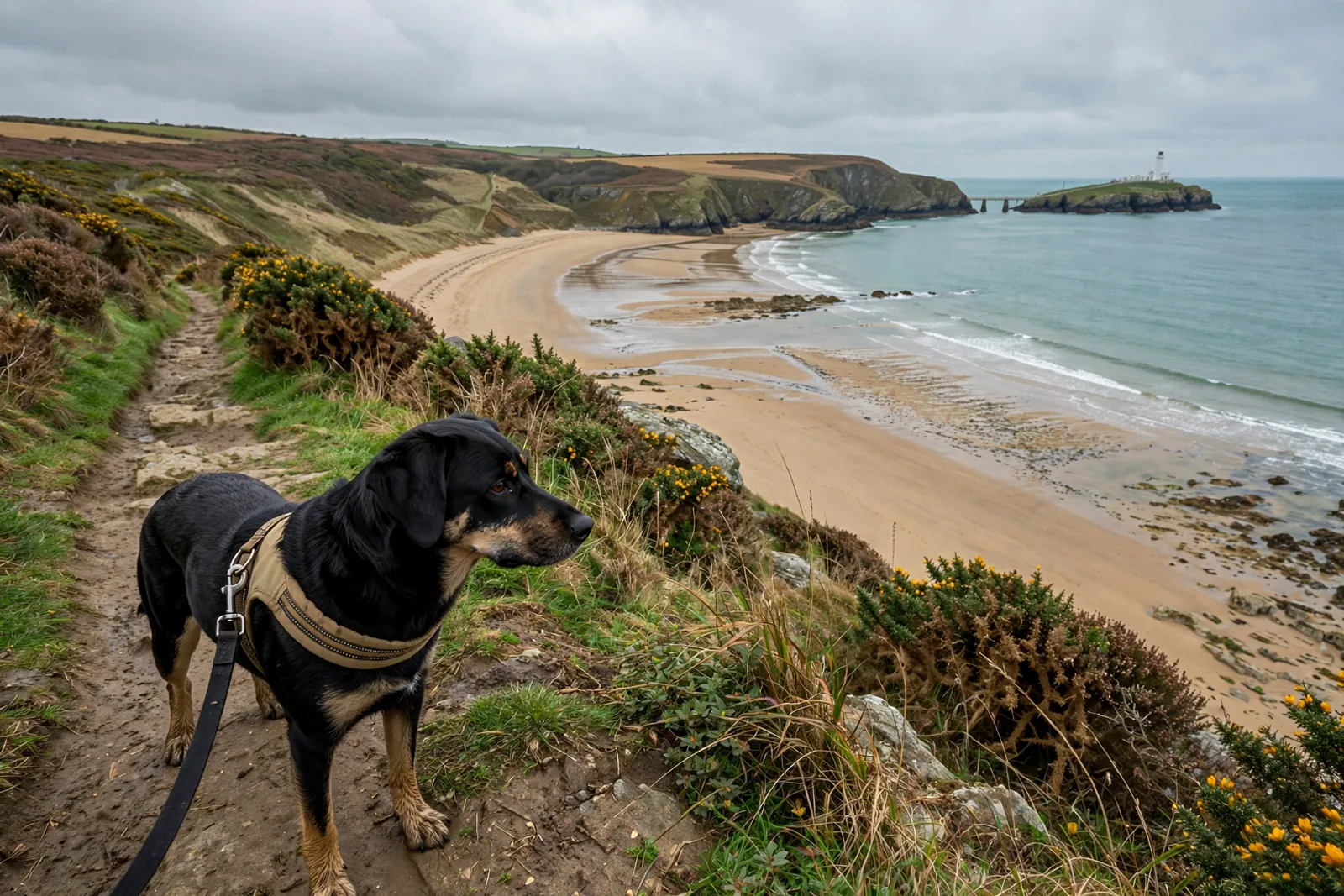
The tide-table problem comes first on Anglesey, because it can undo an otherwise perfect plan before breakfast. Imagine the scene in planning terms, not as a promise of any single beach: you drive across the island for a wide sandy bay, unload the dog, walk down to the shore at high water and discover there is almost no sand left to walk on. The beach that looked enormous in photographs was photographed at low tide. At high tide the same place may be a narrow strip of pebbles against a sea wall, with waves reaching the slipway and no safe space for a dog that pulls towards the water. The day is not ruined, but it has to be rebuilt — a coast path section first, lunch earlier than planned, and the beach saved for mid-afternoon when the tide has fallen back.
That re-planning is the normal Anglesey skill, and learning it before you arrive saves fuel, frustration and a disappointed dog watching the sea from a car park. Anglesey is an island off the north-west coast of Wales, reached by road bridges over the Menai Strait, and almost everything a dog owner wants to do here — beaches, harbour walks, tidal islands, rock pools and estuary paths — is affected by the state of the tide. Some causeways and tidal islands are cut off for hours around high water. Some beaches are at their best two hours either side of low tide, when hard sand opens up for a proper walk. Others are safer at mid tide, when there is still sand but the walk back to the exit is short.
Build every day in three blocks. First, note the times and heights of high and low water for the nearest tide station to where you are staying, and write them on the plan where you would normally write opening times. Second, assign the beach to a falling or low tide wherever possible, and assign cliff paths, forest walks and villages to high tide, when you do not need sand at all. Third, keep one completely tide-free option in reserve — a forest trail, an inland lake path or a dog-friendly cafe in a town — so that a misjudged tide, a closed car park or sudden rain does not leave you improvising in a lay-by. Dogs cope well with a changed order of events; what unsettles them is a long, hot wait in a car while humans debate alternatives.
Tide heights matter as well as tide times. A high spring tide can cover salt marsh, flood low sections of coastal path and push walkers onto narrow cliff-top lines, while a lower neap high tide may leave those same sections passable. Conversely, a very low spring tide can expose rocks, weed and pools a long way from the dry exit, tempting walkers further out than is sensible with a dog on a lead over slippery ground. Check the height, look at the wind forecast — strong onshore winds can push water higher and faster than predicted — and set a turnaround time before you set off. If a section involves a tidal cut-off point, such as the crossing to Llanddwyn, treat the published safe-crossing advice as a hard limit, not a target, and check the latest official guidance before you travel.
Seasonal beach restrictions and how to check them
Anglesey has dozens of beaches, from long dune-backed strands on the west coast to small coves on the east, and dog rules are not the same on all of them. The pattern that catches visitors out is the partial seasonal restriction: on several popular beaches, dogs are excluded from a defined central section during the main season, commonly from 1 May to 30 September, while remaining welcome on other signed parts of the same beach for the rest of the year and, in some cases, all year on the unrestricted ends. Arriving at the main entrance, seeing a restriction sign and assuming the whole beach is closed to dogs — or, worse, ignoring the sign because other dogs are visible further along — are both common mistakes. The dogs further along may be standing exactly where dogs are allowed.
Checking properly takes five minutes and should be done in layers. Start with the Isle of Anglesey County Council information for the specific beach, which sets out any seasonal restrictions, the dates they run and the facilities at that beach. Then look at a map of the restriction zone if one is provided, so you know which car park and which access point put you on the dog-welcome side of the boundary without walking through the restricted section to reach it. Finally, read the sign at the beach entrance on the day itself, because local orders, temporary works and wildlife protection measures can add restrictions that a website summary has not caught up with. If the sign and the website disagree, obey the sign and check the latest official guidance before you travel next time.
Our wider guide to dog-friendly beaches in the UK and their rules explains how seasonal bans, lead zones and bathing-water areas work across Britain, and Anglesey follows the same logic: restrictions protect bathers in the busiest central area during the busiest months, not dogs in general. Outside the restricted dates, many beaches that were partly closed in August become fully open, quieter and often better for dogs in October, November and spring — provided the weather, daylight and tides are planned for. Shoulder season is therefore a genuine strategy on Anglesey, not a compromise.
Whichever beach you choose, the everyday rules still apply. Keep dogs under close control near children, horses and wildlife, keep them out of marked bathing areas where signs require it, and always clear up after them — bins can be scarce on rural beaches, so carry bags out to the car park bin rather than leaving them on a fence post. On dune systems, keep to marked paths where signs ask you to, because dunes are fragile, can be home to ground-nesting birds in season, and often hide steep, unstable drops on the seaward side that a dog running ahead will find before you do. Where a beach is backed by farmland or a nature reserve, expect a lead to be needed for the walk from the car park to the sand even if the beach itself allows off-lead exercise in the unrestricted area.
Facilities shape a beach day with a dog more than most lists admit. Before committing to a beach, check parking charges and whether payment is by app, card or cash; whether there are toilets and a fresh-water tap for rinsing a sandy dog and filling a bowl; how far the walk is from car park to sand, which matters for older dogs in summer heat; and whether there is any shade at all. A beach with no shade, no water and a long hot walk back across sand is a poor choice at midday in July, however good its dog rules are. Early morning and late afternoon visits solve most heat problems and also tend to be when unrestricted sections are quietest.
Anglesey Coast Path sections that suit dogs
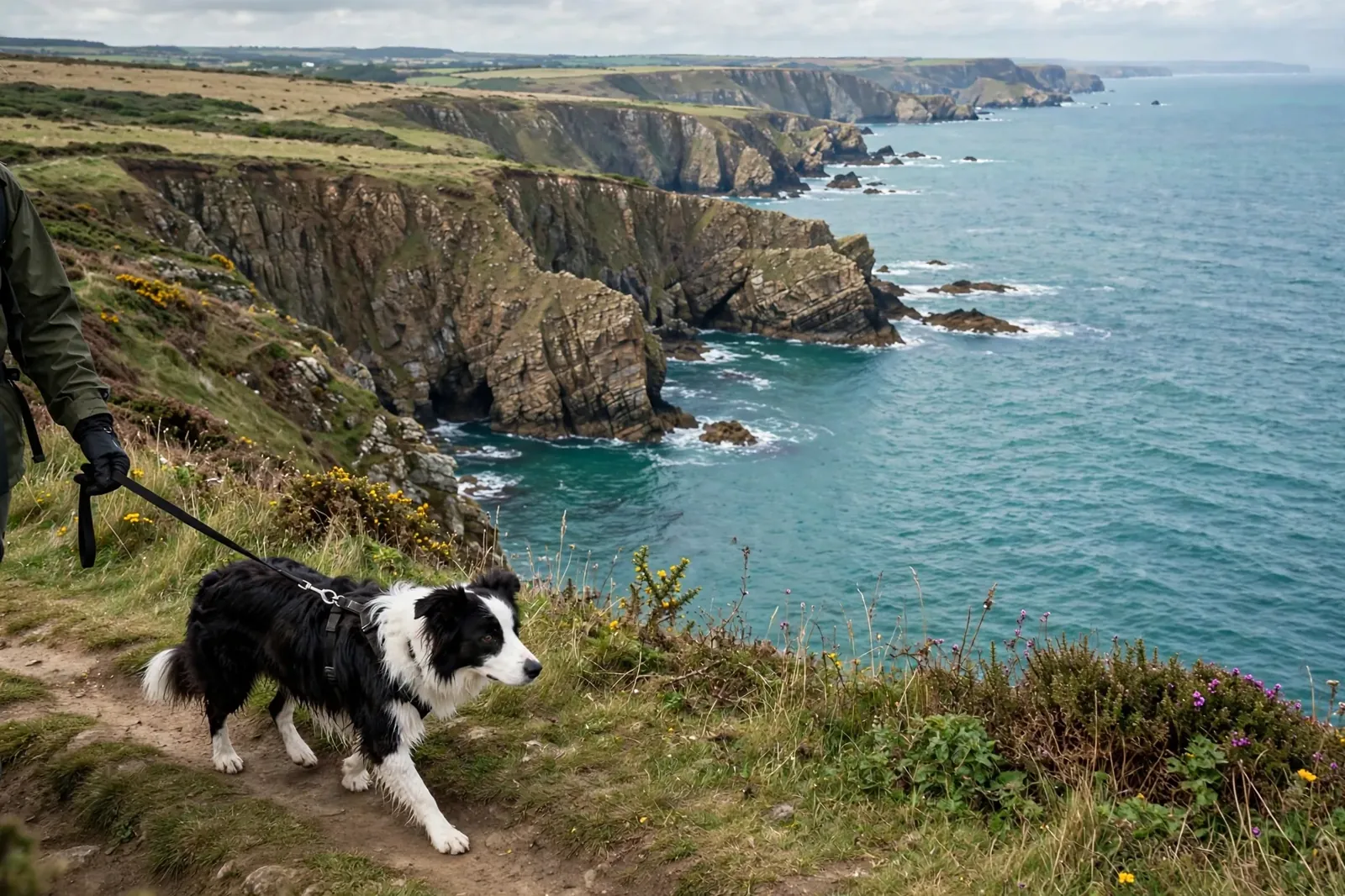
The Anglesey section of the Wales Coast Path runs for roughly 125 miles around the island, and almost no dog — and few owners — should attempt it as a single continuous effort on a short break. The useful question is which shorter sections match your dog's fitness, lead manners and tolerance for livestock, stiles and cliff edges. The path is varied: some stretches are level promenades and harbour edges suitable for older dogs and pushchair-paced walks, some are soft dune and estuary paths, and some are serious cliff walking with narrow sections, steep steps and exposure that demands a steady dog on a short lead and an owner wearing proper footwear.
For an easier introduction, look for sections that follow beaches, estuaries and low headlands on the east and south coasts, where exits to villages and car parks are frequent and the walking can be shortened without retracing a dangerous section. These stretches suit senior dogs, young dogs building fitness and anyone who wants a walk that can be abandoned gracefully for a cafe when the weather turns. For a bigger day, the wilder north and west coast sections offer cliffs, coves and long views, but they also bring the full set of coast path cautions: sheep and sometimes cattle grazing right up to the path, kissing gates and stiles that large or stiff dogs may struggle with, and long gaps between road exits. Plan a linear walk with a bus, taxi or second car where possible, rather than assuming you can double a hard section on tired legs.
Livestock is the defining lead issue on this path. Much of Anglesey is farmed, fields run down to the sea, and a dog that is normally reliable can behave differently around sheep with lambs or cattle with calves. Keep your dog on a short lead in any field with animals in it, give cattle a wide berth and never get between a cow and her calf. If cattle approach in a threatening way, the standard countryside advice is to let go of the lead so you and the dog can separate — a situation that good route planning and early lead use are designed to avoid altogether. The same discipline protects ground-nesting birds on cliff tops and heath in spring and early summer, when a dog ranging through vegetation can cause real harm without ever catching anything. For comparison with another Welsh coast path with similar livestock and cliff questions, see our guide to walking the Pembrokeshire Coast with a dog.
Stiles deserve a specific check. A fit collie may hop a stile easily; a large, older or joint-stiff dog may not be able to climb it and may be too heavy to lift safely on a cliff path. Where a planned section is new to you, assume there will be gates and possibly stiles, take a harness with a handle if your dog needs help, and be ready to turn back rather than improvising a lift on a slope. Mud is the other practical filter: after wet weather, estuary and field sections can be slippery and hard work, gateways become churned, and a dog will need a proper wash and dry afterwards. Pack a towel, a spare lead for when the first is soaked, water for both of you — streams on farmland are not a safe drinking source for dogs — and a headtorch from autumn onwards, because a section that overruns into dusk on an unlit rural coast is a navigation problem, not an adventure.
Navigation itself is straightforward if you prepare. The coast path is waymarked, but signs can be missed at field boundaries and in villages, and phone signal is not guaranteed on every cove. Download an offline map of the section before you leave your accommodation, note the grid references or descriptions of your exit points, and tell someone where you are walking if you are heading out alone. None of this needs to make the walk feel heavy: an hour of preparation buys a relaxed day on some of the finest low-level coastal walking in Wales, with the dog setting a sniffing pace that suits the path well.
Holy Island and South Stack: cliffs, steps and seabirds
Holy Island, joined to Anglesey by road causeways and bridges at Holyhead, concentrates several of Anglesey's best-known dog walks into a small area — and several of its sharpest cautions. South Stack, on the island's western edge, is famous for its lighthouse on a rocky island reached by a long flight of steps and a bridge, for high cliffs, and for a major seabird colony in season. The cliffs and the reserve around them are managed for wildlife, and the visitor experience is built around viewing areas, steps and exposed headland rather than open running space. Dogs need to be on a lead around the reserve, cliff edges and other visitors, and owners should check before travelling whether dogs are permitted in any indoor visitor facilities or on any lighthouse tour, because access rules for buildings and tours commonly exclude dogs other than assistance dogs — check the latest official guidance before you travel.
The steps are the practical deciding factor. Hundreds of steps down towards the lighthouse bridge, and the same number back up, are a serious ask for an older dog, a dog with joint problems or a dog that lunges on stairs. A dog that cannot manage the steps can still have a good South Stack visit from the upper paths and viewpoints, provided cliff-edge discipline is absolute: short lead, no extending lead near edges, and no reliance on a dog understanding a drop it has never seen before. Wind matters here more than on sheltered beaches. Strong gusts on an exposed headland can unbalance people and frighten dogs, and on the worst days the sensible decision is to enjoy the wilder coast from a lower, sheltered section instead.
Beyond South Stack, Holy Island offers gentler options that balance a trip nicely. Harbour and breakwater walks around Holyhead give level, hard-surfaced exercise with sea views and are useful for a dog that needs a short leg-stretch before or after a ferry. Beaches and coves on the island's sheltered side can be calmer than the open west coast in a westerly wind, though the same seasonal restriction and tide checks apply. Inland, the island's low heath and rocky outcrops provide short, interesting walks, but heathland in bird-breeding season is lead territory for the same ground-nesting reasons as the cliff tops. Treat Holy Island as a full day with choices, not a single viewpoint: arrive with a lead, water, a windproof layer and a fallback plan, and it rewards dogs and owners who like their scenery dramatic but their logistics simple.
Newborough: forest shade, red squirrels and lead rules
Newborough, on Anglesey's south-west corner, is the island's best answer to a hot day, a high tide or a dog that needs shade more than sand. Newborough Forest, managed by Natural Resources Wales, offers waymarked trails through pine woodland beside Newborough Warren and the long beach of Traeth Llanddwyn. Forest walking changes the whole rhythm of a dog day: cooler air, softer ground, marked routes of different lengths, and a chance for a nervous dog to walk without the visual pressure of a crowded beach. Parking, toilets and trail information are provided at the main forest car parks, with charges and opening arrangements that should be checked before you travel.
The reason leads matter so much here has a name and a colour: Newborough is one of the important places in Wales for red squirrels. The forest is a stronghold for reds, and dogs chasing squirrels — or any wildlife — is exactly what reserve management is trying to prevent. Keep your dog on a lead in the forest and warren areas where signs require it, and under the closest control everywhere else; a dog that disappears into trees after a squirrel is at risk itself, from roads, from getting lost in a large forest, and from the stress caused to the animals it chases. The same lead discipline protects ground-nesting birds on the warren, grazing ponies that are part of the site's management, and other visitors' dogs on narrow forest trails. Seeing a red squirrel from the path, with a calm dog sitting beside you, is one of the quiet highlights of an Anglesey trip, and it only happens when dogs are kept close.
Llanddwyn, at the end of the beach, adds the tide question in its purest form. The island — connected to the beach at low water and cut off around high tide — holds a lighthouse, ruined church remains and some of the finest views towards Snowdonia and the Llŷn Peninsula. It is also a sensitive place for wildlife and heritage. Check tide times before you cross, allow generous time to return, keep dogs on a lead around wildlife, grazing animals and other visitors, and do not attempt a crossing close to the cut-off time with a slow or elderly dog. If the tide is wrong, the forest trails and the main beach still make a complete day, which is exactly why Newborough works so well in a tide-first plan: the fallback is built into the same car park.
Practical details make Newborough smoother. Arrive early on fine weekends and school holidays, when car parks can fill; carry payment for parking; take water even though the walk is shaded, because forest exercise still dehydrates dogs; and check for any forestry operations or trail diversions on Natural Resources Wales information before you travel, since timber work can close sections of trail. After wet weather, some forest tracks are puddled but passable, while the warren paths can be soft — a towel in the car is not optional. In summer, midges can trouble still forest air at dawn and dusk, another reason a breezy beach walk and a midday forest walk often combine better than the other way round.
Holyhead ferries: day-trip context for dog owners
Holyhead is one of Britain's major ferry ports, with sailings across the Irish Sea to Ireland, and for dog owners it creates two distinct kinds of trip. The first is travelling through Holyhead with a dog on the way to Ireland. The second is staying on Anglesey and treating Holyhead and Holy Island as a day out in their own right, with no sailing involved. Confusing the two leads to muddled planning, because the ferry option brings rules and documents that a day trip never touches.
If you are sailing with a dog, start from the principle that the dog is part of the booking, not an afterthought at the port. Operators carry dogs under conditions that vary by route and by whether you travel by vehicle or on foot: many dogs travel in the vehicle or in designated onboard kennels, access to passenger areas is usually restricted, and exercise and toilet arrangements during a crossing are limited. Book the dog in advance, confirm in writing where the dog will be during the crossing, how long the crossing is, what happens in rough weather, and what you need to bring — a secure lead, bedding for a kennel or vehicle, water and a plan for feeding around sailing times. Then deal with the document question separately and carefully: travel between Great Britain and Ireland involves pet travel requirements, and Northern Ireland and Ireland do not have identical arrangements, so follow the official rules for your exact route and check the latest official guidance before you travel. Our guide to dogs on UK ferries covers the general pattern of vehicle stays, kennels and booking questions in more detail.
Practical port advice is unglamorous and important. Arrive with time to give the dog a proper walk and toilet break away from the immediate port area before check-in, because once you are in a vehicle lane your options shrink to almost nothing. Feed a light meal well before sailing rather than a full meal at the port, keep water available, and never leave a dog in a hot vehicle while you explore the terminal — vehicle decks and queues can warm quickly. If your dog is anxious in kennels, in vehicles or around loud industrial noise, talk to your vet well before a first crossing about travel anxiety, and consider whether a practice visit to Holy Island — harbour noise, gulls, wind and traffic, without sailing — is a useful rehearsal.
If you are not sailing, Holyhead still earns its place in an Anglesey week. The town provides the island's biggest range of everyday services — vets, pet supplies, supermarkets for forgotten dog food, and garages — and the harbour and breakwater area gives dogs a level, interesting walk with working-port sights and sounds. Combine it with Holy Island beaches and the South Stack headland for a varied day, but keep the same discipline about checking beach restrictions and tide times. A port town day is also the natural bad-weather anchor for the west of the island: indoor errands, a harbour walk between showers and an early return to your accommodation beats forcing a cliff section in horizontal rain.
Dog-friendly eating and stays on Anglesey
Anglesey's dog-friendly welcome is real but unevenly distributed, and the pattern is familiar from the rest of rural Wales: many pubs welcome dogs in the bar and garden while keeping the dining room dog-free, many cafes offer outdoor seating where dogs are welcome and indoor seating where they are not, and accommodation ranges from genuinely dog-ready cottages with enclosed gardens to places that accept a dog but provide nothing for one. The solution is the same as everywhere — ask the specific question before you book or set off, and prefer a precise answer over a friendly general one. “Dogs welcome” should always be followed by “where, exactly?”
For eating out, plan around two meals rather than hoping to improvise three. Book a pub lunch or early supper where the dog can settle under the table in a dog-welcome area, and treat beach cafes and kiosks as bonus stops for drinks and snacks where outdoor seating makes dogs easy. Carry water and a portable bowl even when a venue provides a dog bowl, because popular places run out and a queue at a single tap with a thirsty dog is avoidable. In summer, choose garden and terrace tables with shade and avoid leaving a dog in a car while you eat, even briefly and even with windows open — Anglesey car parks by popular beaches can be hot, still and a long walk from the cafe. If your dog is reactive, choose venues with spaced tables, a quieter garden corner and an exit route that does not pass every other dog in the place, and visit at off-peak times; a relaxed meal is a training opportunity, a stressful one sets the next meal back.
For stays, the island offers holiday parks, cottages, farm stays, inns and small hotels, and the checks that matter are practical. Is there an enclosed outside space, and how secure is it really for your dog's size and determination? Are dogs allowed on furniture and in bedrooms, or will you need to bring covers and keep doors shut? Is there a hard floor that copes with a wet, sandy dog, somewhere to dry towels and coats, and a hosepipe or outside tap? What is the per-dog charge, the maximum number of dogs, and the nearest late-night toilet walk — a lit path matters on a dark rural lane with no pavement. If you are comparing Welsh bases more widely, our guide to dog-friendly holiday parks in Wales sets out the booking questions that apply across the country, including on Anglesey.
Location choice on Anglesey is a trade-off worth thinking through. Staying near the bridges, around Menai Bridge and Beaumaris in the south-east, gives easy access on and off the island, pretty harbour towns and good services, with longer drives to the west coast beaches. Staying on the west coast puts big beaches and sunsets on your doorstep but can mean longer drives for a big shop or a vet. Staying near Holyhead suits ferry travel and Holy Island walking. None of these is automatically best for a dog; the right answer depends on whether your dog travels happily in a car for thirty minutes each way to a walk, or whether a shorter drive to a slightly less famous beach produces a calmer holiday. Dogs vote for the second option more often than their owners expect.
Seal and seabird seasons: watching without disturbing
Anglesey's wildlife is a major reason to come, and a major reason lead discipline matters all year. Grey seals haul out on rocky shores and quiet beaches around the island and can be seen in many months, with the pupping season mainly in autumn, when white-coated pups may be resting on beaches while their mothers feed nearby. A pup alone is usually not abandoned, and the worst thing a dog owner can do is let a dog approach it — or approach closely themselves for a photograph. Keep dogs on a lead anywhere seals might be present, give hauled-out seals a very wide berth, and leave a beach by another route if that is what keeping distance requires. Seal bites are serious, seals are easily stressed, and disturbing them is both harmful and, in some circumstances, an offence — check the latest official guidance before you travel if you plan to visit known haul-out areas.
Seabird seasons run to a different calendar. In spring and early summer, cliffs and islands around Anglesey, including the South Stack area, hold breeding seabirds — species such as guillemots, razorbills and puffins in the wider area, along with gulls, fulmars and other cliff nesters — and the colonies are noisy, crowded and sensitive to disturbance from above as well as below. Keep dogs on a short lead on cliff tops, stay back from edges where birds are nesting on ledges below, and never let a dog range through cliff-top vegetation where nests and chicks may be hidden. Outside the breeding season the same cliffs are quieter but still demand lead control, because winter storms, slippery paths and sudden gusts create risks that have nothing to do with birds. Binoculars transform a wildlife day with a dog: you watch from a respectful distance, the dog settles beside you, and nothing is chased, flushed or stressed for the sake of a closer look.
Rock pools and shore life deserve the same care at low tide. Dogs paddling through pools can damage fragile habitats and can also hurt themselves on sharp shells, crab claws and slippery weed, and jellyfish — including stinging species in warmer months — can be stranded on sand where a curious dog will sniff them. Keep a dog close on rocky shores, rinse paws after a beach walk if they have been on weed and rock, and watch for the seasonal hazards that affect many Welsh beaches, such as algal blooms in lakes and slow-moving water inland. Anglesey's inland lakes and reservoirs can look inviting for a swim on a hot day, but dogs should only enter water where it is permitted and known to be safe, and never where signs warn of blue-green algae, which can be fatal to dogs. When in doubt, keep the dog out and find a clean beach run instead.
A tide-first day checklist for Anglesey
Pull the threads together the night before and an Anglesey dog day becomes simple. Write down tomorrow's high and low tide times and heights for the place you are visiting. Decide which block of the day belongs to the beach and which belongs to a path, forest or town, and tell anyone travelling with you, so nobody promises the dog a swim at a time when the sea will be a distant line. Check the seasonal restriction status and the correct access point for your chosen beach, and save a screenshot of the information in case you have no signal in the car park. Check the weather for wind as well as rain, because wind decides whether a cliff section is sensible and whether a west coast beach will be exhilarating or exhausting.
Pack for the dog you have, not the dog in an advertisement. Lead plus a spare, a harness if your dog pulls or needs help on steps and stiles, water and a bowl, poo bags in more than one pocket, a towel, a dry layer or coat for a wet or older dog, food if you will be out over a meal, and any medication your dog needs, timed around the day. Add a charged phone with an offline map, a torch in the darker months, and the number of a local vet saved before you need it — rural cover and out-of-hours arrangements can involve travel to the mainland, which is exactly the sort of detail to know in advance rather than at midnight. Finally, build the day's exit ramps: know where you can shorten the walk, where the nearest cafe with dog-welcome outdoor seating is, and what the plan is if the car park is full. A full car park at a famous beach is a common Anglesey experience in season, and the owners who cope best are the ones who already chose their second-choice beach over breakfast.
Anglesey rewards that modest amount of organisation more than almost anywhere else in Wales. An island of big skies, working harbours, forest squirrels, tidal islands and beaches that change completely twice a day will give a dog a different walk every day of a week — as long as the humans read the tide table first. Check the latest official guidance before you travel, keep the lead handy, and let the falling tide set the pace.
Practical questions
Before you go
Are dogs allowed on Anglesey beaches all year?
No, not on every beach and not on every part of a beach. Several popular Anglesey beaches have seasonal restrictions, commonly from 1 May to 30 September, that exclude dogs from a signed central section while allowing them on other parts. Other beaches remain open to dogs all year. Always read the sign at the beach entrance on the day, check the Isle of Anglesey County Council beach pages before you travel, and check the latest official guidance before you travel if your plans depend on one beach.
Do dogs need to be on a lead on the Anglesey Coastal Path?
Keep your dog on a short lead whenever you are near livestock, cliff edges, ground-nesting birds or other walkers, and under close control everywhere else. Much of the path crosses farmland and nature reserves where a lead is required or strongly advised, and gates and stiles assume a dog that can be held still. A long line is unsafe near cliffs and in fields with cattle, so use a standard lead for coast path sections.
Can I take my dog on a ferry from Holyhead?
Ferry operators sailing from Holyhead to Ireland do carry dogs, but the rules differ by operator, route and whether you are travelling by car or on foot, and many dogs must stay in the vehicle or in onboard kennels rather than in passenger lounges. Travelling to Ireland also brings pet travel document requirements that differ from travel within Great Britain. Book the dog as part of the reservation, confirm where the dog will travel, and check the latest official guidance before you travel.
Are dogs allowed at Newborough Forest and Llanddwyn Island?
Dogs are welcome in Newborough Forest and on much of Newborough Warren and Traeth Llanddwyn, but they must be kept on a lead in sensitive areas to protect red squirrels, ground-nesting birds and grazing ponies, and seasonal restrictions can apply to parts of the beach. Llanddwyn is tidal and is cut off around high water, so check tide times before crossing. Follow all Natural Resources Wales signs on site and keep dogs out of marked conservation zones.
When can you see seals and seabirds on Anglesey, and what should dog owners do?
Grey seals can be seen around Anglesey in many months, with pupping mainly in autumn, while large seabird colonies at places such as South Stack are most active in spring and early summer. Keep dogs on a lead and well away from seals hauled out on rocks or beaches, never let a dog approach a seal pup, and stay back from cliff-top nesting areas. Use binoculars rather than getting closer, and check the latest official guidance before you travel for any temporary closures.