This guide is independent and contains no paid placement. If affiliate links are added later, they will be clearly marked and will not change our editorial checks.
Conwy with a dog works very well as an outdoor town day, provided you accept one clear limit from the start: pet dogs are not generally admitted inside Conwy Castle, which is cared for by Cadw, while trained assistance dogs are welcome. Everything else that makes Conwy memorable can be shared — the town walls on a short lead, the quay and harbour, the Smallest House from outside, Conwy Morfa beach at low tide, and the green walks around Bodlondeb. Keep a short lead inside the walls, carry water and waste bags, check Cadw and tide information before you travel, and arrive early for parking on fine days.
The honest verdict: yes, no and maybe in Conwy
Most town guides bury the bad news in paragraph nine. Conwy deserves it in a table at the top, because the town's one famous interior and its many famous exteriors follow completely different dog rules. Read this verdict before you book, before you park and certainly before you queue, and the rest of the day becomes simple: build the visit around walls, water and walking, and treat the castle interior as an optional extra for the humans, taken in turns if at all.
| Sight or place | With a pet dog? | What it means in practice |
|---|---|---|
| Conwy Castle interior | No | Pet dogs are not generally admitted under Cadw rules; assistance dogs are welcome. Admire it from the walls, the quay and the town streets, or take turns going inside. |
| Town walls walk | Yes, with care | Dogs on a short lead can join accessible sections, but the walkway is narrow, stepped and exposed. Nervous dogs and very busy times are a poor match. |
| The quay and harbour | Yes | Flat, open and made for a lead walk, with boats, crabbing lines and gulls to supervise. Watch edges, ropes and dropped bait. |
| Smallest House | Maybe — outside | View and photograph it from the quay. Going inside is a human-only, seasonal extra and not practical with a dog. |
| Conwy Morfa beach | Yes, check signs | A large, local dog-walking beach at low tide. Seasonal or local restrictions can affect parts of nearby beaches, so read entrance signs on the day. |
| Bodlondeb and green spaces | Yes | Wooded and open ground just outside the walls gives dogs the grass, shade and decompression the stone streets cannot. |
| Pubs, cafés and shops | Maybe, case by case | Many independent places welcome dogs in some areas and some do not. Ask at the door, accept the answer gracefully and never assume. |
That pattern — one firm no, several confident yeses, a fringe of maybes — is typical of Britain's great walled towns, and Conwy handles it better than most because the outdoor alternative is not a consolation prize. The walls themselves are a World Heritage-listed circuit, the estuary setting is superb, and the streets inside the walls are handsome enough to reward slow wandering. A dog that never enters the castle can still have the full Conwy experience, because for a dog the experience was always the walls, the quay and the beach rather than a ticketed interior.
Set expectations for children and other adults in your group just as honestly. If entering the castle is the main purpose of the trip for someone, plan the turn-taking before you arrive: one person walks the walls and quay with the dog for an hour while the other explores inside, then swap outside the entrance. What does not work is arriving at the gate hoping an exception will be made, or leaving a dog tied up outside or waiting in a warm car. Neither is acceptable, and neither is necessary in a town this well supplied with outdoor alternatives.
Conwy Castle and Cadw: pet dogs, assistance dogs and the workaround
Conwy Castle is one of the finest medieval fortresses in Europe, built for Edward I in the 1280s as part of the same campaign that raised the town walls, and cared for today by Cadw, the Welsh Government's historic environment service. Its eight towers dominate every view of the town, which is precisely why the dog rule surprises people: a building you can see from everywhere cannot be entered with a pet dog in almost any circumstance. Understanding the distinction Cadw draws helps. Trained assistance dogs are welcome at Cadw sites, as they should be, because they are working animals supporting their handlers. Pet dogs, however well behaved, are not generally admitted to the castle interior, and Conwy is among the Cadw sites where that restriction applies.
Do not treat this page as the final word on a rule that an official body owns. Opening arrangements, event days and conservation work can all change details, so check the latest information on the official Cadw page for Conwy Castle before you travel, especially if a member of your party relies on an assistance dog and wants to confirm access arrangements, facilities or any documentation expectations in advance. If you read conflicting claims on unofficial listings, trust Cadw over a directory entry every time: third-party dog-friendly listings for heritage sites are frequently out of date, and a listing saying dogs welcome may be describing the town, the grounds of another property, or a rule that changed years ago.
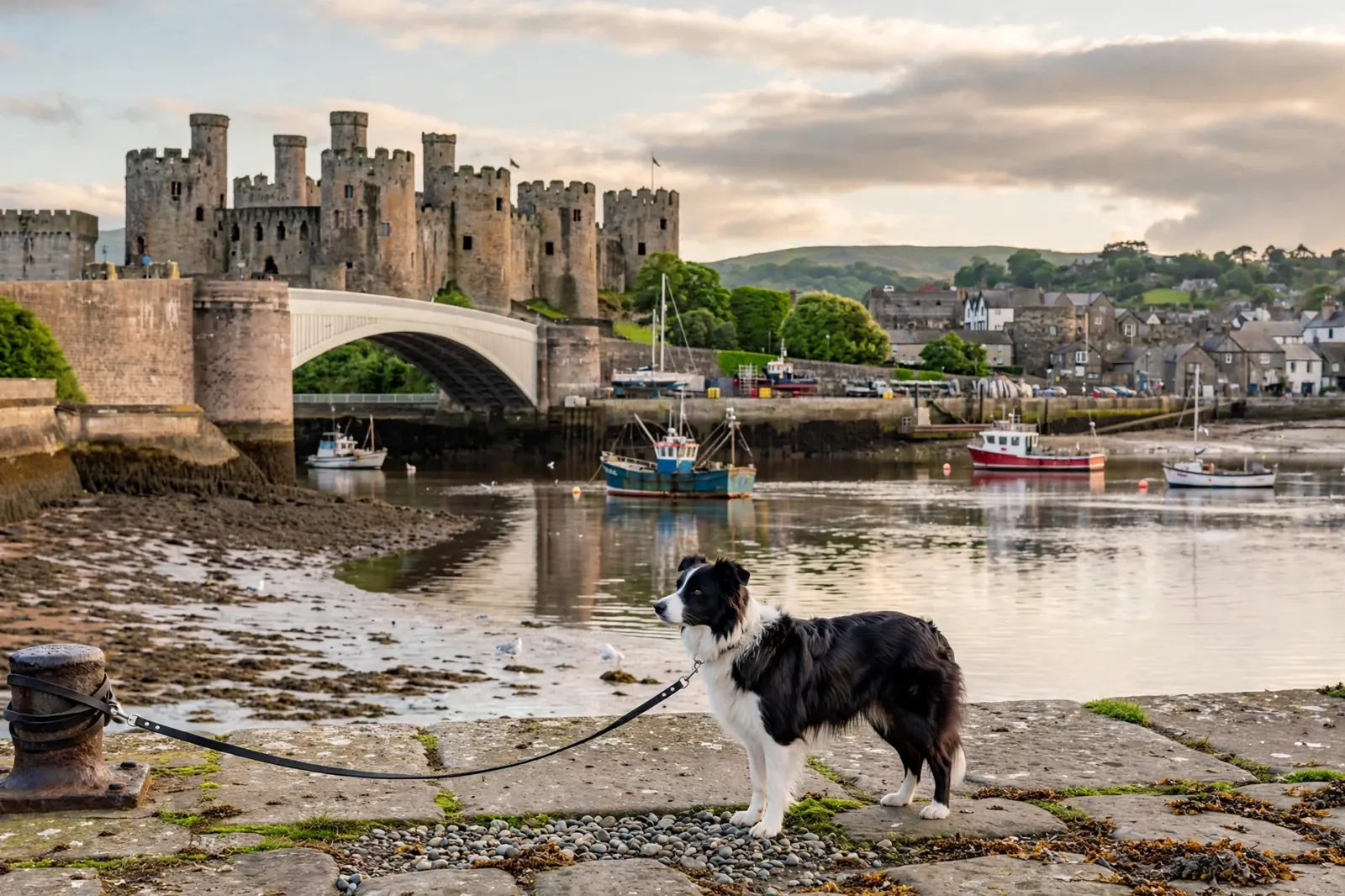
The workaround, happily, is built into the town itself. The castle exterior is magnificent from multiple dog-friendly vantage points: from the quay looking up, from the town walls looking across, from the suspension bridge area and the opposite bank of the estuary, and from the streets that thread between the towers and the harbour. A slow exterior circuit with a dog, reading the interpretation you can access from public ground and following the fortress from every angle, teaches you more about how castle and town were designed as one defensive machine than a hurried interior visit alone. Pair it with the walls walk described next and you have the architectural story twice, from inside the defences and out.
Practical etiquette around the entrance matters too. The area near the castle and its visitor facilities concentrates queues, school groups and excited children in a small space. Keep your dog close, give the queue room rather than walking its length at heel height to a dozen strangers' sandwiches, and settle with the dog at a distance if you are the person waiting during a turn-taking swap. A bench, a water bowl and a view of the towers make the wait a pleasure rather than a punishment — bring a book and it may become the calmest hour of the day.
The town walls with a dog: circuit, steps and bail-out points
Conwy's town walls survive as one of the most complete medieval circuits in Britain: roughly three quarters of a mile of wall, punctuated by more than twenty towers and three original gateways, built at the same time as the castle to enclose the new borough. Substantial sections of the wall walk are open to the public and free to access, and walking them with a dog is the single best activity in Conwy — a raised, traffic-free route with views in two directions at once, across rooftops and chimneys to the hills on one side, and out over the estuary, harbour and castle on the other. For a dog, it adds the fascination of height, wind-borne smells and pigeons at eye level, which is why the lead discipline here is non-negotiable.
Use a short, ordinary lead, held properly, for the entire wall walk. The walkway is narrow — in places barely wide enough for two people to pass — with a parapet on one side and, on some stretches, a drop or lower rail on the other that a lunging dog could test in a way nobody wants tested. Keep the dog on the inner side, step into tower spaces or widenings to let others pass, and never use an extending lead up here. Dogs that pull hard towards birds, dogs that are frightened of heights, grated surfaces or open steps, and dogs that react to close encounters with strangers may all be happier on the street-level circuit instead, which follows the same walls from below and loses surprisingly little.
Plan the circuit in sections rather than as an all-or-nothing lap. Access stairs rise at several points around the town, which means you can climb for one stretch, come down at the next tower or gateway, rest the dog at ground level and rejoin the walls later. The section connecting the castle end of town with the upper gate area gives the classic high views, while quieter stretches towards the quay suit a first attempt. Steps can be steep, worn and slippery after rain, and some dogs — particularly older dogs, short-legged breeds and giant breeds on tight turns — will find particular staircases harder than the flat walkway between them. Go at the dog's pace on steps, allow a full pause at each landing, and treat turning back down the same stairs as a perfectly respectable outcome.
Timing transforms the experience. Early morning and later afternoon, outside peak holiday periods, the walls can feel almost private, with room to pause at every tower. On a fine Saturday lunchtime they become a slow procession in both directions, and a dog that needs space will spend the walk managing encounters instead of enjoying the view. Weather matters as much: the walls are fully exposed to wind off the estuary and to summer sun reflecting off stone, with no shade and no water. Carry water for the dog even on this short circuit, skip the walls in high winds that make dogs skittish at height, and in hot weather keep the high walk for the cool ends of the day and give the dog the shaded green spaces at midday instead.
Quay, harbour and the Smallest House: an easy lead walk
After the heights of the walls, the quay is Conwy at its most relaxed: a wide, flat harbour front where fishing boats unload, pleasure boats come and go, families fish for crabs over the edge and the castle stands photogenically behind everything. For a dog this is an ideal lead walk — level ground, constant interest, plenty of room to give other people space, and benches at sensible intervals for owners who understand that watching a harbour is an activity in itself. Walk the full front slowly, from the castle end towards the marina direction and back, and you will pass the working life of the estuary in miniature: mussel boats, moored yachts, lobster pots, nets, ropes and the ever-hopeful gulls.
Halfway along stands the Smallest House, the famous red-fronted house squeezed into a terrace on the quay, just sixteen feet high and famously too small for its last tenant to lie down in. With a dog, treat it exactly as the honest table promised: a photo stop, not an interior visit. The house is tiny, access when it is open is a brief human peek inside, and no dog could sensibly share the doorway. Photograph your dog beside it from the quay — the scale joke only works from outside anyway — read whatever information is displayed, and check current opening arrangements on the day if a human in your party wants the inside view while another holds the lead a few steps away.
Harbour hazards are modest but real, and they are the familiar ones in concentrated form. Keep the dog back from unfenced edges, especially where the quay drops to water or mud and ladders suggest a route down that a dog should never test. Supervise closely around crabbing lines, hooks, bait and buckets, and around any fish being unloaded or gutted, which will hold a dog's complete attention. Dropped food gathers here — chips, ice cream, bait scraps — so a reliable leave-it and a short lead near the busiest benches protect both the dog's stomach and other people's lunches. If your dog swims, the harbour is not the place: boats move, water quality varies and slipways are working ground. Save swimming and paddling decisions for the beach, with tide information in hand.
The quay also anchors the town's eating options, and this is where the case-by-case rule earns its keep. Pubs, cafés, fish and chip shops and ice cream sellers cluster between the quay and the high street, with dog policies that range from dogs throughout, to dogs in the bar or garden only, to assistance dogs only inside with takeaway as the dog option. Ask at each door, look for the water bowl outside as the traditional signal, and build a plan B around benches and takeaway, which in Conwy is barely a compromise: chips on the quay wall with a settled dog and a castle view is a better lunch than many dining rooms offer. In the evening the harbour quiets, the light on the estuary turns gold and a last lead walk along the front becomes the natural close to a Conwy day.
Conwy Morfa and the beach: space, tides and restrictions
Every walled-town day needs a release valve, and Conwy's is the Morfa: the broad, flat expanse of beach, dunes and open ground on the western side of the estuary mouth, a short drive or a longer walk from the town walls. Conwy Morfa beach is a large sandy shore, backed by dunes and the golf course, facing across to Anglesey and the Great Orme, and it is the beach local dog walkers use most. At low tide the sand seems to go on for ever, giving dogs the off-lead-style freedom — where allowed and under proper control — that stone streets cannot, and giving owners long sightlines in every direction. It balances the town day perfectly: walls in the morning, beach in the afternoon, quay at dusk.
Tides rule everything here, so make tide times the first check of any Morfa plan. The estuary and its channels fill quickly, banks and channels can cut off walkers who wander far out on a falling tide and stop paying attention, and the safe, simple version of this beach is a generous walk parallel to the shore near the dune edge rather than an expedition to the distant waterline. Check tide times from a reliable source before you travel, keep an eye on channels filling behind you, and be especially careful where streams and channels cross the sand. Dogs off the lead near the water should have a recall that works around the ultimate distractions of shorebirds, other dogs and an interesting crab.
Restrictions need the usual honest handling. Beaches in Conwy county, like most Welsh resorts, operate seasonal dog restrictions on some designated bathing beaches during the main season, and the Morfa's status, boundaries and any local orders should be confirmed from the signs at the car park and beach entrance on the day you visit rather than from any guide, including this one. Read the board, obey it exactly, and if part of the shore is restricted, use the parts that are not without argument — there is plenty of Morfa to go round. Keep dogs under close control near the golf course, near horses if riders are using the shore, and around the dune vegetation and any fenced conservation areas, putting the lead on whenever control is in doubt.
Practicalities are refreshingly simple. The Morfa has a large car park close to the beach, making it the easiest parking of the Conwy day and a good base for older dogs that should not walk far before reaching sand. Facilities are limited compared with the town, so arrive with water, bags and everything the dog needs, and take all waste away to the bins provided — a beach this well used by dog walkers keeps its welcome only if its users keep it clean. Combine the Morfa with the wider coast when you have more days: our Anglesey with a dog guide covers the island visible across the water, and the two pair naturally in one North Wales trip of beaches, headlands and harbour towns. Further along the North Wales coast, one famous stop breaks the pattern completely: see our guide to Portmeirion with a dog, where pet dogs cannot enter the village at all.
Bodlondeb, the Vardre and green walks beyond the walls
Inside the walls, Conwy is stone: handsome, historic and almost entirely hard under paw. Dogs need the green counterweight, and Conwy provides it within minutes at Bodlondeb, the wooded grounds and open spaces around the civic buildings on the town's western edge, just outside the walls. Paths thread through mature trees and lawns here, giving shade on hot days, soft ground for older joints, and the kind of unhurried sniffing walk that resets a dog after the stimulation of crowds, gulls and harbour smells. It is also, not coincidentally, near some of the town's most useful parking, so a Bodlondeb circuit makes a natural first walk on arrival and last walk before departure — the two moments when a dog most needs grass, water and a toilet break.
For a longer leg-stretch, the rising ground behind the town offers more. Conwy Mountain — Mynydd y Dref — and the area around the Vardre, the hill with its Iron Age hillfort associations above Deganwy on the eastern side, provide open walking with wide views back to the castle, the estuary and the coast. These are proper small-hill walks rather than promenades: rougher paths, exposure to weather, grazing animals in places and distances that need a map and sensible footwear. Dogs should be on a lead around livestock and under close control elsewhere, and the same hill judgement applies as anywhere in Wales — if the weather closes in or daylight is short, the mountain will wait for another visit. Our Snowdonia with a dog guide covers the bigger hills inland if your trip builds from these foothill walks towards the national park.
Between these two scales sits the everyday walking that makes a stay work. The estuary-side paths, the marina area and the routes linking Conwy with neighbouring Deganwy and Llandudno Junction give flat, waymarked options for morning and evening walks from accommodation, while the lanes climbing behind the town reward exploratory owners with quiet lanes and sudden castle views. Ask wherever you stay for their recommended local loop and the nearest safe after-dark walk; in a compact town the answer is usually a five-minute circuit the dog will learn by day two and request, pointedly, at the usual hour.
Green-space etiquette in Conwy follows the national pattern with a local accent. Bag and bin all waste, including in woodland where some walkers wrongly assume it does not matter — Bodlondeb is used by children, sports teams and picnickers as well as dogs. Keep dogs out of any marked sports pitches in use, off play areas where signs require it, and on a lead in car parks and around the civic buildings. Spring and summer bring ground-nesting birds to the rougher ground on the hills, so close control in the nesting season protects wildlife and keeps access goodwill intact for the next dog that visits.
Parking, arriving and planning a full dog day
Conwy is compact, popular and enclosed by medieval walls, which is a poetic way of saying that parking is the day's main logistical problem and should be solved with a plan rather than optimism. The town's car parks are signed from the main approaches, and useful options for dog visitors include the long-stay parking near Bodlondeb on the western side — handy for the green walks and a short stroll from the walls — town-centre car parks for short stays, and the large car park at Conwy Morfa when the beach is the main event. Charges, time limits, height restrictions and payment methods vary between car parks and change over time, so check the latest Conwy County Borough Council parking information before you travel and read the board in the car park itself on arrival; the board, not any guide, is the authority for the day. On fine weekends and in school holidays, arrive in the morning or accept the Morfa-first version of the day and come into town later.
Arriving by train is genuinely attractive in Conwy. The station sits inside the town on the North Wales coast line, a short walk from the walls and quay, and removes the parking problem entirely for day visitors whose dogs travel well by rail. Keep the dog on a lead on platforms and in the station, settle it away from carriage doors, and time the beach and walls around your return train rather than discovering the last convenient service from a bench at dusk. Arriving by car from the A55, follow signs for the town and its car parks rather than improvising in the narrow streets inside the walls, where access, loading and residents' needs make casual parking both difficult and inconsiderate.
A full dog day in Conwy assembles itself naturally from the sections above. Arrive and park near Bodlondeb, give the dog a green circuit and water, then walk the town walls before the crowds, choosing sections to suit the dog's confidence on steps. Descend for a quay walk, the Smallest House photograph and a takeaway or dog-welcoming lunch, with the castle interior fitted in by turn-taking if your party wants it. Spend the afternoon at Conwy Morfa on a falling or low tide, checking signs and tide times first, and return to the quay for the evening light and a final harbour stroll. Build in a proper rest — in the car with ventilation and supervision arranged safely, at accommodation, or on a bench with a mat — because a full town day asks more of a dog's brain than a long country walk asks of its legs.
Staying overnight turns Conwy into a base for the whole coast, and the dog questions are the standard ones asked with local care: confirm the dog charge, whether the dog can join you where you eat, whether there is any enclosed outdoor space, and what the morning walk is. Self-catering inside the walls puts the quay on your doorstep for first and last walks, while places in Deganwy, Llandudno or the countryside around the town trade the medieval address for easier parking and gardens. Wherever you sleep, end the trip as you began it — with the honest table. The castle said no, and everything else in Conwy said yes loudly enough that the dog, asleep before the car leaves the Morfa, will not feel it missed a thing. Before you travel, check the latest official guidance for Cadw, tide times, beach signs and parking, because those four checks are the difference between the plan above and the day you actually get.
Practical questions
Before you go
Can I take my dog inside Conwy Castle?
Pet dogs are not generally admitted inside Conwy Castle under Cadw rules, while trained assistance dogs are welcome. Plan to admire the castle from outside with your dog, or take turns visiting if you travel as a pair. Check the latest Cadw guidance before you travel, as event and conservation rules can change.
Can dogs walk on Conwy town walls?
Yes, in practice dogs on a short lead can join you on accessible sections of the town walls, but the walkway is narrow, stepped and high in places. Use a short lead, avoid busy times, come down at the regular towers and gates if your dog is nervous, and check for any temporary closures before you set out.
Are dogs allowed on Conwy Morfa beach?
Conwy Morfa is widely used by local dog walkers and offers a large sandy beach at low tide, but seasonal or local restrictions can apply to parts of beaches in the area. Read the signs at the car park and beach entrance on the day, keep dogs under control near other users, horses and wildlife, and check tide times before walking far.
Where can I park in Conwy with a dog?
Useful options include the long-stay parking near Bodlondeb, town car parks signed from the main approaches, and the large car park at Conwy Morfa for beach days. Charges, height limits and time limits vary, so check the latest council information and the board in the car park on arrival. Arrive early on fine weekends and in school holidays.
Can dogs go inside the Smallest House in Conwy?
Treat the Smallest House as an outside photo stop with a dog rather than an inside visit. The house on the quay is extremely small, access arrangements vary by season, and a dog inside would not be practical. Enjoy the view from the quay, take a photograph from outside and check current opening information if you want to look inside without your dog.