This guide is independent and contains no paid placement. Beach restrictions, railway dog policies and opening arrangements change, so every rule below tells you where to verify it rather than asking you to trust a date on a page.
Aberystwyth works well with a dog provided you treat its two beaches as a patchwork of sections, not a single yes-or-no answer. Base the day on the promenade and harbour circuit, add a permitted beach section when the signs allow it, ride up Constitution Hill or out to Devil's Bridge only after confirming the current dog policy with each railway, and keep a sheltered inland or cafe plan ready for Cardigan Bay weather.
Start with the map, not the beach
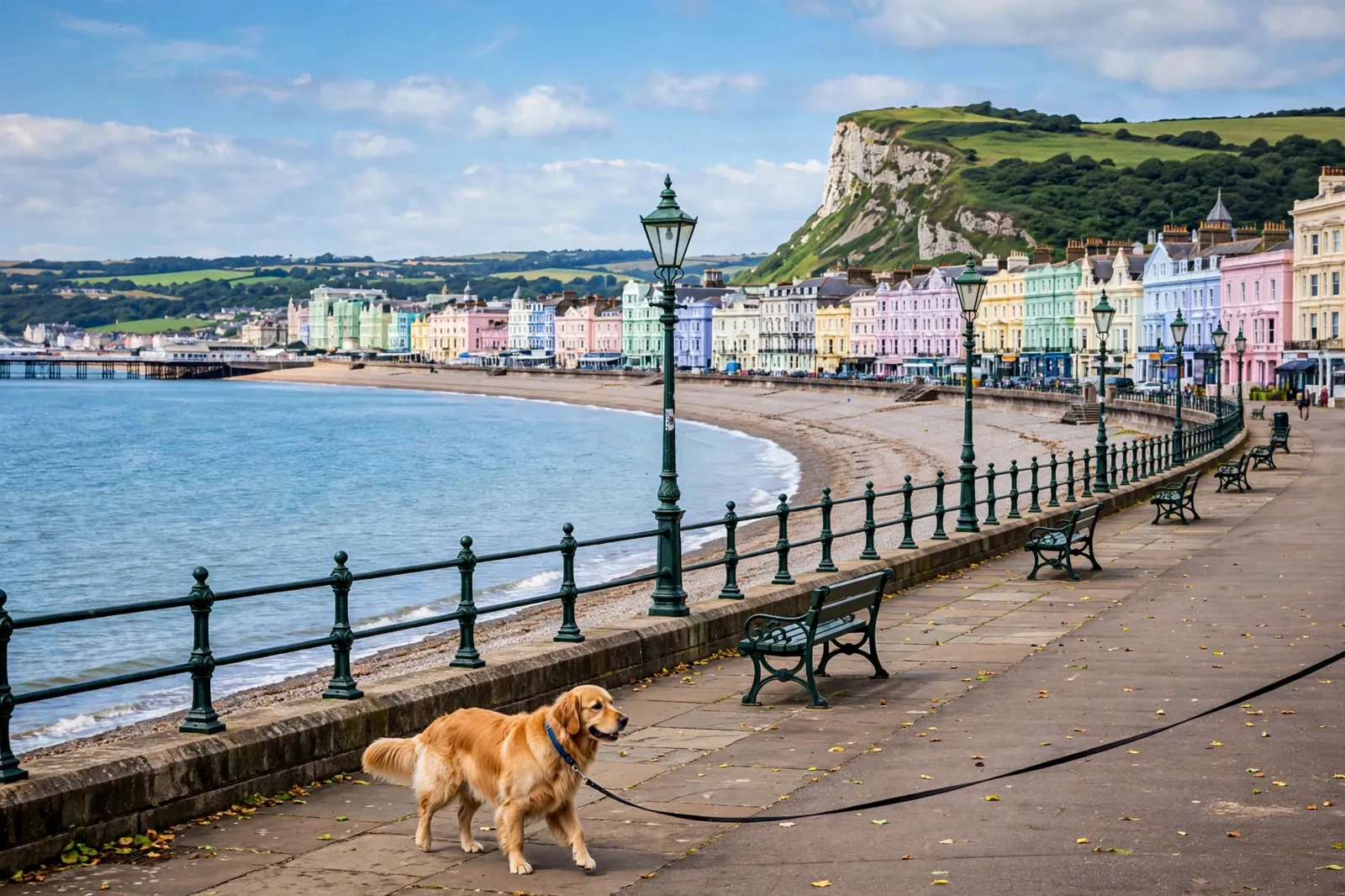
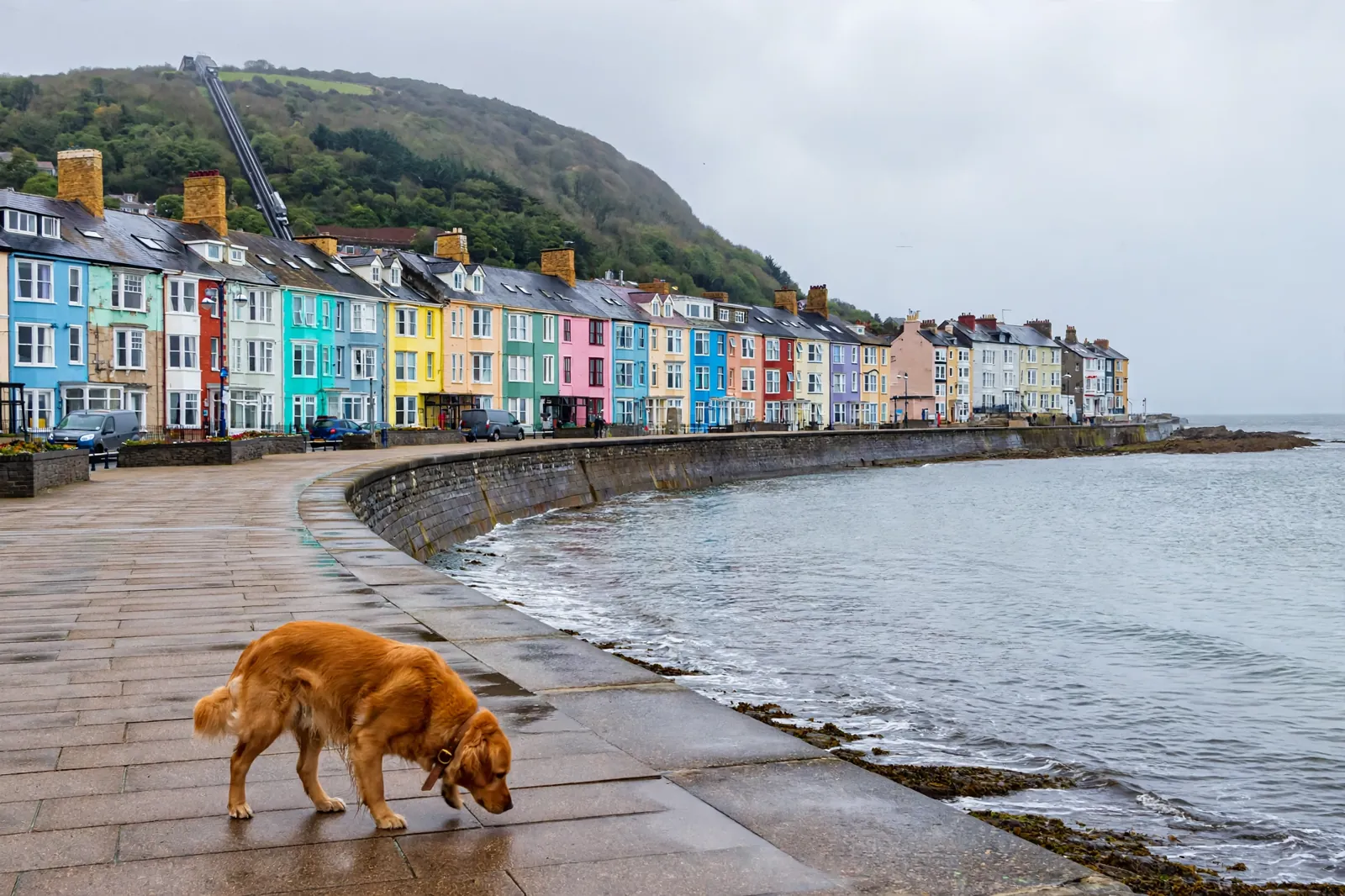
Most dog trips to Aberystwyth go wrong in the first ten minutes, and for a simple reason: people head straight for the nearest sand. The town is better understood as a curve. At the northern end, Constitution Hill closes the bay. The promenade then sweeps south past the pier, the castle ruins and the older seafront hotels, before the shore softens towards the harbour, where the rivers Rheidol and Ystwyth reach the sea. Each part of that curve behaves differently for a dog — different beach rules, different crowding, different shelter, different footing under paw.
Hold that shape in mind and the rest of the planning falls into place. A morning might start with a lead walk along the promenade while you read the beach signs for the day, continue onto whichever beach section is currently open to dogs, and finish with a harbour loop once the dog has burned off the first burst of energy somewhere more forgiving. An afternoon can then add height — Constitution Hill — or distance, on the Vale of Rheidol line inland, without either becoming a gamble.
The university and the National Library of Wales give the town a second character beyond the holiday seafront. Term-time Aberystwyth is a working town of students, staff and residents, which means cafes, buses and pavements are busy at predictable hours and quieter at others. For a nervous dog, the promenade at breakfast time on a weekday is a different proposition from the same stretch on a sunny Saturday when day-trippers, prams, mobility scooters and other dogs all compete for the same width of tarmac. Timing is a genuine tool here, not a footnote.
Finally, plan for the wind. Cardigan Bay faces west, and an onshore breeze that feels pleasant on a sheltered street can make the exposed promenade hard work for a small, elderly or short-coated dog. Build each day with an exposed option and a sheltered option, and switch without regret. That single habit does more for an Aberystwyth dog break than any individual attraction on this page.
North Beach and South Beach, section by section
Aberystwyth has two named beaches, and the distinction matters. North Beach runs from the harbour side of the main seafront up towards Constitution Hill: this is the classic postcard stretch, backed by the promenade, the pier and the bandstand area, and it is the busiest sand in town. South Beach lies beyond the castle and harbour side, towards the mouth of the Ystwyth, and generally feels a touch calmer and more local, with the castle ruins and the harbour as its landmarks.
Dog access on both beaches is governed by seasonal restrictions that apply to defined sections rather than necessarily to every metre of sand, and the boundaries, dates and lead requirements are set locally and can change between seasons. That is why generic statements such as dogs are banned in summer or dogs are fine here are unhelpful: the honest answer is that one signed section may be closed to dogs while another, a few hundred metres away, remains open, sometimes with a lead condition attached. Check the latest official guidance before you travel, then treat the sign at the access point you actually use as the final word on the day.
Work the sections methodically. Walk the promenade first, read every sign at the steps and ramps, and note which stretch each sign refers to — signs usually describe the section between two named points, not the whole beach. If your chosen section is restricted, do not drift along the waterline into the next section assuming the rule travels with you; equally, do not assume a restriction at one access point closes the entire bay. Dog owners who get fined or challenged on Welsh beaches are usually caught by exactly that drift, not by deliberate rule-breaking. Our wider explainer on UK beach dog rules, bans and fines sets out how these section-by-section systems work across the country.
Footing and tide deserve the same care. Much of Aberystwyth's shore is shingle and coarse sand that shelves into the bay, and at high tide the usable beach narrows sharply against the promenade wall in places. A dog that swims needs a planned exit, not just an entry: check where you can both get back up if the tide has covered the section you walked in on. After storms, expect debris, washed-up jellyfish in season and sharp shell and stone — all standard reasons to keep a lead on until you have walked a new section once and seen what the last tide left behind.
The promenade and harbour circuit: your daily circuit
If the beaches are the variable, the promenade is the constant. The surfaced promenade runs the length of the bay and gives you a reliable, lead-on walk in almost any weather and at almost any hour — early enough and it doubles as a calm toilet walk before breakfast; at sunset it becomes the town's shared front room. For many visiting dogs this circuit, done two or three times a day with variations, is the backbone of the whole stay.
Walk it with a system. Keep dogs on a short lead in the busiest central stretch, where cafe seating, other dogs and people stepping out of seafront doors all appear without warning. Use the wider northern and southern ends for a looser, more relaxed pace. Watch for the classic promenade hazards that catch owners out: discarded food around benches and bins, fish and chips carried at exactly dog-nose height, anglers' bait near the pier area, and glass after busy evenings. A dog that scavenges needs the pavement side, not the sea-wall side, and your full attention at bin clusters.
At the southern end, extend the circuit around the harbour. The harbour loop adds boats, gulls, fishing gear and the river mouth — rich smells and plenty to watch, plus working surfaces where leads should stay short and dogs should keep clear of tackle, nets and mooring lines. Gulls here are bold and practised at stealing food; do not let a dog chase them towards the water's edge, and never allow swimming in the harbour itself, where currents, ladders and boat movements make exit difficult. The riverside paths near the harbour also give you a slightly more sheltered option when the open promenade is taking the full wind.
The castle ruins between the two beaches make a natural pause point on the circuit: open grass, sea views and a place to sit while a dog settles and watches the bay. Keep dogs under close control around picnics and children, and off the historic fabric itself. Used this way — promenade, castle pause, harbour loop, and a permitted beach section when the signs allow — one flexible circuit can be stretched or shortened from twenty minutes to two hours without ever needing the car.
Constitution Hill and the cliff railway
Constitution Hill frames the north end of the bay and gives Aberystwyth its best viewpoint: on a clear day the curve of Cardigan Bay, the town rooftops and, in the right conditions, distant headlands in both directions. For a dog, the hill offers something the promenade cannot — grass, gradient and a genuine sense of having climbed somewhere — along with the two hazards that always come with height: cliff edges and grazing or wildlife in rougher ground beyond the paths.
There are two ways up. The walked route follows paths from the northern end of the promenade and suits a fit dog and an owner happy with a steady climb; keep to the paths, keep dogs on a lead anywhere near edges, drops or other walkers on narrow sections, and carry water, because there is little shade and the top is exposed in wind. The second way up is the town's famous cliff railway, the Victorian funicular that links the seafront with the summit and its cafe and attractions.
The cliff railway's dog policy is exactly the kind of detail to verify rather than assume. Funiculars are small: carriages are compact, queues at busy times are close-quarters, and operators may welcome dogs freely, charge a small fare, restrict carriage at peak times, or ask that dogs travel only in a particular car. Check the latest official guidance before you travel — specifically whether dogs are currently carried, any charge, and any rule about leads, floors versus seats and busy-day limits — and be ready to walk up instead if the queue, the heat or your dog's reaction to a crowded carriage says the railway is the wrong choice that day. A dog that dislikes being boxed in at ankle height among strangers will not enjoy the ride however dog-friendly the policy is.
At the summit, manage the dog first and the view second. Settle away from the cafe entrance and any family attractions, keep the lead short around children and picnics, and walk the grass areas with the same cliff discipline as the way up. Many owners find the best pattern is railway up with a verified policy, a relaxed hour on top, and a walked descent once the dog is calm — but reverse it happily if your dog prefers to earn the view on foot and rest on the way down.
The Vale of Rheidol railway with a dog
Aberystwyth's second railway could hardly be more different from the first. The Vale of Rheidol is a narrow-gauge steam line that leaves the town and follows the wooded Rheidol valley inland to Devil's Bridge, where the river drops through a deep, tree-covered gorge beneath a stack of bridges, with waymarked walks to viewpoints and waterfalls. As a dog day out it offers woodland shade, river air and a destination walk — a genuine contrast to salt wind and shingle.
Dogs have long been part of this line's visitor offer, but the working details are the operator's to set and reset: whether a dog ticket is charged and at what price, whether dogs ride in all carriages or only designated ones, whether they must stay on the floor, and how many dogs can travel on a busy service. Heritage carriages have limited floor space and heritage timetables have limited services, so a missed or full return train is a long wait with a tired dog. Confirm the current dog policy and the full timetable directly with the operator before you travel, book ahead where the operator offers it in peak season, and always know the time of the last return service before you set off for the gorge walks.
At Devil's Bridge itself, apply gorge discipline. The paths to the waterfalls and viewpoints involve steps, damp stone, railings and drops; they suit a steady, lead-confident dog and are a poor match for a dog that lunges, hates steps, or is unsteady on wet ground. Keep the lead short and fixed rather than extending, stay behind railings, and skip the steepest sections entirely in or after heavy rain. There is no failure in riding to Devil's Bridge, enjoying the gentler paths and the village, and leaving the gorge circuit for a drier day or a dog-free hour — the railway journey through the valley is half the point of the trip.
Build the day backwards from the return train. Arrive at the Aberystwyth station in good time so the dog can toilet and settle before boarding, carry water and a small mat or towel so the dog has a defined place to lie in the carriage, and plan a promenade leg-stretch on your return rather than heading straight back to your accommodation with a dog that has been still, however happily, for much of the day.
The library quarter, the university and a rainy-day rhythm
Head uphill from the seafront and Aberystwyth changes register. The National Library of Wales, one of the great copyright libraries of Britain, sits above the town near the university's Penglais campus, and the streets between the seafront and the hill are where much of the town's everyday life happens. For a dog owner this quarter matters less as sightseeing — dogs do not go inside the library's reading rooms, and you should assume indoor cultural venues are people-only unless a venue explicitly states otherwise — and more as walking geography: quieter residential streets, campus-edge paths and a hill climb that can stand in for the beach on a rough day.
A rainy-day rhythm in Aberystwyth therefore looks like this. Start with the full promenade and harbour circuit between showers, when the sea is dramatic and the town is quiet. Follow it with a long, slow dog-welcoming cafe stop — confirmed in advance, because welcome on a dry terrace and welcome inside on a wet Tuesday are different promises, and seaside towns are full of the first kind. Add a street-walk through the older town and up towards the library hill for views and a change of smells, then finish with an early evening circuit once the worst of the weather has passed. A dog does not need an attraction every hour; it needs movement, sniffing, food, rest and a dry place to sleep, and a wet Aberystwyth day can supply all five.
Respect the working town while you use it. Keep dogs out of university and library buildings, gardens and signed areas unless dogs are explicitly permitted, use leads in campus and residential streets, and clear up meticulously — nothing turns a tolerant town against visiting dogs faster than fouled pavements outside people's homes. If you are combining the trip with research, study or an event at the university, plan the dog's day separately rather than assuming you can improvise care on the day; local dog walkers and sitters exist in most university towns, but they book up in term time and verifying insurance and references matters more than saving an hour.
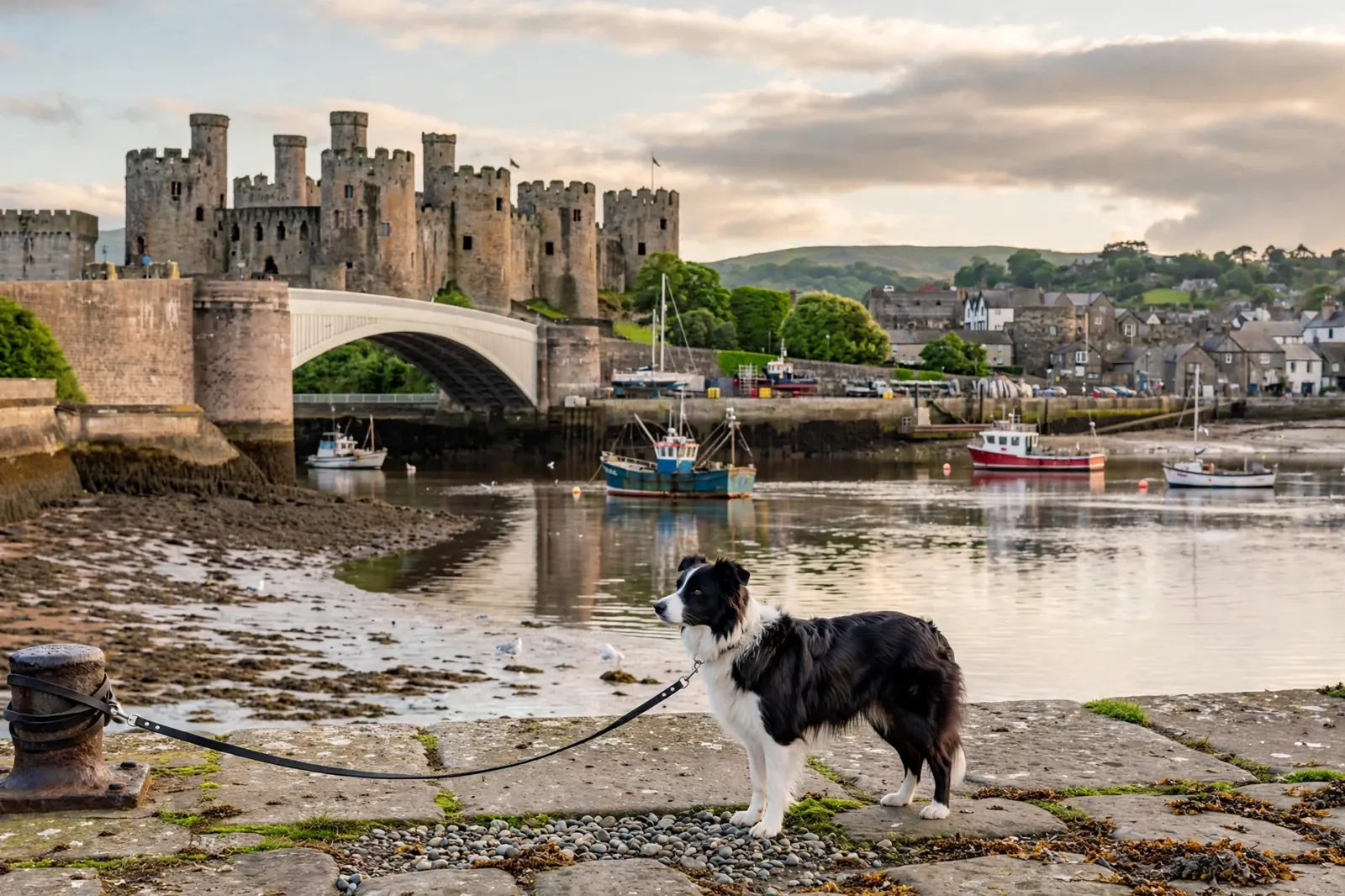
For a second Welsh town base to compare, our guide to Llandudno with a dog covers a grander, more formal promenade town on the north coast, while Conwy with a dog adds castle walls and a smaller harbour — useful contrasts when deciding whether Mid Wales or the north coast suits your dog better.
Where to stay and eat with a dog
Aberystwyth's accommodation splits into recognisable bands: seafront hotels along the promenade, guesthouses and bed-and-breakfasts on the streets behind, self-catering flats and houses across town, and caravan and holiday parks on the outskirts and along the coast nearby. Each band fails dog owners in a different predictable way, so choose by your dog's needs rather than by the photograph. A seafront hotel room is wonderful for a calm dog that settles anywhere and needs only a step outside to the promenade; it is a poor choice for a dog that barks at corridor noise at 2am, because everyone in the building will know.
Ask the unglamorous questions before booking anywhere. Which specific rooms or units take dogs, and is there a per-dog or per-stay charge? Is there a garden, yard or genuinely enclosed space, or is every toilet trip a lead walk to the street? Where is the nearest practical after-dark walk, and is the route lit? Are dogs allowed in the bar or breakfast room, or will you eat in shifts? What is the flooring — pale carpet in a dog room near a shingle beach is a deposit argument waiting to happen — and is there an outdoor tap, hose or drying space for a dog that has been in the sea? Specific answers are a good sign; vague warmth about loving dogs is not a policy.
Self-catering usually gives the most control: your own door, your own routine, room for a crate and a drying line, and no corridor encounters. If you choose it, confirm parking, because unloading a nervous dog from a distant car park through busy streets undermines the calmest arrival, and check whether the property's garden is enclosed to a height and standard your dog actually respects. For parks and sites outside town, add the walk from the gate: some have direct access to lanes or coast path, others require a stretch of main road before the first safe verge.
Eating out follows the same verify-first pattern. Aberystwyth has the pubs, cafes and takeaways you would expect of a university seaside town, and many welcome dogs in some form — but the form varies from dogs throughout, to bar only, to terrace only, to assistance dogs only indoors. Phone or message ahead for the specific meal you have in mind, go at quieter times with a dog that is still learning restaurant manners, and bring a settle mat and a chew so the dog's job is defined. Fish and chips on the promenade, eaten with a dog that has already walked and toileted, remains one of the town's simplest pleasures — provided the gulls are managed with distance and the chips are guarded without exception.
Cambrian coast day trips from Aberystwyth
Aberystwyth earns its keep as a base because the coast works in both directions from it, by train as well as by car. Northwards, the coast path and the Cambrian Line both lead towards Borth, a long, low village behind a shingle bank and sandy shore, and onwards to Ynyslas, where dunes and the Dyfi estuary create a wilder landscape of boardwalks, open sand at low tide and serious tidal movement. Estuary and dune country is superb dog walking with discipline: check tide times before you set out, keep dogs under control around birds and livestock, respect any signed restrictions in the nature reserve areas, and never let a dog chase the tide out across estuary flats where channels fill faster than a person can walk.
Closer in, the coast path south and north of town links smaller coves and headland stretches such as the climb towards Clarach and the cliffs beyond, giving fit dogs and owners a half-day of genuine coast walking without a long drive. Headlands mean edges, stiles, livestock and narrow paths meeting other dogs head-on; a lead you trust, a dog that can pass politely or step aside, and boots and paws checked at the end are the price of admission. In poor visibility or high wind, headland sections stop being invigorating and start being unwise — the promenade will still be there tomorrow.
By train, the Cambrian Line opens the coast towards Machynlleth and the Dovey Valley in one direction and, for a longer expedition, the run up the coast towards Pwllheli in the other — one of Britain's most scenic rail journeys, much of it at the water's edge. Dogs travel on National Rail services under the standard conditions, but check the latest official guidance before you travel for the current rules on numbers, leads and any operator specifics, carry water for long journeys, and break the trip at an intermediate stop if your dog is new to trains. A dog that has only ever ridden for twenty minutes should not make its debut on a two-hour coastal run with no easy exit.
Inland day trips balance the salt. Devil's Bridge on the Vale of Rheidol line is the headline, but the Rheidol valley itself, with its riverside paths and woodland below the reservoirs, offers quieter walking in a green, sheltered register that suits dogs overwhelmed by busy seafronts. As with every destination in this section, the rule that applied in Aberystwyth does not transfer automatically: beach restrictions, lead rules and access arrangements are set place by place, so read the signs at each new car park and access point as if you had never visited Wales before.
Tides, vets and the practical pack
Three habits separate a smooth Aberystwyth dog break from a scrappy one. The first is tide awareness: the bay's usable sand, the harbour edges, the estuary day trips and several coast path sections all change character between low and high water, so look at tide times each evening and shape the next day around them rather than discovering them at the steps. The second is weather honesty: a west-facing bay in a westerly gale is not a place to prove a point, for you or for a dog being sandblasted at ankle height. The third is knowing, before you need it, where the nearest veterinary practice is, what its out-of-hours arrangement looks like, and how long the drive takes from your accommodation — information that takes two minutes to gather on arrival and cannot be gathered calmly in an emergency.
Pack for shingle, salt and rain. A harness the dog cannot back out of on a windy promenade, a standard lead plus a long line for permitted open spaces, and a spare lead in the car. Towels and a drying coat, because sea-wet dogs and guesthouse bedding are natural enemies. Fresh water and a bowl on every walk of any length — dogs that drink seawater commonly end up with upset stomachs, and a dog that has swallowed a lot of salt water, is vomiting repeatedly or seems unwell needs veterinary advice, not a wait-and-see. Poo bags in every pocket and bag, used without exception on promenade, beach, harbour and hill: Aberystwyth is a town people live in, and visiting dogs are guests in it.
Add the small things that solve the problems this specific town creates. A mat that marks the dog's place in cafes and carriages. A torch for the after-dark harbour and residential walks outside the lit promenade stretch. Paw checks after shingle and after any gorge or rocky shore walk, and a rinse for paws and belly after sea sessions to shift salt and sand before they irritate skin. A note of your accommodation's exact address and your own vet's phone number, so any local vet can reach your dog's records quickly if needed.
Leave the town as you found it and the pattern holds: signs read, sections respected, mess cleared, leads used where the place asks for them. Aberystwyth rewards that kind of visiting. What it offers a well-managed dog is rare — two beaches, a hill, a harbour, two railways and a whole coast of day trips, all wrapped around one walkable curve of bay.
Practical questions
Before you go
Are dogs allowed on Aberystwyth beaches all year?
Not on every stretch and not in every month. Seasonal restrictions commonly apply to parts of North Beach and South Beach during the main bathing season, while other sections may remain open to dogs on a lead or off lead at certain times. Signs at each beach access point state the current rule for that exact section, so check the latest official guidance before you travel and re-check the sign on the day.
Can dogs ride the Aberystwyth cliff railway and the Vale of Rheidol railway?
Both railways have historically welcomed well-behaved dogs, sometimes for a small charge and sometimes free, but carriage space, busy-day limits and fare details change. Confirm the current dog policy, any ticket price for dogs, and whether dogs must stay on the floor or on a lead in the carriage directly with each operator before you travel.
Where is the best off-lead walk in Aberystwyth itself?
For a genuine run rather than a pavement walk, head for the open grass areas away from the busiest promenade, the paths around Constitution Hill outside peak times, or a permitted beach section outside restricted months and away from other beach users. Keep recall reliable near cliffs, livestock, harbour water and nesting or resting birds, and use a long line wherever the drop, tide or traffic makes a mistake costly.
Is Aberystwyth a good base for the Cambrian coast with a dog?
Yes. The town sits on the Cambrian Line, so Borth, Ynyslas and stations towards Machynlleth and Pwllheli are reachable without moving the car, and the coast path links neighbouring coves on foot. Check train dog rules, tide times for estuary and dune walks, and seasonal beach restrictions at each destination, because the rule in Aberystwyth does not automatically apply a few miles away.
What should I do if the weather turns bad in Aberystwyth with a dog?
Shorten the plan rather than abandoning it. Use the promenade between showers, pick a dog-welcoming cafe or pub that confirms dogs inside rather than only on a terrace, dry the dog properly back at your accommodation, and save hill, cliff and estuary walks for a clearer window. In strong onshore winds the promenade itself can be rough, so an inland sheltered walk may be the kinder option.