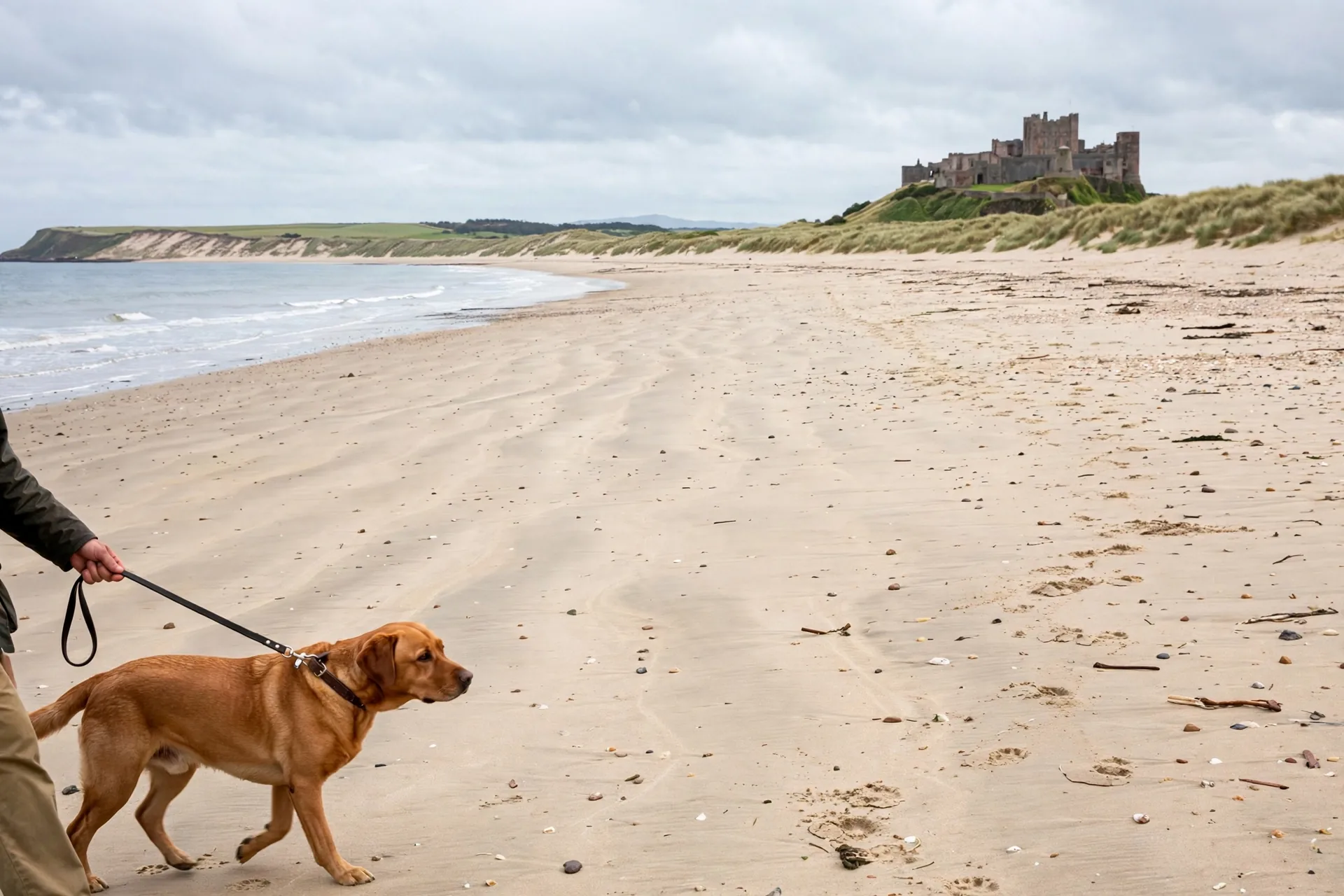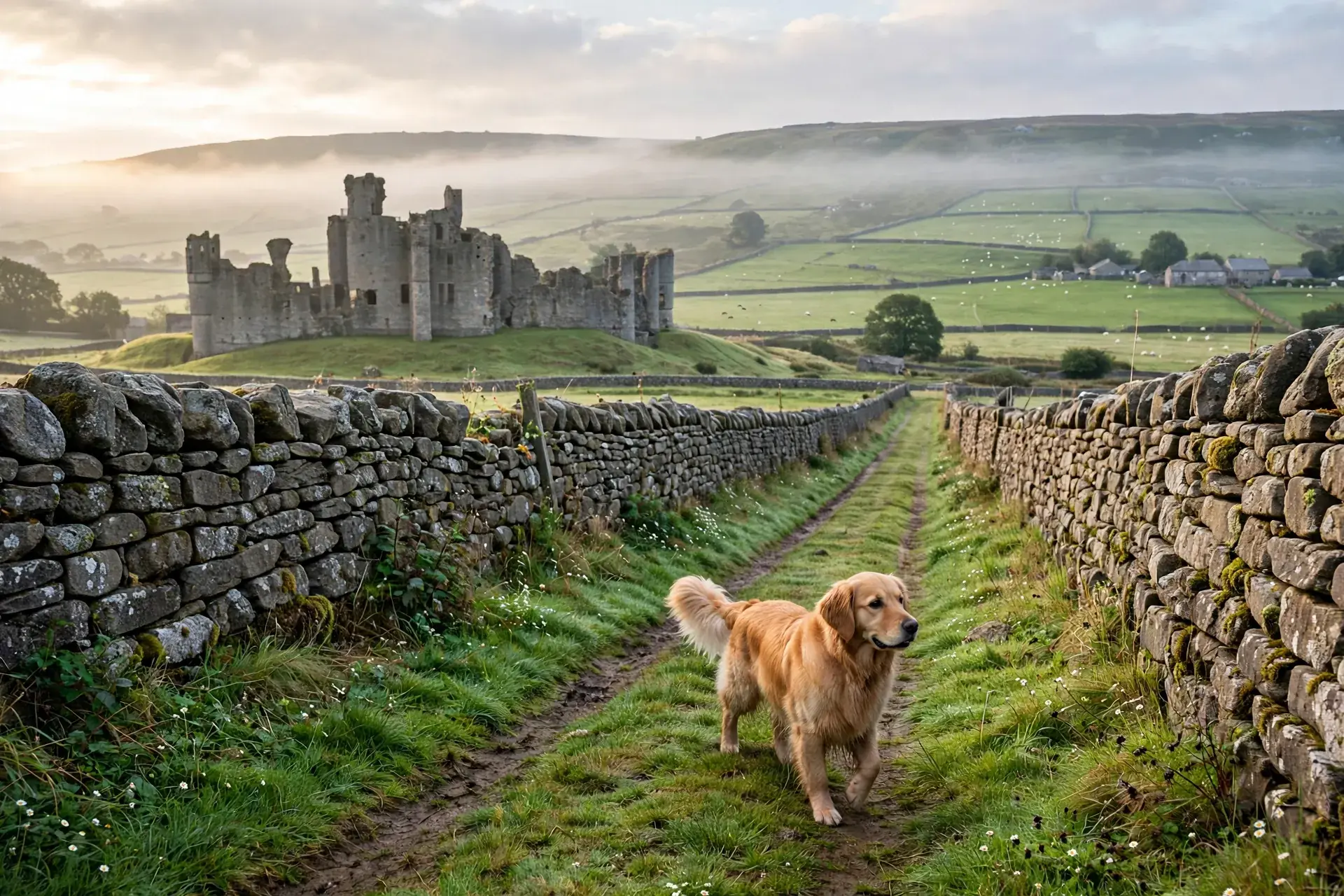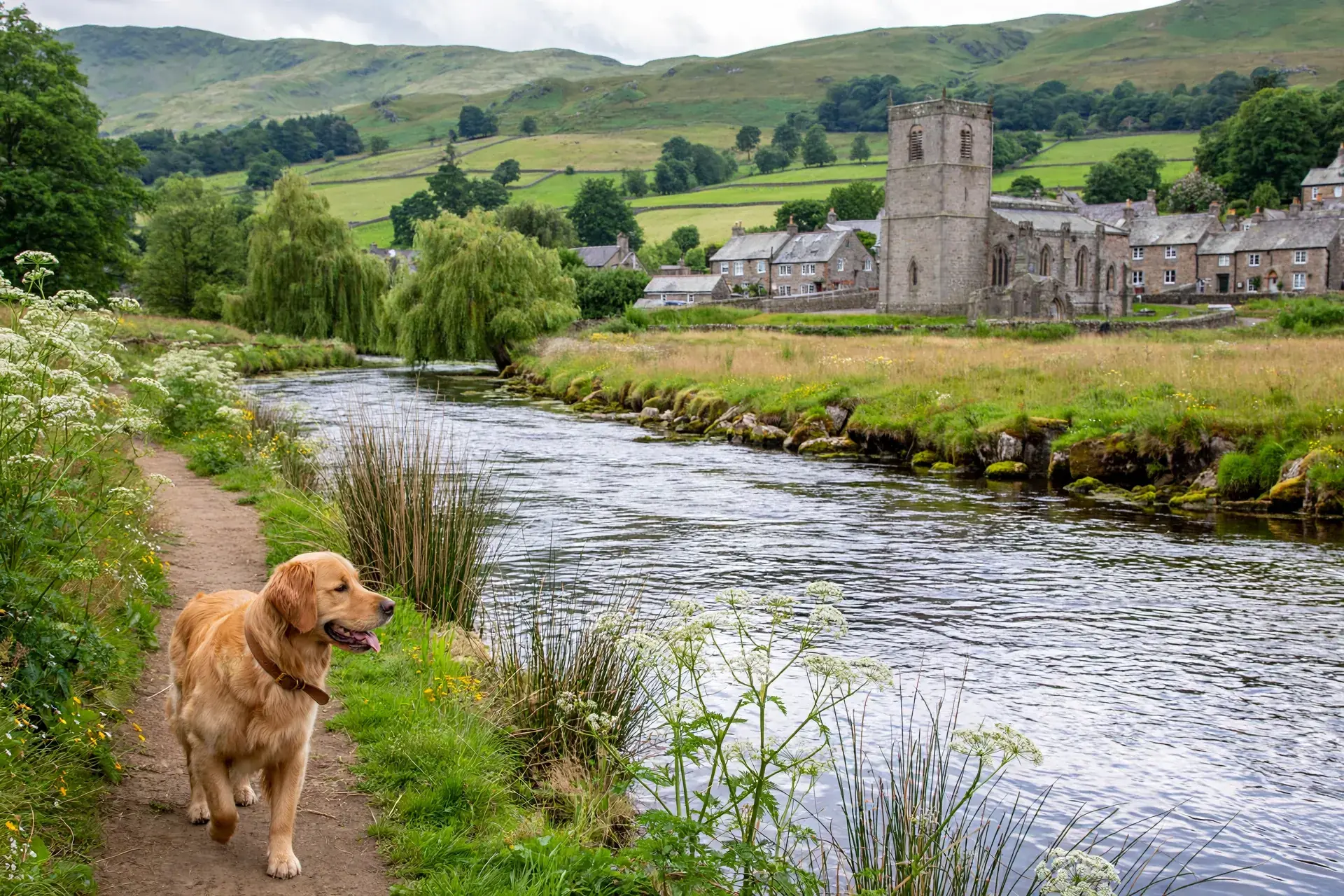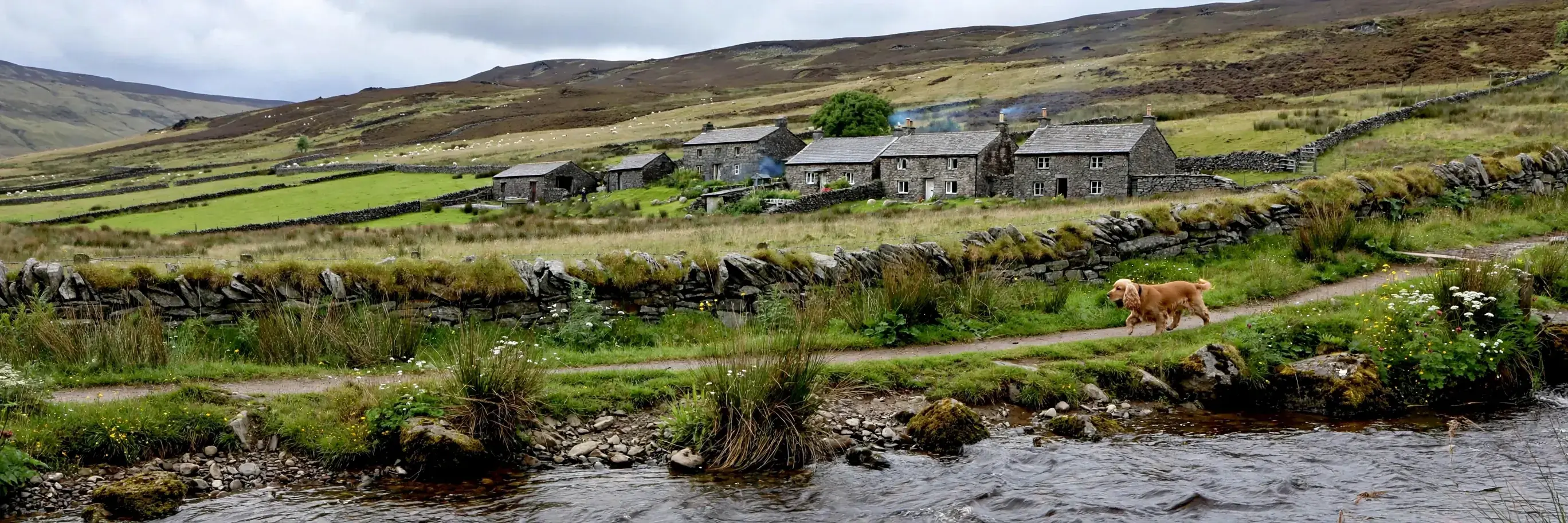
This guide is independent and contains no paid placement. If affiliate links are added later, they will be clearly marked and will not change our editorial checks.
Allendale suits dogs that like variety: a gentle riverside walk from the village, a short heritage walk past old lead-mining remains, and — on a clear, dry day — a longer moorland route with wide views. Keep the dog on a lead near sheep and cattle, carry water on the moor, and plan a valley fallback for fog, rain or tired legs.
Allendale village and the Allen Valleys
Allendale is a small stone-built village in the Allen Valleys, in the western part of Northumberland and within the North Pennines. The village sits in a valley carved by the River Allen, with farmland and wooded slopes close to the houses and open moorland rising on either side. It is a working village rather than a resort: a church, a village shop, a pub, a village hall and a scattering of stone cottages and farm buildings, with fields and drystone walls running right up to the edge of the settlement. For a dog, that matters. The change from pavement to field path is quick, the traffic is generally light, and the first walk of the day does not need a car.
The Allen Valleys take their name from the River Allen and its two main branches, the East Allen and the West Allen, which meet near the village. Walking here is shaped by that geography. Valley walks follow the river and the lower fields, where the ground is gentler and shelter is never far away. Moorland walks climb out of the valley onto higher, open ground, where the views open up and the weather can change much faster. A good Allendale break uses both: the valley for the first and last walk of the day, and the moor for the main walk when conditions allow.
Start by getting your bearings on foot. Walk through the village centre, look at the church and the main street, and find the river. Notice where the pavements end, where the field paths begin, and where the road narrows. Allendale is compact enough to learn in a single short walk, and that first walk is also a useful test: how does your dog cope with a village street, a narrow bridge, a passing tractor or a neighbour's cat? A dog that settles quickly in the village will usually settle quickly on the paths beyond it.
The wider setting is worth understanding before you plan longer routes. Allendale lies south-west of Hexham, the nearest larger town, and the road between the two climbs and falls through farmland and moorland edge. The North Pennines around the village are known for wide skies, dark nights, old mining remains and a landscape that feels remote even though the village itself is small and inhabited. That remoteness is part of the appeal, and part of the planning: shops, vets and fuel are limited in the village, so check opening times and opening days, and check the official guidance before you travel if you are relying on a particular service.
If you are combining Allendale with a wider trip, the county context helps. Our Northumberland with a Dog guide covers castles, beaches, Holy Island tide safety, Hadrian's Wall walks and quiet dark-sky stays across the county, so you can see where a quiet valley break fits alongside a busier coastal day. Allendale works well as the calm base in that kind of plan: a place to walk from the door, sleep well, and recover between bigger days out.
River Allen riverside paths
The River Allen is the easiest walk in Allendale, and often the best one. The river runs through and below the village, with paths, lanes and field edges that let you walk beside the water without climbing onto the moor. The ground is mostly level, the route is easy to shorten, and there is usually somewhere to turn back if the dog tires or the weather turns. For a first morning, an older dog, a puppy, or a dog that is still learning to settle on holiday, the riverside is the right place to start.
Walk the river slowly and watch the dog, not the distance. The best riverside walking is sniffing walking: a steady pace, plenty of pauses, and time to investigate the bank, the trees and the field edges. The river itself is shallow in places and deeper in others, and the banks can be steep, slippery or undercut after rain. Choose a shallow, slow entry point if your dog wants to paddle, and keep the dog on a long line if you are unsure about the current or the exit point. After heavy rain the river can rise quickly and run fast, so avoid the water altogether on those days and keep the dog on the path instead.
River safety deserves a clear routine. Keep the dog away from fast water, weirs and narrow channels, and do not let the dog swim where you cannot see the far bank or a safe way out. A dog that swims well in a lake can still struggle in a river current, and cold water tires dogs faster than warm water. Bring a towel and a drying coat for the walk home, because a wet dog in a cold cottage or a cold car cools down quickly. If the dog drinks from the river, watch for the usual cautions after rain and near farmland: if the water looks discoloured or the flow is carrying debris, offer clean water from your bottle instead, and check the official guidance before you travel if local water-quality advice is in force.
The riverside also needs the usual countryside manners. Keep the dog on a lead where the path crosses farmland, passes through a farmyard, or runs beside a field with sheep or cattle. Close gates behind you, keep the dog out of crops and out of gardens, and pick up after the dog even on a quiet field path. Other walkers, anglers and farmers use these paths too, and a dog that is under control on the river path is a dog that will be welcome back.
Season changes the river walk more than the map suggests. In spring the banks are soft and the grass is long, in summer the shade beside the trees is welcome and the water level is often low, and in autumn the leaves make the path slippery underfoot. In winter the river can be high and the banks muddy, so a short loop with a firm lane back to the village is often better than a long riverside stretch. Whatever the season, the rule is the same: walk the river you can see, not the river you remember from a photograph, and be ready to shorten the route.
Lead-mining heritage on foot
Allendale and the Allen Valleys were shaped by lead mining. For centuries, miners worked the veins of lead ore in these hills, and the remains of that industry are still visible across the valley: old mine buildings, spoil heaps, chimney stacks, leats, tracks and the small settlements that grew up around the mines. Walking past them is one of the most interesting things to do here with a dog, because the heritage is in the landscape itself rather than behind a ticket desk. You do not need a museum visit to understand the place; you need a short walk, a map, and time to look.
The most useful way to approach the mining heritage is as a short, gentle walk with stops, not as a long hike. Choose a route that passes a visible remain — a ruined building, a spoil heap, a chimney or an old track — and read the landscape as you go. Spoil heaps are the pale, stony mounds left after ore was processed; leats are the channels that once carried water to power the mines; and the old miners' tracks often make good walking routes today because they were built to be used in all weathers. Keep the dog on a lead around ruins and spoil heaps, where the ground can be uneven, the stone can be sharp, and old workings can be hidden by grass or bracken.
Do not enter old mine buildings, shafts or adits, and do not let the dog explore them either. Some remains are fenced or signed, and others are simply unstable. A collapsed roof, a hidden shaft or a flooded level is a real hazard, not a photo opportunity. Stay on the path, keep the dog close, and enjoy the remains from outside. If a building looks interesting, look at it from the track and move on. The same caution applies to spoil heaps after rain: the surface can be loose, and a dog that scrambles up a heap can slip or cut a paw on sharp stone.
The neighbouring settlements of Allenheads and the wider valley help put Allendale in context. Allenheads, further up the valley, was once a busy mining village, and the road and paths between the villages follow the old mining landscape. A short drive or a longer walk in that direction gives a sense of how the whole valley worked, from the mines on the high ground to the smelting and transport routes in the valley bottom. Check the official guidance before you travel for current access, opening times and any closures, because heritage sites and small local museums can change their hours with the season.
For families and for dogs that need a shorter day, a heritage walk has a practical advantage: it is easy to make it interesting without making it long. A one-hour loop with two or three visible remains, a river crossing and a village stop is often more satisfying than a three-hour march past the same scenery. Bring water for the dog, keep the lead short near roads and ruins, and let the walk be about looking rather than covering distance. The mining landscape rewards a slow pace, and so do most dogs.
Moorland walks, ground and lead rules
The moorland above Allendale is the reason many walkers come here, and it is also the part of the trip that needs the most planning. The moor is open, high and exposed, with heather, coarse grass, peat and boggy patches, and long distances between shelter, water and roads. On a clear day the views are wide and the walking feels spacious; on a foggy or windy day the same ground can feel featureless and tiring. A dog that is confident on a valley path can still find the moor hard work, so treat the first moor walk as a test, not a target.
Ground conditions decide the walk more than distance does. Peat can be soft and wet even after a dry week, heather can hide holes and ditches, and boggy patches can soak a dog to the belly in a few steps. After rain, low-lying moorland paths can be waterlogged for days. Choose a route with a firm track or a well-used path for the first moor walk, and avoid cutting across open heather with a dog that is not used to it. Check the dog's paws after a moor walk for cuts, thorns and mud packed between the toes, and dry the legs and belly before the dog settles indoors.
Lead rules on the moor are not optional. Sheep and cattle graze the moor and the valley fields, and ground-nesting birds use the heather and grass in the breeding season. Keep the dog on a lead near livestock at all times, and keep the dog on a lead or under very close control during the bird breeding season, roughly from March to July, when a dog running through heather can disturb nests that are invisible from the path. Even a friendly dog can worry sheep, and a farmer is entitled to act if a dog is worrying livestock. If you see sheep ahead, put the dog on a lead early, give the flock a wide berth, and keep moving calmly past them.
Much of the open moorland in England is access land, but access does not mean the dog can run free. Dogs must be kept on a lead on access land during the bird breeding season, and on a short lead near livestock at all times of year. Paths and tracks may cross private farmland where different rules apply, so follow the signs, keep to the marked route, and check the official guidance before you travel for current access and seasonal restrictions. A lead is not a punishment on the moor; it is the tool that lets the dog enjoy the walk without causing harm.
Navigation matters on open ground. The moor can look the same in every direction, and a path that is clear in sunshine can disappear in mist. Carry a paper map and a compass as well as a charged phone, and know the route back to the valley before you set out. Tell someone where you are going and when you expect to be back, especially if you are walking alone. Keep the dog in sight at all times, and use a bright collar or a high-visibility lead so the dog is easy to spot in heather or fog. If the mist comes down, turn back along the route you know rather than trying to find a shortcut.
Longer routes and circular walks
A good Allendale circular walk starts and ends in the village, uses the river for the outward leg and a higher track or lane for the return, and leaves room to shorten the route if the dog tires. The valley gives you that flexibility: there are lanes, field paths and riverside stretches that can be combined in different ways, and most of them pass a bridge, a farm or a junction where you can cut the walk short. Plan the full loop, then plan the short version too, and decide at the halfway point which one the dog is ready for.
Build the walk around the dog's fitness, not the map's distance. A fit adult dog that walks every day may enjoy a three-hour moorland loop, while an older dog, a small dog or a dog that is new to hills will be happier with ninety minutes in the valley. Add time for sniffing, paddling, resting and navigating, and remember that a moorland mile takes longer than a pavement mile. A route that looks short on the map can feel long when the ground is soft, the wind is against you, and the dog is working through heather.
Water and food need more thought on a longer walk than on a village stroll. There is no shop on the moor, and the river is not always a safe or convenient water source, so carry enough clean water for the dog and for yourself. A collapsible bowl weighs almost nothing and makes it easy to offer water little and often. Bring a small snack for the dog on a walk of more than two hours, and save the main meal for after the walk, when the dog has had time to cool down and settle. Do not feed a large meal immediately before a long walk, and do not let the dog gulp cold water straight after hard exercise.
Rest stops are part of the walk, not a sign that it has gone wrong. Choose a sheltered spot out of the wind, offer water, and let the dog lie down for a few minutes. On a hot day, rest in shade and watch for signs of overheating: heavy panting, drooling, a bright red tongue, or a dog that slows down and seeks shade. On a cold day, keep the stops short and keep the dog moving, because a wet dog cools down quickly when it stops. A drying coat or a lightweight dog coat is worth carrying on a longer walk in the North Pennines, where the weather can change in an hour.
If you want a longer day without a longer walk, pair a valley circuit with a short drive to a neighbouring valley or a nearby village. The Allen Valleys are close together, and a change of valley can feel like a change of landscape even when the distance is small. The Middleham with a Dog guide shows a different kind of northern valley walk — castle ruins, gallops and Wensleydale river paths — and it is a useful comparison if you are planning a longer trip that takes in more than one valley. The point is not to collect villages; it is to choose the valley that suits the dog you have on that particular day.
Hexham, buses and getting there
Most visitors reach Allendale by car, and the drive is part of the experience. The road from Hexham climbs out of the Tyne Valley and into the Allen Valleys, with views across farmland and moorland and a village at the end of it that feels properly away from the main road. The drive takes roughly half an hour from Hexham in normal conditions, but allow longer in winter, in fog, or when the road is busy with farm traffic. The roads are mostly single-carriageway, with passing places on the narrower stretches, so drive slowly, keep the dog secure in the car, and stop in the village rather than on a verge.
Hexham is the practical base for anything Allendale does not have. It has supermarkets, a railway station, veterinary practices, fuel, outdoor shops and a wider choice of cafes and pubs. If you are staying in Allendale for several days, a trip to Hexham for supplies is worth planning early in the stay rather than leaving it until you run out of something. Buy dog food, treats and any medication before you settle into the valley, because the village shop, useful as it is, will not stock everything a particular dog needs.
Bus services link Allendale with Hexham, but they are infrequent and the timetable changes with the season, so check the current timetable before you travel. Sunday services are limited, evening services are rare, and a missed bus can mean a long wait or a taxi. Dogs are usually allowed on local buses at the driver's discretion, so keep the dog on a lead, keep the dog on the floor rather than on a seat, and be ready with a backup plan if the bus does not run. A taxi from Hexham is possible, but book ahead and confirm that the driver accepts dogs, because not every taxi will.
Hexham railway station, on the Tyne Valley line between Newcastle and Carlisle, is the nearest rail link. Dogs can travel on trains, usually on a lead and on the floor, and the journey from Newcastle or Carlisle is a pleasant way to arrive without a car. From Hexham, the onward journey to Allendale needs a bus, a taxi or a lift, so plan that leg in advance and do not assume it will be easy to arrange on arrival. If you are travelling without a car, choose accommodation within a short walk of the village centre and the bus stop, and keep your first day's walks close to the village.
Walking between Allendale and Hexham is possible for experienced walkers, but it is a long day with a dog and it needs a proper route, a map and good weather. Do not attempt it as an afterthought, and do not rely on it as a way back if you have walked one way by bus. The safer pattern for a car-free stay is simple: walk from the village, use the bus for a single planned trip to Hexham, and keep the rest of the break within the valley. That way the dog gets a proper walk every day, and the logistics never become the story of the trip.
Pubs, cafes and dog-friendly stays
The village pub is the social heart of Allendale, and for many visitors it is also the test of whether a dog-friendly break actually works. A good village pub for dogs has a clear policy, a welcoming bar area or a dog-friendly corner, water on arrival, and space for the dog to lie down without blocking the way to the bar. Ask before you sit down, keep the dog on a lead under the table, and bring a mat or a blanket so the dog has a familiar place to settle. A dog that can settle in a pub is a dog that can enjoy the whole break, so practise the routine on the first evening rather than leaving it until the last night.
Pub manners are simple and they matter. Keep the dog off the furniture unless the pub clearly allows it, keep the dog away from other people's food, and take the dog outside if it barks, whines or becomes restless. Not every dog enjoys a pub, and a dog that is stressed by noise, crowds or other dogs will be happier with a short visit or a takeaway meal back at the cottage. Watch the dog, not the menu: if the dog cannot settle after ten minutes, a quiet walk and an early night is a better choice than a long evening in a busy bar.
Cafes and tea rooms in the village and the wider valley vary in their dog policies, and the rules can change with the season. Some welcome dogs inside, some welcome dogs in a garden or an outdoor seating area, and some ask dogs to wait outside. Check before you arrive, and do not assume that a cafe that welcomed dogs last year still does. A takeaway coffee and a bench by the river is often the simplest option, and it suits a muddy dog far better than a clean cafe interior after a wet walk.
Dog-friendly stays in Allendale and the Allen Valleys are mostly cottages, bed and breakfasts and farm stays rather than large hotels. The choice is small, so book early for summer weekends, school holidays and the festive season, and confirm the details that matter before you pay: how many dogs are allowed, whether there is a pet charge, whether the garden or yard is enclosed, where the dog sleeps, and whether the dog can be left alone in the property. A cottage with an enclosed garden and a hard floor by the door will suit most dogs better than a prettier cottage with an open garden beside a road.
Ask about the practical details that do not appear in the photographs. Is there a hose or an outdoor tap for muddy paws? Is there a place to dry a wet dog? Is the heating reliable in winter? Is there a washing machine for muddy towels? Is the nearest walk from the door, or does it need a drive? The answers to those questions decide whether the stay is easy or tiring, and a host who answers them clearly is usually a host who has thought about dogs properly. The Wensley with a Dog guide covers a similar kind of small-village stay in Wensleydale, with river paths and village history, and its notes on lead rules, parking and dog-friendly stays are a useful cross-check before you book in any northern village.
Winter, mist and wet-weather plans
Allendale in winter is quiet, dark and beautiful, and it needs a different plan from a summer visit. The days are short, the moor can be cold and windy, and the valley can hold mist and frost long after the higher ground has cleared. A winter walk should be shorter, closer to the village, and easier to cut short than a summer walk. Walk in the middle of the day, when the light is best and the temperature is highest, and save the evening for the pub or the cottage rather than a long walk in the dark.
Mist is the most common reason to change a moorland plan. The Allen Valleys can fill with mist that hides the path, the landmarks and the way back, and a dog that is off lead in mist can disappear from sight in seconds. If the mist comes down while you are on the moor, keep the dog on a lead, turn back along the route you know, and do not try to find a shortcut. A valley walk in mist is still a good walk: the river, the trees and the village are close, the ground is lower, and the dog can still have a proper outing without the risk of open ground.
Wet weather needs a system, not just a coat. Pack a drying coat and at least two towels, and plan a drying routine for the cottage door: towel the dog down outside or in a porch, dry the paws and belly, and let the coat do the rest while the dog settles. Keep muddy leads, boots and towels by the door, and protect the cottage floor with a washable mat under the dog's bed and bowls. A wet dog in a cold cottage is an unhappy dog, so check the heating before you arrive and bring a familiar blanket so the dog has a warm, dry place to sleep.
Snow and ice change the ground as well as the weather. Moorland paths can be hidden under snow, field paths can be icy, and roads to the village can be difficult after a snowfall. Check the forecast and the road conditions before you travel, and check the official guidance before you travel if severe weather is expected. Keep the dog on a lead on icy paths, where a slip can injure a leg, and watch for salt and grit on village roads, which can irritate paws. Wash the paws after a walk on treated roads, and dry them properly before the dog settles.
A good wet-weather backup is not a second-best walk; it is a different kind of day. Use a rainy morning for a short village loop, a river walk in a waterproof coat, and a longer rest in the cottage. Use a foggy afternoon for a drive to Hexham, a visit to a dog-friendly cafe, or a short heritage walk in the valley. The dogs that enjoy Allendale most are not the ones that walk furthest in the rain; they are the ones whose owners change the plan when the weather changes, and who come home warm, dry and ready for the next day.
Parking, vets and practical details
Parking in Allendale is limited, so arrive with a plan rather than a hope. The village has a small car park and on-street parking, and both can fill up on a busy weekend or during a village event. Park in a marked bay or a proper car park, do not block a farm gate, a driveway or a passing place, and do not park on a verge where the car will damage the grass or block the path. If you are staying in the village, use the parking at your accommodation and walk from there; if you are visiting for the day, arrive early and be ready to walk a little further from the car.
For moorland and valley walks outside the village, parking is often a lay-by, a small pull-in or a farm track entrance. Only use a place where parking is clearly allowed, and never block a gate or a track that a farmer or a forestry vehicle may need. Leave the car tidy, take valuables with you, and note where you parked before you set out, because a moorland walk can end at a different gate from the one you started at. A paper map with the parking spot marked is worth more than a phone signal that may disappear on the moor.
Veterinary care is a practical point to settle before you need it. The nearest veterinary practices are in Hexham, roughly half an hour away by car, and the village itself has no vet. Save the number and the address of a Hexham practice in your phone before the trip, and check its opening hours and its out-of-hours arrangements. If your dog needs regular medication, bring more than you think you will need, and carry the prescription details with you. If the dog is injured or unwell on a walk, keep the dog warm and still, call the vet for advice, and do not try to carry a large dog across the moor without help.
Mobile phone signal in the Allen Valleys can be patchy, especially on the moor and in the deeper parts of the valley. Download offline maps before you set out, carry a paper map, and do not rely on the phone for navigation or for calling for help. Tell someone your route and your expected return time, and carry a charged phone and a portable charger if you have one. A whistle, a torch and a basic first-aid kit for the dog — including a bandage, tweezers for ticks, and a spare lead — weigh very little and can make a real difference if something goes wrong.
Finally, plan for the small things that make a valley break easy. Bring poo bags and a way to carry them, because there are no bins on the moor. Bring clean water for the dog, a towel for the car, and a spare lead. Check the village shop opening times, because they can be shorter than in a town, and check the official guidance before you travel for any current access, livestock or weather advice. Allendale rewards a little preparation, and the dogs that enjoy it most are the ones whose owners have already thought about water, weather, parking and the way home.
A simple Allendale packing checklist
Pack for the valley and the moor, not just for the village. The list below covers the items that matter most in Allendale, and it fits in a single bag beside the dog's bed. Start with the lead and the long line: a short lead for the village, the pub and livestock, and a long line for riverside and open ground where a free run is not safe. Add a harness that fits well and does not rub, a bright collar with an ID tag, and a spare lead in the car in case one breaks or gets muddy.
Water and food come next. Carry a water bottle and a collapsible bowl on every walk, and bring the dog's usual food plus a little extra, because the village shop may not stock the same brand. Bring treats for recall and for settling in the pub, and a chew or a familiar toy for the evening in the cottage. Do not change the dog's food on holiday; a new food plus a new place plus a long walk is a common recipe for an upset stomach.
For the weather, pack a drying coat, two towels, a waterproof mat for the car boot, and a lightweight dog coat for cold or wet days on the moor. Add a torch and a reflective lead or collar for short winter days, and a small first-aid kit with tweezers, a bandage and any regular medication. A paper map of the Allen Valleys and the North Pennines is worth carrying even if you usually navigate by phone, because the signal can disappear exactly when you need it most.
For the cottage, bring the dog's bed or a familiar blanket, a non-slip mat for food and water bowls, and a lidded box for muddy leads and towels. A baby gate or a travel crate can help a dog settle in an unfamiliar cottage, especially if the dog is used to one at home. Check with the host before you bring a crate, and ask where the dog will sleep so you can set the bed up in the same place on the first night.
Check the list the night before you travel, and check it again before you leave the cottage for the first walk. A missing lead, a forgotten water bottle or a wet towel left in the car will not ruin a break, but a little preparation will make the whole stay smoother. Allendale is a village that rewards walkers who are ready for the river, the heritage, the moor and the weather — and a dog that is warm, dry, fed and tired at the end of the day is the best sign that the plan worked.
Practical questions
Before you go
Can dogs walk off lead around Allendale?
Sometimes, but not everywhere. Short riverside stretches and enclosed areas can suit a reliable recall, while moorland, farmland and anywhere near sheep, cattle or ground-nesting birds needs a lead. Keep the dog on a lead near livestock at all times, and check the official guidance before you travel for current access and seasonal restrictions.
Is the River Allen safe for dogs to paddle in?
Many dogs paddle happily in the shallow edges of the River Allen, but the river rises quickly after rain and the current can be strong in narrow stretches. Choose a shallow, slow entry point, keep the dog on a long line if you are unsure, and avoid the water after heavy rain. Check the official guidance before you travel if conditions are unclear.
Are the moorland walks around Allendale suitable for older dogs?
The village and riverside paths suit many older dogs, but open moorland is a different walk: uneven ground, peat, heather, boggy patches and long distances between shelter. Choose a short valley route for an older dog, carry water, and save the higher moor for a fitter dog on a dry day.
Can I get to Allendale by bus with a dog?
Bus services link Allendale with Hexham, but they are infrequent and Sunday services are limited, so check the current timetable before you travel. Dogs are usually allowed on local buses at the driver's discretion, so keep the dog on a lead, on the floor, and be ready to use a car or taxi if the service does not run.
Where can I stay with a dog in Allendale?
Allendale and the wider Allen Valleys have dog-friendly cottages, bed and breakfasts and farm stays, but the choice is small and popular places book early, especially in summer and at weekends. Confirm the dog policy, any pet charge, the number of dogs allowed and whether the garden is enclosed before you pay.
What should I do if the weather closes in on the moor?
Turn back early rather than pushing on into fog or heavy rain. Drop down to the valley, use a riverside or village route instead, and keep the dog warm and dry afterwards. Carry a map, a charged phone and a lead, and check the official guidance before you travel for current weather and access advice.