This guide is independent and contains no paid placement. If affiliate links are added later, they will be clearly marked and will not change our editorial checks.
Wensley rewards a slow visit: start at Holy Trinity church, follow the River Ure footpaths on a lead, and treat the village as a quiet base for Leyburn, Bolton Castle and the wider dale. Parking is limited, the river is the main attraction, and the best walk in the village is the one that leaves it.
Start at the church, not the car park
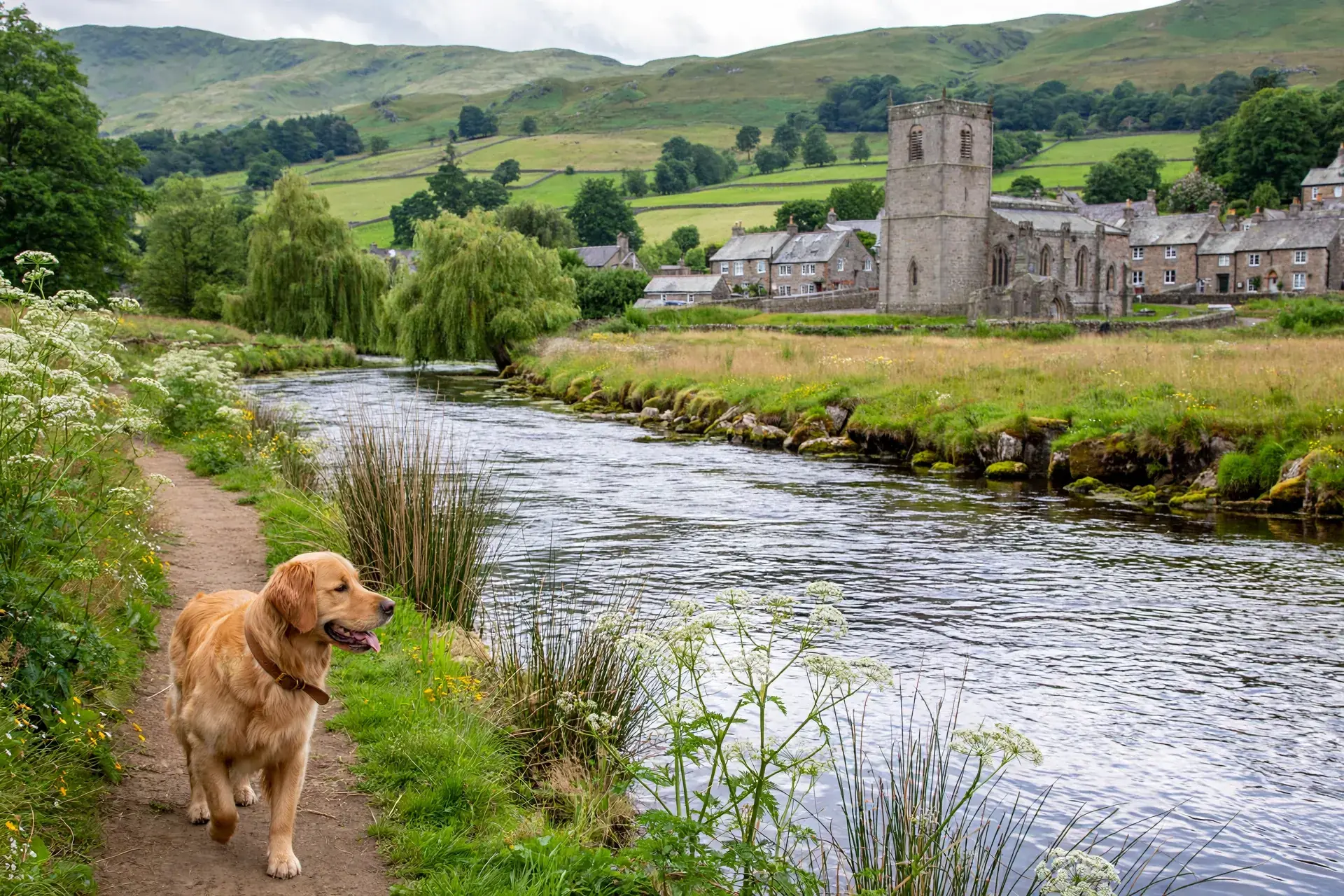
Most Wensleydale villages are best approached from their main street. Wensley is the exception, and the reason is standing on the low rise above the River Ure: the church of Holy Trinity, a large stone building that looks far too grand for the small village gathered around it. The church is the key to understanding the place. Wensley was once far more important than its present size suggests, and the building is the surviving evidence — a medieval parish church with a fine tower, set in a churchyard that looks out over water meadows towards the river. Begin a visit here, with the dog on a lead, and the rest of the village falls into place.
Holy Trinity dates largely from the thirteenth and fourteenth centuries, with later additions that record the village's changing fortunes in stone. It is a Grade I listed building, and it is now in the care of the Churches Conservation Trust, which looks after historic churches that are no longer needed for regular parish worship. That arrangement matters for visitors, because it means the church is not always open in the way a working parish church is. Opening depends on volunteers, events and the season, and the building may be locked on an ordinary weekday. Check the official guidance before you travel if seeing the inside matters to you, and treat an open door as a bonus rather than a guarantee.
What you can count on is the outside. The churchyard is a calm, enclosed space of old gravestones, yew trees and short grass, and it is one of the best places in the village to let a dog settle after a car journey. Keep the dog on a lead and on the paths: a churchyard is a place of remembrance, and other visitors may be visiting a grave. Pick up after your dog without exception, and keep the dog away from fresh flowers and memorials. A dog that barks at strangers or chases birds will be happier walked through the churchyard briefly and then taken down to the open riverside, where there is room to move.
The interior, when it is open, repays the effort. Look for the medieval stonework, the monuments to local families, and the sense of scale that tells you this was once the church of a much larger and wealthier settlement. Wensley's decline is part of its story: the village gave its name to the whole dale — Wensleydale is the valley of Wensley — yet the market and the bustle moved two miles east to Leyburn, and Wensley kept its church, its bridge and its quiet. That is exactly what makes it a good dog village today. There is very little traffic, very little noise, and a dog that is unsettled by busy streets will find the lanes here easy.
Plan the church visit as the first fifteen minutes of the day, not the whole morning. Walk the churchyard, look at the tower from the riverside meadow below, and let the dog sniff the boundary walls and the grass. If a service, concert or open day is running, follow the organisers' lead on dogs: some events welcome a quiet dog on a lead, others do not, and the answer can change from one event to the next. A dog that cannot settle for half an hour indoors is better walked along the river while the other half of your party goes inside, and nobody needs to feel guilty about that division of labour. It is a practical arrangement that keeps the visit pleasant for everyone, including the dog.
A village shaped by the river
Wensley is a village of two levels. On the higher ground sit the church, a scatter of stone cottages and the village's few lanes; below them, the ground falls away to flat water meadows and the River Ure, which curves past the village on its way east towards Leyburn and the lower dale. The shape is no accident. The river made the village: it watered the meadows, powered the mills that once stood along its banks, and gave the settlement its reason to exist. Walk from the church down to the river and you are walking through the village's history in about five minutes.
The houses are built of the local stone, with stone roofs and small gardens, and they sit close to the lane in the way that older Dales villages do. There is no high street to browse and no row of shops. That absence is worth understanding before you arrive, because it sets the tone of the whole visit. Wensley is not a place to tick off attractions; it is a place to slow down. The pleasures here are small and specific: the sound of the river from the bridge, the view back up to the church tower from the meadow, the way the light falls across the water in the late afternoon, and a dog that finally relaxes into a long, unhurried sniff along a grassy bank.
Wensley Bridge carries the road across the Ure at the eastern end of the village, and it is worth a pause in its own right. Stand on it with the dog on a short lead — the parapet is low and the road, though quiet, is used by farm traffic — and look upstream towards the meadows and downstream towards Leyburn. On a still morning the river runs clear over gravel, and you can often see fish holding in the deeper pools. In high water after rain the same river turns fast and brown, and the bridge is the place to appreciate that change safely, from above, rather than from the bank.
The main road through the dale, the A684, passes close to the village, which is both a convenience and a warning. It makes Wensley easy to reach from Leyburn, Hawes and the A1, and it means the village is never far from a bus route or a pub lunch. But the A684 is a proper through road with fast traffic and no pavement in places, so treat every stretch of it as a short-lead, pavement-side walk, and never let a dog wander onto it. The village lanes are a different world: quiet, narrow and easy, and the dog can walk them on a loose lead while you look at the cottages and the church.
Because the village is small, it is easy to walk the whole of it in half an hour, and that is a good way to start. Loop from the church down to the river, along the bank for a stretch, and back up through the lanes, and you will have a clear sense of the place before you commit to a longer walk. Note where the field gates are, where the river is fenced and where it is open, and where the dog can drink safely. That short orientation loop saves a surprising amount of confusion later, especially if you are staying nearby and will be walking the same ground at dusk, when the light goes quickly in the dale and the riverbank paths are unlit.
The riverside walk to Leyburn
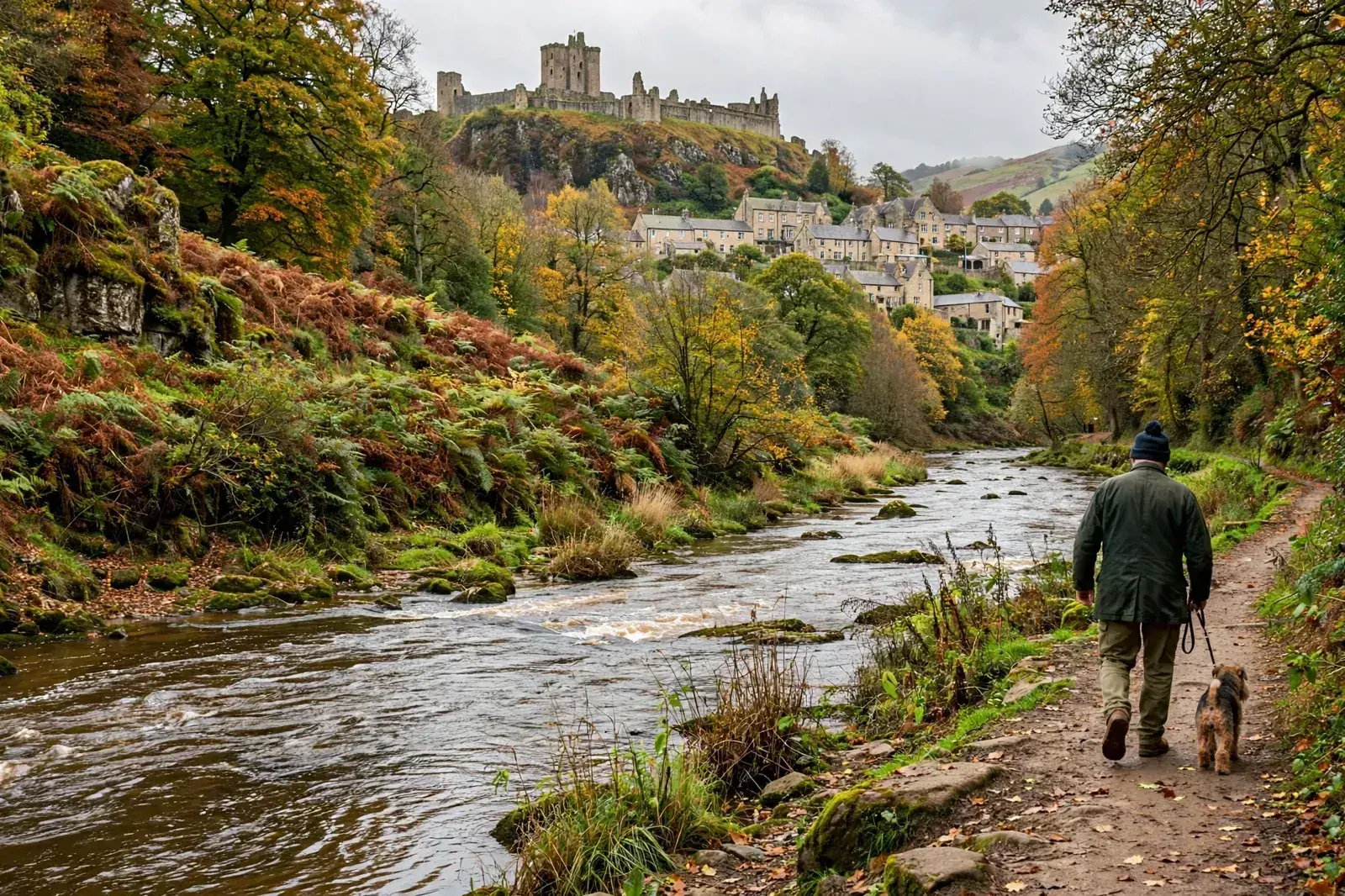
The walk that defines a dog visit to Wensley is the riverside path east to Leyburn, about two miles each way along the River Ure. It is not a grand hike and it does not need to be. Its appeal is the steady company of the river: gravel banks, alder trees, meadows full of curlew in spring, and a path that rises and falls gently enough for an older dog or a family with a pushchair on the easier stretches. Allow 45 minutes to an hour each way, and twice that if your dog is the sort that reads every scent post like a newspaper.
Start from the village and pick up the footpath that follows the river downstream. The surface underfoot is a mixture of grass, riverside track and short stretches of field path, and it can be muddy after rain, particularly where cattle have crossed. Wear boots you do not mind getting dirty, and accept that the dog will need towelling down at the end. There are stiles and gates along the way, so a dog that cannot be lifted over a stile needs to be able to manage a kissing gate or a gap beside it — check each crossing as you reach it rather than assuming the next one will be easier.
Keep the dog on a lead for the whole riverside stretch, and a long line is the best compromise between freedom and control. The reasons stack up quickly: the river itself, which is deep and fast in places; livestock in the riverside fields, including sheep with lambs in spring and cattle through the summer; ground-nesting birds in the meadows; and other walkers, some with dogs of their own and some without. A dog that charges into the river after a duck, or that runs at sheep, can end a walk in minutes. The lead rule here is not a bureaucratic nicety; it is the difference between a relaxed walk and a rescue.
The river offers safe drinking and paddling spots if you choose them carefully. Look for shallow gravel edges where the water moves slowly and the bank slopes gently, and avoid steep, undercut banks, fast water below weirs and bridges, and any stretch where the river is running high and brown after rain. Let the dog paddle and drink, then call it back to the path. Never throw a ball into the river: a dog that swims after a ball in a current it cannot judge is in real danger, and the Ure has a deceptive strength even when it looks calm. The same rule applies to sticks. Keep the game on the bank, where the dog can run and turn safely.
Halfway along, the path gives you the view that makes the walk worthwhile: the river bending through flat meadows with the high ground of the dale rising on both sides, and the sound of the water carrying further than you expect on a still day. It is a good place to stop, give the dog water from your own bottle, and let it rest in the shade of an alder. Dogs overheat more easily than their owners admit, especially the flat-faced breeds and the older ones, and a riverside walk in warm weather needs water breaks even when the river is right beside you. Carry more water than you think you need, because the river is not always a safe drinking source, particularly after heavy rain when field run-off enters the water.
Arriving in Leyburn on foot feels like a small achievement, and the market town is the natural turning point. There are pubs, cafes and shops, and a proper car park if you want to leave the car there and walk back. Our Leyburn guide covers the market square, the Shawl viewpoint and the dog-friendly pubs in detail, and it is worth reading before you set out so the Leyburn end of the walk is planned rather than improvised. Walk back the same way, or return by the road if the light is going and the field paths are getting dark. Do not try to invent a new return route at dusk; the riverside path is easy in daylight and confusing in the half-light, and a tired dog is a dog that stops listening.
Fishing the Ure at Wensley
The River Ure at Wensley is fished for brown trout and grayling, and on a quiet morning the riverbank has the particular stillness that anglers travel for. If you fish, Wensley is worth planning around; if you do not, the fishing still matters, because it shapes how the riverbank is used and who you will meet there. Anglers arrive early, sit quietly for hours, and expect other river users to give them space. A dog that runs along the bank barking at a heron will ruin somebody's morning, so the etiquette of the fishing bank is also the etiquette of the dog walk.
The first rule is that fishing rights on the Ure are privately held, and you cannot simply cast a line because the river is there. You need a valid Environment Agency rod licence and a permit or day ticket for the specific beat you intend to fish. Beats are controlled by clubs and riparian owners, and the arrangements change from stretch to stretch, so check the official guidance before you travel and buy the right ticket for the right water. Fishing without permission is not a minor technicality; it is poaching, and it is taken seriously by the people who manage the river. Do not rely on what worked on a different river or in a different year.
Seasons matter too. The trout season on the Ure runs through the spring and summer, while grayling fishing extends into the winter months, and the exact dates, methods and catch limits are set by the Environment Agency and the beat owner. Check the official guidance before you travel, because the rules are specific and they change. If you are new to the river, ask the beat owner or the local tackle shop in Leyburn what is fishing well and what methods are allowed — fly only, or spinning too — rather than guessing. A short conversation before you start is worth more than a day of fishing the wrong way.
Taking a dog fishing is possible, but it is a different outing from taking a dog for a walk, and it works only if the dog can settle. A fishing session means hours of sitting still on a bank, and a dog that paces, whines or lunges at every passing bird will make the session miserable for everyone, including the dog. The dogs that do well at the bank are the ones that have a mat or bed, a chew or a settled routine, and an owner who accepts that the dog's comfort comes first. Bring water and a bowl, a shade option on a hot day, and a lead that keeps the dog on your peg rather than wandering along the bank to investigate the next angler's tackle.
Keep the dog out of the water while you fish. A dog splashing at the edge of your swim spooks the fish and tangles the line, and a wet dog shaking itself over a rod, a reel and an open tackle box is a scene nobody enjoys twice. If the dog needs to cool off, take a proper break, walk it to a safe shallow edge away from the fishing, and let it paddle there. The same applies to the end of the session: pack the rod away first, then let the dog have its river moment. That order keeps the tackle safe and the dog happy, and it is a small discipline that makes the difference between a fishing trip with a dog and a dog walk that happens to involve a rod.
Even if you never pick up a rod, the fishing calendar is useful knowledge for a dog walker. Early mornings and late evenings in the trout season are the busiest times on the bank, and those are also the times when a dog walker is most likely to meet an angler. Give anglers a wide berth, keep the dog on a short lead as you pass, and keep your voice down. A brief nod and a quiet "morning" is the right level of interaction. The river is shared, and the people who fish it are often the people who know it best — including where the deep pools are, where the banks are undercut, and which stretches are safest for a dog to paddle. Ask, and you will usually get a helpful answer.
Longer loops from the village
Wensley works as a starting point as well as a destination, and the longer walks from the village are where a fit dog earns its supper. The simplest extension is to keep going past Leyburn and up onto the Shawl, the wooded escarpment that overlooks the town and the dale, for a view that repays the climb. The climb is steady rather than steep, but it is a proper hill, so save it for a dog that is fit and a day that is cool. Our Leyburn guide describes the Shawl route and the woodland falls walks below it, and the two guides together make a natural pair for a weekend.
West from Wensley, the dale opens up towards Redmire and the upper valley. The Wensleydale Railway runs through this stretch, and the line between Leeming Bar and Redmire passes through the dale that Wensley overlooks. The railway is a heritage line, and its timetable is seasonal, so check the official guidance before you travel if you want to combine a walk with a ride. Dogs are generally welcome on heritage railways on a lead, but the rules vary by operator and by carriage, and a steam locomotive is a loud, smoky experience for a nervous dog. If your dog has never met a train, walk the line first from a distance and watch the reaction before you book.
North of the village, the lanes climb towards Preston-under-Scar and the high ground beneath the scar itself, a limestone edge that gives the village its name. The walking here is higher, more exposed and more rewarding, with views back across the dale to Wensley church tower and the river below. It is also walking that needs more care with a dog: the ground is rougher, the wind is stronger, and the sheep are everywhere. Keep the dog on a lead through the lambing season and near any flock, and carry a map rather than relying on a phone signal that can disappear behind the hill.
For a day out by car, Bolton Castle is a short drive west, and it is one of the best historic days out in the dale with a dog. The castle is a substantial medieval fortress with gardens and falconry displays, and dogs are welcome on leads in the grounds. Check the official guidance before you travel, because access to the interior and to special events can change, and a castle is a place of stone stairs, uneven floors and sudden drops — a dog that pulls on the lead is a hazard on a spiral staircase. Pair the castle with a walk back towards Wensley and you have a day that mixes history and river air without a long drive.
Further west still, Hawes is the market town at the head of the dale, and it makes a good second base for a longer stay. The drive from Wensley to Hawes follows the river upstream through the heart of Wensleydale, past the villages and waterfalls that give the dale its character, and it is a drive worth taking slowly. Hawes has the cheese, the waterfalls and the market-town bustle that Wensley deliberately does not, and the contrast is the point: stay in the quiet village, visit the busy town, and come home to the river.
Whichever loop you choose, plan the return as carefully as the outward leg. Dales walks have a habit of taking longer than the map suggests, because the dog stops, the views stop you, and the stiles slow everyone down. Carry a head torch in autumn and winter, keep the car keys and the phone in a pocket the dog cannot knock, and have a plan for what happens if the dog goes lame halfway round. A loop is only a good idea if you can shorten it: know where the lanes and the valley road offer an escape route back to the village, and use them without embarrassment. The best walk is the one the dog finishes happily, not the longest one on the map.
Wensley through the seasons
Spring is the season when Wensley is at its most demanding and its most beautiful. The lambs arrive in the riverside fields, the curlews return to the meadows, and the river runs clear and cold after the winter rains. It is also the season when the lead rule is most important. Ewes with lambs are easily stressed by a loose dog, and a farmer is within their rights to take action against a dog worrying livestock. Keep the dog on a lead through every field with sheep, however calm the dog seems, and keep to the marked paths. The wildflowers along the bank — cowslips, primroses and later the meadowsweet — are a pleasure that costs nothing, and a dog that is allowed to sniff them from the path is a dog that is enjoying spring properly.
Summer brings the long evenings that make Wensley feel like a different village. The river is at its lowest and warmest, the meadows are cut for hay, and the light lasts until late. It is the best season for a slow evening walk after supper, when the swallows are over the river and the village is quiet. It is also the season to watch for heat. A dog walking a riverside path in full sun can overheat quickly, and the river is a temptation rather than a solution if the water is fast or the bank is steep. Walk early or late, carry water, and use the shade of the alder trees along the bank. Check the dog for ticks after every summer walk — the riverside grass is exactly where ticks wait — and remove any you find promptly.
Autumn is the connoisseur's season in Wensley. The trees along the river turn, the fishing for grayling begins, and the village empties of summer visitors. The light is lower and warmer, and the church tower against an autumn sky is the photograph that the village deserves. It is also the season when the paths get muddy and the river rises after rain, so check the ground before you set out and be ready to turn back if the bank is flooded. A flooded riverside path is not a challenge to overcome; it is a sign to take the lane route instead. The fields are quieter in autumn, but the livestock is still there, and the lead rule does not expire with the summer.
Winter in Wensley is quiet, short-dayed and honest. The river runs high and grey, the meadows flood in the lowest places, and the village settles into itself. It is a good season for a short, brisk walk and a pub lunch in Leyburn, and a poor season for a long riverside expedition with a dog that hates the cold or the wet. Shorten the walks, dry the dog thoroughly when you get back, and watch the paws for salt and grit on the treated roads. A dog that is wet and cold at the end of a walk is a dog that will not want to walk tomorrow, and in a small village where the walk is the day's main event, that matters. Keep the winter walks short, frequent and cheerful, and save the long loops for the spring.
Where to eat, drink and stay
Wensley itself has no pub, cafe or shop, and it is better to know that before you arrive than to discover it with a hungry dog at noon. The village is a place to stay and to walk, not a place to eat out, and the food and drink are two miles away in Leyburn, which has pubs, cafes and takeaways that welcome dogs in their own ways. Plan the day so that the eating happens in Leyburn and the sleeping happens in Wensley, and the arrangement works well. Walk into town, eat, and walk home along the river with a full dog and a tired one.
In Leyburn, the dog rules vary from pub to pub and from room to room within the same pub, so ask before you sit down rather than after. Some pubs welcome dogs throughout, some restrict them to a bar area or a terrace, and some allow them only outside. A dog that settles under a table is welcome almost everywhere; a dog that barks at every person who walks past the table is welcome almost nowhere. Bring a mat for the dog to lie on, order at the bar if the dog is unsettled, and keep the lead short and under your foot. Our Leyburn guide lists the town's dog-friendly pubs and the details that matter, and it is worth checking before you set out, because pub policies change with new management and new seasons.
For staying overnight, Wensley and its surroundings offer the usual Dales mix: cottages, farm stays, bed and breakfasts and small holiday lets, most of them dog-friendly by arrangement rather than by default. The questions to ask before booking are the same ones that matter everywhere in the dale, and they matter more in a small village where there is no alternative around the corner. Ask how many dogs are allowed and whether there is an extra charge, whether the garden or yard is enclosed and how high the fence is, where the dog can be left if you go out for a meal, and where the nearest practical toilet walk is after dark. A cottage with a secure garden and a riverside walk from the gate is worth more than a larger cottage a drive from the nearest path.
Book early for the school holidays and for the summer weekends, because the dog-friendly stays in and around Wensley are few and they fill quickly. If you are travelling with two dogs, say so at the enquiry stage rather than at check-in: some stays cap the number at one dog, some charge per dog, and some have a size or breed condition that is not obvious from the listing. Be honest about your dog's behaviour too. A host who knows the dog barks at strangers can put you in the right cottage; a host who discovers it at midnight cannot. The same honesty applies to the dog's age and mobility: a cottage up a flight of stone steps is a poor choice for an arthritic dog, however pretty the photographs are.
Self-catering is the easiest arrangement for a dog stay in Wensley, because it removes the question of where the dog eats and where it sleeps. Bring the dog's own bed, bowls and food, and a towel and a drying coat for the river walks. Pack a stair gate if the dog needs to be kept out of a bedroom or off the furniture, and a familiar blanket that smells of home. The first night in a new cottage is the hardest for a dog, so keep the routine as close to home as possible: same feeding time, same last walk, same bed in the same corner. A dog that settles on the first night will enjoy the whole stay; a dog that paces the cottage all night will not.
If you are staying further afield and visiting Wensley for the day, the same logic applies in reverse. Base yourself in Leyburn or Hawes, where the choice of dog-friendly accommodation is wider, and drive or walk to Wensley for the church and the river. The village is a half-day visit at its most generous, and it pairs naturally with a morning in Leyburn or an afternoon at Bolton Castle. Do not try to make Wensley carry a whole day on its own unless the plan is deliberately slow — a long lunch, a long river walk, and an evening in the cottage garden — because the village will not provide the variety that a full day needs.
Practicalities: parking, leads and river safety
Parking is the most practical problem in Wensley, and it is worth solving before you arrive. The village has only a small amount of roadside parking, and on a busy weekend it fills early. Park considerately: never block a farm gate, a driveway, the church approach or a passing place on the narrow lanes, and never park on the grass verge where a verge is the only place a pedestrian can step off the road. If the village parking is full, do not circle the lanes hoping for a space. Drive on to Leyburn, where there are proper car parks, and walk the riverside path into Wensley. The walk is the better part of the visit anyway, and it turns a parking problem into a pleasant start.
Leads are the second practical matter, and the rule in Wensley is simple: on a lead everywhere except a secure garden. The reasons are the river, the livestock, the road and the other users of the paths, and they apply in every season. A long line is the most useful single piece of kit for the village, because it gives the dog room to sniff on the open meadow stretches while keeping you in control near water, stiles and sheep. A retractable lead is a poor substitute on a riverside path: it gives the dog freedom at exactly the wrong moments and it is hard to reel in quickly when a sheep appears around a bend. Bring a fixed lead and a long line, and use the short lead in the village and the long line on the open bank.
River safety deserves its own paragraph, because the Ure is a beautiful river that demands respect. The current is deceptive: water that looks slow on the surface can be fast underneath, and the riverbed is uneven gravel that can drop away without warning. Never let a dog swim in the river, and never throw a ball or a stick into the water. If a dog does go in, do not go in after it; call it to the bank from a safe spot and let it swim to the shallow edge. After heavy rain, stay off the bank altogether until the river drops, because a flooded meadow hides the path edge and the current at the bank is stronger than it looks. Children and dogs should both be kept well back from a river in spate.
Water quality is a quieter concern. After heavy rain, field run-off can enter the river, and in warm weather some slow stretches can carry algae. Let the dog drink from your own bottle where you can, and discourage drinking from stagnant pools and ditches. If the dog does drink from the river and develops sickness or diarrhoea afterwards, mention the river to your vet. The same caution applies to the dog's paws and coat: rinse off river mud when you get back, check between the toes for grit and small cuts, and dry the ears of a floppy-eared dog after a paddle, because damp ears are where infections start.
Finally, know where the nearest vet is before you need one. Leyburn has veterinary services, and the larger practices in the dale cover the surrounding villages, but rural vets keep rural hours, and the nearest out-of-hours service may be a drive away. Save the number in your phone before you set out, and carry a basic first-aid kit: a bandage, a tick remover, saline for flushing a wound, and the dog's regular medication. A small cut from a stile or a thorn in a paw is the commonest injury on a Dales walk, and it is a five-minute job if you have the kit and a miserable hour if you do not. Check the official guidance before you travel for the current opening hours of the nearest practice, because they change with the season.
A slow day in Wensley with a dog
The best day in Wensley is a slow one, and it helps to have a shape for it before you arrive. Start in the morning at the church. Walk the churchyard with the dog on a lead, look at the tower from the meadow below, and take the short orientation loop down to the river and back through the lanes. This is the dog's chance to settle after the journey and your chance to learn the village. Allow half an hour, and do not rush it. A dog that has sniffed the village properly in the morning will walk more calmly for the rest of the day.
Late morning is for the riverside walk to Leyburn. Set out with water, a long line and a towel in the car for the return, and walk the river path at the dog's pace. Stop at the halfway view, let the dog paddle at a safe shallow edge, and arrive in Leyburn in time for lunch. Eat in a dog-friendly pub, with the dog settled on its mat under the table, and use the stop to check the dog over: paws, ticks, water, and whether the morning's walk has tired it more than you expected. If the dog is flagging, drive back to Wensley rather than walking the return leg. There is no prize for a tired dog.
The afternoon belongs to the village again. Walk the lanes, sit on the bridge and watch the river, and let the dog doze in the cottage garden or the car with the windows shaded and the doors open. If the dog still has energy, drive to Bolton Castle for the grounds and the gardens, or walk the lanes towards Preston-under-Scar for the views back across the dale. If the dog is tired, do nothing at all. A dog asleep in the sun outside a stone cottage is not a wasted afternoon; it is the point of the whole trip, and it is the image you will remember when the working week starts again.
Evening in Wensley is short and sweet. Walk the riverbank once more as the light goes, keeping the dog on a short lead as the path darkens, and be back before the light is gone. Feed the dog at its usual time, settle it in its own bed, and let the village go quiet around you. The river will still be running in the dark, and the church tower will still be standing over the meadows in the morning. That continuity is what Wensley offers that a busier town cannot: a village that is the same tomorrow as it is today, and a dog that knows its way around it by the second day. If you are staying for a week, the second day is when the village starts to feel like yours, and the third day is when the dog starts to lead you to the river without being asked.
Practical questions
Before you go
Can dogs go inside Holy Trinity Church, Wensley?
It depends on the day and the event. The church is a historic building cared for by a conservation charity and is not always open, so check the official guidance before you travel. Dogs are generally welcome on a lead in the churchyard, but do not assume interior access: services, concerts and open days each have their own rules, and a dog that cannot settle quietly is better left outside with one of your party.
Is the riverside path at Wensley suitable for dogs off the lead?
Treat it as a lead walk. The paths run beside the River Ure, cross farmland where sheep and cattle graze, and meet roads at the village end, so an off-lead dog can be in trouble quickly. A long line gives a dog sniffing room on the open stretches while keeping you in control near water, livestock, stiles and other walkers.
Can I fish the River Ure at Wensley with my dog beside me?
You can fish only with the right permission: a valid Environment Agency rod licence plus a permit or day ticket for the beat you are on, because fishing rights on the Ure are privately held. Check the official guidance before you travel, keep your dog on a lead at the bank, and bring water and shade for the dog, since a fishing session is a long, still wait for an animal that cannot cool off in the river on demand.
How far is the walk from Wensley to Leyburn?
About two miles each way, roughly 45 minutes to an hour of easy walking with a dog. The riverside and field-path route is the pleasant option; the road route along the A684 is faster but busier and less enjoyable on foot. Allow time for the dog to sniff and paddle, and plan your return before dark, because the field paths are unlit.
Where can I park in Wensley with a dog?
Parking in the village itself is limited to a small amount of roadside space, so arrive early, park considerately and never block farm gates, driveways or the church approach. Many visitors park in Leyburn, where there are proper car parks, and walk the riverside path into Wensley, which makes the parking problem part of the walk rather than part of the stress.
Is Wensley a good base for a longer Wensleydale stay with a dog?
Yes, if you want quiet rather than convenience. Wensley itself has few facilities, but it sits within a short drive or a good walk of Leyburn, Bolton Castle, the Wensleydale Railway and the waterfalls of the upper dale, so it works well as a calm base with a river walk on the doorstep. Book dog-friendly accommodation early, because the village and its surroundings are small and the best dog-welcoming stays fill quickly in school holidays.