This guide is independent and contains no paid placement. Opening rules, tide times and boat policies change, so check the official latest guidance before you travel.
Northumberland rewards dogs that like space: huge beaches at Bamburgh, Seahouses and Beadnell, castle grounds to explore on a lead, and quiet inland walks under dark skies. The three rules that shape every trip are simple — check each castle separately because grounds and interiors differ, never cross the Holy Island causeway against the tide, and expect livestock on Hadrian's Wall sections, so a short lead is non-negotiable.
Why Northumberland suits dogs
Northumberland is one of the least densely populated counties in England, and that emptiness is exactly what many dogs need. Instead of queuing for a small exercise area, you get miles of firm sand, dune paths, river valleys and moorland edges where a reactive or nervous dog can often see other walkers coming long before they arrive. Distances between highlights are real — Bamburgh to Holy Island, or the coast to Hadrian's Wall, can each take the best part of an hour by car — so the county suits a base-and-explore trip rather than a rushed tour where the dog spends the holiday in the car.
The coast is the obvious draw. The Northumberland Coast Area of Outstanding Natural Beauty runs from Berwick-upon-Tweed down towards Amble, linking castle villages, working harbours and long beaches in a single chain. Behind the dunes you will usually find a small car park, a village shop and a pub, which makes practical dog logistics — water, shade, a toilet stop and a short lead walk after dark — far easier than on wilder coasts with no facilities at all. Inland, the Northumberland National Park and the Cheviot Hills offer a completely different texture: heather, stone walls and very few people, ideal for dogs that settle better away from beach crowds.
Weather deserves respect rather than optimism. North Sea wind can make even a mild day feel cold on the beach, and a dog that has swum will lose heat quickly. Pack a drying coat or towel in the car, plan a warm indoor backup for at least one day, and do not build the whole trip around a single beach. The good news is that Northumberland's pleasures are mostly outdoor and low-cost: a castle exterior, a harbour wall and a sunset walk cost little, so a wet morning rarely ruins the budget as well as the plan.
Choose your base by your dog, not by the prettiest listing. A village base such as Bamburgh, Seahouses or Beadnell puts the beach on your doorstep for the first and last walks of the day. A market-town base such as Alnwick, Berwick-upon-Tweed or Hexham gives you vets, supermarkets and fuel within a short drive, which matters for older dogs, dogs on medication and anyone travelling in winter when rural services keep shorter hours. Either way, check the official latest guidance before you travel for any seasonal restrictions at the places on your shortlist.
Castles: grounds versus interiors
Northumberland has more castles than any other county in England, but there is no single dog rule that covers them all. The pattern to plan around is this: grounds are often dog-welcoming on a lead, interiors often are not. State rooms, exhibitions, tea rooms and gift shops may each apply a different rule within the same castle, and a special event can tighten the rules for a weekend. Treating every castle as a separate venue check — not as one generic “castles allow dogs” assumption — is the single most useful habit for this county.
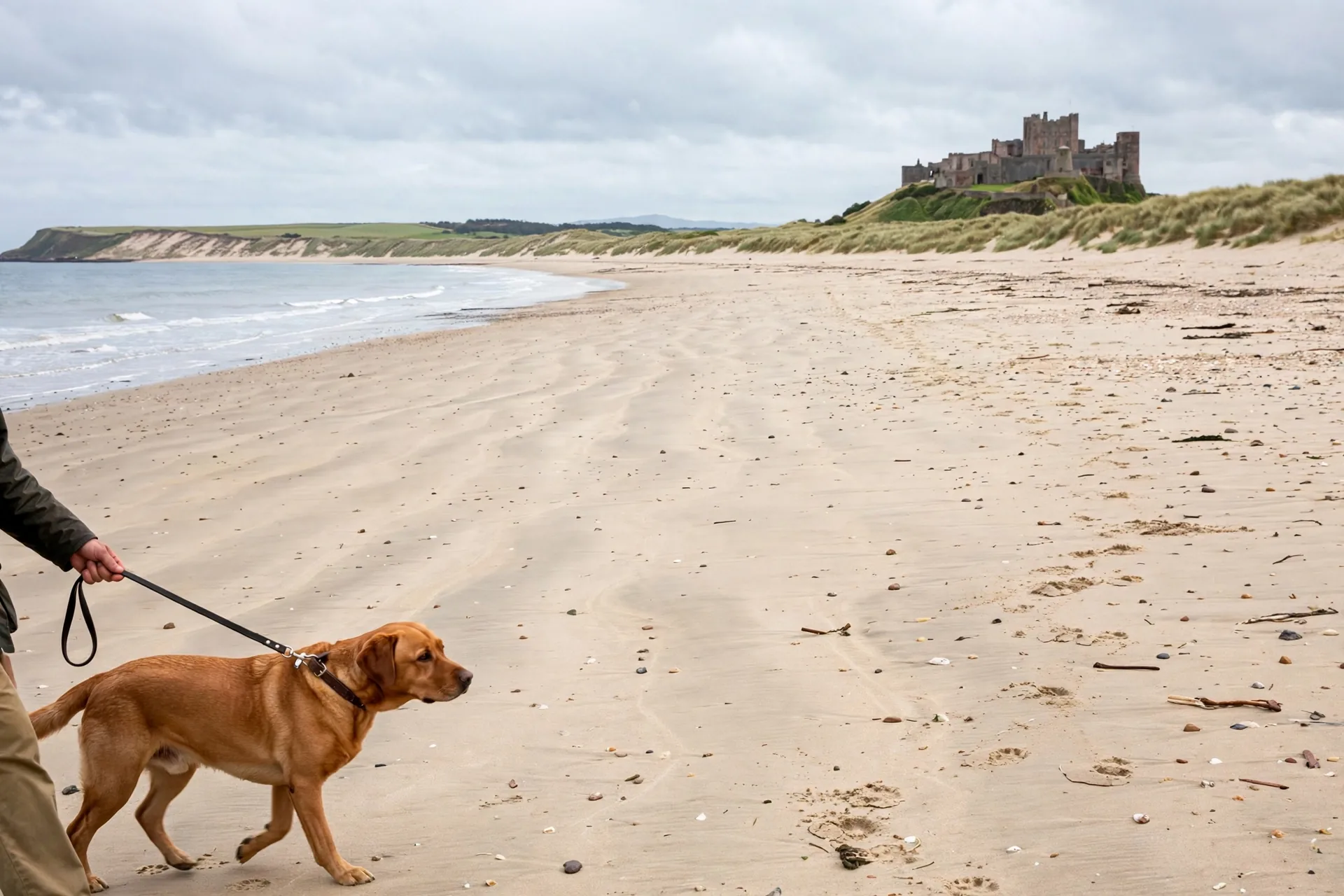
Bamburgh Castle dominates its village and beach, and its grounds and battlements are the highlight for most visitors with dogs, while interior rooms follow their own policy. Alnwick Castle, home to formal gardens as well as the castle itself, applies separate rules to the castle and to The Alnwick Garden, so check both listings independently rather than assuming one ticket means one dog policy. Warkworth Castle and Dunstanburgh Castle, both cared for by English Heritage, sit at opposite ends of the effort scale: Warkworth is a compact visit in a riverside village, while Dunstanburgh is reached only on foot, with a walk of roughly a mile and a half each way from Craster across open coastal grassland — a lovely dog walk in itself, but a poor surprise if you expected a car park at the gate. Our guide to dog-friendly National Trust places explains how to read grounds-versus-house rules at large heritage sites, and the same checking method applies to English Heritage properties here.
Build a castle day that works even if interiors are closed to your dog. Arrive early, walk the grounds first while they are quiet, and take turns for any indoor exhibition so one person always stays outside with the dog in shade with water. Never leave a dog alone in a car in a castle car park — coastal car parks offer little shade and temperatures rise quickly even on the North Sea coast. If you are travelling solo with a dog, favour castles where the experience is mainly outdoors, such as ruined sites and grounds-led visits, and save interior-heavy sites for a trip with a second adult.
Small practical checks save the day. Many castle grounds are uneven, with cobbles, steep banks and unfenced drops near battlements and cliff edges, so a short lead and a harness your dog cannot back out of are worth more than a long line. Carry water for the dog as well as yourself: some rural sites have limited catering, and a queue for the single cafe is no place to discover there is no dog bowl. Finally, photograph the dog rules sign at the entrance when you arrive. If a rule changes mid-visit for an event, a photo of what you were told at entry is the clearest way to resolve any confusion politely.
Bamburgh, Seahouses and Beadnell beaches
The Bamburgh to Seahouses to Beadnell chain is the easiest beach holiday in the county to plan with a dog, because the three places link together along one stretch of coast. Bamburgh beach is the showpiece: a vast sweep of sand beneath the castle, backed by dunes, with room even on busy days to find a quieter section by walking further from the main access points. The sand is generally firm and good for older dogs that struggle on shingle, but the sea here is the North Sea — cold, with rip currents in places — so swimming should be a choice for confident dogs in calm conditions, never an assumption, and always rinse salt water off afterwards.
Seahouses is the working harbour between the two beach villages, useful for boat trips, fish and chips, supplies and a flatter, shorter lead walk along the harbour when a full beach session is too much for a puppy or a senior dog. Beadnell, just south of Seahouses, curves round a bay with a small harbour and lime kilns, and its beach feels slightly more sheltered for a first paddle. Between the villages, dune paths and the England Coast Path give you an off-beach alternative on days when the tide has covered the sand. Tide awareness matters on this coast even away from Holy Island: at high tide some sections narrow considerably, so check tide times each morning and plan the long beach walk for a falling tide, when the sand is widest and cleanest.
Beach rules are local, seasonal and sign-led, so read the board at the access point you actually use rather than relying on a general article — including this one. Our guide to UK dog-friendly beach rules explains how seasonal dog bans, lead zones and local bylaws work across Britain, and Northumberland follows that same pattern: a beach that is open in October may have a restricted section in July, and wildlife protection can close dune or nesting areas at short notice. Grey seals haul out on parts of this coast, particularly in autumn and winter. Give seals a wide berth, keep your dog on a lead anywhere near them and never let a dog approach a seal pup, however still it looks — its mother is likely nearby and disturbance can be fatal for the pup as well as dangerous for your dog.
Facilities shape how long you can stay. Bamburgh village has shops and places to eat a short walk from the beach, Seahouses has the widest choice, and Beadnell is smaller and quieter. Carry poo bags for dune paths as well as the sand itself — bins cluster at car parks and access points, not along the beach — and take litter home if a bin is full. After any beach day, check paws for sand and small shells packed between toes, rinse legs if your dog has sensitive skin, and dry ears thoroughly if they have been swimming. A dog that has run on sand all day will be more tired than the distance suggests, so keep the evening walk short and familiar.
Holy Island and the tidal causeway
Holy Island of Lindisfarne is one of Britain's great small places — a village, a castle, a priory and a harbour on an island that is only an island for part of the day. For a dog owner, it is also the one place in Northumberland where a timetable error becomes a safety emergency. The island is reached by a tidal causeway that floods twice a day. Vehicles are stranded on this causeway every year by drivers who ignore the signs, and the lifeboat and coastguard are called out repeatedly. With a dog in the car, the stakes are higher still: a stranded vehicle in rising water is frightening and dangerous for everyone inside it.
The safe method is unglamorous and absolute. Check the published safe crossing times from an official source before you set off and again on the day, because times shift daily with the tides. Cross only well inside the safe window, never at its edges, and never cross against the tide or through water already covering the road, however shallow it looks. Build your whole island visit backwards from the closing time of the window: decide the latest moment you must leave the island car park, set an alarm for an hour before that, and treat the alarm as non-negotiable even if the cafe queue is long and the dog is happily asleep. If the crossing times do not fit your day, do not squeeze the visit in — Holy Island will still be there tomorrow, and the mainland coast opposite, around Ross Back Sands and the dunes south of Berwick, makes a fine alternative day.
Walking the causeway route with a dog is possible for experienced walkers using the marked pilgrims' route across the sands, but it demands even more caution than driving: the tide here moves faster than a person can run, the sand route is exposed with no shelter, and refuge boxes on the causeway are an emergency last resort, not a viewing platform. Most visitors with dogs will have a better day driving across safely, then enjoying the island on foot. On the island itself, keep dogs on a lead around the village, harbour and grazing areas, carry water because facilities are limited outside the village, and note that Lindisfarne Castle and the priory apply their own dog rules for grounds and interiors — check the official latest guidance before you travel, as with every castle in this guide.
One more island habit is worth copying from locals: tell someone on the mainland your crossing plan. A simple message with your intended crossing times and return window means that if anything does go wrong, rescuers know where to start. It takes thirty seconds, costs nothing, and is the kind of boring precaution that pairs well with a genuinely relaxing day — because once you are safely on the island with time in hand, it is a wonderful place to slow down with a dog, watching harbour seals from a respectful distance and walking the quiet lanes away from the main car park crowds.
Farne Islands boats and dogs
The Farne Islands, visible from Bamburgh and Seahouses on a clear day, are among Britain's most important seabird sanctuaries, home in season to puffins, guillemots, razorbills and grey seals. Boat trips run from Seahouses harbour with several operators, ranging from sail-around cruises that do not land, to landing trips on Inner Farne under National Trust care. They are a highlight for many visitors — but for dog owners, they need an honest paragraph rather than a hopeful one.
As a general rule, expect dogs not to be carried on landing trips to the Farne Islands. The islands are a protected sanctuary, ground-nesting birds are highly vulnerable to disturbance, and landing rules are strict for human visitors, let alone dogs. Some operators may allow a dog on a non-landing sail-around trip in some circumstances, but this genuinely varies by operator, vessel and season, and it can change. The only reliable approach is to check directly with the boat operator before you book, describe your dog honestly, and accept the answer without argument. Do not arrive at the harbour with a dog and a booking and hope to negotiate at the quay.
Plan the backup before you need it. If one adult takes the boat and the other stays ashore, Seahouses itself is an easy place to spend two or three hours with a dog: a harbour lead walk, a short drive or walk to Beadnell beach, and plenty of places to sit with a coffee while watching other boats come and go. Solo travellers with a dog may prefer to enjoy the Farnes from the mainland — the view from Bamburgh beach and the cliffs around Dunstanburgh frames the islands well — and keep a boat trip for a future visit without the dog. Never leave a dog alone in a car in the harbour car park while you take a boat trip, and never tie a dog up unattended outside a booking office.
If an operator does confirm a dog can travel on a specific non-landing trip, prepare properly. Use a secure harness, keep the dog settled between your feet rather than at the rail, carry water and a small towel, and think honestly about whether your dog will cope with engine noise, swell, gulls and a boatload of strangers in waterproofs. A dog that hates the car will rarely love a boat. For dogs that do cope, a short sail-around in calm weather can be a gentle experience — but the dog's comfort, not the photo, should make the final decision.
Hadrian's Wall with a dog
Southern Northumberland offers a complete change of scene: the central sections of Hadrian's Wall, where the wall rides along the Whin Sill crags through open upland country. The Hadrian's Wall Path National Trail follows the wall for 84 miles coast to coast, but with a dog the sensible approach is to walk short, well-chosen sections as out-and-back or circular walks from a car park, rather than attempting long linear days that depend on buses and tired legs. Popular central sections around Steel Rigg, Housesteads and Once Brewed give you the classic crag-and-wall views within a mile or two of walking, while quieter stretches further east or west suit dogs that find busy fort sites overwhelming.
Livestock is the defining rule of wall country. Sheep and cattle graze right up to the wall line, fields are crossed on the path itself, and there is no version of this walk where livestock awareness is optional. Keep your dog on a short lead whenever livestock is visible or likely, give cattle with calves a particularly wide berth, and if cattle approach, let go of the lead so you can both get to safety — standard countryside advice that matters more with a large dog pulling towards a fence line. Our guide to the livestock worrying law sets out the legal position in England: a farmer may act to protect livestock from a dog that is worrying them, and “under close control” on a path through a grazing field in practice means a short lead, not a dog ranging ahead on a long line.
The Roman sites along the wall each set their own dog policy. Large sites such as Housesteads, Vindolanda and Chesters combine outdoor remains with museums and visitor centres, and the grounds-versus-interiors split you met at the castles applies here too: dogs are commonly welcome in outdoor areas on a lead and not inside museums. Check each site's official page before you travel, especially if the museum is the main reason for your visit. Fort car parks can fill by mid-morning in summer, so arrive early, and remember that exposed crag sections offer no shade or water — carry both, and turn back sooner than you think on a hot or windy day.
Underfoot, the wall path mixes grass, stone pitching, stiles and gates. Some stiles have dog gates beside them and some do not, which matters if you have a large dog you cannot lift. A harness with a handle, dry spare socks for the humans and a towel in the car cover most wall-path realities. Finally, respect the archaeology itself: dogs should stay on the path and off the wall and its turf banks. It has stood for nearly two thousand years; helping it stand a little longer is part of the bargain for enjoying it with a dog at your side.
Dark skies and quiet roads
Northumberland National Park together with Kielder Water and Forest Park forms an International Dark Sky Park, one of the largest areas of protected night sky in Europe. For dog owners, the dark skies are more than a stargazing slogan: they shape the whole rhythm of a trip. Evenings are properly dark, village street lighting is limited, and the last walk of the day needs a torch, a reflective or lit collar for the dog and a route you have already walked in daylight. In return, a clear night walk to the end of a village lane can deliver a sky full of stars that most dogs' owners simply never see at home.
Quiet roads are the other side of the same coin. Single-track lanes with passing places, unfenced moorland roads where sheep wander onto the tarmac, and long distances between fuel stations are normal inland. Drive slowly, expect livestock and deer on the road at dawn and dusk, and keep the dog secured in the car so a sudden stop does not throw them forward. Download maps before you set off, because mobile signal drops out across large parts of the national park and Kielder — an offline map is also the reliable way to relocate a car park after a forest walk when no signal is available to help.
Kielder itself deserves a place on many dog itineraries: forest trails, a large reservoir shoreline and waymarked walks of different lengths give you a sheltered option on days when the coast is too windy. Forest walking suits dogs that overheat on open beaches, but check for forestry operations and temporary diversions before you travel, keep dogs under control around mountain-bike trails, and rinse paws after forest tracks in wet weather. Whether you choose forest, moor or coast for the day, the pattern is the same — fewer people, more space, and a dog that returns to your accommodation pleasantly tired rather than overstimulated.
Build one slow day into every Northumberland trip. The county's distances punish itineraries that try to stack a castle, a boat trip, a wall walk and an island in forty-eight hours, and dogs feel that rushing more than their owners admit. A slow day — a long beach walk from your base village, a pub lunch where dogs are welcome in the bar, an early night under dark skies — is usually the day people remember most fondly. Northumberland does not need to be conquered. It needs to be given time, and dogs are excellent at teaching exactly that lesson.
Planning checklist and bases
A short checklist pulls the whole county together. Before you book, confirm your accommodation's dog rules in writing: number and size of dogs, any charge, whether the garden is genuinely enclosed, and whether dogs may be left alone briefly. Before you travel, check the official latest guidance for every castle, fort and island on your list, download tide times for beach and Holy Island days, and save the number of a vet near your base — practices in Berwick-upon-Tweed, Alnwick, Seahouses area and Hexham cover most bases, but rural cover thins out further west, so check rather than assume. Pack for four seasons in one bag: waterproofs, a dog drying coat, a torch and spare lead alongside the usual bowls, food and medication.
Match the base to the trip you actually want. For a beach-led holiday with minimal driving, base yourself in or near Bamburgh, Seahouses or Beadnell and day-trip inland once. For a wall-led holiday, base around Hexham, Corbridge, Haltwhistle or Once Brewed so the central crags are minutes away and the coast becomes the day trip. For a first visit that samples both, Alnwick sits usefully between the two, with the coast at Alnmouth and Warkworth close by and the wall under an hour away. Multi-base trips work too, but each move costs a dog a settling-in evening, so two bases in a week is usually the comfortable maximum.
On the ground, keep a simple daily routine. Check the tide and weather over breakfast, do the big walk in the best part of the day, keep a water bowl and towel permanently in the car, and end each day with a short familiar lead walk near your accommodation so the dog learns the local “last walk” quickly. If you are visiting National Trust or English Heritage sites more than a couple of times, membership can change the sums — see our National Trust dog guide for how Pawprint ratings describe dog facilities at Trust places. Above all, leave slack in the plan. Northumberland's gifts — an empty beach at low tide, a castle almost to yourself at opening time, stars over a quiet lane — tend to arrive on the days you were not rushing anywhere else.
Northumberland town by town
The county is too big for one guide to cover street by street, so the towns now have their own: Berwick-upon-Tweed with a Dog, Alnwick with a Dog, Hexham with a Dog, Corbridge with a Dog, Rothbury with a Dog, Wooler with a Dog, Seahouses with a Dog, Bamburgh with a Dog, Craster with a Dog, plus Eyemouth with a Dog just over the border. Each one gives routes, parking, seasonal beach rules and dog-friendly places to eat.
Practical questions
Before you go
Can dogs go inside Northumberland castles?
It varies by castle. At many sites dogs are welcome in the grounds on a lead but not inside state rooms, exhibitions or cafes, while a few smaller sites allow dogs more widely. Bamburgh, Alnwick, Warkworth and Dunstanburgh all apply their own rules, and those rules can change by season or event. Check the official page for each castle before you travel and plan for one person to stay outside with the dog if interiors are closed to dogs.
Are dogs allowed on Bamburgh beach all year?
Bamburgh's wide sandy beach is popular with dog walkers and is generally usable year-round, but local restrictions, wildlife protection zones and seasonal signs can apply on parts of the Northumberland coast. Always read the signs at the access point you use, keep dogs under close control near nesting birds and seals, and check the official latest guidance before you travel. Our UK beach rules guide explains how seasonal bans and local bylaws work.
How do I cross to Holy Island safely with a dog?
Only cross the Holy Island causeway within the published safe crossing times and never attempt to cross against the tide. Check tide times from an official source on the day, allow generous extra time, walk or drive straight across without stopping on the causeway, and if you are walking with a dog keep to the marked route and be ready to turn back early. If the tide times do not fit your plans, visit on another day instead.
Can I take my dog on a boat to the Farne Islands?
Generally, dogs are not carried on landing trips to the Farne Islands, because the islands are a protected seabird sanctuary and landing rules are strict. Some operators may allow dogs on non-landing sail-around trips, but this varies and can change. Check directly with the boat operator in Seahouses before you book, and make a backup plan for the dog if the answer is no.
Where can I walk Hadrian's Wall with a dog?
Many sections of the Hadrian's Wall Path welcome dogs, but you will share the trail with grazing sheep and cattle, narrow gates and steep crags. Keep your dog on a short lead around livestock, follow local signs at farms and forts, and check each English Heritage or National Trust site on your route for its own dog rules before you travel. Quieter eastern and central sections suit nervous dogs better than busy fort sites at peak times.
Walking the coast itself: the Northumberland Coast Path guide breaks the whole route into dog-friendly stages with beach rules and places to stay, and St Oswald's Way covers the inland alternative from Heavenfield to Holy Island. For the sand alone, see our Northumberland beaches guide.