This guide is independent and contains no paid placement. If affiliate links are added later, they will be clearly marked and will not change our editorial checks.
Middleham rewards early risers and calm dogs. Walk the castle grounds on a lead, watch the morning gallops from a safe distance on a public path, then drop down to the River Ure for the valley walk your dog actually wants. Keep the dog close around horses and livestock at all times, and check the official guidance before you travel for castle opening times and access rules.
A racing town first, a tourist town second
Most Yorkshire Dales market towns run on visitors, farmers and walkers. Middleham runs on horses. The town sits in the middle of Wensleydale, below the great ruined castle that once belonged to Richard III, and its streets, yards and lanes are organised around racing stables. Strings of thoroughbreds leave the yards in the early morning, cross the town on their way to the gallops, and come back through the same streets a couple of hours later. For a dog owner, that single fact shapes the whole visit: Middleham is at its best, and at its most demanding, before most holiday towns have woken up.
The practical consequence is a different daily rhythm. If you arrive at midday, you will see a handsome small town with a wide market place, a castle on the hill and a handful of pubs — pleasant, but only half the story. If you arrive the evening before and set an early alarm, you will see the town doing the work it exists for: horses moving through the streets in the half light, stable staff on bicycles, and the gallops busy with exercise. Dogs that cope well with that scene — horses passing close, hooves on tarmac, the smell of a working yard — will have a memorable morning. Dogs that bark, lunge or panic at horses will not, and it is kinder to know that before you book than to discover it on a narrow lane at seven in the morning.
Middleham is also small. There is no long high street of shops to browse, no big visitor centre and no parade of attractions to tick off. What it offers instead is concentration: a castle, a racing yard culture, a river, and the open valley of Wensleydale, all within walking distance of the market place. That suits a dog break well, because the town is walkable end to end and the countryside starts almost as soon as the houses stop. A dog that needs a proper morning walk does not need a car here; it needs a lead, a route, and a plan for the horses.
The town's history helps explain why it feels the way it does. Middleham Castle was one of the great northern strongholds of the fifteenth century, the childhood home of Richard III, and its ruined keep still dominates the skyline from almost every approach. The castle is the reason the town exists in its present form, and the racing yards are the reason it still feels busy and working rather than preserved. The combination is unusual in the Dales: a place where medieval stone and modern horse racing share the same streets, and where a dog walk can pass a castle wall, a stable yard and a field of sheep in the space of twenty minutes.
Plan the visit around that rhythm and the town makes sense. Arrive the day before if you can, walk the dog around the quieter lanes in the evening, and be out early for the gallops. Use the middle of the day for the castle, the river and a long pub lunch. Keep the late afternoon for a valley walk when the yards are quiet and the light drops across Wensleydale. Dogs that are exercised early, fed on time and given a calm base to return to will settle far better in a small town where the morning is busy and the afternoon is slow.
Middleham Castle with a dog
Middleham Castle is the town's anchor and the first stop for most visitors, and it works well as a dog stop provided you treat it as an outdoor visit. The castle is managed by English Heritage, and dogs on leads are welcome in the grounds, while dogs are not allowed inside the castle buildings themselves. That division matters for planning: the visit is about the walls, the views and the open grass around the ruins, not about going inside the keep with the dog. Check the official guidance before you travel, as opening times, admission and access rules change through the year, and the site can close for events or in poor weather.
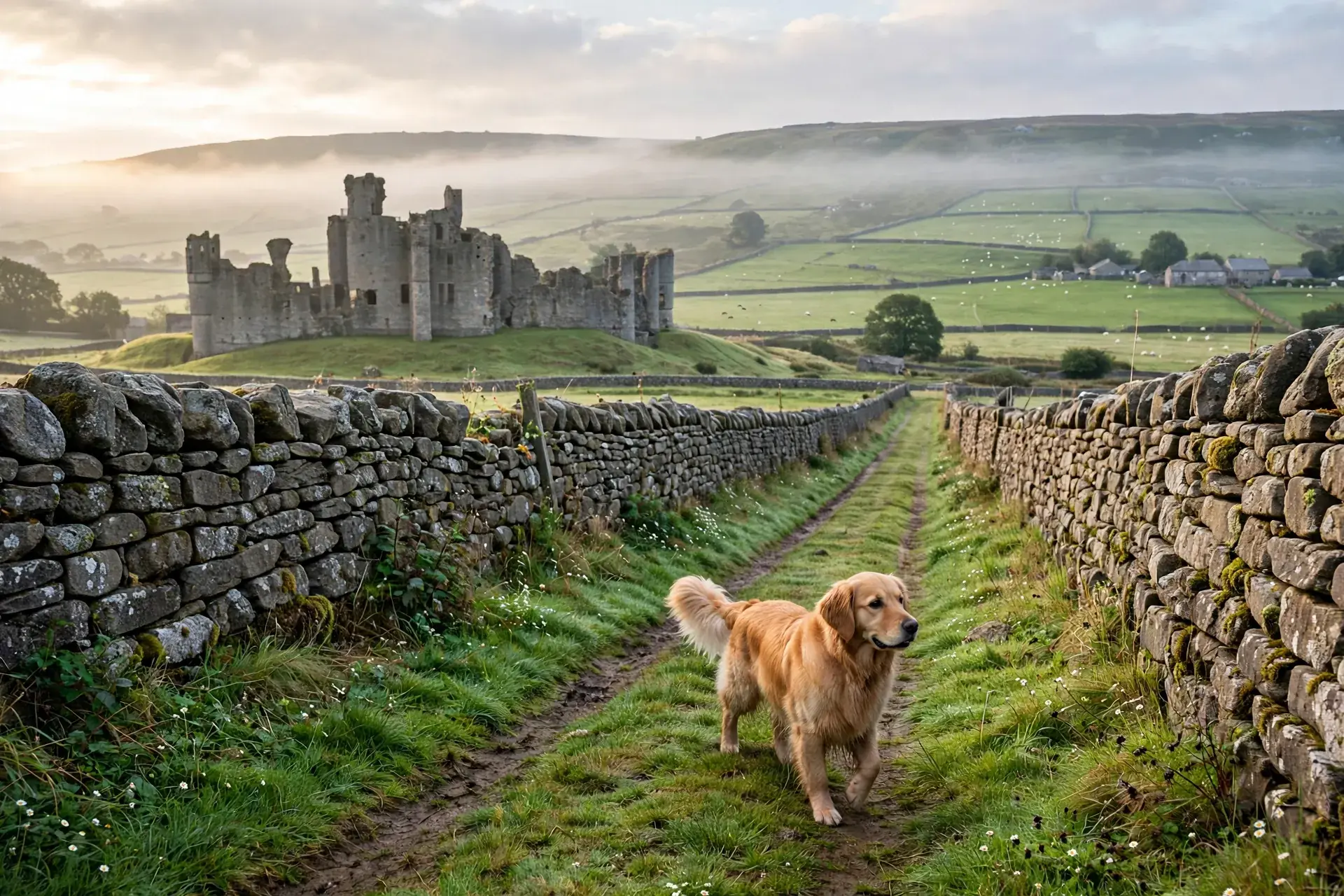
Approach the castle on foot from the market place if you can. The walk up through the town is short, and it gives the dog time to settle before the open ground around the ruins. The castle stands on a rise above the town, and the ground around it is open grass with long views across Wensleydale — the kind of space where a dog will want to run, and where a lead is still the right choice. The walls are high, the drops are real, and the ground is uneven in places, so keep the dog close and watch where small dogs and children go near the edges.
Allow about an hour for the castle grounds, longer if the dog likes to sniff and the weather is kind. The circuit around the outside of the walls gives the best sense of the castle's scale, and the views from the higher ground take in the valley floor, the river and the gallops below. Bring water for the dog in warm weather, because there is little shade on the open grass, and remember that the walk back down to the town is the easier half of the visit — the climb up is short but steady, and older dogs will feel it.
Photographs work best from the lanes below the castle rather than from the top, where the wind is stronger and the dog is harder to keep still. The classic view is from the south-east, where the keep stands against the valley, and the early morning light suits the stone. If you are visiting with a camera and a dog, keep the dog on a short lead and the camera in one hand; the ground is uneven, and a dog that pulls towards a rabbit or a passing horse will not wait for you to frame the shot.
Combine the castle with a walk rather than treating it as a standalone attraction. From the castle grounds you can drop back into the town for a drink, or continue along the lanes towards the river, which makes a natural second half to the morning. If the castle is closed on the day you visit, the outside circuit and the views from the lanes are still worth the walk, and the town itself — the market place, the church and the old coaching inns — fills the gap without a car.
The gallops at dawn: watching horses, keeping dogs safe
The gallops are the heart of Middleham's working life, and they are also the part of the visit that needs the most care. Every morning, strings of racehorses are exercised on the gallops above and around the town, and the sight of horses moving in formation across the open ground is one of the most distinctive things a visitor to the Dales can see. It is also a working training ground, not a public dog park, and the rules that keep it safe are not optional.
Start by understanding what the gallops are. They are strips of maintained grass and all-weather track where trainers work their horses, and they are crossed and bordered by public rights of way. You can walk those rights of way with a dog, and you can watch the horses from them, but you cannot treat the gallops themselves as open access land for a dog to run on. Keep the dog on a lead at all times near the gallops, stay on the marked paths, and never let a dog run loose where horses are working. A loose dog near a string of thoroughbreds is not a minor nuisance; it is a genuine safety risk to the horse, the rider and the dog.
Timing matters. The gallops are busiest in the early morning, when most strings are out, and quieter by late morning. If your dog is steady around horses, the early morning is the time to watch from a distance: find a public path with a clear view, keep the dog close and settled, and let the horses pass without chasing, barking or pulling. If your dog is reactive to horses, avoid the gallops entirely during the morning work, and walk the river or the valley floor instead. There is no prize for testing a reactive dog against a string of racehorses.
When horses approach on a lane or a path, the routine is simple and worth rehearsing before you need it. Move well to one side, off the track if you safely can, keep the dog on a short lead on the side away from the horses, and stand still until the string has passed. Do not let the dog step out towards the horses, do not wave, and do not try to take a photograph at close range while holding a lead. Riders will usually acknowledge you if you give them room; they are working, and they notice the dog owners who make their morning easier.
Children and dogs need the same briefing. A child who runs towards a horse, or a dog that darts across a path in front of a string, creates the same problem. Walk the gallops paths with the dog on a short lead, not a long line, and keep the dog on the side away from the horses. If you are using a long line anywhere near the gallops, shorten it well before the horses arrive — a long line across a bridleway is a trip hazard for a horse as well as a tangle for the dog.
Finally, respect the yards themselves. The stable yards in Middleham are private working premises, not visitor attractions, and dogs should not be taken into them. Admire the yards from the street, watch the horses from the public paths, and do not approach horses in their boxes or in the yard without an invitation. The town is welcoming to visitors who respect the working side of it, and the gallops are the clearest test of that respect.
Wensleydale walks from the town centre
The best thing about walking from Middleham is that you do not need a car to reach good ground. The town sits on the valley side, and the paths drop quickly from the streets to the fields and the river, so a proper walk starts within ten minutes of leaving the market place. The walking here is valley walking rather than fell walking: rolling green fields, dry stone walls, hedgerows and river meadows, with the higher fells as a backdrop rather than a destination. That suits most dogs better than a long climb, and it suits owners who want a walk that ends with a pub rather than a mountain rescue.
Start with the short loop that every visitor should know. From the market place, head down towards the River Ure on the lanes and field paths, follow the river for a stretch, and return to the town on a different lane. The loop is roughly two to three miles depending on the exact route, mostly level once you reach the valley floor, and it gives the dog water, shade and open grass. The riverbanks can be muddy after rain, and the paths cross farmland, so keep the dog on a lead through fields with livestock and near the road crossings at each end.
For a longer walk, the valley path towards Leyburn is the natural next step. Leyburn lies a few miles to the west along the valley, and the route between the two towns follows field paths and quiet lanes with views across Wensleydale. It is a walk that rewards a slow pace: the dry stone walls, the field barns and the views towards Penhill give it a character that is different from the river loop, and the dog gets a longer stretch of open ground. Our guide to Leyburn with a dog covers the market square, the Shawl and the falls walks at the other end, so the two towns pair well as a there-and-back or a two-centre stay.
Eastwards, the valley opens towards the River Ure and the lanes that run down to the river crossings. These are quieter than the Leyburn direction, and they suit dogs that prefer space to company. The walking is easy, the ground is mostly flat, and the views back towards the castle give the route a sense of place that a flat valley walk does not always have. Allow time to stop: the best of Wensleydale walking is not the distance covered but the places where you stand still and let the dog sniff, drink and watch the valley.
Route-finding in the valley is straightforward but not foolproof. The rights of way are waymarked, but signs can be weathered, stiles can be awkward for large or older dogs, and a field path that looks clear on a map can be overgrown in high summer. Carry a paper map or a downloaded offline map, and do not rely on phone signal in the valley bottoms. If a path is blocked or a stile is impassable for the dog, retrace your steps rather than climbing a fence or cutting across a field — the farmers who maintain these paths notice, and the next walker pays for the shortcut.
Season changes the valley walks more than the distance does. In spring, the fields are full of lambs and the lead rule is absolute. In summer, the river is the dog's best friend and the shade along the hedgerows matters more than the route. In autumn, the valley is at its most colourful and the ground is at its softest, so a walk that was dry in August can be heavy going in October. In winter, the valley floor can flood near the river, and the lanes are icy in the mornings — check the conditions before you set out, and be ready to shorten the walk rather than push on through standing water.
River Ure, Coverdale and the longer routes
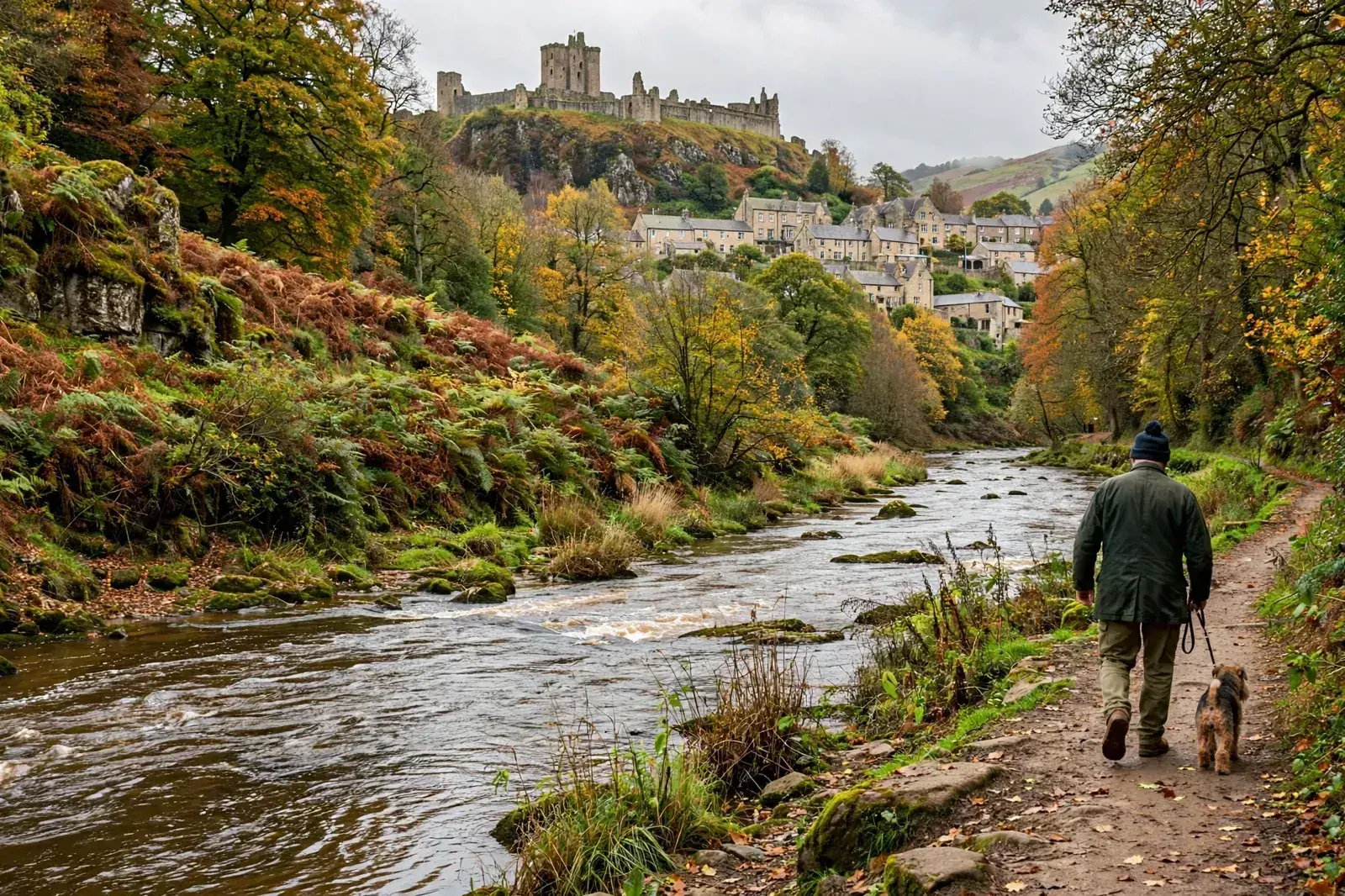
The River Ure is the thread that runs through Wensleydale, and the walking along it is the most rewarding riverside walking in the Dales for a dog. The river is wide, fast in places and shallow in others, and the banks change from open meadow to wooded stretches within a single walk. Dogs that like water will find places to paddle and swim; dogs that do not will find plenty of dry bank to walk on. The one constant is the lead rule near livestock and the need to watch the current after heavy rain, when a river that looks inviting in the morning can be dangerous by the afternoon.
The river paths near Middleham are not a single signed trail but a network of rights of way that follow the valley floor, cross the river at bridges and fords, and link the lanes between the villages. The practical approach is to choose a bridge as a turning point, walk out along one bank and back along the other, or return by a lane. That gives a circular walk of three to five miles without any complicated navigation, and it keeps the dog off the busier roads. Check the official guidance before you travel for any path closures, and ask locally about the river level after rain — the valley floods quickly, and a path that was passable yesterday can be under water today.
Coverdale, the side valley that runs south from Middleham towards Kettlewell, is the quieter alternative and the one that experienced walkers in the area tend to recommend. The valley is narrower, the river is smaller, and the walking feels more enclosed than the open Wensleydale floor. The lane up Coverdale is a good walk in itself, and the field paths that branch from it give a dog open ground with fewer people. Coverdale is also a working farming valley, so the lead rule applies throughout, and the sheep are never far from the path. Keep the dog close, close every gate, and do not let the dog chase or worry livestock.
For a full day, the longer routes from Middleham connect to the wider Dales network. The walk to Hawes, further up the valley, is a serious day out rather than a morning stroll, and it needs a plan for the return journey — either a walk back, a bus, or a lift. Our guide to Hawes with a dog covers the market town, the waterfalls and the cheese town at the top of the valley, and it is worth reading before committing to the longer route. The same applies to the paths north towards Richmond and Swaledale, where our guide to Richmond with a dog covers the castle, the River Swale and Easby Abbey.
Whatever distance you choose, the river rules stay the same. Keep the dog on a lead near roads, through farmyards and in fields with livestock. Let the dog off the lead only where you have a clear view, no livestock, no horses and a reliable recall, and put the lead back on before the next gate. Carry water for the dog even on a riverside walk, because river water is not always safe to drink, and a dog that has been running in the sun needs clean water at the end of the walk. A collapsible bowl weighs nothing and saves a search for a tap at the pub.
Finally, plan the return. The valley walks from Middleham are easy to extend and easy to underestimate, and a walk that starts at nine in the morning can still be going at three in the afternoon if the dog is enjoying itself. Agree a turning point before you set out, and stick to it. The dog will be happier for a walk that ends with energy to spare than for one that ends with a tired dog being carried back to the car.
Pubs, tea rooms and the market place
Middleham's market place is the town's living room, and it is where a dog break either works or does not. The square is wide, the pubs and inns face onto it, and on a fine day the outside tables are the natural place to sit with a dog after a walk. The town's pubs have served racing people, farmers and walkers for generations, and most of them are accustomed to dogs — but accustomed is not the same as universally welcoming, and the rules vary by venue, by room and by season.
The pattern to expect is that dogs are welcome in the bar area and on the terrace, and less often in the main dining room. That is a workable arrangement for most dog owners, because the bar is usually the more relaxed room anyway, and a dog that settles under a table in the bar is easier to manage than one in a formal dining room. Telephone ahead if you are visiting at a busy time, if you have more than one dog, or if your dog is large, reactive or still a puppy. A five-minute call saves a ten-minute stand at the door with a dog that has just been told it cannot come in.
Tea rooms and cafes in the town follow a similar pattern, with outdoor seating in the warmer months and a more restricted policy indoors. The practical approach is to treat the market place as the base and the pubs as the plan: walk the dog, sit outside with a drink, and eat where the dog is welcome rather than where the menu looks best. The town is small enough that you can walk past every option in five minutes and choose the one that suits the dog, not the one the guidebook recommends.
Feeding the dog in town needs the same planning as feeding yourself. Bring the dog's own food and bowl, and feed at the accommodation rather than at the table. A dog that is fed before a pub visit settles better than one that is hungry and watching every plate. Bring a chew or a settled mat for the pub, and keep the dog on a lead throughout the visit — even in a beer garden, where a loose dog can trip a server, steal a plate or start a row with another dog.
The market place itself is worth a slow look. The town's history as a market and coaching town is visible in the wide square, the old inns and the church, and the castle above gives the whole scene a backdrop that few small towns can match. Walk the square with the dog on a lead in the evening, when the yards are quiet and the light drops, and the town feels at its most itself. The market place is also the natural meeting point for a walk: start and finish here, and the dog will learn the route home within a day.
One last practical note: the town's shops are few, so do not rely on buying dog supplies in Middleham. Bring food, treats, poo bags, towels and any medication the dog needs, and top up in Leyburn or Richmond if you run short. The town has the essentials for a visitor — pubs, a tea room, a church and a castle — but it is not a shopping destination, and a dog owner who arrives without supplies will be driving to the next town for them.
Where to stay with a dog in Middleham
Staying in Middleham with a dog means choosing between the town's inns, self-catering cottages and the farm stays in the surrounding valley, and the right choice depends on the dog more than on the budget. A dog that settles quickly in a new room will be happy in an inn; a dog that needs a garden, a routine and a door it can go in and out of will be happier in a cottage. A dog that barks at horses passing the window needs a cottage away from the stable lanes, not a room above the market place.
Inns and pubs with rooms are the simplest option for a short stay. The advantages are obvious: you eat downstairs, the dog is welcome in the bar, and the market place is outside the door. The disadvantages are just as real: a small room, a dog that can hear every horse and every guest in the corridor, and a check-in time that may not suit a dog that needs a walk first. Ask before booking whether dogs are allowed in the specific room, whether there is a charge, whether the dog can be left alone in the room, and where the nearest toilet walk is after dark. Get the answers in writing, and do not assume that a pub that welcomes dogs in the bar welcomes them in every bedroom.
Self-catering cottages in and around Middleham suit longer stays and dogs that need space. Look for an enclosed garden, a hard floor that is easy to clean, a ground-floor bedroom if the dog is older, and a drying area for wet coats and muddy paws. The valley cottages often have the best gardens, while the town cottages have the best access to the castle, the river and the pubs. Either way, ask about the garden boundary before you book: a low wall or an open gate is not an enclosed garden, and a dog that can get out onto a lane with horses is a dog at risk.
Farm stays and bed-and-breakfasts in the valley are the third option, and they suit dogs that are calm around livestock and comfortable with a working farm. The advantages are space, quiet and a host who knows the local walks. The disadvantages are the same as the advantages: a working farm has livestock, machinery and early mornings, and a dog that chases sheep or barks at tractors will not be welcome for long. Be honest about the dog when you enquire, and choose a farm stay only if the dog is genuinely steady around animals.
Wherever you stay, the first hour matters more than the booking. Walk the dog before you go inside, check the garden and the gates, move anything chewable or breakable out of reach, and set up the dog's bed in the place it will sleep for the whole stay. Feed at the usual time, walk the usual last route, and keep the evening routine close to home. A dog that knows where it sleeps, where it toilets and when it eats will settle in a new place far faster than one that is left to work it out.
Booking ahead is essential in the racing season and in the summer, when the town's small number of dog-friendly rooms fills quickly. The town is not a place with dozens of spare beds, and a last-minute arrival with a dog is likely to find the dog-friendly rooms taken. Book early, confirm the dog in writing, and check the cancellation terms before you pay — a stay that cannot be moved is a risk if the dog is ill or the weather turns.
Parking, arrival and what to pack
Middleham is a small town, and parking is a small-town matter: the market place, a small car park and on-street parking on the surrounding lanes. On an ordinary weekday there is usually space, but on race days, summer weekends and bank holidays the town fills quickly, and the market place can be busy with cars, horses and pedestrians at the same time. Arrive early if you can, park on the edge of town and walk in if the centre is full, and do not leave the dog in the car while you look for a space. Check the official guidance before you travel for current charges and restrictions, as these change.
Arrival is easier if the dog has already had a walk. If you are driving in, stop at a lay-by or a quiet lane before the town, give the dog a ten-minute leg stretch and a toilet break, and arrive with a dog that is ready to settle rather than one that is bursting. The first walk in the town should be a short, calm loop around the quieter streets, not a march straight to the castle or the gallops. Let the dog learn the smells of the town, the sound of the horses and the route back to the car or the accommodation before you ask it to cope with anything more demanding.
Packing for Middleham is packing for a working valley town, not for a resort. The essentials are a lead and a spare, a long line for the open fields where it is safe to use one, poo bags, a collapsible water bowl, towels for wet paws, a drying coat for the colder months, and the dog's usual food measured for the stay. Add a first-aid kit with tick removers, a torch for the after-dark toilet walk, and a copy of the dog's vaccination record if the accommodation asks for it. A blanket or a familiar bed helps a nervous dog settle in a new room, and a chew keeps a dog occupied in a pub.
Clothing for the owner matters as much as kit for the dog. The valley walks are muddy after rain, the gallops paths are exposed to the wind, and the riverbanks are slippery. Waterproof boots with a good grip, a waterproof jacket and layers that can be added or removed are the right choices. The town itself is casual — nobody in Middleham expects smart dress in a pub — but a dog owner in clean boots and a dry coat will enjoy the town more than one who is cold and wet by midday.
Before you travel, save the numbers you might need: the nearest vet, the accommodation's telephone number, and the number for the local taxi if you need a lift back from a long walk. Mobile signal in the valley is patchy, so do not rely on looking a number up when you need it. Write the numbers down, keep them in the car, and tell someone at home where you are walking and when you expect to be back, especially on the longer routes.
Finally, plan the departure as carefully as the arrival. Walk the dog early on the last morning, check the room or cottage for anything the dog has moved or chewed, and leave the place as you found it. A dog-friendly stay that ends cleanly is one the host will offer again; a stay that ends with a damaged carpet or a garden full of holes is one that makes the next dog owner's booking harder.
Horses, sheep and lead rules: the rules that keep everyone safe
Middleham is a town where a dog meets working animals every day, and the lead rules here are not a courtesy — they are the difference between a good visit and a dangerous one. The town's horses are athletes in training, its sheep are a farmer's livelihood, and its cattle are large animals that do not tolerate a loose dog. The rules below are the ones to follow without exception, and they apply from the moment you arrive until the moment you leave.
First, the horses. Keep the dog on a lead whenever horses are visible, on a lane, on a path near the gallops, or anywhere in the town in the early morning. Use a short lead, not a long line, and keep the dog on the side away from the horses. If a string approaches, step aside, stand still and wait. Do not let the dog bark, lunge or pull towards the horses, and do not let the dog run alongside a string. If your dog cannot be relied on to stay calm near horses, avoid the gallops and the stable lanes entirely and walk the river instead.
Second, the sheep. Wensleydale is sheep country, and the fields around Middleham are full of ewes and lambs for much of the year. The law in England allows a farmer to shoot a dog that is worrying livestock, and the definition of worrying is wider than most dog owners realise — chasing, barking at or even running through a flock can count. Keep the dog on a lead in every field with sheep, even if the sheep look a long way off, and keep the lead on until you are through the gate and the field is behind you. Close every gate, and do not let the dog through a gap in a dry stone wall into a field you cannot see into.
Third, the cattle. The valley fields also hold cattle, and a dog that runs at cattle can be kicked or trampled, while a cow with a calf can be aggressive towards a dog even when the dog is on a lead. If you meet cattle on a path, keep the dog on a short lead, walk calmly and steadily past them, and do not let the dog approach or bark. If the cattle block the path or show signs of agitation, turn back and find another route — no walk is worth a confrontation with a herd.
Fourth, the recall test. A dog is only off the lead when you have a clear view, no livestock, no horses, no road and a recall you trust. In practice, that means the open valley floor away from the farms, the riverbank where you can see both directions, and the enclosed spaces where the dog cannot get out. If any one of those conditions is missing, the lead stays on. The test is not whether the dog usually comes back, but whether it will come back when it sees a horse, a sheep or a rabbit — and most dogs will not.
Fifth, the other dogs. Middleham's paths are used by local dog walkers, stable staff with dogs and visitors, and not every dog wants to meet yours. Keep your dog on a lead on narrow paths, ask before letting dogs greet, and respect a dog that is on a lead for a reason. A dog that is reactive, nervous or in training deserves space, and the narrow lanes around the town are not the place to test a greeting.
The lead rules are the price of walking in a working landscape, and they are not negotiable. A dog owner who follows them will be welcomed back to Middleham; one who does not will be remembered for the wrong reasons.
Wet weather and winter in Wensleydale
Wensleydale is beautiful in the rain and miserable without a plan, and Middleham is no exception. The valley catches the weather that comes over the fells, and a morning that starts dry can be wet by lunchtime. The good news is that a wet day in Middleham is still a good dog day, provided you have a drying system, a short walk and a pub to finish in. The bad news is that a wet day without a plan means a cold dog, a muddy car and a host who is not pleased.
Start with the walks. In wet weather, favour the surfaced lanes and the valley-floor paths that drain well, and avoid the clay field paths and the riverbanks when the river is high. The short loop to the river and back is a better wet-weather walk than a long cross-country route, because it keeps the dog close to the town and the car, and it can be shortened at any point. Carry a towel in the car and another at the accommodation, and dry the dog before it goes inside — a wet dog in a small room makes everything damp, including the next day's clothes.
The castle grounds are exposed in bad weather, with little shelter from wind or rain, so a wet day is a poor day for a long castle visit. The market place pubs are the better choice: a bar with a fire, a dog that can dry off under the table, and a lunch that takes the edge off a wet morning. The town's tea rooms serve the same purpose in the afternoon. Plan the wet day around the indoors, and treat the walks as short outings between shelters rather than as the main event.
Winter brings its own conditions. The valley floor can flood near the river, the lanes are icy in the mornings, and the gallops paths are exposed to a wind that comes straight off the fells. The racing yards still work in winter, so the horses are still out in the early morning, and the lead rules still apply. Dress for the cold, carry a torch for the short days, and check the conditions before you set out — a walk that is pleasant in November can be dangerous in January if the river is high and the ground is frozen.
Finally, think about the dog's comfort in cold and wet weather. Short-coated dogs, older dogs and puppies feel the cold faster than a thick-coated collie, and a dog that is wet and cold will not enjoy a long walk no matter how keen it looks at the start. A drying coat, a warm bed and a shorter walk are kinder than a long walk in the rain. The dog will tell you when it has had enough — a dog that slows down, seeks shelter or shivers is a dog that needs to go home.
A two-day plan that fits the town's rhythm
Middleham works best over two days, because the town's rhythm is a two-day rhythm: an early morning for the horses, a slow middle of the day for the castle and the river, and an evening in the market place. A single day can cover the castle and a river walk, but it cannot cover the gallops at dawn and the valley at its best. If you have two days, use them the way the town uses them.
Day one starts the evening before, if you can manage it. Arrive in the late afternoon, walk the dog around the quieter lanes, find the market place and the pub, and settle the dog at the accommodation with its usual routine. The evening walk is a short one — a loop around the town, a look at the castle from below, and back for food. The point of the first evening is not distance but familiarity: the dog learns the route home, the smell of the town and the sound of the horses in the yards.
Day two is the early morning. Set an alarm, walk the dog to a public path near the gallops, and watch the horses from a safe distance with the dog on a short lead. Give the morning an hour, then drop back to the town for breakfast and a rest. The middle of the day is for the castle grounds and the river loop: castle first while the light is good, river second while the dog still has energy, and a pub lunch in between. The afternoon is for a longer valley walk — towards Leyburn or up into Coverdale — and the evening is for the market place, a drink and an early night.
If you have a third day, use it for the longer routes. The walk to Hawes is a full day, the paths to Richmond are a full day, and the valley deserves a day that is not rushed. A third day also gives you a spare morning if the weather turns on the second: the gallops can be watched on any morning, and a wet day is better spent in the pubs than on the fells.
The plan above is a framework, not a timetable. Adjust it for the dog in front of you: a young dog that needs more exercise will want the longer valley walk on the first day, an older dog will want the shorter river loop twice, and a reactive dog will want the river and the valley and no gallops at all. The town will still be there, the castle will still be there, and the river will still be running — the plan should fit the dog, not the other way round.
When you leave, take the same care you took on arrival. Walk the dog early, check the room, and leave the town as you found it. Middleham is a small town that remembers its visitors, and a dog owner who respects the horses, the livestock and the people who live there will be welcome back. That is the best souvenir a dog break can leave behind.
Practical questions
Before you go
Can dogs go into Middleham Castle?
Dogs on leads are welcome in the castle grounds, which are managed by English Heritage, but they are not allowed inside the castle buildings themselves. Check the official guidance before you travel, as access rules and opening times change through the year. Plan the visit as an outdoor stop: walk the grounds, take photographs from the outer walls, and keep the dog on a lead throughout.
Can I walk my dog on the Middleham gallops?
The gallops are working training grounds, not a public dog park, so treat them with the same care as a road. Keep your dog on a lead, stay on the public rights of way that cross or run beside the gallops, and never let a dog run loose near horses in training. Early mornings are the busiest time for string work, so watch for riders, keep well back, and move off the track promptly when horses approach.
What is the best dog walk from Middleham town centre?
The most reliable short walk is the loop down to the River Ure and back along the valley floor, which gives a dog water, shade and open grass without a long drive. For a longer day, the valley paths towards Leyburn or up into Coverdale add distance and views while staying on clear rights of way. Check the official guidance before you travel, and carry a map, as valley paths can be muddy after rain.
Are Middleham pubs dog-friendly?
Several pubs and tea rooms in and around Middleham welcome dogs, usually in the bar area or on a terrace rather than in the main dining room. Rules vary by venue and by season, so check the official guidance before you travel or telephone ahead, especially if you are visiting with more than one dog or at a busy weekend lunchtime.
How close should my dog be to racehorses?
Keep a generous distance and keep the dog on a short lead. Horses in training are focused, fast and easily startled, and a loose or barking dog near the gallops can cause a serious accident. If horses are approaching, step well to one side, keep the dog close and still, and wait until the string has passed before continuing. Never try to photograph horses at close range with a dog at your side.
Where can I park in Middleham with a dog?
Middleham has a market place and small car parks in the town centre, with on-street parking on the surrounding lanes. Spaces fill quickly on race days and summer weekends, so arrive early or park on the edge of town and walk in. Check the official guidance before you travel for current charges and restrictions, and never leave a dog in a car on a warm day.