This guide is independent and contains no paid placement. If affiliate links are added later, they will be clearly marked and will not change our editorial checks.
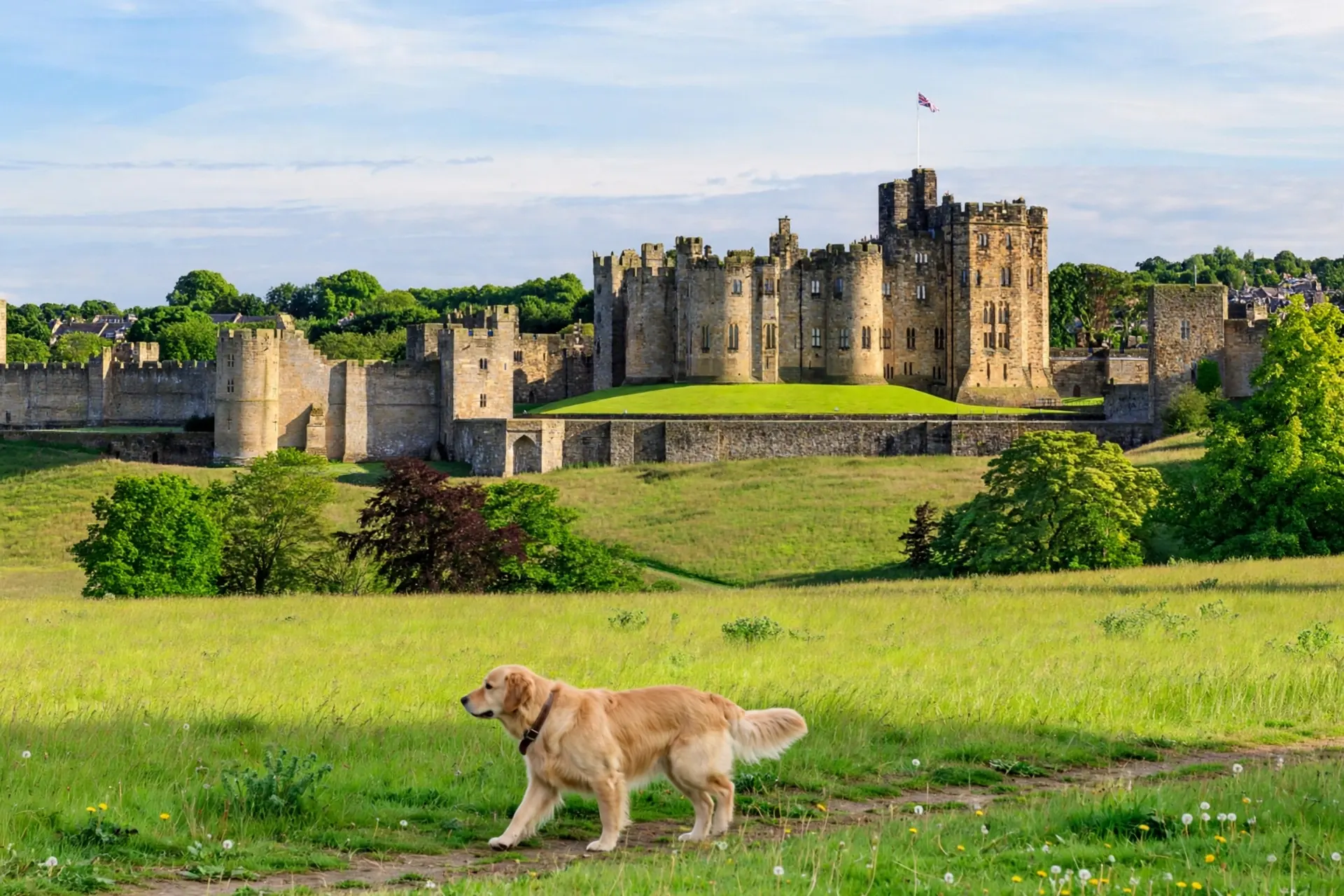
Do not try to take your dog through Alnwick Castle and The Alnwick Garden as if they were one attraction. They are separate places with separate rules, and dogs are not generally admitted to either in the way they are to a public park. Split your party, take turns, and give the dog the better half of the day: Hulne Park and the River Aln. The town itself — its streets, market square and Barter Books — is the easy, dog-welcoming part of the trip.
The split-visit problem: castle and garden
Most visitors arrive in Alnwick with one plan and one dog, and the plan falls apart at the first gate. Alnwick Castle and The Alnwick Garden sit close together on the edge of the town, and it is natural to assume they work as a single day out. They do not, at least not for a dog owner. The castle is a historic house and visitor attraction with its own admission and entry conditions; the garden is a separate attraction with its own ticket, its own opening times and its own rules about dogs. The two sets of rules are not the same, and neither is the same as the rules for the public paths and parkland around them. The single most useful thing you can do before you travel is to check the official guidance before you travel for both places, on the day you plan to go, rather than relying on a general impression that either place is "dog-friendly".
The practical rule of thumb is this: assume the dog stays outside both the castle building and the garden, and plan the day around that assumption. Assistance dogs are the usual exception, as they are at most UK attractions, but a pet dog should not be expected to be admitted. That sounds like bad news, and for a solo traveller it genuinely is a constraint. For a couple, a family or a group of friends, it is simply a rota problem. One person visits the castle while the other walks the dog; then you swap, or the second person visits the garden while the first takes the dog to the river. The person with the dog is not the person missing out. Hulne Park, which begins almost at the garden's edge, is a far better dog walk than either attraction would be, and the dog's half of the day is the part you will both remember.
Make the swap concrete before you arrive, because the vague version — "we will sort it out when we get there" — is what strands one person with a bored dog beside a car park. Agree on a meeting point and a time. The town centre works well: the Market Place is a short walk from both the castle and the garden, and it has cafes where the waiting person can sit with the dog. Agree on a time limit for each visit, too. Two hours inside the castle is a generous visit; three hours in the garden, with its water features and long paths, is a full one. Shorter is kinder to the person waiting outside, and a dog that has already had a proper walk will settle far better while it waits than a dog that has been marched straight from the car to a bench.
Walk the dog first, then split. This is the single best piece of sequencing advice in this guide, and it applies whether you are travelling as a pair or alone. A dog that has had forty minutes in Hulne Park, with time to sniff, toilet and settle, will wait quietly outside a cafe or rest in the car in shade with the windows cracked and water available. A dog that has had no walk at all will pull, whine and demand attention at exactly the moment its owner is trying to enjoy the castle. If you are travelling alone, the honest version of this advice is harder: you cannot take a pet dog into the castle or the garden, so your choice is between skipping one or both, or booking a local dog-sitting or day-care arrangement in advance. Do not leave a dog alone in a car while you visit an attraction, and never assume a stranger will watch your dog outside a gate.
Check opening times separately, because the castle and the garden do not run identical seasons. The castle is a seasonal attraction with a defined open season, and the garden also varies its hours through the year. Both can close for private events, filming or maintenance, and both can change their dog policy, so the guidance you read in spring may not match the rules in October. Check the official guidance before you travel, and check it again a day or two before you set off. If either place is closed on your date, the split-visit problem disappears and the day becomes simpler: the whole day belongs to the dog, the town and the parkland, which is no bad outcome at all.
Finally, manage expectations about what the dog gets from the famous sights. A dog does not care about the castle's history or the garden's planting design, and it will not be disappointed to miss them. What a dog does care about is open ground, interesting smells, moving water, shade and a calm owner. Alnwick gives a dog all of those in abundance, just not inside the ticketed attractions. Once you accept that split, the day stops being a negotiation and becomes a good walk with a castle in the background — which is, for most dogs, the better deal.
Hulne Park: the big walk
Hulne Park is the reason Alnwick works so well as a dog destination, and it is the walk to build your day around. It is a large area of estate parkland on the western edge of the town, crossed by the River Aln, with open grassland, woodland, riverside paths and long views back towards the castle. It feels spacious in a way the town centre cannot, and it gives a dog the two things a town walk never quite provides: room to move at its own pace, and ground that changes underfoot — grass, woodland floor, riverside track — so that the walk stays interesting for an hour or more. The park is also where the "waiting" half of a split visit should go. While one person is inside the castle, the other can be properly walking the dog here, not killing time on a pavement.
Enter from the town side and the first thing to notice is how quickly the noise drops away. The paths lead past the remains of Alnwick Abbey, a ruined abbey by the river, and on through woodland and open parkland towards Brizlee Tower, a stone folly on a hill that makes a natural turning point for a longer walk. The tower is a useful landmark for judging distance: a gentle out-and-back to the abbey and back is a short walk of well under an hour, while a loop that takes in the tower is a proper half-day outing. Distances feel longer than they look on a map because the ground undulates and the riverside paths meander, so allow more time than the mileage suggests and carry water for the dog even on a mild day.
Keep the dog on a lead in Hulne Park. This matters for three reasons, and none of them is negotiable. First, the park is working estate land, and livestock and deer are present; a dog that chases, even playfully, can cause real harm and real trouble. Second, the park is shared with other walkers, families, runners and horse riders, and a loose dog that rushes up to a horse or a child creates a problem that a lead would have prevented. Third, the River Aln runs through the park, and a dog that plunges in after a duck or a scent can be swept into a current or stuck on a steep bank. A long line is a good compromise where the ground is open and clear: it gives the dog room to sniff and explore while keeping you in control. Check the signs at the entrance for the current lead rules, and follow them even when other dogs appear to be off lead.
The ground underfoot deserves a mention, because it changes with the weather. After rain, the riverside paths and the woodland tracks can be muddy and slippery, and the low ground near the river can flood or hold standing water. In a dry summer the same paths are firm and dusty, and the open grassland can be hot at midday with little shade. Good walking shoes matter here, and so does a towel in the car: a dog that has been through a muddy riverside path will need drying before it is allowed back into a cafe or a car. In winter, the park is quieter and the light is lower and more dramatic, but the paths are at their muddiest and the daylight is short, so start early and carry a torch if you plan a late-afternoon walk.
Wildlife is part of the park's character. Deer are often visible at a distance in the early morning or late evening, and the river attracts herons, ducks and kingfishers. For a dog, every one of those is a reason to pull, so keep the lead short near the riverbank and near any deer you can see. Do not let the dog drink from the river without thinking: river water can carry bacteria and parasites, and a dog that drinks from a slow pool after livestock have been nearby is taking a risk. Carry fresh water and a bowl, and offer it regularly, especially on warm days. If your dog does swim, rinse it off afterwards if you can, and watch for ear irritation in the days that follow.
Respect the park as a place other people use quietly. Take bags and use them — there are no excuses in a park this well used — and carry them out if there is no bin at the exit you use. Keep the dog out of the river at the abbey ruins and away from any fenced or signed-off areas, and do not let it dig in the open grassland. The park is free to enter, which is generous, and the price of that generosity is that every visitor leaves it as they found it. A dog owner who does that is welcome back; a dog owner who does not gives the next dog owner a harder time.
The River Aln: the short walk
If Hulne Park is the big walk, the River Aln is the short one — and for many dogs, the short one is the one they actually need. The river runs through and around Alnwick, and its banks offer a gentle, level walk that starts close to the town centre, needs no driving, and fits neatly into the gaps of a split visit. It is the walk to choose when you have forty minutes between the castle and lunch, when the dog is older or less fit, or when the weather is good enough for a stroll but not good enough for a long hike across muddy parkland. It is also the walk that gives you the castle in the background without the castle's entry rules, which is a fair trade.
The best stretch for a dog is the riverside path downstream from the town, where the water is visible, the banks are open, and the path is wide enough for a dog on a lead to walk beside you without blocking other users. Walk slowly and let the dog sniff. A riverside walk is a scent-rich walk: the dog will read the river, the bank, the trees and the other dogs that passed that morning, and that mental work tires a dog out faster than the same distance on a pavement. Do not rush it. Forty minutes of slow riverside sniffing will settle most dogs better than an hour of brisk marching on a road.
Water is the pleasure and the risk of this walk. Dogs are drawn to rivers, and the Aln is no exception. A dog that paddles at the edge on a lead is enjoying the walk; a dog that launches itself into a fast stretch, or that scrambles down a steep bank and cannot get back up, is in trouble. Keep the lead on near the water, and keep it short where the bank drops. After heavy rain, the river rises and runs faster than it looks, and the banks become slippery with mud. If the water is high, brown and fast, keep the dog well back and shorten the walk. Never throw a ball or a stick into the river for a dog to fetch: the current decides where it goes, and the dog will follow it.
The riverside path also connects Alnwick to its surroundings in a way that rewards a slightly longer walk. Follow the river out of town and the houses thin out, the path becomes quieter, and the walk turns into a proper countryside outing. This is a good option for the second half of the day, after the castle and garden visits are done and the whole party is together again. Walk out for half an hour, turn around, and walk back: the dog gets a second walk, the group gets a shared walk instead of another split, and the day ends with everyone tired in the right way.
Other users matter here more than in Hulne Park, because the path is narrower and closer to the town. Cyclists, runners, families with children and other dog walkers all use it, and the path is a shared space, not a dog exercise area. Keep the dog on your side of the path, shorten the lead when someone approaches, and step aside where the path narrows. If your dog is reactive to other dogs, the riverside path at a busy weekend hour is a poor choice; go early in the morning or late in the afternoon instead, or use the wider ground in Hulne Park where you can see other dogs coming from a distance.
Finally, think about what the dog drinks and where it toilets. Carry water, as ever, and do not rely on the river. Use the bins provided where they exist, and carry bags out if they do not. The river is a public asset and a wildlife habitat, and the standard is the same as in the park: leave the bank cleaner than you found it, and the next dog walker will find the same good walk you did.
The town centre and Barter Books
Alnwick town centre is small, walkable and — for a dog owner — pleasantly undramatic. The Market Place sits at the heart of the town, surrounded by stone buildings, with the castle at one end of the main street and the river at the other. The streets are narrow in places, and the pavements can be busy on a market day, but the distances are short: you can walk from the castle to the Market Place, down to the river and back, in well under an hour, and the dog will have had a proper town walk without ever needing the car. That compactness is the town's greatest strength. Everything in this guide is within a short walk of everything else, which means less driving, less waiting and less time spent working out where the dog is allowed to be.
The Market Place itself is worth a slow circuit. On market days it fills with stalls, shoppers and the smell of food, and a dog on a lead can enjoy the bustle if it is comfortable in a crowd. If your dog is not comfortable in a crowd — if it startles at trolleys, flinches at children, or barks at other dogs — then walk the market square early, before the stalls are fully set up, or skirt it along the quieter side streets. There is no rule that says a dog must enjoy a market, and a dog that is stressed by a crowd will not enjoy the rest of the day either. Read your dog, not the guidebook, and choose the quieter route when the dog tells you to.
Barter Books is the town's most famous dog-friendly stop, and it is worth planning around. Housed in the old Alnwick railway station, it is one of Britain's largest second-hand bookshops, and it welcomes dogs inside. That is a genuine pleasure for a dog owner who has spent the morning outside the castle and the garden: here, at last, is a famous Alnwick attraction where the dog is invited in, not left outside. The building is large, the floor is solid, and the atmosphere is calm — the station's old waiting room now holds a cafe, and the book rooms stretch along the former platform. Keep the dog on a lead, keep it close in the narrower aisles between shelves, and do not let it nose the books off the lower shelves. A dog that settles under a table in the cafe while you browse is the ideal Barter Books dog; a dog that pulls from shelf to shelf is not.
The cafe inside Barter Books is a good place for the waiting half of a split visit to spend time with the dog. It is warm, it is indoors, and it is one of the few places in Alnwick where the dog is genuinely part of the visit rather than an exception to it. Order, sit, let the dog settle, and read a book you have just bought. If you are the person who has just come out of the castle, it is also a good place to compare notes with the person who walked the dog: the castle visitor tells the dog walker what they saw, and the dog walker tells the castle visitor what the dog found in the park. That exchange, over coffee, is the point of a split visit done well.
Beyond Barter Books, the town's shops and cafes set their own rules, and those rules vary from door to door. Some shops welcome dogs openly and will have a water bowl by the door; others ask dogs to wait outside; many have no sign at all, which means you should ask before you walk in. The polite rule is to look for the sign, and if there is no sign, to ask a member of staff. Do not assume that because one shop welcomed the dog, the next one will. And do not tie a dog up outside a shop and go inside: it is stressful for the dog, it is a theft risk, and it is unnecessary in a town this small, where one person can always wait with the dog while the other goes in.
The town's side streets reward a wander. Bailiffgate, Narrowgate and the lanes around the Market Place hold small shops, galleries and cafes, and the stone buildings give the town a consistent, handsome character. Walk slowly, keep the dog on a short lead on the narrow pavements, and give way to other pedestrians. A dog on a long lead across a narrow pavement is a trip hazard, and a dog that darts into a shop doorway can startle someone coming out. Short lead, close heel, and a calm pace: that is the whole technique for a town walk, and it works in Alnwick as well as anywhere.
Parking without the circling
Parking in Alnwick is not difficult, but it rewards a plan and punishes improvisation. The town's streets are narrow and old, and the roads near the castle are not designed for cars circling in search of a space. The sensible approach is to choose a car park before you arrive, drive to it, and walk from there. The signed town car parks are the obvious choice: they are close to the centre, they are designed for visitors, and they put you within a short walk of the castle, the garden, the town centre and the river. Circling the streets in the hope of a free on-street space saves nothing and costs time, fuel and patience — and a dog waiting in a circling car is not having a good morning.
Choose your car park by your first walk, not by your first attraction. If the dog's first job is a walk in Hulne Park, park on the side of town nearest the park entrance. If the first job is the castle, park nearest the castle. If you are splitting the party, park somewhere the waiting person can reach a cafe and a walk without moving the car. The point is to park once and walk everywhere, because Alnwick is small enough for that, and because every move of the car is a move the dog has to endure. Check the tariff board and the maximum stay before you leave the car, and pay for enough time: a rushed return to feed a meter is the enemy of a relaxed day.
Never leave a dog in a parked car on a warm day, and be cautious even on a mild one. A car heats up far faster than most people expect, and a dog in a hot car is in danger within minutes. If the dog cannot come with you into the castle or the garden, the answer is a split visit, a shaded walk, or a cafe — never the car as a waiting room. On a cold day the risk is different but still real: a dog left alone in a cold car can become chilled and distressed, and a dog left alone anywhere can bark, scratch and damage a car interior. The rule is simple and absolute: if the dog is with you, the dog is with a person, not in a car.
Think about the return to the car, too. A dog that has had a long walk in Hulne Park will be muddy, wet or both, and the car needs to be ready for that. Keep a towel and a blanket in the boot, and a spare lead. If the dog is wet, dry it before it gets into the car, and put the blanket down first. A dog that travels home wet and cold is a dog that will be stiff and miserable by the time you get home, and a wet car is a car that smells of wet dog for a week. Five minutes of drying in the car park is time well spent.
For visitors staying overnight, ask your accommodation about parking before you arrive. Some places include a space; others rely on the public car parks, which may have overnight restrictions or charges. Check the official guidance before you travel for the car park you plan to use overnight, and do not assume that a daytime space is an overnight space. If you are arriving by public transport instead, Alnwick is served by buses from the nearby mainline station at Alnmouth, and the walk from the bus stop into the town is short and level — a good option if you would rather not drive at all.
Where to stay with a dog
Alnwick has a good range of dog-friendly places to stay, and the range is part of its appeal. There are pubs with rooms in the town centre, bed and breakfasts in the streets around the Market Place, and self-catering cottages in and around the town. For a dog owner, the differences between those options matter more than the price. A pub with rooms puts you in the middle of the town, with a bar downstairs that may welcome the dog and a short walk to the river in the morning. A bed and breakfast gives you a host who knows the local walks and can advise you in person. A self-catering cottage gives you a kitchen, a garden and the freedom to come and go with the dog without negotiating mealtimes.
When you enquire, ask the questions that decide whether the stay will work, and ask them before you pay. The list is short: is there a pet fee, and how much is it per dog per night or per stay? How many dogs are allowed, and is there a size or breed condition? Can the dog be left alone in the room, and if so, for how long and under what conditions? Is there an enclosed garden, and how high is the fence? Is the room on the ground floor, or are there stairs the dog must manage? Get the answers in writing, with the fee itemised on the booking confirmation. A place that answers these questions clearly is a place that has thought about dogs; a place that answers vaguely is a place that will surprise you on arrival.
Think about the dog's night as well as its day. A dog that has walked all day in Hulne Park will sleep well, but only if its sleeping arrangements are familiar. Bring its own bed or blanket, its own bowl, and its usual food — do not change the food on a holiday, because a stomach upset in a strange room is miserable for everyone. Keep the feeding and last-outing routine as close to home as possible. If the dog sleeps in a crate at home, bring the crate; if it sleeps on its own bed, bring that. A dog that settles quickly in the evening is a dog that will be ready for an early walk in the morning, and an early walk in Alnwick, before the town wakes up, is one of the best parts of staying over.
Location matters for a stay, and the best location depends on your dog. If your dog is older or less mobile, choose somewhere close to the river path or the Market Place, so the morning toilet walk is short and level. If your dog is young and energetic, a place on the edge of town, nearer Hulne Park, gives you a longer walk from the door. If your dog is reactive, ask for a quiet room away from the main entrance and the dining room, and avoid a room that faces a busy street where the dog will watch every passer-by. These are small choices, and they make the difference between a stay that feels easy and a stay that feels like a negotiation.
Alnwick also works as a base for a longer stay in Northumberland. The county is large, and its castles, beaches and border country are spread out, so a single base cannot cover everything. But Alnwick's position is convenient: the coast is a short drive east, the Cheviot Hills are to the west, and the city of Newcastle is within easy reach to the south. Our Northumberland dog guide covers the county's castles, beaches and dark-sky stays in more detail, and it is worth reading before you decide whether to stay one night in Alnwick or a week in the county. If you do stay longer, plan rest days: a dog that walks hard every day for a week will be tired and sore by the end of it, and a quiet day in the town, with a short river walk and a long afternoon in Barter Books, is a kindness.
Book early for the times when Alnwick is busiest. School holidays, bank-holiday weekends and the summer months fill the dog-friendly rooms first, because there are fewer of them than there are ordinary rooms. If you are travelling in peak season, book weeks or months ahead, and confirm the dog arrangements at the time of booking, not a week before arrival. In the quieter months, you will have more choice and more flexibility, and a host who has time to talk to you about the local walks is worth more than any booking-site filter.
Eating and drinking with a dog
Eating out with a dog in Alnwick is straightforward once you know the pattern, and the pattern is the same as in most English market towns. Dogs are generally welcome in pub gardens, on terraces and in the bar areas of pubs that choose to welcome them; they are less often welcome in formal restaurant dining rooms. Cafes vary: some welcome dogs throughout, some welcome them in a particular area, and some ask dogs to wait outside. The rule is to look for the sign, ask a member of staff, and respect the answer. A pub that welcomes dogs is doing you a favour, and a dog that behaves well in that pub keeps the door open for the next dog owner.
The best dog-friendly meal in Alnwick is often the simplest one: a pub lunch with the dog under the table. Choose a pub with a flagstone or wooden floor rather than a carpeted dining room, because a dog that settles on a hard floor is easier to manage and easier to clean up after. Ask for a table in a corner or by the wall, where the dog can lie out of the way of the route to the bar. Bring a mat or blanket for the dog to lie on — a dog that has its own place will settle faster than a dog that is expected to lie on a strange floor. And bring water: pubs will usually provide a bowl if you ask, but a collapsible bowl in your own bag is more reliable.
Terraces and gardens are the summer answer. A dog that can lie in the shade of a pub garden while you eat is a happy dog, and the garden gives the dog space without the constraints of an indoor room. But check the details: is the garden enclosed, or does it open onto a road? Is there shade, or will the dog be in full sun at midday? Is the garden busy with children and other dogs, or is it quiet enough for a nervous dog? A garden that looks good in a photograph can be a poor fit for a reactive dog, and a quiet corner of a smaller pub can be a better choice than the famous garden everyone recommends.
Teach the dog the restaurant routine before you travel, because the routine is a skill, not a temperament. A dog that has practised lying quietly under a table at home, with a chew or a stuffed toy to keep it occupied, will manage a pub lunch. A dog that has never been asked to lie still in a busy room will not learn how in the middle of a meal. Practise at home with a cafe visit first, keep the first pub visit short, and be ready to take the dog outside for a break if it becomes restless. Leaving a meal early because the dog needs you is not a failure; it is the deal you make when you bring a dog to a restaurant.
If you are staying in self-catering accommodation, the eating question is simpler: cook for yourself, eat in, and take the dog to the pub for a drink rather than a meal. Alnwick has food shops in the town centre, and a self-catering cottage with a kitchen gives you the freedom to eat when the dog is tired and settled. And if you are visiting in the winter, when terraces are closed and gardens are cold, the indoor dog-friendly pubs and the cafe at Barter Books become more important — they are the warm rooms where the dog is genuinely welcome, and they are worth knowing about before you arrive cold and wet from a walk.
Seasons, opening times and crowds
Alnwick changes through the year, and the best time to visit with a dog depends on what you want from the trip. Spring is the gentlest season: the garden is coming into flower, the parkland is green, the river is full, and the town is busy but not crowded. The paths can be muddy after winter rain, and the weather can change quickly, so pack layers and a waterproof for the dog as well as for yourself. Spring is also the season when livestock and young wildlife are most vulnerable, so keep the dog on a lead in the parkland and near the river, and keep it out of fields where lambs or nesting birds may be present.
Summer is the busiest season, and the one that needs the most planning. The castle and the garden are at their fullest, the town is at its busiest, and the car parks fill early. Arrive early, walk the dog in Hulne Park before the heat of the day, and use the middle of the day for the shaded town centre, Barter Books and a long pub lunch. Heat is the real risk in summer: a dog can overheat on a long walk in full sun, and a dog in a car is in danger within minutes. Carry water, walk in the shade, avoid the midday sun, and never leave the dog in a parked car. If the day is genuinely hot, shorten the walks, lengthen the rests, and let the dog swim — on a lead, and only where it is safe — rather than pushing on.
Autumn is, for many dog owners, the best season in Alnwick. The crowds thin, the light turns golden, the parkland colours change, and the air is cool enough for long walks without the dog overheating. The garden has its own autumn character, and the castle season is still running in early autumn. The paths can be slippery with fallen leaves, and the river can rise after autumn rain, so watch the ground and the water. Autumn is also the season when the town feels most like itself again, after the summer visitors have gone: the market is local, the pubs are quiet, and a dog owner can walk the streets without negotiating a crowd.
Winter is the quietest season, and it has its own rewards. The town is calm, the parkland is stark and beautiful, and a dog that likes cold weather will enjoy the long walks more than it would in summer. But winter is also the season when the castle and the garden are most likely to be closed or on reduced hours, so check the official guidance before you travel and do not plan a split visit around an attraction that is not open. Daylight is short, so start walks early and carry a torch. The paths are at their muddiest, the river is at its highest, and the wind across the open parkland can be bitter, so dress the dog as well as yourself: a waterproof coat for a short-coated dog is a kindness, not an indulgence.
Crowds deserve a word of their own, because they shape the dog's day more than any other factor. Alnwick is a popular destination, and on a sunny bank-holiday weekend the castle, the garden and the town centre can all be busy at once. A dog that is comfortable in a crowd will cope; a dog that is not will be stressed, and a stressed dog makes the whole day harder. If you can choose your date, choose a weekday, or a weekend outside the school holidays. If you cannot choose, arrive early, walk the dog first, and use the quiet hours before the crowds arrive. The town is at its best in the early morning, when the streets are empty, the river is quiet, and the dog has the parkland almost to itself.
Finally, check the calendar for events. Alnwick hosts markets, fairs and festivals through the year, and a festival can transform the town centre for a day — more people, more noise, more food smells, more dogs. For some dogs that is exciting; for others it is overwhelming. Check what is on before you travel, and if a large event coincides with your visit, plan around it: walk the dog early, visit the town late, or choose a different day. The event is not a problem, but it is a fact, and a dog owner who knows the fact can plan around it.
A workable day plan
Here is a day plan that puts the advice in this guide together, for two people and one dog, visiting Alnwick on a day when the castle and the garden are both open. It is a template, not a timetable: adjust it to your dog, your party and the weather, and be ready to abandon it if the dog tells you to. The principle behind it is simple: walk first, split second, come together third.
Start early. Arrive in Alnwick by nine, park once, and walk straight into Hulne Park for forty-five minutes to an hour. Let the dog sniff, toilet and settle, and walk as far as the abbey ruins or beyond. This is the dog's walk, and it sets the tone for the day: a dog that has walked is a dog that will wait, settle and behave for the rest of the day. Carry water, keep the lead on, and take the time to enjoy the parkland yourself — the early morning light on the river is worth the early start.
Then split. One person visits the castle while the other takes the dog into the town centre: a slow circuit of the Market Place, a browse in Barter Books, and a coffee in the cafe with the dog settled under the table. Meet at an agreed time and place — the Market Place is the obvious choice — and swap. The second person visits the garden while the first takes the dog for the short riverside walk along the Aln, or back into Hulne Park for a shorter loop. The dog gets two walks and a cafe visit; each person gets one attraction; nobody waits beside a car park.
Come together for lunch. Choose a dog-friendly pub, ask for a corner table, and let the dog lie on its mat while you eat. A pub lunch is the natural end to a split morning: it gives everyone a rest, it gives the dog a chance to settle, and it gives the party a chance to compare notes. If the dog is restless, take it outside for a short break and come back; if it is settled, stay as long as you like. After lunch, take a shared walk — the riverside path out of town, or a longer loop in Hulne Park — and then return to the car, dry the dog, and drive home. That is the whole day, and it is a good one.
If you are travelling alone, the plan changes but the principle does not. Walk the dog first in Hulne Park, enjoy the town centre and Barter Books with the dog, and treat the castle and the garden as places to visit on another trip — or to visit while the dog is in local day care, booked in advance. A solo day in Alnwick with a dog is still a full day: the park, the river, the town and the bookshop are more than enough, and the castle will still be there next time. Do not try to fit a solo castle visit around a dog left in a car; the day is not worth the risk.
If you are staying overnight, the plan stretches naturally. Use the first day for the split visit and the second day for a longer walk — the coast to the east, or a longer loop in Hulne Park, or a day trip to Newcastle, which is an easy drive south and has its own dog-friendly quayside, parks and coastal walks. Our Newcastle with a dog guide covers the city in the same practical style as this one, and it pairs well with an Alnwick stay: a market town one day, a riverside city the next, and the dog walked properly in both. Whatever you choose, end each day the same way: a short evening walk, a familiar bed, and a dog that is tired in the right way.
Practical questions
Before you go
Can dogs go into Alnwick Castle?
Dogs are not generally admitted inside the castle itself, and assistance dogs are the usual exception. The rules for the castle grounds can differ from the rules for the building, so check the official guidance before you travel, and plan on the dog staying outside the castle with one member of your party.
Can dogs visit The Alnwick Garden?
The Alnwick Garden has its own entry rules, and dogs are not generally admitted in the same way as in a public park. Assistance dogs are the usual exception. Check the official guidance before you travel, and treat the garden as a separate, dog-free visit that you plan around rather than through.
Where is the best dog walk in Alnwick?
Hulne Park is the best all-round choice: broad estate parkland beside the River Aln with long, quiet routes, open grass and woodland shade. The riverside paths along the Aln are the best short alternative, and both are best walked with the dog on a lead because of livestock, wildlife and other walkers.
Is Alnwick town centre dog-friendly?
Yes, in the practical sense that matters most: the streets, the Market Place and the riverside paths are easy on a lead, and Barter Books, the famous second-hand bookshop in the old station, welcomes dogs inside. Individual shops and cafes set their own rules, so look for the sign on the door and ask before you walk in.
Where can I park in Alnwick with a dog?
Use the signed town car parks rather than circling the narrow streets by the castle. Choose a car park close to your first walk so the dog is not left waiting in the car, check the tariff board and the maximum stay before you leave the car, and never leave a dog in a parked car on a warm day.
Can I stay overnight in Alnwick with a dog?
Yes. Alnwick has dog-friendly pubs with rooms, bed and breakfasts and self-catering cottages in and around the town. Confirm the pet fee, the number of dogs allowed, whether the dog can be left alone in the room, and whether the garden is enclosed, and get the answers in writing before you pay.