This guide is independent and contains no paid placement. If affiliate links are added later, they will be clearly marked and will not change our editorial checks.
Alston rewards dogs that are happy on long, gentle trails and open moor. Walk the South Tyne Trail in short railway sections, keep your dog on a lead around sheep and ground-nesting birds from March to July, and plan around the altitude: the weather on the fells can be a season ahead of the town.
A lead town at the top of England
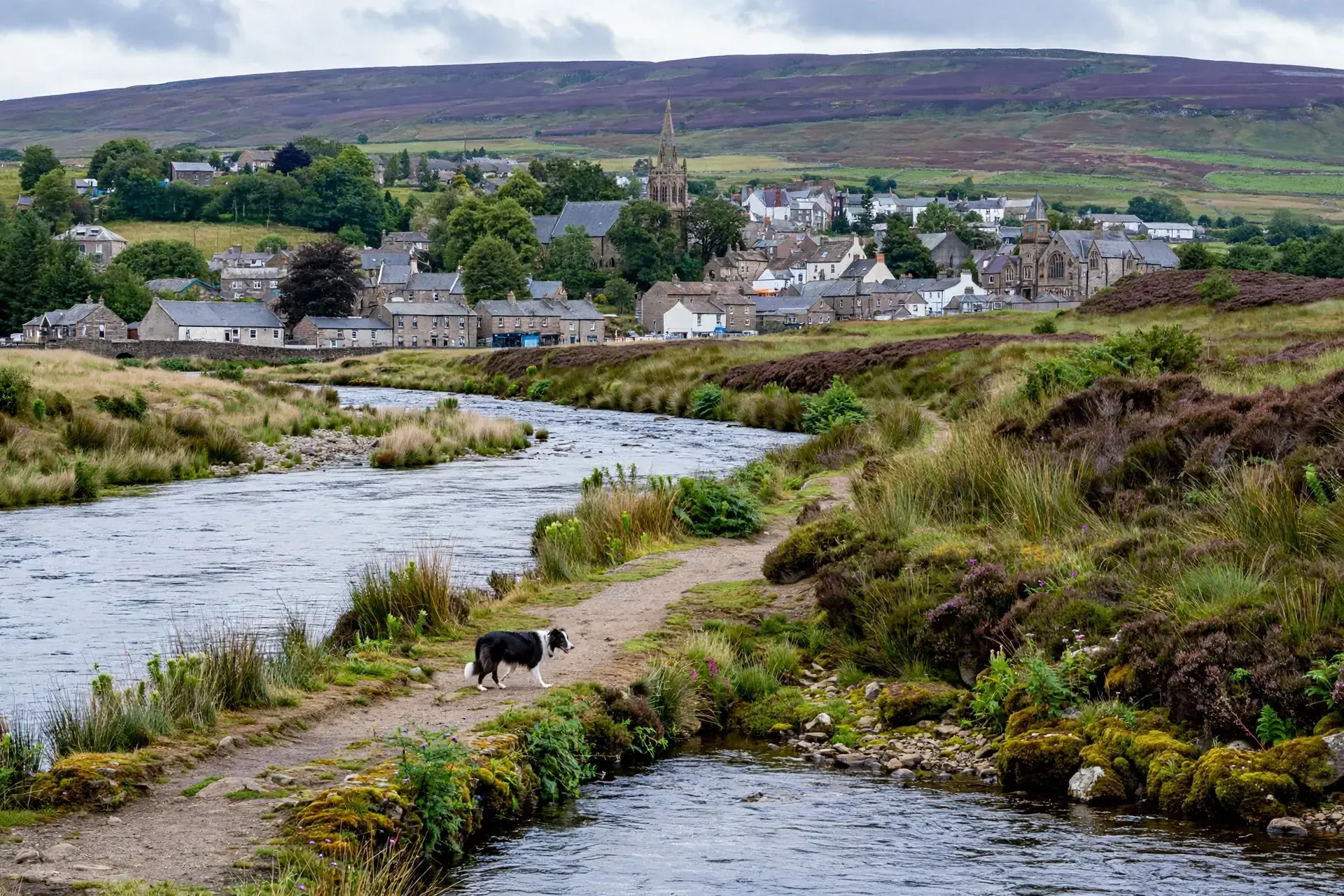
Alston is usually introduced with a single superlative, that it is the highest market town in England, sitting at roughly 300 metres above sea level in the North Pennines. The figure is worth knowing, but it only makes sense once you understand what built the town in the first place. Alston was a lead-mining town, and the whole valley around it was shaped by that trade. The River South Tyne rises on the fells above the town, and for two centuries the valley below it was worked for lead ore, with mines, smelt mills, workers' cottages, packhorse tracks and later a railway all fitted into a narrow, steep-sided valley. When you walk here with a dog, you are walking through an industrial landscape that has softened into moorland, woodland and pasture, and the clues are everywhere if you know what to look for.
The mining story is easiest to read in the buildings and the ground itself. Alston's steep Front Street climbs from the river to the Market Cross, and the stone houses along it were built for a working town rather than a resort. Look for the solid two-storey cottages, the former shops and workshops, and the way the town crowds into the valley bottom because the land above was too exposed and too valuable as mining ground to build on. A few miles up the valley, Nenthead was the centre of the mining industry, and it is often described as the highest village in England, at around 450 metres. The remains there include mine buildings, spoil heaps, a smelt mill chimney and the long, straight lines of the mineral tramways. Dogs on leads are welcome around the outdoor remains, and the open ground is one of the most interesting places in the North Pennines to walk a dog that is comfortable on rough, uneven terrain.
The lead trade was organised on a scale that still surprises visitors. The London Lead Company, a Quaker-owned business, ran much of the mining in Alston Moor from the late eighteenth century onwards, and it built housing, a school and a library for its workers at Nenthead, which was unusual for its time. The mines produced lead and silver, and the ore was carried out by packhorse and later by rail. When the mines declined in the late nineteenth century, the valley emptied, and the population of Alston Moor fell sharply. That history explains the character of the place today: a small, quiet town with a strong sense of its own past, surrounded by empty moorland that was once busy with miners, smelters and quarrymen. The silence on the fells is a recent thing, and walking there with a dog you can feel how recently the valley was a working place.
The railway is the second strand of the story, and it is the one that matters most for dog walkers. The Haltwhistle to Alston branch line opened in the 1850s to serve the mines and the town, and it closed to passengers in 1976 as part of the long decline of rural railways. The trackbed was later converted into the South Tyne Trail, which is why Alston has one of the best traffic-free valley walks in northern England. The old station at Alston is now the terminus of the South Tynedale Railway, a narrow-gauge heritage line that runs down the valley towards Slaggyford, and the station yard is a useful landmark for the start of a walk. The railway's story also explains why the trail is so gentle: it follows the gradient a steam locomotive could manage, which means long, easy miles for a dog that is happy to keep moving but does not want steep climbs.
Before you set off, it helps to understand the shape of the land. The South Tyne rises on the moors above Garrigill, flows south through Alston and then turns north-east towards Haltwhistle, where it joins the North Tyne. The valley is narrow and wooded in places, open and moorland in others, and the fells rise steeply on both sides. Cross Fell, at 893 metres, stands to the south-west of Alston and is the highest point of the Pennines outside the Lake District, and the Pennine Way crosses it. The ground is high, exposed and often wet, and the weather changes fast. That is the single most important thing to carry into a walk here: a bright morning in the town can turn into wind, rain and low cloud on the fell within an hour, and a dog that is comfortable in the valley may need a coat, a drying towel and a shorter route on the tops.
The practical consequence of the altitude is that Alston is colder than the towns most visitors drive from. Snow is not unusual from late autumn into spring, and the roads over the fells, including the A686 over Hartside, can be closed or difficult in winter. The town itself is well served by shops, cafes and pubs, but the surrounding countryside is genuinely remote, with long stretches of path where there is no shelter, no water and no phone signal. Plan walks the way you would plan any upland walk: check the forecast, carry a map, take more water than you think you need, and have a shorter route in mind before you start. Dogs cope well with the Pennines, but they cope best when their owners respect the height and the wind.
The South Tyne Trail, section by section
The South Tyne Trail runs for about 23 miles from Alston to Haltwhistle, following the old railway line all the way down the valley. It is a multi-use trail, shared by walkers, cyclists and horse riders, and it is surfaced with compacted stone for most of its length. Because it was built for trains, the gradients are gentle and the curves are wide, which makes it one of the most forgiving long-distance valley walks in the North Pennines. You do not need to walk it end to end. The trail is best used in sections, and the sections below are the ones that work best with a dog, starting at Alston and working downstream.
The first section, from Alston to Slaggyford, is about three miles and is the natural first walk for anyone staying in the town. Leave Alston by the old station and follow the trail as it drops gently through woodland and open fields beside the river. The path is wide and easy underfoot, and there are places where the river runs close enough for a dog to paddle in settled weather. Slaggyford is a small village with a handsome viaduct, and it is a good turning point for a first outing: walk down, have a rest, and walk back, or arrange a lift from the other end. The heritage railway runs part of this section on its own narrow-gauge track beside the trail, and on running days you will hear the little steam locomotives, so keep a nervous dog close and on a lead as the train passes.
The second section, from Slaggyford to Lambley, is another three miles or so and is quieter than the first. The trail passes through a mix of woodland, pasture and riverside meadow, and the river is never far away. Lambley has a church and a viaduct, and the village is a useful stop for a shorter walk if you drive to the trailhead there. This is also the section where livestock is most likely to be close to the path, because the fields on either side are grazed. Keep your dog on a lead through the farm sections, and be ready for gates and stiles where the trail crosses farm tracks. The surface stays good, but after heavy rain the lower stretches can be muddy, and the river can rise quickly enough to flood the lowest parts of the path.
The third section, from Lambley to Featherstone and on towards Haltwhistle, is the longest and most varied stretch. The trail passes Featherstone Castle, crosses the river on old railway bridges, and runs through woodland that is particularly good in autumn. The distance from Lambley to Haltwhistle is roughly eight miles, so this is a full-day walk rather than a morning stroll, and most dog owners tackle it as a one-way walk with a lift or a bus back. The trail here is further from the road and feels more remote, with long stretches where you will meet nobody. Carry water for the dog, because there are few places to fill up, and check the official guidance before you travel if you plan to rely on a bus back, because rural services are infrequent.
Walking the trail in the other direction, upstream from Alston towards Garrigill and the head of the valley, is a different experience and a shorter one. The valley narrows, the river becomes a beck, and the path climbs gently towards the village of Garrigill, about three miles from Alston. This is a good walk for a dog that likes open ground and running water, and the beck has shallow stretches for paddling in summer. Beyond Garrigill the valley opens onto the moors around Tynehead, where the river begins, and the walking becomes rougher and more exposed. This is where you need to start thinking about the moorland rules in the next sections of this guide, because the ground is open, the sheep are free-ranging, and the weather can change in minutes.
A few practical points apply to the whole trail. Dogs are welcome throughout, but the Countryside Code applies: keep your dog on a lead near livestock, near roads and where the path runs beside the river in spate. Pick up after your dog and take the bag with you, because there are few bins on the trail and the farmers who work the valley notice. The trail is open all year, but winter ice and snow can make the surface treacherous, and the lowest sections can flood after heavy rain. In summer, the trail is popular with cyclists, so keep your dog to one side and be ready to step aside. The trail is at its best in spring and autumn, when the light is low, the crowds are thin and the valley is at its most colourful.
For a first visit, the simplest plan is to walk the Alston to Slaggyford section and back, which gives you about six miles of easy riverside walking and a good sense of the valley. If that goes well, try the Garrigill walk the next day, which is shorter but wilder. The full trail to Haltwhistle is a project for a fit dog and a long day, and it is best saved for a return visit when you know the valley and your dog's stamina. The trail rewards patience: it is not a walk to rush, and the best moments are the quiet ones, the river, the viaducts and the long views down the valley.
Walking and cycling the same valley
The South Tyne Trail is one of the few long routes in the North Pennines where walking and cycling genuinely share the same ground, and that opens up combinations that are hard to find elsewhere. The railway gradient means a cyclist can ride the whole valley without the steep climbs that dominate most Pennine routes, and a dog that is fit enough to trot alongside a bike can cover far more ground than on foot. The trick is to treat the trail as a set of building blocks rather than a single out-and-back, and to plan each combination around the dog rather than the distance.
The easiest combination is the bike-and-walk swap. One person cycles from Alston to Slaggyford while the other walks the dog along the trail, and you meet at the village, swap roles, and come back the other way. This works well because the trail is flat enough for an unhurried cyclist and interesting enough for a walker, and it means the dog gets a steady walk rather than a forced run. If you are cycling alone with a dog, a lead attached to the bike is not the right tool on a shared trail: use a proper bike attachment that keeps the lead low and away from the wheels, or keep the dog on a short lead in your hand at walking pace on the busiest sections. The trail surface is loose in places, and a dog that pulls can unbalance a bike on gravel, so build up gradually with short rides before attempting a longer one.
For dogs that cannot run beside a bike, a trailer or a basket is the practical answer, and the South Tyne Trail is gentle enough for both. A small dog in a front basket or a larger dog in a trailer can ride the valley in comfort, and the flat gradient means you are not hauling extra weight up steep hills. Check the width of the gates and barriers on the trail before you set off with a trailer, because some of the access points are narrow, and be ready to lift the trailer over the occasional step. If your dog is nervous of traffic, the trail is a good place to start because there are no cars, but the heritage trains, cyclists and horses are all new sights and sounds, so introduce them slowly and reward calm behaviour.
A longer combination is the valley loop that pairs the trail with the quiet lanes above it. Cycle or walk down the trail from Alston to Lambley, then return by the lanes that run along the valley side, which gives you a circular route with views over the river and the fells. The lanes are narrow and mostly empty, but they are used by farm vehicles and the occasional car, so keep the dog on a lead on the road sections and walk on the verge. The loop from Alston to Lambley and back by the lanes is roughly ten miles, and it is a full day out for most dogs. Shorter versions are easy to build by turning back at Slaggyford or by using the lanes only for the return leg, which cuts the distance and gives the dog a change of surface.
Cyclists should also know that the South Tyne Trail connects with the wider cycle network. The Pennine Cycleway, National Cycle Network route 68, passes through the valley, and the C2C, the Coast to Coast cycle route, runs not far to the south. That means Alston can be a stop on a longer cycling trip, and a dog that travels in a trailer can join a multi-day ride. The practical limit is the same as for any cycling with a dog: the dog's fitness, the weather and the surface. The Pennine Cycleway climbs steeply out of the valley in both directions, so a dog that is happy on the flat trail may struggle on the hills, and the exposed moorland sections are no place for a dog in a trailer in high wind.
Horse riders share the trail too, and this is where dog owners need to be at their most careful. A horse can be startled by a dog running towards it, and a rider has limited room to manoeuvre on a narrow path. When you see a horse ahead, call your dog back, put it on a lead, move to the side of the trail and stand still until the horse has passed. Talk to the rider so the horse knows you are a person rather than a surprise, and keep the dog close until the horse is well past. The same courtesy applies to cyclists: a dog that darts across the trail in front of a bike is a hazard to everyone, and the trail is narrow enough that a sudden movement can cause a fall.
Finally, remember that the trail is a shared space and that the best combinations are the ones that leave everyone room. Walk on the left, keep the dog close when others approach, and step aside for faster users. The valley is quiet enough that a little courtesy goes a long way, and the farmers, cyclists and riders who use the trail every day are the people whose goodwill keeps it open and welcoming. A dog that is calm around bikes and horses is a pleasure on this trail, and a dog that is still learning needs the quieter sections and the quieter times of day.
Market Cross, cafes and pubs
Alston's town centre is small, steep and full of character, and it is built around the Market Cross at the top of Front Street. The cross stands in a small paved square where the market was once held, and the streets that run off it are lined with stone shops, cafes and pubs. For a dog owner, the town centre is the practical heart of a visit: it is where you park, where you eat, where you buy supplies, and where you shelter when the weather turns. It is also the place where the town's dog-friendly reputation is earned or lost, one doorway at a time.
The Market Cross itself is a good place to start a walk. The square is traffic-calmed and the streets around it are narrow, so a dog on a short lead is comfortable here, and there are benches where you can sit and watch the town go by. The cross is thought to date from the nineteenth century, and the market it served was once the commercial centre of the whole of Alston Moor. The surrounding buildings include former inns, shops and workshops, and the steepness of Front Street is a reminder that the town was built on a hillside rather than a flat site. Take a slow turn around the square before you set off, and let the dog sniff the corners and the doorways: it is a small town, but it is full of smells, and a dog that has had a chance to explore the centre will settle more easily later.
Front Street runs steeply down from the Market Cross to the river, and it is lined with the town's shops and cafes. The street is narrow and the pavements are uneven, so keep the dog close and on a short lead, and be ready for the occasional car squeezing past. The shops include a small supermarket, a bakery, a butcher and a handful of gift shops, and most of them are used to dogs waiting outside or, in some cases, coming in with their owners. Ask before you bring a dog into a shop, and carry a bag for muddy paws, because the stone floors are easily marked and the shopkeepers remember the dogs that behave well.
The cafes and pubs around the Market Cross and Front Street are generally welcoming to dogs, and this is one of the things that makes Alston a good base for a dog holiday. The Angel Inn, on Front Street, is the town's best-known pub, and the Cumberland Hotel, near the Market Cross, is another long-standing inn. Both have a history of welcoming walkers and their dogs, and both offer the kind of warm, stone-flagged interior that suits a wet dog after a long walk. Policies vary by room, season and landlord, and some places are dogs-on-the-terrace only in summer or dogs-in-the-bar only in winter, so ask at the door before you settle in. Carry a mat for the dog to lie on, because stone floors are cold and hard, and a wet dog on a pub carpet is not a popular sight. If you are staying overnight, ask the accommodation about its dog policy before you book, because some rooms accept dogs and others do not, and the difference is usually in the small print.
Eating out with a dog in Alston is easier than in many towns of the same size, because the town is small enough that the staff know the regulars and the regulars know the dogs. The cafes around the square usually have outdoor seating in summer, and the pubs have fires in winter, and both are good places to rest a tired dog. Order at the bar or the counter where possible, and keep the dog out of the way of people carrying food. A dog that lies quietly under the table is welcome almost everywhere; a dog that begs, barks or wanders is not. The town's size works in your favour: if one place is full or does not take dogs, there is another a few steps away, and the walk between them is part of the pleasure of the place.
Parking and supplies are straightforward. There is public parking in the town, and the car parks are within a short walk of the Market Cross. Fill up with supplies before you head out onto the moor, because there are no shops once you leave the town, and the nearest large supermarket is a long drive away. Buy drinking water, dog food, poo bags and a spare towel, and check that you have a lead, a long line and a first-aid kit before you set off. The town's shops are used to walkers stocking up, and the staff are a good source of local advice: ask about the state of the trails, the weather on the fells and whether the river is up, and you will usually get an honest answer from someone who walked the same ground that morning.
The town centre is also the place to come back to at the end of a walk. A slow wander around the square, a coffee or a pint, and a chance for the dog to dry off and settle are the right way to finish a day on the fells. Alston is not a town that rewards rushing, and the best way to enjoy it is to treat the centre as a base camp rather than a destination: a place to eat, rest, plan and warm up between walks. The dog will learn the route from the car park to the pub faster than you will, and that familiarity is part of what makes a return visit so easy.
Moorland and high-fell loops
Above the valley, Alston Moor is open, treeless and exposed, and it is the part of the area that most rewards a dog that likes space. The moorland is a mix of heather, rough grass, blanket bog and old mine workings, and the walking is rougher and more navigational than the trail in the valley. The loops below are the ones that work best with a dog, and they are described from the easiest to the hardest, so you can build up to the high fells rather than starting with them.
The gentlest moorland walk is the loop from Garrigill up to Tynehead and back along the beck. Garrigill is a small village about three miles south of Alston, and the walk from the village to the head of the valley is a steady climb on a good track. The beck runs beside the path for much of the way, and there are shallow stretches where a dog can drink and paddle. At Tynehead the valley opens out and the moor begins, and the views back down the valley are some of the best in the area. The return can be made by the same track or by the higher path on the valley side, which gives you a circular walk of about five miles. This is a good first moorland walk because it is never far from the village, the navigation is simple, and the ground is firm underfoot for most of the year.
A longer loop runs from Nenthead over the moor to the old mine workings and back by the valley road. Nenthead sits at the head of the Nent valley, and the moor around it is dotted with the remains of the lead mines: shafts, spoil heaps, the ruins of mine buildings and the long, straight lines of the old tramways. The walking here is on rough tracks and open moor, and the ground can be boggy after rain, so wear boots that can cope with wet ground and keep the dog on a lead near the mine remains. The loop is about six miles and takes most of a morning, and it is best walked in settled weather, because the moor is exposed and there is little shelter if the weather turns.
The serious fell walk in the area is Cross Fell, the 893-metre summit that dominates the skyline to the south-west of Alston. The Pennine Way crosses the summit, and the usual approach is from Garrigill, climbing steadily up the fellside to the ridge and then along it to the top. The walk from Garrigill to Cross Fell and back is about ten miles with more than 500 metres of ascent, and it is a full day out for a fit dog and a fit walker. The ground is rough, with boulders, peat hags and long stretches of pathless moor, and the summit is often in cloud. The views from the top, on a clear day, stretch across the Eden Valley to the Lake District and across to the Northumberland coast, and the sense of space is extraordinary. But this is not a walk to attempt in poor weather, and it is not a walk for a dog that is not used to long, rough days. Check the forecast, carry a map and compass, take food and water for both of you, and be ready to turn back if the cloud drops or the wind rises.
A less demanding high walk is the Hartside loop, which starts from the A686 over Hartside Pass and follows the fellside paths above the valley. The Hartside Cafe, at the top of the pass, is a well-known stopping point for drivers and cyclists, and the views from the pass are among the best in the North Pennines. The walking here is on open moor with long views, and the ground is drier than the boggy moor around Nenthead. The loop is about five miles and can be shortened easily, which makes it a good choice for a dog that is fit but not ready for Cross Fell. The road over Hartside is steep and busy in summer, so park carefully, keep the dog on a lead near the road, and start the walk away from the traffic as quickly as you can.
Navigation on the moors deserves a paragraph of its own, because it is the skill that separates a good day from a miserable one. The paths on the open moor are often faint, and in mist or low cloud they can disappear altogether. Carry a paper map as well as a phone, because the phone signal is patchy and the battery dies faster in the cold. Learn to read the ground: follow the becks and the walls, use the cairns and the old mine buildings as landmarks, and keep a note of the direction you came from. Dogs are no help with navigation, and a dog that runs ahead on open moor can be out of sight in seconds, so keep the dog close in poor visibility and use a long line if you want to give it freedom without losing it. The moor is not dangerous if you respect it, but it is unforgiving of carelessness.
After a moorland walk, the dog will need care. Check the paws for cuts from sharp stones and for the small, spiky seeds that lodge between the toes, and check the coat for ticks, which are common on the moors in spring and summer. Dry the dog thoroughly, because the wind chill on a wet coat is severe, and feed it a little extra, because a long day on the fell burns more energy than a walk in the valley. The dog will sleep well after a day on the moor, and so will you, and the next morning the fells will still be there, waiting for another loop.
Sheep, curlews and nesting season
The single most important thing to understand about walking a dog on Alston Moor is that it is a working landscape, and the sheep and the wild birds that live here are not scenery. The moors and the valley fields are grazed by sheep all year, and the open moor is one of the most important breeding grounds in northern England for ground-nesting birds. A dog that chases sheep or disturbs nesting birds can do real damage, and a farmer whose sheep have been worried by a dog is within their rights to take action. The rules are simple, but they need to be followed every time, not just when someone is watching.
Sheep are present on the moors and in the valley fields throughout the year, and they are often free-ranging, which means they can appear around a bend or over a rise with no warning. The Countryside Code is clear: keep your dog on a lead near livestock, and under effective control at all times. In practice, that means a lead on whenever sheep are in sight, and a lead on whenever you are walking through enclosed fields, even if you cannot see the sheep. Lambing takes place in spring, usually from March to May, and this is the most sensitive time of all: ewes with lambs are easily stressed, and a dog that chases a lamb can cause it to be abandoned or injured. If you see lambs, give them a wide berth, keep the dog on a short lead, and move quietly past.
Ground-nesting birds are the other reason for care, and they are the reason the months from March to July matter so much. Curlews, lapwings, golden plovers and red grouse all nest on the ground on the open moor, and their nests are little more than a scrape in the heather, almost invisible to a walker and completely invisible to a dog. A dog running free across the moor in the breeding season can destroy a nest in seconds, and a bird that is flushed from its nest may not return. The curlew is the bird to listen for: its haunting, bubbling call is one of the sounds of the North Pennines, and its numbers have fallen sharply in recent decades. Keeping your dog on a lead on the open moor from March to July is the single most useful thing a dog owner can do for these birds, and it is a small price to pay for the privilege of walking in their breeding grounds.
The practical rule is straightforward. From March to July, keep your dog on a lead on open moorland and on rough grassland, and keep it on a short lead rather than a long line, because a long line still allows a dog to range widely enough to disturb a nest. Outside the breeding season, a dog with good recall can be let off the lead on the open moor, but only if it does not chase sheep or birds, and only if you can see it at all times. If your dog has a strong chase instinct, keep it on a lead all year on the moor, and use the South Tyne Trail for off-lead exercise instead, where the ground is enclosed and the wildlife is less vulnerable.
Other wildlife deserves a mention too. Adders live on the moors and in the rough grassland, and they are most active on warm, sunny days in spring and summer. A dog that sniffs around rocks and dry stone walls can be bitten, and an adder bite is a veterinary emergency. Keep the dog out of rocky areas in warm weather, and know where the nearest vet is before you set off. Ticks are common on the moorland and in the woodland, and they can carry disease, so check the dog after every walk and remove any ticks promptly with a tick remover. Grouse are present on the moors all year, and the shooting season runs from August, so be aware that there may be shooting parties on the moor in late summer and autumn, and keep the dog close and visible.
Finally, remember that the farmers and the gamekeepers who work this land are the people who keep the paths open and the moor in good condition, and their goodwill matters. A dog owner who keeps their dog on a lead, picks up after it, closes gates and follows the signs is welcome back. A dog owner who lets their dog chase sheep or disturb birds is not, and the consequences can be serious for the dog, the farmer and the whole community of walkers. The moor is a shared place, and the rules that protect it are the rules that keep it open for everyone, dogs included.
The rainy-day backup plan
Alston is one of the wettest towns in England, and a visit here without a rainy day is the exception rather than the rule. The rain in the North Pennines is not the gentle drizzle of the south: it is often driven by a strong wind, it can last for hours, and it can turn a pleasant valley walk into a cold, wet slog. A good rainy-day plan is not a luxury here, it is a necessity, and the best plans are the ones that keep the dog warm and dry while still giving it something to do.
The first option on a wet day is the heritage railway. The South Tynedale Railway runs from Alston station down the valley towards Slaggyford, and a ride on the little narrow-gauge trains is a good way to see the valley without getting soaked. Check the official guidance before you travel, because the railway runs on selected days and the timetable changes with the season, and confirm whether dogs are welcome on the train before you go. The station at Alston has a cafe and a small museum, and the train ride itself is short enough that a dog can manage it comfortably. The railway is also a good wet-day option because it is a contained experience: you ride down the valley, look at the river and the viaducts from the warmth of the carriage, and ride back, all without a long walk in the rain.
The second option is the mining heritage at Nenthead. The Nenthead Mines Heritage Centre has indoor displays about the lead-mining industry, and the site itself includes mine buildings, a smelt mill and the remains of the workers' village. Dogs are generally welcome on a lead in the outdoor areas, but the indoor exhibitions have their own rules, so check before you go. The centre is a good place to learn the history that the rest of this guide describes, and it gives a wet day a purpose beyond waiting for the rain to stop. The site is exposed and the ground is rough, so wear waterproofs and boots even on a short visit, and keep the dog on a lead near the mine buildings and the open shafts.
The third option is to stay in the town and let the dog rest. A wet day is a good day for a short walk on the South Tyne Trail, which is sheltered by trees for much of its length and stays passable in rain, followed by a long, warm afternoon in a pub. The trail from Alston to Slaggyford is a good wet-day walk because the surface is firm, the gradients are gentle, and there are places to shelter under the trees and the bridges. Walk for an hour, dry the dog off in the pub, and let it sleep by the fire while you plan the next day. A dog that is tired from the previous day's walking will often welcome a rest day, and a wet day is the right time to give it one.
A fourth option is a drive, and the North Pennines has some of the best driving in northern England. The A686 over Hartside Pass is a spectacular road in any weather, and the views from the top are worth the drive even in rain, when the cloud sits on the fells and the valley below is a patchwork of green and grey. The road to Nenthead and over to the Eden Valley is another good drive, and the villages along the way have cafes and pubs where a dog is welcome. Driving with a dog in the rain is straightforward as long as the dog has a dry place to lie in the car and a towel for the inevitable muddy paws. Keep the car ventilated, because a wet dog in a closed car steams up the windows fast, and take the dog out for a short walk at each stop rather than leaving it in the car.
Whatever you choose, the practical rules for a wet day are the same. Dress the dog as well as yourself: a waterproof coat for a short-coated or older dog, a drying coat for the car, and a towel for the paws. Avoid the river after heavy rain, because it rises fast and the current is strong, and avoid the open moor in high wind, because the wind chill is severe and the ground becomes boggy and difficult. Check the forecast before you set off, and be ready to change your plans if the weather worsens. The rain in the Pennines usually passes, and a wet morning is often followed by a bright afternoon, so a flexible plan is worth more than a fixed one.
The last piece of advice for a wet day is to enjoy it. Alston in the rain is a different place from Alston in the sun: the stone is darker, the river is louder, the pubs are warmer, and the town feels more like itself. A dog that has walked in the rain and dried off by a fire has had a good day, and a walker who has learned to enjoy the wet weather has learned the most important lesson of the North Pennines. The rain is not an interruption to a visit here, it is part of the visit, and the best days in Alston are often the ones that start wet and end with a dry dog and a warm pub.
Short trips out from the town
Alston is a good base for short trips, because the valley is compact and the neighbouring villages are all within a short drive or a long walk. The trips below are the ones that work best with a dog, and they are all short enough to fit into a morning or an afternoon, which leaves time for a walk in the valley and a pub lunch in the town.
The closest trip is to Garrigill, the small village three miles south of Alston at the head of the South Tyne. Garrigill is a quiet place with a village green, a church and a pub, and the walk from Alston to the village along the valley is one of the best short walks in the area. The village is a good turning point for a walk, and the pub is a useful stop for a drink and a rest. The beck that runs through the village has shallow stretches for paddling, and the lanes around the village are quiet enough for a dog on a lead. Garrigill is also the starting point for the walk up to Cross Fell, so it is worth visiting on its own before you attempt the longer fell walk.
The second trip is to Nenthead, the old mining village four miles east of Alston, up the Nent valley. Nenthead is the highest village in England, and the drive up the valley is a good introduction to the mining landscape, with spoil heaps, mine buildings and the smelt mill chimney visible from the road. The village has a heritage centre, a pub and a small shop, and the moorland around it is open and quiet. Walk the loop around the mine remains, have a look at the heritage centre, and come back by the same road. The trip is short, but the change in character from Alston is striking: Nenthead feels higher, wilder and more remote, and the dog will notice the difference in the wind and the smells.
The third trip is down the valley to Slaggyford and Lambley, which can be done by the South Tyne Trail on foot or by bike, or by car on the valley road. Slaggyford has a viaduct and a village hall, and Lambley has a church and a pub, and both are good places for a short stop on a longer walk. The valley road is narrow and winding, and it is used by farm vehicles, so drive slowly and keep the dog in the car until you reach a safe place to stop. The villages are quiet, and the walks around them are gentle, which makes them a good choice for a dog that is tired from a longer day or for a walker who wants a short, easy outing.
A fourth trip, for a longer half-day, is to Haltwhistle, the market town at the far end of the South Tyne Trail. Haltwhistle is about fifteen miles from Alston by road, and it is the nearest town of any size, with shops, cafes and a railway station on the Tyne Valley line. The town is a good base for exploring Hadrian's Wall, which runs just north of the town, and the wall country has some of the best dog walking in Northumberland, with open moorland, Roman forts and long-distance trails. If you are staying in Alston for several days, a day trip to Haltwhistle and the wall is a good change of scene, and the drive down the valley is a pleasure in itself. Our guide to Northumberland with a dog covers the castles, beaches and wall country in more detail, and it is worth reading before you plan a day over the border.
A fifth trip, in the other direction, is over Hartside Pass to the Eden Valley and the town of Penrith. The A686 over Hartside is one of the great driving roads of northern England, and the views from the top are worth the climb. The Eden Valley below is gentler and greener than Alston Moor, with riverside walks, villages and pubs, and it makes a good contrast to the high moor. The drive takes about forty minutes, and the return can be made by a different route, through the villages of the Eden Valley and back over the fells. This is a good trip for a wet day, because the driving is the attraction, and the dog can enjoy the short walks at each stop without a long day on the fell.
Finally, consider a trip to the Yorkshire Dales, which are within an hour's drive of Alston. The Dales have a different character from the North Pennines: greener, more wooded, with limestone pavements, waterfalls and market towns. Middleham with a dog is a good introduction to the Dales, with its castle, gallops and riverside walks, and it makes a good day trip from Alston for a dog that is ready for a change of scenery. The drive from Alston to the Dales crosses some of the highest and emptiest country in England, and it is a reminder of how much open land there is between the towns. Plan the trip as a full day, take food and water for the dog, and be ready for a long drive home in the dark if you stay late.
Whichever trip you choose, the rule is the same: keep the distances short, keep the dog comfortable, and leave time to come back to Alston for the evening. The town is a good base because it is small and quiet, and the best trips are the ones that start and end there, with a walk, a pub and a warm fire at the end of the day.
Practical questions
Before you go
Is the South Tyne Trail open all year round for dogs?
Yes, the trail itself is open all year and dogs are welcome on it, but the experience changes sharply with the seasons. The surface is a former railway line, so it stays passable in most weather, yet winter ice, snowdrifts and flooded sections near the river can close parts of it in practice. Check local conditions before you set off, keep your dog on a lead where the path runs beside livestock or the river, and carry water in summer because there are long stretches with no facilities.
Can I cycle the South Tyne Trail with my dog?
Yes, the trail is a multi-use route shared by walkers, cyclists and horse riders, and it is one of the gentlest traffic-free rides in the North Pennines because it follows the old railway gradient. A fit dog can trot alongside a bike on the flatter sections, but the surface is loose in places and the trail crosses farm tracks and roads, so a lead or a bike attachment is essential. Take it slowly past walkers, give horses a wide berth, and build up distance gradually rather than attempting the full 23 miles on a first ride.
Can dogs visit the lead-mining heritage sites around Alston?
Dogs are welcome on a lead around the outdoor mining remains, including the ruins, spoil heaps and trails at Nenthead and along the valley, but buildings, mine tours and indoor exhibitions have their own rules and many do not admit dogs. Keep dogs on a lead and away from open shafts, adits and unstable structures, and do not let them drink from mine water or old settling ponds. Check the official guidance before you travel, because access and opening arrangements change with the season.
What should I expect from the weather on the high moors in winter?
Alston sits around 300 metres above sea level and the surrounding fells rise much higher, so winter here is colder, windier and snowier than in the valleys below. Snow can lie from late autumn into spring, the wind chill on Cross Fell is severe, and the famous Helm Wind can make exposed ridges unpleasant even on a bright day. Dress for the fell rather than the town, carry a map and a charged phone, and turn back early if the cloud drops or the wind rises.
Are dogs welcome inside Alston's cafes and pubs?
Many of the cafes and pubs around the Market Cross and Front Street welcome dogs, often with water bowls and a spot by the fire, but policies vary by room, season and landlord, and some places are dogs-on-the-terrace only. The town is small enough that you can ask at the door before settling in, and it is worth carrying a mat so your dog has somewhere clean to lie on a stone floor. Check the official guidance before you travel if a particular pub is the centrepiece of your plan.
Where can my dog paddle or swim safely near Alston?
The River South Tyne has shallow gravelly stretches that suit paddling in settled summer weather, particularly on the flatter reaches below the town, but the river rises fast after rain on the fells and the current can be strong even when the surface looks calm. Avoid the river after heavy rain, keep dogs out of mine-water pools and old settling ponds, and never let a dog swim near weirs or culverts. If in doubt, stick to the becks and shallow edges where your dog can stand.