This guide is independent and contains no paid placement. If affiliate links are added later, they will be clearly marked and will not change our editorial checks.
West Tanfield is a small Ure valley village best enjoyed at river level: walk the bank first, look at Marmion Tower, wander the green and the lanes, then decide whether to push on to Masham. Keep your dog on a lead near livestock and roads, never swim the river in spate, and treat the pub and the tower as short, easy stops on a slow day rather than destinations in themselves.
Start at the river, not the car park
Most visitors to a new village do the same thing: they park, look around for a sign, and wonder where to begin. In West Tanfield, the answer is the river. The village sits on the banks of the River Ure where the valley is wide and green, a few miles downstream from the steeper dales country around Wensleydale, and the water sets the pace for everything that follows. Walk down to the bank before you do anything else. Let your dog sniff the air, watch the current, and settle into the day. A dog that has had ten unhurried minutes by the water behaves differently for the rest of the morning than a dog dragged straight from the car into a village street.
The Ure at West Tanfield is a working river, not a picture-postcard stream. It runs clear over gravel in dry weather and turns brown and powerful after rain on the high moors, and the difference between those two states is the single most important thing to understand before you let a dog near it. On a calm day you will find shallow runs where the water barely covers a dog's paws, gravel bars where a spaniel can paddle and dig, and deeper pools further out where the current quickens. Stand on the bank and read it the way you would read a road: where is the water moving fast, where is it eddying back, where does the bank drop away under the surface? If you cannot see the bottom, or the water is pushing hard against the bank, keep your dog on a lead and on dry ground.
The river also explains the village. West Tanfield grew where the valley floor was flat enough to farm and the river was crossable, and the old bridge, the lanes down to the water and the fields that run right up to the bank are all part of that story. The houses face the green and the lanes rather than the river itself, which is why first-time visitors sometimes walk through the village without realising how close the water is. That is the first practical tip in this guide: do not judge West Tanfield from its main street. The village is a small place, and its best ground is the hundred metres between the last cottage and the water's edge, where the valley opens out and the whole landscape suddenly makes sense.
For the dog, the riverbank is a sensory feast, and that is worth planning around rather than rushing through. River smells carry further than field smells, and a dog that has spent the car journey watching hedges go past will want time to work through the bankside scents: otter spraint on stones, waterfowl further up, sheep on the far side, the damp earth under the alders. Give them that time. A lead walk along the bank, with pauses to let the dog investigate, is a better start than a brisk march to a viewpoint. Dogs that are allowed to sniff properly at the start of a walk are calmer, less reactive and less likely to pull for the rest of it, and the Ure bank is one of the best places in the valley to let that happen.
One more thing to settle before you go further: the river is not a toilet, a swimming pool or a playground with lifeguards. It is a natural watercourse with cold water, uneven beds, hidden currents and banks that crumble after wet weather. Treat it with respect, keep a long line on your dog near the water until you know the stretch, and carry a towel and a spare lead in your bag. The rest of this guide follows the same logic: enjoy the valley slowly, read the ground in front of you, and let the dog's needs set the timetable.
Marmion Tower and the village's medieval edge
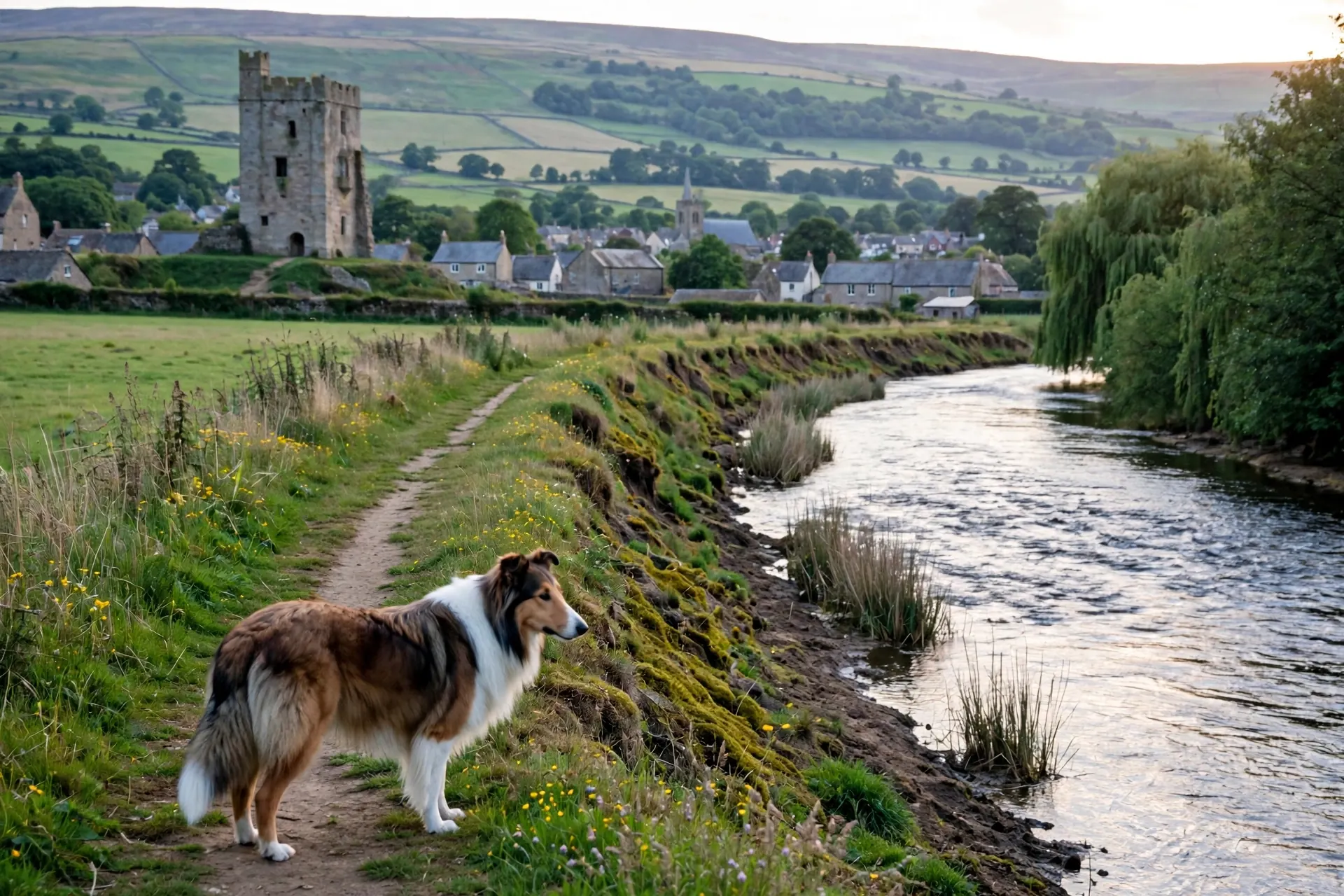
West Tanfield's one famous landmark stands on the edge of the village, and it is worth understanding what you are looking at before you walk over to it. Marmion Tower is the surviving gatehouse of Tanfield Castle, a fortified manor house of the fourteenth century, and it is a scheduled monument in the care of English Heritage. What remains is a tall stone tower with a great arched gateway, arrow slits and the broken lines of walls that once enclosed a courtyard. It is a ruin, not a castle you can tour, and that distinction matters: you go to look, to stand underneath the arch and imagine the household that passed through it, and then you walk on. Dogs on a lead are welcome on the paths around the site, and the tower makes a natural turning point for a village walk.
The history is worth a few minutes because it explains the shape of the village. The Marmion family held the manor here in the Middle Ages, and the castle they built was a statement of local power as much as a home: a gatehouse you could defend, walls you could see from across the valley, and a household that employed and fed a good part of the village. The castle fell out of use centuries ago and its stone was reused elsewhere, which is why the gatehouse stands alone now, a single vertical note in a horizontal landscape of fields and river. Look at the stonework closely and you can see the different phases of building: the dressed stone of the arch, the rougher coursing of the upper walls, and the places where later repairs have been stitched in. It is the kind of monument that rewards a slow look rather than a quick photograph.
For the dog owner, the tower is useful in a very practical way: it is a landmark you can see from almost anywhere in the village, which makes it an excellent anchor for a walk with a dog that needs a clear route. Walk to the tower, let the dog sniff the grass around it, take your photograph, and then choose your next leg from there. The ground around the tower is open grass, which is good for a short off-lead moment if your dog has reliable recall and no other dogs or livestock are nearby, but keep the lead on if you are unsure. The tower stands near a road and near fields that may hold sheep, and a dog that bolts from the grass towards either is a dog you will be chasing across someone else's land.
Check the official guidance before you travel if you want to know the current access arrangements, because opening times and any temporary closures for conservation work can change. English Heritage lists the tower as a free-to-visit ruin, but that status does not guarantee that every path around it is open on the day you arrive, and after heavy rain the ground can be soft underfoot. The information panel beside the site gives the essential history in a few paragraphs, and it is worth reading it with your dog settled at your feet rather than trying to absorb it while the dog is pulling towards the next smell. Five unhurried minutes at the tower, with the dog calm and the valley spread out behind you, is worth more than a hurried circuit of the whole village.
The tower also connects West Tanfield to the wider story of the Ure valley. This was border country in the medieval period, fought over and fortified, and the castles at Middleham and Bolton further up the dale belong to the same world. If your dog enjoys a longer day, the tower is a good place to start thinking about that wider landscape, and our guide to Leyburn, a market town further up the valley with its own castle connections and waterfall walks, makes a natural next read. For now, though, stay in the village: the tower is a beginning, not a destination, and the green and the river are waiting.
The village itself: green, church and pub
West Tanfield is a small village, and that is the point. There is no high street of shops, no visitor centre and no queue for anything, and for many dogs that is exactly what makes it work. The village is arranged around a green and a handful of lanes, with stone cottages, a church and a pub, and you can walk the whole of it in twenty minutes if you do not stop. The trick is to stop. A small village rewards the walker who treats it as a place to be rather than a place to pass through, and a dog that is allowed to amble, sniff gateposts and watch the world from a quiet corner will enjoy West Tanfield far more than a dog marched briskly through it on the way to somewhere else.
Start at the green. Village greens in this part of Yorkshire are working spaces as much as ornamental ones: children play on them, fairs and gatherings use them, and dogs learn the local news from every blade of grass. Let your dog have a proper sniff around the edges before you move on. The green is also the best place to get your bearings, because from it you can see the lanes that lead down to the river, the road that runs on towards Masham, and the tower rising above the rooftops. If your dog is nervous around traffic or strangers, the green is a good decompression zone: open enough that you can see what is coming, quiet enough that not much does.
The parish church of St Nicholas stands at the heart of the village, and it is worth a pause even if you do not go inside. Churches in villages like this one are often the oldest buildings still in use, and St Nicholas carries the long memory of the place: the families who farmed the valley, the lords of the castle, and the generations of villagers who were baptised, married and buried within its walls. The churchyard is a calm, enclosed space, but it is not a dog exercise area. Keep your dog on a lead, keep them off the graves, and treat the churchyard as a place for a quiet walk-through rather than a play session. If the church is open, check the noticeboard for local events and the parish newsletter, which often lists walks, fairs and community happenings that a visitor would otherwise miss.
The village pub is the third leg of the village, and it is the one that needs the most checking before you rely on it. Village pubs in the Ure valley generally welcome dogs in the bar area, and many have a water bowl by the door and a biscuit jar behind the counter, but policies, opening hours and food service change with the seasons and with new landlords. Check the official guidance before you travel, and have a backup plan: a picnic by the river or a drive to Masham, where there are several dog-friendly pubs and cafes around the market square. When you do settle in a pub with a dog, choose a corner table away from the main route to the bar, bring a blanket or mat for the dog to lie on, and order at the bar rather than expecting table service for a dog that is still settling. A dog that can lie quietly under a pub table is a dog that has had enough exercise first, which is another reason to walk the river before lunch rather than after it.
The lanes between these three points are where the village shows its character. Stone walls, cottage gardens, a post box, a noticeboard, a bench with a view down the valley: none of it is dramatic, and all of it is the point. Walk the lanes slowly and let your dog read them. The smells of a village lane are different from the smells of a field or a riverbank: woodsmoke, cut grass, somebody's cooking, the cat that lives at the end of the row. A dog that is allowed to take all of that in is a dog that is working hard, mentally, even though it has barely walked a mile. For older dogs, puppies and reactive dogs, a slow village amble is often a better use of the morning than a long hike, and West Tanfield is built for exactly that kind of walk.
One practical note about small villages: they are also places where people live, and the courtesies matter. Keep your dog close on the lanes, pick up after them every single time, do not let them wander into gardens or across driveways, and do not let them bark at the cat on the wall for five minutes while you admire the view. The village is welcoming to dogs precisely because most dog owners behave well in it, and the fastest way to lose that welcome is to treat the lanes as an off-lead playground. A lead, a pocket full of poo bags and a bit of patience will get you further in West Tanfield than any amount of walking boots and route planning.
The riverside loop: a walk in four parts
The best walk from the village is a loop of around 2.5 to 3 miles that follows the river, crosses the valley floor and comes back through the lanes. It is not a waymarked trail with a name and a logo, and that is part of its charm: it is a walk you piece together from the bank, the bridge and the field paths, and it changes with the seasons. Allow 1.5 to 2 hours at a dog's pace, including stops, and treat the timings below as a guide rather than a timetable. If your dog is older, very young or new to walking, the first part alone makes a perfectly good outing, and you can build up to the full loop on a later visit.
Part one is the riverbank itself. From the village, take the lane down to the water and follow the bank downstream, keeping the river on your right and the village behind you. The path here is grass and worn earth, flat and easy underfoot in dry weather, and it gives your dog the first proper stretch of off-lead or long-line walking of the day, provided there is no livestock on the bank and your dog's recall is reliable. The bank is lined with alder and willow in places, and the trees are worth noticing: they stabilise the bank, shade the water and provide cover for kingfishers, herons and the dippers that work the shallow runs. A dog that plunges into the river here will come out wet and happy, so bring a towel and be ready for the shake-off in the car park later.
Part two is the crossing. The loop needs a bridge, and the village bridge is the natural place to cross from one bank to the other. Bridges concentrate everything a nervous dog dislikes: traffic, noise, narrow pavements and the sight of water moving fast below. Keep your dog on a short lead, walk on the side away from the traffic, and do not stop in the middle of the bridge to admire the view unless the road is completely clear. If your dog is frightened of bridges, cross briskly and reward them on the far side, and remember the crossing on the way back so you can plan for it. Some dogs are fine with bridges and some never are, and there is no shame in turning around and walking the same bank back to the village instead of completing the loop.
Part three is the far bank and the fields. Once across, the walk leaves the river for a stretch and follows field paths and farm tracks across the valley floor, with the tower and the village visible ahead of you. This is the part of the walk where the lead rules change: the fields are working farmland, and sheep and cattle may be grazing on either side of the path. Keep your dog on a lead through the fields, close gates behind you, and stick to the marked line of the path rather than cutting corners across crops. The views here are the reward: the valley opens out, the river glints behind you, and the green slopes of the valley sides rise on both sides. On a clear evening, with the light low and the fields turning gold, this is one of the prettiest short walks in the lower Ure valley.
Part four is the lane back into the village. The return leg follows a quiet lane that climbs gently back towards the green, and it is the right place to slow down. By now your dog will be tired, and a tired dog on a lead on a lane is a dog that is ready for water, a rest and possibly a pub garden. The lane has grass verges where a dog can sniff and toilet, but it also has the occasional car, so keep the lead short and the dog on the verge side. When the rooftops come back into view, you are nearly home: a final stretch past the cottages, a drink for the dog, and the loop is done. Total distance is modest, but the variety is what makes it work: river, bridge, fields and lanes, all inside a couple of hours.
Valley fields, farm tracks and livestock
Everything beyond the village green in West Tanfield is farmland, and walking here means walking through somebody's workplace. The fields of the Ure valley are mostly permanent pasture, grazed by sheep and cattle, with hay meadows cut in summer and arable crops on the flatter ground near the river. The dry stone walls and hedges that divide the fields are part of the landscape's character, and they are also working boundaries that keep stock in and walkers on the right side of the fence. Understanding a little about how the valley is farmed will make you a better guest in it, and it will keep your dog safe.
The single most important rule is about livestock. Sheep and cattle are not scenery; they are animals that can be frightened, injured or killed by a dog, even a friendly one that only wants to play. Under the Dogs (Protection of Livestock) Act 1953, a farmer may shoot a dog that is worrying livestock, and the law is on the farmer's side. That is not a threat, it is a fact worth knowing before you unclip a lead in a field. Keep your dog on a lead whenever livestock are in the field or in the next field, and keep them on a lead through any field where you cannot see the whole of it from the gate. If sheep are on the path itself, pick your dog up if they are small, or walk calmly past with the dog on a short lead on the far side from the sheep, without stopping to let the dog stare.
Cattle deserve a separate warning, because they behave differently from sheep. Cows with calves are protective, and a herd can be curious rather than fearful, which is worse for a dog owner: a group of young cattle crowding around a dog on a lead is a frightening experience for everyone. Never walk through the middle of a herd. Walk around the edge of the field, keep the dog close, and if cattle start to approach, let the dog go if you are in danger: a dog can outrun cattle, a person often cannot. This advice sounds dramatic for a gentle valley walk, but it is the standard guidance for walking in cattle country, and the Ure valley is cattle country.
Lambing season, roughly from late February to May, is the time for extra care. Ewes with young lambs are easily stressed, and a dog running through a lambing field can cause ewes to abandon lambs or lambs to become separated from their mothers. During lambing, keep your dog on a lead on every field path, even on paths where you would normally let them run, and if a field has a sign asking you to keep dogs on leads, obey it without argument. The same goes for fields with signs about ground-nesting birds in spring and early summer: keep to the path, keep the dog close, and do not let them crash through long grass and hedgerows where birds may be nesting.
Gates, stiles and walls are the other half of farm walking. Leave gates as you find them: if a gate is shut, shut it behind you; if it is open, leave it open. Do not climb over walls, do not let your dog jump walls or squeeze through gaps in hedges, and do not use a field as a shortcut because it looks empty. Stiles are a particular problem for dogs: some dogs can be lifted over, some can be coaxed through a gap beside the stile, and some simply cannot manage them, which is worth knowing before you commit to a route. If your dog cannot do stiles, plan a walk that uses gates and lanes instead, and be prepared to turn back if the route throws up an obstacle you cannot get a dog over safely.
On to Masham: the valley road and the longer walk
West Tanfield is a good base for a longer valley day, and the obvious next step is Masham, the small market town around 3 miles to the south. Masham is famous for its breweries, its wide market square and its position on the edge of the Dales, and it has far more in the way of pubs, cafes and shops than West Tanfield. The walk between the two places is one of the pleasures of the valley: a mix of lanes and field paths with the river never far away, and a proper sense of travelling through a landscape rather than just visiting a viewpoint.
The route is around 3 miles each way, and you should allow about 1.5 hours each way at a dog's pace, more if you stop to look at the river or to let the dog paddle. The lanes are quiet but they are not traffic-free, and there are stretches without pavements, so keep your dog on a lead on the road sections and walk facing oncoming traffic where there is no footway. The field paths are a pleasanter alternative where they exist, but they depend on the time of year: in summer they are dry and easy, after rain they can be muddy, and in lambing season they need the same lead discipline as every other field path in the valley. Check the official guidance before you travel if you want to confirm the current state of the paths, and carry a map or a charged phone, because the field paths are not always obvious on the ground.
Masham itself is a proper market town, and it rewards a dog that has walked in. The market square is wide and open, with room for a dog to settle while you look at the shops, and the town has several dog-friendly pubs and cafes where a tired dog can lie under a table while you eat. The town's two breweries, Theakston and Black Sheep, are part of its identity, and the brewery shops and tours are worth knowing about, although the tours themselves are not dog-friendly and are best done as a split visit if one of your party can stay with the dog. The town also has a small selection of shops, a butcher and a bakery, which makes it a good place to pick up picnic supplies for the walk back.
If the full there-and-back is too much for your dog, there are sensible ways to shorten it. Walk one way and arrange a lift back, drive to Masham and walk the valley from that end, or split the day: a morning in West Tanfield, a drive to Masham for lunch, and an afternoon riverside walk from the town. There is no prize for covering the most miles, and a dog that has walked 6 miles in the morning and then has to do it again in the afternoon is a dog that will be stiff and sore the next day. Older dogs, puppies and dogs that are not used to long walks are better served by one leg of the route and a car ride for the other.
For a bigger market town day further up the valley, our guide to Leyburn covers the market square, the Shawl views and the waterfall walks around Wensleydale, and it pairs well with this one if you are staying in the area for a few days. Masham and Leyburn are different kinds of towns: Masham is a brewery town with a market square, Leyburn is a market town with a fell at its back, and both are worth a day each. West Tanfield sits between them in the valley, which is why it works so well as a quiet base: you can be in either town within half an hour, and come home to a village where the loudest sound is the river.
Seasons, river levels and when to stay off the banks
The Ure at West Tanfield is a different river in every season, and the walk that is a delight in July can be a hazard in January. Understanding the seasonal rhythm of the valley will help you choose the right day, the right walk and the right kit, and it will keep your dog out of trouble.
Spring is lambing season and nesting season, and it is also the season when the river is at its most changeable. March and April can bring warm, still days when the valley feels like summer, and they can also bring cold rain off the moors that sends the river up overnight. The fields are full of ewes and lambs, the hedgerows are full of nesting birds, and the paths are often muddy from winter. Keep the dog on a lead in the fields, keep to the paths, and carry a towel: a spring walk in the Ure valley usually ends with a muddy dog. The compensation is the valley at its greenest, with lambs in the fields, blossom in the hedges and the first kingfishers of the year working the river.
Summer is the best season for the river itself. The water is low and clear, the gravel bars are exposed, and a dog can paddle and swim in the shallow runs without much risk, provided you choose the spot carefully and keep a long line on. Summer is also the season when the village is at its busiest, with walkers and visitors using the lanes and the riverbank, so arrive early if you want a quiet walk, and never leave a dog in a car on a warm day: even a mild summer day can make a car dangerously hot within minutes. Carry water for the dog, because river water is not a reliable substitute for fresh drinking water, and be aware that blue-green algae can appear in slow, warm water in hot weather. If the water looks green and soupy, keep your dog out of it and check the official guidance before you travel.
Autumn is the valley's most beautiful season and its most deceptive. The trees along the river turn gold, the light is low and the fields are quiet after the harvest, and the walking is at its best. But autumn is also when the first heavy rains arrive, and the Ure can rise fast after a night of rain on the high fells. A river that was ankle-deep on Friday can be bank-full on Saturday, and the brown, fast water that follows a spate is no place for a dog. Check the level before you let a dog near the water, and if the river is up, enjoy it from the bank and walk the lanes and the fields instead. Autumn is also tick season, so check your dog after every walk and remove any ticks promptly with a tick remover.
Winter is the quiet season, and it has its own rewards: frost on the fields, mist on the river, and the village to yourself. It is also the season when the valley is at its hardest. The paths are muddy or frozen, the days are short, and the river is high and cold. A winter walk in West Tanfield should be short, well-planned and finished before dark, with a warm car and a towel waiting at the end. Older dogs and dogs with arthritis feel the cold and the damp more than younger dogs, so consider a dog coat and a shorter loop, and dry the dog thoroughly before the drive home. If the river is in flood, stay well back from the bank: flood water undercuts banks and can collapse without warning, and a dog that falls into a flooded river is in serious danger.
Parking, pubs, toilets and the practical kit
West Tanfield is a small village, and its facilities are small-village facilities. That is not a complaint, it is a fact to plan around, and the planning is simple once you know what to expect. Arrive with the kit you need, know where the nearest pub and the nearest town are, and do not expect a visitor centre, a cafe on every corner or a public toilet on the green.
Parking is the first practical question, and the honest answer is that there is no large visitor car park in the village. Parking is limited on-street parking on the lanes, and on a sunny weekend it can be tight. Arrive early, park considerately, and never block a lane, a gateway, a driveway or a passing place: the lanes are narrow, farm vehicles use them, and a badly parked car can block the whole village. If the village is full, do not squeeze into a gateway or onto a grass verge; drive on to Masham, where there is more parking, and walk the valley from there. On weekdays the village is quiet and parking is much easier, which is one more reason to visit outside the weekend rush if you can.
Public toilets are not something to rely on in a village of this size. Plan as if there are none: use the facilities at the pub if you are eating there, or in Masham before and after your walk. For the dog, the practicalities are simpler: carry poo bags, a bottle of water and a bowl, and a towel for the inevitable river paddle. A long line is more useful here than a short lead for much of the day, because it gives the dog freedom on the riverbank while keeping you in control near livestock and roads. A spare lead in the bag is cheap insurance against a chewed or muddy lead, and a tick remover and a small first aid kit are worth carrying on any valley walk.
The pub is the social centre of the village, and it is worth treating it well. Dogs are generally welcome in the bar area of a Yorkshire village pub, but the details change: some pubs welcome dogs throughout, some restrict them to one room, and some have seasonal rules. Check the official guidance before you travel, and when you arrive, ask where the dog is welcome rather than assuming. Bring a blanket for the dog to lie on, keep them on a lead under the table, and do not let them wander between tables or beg from other diners. A pub lunch after a river walk is one of the pleasures of the Ure valley, and a dog that has had a good walk and a drink of water is usually happy to settle for an hour.
If the pub is closed or full, Masham is the backup, around 3 miles away, with several dog-friendly pubs and cafes around its market square. And if you are staying in the area for a few days and want a bigger town with more choice, our guide to Harrogate covers the spa town's parks, promenades and dog-friendly stays, and it makes a good contrast to a quiet valley village: Harrogate is a town for a day out, West Tanfield is a village for a slow morning, and both have their place in a Yorkshire trip.
Staying over with a dog
West Tanfield is small, but it works well as an overnight base, because the village itself is quiet and the valley is full of places to stay within a short drive. The most common option is a self-catering cottage in the village or in one of the neighbouring villages, booked through a cottage agency or a direct listing. Cottages suit dogs well: there is usually a garden or a yard, a kitchen for preparing the dog's food, and no shared corridors or dining rooms to negotiate. When you book, ask the specific questions that matter: is the garden enclosed, and how high is the fence; is there a ground-floor bedroom if your dog cannot do stairs; and what is the rule about leaving the dog alone in the cottage while you eat out? Get the answers in writing, because a cottage that welcomes dogs in principle can still have a rule that changes your plans.
Bed and breakfasts and small inns in the valley are a second option, and they suit a shorter stay. A village B&B will usually have a couple of dog-friendly rooms, often on the ground floor, and the hosts will know the local walks and the nearest vet. The trade-off is less space and less privacy than a cottage, and a dog that barks at unfamiliar sounds in the night will be heard by everyone in the house. Be honest with the host about your dog before you book: a host who knows they are expecting a large, lively dog will put you in the right room, while a host who is surprised by one at the door may not be able to accommodate you at all.
Farm stays and rural cottages on the valley's edges are a third option, and they have a particular advantage: they are usually surrounded by the very fields and tracks you will be walking, and the hosts are farmers who understand dogs and livestock. The disadvantage is the same as the advantage: you are staying on a working farm, and there will be sheep, cattle, machinery and early mornings. Keep your dog on a lead around the farmyard, never let them chase the farm's own animals, and ask the host where the dog can be let off safely. A farm stay that is arranged well is one of the best dog holidays in Yorkshire; a farm stay where the dog has been chasing sheep by eight in the morning is a holiday that ends early.
For a longer stay, consider basing yourself in Masham or Leyburn and using West Tanfield as a day out. Both towns have more accommodation, more places to eat and more to do on a wet day, and both are within a short drive of the village. The trade-off is that you lose the quiet of the village itself: waking up to the river and the tower is a different experience from waking up in a market town, and for a short break of two or three nights, the village base is hard to beat. Whichever you choose, book early for school holidays and summer weekends, when dog-friendly accommodation in the Dales sells out months ahead.
One last practical point about staying over: know where the nearest vet is before you need one. The nearest practices are in the surrounding towns, and rural vets can be twenty minutes away and close early. Save the number in your phone, note the out-of-hours arrangements, and carry your dog's insurance details and vaccination record. It is the kind of preparation you hope never to use, and the kind you will be very glad to have if your dog eats something they should not have, cuts a paw on a river stone, or picks up a tick that needs attention.
A half-day plan that fits the dog
Plans work best when they are built around the dog rather than around a list of sights, so here is a half-day in West Tanfield that puts the dog first and fits the village, the tower and the river into a morning that ends with lunch.
Arrive at around ten in the morning, when the village is quiet and the river is at its best. Park considerately, give the dog water, and walk straight down to the riverbank for the first part of the morning. Let the dog sniff, paddle and settle for half an hour without any agenda at all. This is the most important part of the day: a dog that has had a proper riverbank start is a dog that will cope happily with everything that follows, while a dog that has been rushed from the car to the first viewpoint will spend the rest of the morning pulling and whining.
From the river, walk up to Marmion Tower. Take the lane slowly, let the dog investigate the hedges, and spend ten minutes at the tower: look at the arch, read the information panel, take a photograph with the valley behind you. Then wander back through the village, past the green and the church, and give the dog a second sniff around the lanes. By now it will be late morning, and the dog will be ready for a rest. Find a bench or a patch of grass, sit down, and let the dog lie at your feet for ten minutes. Doing nothing is part of the walk, and dogs that are allowed to rest in a new place learn that the place is safe.
Lunch is the reward for the morning, and it is best taken in the village pub if it is open and welcoming to dogs, or as a picnic by the river if the weather is good. A pub lunch works if the dog has had enough exercise to settle under the table; a picnic works if the dog is still restless and needs space. Either way, keep lunch simple and unhurried. After lunch, you have a choice: a short afternoon loop along the riverbank, a drive to Masham for a look at the market square and a coffee, or simply the drive home with a tired dog asleep in the back. All three are good endings, and the right one depends on the dog.
Adapt the plan to the dog in front of you. A puppy needs a shorter morning: half an hour at the river, a look at the tower from the lane, and home before lunch. An older dog needs a slower morning: more sitting, less walking, and a warm car to rest in between stops. A reactive dog needs a quieter morning: arrive early, avoid the busiest part of the day, and choose the riverbank over the village lanes when the village is busy. A young, fit collie can do the full riverside loop and the walk to Masham and still want more, but even a fit dog needs water, rest and shade, and the riverbank is the place to provide all three. The plan is a starting point, not a test, and the best version of it is the one your dog enjoys.
Practical questions
Before you go
Can my dog swim in the River Ure at West Tanfield?
In calm summer conditions, yes, at the shallow gravel runs where the water is slow and clear, and only with your dog on a long line so you can call them back. Never let a dog swim after heavy rain, when the Ure rises fast and runs brown and strong, and never let a dog swim near the bridge or any fast channel you cannot see the bottom of. Check the official guidance before you travel, and if the level looks high or the current looks quick, keep your dog on the bank.
Is Marmion Tower open to visitors with dogs?
You can view Marmion Tower from the outside as part of a village walk, and dogs on a lead are welcome on the paths around it. The tower itself is a ruined medieval gatehouse in the care of English Heritage, and access arrangements can change, so check the official guidance before you travel. Treat it as a short stop to look, read the information panel and take a photograph, rather than a place to spend an hour.
How long is the riverside walk from West Tanfield?
The riverside loop described in this guide is around 2.5 to 3 miles and takes most dogs and walkers about 1.5 to 2 hours at a sniffing pace, including stops at the gravel bars and the tower. Shorter options exist: a 30-minute out-and-back stroll along the bank from the village suits puppies, older dogs and anyone short on time, while the full loop adds the field paths and the lane back into the village.
Are there dog-friendly pubs in West Tanfield?
The village pub welcomes dogs in its bar area in the usual arrangement for a Yorkshire village pub, but dog policies, opening hours and food service can all change, so check the official guidance before you travel. If you want more choice, Masham is around 3 miles away and has several dog-friendly pubs and cafes around its market square, which makes it a good lunch stop on a longer valley day.
Can I walk from West Tanfield to Masham with my dog?
Yes. Masham is around 3 miles from West Tanfield, and the route follows valley lanes and field paths with views across the Ure valley. Keep your dog on a lead on the road sections and anywhere near livestock, carry water and poo bags, and allow about 1.5 hours each way at a dog's pace. If the full there-and-back is too much, walk one way and arrange a lift or a taxi back, or drive to Masham and walk the valley from that end instead.
Where can I park in West Tanfield with a dog in the car?
West Tanfield is a small village with limited on-street parking and no large visitor car park, so arrive early on sunny weekends and park considerately. Do not block lanes, gateways, driveways or passing places, and never leave a dog in a car on a warm day. If the village is full, use Masham instead and walk the valley from there, or come on a weekday when the lanes are quiet and parking is much easier.