This guide is independent and contains no paid placement. Venue, boat and parking details change — check the latest operator and venue rules before you travel, especially for lake cruises and dog charges.
Base in Ambleside if you want town comforts and fell walking from the door. Do Stock Ghyll Force early, Loughrigg Fell on a clear morning, Rydal caves as a half-day with the lead on around livestock, and finish at Waterhead for the lakeshore and a boat. Keep dogs on a lead near sheep everywhere, arrive early for parking, and confirm boat and venue dog rules on the day.
Start at the Bridge House: reading the town with a dog
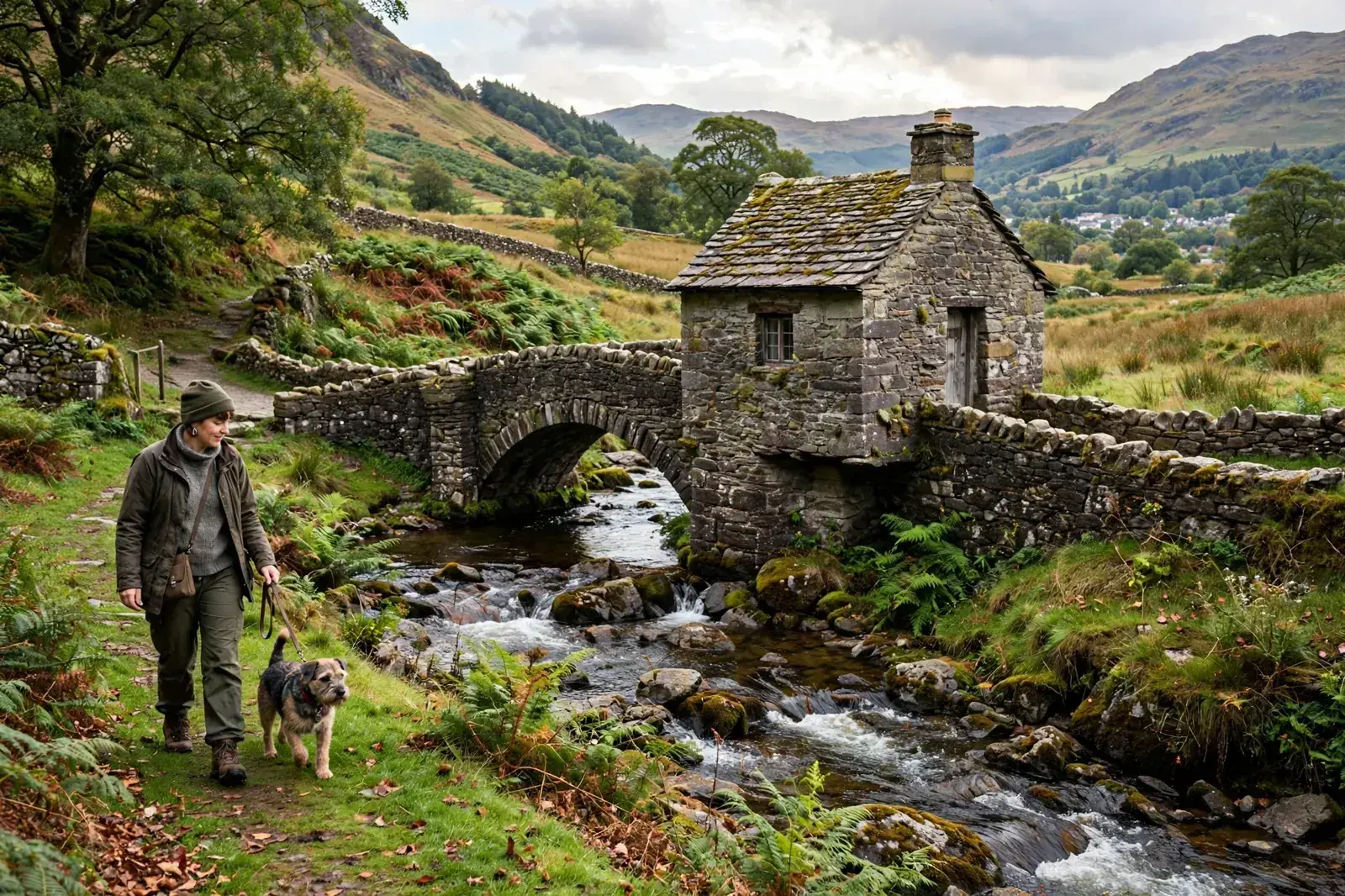
Stand beside the Bridge House and Ambleside explains itself. The tiny stone house, built over Stock Beck in the seventeenth century and now one of the most photographed buildings in the Lake District, sits where the town narrows to a bridge, a beck and a knot of lanes. It is not a walk in itself — you cannot take a dog inside for a tour in any meaningful sense, and the pavement beside it is busy — but as a starting point it is perfect. From here the waterfall walk climbs behind the shops, the road south drops in about a mile to Waterhead and the Windermere piers, and lanes north and west lead towards Rydal, Grasmere and the foot of Loughrigg Fell. Orient yourself at the Bridge House, get your dog watered and settled, and every route in this guide becomes a spoke from one hub.
That compactness is Ambleside's great advantage with a dog, and also its main trap. Everything feels close, so visitors try to do everything in one day: waterfall before breakfast, summit by lunch, caves in the afternoon and a boat at teatime. A fit young dog on a cool day might enjoy that. Most dogs, and most owners, will enjoy Ambleside far more by picking one hill, one lakeshore session and plenty of unhurried town time. The town itself rewards lingering. Stone-built streets hold outdoor shops used to muddy boots, bakeries and cafes with water bowls by the door, and short level loops for the last walk of the day that do not require driving anywhere. Plan Ambleside as a base to return to between walks, not as a checklist to clear.
It also helps to understand how Ambleside differs from its famous neighbour. Our guide to Windermere with a dog covers the town of Windermere and Bowness, the busier southern piers, jetty walks and the west shore. Ambleside sits at the northern head of the same lake but feels quite different: smaller, more enclosed by fells, and more directly a walkers' town, where the hills begin almost at the high street. If you stay in Ambleside you will use Waterhead pier rather than Bowness for boats, walk Loughrigg rather than Orrest Head for your viewpoint, and use Ambleside as the gateway to Rydal and Grasmere rather than to the southern lake. The two bases combine well in one trip, but they are not interchangeable, and the dog logistics — parking pressure, pier crowds, livestock on the fells — play out differently in each.
Practical towncraft matters from the first hour. Pavements in the centre are narrow, delivery vehicles and buses pass close, and in peak season a reactive dog will find the main street stressful at midday. Walk the centre early or late if your dog dislikes crowds, use the quieter back lanes around St Mary's Church and the lanes towards Rothay Park for toilet walks, and give your dog a proper off-pavement walk before asking for a calm settle in a cafe. Rothay Park, a short stroll from the centre beside the River Rothay, is the town's pressure valve: open grass, river views towards the fells and room for an on-lead leg stretch, though you should watch for other dogs, picnics, ball games and, after heavy rain, a swollen river that must be kept away from. Treat the park as an on-lead town space, not an enclosed dog field, and always check current signage on arrival.
Stock Ghyll Force: the waterfall behind the shops
Every dog staying in Ambleside should do the Stock Ghyll Force walk once, and ideally early in the stay, because it teaches you the town's terrain in miniature. Stock Ghyll is the beck that runs under the Bridge House, and a signed path follows it uphill from near the centre, past old mill buildings and through woodland, to a waterfall of around 70 feet falling in stages through a wooded ravine. Viewpoints with railings look across to the falls. The full loop from the town centre is short — most parties allow an hour to an hour and a half with stops — but it is not a pavement stroll. Paths are uneven, roots and wet stone are slippery after rain, there are steps and gates, and the beck runs fast alongside. Dogs need to be on a lead for most of it, both for their own safety near drops and fast water and because the path is narrow where other walkers pass.
Go early for the best experience. By late morning in summer the viewpoints fill, and a dog that needs space will be squeezed against railings while photographs happen. After rain the falls are at their most impressive, but that is also when the paths are greasiest and the beck highest, so shorten the walk and keep well back from edges if conditions are poor. In dry spells the falls thin out, yet the woodland shade makes this one of Ambleside's better hot-day walks, provided you carry water for the dog rather than letting them drink from or plunge into the fast beck. Keep dogs out of the water here altogether: banks are steep, currents are deceptive even when the surface looks calm, and getting a wet, excited dog back up a muddy bank is harder than it looks from the path.
Make the walk work harder by treating it as a loop with intent. Walk up one side, pause at the main viewpoints, and return by the alternative lane or path where the signed route allows, so the dog gets new smells on the way down rather than a retrace. Finish back in town with water and a rest before the next activity. Puppies, older dogs and dogs recovering fitness can do a shortened version to the lower viewpoints and turn around without any sense of failure — the point of Stock Ghyll is atmosphere and woodland, not a summit tick. Check footwear as carefully as the dog's kit: trainers with worn soles struggle on wet Lakeland stone, and you cannot help a slipping dog if you are slipping yourself. As with all routes in this guide, follow the signed paths and any temporary closures on the day, and check the latest local information before you travel if severe weather has been forecast.
Loughrigg Fell: the big view without a big mountain day
If Ambleside has a signature dog walk, it is Loughrigg Fell. At 335 metres it is modest by Lake District standards, yet its position — a broad, knobbly ridge between Ambleside, Grasmere and Rydal Water — gives it views out of all proportion to the climb. Windermere stretches south, Rydal Water and Grasmere lie below to the north and west, and on a clear day the higher fells fill the horizon in every direction. Several routes climb it, from Ambleside via lanes and fell paths, from Rydal, and from Grasmere, and the summit plateau rewards wandering: small tarns, rocky outcrops and the famous Loughrigg Terrace path traversing the southern flank above Rydal Water. Allow half a day for a comfortable circuit with a dog, longer if you plan to combine it with the caves or a lakeshore return, and start early in summer to have the terrace paths at their quietest.
The reason Loughrigg suits dogs so well is choice. There is no single exposed ridge or scramble that must be crossed, so you can shape the day to the dog in front of you. A confident, fit dog can do a full circuit from Ambleside: out past Rydal, up to the summit trig point, across the plateau and down through woodland back to town. A younger or older dog can walk the lower terrace, enjoy the views over Rydal Water without the final summit pull, and turn the day into a scenic out-and-back. What Loughrigg does demand is respect for ordinary fell hazards. The plateau is surprisingly confusing in mist, with many small paths between outcrops; carry a map or a reliable offline route and do not rely on following other walkers. Stone paths are hard on paws over a full day, bracken in summer hides ticks and uneven ground, and there is little natural water on the top in dry weather, so carry more than you think you need for both of you.
Livestock shapes the whole walk, and the next section covers the discipline in detail, but Loughrigg deserves its own warning here. Sheep graze across much of the fell, sometimes appearing suddenly from behind an outcrop on the summit plateau itself. Keep the lead short on blind corners, scan ahead at every rise, and put the dog on a lead before you can see sheep rather than after your dog has seen them. Fell ponies and cattle appear on some Lake District routes too, and the rule is the same: give all livestock a wide berth, never pass between a mother and young, and if animals approach, stay calm and move away steadily rather than running. A dog that cannot walk past sheep on a lead without lunging is not ready for an off-lead fell day anywhere in the Lakes, and Loughrigg, precisely because it feels friendly and accessible, is where that lesson is most often learned the hard way. Build up to it with enclosed fields and quieter lanes, and keep the fell day on-lead and enjoyable instead.
Rydal caves and the coffin route: stone, water and patience
The walk from Ambleside towards Rydal and its caves is the natural second half-day, and it pairs beautifully with Loughrigg without repeating it. Routes head out of town towards Rydal Hall and Rydal Mount, pick up the historic coffin route — the old track along the valley side towards Grasmere, so named because coffins were carried along it to St Oswald's Church — and traverse the fellside to the large man-made cavern on Loughrigg's northern flank, created by historic quarrying for slate. A smaller cave sits nearby. The big cave, with its stepping-stone approach across a shallow pool and its echoing interior, is one of the most distinctive short-walk destinations in the central Lakes, and older children and dogs alike tend to remember it long after they have forgotten a summit. Allow two to three hours from Ambleside depending on route, or longer if you add Rydal Hall grounds, the river and a cafe stop into the loop.
With a dog, the detail is everything. The stepping stones into the main cave are uneven, can be submerged or slippery, and defeat many dogs entirely — never drag a reluctant dog across, and never carry a large dog over wet stone where a slip hurts you both. Many parties enjoy the cave from the entrance, let a confident dog paddle at the shallow edge on a lead, and leave the interior crossing to the humans in rotation. Inside and around the caves the ground is loose slate and rock, sound echoes, and other visitors cluster at the entrance, so keep leads short and give nervous dogs an easy escape route back to open ground. The coffin route itself is a delight for dogs in a different way: a largely level, well-made track with walls, woodland and valley views, ideal for a steady on-lead walk, though it is shared with many walkers and, in places, passes grazed fields where the lead rules apply without exception.
Rydal also teaches good route judgement. In wet weather the River Rothay and its tributaries rise quickly, riverside paths flood, and the cave pool deepens; in those conditions the high coffin route is usually the wiser line and the riverside return should be dropped without regret. In summer, the valley floor has little shade at midday and the slate around the caves holds heat, so time this walk for morning or late afternoon and carry water. Respect closures and signs at the caves and on private land around Rydal Hall, check whether any part of the grounds or gardens is dog-restricted before you set off, and confirm the latest access information before you travel, as arrangements at popular sites do change. Done well — early start, lead on, no forced stepping stones, cafe at the end — Rydal is often the walk Ambleside visitors with dogs rate highest of the whole stay.
Waterhead and the lake shore: boats, jetties and breathing space
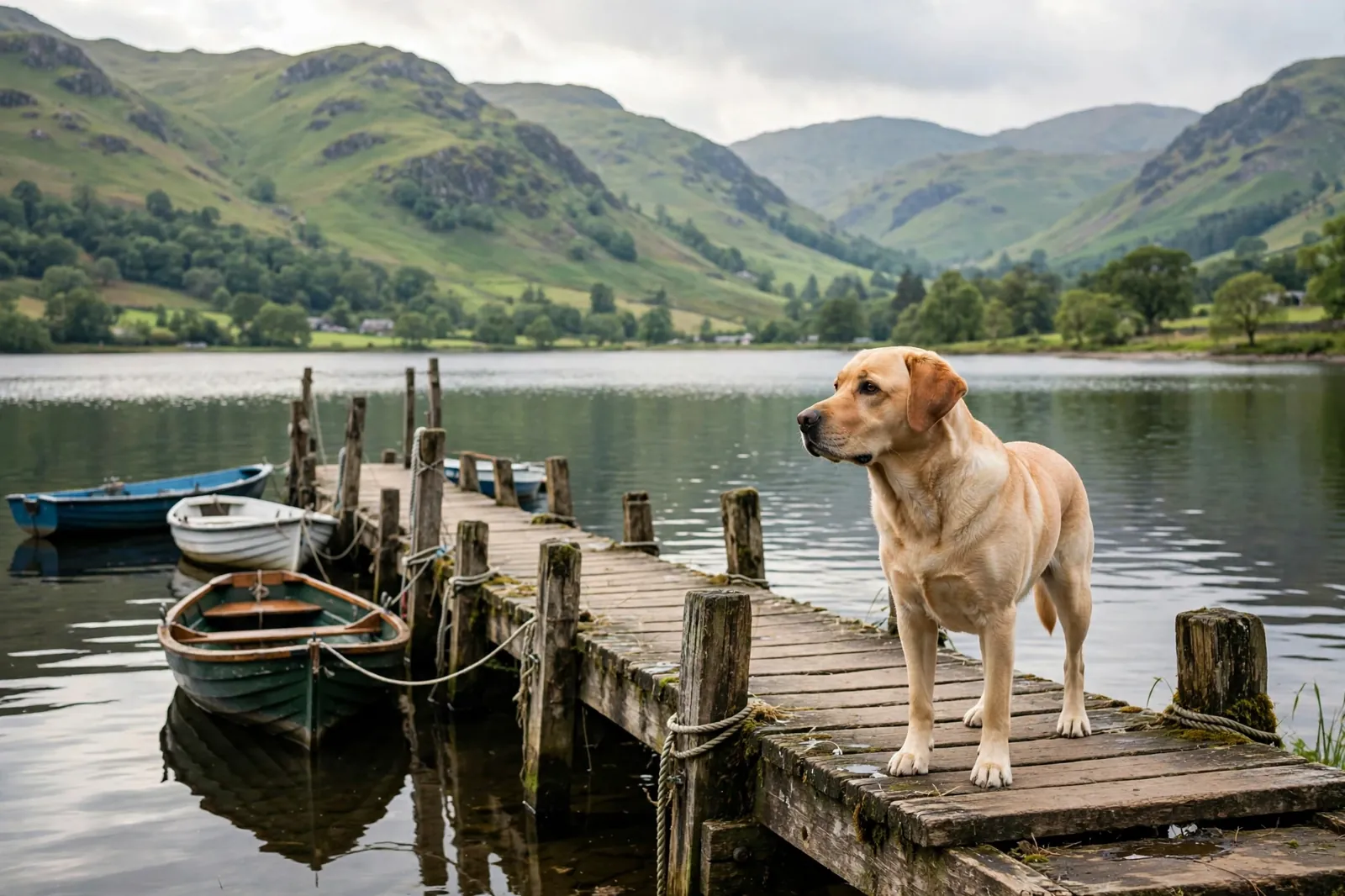
Walk south from the Bridge House for roughly a mile, on pavement and then lakeshore path, and Ambleside gives you its second landscape: Waterhead, at the northern tip of Windermere, where piers, boat landings, cafes and open shore spread out below the town. Borrans Park beside the shore offers green space and Roman history — the remains of Galava fort lie here — and the waterfront itself is the place for a dog to watch swans at a distance, paddle at a designated shallow edge where permitted, and settle under a bench while the lake does the entertaining. It is also busy. On a fine weekend afternoon Waterhead concentrates coaches, boat queues, ice-cream wrappers and excitable dogs into a small area, so time it as you would the town centre: early and late are calmer, and a dog that needs space will prefer the shore at 9am to the shore at 2pm.
Boat trips from Waterhead are a highlight for many visitors, and dogs are a familiar sight in the queues. Lake cruises connect Waterhead and Ambleside with Bowness and Lakeside at the southern end of Windermere, making a boat one way and a walk or bus back a realistic dog day. However, you must treat the dog policy as a question to ask every time, not a fact to assume. Operators differ, policies change, and the detail that matters — whether dogs travel free or for a small fare, whether they are restricted to outside decks, whether busy sailings limit numbers, and whether a particular vessel or service differs — is exactly the detail that changes between seasons. Check the current operator terms before you travel and again at the pier, keep your dog on a short lead in the queue and on board, bring water and a small mat for longer crossings, and plan toilet breaks before boarding, because a full lake-length cruise is a long time for a dog that has just drunk half the lake. Self-drive motor boats and rowing boats are a separate question again: some hire fleets accept dogs and some do not, lifejacket and weight rules may apply, and a dog that will not settle in a small boat should not be put in one. Ask the hire desk directly and accept a no gracefully.
Swimming and paddling need the same calm assessment. Windermere is a large, cold, working lake with boats, and not every shore is a beach. Keep dogs out of the water near piers, moorings and boat lanes, watch for blue-green algae warnings in warm weather and obey any posted notices, and rinse paws and coats after lake swimming where facilities allow. Our Windermere guide covers west shore and southern lake swimming safety in more depth, and the principles transfer directly to Waterhead: supervised paddling in clear shallow water away from boats, no chasing of birds, and a lead or long line until you know the shore. A final Waterhead pleasure needs no ticket at all — simply watching the light change over the lake in the evening, with the fells behind you and a tired dog asleep at your feet, is Ambleside at its best.
Sheep, leads and fell discipline: the rules that protect your whole trip
No Ambleside guide is honest without a full section on livestock, because the central Lakes are a farmed landscape first and a walking landscape second. Sheep graze the fells, the valley fields and sometimes the roadside verges, and the law and the Countryside Code are clear: keep dogs under close control or on a lead near livestock, and understand that a farmer may legally protect their animals if a dog is worrying them. Worrying does not mean biting. Chasing, harassing or simply causing a sheep to run in panic counts, ewe and lamb injuries and miscarriages follow chases that owners describe as playful, and every spring the Lakes see incidents that end dogs' holidays — and sometimes dogs themselves. The lead is not a failure of training or a lack of trust in your dog. On grazed Lakeland ground, the lead is simply the correct equipment, in the same way boots are.
Build a routine and it stops feeling like a restriction. Lead on at every field gate unless you can see the whole field is empty. Lead on along lanes in lambing season, roughly late winter into spring, when ewes and lambs are at their most vulnerable and may be on ground you expect to be clear. Lead on around Rydal Water and Grasmere shores during bird nesting season where signs ask for it, because ground-nesting birds flush as readily as sheep run. Use a normal lead rather than an extending lead near livestock, other walkers and on narrow terrace paths, where a long line across the path is a trip hazard and gives you no real control at the moment it matters. If you meet cattle, the advice differs in one important way: if cattle approach and threaten you, let the dog go so it can run to safety and you can move calmly to a gate or wall, rather than holding a lead between yourself and the herd — then regroup once clear. Read the current Countryside Code and local signs before each trip, as seasonal requests are posted for good reason.
The rest of fell discipline is quieter but just as trip-saving. Close every gate, even if you found it open, unless a sign says otherwise. Keep to paths across farmland, take all dog waste away with you — bags left hanging on walls and trees are a persistent Lakeland problem and far worse than the waste itself — and never let a dog drink from or swim in farm troughs. On the high ground, add weather discipline: conditions on Loughrigg change faster than visitors expect, a summit that was sunny at the car can be in cloud twenty minutes later, and a wet dog gets cold quickly when you stop. Turn-around decisions made early are a sign of a good Ambleside walker, not a failed one, and the town's pubs will still be there when you come down. If you are building a wider Lakes trip, compare this approach with our guide to Keswick with a dog, where the same livestock and weather discipline applies on Catbells and around Derwentwater, with northern Lakes variations in parking and market-day crowds.
Pubs, cafes and wet-day stops: eating with your dog in Ambleside
Ambleside feeds walkers well, and dog owners are a core part of that trade rather than an afterthought. Traditional pubs around the town welcome dogs in bar areas and gardens, cafes cater happily to the waterproof-trouser crowd, and a rainy afternoon can be spent very pleasantly moving between a bookshop browse, a cafe with a settle mat and an early pub supper — provided you work to venue rules rather than assumptions. The pattern to expect is bar and terrace yes, formal dining room often no; water bowls commonly provided, dog menus occasionally offered, and everywhere busy at peak times. Check each venue's latest listing or ask at the door, especially after refurbishments, keep dogs on a lead and off seats and beds, and settle your dog under the table rather than in the walkway where staff carry hot food. A dog that has been walked first and given a chew or a mat to lie on will be welcomed back. A wet dog shaken off over a neighbouring table will not, and in a small town reputations travel.
Wet days deserve a plan of their own, because Ambleside in rain is still Ambleside — arguably it is the authentic version. Shorten rather than cancel: Stock Ghyll in full spate is spectacular on a rainy morning, the coffin route holds up better than riverside paths, and Waterhead in mist has a mood that sunshine never gives. Then build the day around warm interiors. Dry the dog properly before entering anywhere, carry a lightweight drying coat or towel in the rucksack for exactly this moment, and choose venues with hard floors and space rather than squeezing a large wet dog into a carpeted corner. If your dog struggles to settle in busy indoor spaces, a takeaway eaten in Borrans Park between showers or back at your accommodation is a better holiday memory than an hour of whining under a pub table. Many stays provide boot rooms and drying areas precisely because this is the Lakes' normal weather; use them, and ask about them when you book.
A word on shopping, because Ambleside's outdoor and gift shops are part of the town's appeal. Some shops welcome dogs inside, many provide a tying point or water outside, and none should be assumed. Never leave a dog tied outside a shop for more than a brief moment, never in sun or beside a busy road, and ideally not at all — take turns staying outside with the dog instead. It is safer, kinder, and in line with how most Lakes towns now ask visitors to behave. For longer indoor attractions in the area, check dog rules individually before you travel: gardens, houses and museums in the central Lakes vary widely, some welcoming dogs in grounds only, some not at all, and our guide to National Trust places with dogs explains how to decode those pawprint-style ratings before you commit to a day out.
Where to stay: choosing a base in and around Ambleside
Ambleside offers the full Lakeland range within a small radius: hotels and inns in the centre, guest houses and bed and breakfasts on the lanes climbing out of town, self-catering cottages and flats throughout, and holiday parks, lodges and campsites in the wider valley towards Windermere, Rydal and Grasmere. For a dog trip, the best base is rarely the prettiest listing — it is the one whose practical details fit your dog. Prioritise a ground-floor or easily accessed room if your dog is older or dislikes stairs and lifts, hard flooring rather than pale carpet, a genuinely enclosed garden or a very short, safe last walk at night, and a drying space for coats, towels and boots. A cottage on a quiet lane ten minutes from the centre often beats a smart central hotel for a nervous dog, while a sociable dog that loves people may thrive in an inn with a resident pub downstairs. Decide which dog you have, then book for that dog.
Ask the questions that booking pages do not answer. How many dogs are allowed, is there a per-dog charge, and are there size or breed conditions? Are dogs allowed in the dining room at breakfast, or is there a dog-friendly seating area — because a dog that cannot be left alone in a room plus a breakfast room that bans dogs is a logistical puzzle you want to solve before arrival, not at 8am. Can the dog be left unattended in the room at all, and if so under what conditions? Where is the nearest grass for a late-night toilet walk, is it lit, and does it involve crossing a main road? Is there an outdoor tap, a dog shower or a laundry you may use for bedding? Good Ambleside hosts answer these questions easily and specifically, because dog guests are a large share of their business. Vague answers, or a dog policy that appears only as a single line in the terms, deserve a follow-up email before you pay a deposit.
Location choices carry trade-offs worth naming. Staying in the centre means walks, pubs and cafes from the door and no evening driving, at the cost of busier streets and harder parking. Staying towards Rydal or on the Grasmere road puts the coffin route and quieter lanes at your door and makes early fell starts effortless, but evening eating may need a walk in the dark or a short drive. Staying south towards Waterhead and the lake suits boat days and lakeshore evenings. None of these is wrong; the mistake is booking a base that fights your plan, such as a centre stay for a dog that hates crowds, or a remote cottage for owners who want a different pub every night. Book early for school holidays and summer weekends — the genuinely dog-suitable rooms, with gardens and ground-floor access, sell first — and confirm the dog booking in writing with the charge itemised, so there is no debate at check-in.
Parking, buses and arriving without stress
Ambleside's one predictable frustration is parking, and it is entirely manageable with timing. The town sits where the A591 and valley roads meet, central car parks are not large, and on fine weekends and throughout school holidays they can be full by mid-morning, with queues adding stress to the start of a walk and a hot, impatient dog in the back. Arrive before ten for a full day, earlier still in high summer, or come later in the afternoon when day visitors leave and evening light on the fells is at its best. Use signed public car parks rather than residential streets, check the current charges, maximum stays and payment method — machine, card or app — before you walk away, and photograph the tariff board if you are unsure. Never leave a dog alone in a parked car in Ambleside or anywhere else: Lakeland car parks heat up even on overcast days, and a walking town offers no excuse for it. Plan the day so the dog walks with you, rests at dog-friendly venues, or stays properly at your accommodation within its rules.
The bus is Ambleside's underused advantage with a dog. The A591 corridor is served by frequent Lake District buses linking Windermere station and town, Ambleside, Rydal, Grasmere and Keswick, which unlocks linear walks that drivers cannot easily do: walk the coffin route to Grasmere and bus back, or boat one way along Windermere and return by bus to Ambleside. Dogs are generally carried on local buses at the operator's discretion and usually free or for a small fare, travelling on the floor, but you must check the current operator terms before you rely on a particular service, keep the dog on a lead and off seats, and avoid the busiest school and commuter runs with a large or anxious dog. Arriving by train to Windermere station and connecting by bus or taxi to Ambleside removes the parking problem entirely and suits a light-packing weekend; if you use a taxi, book ahead and state clearly that a dog is travelling, as not every vehicle accepts one.
Driving in needs its own dog notes. Valley roads are narrow, sheep stray onto unfenced stretches, and in summer you will share the lanes with cyclists, walkers and slow sightseeing traffic, so allow far more time than the mileage suggests and never rush for a parking space. Build a comfort stop into the journey rather than pushing a young dog through a long drive, carry water in the car for arrival, and do the first Ambleside walk as a short leg-stretch — Rothay Park or the lower Stock Ghyll path — rather than heading straight up Loughrigg off the motorway. Trips start better, and dogs settle better at new accommodation, when the first hour in town is deliberately dull.
One day in Ambleside with a dog: a plan that fits
If you have a single day — perhaps passing through the Lakes or adding Ambleside to a Windermere base — resist the urge to sample everything and do this instead. Arrive early and park, then start at the Bridge House with a coffee and the short Stock Ghyll Force loop while the paths are quiet and the dog is fresh. It wakes everyone up, it is achievable in well under two hours, and it leaves the rest of the day open. Follow it with a slow town hour: outdoor shops, a bakery, water and a rest in Rothay Park. By late morning, choose your one main event by weather and by dog. On a clear day, that is Loughrigg Terrace at the least — out towards Rydal, along the terrace with the views over Rydal Water, and back by the coffin route if legs allow. On a wet or very hot day, make the main event the Rydal caves at lower level, or a Waterhead boat and lakeshore afternoon instead of a summit.
Finish the day at Waterhead regardless, because the lake at the end of the day is what people remember. Paddle where permitted, watch the boats come in, eat early in a dog-friendly pub back in town, and give the dog a final short loop before the drive or the evening bus. This single-day shape — waterfall, one hill or cave, lake to finish — gives a dog variety without exhaustion and gives you all three of Ambleside's landscapes. What it deliberately leaves out is a full summit circuit plus caves plus a full-length cruise, and leaving things out is the skill Ambleside rewards. Note the boat sailing times on arrival if a cruise matters to you, because the last sailings, not your walking speed, will set the shape of the afternoon, and always confirm dog carriage at the pier before you build the plan around it.
A weekend plan: Friday to Sunday based in Ambleside
A weekend lets Ambleside breathe, and the rhythm that works best with a dog is one big walk, one medium walk and plenty of town time. Arrive Friday, settle the dog at your accommodation with the boring-first-hour routine — boundary check, water, familiar bed, short toilet loop — and eat somewhere dog-friendly and unhurried rather than attempting a fell walk on travel legs. Saturday is the hill day. Start Loughrigg early, take the summit if conditions and the dog are right, descend by a different line, and keep the afternoon deliberately light: Waterhead shore, a cafe settle, an early night. Sunday belongs to Rydal. Walk the coffin route, visit the caves without rushing the stepping stones, pause at Rydal Hall's grounds if dogs are currently permitted in the areas you want, and be back in Ambleside for lunch and the journey home, with a final park loop to tire the dog before the car.
Hold a wet-weather alternative for each day so rain changes the plan rather than ruining it. Swap Saturday's summit for the caves and a long cafe lunch; swap Sunday's coffin route for Stock Ghyll in spate, town browsing and a Waterhead boat if sailings run and your dog settles on board. Build the dog's rest into the schedule explicitly — a young dog that does Loughrigg on Saturday will not thank you for a dawn start on Sunday, and an older dog may need the whole of Saturday afternoon asleep to enjoy Sunday at all. Weekends also need a food plan in high season: book evening meals where the venue takes bookings and states dogs are welcome in the area you will sit, because walking a hungry dog around a full town at 7pm on a Saturday is the fastest way to sour a good trip. Leave Ambleside with one walk undone on purpose. It gives the dog a reason, and you a reason, to come back and do the place properly at another season.
Packing and safety: the short kit list that covers Ambleside
Ambleside shops can replace almost anything you forget, but the dog kit is worth packing deliberately because fell days expose gaps quickly. Bring a normal lead and a spare, a long line only for suitable open ground away from livestock and paths, a harness in good repair if your dog pulls on descents, and poo bags in every pocket and pack, with a sealed container for carrying used bags off the fell. Pack more water than the route suggests, a collapsible bowl, and food or treats measured for the day rather than left at the accommodation. Add a drying coat or microfibre towel, a settle mat for pubs and boats, paw balm or a basic first-aid kit with tick remover, and any medication your dog needs, with your vet's number and the nearest emergency vet saved in your phone before you need them. In summer add shade planning and heat discipline — walk early, rest at midday, never exercise a dog hard in heat for the sake of a view. In winter add a warm, waterproof dog coat for stops, a torch for lanes without pavements, and reflective gear for both of you.
Safety on Ambleside's routes is mostly about honest assessment. Check the mountain forecast rather than the town forecast for Loughrigg, tell someone your route, keep a phone charged but do not rely on signal in the valleys, and know that a minor paw cut or a dog that simply sits down and refuses is a reason to shorten the day, not a problem to push through. After any lake swimming, watch for signs of illness in the following days and contact a vet promptly if your dog is unwell, mentioning the swim. After fell walks, check for ticks the same evening, rinse mud from paws and belly, and inspect pads for slate cuts after the Rydal caves in particular. None of this should put you off. Ambleside with a dog, planned with a lead, a map, water and a willingness to turn back, is one of the most rewarding small-town breaks in Britain — compact enough for a day, deep enough for a week, and built, fell by fell and beck by beck, for walking together. Before you travel, check the latest operator, venue and local authority information for anything you are relying on, as rules, charges and access arrangements change.
Practical questions
Before you go
Are dogs allowed on boats from Waterhead near Ambleside?
Dogs are commonly carried on Windermere lake cruises from Waterhead, usually on a lead and often free or for a small charge, but policies, fares and which decks or indoor areas dogs may use change by operator and season. Check the current operator terms, sailing times and any charge on the day you travel, keep your dog on a short lead at the pier and on board, and never assume a self-drive hire boat takes dogs without asking first.
Can dogs go off lead on Loughrigg Fell?
Only where there is no livestock and your dog is under genuinely close control. Loughrigg is sheep country, paths cross grazed ground without always having a fence or warning sign, and a dog that recalls at home may not recall around sheep, deer or other walkers' dogs. Keep the lead on near livestock, around Rydal Water and Grasmere shores in bird-nesting season, and on narrow terrace paths, and use a long line only where it cannot tangle or trip other walkers.
Is Ambleside suitable for older or less mobile dogs?
Yes, if you choose the flatter options. The Waterhead lakeshore, Borrans Park, the level paths around Rydal Water in part, and short town loops to Stock Ghyll Force viewpoints at lower level suit many older dogs, while Loughrigg summit routes and the higher Rydal caves path involve stiles, rock and steady climbing. Check gradients, stiles and surface for your own dog, build in frequent rests and water, and turn back early rather than completing a circuit on tired legs.
Where should I park in Ambleside with a dog?
Central car parks fill quickly on weekends and in school holidays, and the most convenient spaces for Waterhead are often full by mid-morning. Arrive early, use signed public car parks rather than residential streets, check current charges, time limits and whether the machine or app is required before you leave the car, and never leave a dog alone in a parked car. If central parking is full, consider arriving by bus so the walk can start and finish in different places.
Are dogs welcome in Ambleside pubs and cafes?
Many Ambleside pubs, cafes and outdoor terraces welcome dogs, typically in the bar or garden rather than a formal restaurant room, but the detail varies by venue and can change with refurbishment or season. Assume the bar area only until staff confirm, keep your dog on a lead and off furniture, bring a settle mat for longer stops, and check the venue's own latest listing or ask on arrival if your dog needs a quiet corner away from other dogs.