This guide is independent and contains no paid placement. If affiliate links are added later, they will be clearly marked and will not change our editorial checks.
Appleby is a small, walkable market town wrapped in a loop of the River Eden, with a castle on the hill and quiet lanes in every direction. Keep your dog on a lead in town, on bridges and near livestock, enjoy the riverside paths and the views of the castle from outside, and avoid the town altogether with a dog during Appleby Horse Fair week in early June.
Why Appleby suits dogs
Appleby-in-Westmorland is a market town in the Eden Valley in Cumbria, and it is one of the calmest bases in the north of England for a break with a dog. The town sits inside a great loop of the River Eden, which almost encircles it, so water, grass and open sky are never more than a few minutes from any street. The town was once the county town of the historic county of Westmorland, and that history is still visible in its wide main street, its church, its market cross and its castle on the hill. Yet it is small enough to cross on foot in well under an hour, which matters when you are planning around a dog that needs regular, short outings rather than one long expedition.
The appeal for dog owners is the balance. Appleby is not a purpose-built resort, so there are no dog beaches with seasonal bans to memorise and no crowded promenade to negotiate. Instead, the daily routine is simple: a riverside walk in the morning, a wander through the town in the middle of the day, and a lane walk in the evening when the light softens over the fells. Dogs that are nervous in crowds do well here outside the busiest weeks, because the streets are quiet, traffic is light by town standards, and there are always grassy verges and side streets where you can step aside and let a noisy vehicle pass. Dogs that need more exercise can head out along the Eden or up the lanes towards the fells, where the walking quickly becomes rural.
Appleby also works as a base rather than only a destination. Penrith is about 14 miles to the north-west, and the northern Lake District is an easy drive from there, which makes Appleby a good place to sleep somewhere quiet and then drive out for bigger days. If you are weighing up where to stay, our Lake District vs Peak District guide for dogs compares the two national parks on terrain, lead rules, swimming water and costs, and it will help you decide whether the Lakes, the Eden Valley or a mix of both fits your dog. Appleby sits on the quieter side of that choice: fewer crowds, gentler walking, and a town that rewards slowing down.
That said, Appleby is a working market town, not a dog park. Sheep and cattle graze the fields around the town, horses use the roads, and the river is a real river with currents, banks and a weir. The advice in this guide is built around those facts: leads on in town and near livestock, care near the water, and respect for the people and animals who live and work here. Get those basics right and Appleby is the kind of place where a dog can settle into a routine within a day, and where you will find yourself walking the same riverside stretch twice because the dog asked for it, not because the guidebook told you to.
Appleby Castle: history and views
Appleby Castle stands at the top of Boroughgate, on a steep, wooded bank above the River Eden, and it is the first thing most visitors look for. The castle is believed to have been founded in the early 12th century by Ranulf de Meschines, and its surviving fabric includes 12th-century earthworks and a keep, a 13th-century round tower known as Caesar's Tower, and a 15th-century square tower. Much of the castle was rebuilt in the reign of Henry VI by Thomas, Lord Clifford, after repeated damage in the wars with Scotland, and it was later restored in the 17th century by Lady Anne Clifford, Countess of Pembroke, who made it her main home and rebuilt much of the town's church of St Lawrence as well. That layered history is visible from the street: the castle is not a single neat building from one period, but a collection of towers, walls and ranges that have been repaired, rebuilt and adapted over eight centuries.
The important practical point for dog owners is that Appleby Castle is a private residence and is not generally open to the public. You cannot plan a visit inside the castle with your dog, and you should not expect to walk through the castle grounds. What you can do, and what most visitors do, is enjoy the castle from the outside. The view from the top of Boroughgate, looking up at the castle gates and the stonework above the street, is the classic Appleby photograph. The view from the far bank of the Eden, looking back across the river towards the castle and the wooded bank, is arguably better, because you can see the whole mass of the building in its landscape rather than only its gatehouse. Both views are on public streets and paths, so a dog on a lead is welcome.
Build the castle into your walk rather than treating it as a separate attraction. Start at the bottom of Boroughgate and walk slowly uphill, letting your dog sniff the doorways, the market cross and the old shopfronts. The street climbs gently, so older dogs and short-legged dogs can manage it at their own pace, with pauses at the benches and the wider spots. At the top, turn around: the view back down Boroughgate towards the church is one of the finest street views in Cumbria, and it gives your dog a moment to rest in the shade of the castle walls. Then drop down towards the river on one of the side lanes and pick up the riverside path, where the castle appears again above the trees. That sequence, street then river, is the best way to see the castle with a dog, because it spreads the walking out and keeps the dog moving at a natural pace.
One more thing to note: the castle's position above the river means the ground around it is steep and wooded. Do not let your dog scramble up the bank below the castle walls or into the trees on the steep slope, where the ground can be slippery after rain and where the boundary of the private grounds may not be obvious. Keep to the pavements and the marked riverside paths, keep the lead short near the top of the bank, and save the off-lead running for the open meadows further along the river, where the ground is flat and the boundaries are clear.
The River Eden and its meadows
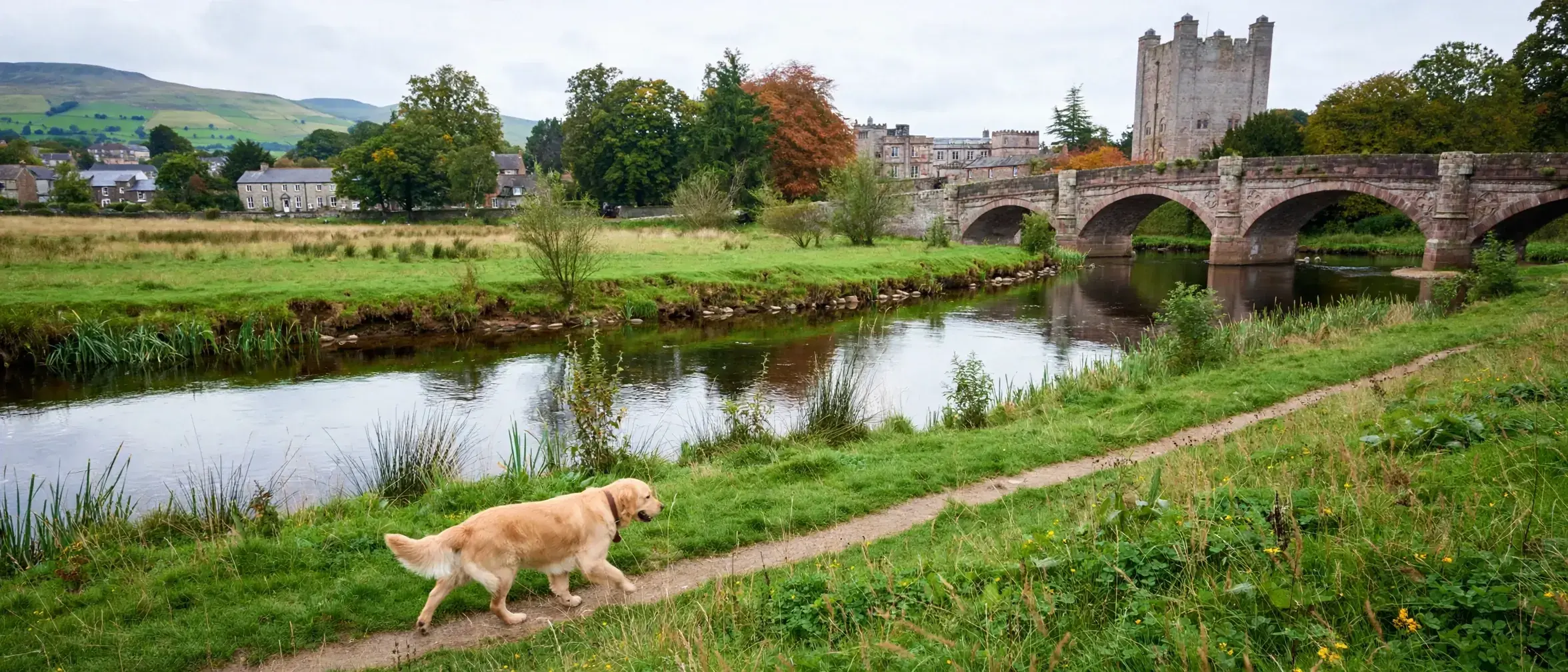
The River Eden is the heart of Appleby, and the riverside is where your dog will spend most of its happiest time. The river loops around the town, flowing past wooded banks, open meadows and the weir near Jubilee Bridge, and the paths along it give you level, easy walking with constant interest for a dog: water to sniff, ducks and moorhens to watch, grass to roll in and other dogs to greet at a distance. The Eden is one of the great rivers of the north, rising in the Pennines and flowing through the Eden Valley towards Carlisle and the Solway, and at Appleby it is wide, calm-looking and deceptively strong in places, especially after rain.
The meadows beside the river are the natural place for a longer, slower walk. In dry weather the grass is firm and the ground is flat, which suits older dogs, puppies building up their stamina and dogs recovering from injury. In wet weather the same ground can become soft and muddy, particularly near the riverbank and on the lower paths, so bring a towel and a drying coat and expect to wash paws afterwards. The meadows are also grazing land in places, so check for livestock before you let your dog off the lead, and keep the lead on if there are sheep or cattle in the field. Even where there is no livestock visible, keep your dog under close control near the water's edge: the bank can be undercut in places, and a dog that charges into the river after a duck can find itself in deeper water than it expected.
Swimming needs a careful decision. Some dogs do paddle and swim in the Eden at Appleby, and on a hot summer day a cool dip looks inviting. But the Eden is not a managed swimming spot: there are no lifeguards, no marked entry points and no water-quality notices of the kind you would find at a managed lido or beach. Depth and current change with rainfall, the riverbed is uneven, and the weir near Jubilee Bridge creates a dangerous undertow that no dog should go near. If your dog is a confident swimmer, choose a slow, shallow stretch well away from the weir, keep the lead on until you are sure of the entry, and stay close enough to call the dog back. If your dog is a poor swimmer, a puppy, an older dog or a breed that struggles in water, keep them on the lead and let them paddle at the edge instead. After heavy rain, skip swimming entirely: the river rises fast, the current strengthens, and the water carries debris. Check the official guidance before you travel if you are unsure about river conditions on the day.
Wildlife is part of the riverside experience. The Eden is known for its fish, including salmon and trout, and for the birds that feed along it: herons, kingfishers, dippers and goosanders are all possible sightings, and your dog will certainly smell them long before you see them. Keep your dog from chasing birds along the bank, and pick up after your dog everywhere on the riverside paths. The meadows and paths are used by walkers, runners, families and other dog owners, and a clean, considerate dog is welcome back; a dog that chases wildlife or leaves mess behind is not. Carry bags, use the bins in town, and take the bag with you if a bin is full rather than leaving it beside the path.
Jubilee Bridge and the far bank
Appleby has two crossings that shape every walk: the road bridge and the footbridge. The main road bridge is St Lawrence's Bridge, which connects Bongate, on the eastern bank, with the old borough on the western bank. The original bridge on this site connected the two settlements, and the current bridge is a rebuild completed in 1889. It is a handsome stone bridge with three arches, and it carries the main road into town, so crossing it with a dog means pavements, traffic and a short lead. The footbridge is Jubilee Bridge, a smaller crossing further along the river, near the weir where the water drops a few feet across the full width of the river. The weir is a striking sight and a useful landmark, but it is also the most dangerous piece of water in the town, and dogs should be kept well away from it.
A good circular walk uses both bridges. Cross St Lawrence's Bridge from the town centre into Bongate, where the streets are quieter and the houses back onto the river, then follow the far bank downstream towards Jubilee Bridge. This side of the river gives you the best views back across the water to the castle, the church and the wooded bank, and it is usually quieter than the town side, which makes it a good choice for a nervous dog or for a first walk when you are still learning the town. The path is mostly level, with grassy stretches where a dog can sniff and explore, but keep the lead on near the road crossings and near the weir, and watch for cyclists and other walkers on the narrower stretches.
Crossing Jubilee Bridge itself is a small adventure for a dog. Footbridges can unsettle dogs that are not used to them: the surface may be slatted or uneven, the sides may be open, and the sound of the weir below can be loud. Walk your dog across on a short lead, at a steady pace, without stopping in the middle for a photograph. If your dog freezes or panics, do not drag them; step back, let them settle, and try again slowly, or turn around and use the road bridge instead. Puppies and small dogs may need to be carried across, and that is perfectly fine. Once you are over, the path back along the town side of the river leads you past the meadows and back towards the town centre, completing a loop that takes most people and dogs between forty minutes and an hour at a sniffing pace.
The weir deserves a final word of caution. Weirs look calm from above and harmless from the side, but the water below a weir recirculates and can trap even a strong swimmer, human or canine. Never let your dog swim near the weir, never let them play on the weir structure, and keep children and dogs on the lead on the paths beside it. The same caution applies after rain, when the flow over the weir increases and the paths beside it can become slippery. Admire the weir from the bridge and the bank, take your photograph, and then move on to the quieter water downstream.
Boroughgate and the market town
Boroughgate is Appleby's main street, running from the castle gates at the top down to the church of St Lawrence and the market area at the bottom. It is a broad, gently sloping street lined with stone houses, old inns, shops and the Moot Hall, and it is the natural place for a town walk with a dog. The street is wide enough that you can usually keep a comfortable distance from other people and dogs, and there are doorways and side lanes to duck into if your dog needs a break from passing traffic. The market cross and the cloisters by the church mark the lower end of the street, and the church itself, largely rebuilt by Lady Anne Clifford in the 17th century, is worth a look from the churchyard, where the grass and the trees give your dog a quieter spot to rest.
Appleby's market tradition goes back centuries: the town was laid out as a planned Norman borough with its market focused on Boroughgate, and it was once famous for its corn market. Today the town holds a regular market, and market days are the liveliest days in the town calendar outside Horse Fair week. On a market day, expect more people, more stalls, more smells and more dogs, which can be either a delight or a challenge depending on your dog. A sociable dog will enjoy the bustle and the dropped crumbs, while a reactive or nervous dog will do better on a quieter weekday, or on a market morning before the crowds build. If you do visit on market day, keep the lead short, keep your dog close to your side rather than letting them wander in front of the stalls, and watch for food on the ground, which can include things that are not safe for dogs.
Shops and cafes in Appleby vary in their dog policies, and the honest advice is to ask at the door rather than assume. Some cafes welcome dogs inside, some welcome them only in an outdoor seating area, and some do not allow dogs at all. The same applies to the town's pubs and inns, where policies can differ between the bar, the dining room and the garden. A polite question at the door, with your dog sitting calmly beside you, will usually get a friendly answer. If a place says no, do not argue: thank them and move on, because there will be another cafe a few doors down. Bring a mat or a blanket so your dog has a defined place to settle if you do sit down for a coffee, and bring water, because not every cafe will have a dog bowl to hand.
The town centre is also where you will find the practical things: a small supermarket and food shops for supplies, a pharmacy, a post office and the tourist information point. Stock up on dog food, treats and poo bags when you arrive, because the shops are small and may not carry the specialist food your dog eats. If your dog needs a particular diet, bring enough from home for the whole stay rather than relying on finding it in town. And remember that Appleby is a small town: most things close earlier than they would in a city, and on Sundays some shops may not open at all, so plan your shopping around your dog's routine rather than the other way around.
Appleby Horse Fair: dog advice
Appleby Horse Fair is the event that defines the town for one week each year, and it is the one week when the advice for dog owners is simple: do not bring your dog. The fair is a traditional annual gathering of Gypsy, Roma and Traveller communities, held from the first Thursday in June for about a week, ending on the following Wednesday, with the main days from Thursday to Sunday. It attracts around 10,000 Travellers and more than 30,000 other visitors to a small town, and it is not an organised event in the usual sense: there are no ticket gates, no official programme and no central arena. Horses are bought and sold on Fair Hill, washed in the River Eden at the Sands, and ridden along the Flashing Lane on Long Marton Road, and they are also on the roads and streets of the town itself.
Visitor advice published for the fair says plainly not to bring a dog, because dogs can startle and frighten horses. That is not a suggestion to weigh up; it is a safety warning. A frightened horse is a danger to itself, to its rider, to bystanders and to your dog. The fair is also extremely crowded, with fast-moving horses everywhere, not just on the Flashing Lane but in the streets of Appleby, and with slow-moving horse-drawn vehicles on the approach roads, including the A66 and the A685. A dog on a lead in that environment is at risk of being kicked, knocked over or tangled in traffic, and a dog that barks or lunges at a horse could cause a serious accident. Even a calm, well-trained dog does not belong in the middle of a horse fair.
If you have booked a stay in Appleby and then discover that it falls in Horse Fair week, you have three sensible options. The first is to move your dates: Appleby is a different, much quieter town the week before and the week after the fair, and the same riverside walks and lanes will be there waiting. The second is to leave your dog in safe, comfortable accommodation elsewhere for the fair days, for example with a trusted sitter or at home, and to visit the fair without the dog. The third, if you are already in the area with your dog, is to stay well away from the town and the fair sites during the fair, walk your dog on quiet lanes away from the horse routes, and keep the dog on a lead at all times. Do not leave a dog in a car during the fair: the town is crowded, the weather in June can be warm, and a car heats up fast.
If you do visit the fair without a dog, the same advice applies to you as to any visitor: be horse aware at all times, keep children under close supervision, do not approach or touch horses without the owner's permission, and expect mud on Fair Hill, so wear wellington boots. The Sands, where horses are washed in the river, and the Flashing Lane are closed to vehicle traffic during the fair, and parking in the temporary car parks around the fair site typically costs around ten pounds per car per day. Check the official guidance before you travel for the current year's dates and arrangements, because the fair's dates and the local traffic measures can change, and the fair is not an organised event with a fixed programme to consult.
Outside Horse Fair week, horses are still part of everyday life around Appleby, and your dog should be prepared for them. Horses use the country lanes, ride along the bridleways and graze in the fields, and a dog that has never met a horse can react badly: barking, lunging or chasing. Train a calm response before you travel, keep your dog on a lead when horses are near, and give horses plenty of space on narrow lanes. If you meet a horse on a lane, step off the path with your dog, keep the dog still and quiet, and let the horse pass. That small courtesy keeps everyone safe and is the kind of behaviour that makes dog owners welcome in a horse town.
Country lanes towards Dufton
South-east of Appleby, the lanes towards the village of Dufton offer the kind of walking that suits dogs who have had enough of town pavements. Dufton sits below the northern Pennines, in the shadow of the great hills, and the lanes between Appleby and Dufton pass through farmland, past stone walls and hedgerows, with views opening up towards the fells as you climb gently out of the Eden Valley. The walking is on quiet country lanes and public footpaths, and it is easy to build a walk of an hour or two that starts and ends in Appleby without ever needing the car.
Lane walking with a dog has its own rules. Keep your dog on a lead on the lanes themselves, because cars, tractors and horse-drawn vehicles use them, and the lanes are narrow with few verges. Use the footpaths and bridleways for off-lead time, but only where the path is clear of livestock and where you can see well ahead. Sheep are the main concern: the fields around Appleby and Dufton are working farmland, and sheep with lambs are especially vulnerable in spring. A dog that chases sheep can cause serious harm, and a farmer is entitled by law to protect livestock. The rule is simple and non-negotiable: if there are sheep in the field, the dog stays on the lead, and if you cannot be sure the dog will come back instantly when called, the dog stays on the lead on open ground as well.
Navigation matters more on the lanes than it does in town. Bring a map or a mapping app with the public rights of way marked, and check the route before you set off, because some paths cross farmyards or pass through fields where the waymarking is thin. Wear boots with good grip, because the lanes and field paths can be muddy after rain and slippery with fallen leaves in autumn. Carry water for the dog, because there may be no safe drinking water on the route, and do not let your dog drink from troughs or stagnant ponds, which can carry bacteria. In summer, watch for adders on sunny banks and dry stone walls in the fells country, and keep your dog from nosing into long grass and bracken where adders bask.
The reward for the care is a walk that feels properly rural. The lanes around Dufton are quiet enough that you will often have them to yourself, the views towards the Pennines are wide and open, and the dogs that do best here are the ones that enjoy sniffing hedgerows, splashing in becks and trotting along at a steady pace. Turn back when your dog starts to tire rather than pushing on to a target village: a dog that is walked to exhaustion on a lane has a long walk back to the car, and there is no shortcut. A good rule is to turn around when you have used about half of your dog's comfortable walking time, so the return leg is as enjoyable as the way out.
A half-day loop for dogs
If you only have a morning in Appleby, this loop packs the town's best features into a manageable walk. It takes most people and dogs between two and three hours at a leisurely pace with stops, and it covers the castle, the river, both bridges and the far bank. Start in the town centre and walk up Boroughgate to the castle gates, pausing at the top to look back down the street and to let your dog rest. Then drop down towards the river and pick up the riverside path, following the Eden downstream through the meadows towards Jubilee Bridge. Cross the footbridge carefully, with your dog on a short lead, and then follow the far bank back upstream towards St Lawrence's Bridge, enjoying the views of the castle and the church from across the water. Cross the road bridge back into town, keeping your dog close on the pavement, and finish with a slow wander back through the market area.
Timing matters. Start early in summer, before the sun is high, because the riverside meadows offer little shade at midday and the stone streets of the town hold the heat. In winter, start after the frost has lifted and the paths have dried a little, and finish before dusk, because the riverside paths are not lit and the ground beside the river can be slippery in the dark. In spring, watch for lambs in the meadows and for ground-nesting birds along the riverbank, and keep your dog on the lead where the signs ask for it. In autumn, the riverside trees turn gold and the fallen leaves make the paths soft underfoot, but they also hide mud and uneven ground, so watch your footing.
Build in breaks. A dog that walks for two hours without a rest is a dog that will be stiff the next day, especially if it is older or unfit. Stop at the benches on Boroughgate, sit on the grass in the meadows, and let your dog sniff and rest for ten minutes at a time. Offer water at each stop, and carry a small snack for a long walk. If your dog is a puppy or a senior, shorten the loop: skip the far bank and do the castle and the town-side meadow only, which gives you the same highlights in about an hour. If your dog is young and fit, extend the loop by continuing along the river beyond Jubilee Bridge or by adding a lane walk towards Dufton after lunch.
For a longer break, Appleby pairs well with a day out in the Lakes. Our three-day Lake District itinerary with a dog shows how to balance three days around Windermere, Keswick and Grasmere, with lakeside stops, lead rules and rainy-day backups, and it works well as a template for a day trip from Appleby: one big day out, then a quiet day on the Eden to recover. And if you are planning a longer tour of the north, our Northumberland guide for dogs covers castles, beaches and Hadrian's Wall walks further up the coast, which makes a natural next stop after Cumbria.
Seasons, water and livestock
Appleby changes with the seasons, and each season asks something different of a dog owner. Spring brings lambs, nesting birds and fast-growing grass. Keep your dog on a lead in fields with lambs, respect any signs about ground-nesting birds, and check for ticks after every walk, because ticks are active from spring onwards in the Eden Valley. The river can be high in spring after winter rain, so check the banks before letting your dog near the water, and keep them away from fast, flooded stretches entirely.
Summer is the busiest season in Appleby and the warmest. The riverside meadows are at their best, the lanes are dry, and the long evenings are made for a late walk after the heat of the day. But summer also brings the risks that catch dog owners out: hot pavements on Boroughgate at midday, which can burn a dog's paws; warm cars, which should never hold a dog even for a few minutes; and blue-green algae in slow-moving water, which can be toxic to dogs. If you see water that looks green, soupy or scummy, keep your dog out of it and do not let them drink from it. Offer water often, walk in the early morning and the late evening, and use the shade of the riverside trees for the middle of the day.
Autumn is many dog owners' favourite season in Appleby. The crowds thin, the light turns golden, the riverside trees change colour, and the air is cool enough for a long walk without overheating. The trade-offs are mud, fallen leaves hiding uneven ground, and the start of the shooting season on the surrounding estates, which means you may hear gunfire on some days and should keep your dog close on the lanes. Fireworks around early November can unsettle noise-sensitive dogs, so ask your accommodation whether there are displays nearby and plan a calm evening indoors if there are.
Winter in Appleby is quiet and beautiful, but it asks for preparation. The Eden Valley can be cold, with frost on the meadows and ice on the pavements, and the riverside paths can be treacherous when frozen. Shorten walks in very cold weather, wipe grit and salt from your dog's paws after walking on treated roads, and dry your dog thoroughly after a wet or snowy walk. The river can flood after heavy rain, and the lower riverside paths may be underwater or closed, so check the official guidance before you travel in winter and be ready to swap a riverside walk for a lane walk on higher ground. A drying coat, a warm bed and a hot meal at the end of a winter day make all the difference to a dog that has been out in the cold.
Parking, vets and practical details
Parking in Appleby is straightforward outside the busiest weeks. The town has public car parks in and around the centre, as well as on-street parking on some streets, and most visitors find a space without much trouble on an ordinary weekday. On market days, in the summer holidays and during Horse Fair week, the town fills up and you should arrive early or be prepared to walk in from a little further out. Charges and time limits change from time to time, so check the official guidance before you travel for the current position, and always read the signs in the car park itself before you leave the car. Never leave a dog in a parked car in warm weather, even with the windows open and even for a few minutes: a car heats up far faster than most people realise.
Knowing where the vet is before you need one is one of the most useful things you can do on arrival. Appleby has veterinary practices serving the town and the surrounding Eden Valley, and Penrith, about 14 miles away, has further practices including out-of-hours cover. Save the number of the nearest vet and the nearest out-of-hours vet in your phone on the day you arrive, along with your own vet's number at home, and carry your dog's insurance details and vaccination record with you. If your dog takes regular medication, bring more than you need for the stay, in its original packaging, and keep it somewhere cool and dry. Rural practices can be a twenty-minute drive away and may close early, so do not leave a health worry until the evening.
Stays in and around Appleby range from cottages and bed and breakfasts to pubs with rooms and holiday lets in the surrounding villages. When you book, confirm the dog rules in writing: how many dogs are allowed, whether there is a charge, whether dogs can be left alone in the room, and where the dog can go to the toilet at night. Ask about the garden or outdoor space, because a cottage with a secure garden is worth more than a larger cottage with an open front onto a road. Ask about the nearest walk from the door, because a stay where you can step out for a morning walk without driving is a better stay for the dog. And be honest about your dog: a barking dog, a chewing puppy or a dog that is not house-trained needs a different kind of accommodation from a calm older dog, and the host will be far happier if they know in advance.
Getting to Appleby is part of the planning. The town is on the A66, which runs across the Pennines between Penrith and Scotch Corner, and on the A685 from Kendal, and both roads are scenic but can be slow in bad weather and busy in the summer. Appleby station is on the Settle to Carlisle line, one of the most beautiful railway journeys in England, and the station is a short walk from the town centre, which makes a car-free visit possible if you plan your walks from the town itself. If you arrive by train, remember that dogs travel on trains at the discretion of the operator and should be kept on a lead and under control, and check the official guidance before you travel for the current rules. Whatever way you arrive, give your dog a quiet walk and a drink as soon as you get there: the journey is tiring, and a calm first hour sets the tone for the whole stay.
What to pack for Appleby
Packing for Appleby is packing for a small town with big countryside around it, and the list is mostly about being ready for mud, water and weather. Start with the lead and the basics: a lead, a spare lead, a harness that fits well, poo bags, a collapsible water bowl and a bottle of water. Add a long line for the meadows if your dog's recall is not reliable, because a long line gives the dog freedom to run and sniff while keeping them safe near the river and the livestock. Add a drying coat or two large towels, because a dog that has been in the Eden or in a muddy meadow will need drying before it comes indoors, and most accommodation will thank you for it.
For the dog's comfort, pack their own bed or blanket, their usual food and treats, any medication, and a familiar toy or chew. Dogs settle faster in a new place when something smells of home, and a bed that they know is theirs gives them a place to retreat to when the new house gets busy. Pack a first-aid kit for the dog as well: tick remover, antiseptic wipes, bandages, and the number of the vet. Ticks are common in the Eden Valley, so check your dog after every walk in long grass or woodland, and remove any tick promptly with a tick remover rather than pulling it off by hand.
For yourself, pack boots with good grip, a waterproof jacket, layers for cold mornings and warm afternoons, and a map or a mapping app with the public footpaths marked. The weather in the Eden Valley can change quickly, and a walk that starts in sunshine can end in rain, so a waterproof is worth carrying even on a fine morning. Bring a bag for muddy leads and wet towels, and a spare pair of socks: the small comforts matter on a walking holiday, and dry feet at the end of the day are one of them. Finally, bring patience. Appleby is not a place to rush. The best days here are the slow ones: a morning on the river, a lazy lunch, an evening lane walk and a dog asleep by the fire. Pack for that pace, and the town will give it back to you.
Practical questions
Before you go
Can dogs go inside Appleby Castle?
Appleby Castle is a private residence and is not generally open to the public, so plan to enjoy it from the outside. Dogs on leads are welcome on the public streets and riverside paths around it, and the best views are from Boroughgate, the castle gates and the far bank of the River Eden. Check the official guidance before you travel, because access arrangements can change.
Can my dog swim in the River Eden at Appleby?
Some dogs paddle and swim in the Eden at Appleby, but the river is not a managed swimming spot. Depth and current change with rainfall, the weir near Jubilee Bridge is dangerous, and livestock graze nearby. Keep your dog on a lead near the weir and fast water, check the official guidance before you travel, and skip swimming entirely after heavy rain.
Is Appleby a good base for a Lake District trip with a dog?
Yes, Appleby works well as a quieter base east of the Lake District. Penrith is about 14 miles away and the northern Lakes are an easy drive, while Appleby itself gives you riverside walks without the Lakes crowds. Our three-day Lake District itinerary with a dog shows how to balance busy days out with rest days in a calmer town like Appleby.
Should I bring my dog to Appleby Horse Fair?
No. Visitor advice for Appleby Horse Fair says not to bring a dog, because dogs can startle and frighten horses, and the fair is extremely crowded with fast-moving horses on the roads and on Fair Hill. The fair runs from the first Thursday in June for about a week, with the main days from Thursday to Sunday. If you are in Appleby that week, leave the dog in safe accommodation or plan your visit for another week.
Where can I park in Appleby with a dog?
Appleby has public car parks in and around the town centre, and on-street parking on some streets. Arrive early on market days and in summer, because the town is small and spaces fill up. Never leave a dog in a parked car in warm weather. Check the official guidance before you travel for current charges, time limits and any temporary closures.