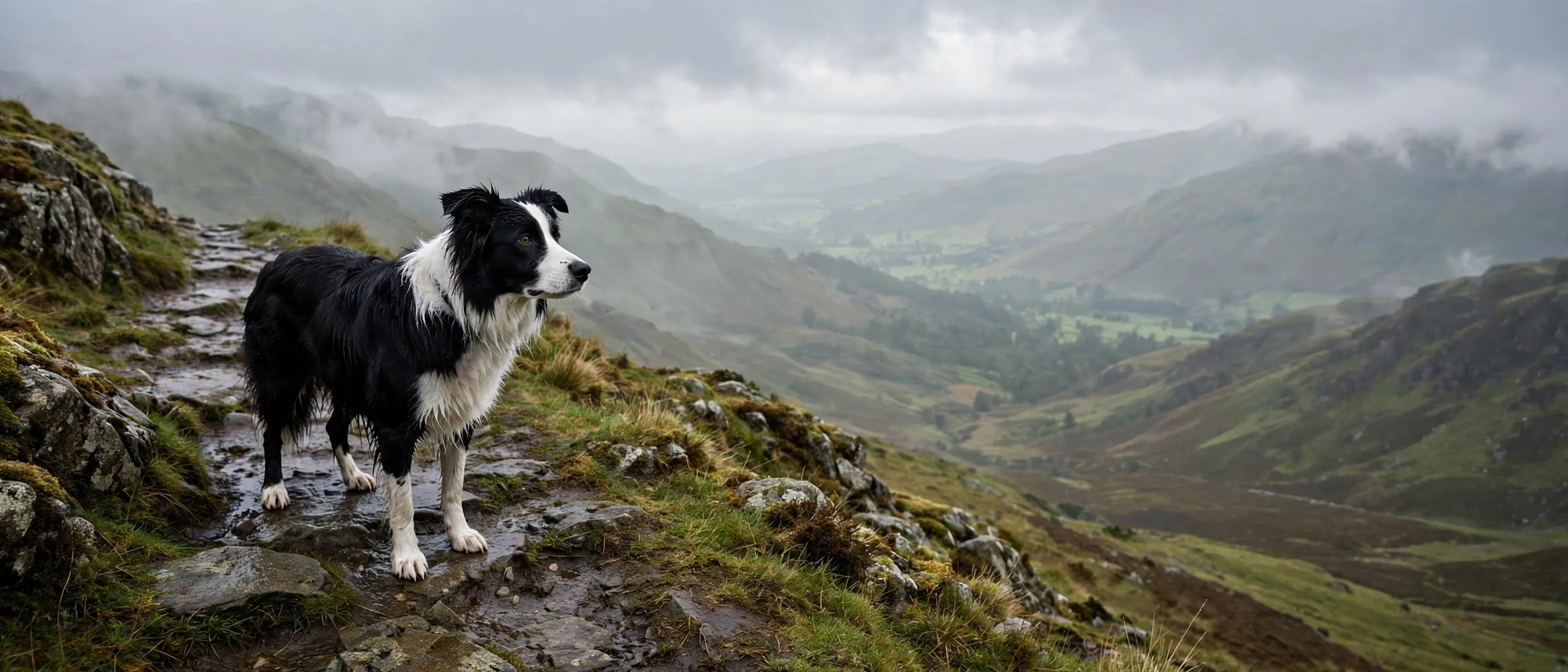
Neither park is “better” for dogs; they suit different dogs. Pick the Lake District for big mountain days and lake swimming if your dog is fit, calm around sheep and comfortable on a lead near livestock. Pick the Peak District for shorter drives, gentler walks, easier logistics and lower costs — the kinder choice for older dogs, nervous dogs and weekend breaks. The deciding factors are your dog’s stamina, recall around sheep and how far you are willing to drive.
Ask the dog before you ask the map
Most “Lakes or Peaks?” advice compares scenery. Scenery is the least important variable on a dog holiday. What decides whether the week is a joy or a slow-motion argument is the dog at the end of your lead — their legs, their recall, their nerves and their manners around sheep. Write down an honest profile before you look at a single cottage listing. Six questions matter more than any brochure.
First, stamina and joints. Be blunt about what your dog can actually do day after day. A three-year-old spaniel that does two hours off lead at home is a different animal from a nine-year-old labrador that naps after forty minutes on flat ground. Multi-day hill walking accumulates fatigue: day three of a fell holiday punishes legs that coped fine on day one. If your dog is recovering from cruciate surgery, has arthritis, or is a giant breed still growing, the answer shapes everything that follows.
Second, recall and livestock manners. This is the question owners answer most dishonestly. “Good recall except around sheep” is not good recall on a hill holiday — it is no recall, because sheep are the one guaranteed distraction in both parks. A dog that fixates, herds or chases needs a lead strategy, not a destination that somehow fixes it. Decide now whether you are willing to walk most of the week on a lead or a long line, because that willingness decides more than the park does.
Third, lead tolerance. Some dogs walk happily on a lead for hours; others wind themselves into a frustrated spiral by mile two. If your dog falls apart on lead, you need a park with genuine off-lead room — enclosed spaces, livestock-free areas, beaches or woods — rather than open fell where every horizon has sheep on it. Fourth, water habits. A dog that launches into every puddle will find the Lakes a paradise and the Peaks a mild disappointment; a dog that hates getting wet will find both parks testing in November, but the Peaks’ shorter walks at least keep the misery brief.
Fifth, nerves. Reactive dogs, rescue dogs still decompressing, and dogs that guard space around their owners all have a harder time on narrow, busy paths where every passer-by squeezes past with another dog. Wide moorland and quiet dales give a nervous dog room to breathe; a packed lakeside path in August does not. Sixth, travel tolerance. A dog that settles in the car for four hours opens up the Lakes from anywhere south; a dog that pants and paces from mile twenty makes the Peaks’ shorter journey the humane choice. Answer these six honestly and the table below almost reads itself.
Head to head: the comparison table
Use this as the quick-reference version. The sections underneath explain what each row actually feels like with a dog.
| Round | Lake District | Peak District |
|---|---|---|
| Landscape for paws | Steep fells, rocky pitched paths, scree, boggy high ground. Big days, big climbs. | Two moods: gentle limestone dales in the White Peak; wilder gritstone edges and peat moor in the Dark Peak. |
| Easy, flat walks | Lakeside loops at Windermere, Derwentwater and Coniston; valley-bottom paths. Lovely but fewer. | Plenty: dale-bottom riverside trails, reservoir circuits, converted railway trails. Wins this round. |
| Big summit days | Scafell Pike, Helvellyn, the Fairfield horseshoe — the classic English mountain days. | Kinder Scout, Mam Tor, Stanage Edge — high, dramatic, but lower and less committing. |
| Off-lead freedom | Hard to guarantee; sheep on most open fell. Livestock-free pockets exist but need research. | Similar sheep problem, but walled dales and quieter moor stretches offer more predictable options. |
| Sheep and cattle exposure | Constant on the fells; Herdwicks everywhere. Cattle in valley pastures. | Sheep on the moors and in dales; cattle in pastures. Grouse moors add managed-moorland rules. |
| Swimming | The clear winner: big lakes with easy entry points nearly everywhere. | Mostly paddling — rivers and streams; reservoirs usually off limits. |
| Dog-friendly bases | Keswick, Ambleside, Coniston, Bowness — superb pubs and cottages, priced accordingly. | Bakewell, Castleton, Buxton, Edale, Hathersage — strong pub culture, often cheaper. |
| Getting there from London | Roughly 4–5 hours by car; train via Oxenholme then the Windermere branch line. | Roughly 3–4 hours by car; Hope Valley and Buxton rail lines from Manchester and Sheffield. |
| Parking pressure | Intense at honeypots (Ambleside, Glenridding, Bowness) in season; arrive early. | Intense at Mam Tor, Stanage and Dovedale on sunny weekends; quieter midweek. |
| Crowds at peak | The busiest of England’s national parks in summer; narrow paths get congested. | Extremely busy on fine weekends due to the central location, but crowds thin fast off the honeypots. |
| Winter walking | Fells can be genuinely dangerous in snow and ice; valley walks stay doable. | Lower tops and dales stay walkable most winters; a safer cold-season pick. |
| Typical cost level | Higher: accommodation, parking and eating out all carry a Lakes premium in season. | Lower: more budget cottages, B&Bs and free or cheap parking. |
| Wet-weather backup | Good: dog-friendly attractions, boat trips and pubs are plentiful around the lakes. | Good: caverns, Chatsworth’s grounds, Bakewell and Buxton all absorb a rainy day. |
The table looks close until you weight it by your dog’s profile from the previous section. An athlete weights the summit and swimming rows; a senior weights the flat-walk, cost and winter rows; a nervous dog weights the off-lead and crowds rows. That weighting is the actual decision.
Terrain in dog terms
Forget the guidebook superlatives and think in paw-miles. The Lake District is a mountain park that happens to have lakes at the bottom. Its classic walks climb 500 to 900 metres on pitched stone paths, cross scree, skirt crags and finish across boggy tops where the path dissolves into a suggestion. A fit dog thrives on this — cool air, endless scent, streams to drink from. But the descents are what break dogs: hours of pounding down pitched steps wreck paws and shoulders, especially on heavier breeds and older dogs. Plan big days with the descent in mind, not the summit photo, and carry water even where streams look plentiful, because high becks can run dry in a hot spell.
The valleys are the Lakes’ secret for dogs that cannot do fells. Derwentwater’s shoreline loop from Keswick, the western shore of Coniston, and the low paths around Rydal and Grasmere are flat or gently rolling, shaded, and close to cafés that expect muddy paws. You can have a perfectly good dog week in the Lakes without climbing anything — but you will be sharing those valley paths with everyone else who had the same sensible idea.
The Peak District is two parks wearing one name, and the distinction matters for dogs. The White Peak is limestone country: dales like Dovedale, Lathkill and Monsal with clear rivers, dry-stone walls, and riverside trails that a stiff-legged dog can manage for miles. The walking is gentle, the views are enclosed rather than epic, and stiles are frequent — a genuine obstacle for dogs that cannot be lifted or will not jump them. Check stile density on any planned route if your dog is small, old or clumsy.
The Dark Peak is the wilder half: gritstone edges like Stanage and Curbar, peat moor, heather and big skies. Kinder Scout’s plateau is a proper mountain walk in bad weather, with navigation that genuinely matters in mist — a place where a dog’s bright coat or a GPS tracker earns its keep. The edges themselves are a gift for dogs: long, level, spectacular walks along the top of the escarpment where a strong dog can cruise for miles without a single steep pitch. Between the two halves, the Peaks offer more walkable variety for mixed-ability groups — the athlete can take the edges while the senior takes the dale, and you can all meet at the pub.
Livestock, grouse moors and lead rules
Sheep are the unavoidable fact of both parks, and this section is the one most owners skim. Do not skim it. The Lake District’s fells carry hardy Herdwick flocks that live on the open hill year-round; there is no season and no valley where you can assume a summit path is sheep-free. Valley pastures add cattle, including cows with calves in spring and early summer — the single most dangerous livestock encounter for a dog owner, because a protective cow will go through the dog to get to you. The correct response is counterintuitive but well established: let go of the lead and let the dog run, then regroup once the cattle lose interest. Practice the decision in your head before you need it.
The Peak District’s livestock picture is more compartmented. Sheep graze the open moors and many dales, cattle fill the White Peak pastures, and the Dark Peak adds a variable owners from the south rarely expect: managed grouse moors. During the shooting season, which runs from August to December, estates may ask walkers to keep to paths and keep dogs on leads; beaters’ days with guns and dogs of their own are no place for an excitable pet. The signs are usually clear and the restrictions local — read every notice at the moor edge and treat keeper requests as instructions, not suggestions.
The legal baseline is the same in both parks. On open access land under the Countryside and Rights of Way Act, dogs must be kept on a fixed lead of no more than two metres from 1 March to 31 July, and must be on a lead near livestock at all times of year. Note what this means in practice: most of the open hill walking in both parks, for five months of the year, is legally a lead walk. Plan for it rather than resenting it. A 5-metre or 10-metre long line (not a retractable lead, which teaches pulling and tangles in heather) turns a lead-only week from a chore into a perfectly good holiday — the dog still gets to sniff, mooch and choose the route, just within a radius you control.
Where the parks genuinely differ is in how easy it is to find livestock-free variety. The Peak District’s walled dales, disused railway trails and reservoir-side paths give you predictable, enclosed-feeling walks where sheep sightings are visible from far off and escape routes are obvious. The Lakes’ open fells offer fewer such certainties, though woodland around the big lakes and some National Trust land with seasonal grazing exclusions can help. If your dog’s livestock manners are the weak link, the Peaks make management easier — but neither park excuses skipping training. Before any hill holiday, rehearse an emergency recall and a rock-solid “leave it” until they work at distance with distractions; the hills will test both by the second day.
Water and swimming
This is the round the Lake District wins without a contest. Windermere, Coniston Water, Derwentwater and Ullswater are enormous, beautiful and ringed with entry points: shingle beaches, jetties, quiet bays where a dog can walk straight in. For a water-obsessed labrador or spaniel, a Lakes week is about the swimming first and the walking second, and the cool water doubles as the perfect post-hill cooldown for tired muscles. The water is cold even in August — keep swims short, watch for shivering, and never throw toys far out into deep water where a tired dog can get into trouble.
The one serious caution is blue-green algae. Blooms have been reported on Windermere and other Cumbrian lakes in recent summers, and the toxins can kill a dog quickly. Before any swim, scan the shoreline for green scum or paint-like streaks, check local notices, and if anything looks off, keep the dog out entirely — when in doubt, paddle instead. Our guide to blue-green algae and dogs explains exactly what to look for and what to do if your dog swallows suspect water. Rinse the dog with clean water after every lake swim, whatever the algae situation, because lake water plus a long car ride home is a recipe for a very smelly dog.
The Peak District cannot compete on swimming, and honest planning means accepting that. Most reservoirs are working water supplies where swimming — for dogs and people — is prohibited, and the signs say so plainly. What the Peaks offer instead is superb paddling: the clear limestone rivers of Dovedale and the Manifold Valley, shallow fords, and stream crossings on moorland walks where a hot dog can lie down and cool off. It is enough for a dog that likes a splash, and nowhere near enough for one that lives for the water. Read our dog water safety guide before either trip — cold water, currents and tired swimmers behave the same in both parks.
Where you sleep with a dog
Both parks are genuinely good at hosting dogs; the difference is price, availability and what “dog-friendly” costs you. The Lake District has one of the densest concentrations of dog-welcome accommodation in Britain: cottages with enclosed gardens, pubs with dogs-asleep-by-the-fire bedrooms, campsites with direct fell access. Keswick is the standout base — a proper walking town where dogs are expected in cafés and the Derwentwater loop starts at the end of the street. Ambleside and Coniston offer the same in a smaller, prettier package; Bowness is livelier and more touristy, which suits some dogs and frays others. The catch is the Lakes premium: in school holidays, dog-friendly cottages in prime villages book out months ahead and charge accordingly, and the pet fee or “dog supplement” is priced with confidence.
The Peak District’s bases are less famous and often better value. Bakewell is the classic — central, genuinely dog-welcoming, with the Monsal Trail on its doorstep for flat off-lead-friendly miles. Castleton suits walkers who want Mam Tor and the Great Ridge without driving; Edale is the hiker’s village at the start of the Pennine Way; Buxton and Hathersage give you town facilities with moorland minutes away. You will find more budget B&Bs, more pubs where the dog sleeps in the room rather than the car, and shorter booking lead times outside school holidays. For a working comparison of what “dog-friendly” accommodation actually includes — fees, boundaries, alone-time rules — our holiday park booking guide covers the questions worth asking anywhere, parks included.
A practical note for both: book the enclosed garden, not the promise of one. “Enclosed” in a listing photo can mean a wall with a gap a terrier could drive through. Ask for the boundary height, check the gate latch type, and on arrival walk the perimeter with the dog on a lead before you unpack. Multi-dog households should declare the full headcount at booking in both parks — limits of two dogs per property are common, and a third dog discovered on arrival has ended holidays early.
Getting there and getting around
Distance is the Peak District’s quiet superpower. From most of the Midlands, the south and the east, it is a two-to-four-hour drive against the Lakes’ four-to-six, which turns a weekend from a motorway endurance test into an actual holiday. For dogs that travel badly — the panters, the droolers, the ones who need a stop every hour — the shorter journey is not a convenience, it is the difference between arriving settled and arriving stressed. The Lakes reward longer stays: once you have driven five hours, a week makes sense in a way a weekend never quite does.
By public transport, both parks are reachable with a dog, which surprises people. For the Lakes, the West Coast Main Line to Oxenholme Lake District connects to the branch line for Windermere, putting you in the heart of the central Lakes without a car. For the Peaks, the Hope Valley line runs between Sheffield and Manchester with stops at Edale, Bamford and Hathersage, and the Buxton line serves the western side — both put classic walks within a short stroll of the platform. Dogs travel free on trains but must stay on a lead and under control; on summer Saturdays the branch lines are packed, so travel midweek or early if your dog dislikes crowds.
Once there, the car question splits the parks. The Lakes’ honeypot parking — Ambleside, Glenridding, Bowness, the Langdale valleys — fills by mid-morning on fine days in season, and circling for a space with a whining dog is a miserable start. The Peaks’ honeypots — Mam Tor, Stanage Edge, Dovedale — suffer the same sunny-weekend crush, but the park’s road network is denser and alternatives are closer. Either way, the winning strategy is identical: start walks before 9am or after 3pm in season, and keep a short backup walk near your accommodation for the days the car parks defeat you.
Crowds, seasons and costs
The Lake District is the busiest of England’s national parks in summer, and it feels it on the classic routes. The Helvellyn ridges, the Scafell Pike corridor and the Windermere shoreline on an August Saturday are sociable in a way that tests reactive dogs and delights social ones. The pressure eases dramatically with altitude and obscurity: a mile off the popular path, or on any wet Tuesday, the fells empty out. The Peak District’s pattern is different — its central location makes it the day-trip park, so fine-weather weekends bring huge numbers to a handful of famous spots while the wider moors stay quiet. A nervous dog can have a peaceful Peaks Saturday by simply avoiding the three or four honeypots everyone photographs.
Seasons rewrite the rules in both parks. Spring means lambs, which means the March-to-July lead requirement bites hardest exactly when the weather turns inviting. Summer brings the algae risk to Lakes swimming and the grouse-season lead requests to Peaks moors from August. Autumn is the connoisseur’s choice for dogs: settled weather, empty paths, no lambs, and the bracken turning. Winter favours the Peaks — its lower tops and dale paths stay walkable in most winters, while the high Lakes fells demand winter skills, ice axe territory that has no place for a dog holiday. If your only free week is February half-term, the Peaks are the safer booking.
On money, the Lakes cost more at almost every step: accommodation premiums in season, busier paid car parks, and eating out in villages where every other table is a tourist. The Peaks are not cheap — Bakewell on a bank holiday is no bargain — but the spread of budget options is wider and the low-season discounts deeper. A realistic week for two people and a dog in a decent cottage, eating out a few times, runs noticeably higher in the Lakes; the gap narrows outside school holidays and widens to its maximum in August. Whichever you choose, price the pet fees, parking and the “one more pub lunch” habit honestly — the scenery is free, but everything around it is not.
Match the winner to your dog
Here is the decision framework. Find your dog, read the verdict, and check the “but” — because every dog is an individual and the exceptions matter.
- The athlete — collies, spaniels, vizslas, fit labradors. The Lake District, for the big days and the lake swimming that a high-energy dog converts into contentment. But: only if recall around sheep is genuinely reliable or you commit to the long line; an athlete with no brakes is a liability on open fell.
- The nervous or reactive dog. The Peak District. Quieter dales, wider moorland, easier escape routes and fewer congested pinch points give a worried dog room to decompress. But: avoid the honeypots on sunny weekends, and start with a dale walk before attempting an edge.
- The senior or the recovering dog. The Peak District, usually. Limestone dale trails and reservoir circuits offer miles of level walking with cafés and car parks close by. But: stiles are the hidden enemy — check routes for stile-free alternatives, and in the Lakes, a valley base with lakeside loops can work just as well.
- The water obsessive. The Lake District, and it is not close. Daily lake swims transform the holiday. But: learn the algae check first, and accept that summer swimming needs vigilance — see the water section above.
- The recall-challenged. The Peak District edges it, because walled dales and railway trails make sheep encounters predictable and management easier. But: this is a management win, not a freedom win — the lead stays on in both parks, and the trip is a good deadline for finally fixing recall.
- The family with children and a dog. The Lake District. Lakeside loops, boat trips that welcome dogs, and villages full of cafés keep every species happy. But: book early for school holidays, start walks early, and give the dog quiet midday rest — children’s excitement and a tired dog are a poor combination.
- The weekend breaker from the south or east. The Peak District. Two to four hours each way leaves you an actual weekend. But: book accommodation near your chosen walks, because weekend traffic around the honeypots eats the time you saved.
- The week-long walker. The Lake District. A week justifies the drive, and the variety — fells, lakes, valleys, coast within reach — fills seven days without repetition. But: build in rest days; fell fatigue accumulates, and day five on tired legs is when injuries happen.
- The tight budget. The Peak District, outside school holidays. Cheaper cottages, cheaper parking, cheaper pubs. But: the cheapest week is the one you actually enjoy — do not pick the Peaks to save money and then resent the lack of lakes.
- The multi-dog household. Either, with homework. Declare all dogs at booking, demand a genuinely secure garden, and favour bases with direct walk access so three leads never have to cross a main road. The Peaks’ cheaper cottages make the “we need the whole place” maths kinder.
If your dog appears in two categories pointing at different parks, let the stronger constraint win. A senior water-obsessive, for example, gets the Lakes’ valley loops and gentle swims — not the fells the athlete in them remembers, but the water they love. And if you are still torn after all this, the honest tiebreaker is logistics: the park you can reach without exhausting the dog is the park where the holiday starts well.
Make either park work
Whichever park wins, the hill kit is the same. Pack a long line and a spare lead, more poo bags than seems reasonable, a drying coat or two towels, and a basic dog first-aid kit including tick removers — both parks have ticks, and the Peaks’ bracken and the Lakes’ deer ground are prime habitat. A dog GPS tracker is worth its weight on misty tops like Kinder or Helvellyn, where a dog that bolts after a scent can vanish in seconds. Save the number of a local emergency vet before you go, not after something happens — our emergency vet guide explains what counts as a true emergency and how to get help fast in an unfamiliar area.
Check the mountain weather forecast, not the town one. The Met Office mountain forecasts for the Lake District and the Peak District describe summit conditions that can be twenty degrees colder and far windier than the valley — and conditions change fast. If the forecast is poor, use your valley or dale backup walk without guilt; the hills will still be there tomorrow, and a dog does not care about your summit count. Finally, verify the specifics that matter to you before travelling: algae notices, grouse-moor restriction signs, car park opening times and any access updates are all published online by the national park authorities, and the few minutes spent checking beat the disappointment of arriving to a closed gate. Where official guidance is unclear or seems out of date, treat the cautious reading as correct — with dogs on hills, the careful interpretation is nearly always the right one.
Practical questions
Before you choose
Is the Lake District or the Peak District better for dogs?
There is no single winner; the right park depends on your dog. The Lake District suits fit, confident dogs and owners who want big mountain days and lake swimming, while the Peak District suits older or nervous dogs, weekend trips and tighter budgets thanks to gentler terrain, shorter drives and cheaper logistics. Compare your dog's stamina, recall around sheep and lead tolerance first, then pick.
Can my dog walk off lead in the Lake District or Peak District?
Sometimes, but far less often than people expect. On open access land under the Countryside and Rights of Way Act, dogs must be on a lead of two metres or less from 1 March to 31 July and near livestock at all times of year. Both parks have sheep almost everywhere, so plan for long stretches on lead and only let your dog off where you are certain there is no livestock nearby and recall is genuinely reliable.
Which park is safer for a dog that chases sheep?
Neither is safe without management; a dog that chases sheep needs a lead in both parks, every time, and ideally a long line rather than a retractable lead. The Peak District's walled dales can make sheep sightings more predictable, while the Lake District's open fells give sheep nowhere to hide from a loose dog. Use the trip as a reminder to train a rock-solid emergency recall before any hill walking.
Where can my dog swim: the Lakes or the Peaks?
The Lake District wins clearly for swimming, with Windermere, Coniston Water, Derwentwater and Ullswater all offering easy entry points. Always check for blue-green algae warnings before letting a dog in during summer, keep swims short in cold water, and rinse the dog afterwards. The Peak District's reservoirs are mostly off limits for swimming, so expect paddling in rivers and streams instead.
Which is better for an older or less mobile dog?
Usually the Peak District. Its limestone dales and reservoir-side paths are flatter, shorter and closer to car parks and cafés, which suits dogs with stiff joints. The Lake District can work too if you stay in the valleys and choose lakeside loops rather than fells, but its headline walks are steep and long, and its stiles and scree punish older legs.
Can I get to either park by train with a dog?
Yes. For the Lakes, take the West Coast Main Line to Oxenholme and change onto the Windermere branch line; for the Peaks, use the Hope Valley line between Sheffield and Manchester or the Buxton line from Manchester. Dogs travel free on trains but must stay on a lead, and rural branch-line trains can be busy on summer weekends, so avoid peak hours if your dog is nervous in crowds.
Keep planning
Useful next reads
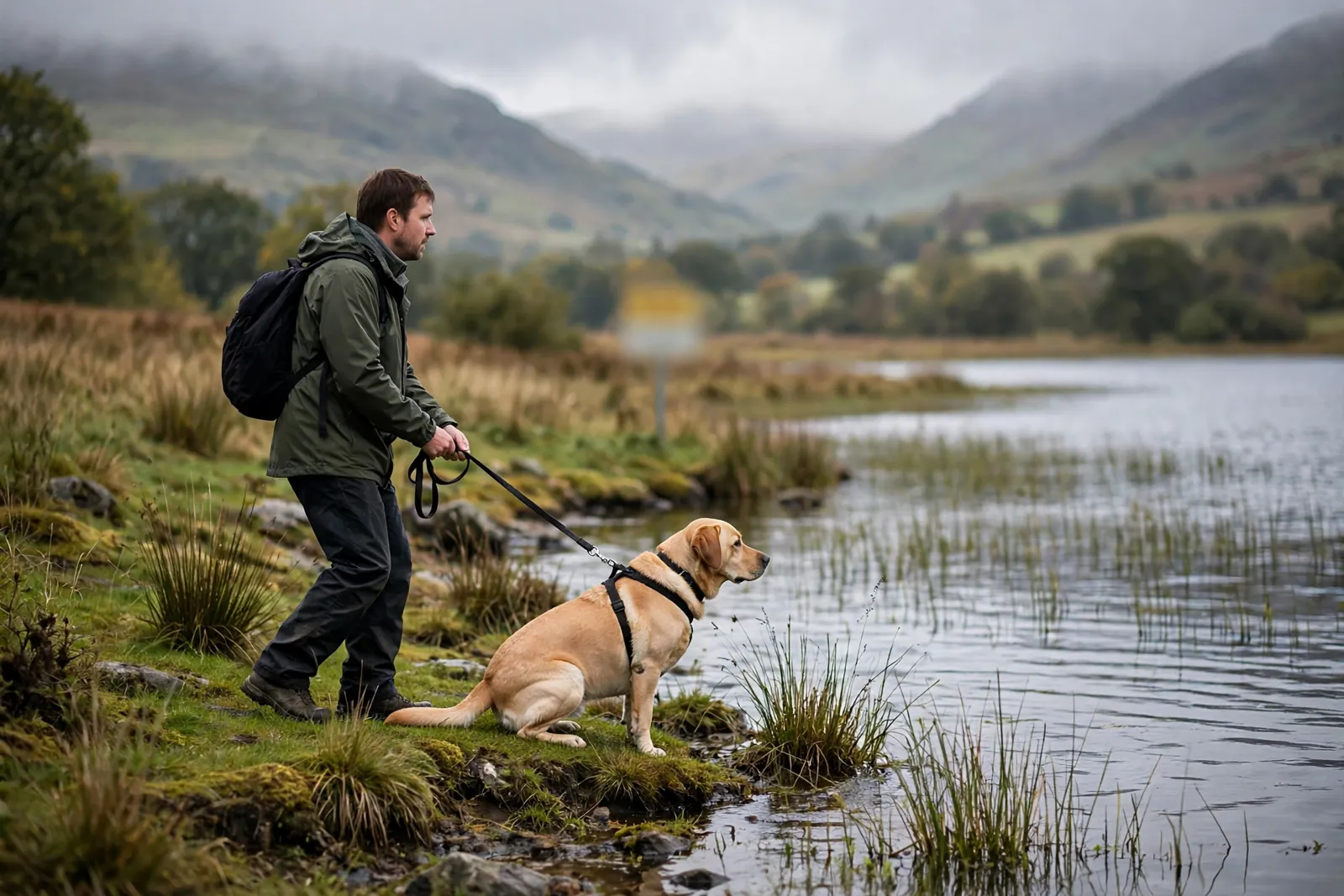
Blue-Green Algae & Dogs UK: Deadly Water Risk
Blue-green algae can kill dogs fast. Learn to spot toxic blooms in UK lakes and rivers, act fast in an emergency and choose safer swimming for your dog.
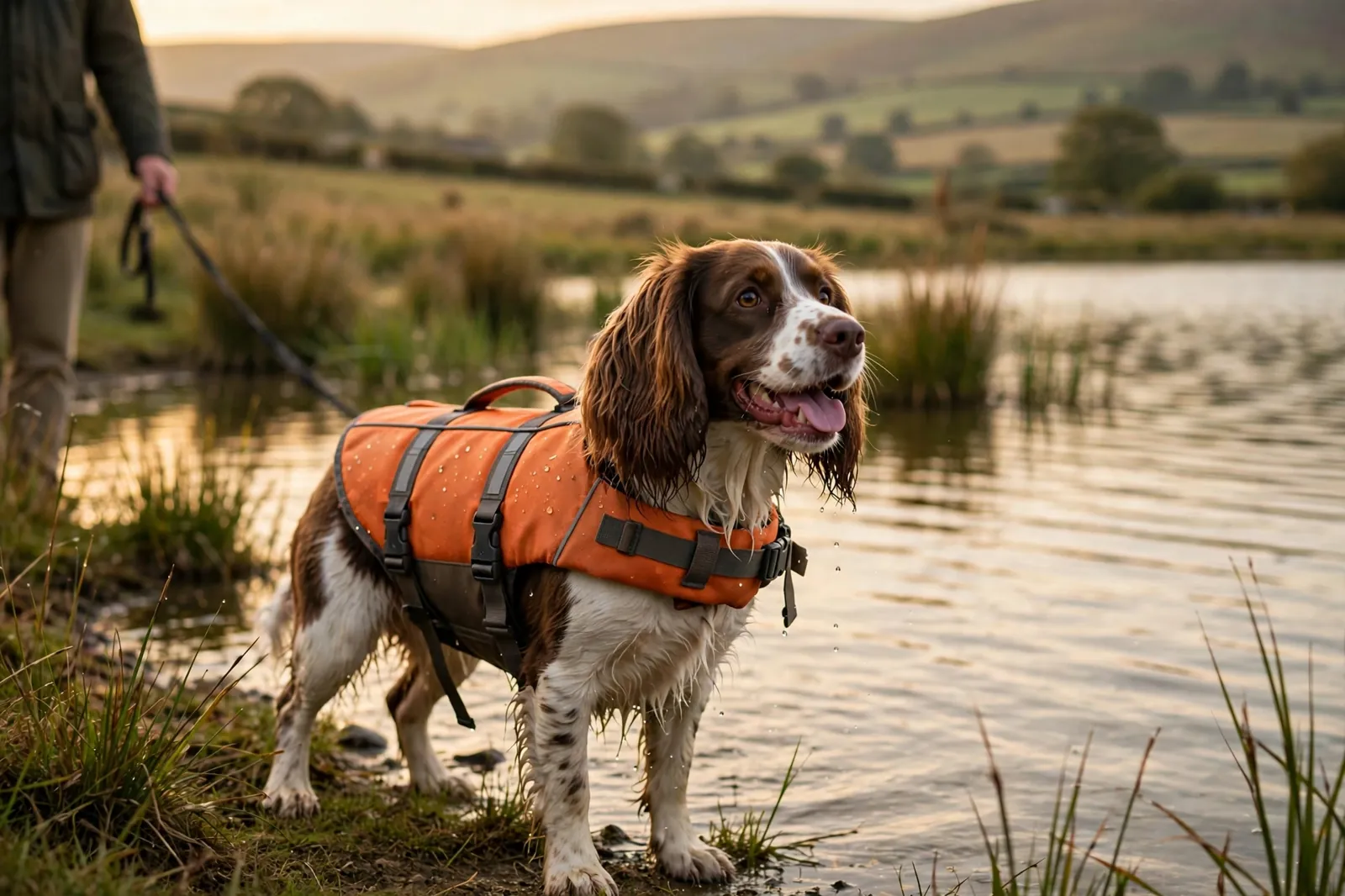
Dog water safety in the UK: how to let your dog swim without the preventable risks
Dog water safety in the UK explained clearly: blue-green algae, tides, cold water, life jackets, safe swimming places and emergency steps for owners.
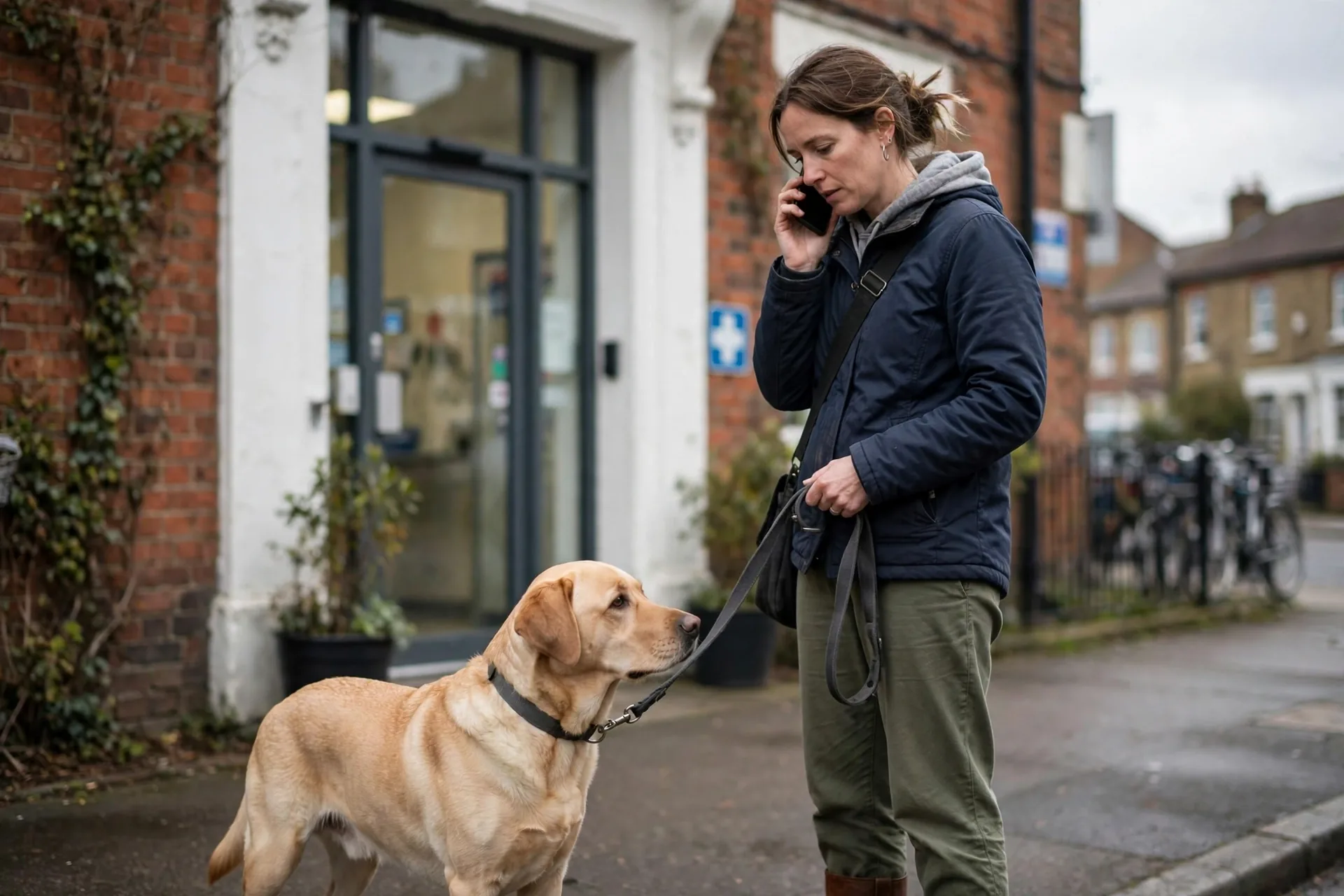
Emergency Vet on Holiday UK: Find Help Fast
Emergency vet on holiday in the UK? Learn how to find help fast, spot true emergencies, call ahead, handle costs and insurance, and follow up at home.