This guide is independent and contains no paid placement. If affiliate links are added later, they will be clearly marked and will not change our editorial checks.
Arbroath is one of the easiest Angus coast towns for a dog trip: West Links Beach allows dogs all year, the Seaton Cliffs path from Victoria Park is a superb on-lead walk, dogs are welcome on leads in the abbey grounds, and Lunan Bay is a short drive north. Keep the dog on a lead on the cliffs, check tides before any beach or bay, and check the official guidance before you travel for opening times and prices.
Why Arbroath works for dogs
Arbroath is a small working fishing port on the Angus coast in north-east Scotland, about 16 miles from Dundee, with a population of around 23,500. It is not a polished resort town, and that is exactly why it suits dogs. The seafront is practical rather than precious: a long sandy beach where dogs are welcome all year, a harbour where fishing boats still come and go, stacks of creels along the walkways, and a cliff path that starts at the edge of a public park. You do not have to drive out of town to find a proper walk, and you do not have to negotiate a maze of seasonal dog bans to use the beach.
The town packs a surprising amount into a compact area. Within a short walk of the railway station you can reach the harbour, the High Street, the red sandstone ruins of Arbroath Abbey at the top of the High Street, and the seafront. Victoria Park, at the north end of town, is the gateway to the Seaton Cliffs. West Links Park and the beach lie to the south-west of the town centre. Keptie Pond, a sheltered park around a pond, sits close to the centre. That density matters with a dog: you can build a day from short links between places instead of one long car journey, and you can always cut a walk short and be back at the car, the station or a cafe within minutes.
Arbroath also makes a good base for the wider Angus coast. Carnoustie is a short hop south along the coastal path and the railway line, Dundee is under half an hour away by train, and Lunan Bay and Montrose lie to the north. If you are planning a longer Angus trip, our Dundee with a dog guide covers the waterfront, Broughty Ferry beach rules and the parks that pair well with a day in Arbroath. The coast here rewards slow travel: the light changes fast over the North Sea, the cliffs look different at every tide, and a dog that has had a good beach run in the morning will settle happily while you look at the abbey in the afternoon.
Arrive well: the first hour
Start at Victoria Park if you are driving, or at the station if you are arriving by train. Drivers get free parking at the Arbroath Cliffs car park in Victoria Park, with public toilets nearby and a snack van often parked close by in good weather. That car park is the trailhead for the cliff path, so it doubles as your base for the morning. Walk the dog around the park first on a lead, let them sniff the sea air and settle, and check the wind before you commit to the cliffs. If the wind is strong or gusty, keep the first outing short and low: the beach or the park, not the exposed clifftop.
If you arrive by train, the station has step-free access to both platforms, a staffed ticket office, machines, toilets and a waiting room, and the bus station is a short distance east of the railway station. The walk from the station to the seafront and the harbour is straightforward, but give a nervous dog ten unhurried minutes around the station approach first. Town-centre traffic, gulls and the smell of fish can be a lot for a dog fresh off a train, and a calm start pays off for the rest of the day.
Finally, decide the shape of the day before the dog decides it for you. A sensible pattern is a beach run first, while the dog is fresh and the sand is quiet, then the cliff path or the abbey grounds in the middle of the day, then a slow harbour wander and an early dinner. Dogs that have burned off energy on sand cope far better with on-lead sightseeing later. If you do it the other way round — abbey first, beach last — you will be managing a frustrated dog through the part of the day that needs the most patience.
Seaton Cliffs and the Auchmithie path
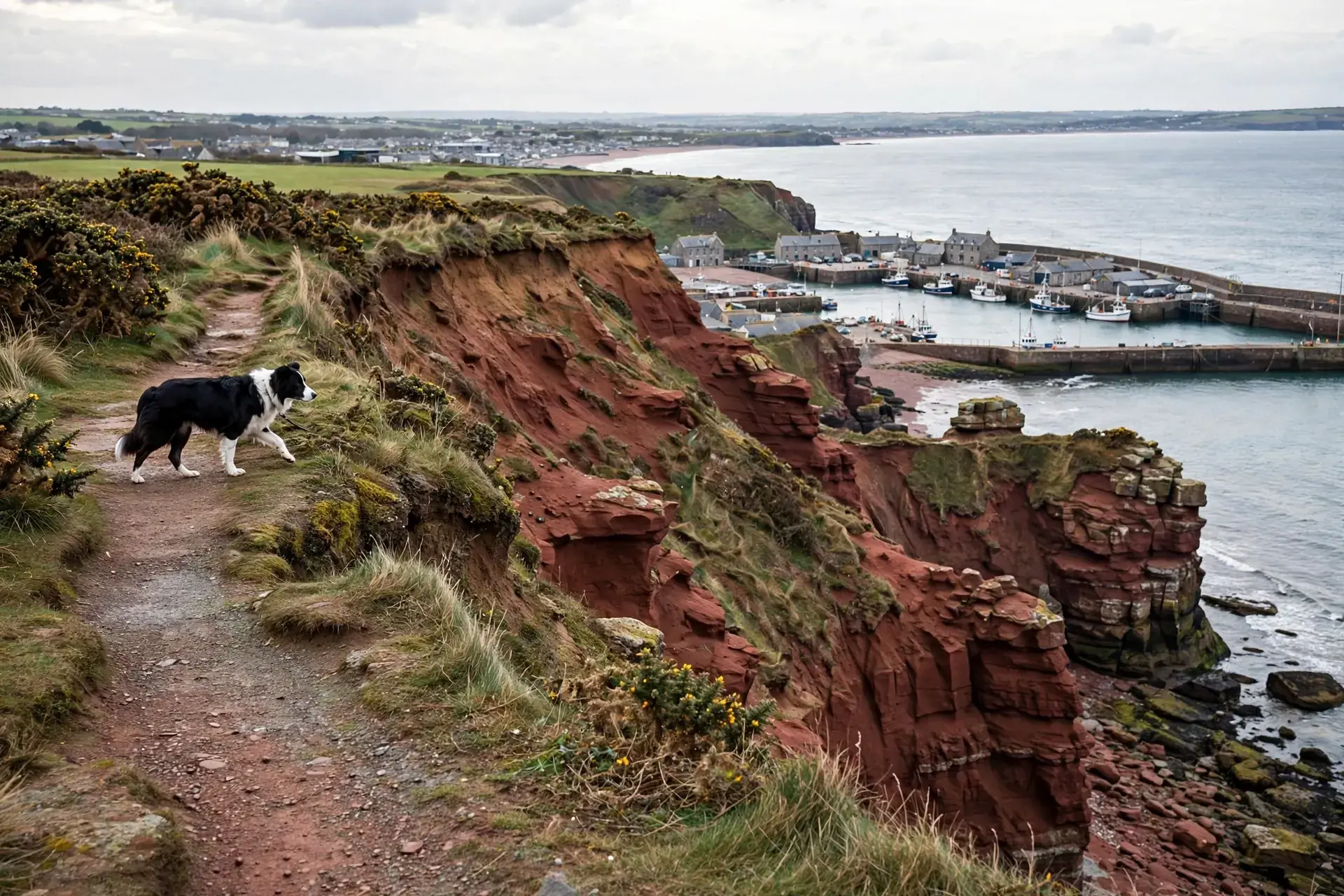
The Seaton Cliffs are the single best reason to bring a dog to Arbroath. The path starts at the east end of Victoria Park, where it winds up above the cliffs and levels out into a coastal path along the top. The cliffs are Devonian red sandstone, formed roughly 400 million years ago, and the sea has sculpted them into sea stacks, arches, blowholes and hidden caves. The named landmarks along the way include the Deil’s Heid, the Needle E’e arch and Dickmont’s Den, and the whole stretch is part of the Seaton Cliffs Nature Reserve, managed by the Scottish Wildlife Trust.
Keep your dog on a lead for the whole clifftop section. This is not a suggestion to weigh up on the day: the path runs close to a very steep drop in places, and Visit Angus is explicit that dogs should be kept on leads because the drop is steep and the path is close to the edge. The main footpath along the clifftops is surfaced and mostly flat, which makes it feel easier than it is, and that is part of the risk — a dog chasing a gull or a rabbit can cover the distance to the edge in seconds. Use a short lead, not a long line, and keep the dog on the landward side of the path wherever the ground allows.
The classic walk is the trail from Victoria Park to Carlingheugh Bay, about 1.75 miles each way and 3.5 miles there and back. From the eastern end of the Arbroath Cliffs car park, head up the ramp onto the clifftops and follow the surfaced path with the sea on your right for just over a mile to a split in the path above Carlingheugh Bay, where a wooden signpost marks the Angus Coastal Path. Carlingheugh Bay itself is a long stretch of sand and pebble beach with a red sandstone sea arch and rock stacks at its southern end and dramatic tall cliffs at its northern end, and there is a set of steps down to the bay if you want to let the dog paddle. Those steps are steep, so only take a dog down if it is steady on steps and you can manage the climb back up.
West Links Beach
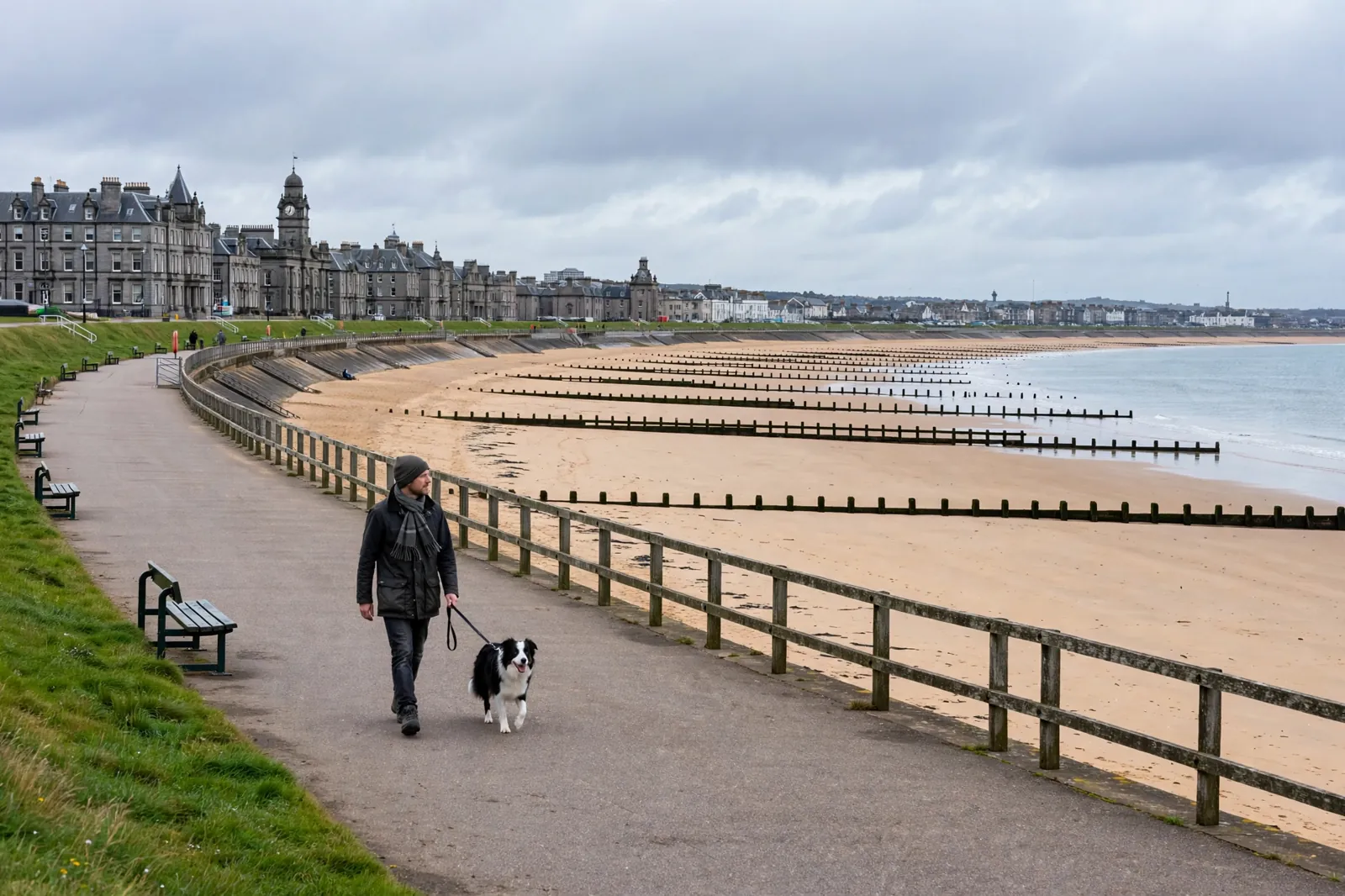
West Links Beach, also known as Elliot Beach, is Arbroath’s main beach and its most forgiving place for dogs. Dogs are allowed all year, and the beach is a popular spot for dog walkers in every season. The best access is from West Links Park, and the beach itself is a long stretch of sand with rock pools to explore at low tide. It is the place to let a dog run, play and paddle after the discipline of the cliff path, and it is also the easiest beach in town to reach without a car.
Time your visit to the tide. At low tide the beach opens out into a wide expanse of sand with rock pools that dogs love to investigate, while at high tide the usable sand narrows considerably. Check tide times before you travel, and watch the weather: the beach is exposed to the North Sea wind, and wind chill can make a mild day feel cold, especially for a wet dog. Bring a towel and a drying coat, and rinse sand and salt water off paws and belly before the drive home. Salt water is not a drink — carry fresh water and offer it regularly, because a dog that has been running on sand will drink sea water if it is thirsty enough.
The beach is also the southern end of a longer coastal walk. From Arbroath you can follow the coastal path south towards East Haven, Carnoustie, Monifieth and Broughty Ferry, with the dunes offering quieter side trails. The stretch from Arbroath to East Haven is a relaxed coastal wander rather than a dramatic one: it is about space and calm, and it is popular with dog walkers and families. If you want a longer day, walk south along the beach and the dunes in the morning and save the cliffs for the afternoon, when the light is on the red rock. For the rules that apply across Scotland’s beaches, including the access code and the bird breeding season, our dog-friendly beaches in Scotland guide sets out the general picture.
Harbour, marina and Signal Tower
Arbroath Harbour is one of the most photographed places in the town, and it is worth a slow wander with a dog on a short lead. Fishing boats come and go, stacks of creels line the walkways, and a row of colourful buildings behind the marina adds a bright backdrop. You can climb stairs at sections to the top of the seawall for viewpoints across the water, but keep the dog well back from the harbour edge and away from ropes, nets, creels and fish boxes. Harbour surfaces are often wet, oily or uneven, and a dog that slips on a wet quay can be in the water before you can react.
The harbour is also the starting point for the town’s lighthouse story. In the early nineteenth century Arbroath was the base for building the Bell Rock lighthouse on a treacherous rock far out to sea, and a signal tower was built in the town to communicate with the builders working offshore. That tower now houses the Signal Tower Museum, which tells the story of the lighthouse, built by Robert Stevenson and completed in 1811, alongside the history of the town, its customs and the local fishing industry. The museum is a small indoor attraction, so check the official guidance before you travel for current opening times, prices and whether dogs are allowed inside — do not assume a dog can go in, and plan the harbour as an outdoor walk with the museum as a possible extra for one person while the other waits outside with the dog.
Harbour etiquette matters more here than at the beach. Keep the dog on a short lead at all times around the harbour, because boats, vehicles and forklifts share the same narrow space as pedestrians, and a loose dog around working fishermen is a hazard to everyone. Do not let the dog drink harbour water, eat fish scraps or discarded bait, or chew rope and netting. Gulls are bold around the harbour, especially near fish boxes, so keep the dog close when gulls are feeding. The harbour is at its best early in the morning, when boats are moving and the light is low, and again in the evening, when the water calms and the town goes quiet. Both are good times for a dog that finds the midday harbour too busy.
Arbroath Abbey grounds
Arbroath Abbey is the town’s great historic site, and it is one of the few major Scottish abbeys where a dog can properly be part of the visit. The abbey was founded in 1178 by William the Lion in memory of the martyr Thomas Becket, and it was one of the nation’s grandest monasteries for almost 400 years. It is most famous for the Declaration of Arbroath, issued in 1320, in which the Scottish nobility asserted Scotland’s independence to Pope John XXII. The distinctive red sandstone ruins stand at the top of the High Street, and you can see much of the structure, including the well-known round window, from the surrounding streets.
Dogs are welcome in the abbey grounds, other than in roofed areas, and must be kept on leads at all times in the grounds. That makes the abbey a realistic stop on a dog day, rather than a place to admire only from the car. Walk the grounds slowly, keep the dog on a short lead, and remember that this is a scheduled monument cared for by Historic Environment Scotland: do not let the dog climb on walls, dig, or chase birds around the ruins. The abbey is open to the public throughout the year with an entrance charge, and the visitor centre beside the west front explains the history of the Declaration and the lives of the monks. Dogs are not expected to be allowed inside the visitor centre or roofed areas, so check the official guidance before you travel for current opening times, prices and the exact dog rules.
The abbey works best as a short, calm stop rather than a long visit. Arrive with a dog that has already had a walk — the beach or Keptie Pond first, the abbey second — and keep the visit to the grounds at a gentle pace. The site is about ten minutes’ walk from the train station, with a small car park beside the visitor centre, so it is easy to fit in between the harbour and lunch. If you visit on 6 April, the anniversary of the Declaration, expect a street procession and short piece of street theatre, and a much busier town: a noise-sensitive dog will be happier on the beach that day. The annual commemoration is a reminder that the abbey is still a living part of the town, not just a ruin, and it is worth planning around rather than stumbling into.
St Vigeans Nature Trail
For a quieter walk away from the sea, the St Vigeans Nature Trail is the local favourite. The trail sets off from the tiny village of St Vigeans, just north of Arbroath, where you will see an impressive sandstone church sitting on top of a small hill — often described as one of the most picturesque churches in Scotland. Starting from the church, the route follows an old disused railway line, lined with trees and shrubs, running alongside a bubbling stream. It is a sheltered, wooded walk, which makes it a good choice on a windy day when the cliff path would be unpleasant.
The trail suits dogs that prefer sniffing and shade to open running. The old railway line is mostly level and easy underfoot, with multiple paths that allow a longer or shorter outing, and the riverside setting gives dogs plenty to investigate without the hazards of the cliff edge. The walk is described by local walkers as good for both on-lead and off-lead walking, but that does not mean off-lead is right for every dog: there are other walkers, horses behind fences, and wildlife along the stream, so keep your dog under close control and put the lead on whenever you meet other people or animals. Follow the Scottish Outdoor Access Code throughout, and check the official guidance before you travel if you are unsure about access on any section.
St Vigeans village itself is worth the approach alone. It is a single street of old sandstone cottages leading to a seventeenth-century bridge, with the church — which goes back to the twelfth and thirteenth centuries, though much was over-restored in the nineteenth — prominent on its mound. The village is small and residential, so keep noise down, keep the dog on a lead through the village, and do not block driveways or the narrow street when you park. There is also a small museum in the village, open seasonally on limited days, which tells the story of the area’s carved Pictish stones; check the official guidance before you travel for current opening days, and do not assume dogs are allowed inside.
Keptie Pond and Victoria Park
Keptie Pond is Arbroath’s gentlest dog walk: a scenic park wrapped around a pond, with a circular hard path around the water that is ideal for buggies, wheelchairs and dogs that struggle with rough ground. At the top of the hill there is a stone building locals call the Water Tower, overlooking the park. The pond walk is short and flat, which makes it perfect as a first or last walk of the day, a toilet walk before a long drive, or a calm outing for a puppy, an older dog or a dog recovering from injury.
Keep the dog on a lead around the pond, and do not let it swim or drink from the pond. Still water can carry bacteria and blue-green algae in warm weather, and a dog that drinks pond water can become ill quickly. If you see algae, scum or dead fish, keep the dog well away and report it if there is a notice with a contact number. The same rule applies to any standing water you meet on the Angus coast: a moving stream is a safer place for a paddle than a still pond. Bring fresh water even for a short park walk, because a dog will drink whatever is nearest when it is thirsty.
Victoria Park, at the north end of town, is the other green space that matters for dog owners. It is the starting point for the cliff path, with free parking, accessible toilets and a snack bar or ice cream shop, and ample space for dog walking. The park is also where Arbroath hosts events in summer, so check whether an event is on before you arrive with a noise-sensitive dog — a busy summer event changes the park completely. On a quiet day, the park is a good place for a lead walk and a settle before the cliffs, and the promenade at its eastern end is where the cliff path begins. Treat the park as your base camp: toilet, water, parking and the trailhead in one place.
Lunan Bay day trip
Lunan Bay is the great beach north of Arbroath, and it deserves half a day of its own. It is about two miles of sand below the ruins of Red Castle, between Arbroath and Montrose, and it is often described as one of the very best beaches in Angus. Dogs are welcome all year, and at low tide there is a huge expanse of sand for dogs to run and play, with the chance to explore caves at the north end of the beach or head along the road to the longer south section.
Start from the Lunan Bay beach car park, and check the tide before you set off: low tide is when the bay is at its best, and a rising tide can cut off the caves and narrow the beach quickly. Keep dogs away from resting shore birds and under close control by the river, the dunes and the farmland that borders the bay. The dunes are a sensitive habitat, so keep to paths through them rather than letting the dog crash through nesting areas, and keep the dog on a lead near the river and around livestock. The beach is popular with dog walkers, so expect company even on a quiet day, and be ready to recall your dog around other dogs and families.
The bay is wilder and more exposed than West Links Beach, and it needs more planning. There is a cafe and diner near the beach that welcomes dogs, which makes it a practical lunch stop, but check the official guidance before you travel for current opening times. Bring water, a towel and a windproof layer even on a sunny day, because the bay catches the wind off the North Sea and the sand blows hard when it picks up. Mobile signal can be patchy on this stretch of coast, so download your maps and tide times before you leave Arbroath rather than relying on a signal at the car park.
Auchmithie, home of the smokie
Auchmithie is the small fishing village at the far end of the cliff path, and it is famous as the home of the Arbroath smokie: haddock smoked over hardwood in a traditional smokehouse, a protected food name and the town’s signature dish. Walking here from Arbroath is the natural end of the coastal path, and the village is a good place to stop, rest the dog and look back along the cliffs you have just walked.
The village is small, steep in places and very much a working fishing village, so treat it with the same care as the harbour in Arbroath. Keep the dog on a lead through the village and around the harbour, watch for vehicles on the narrow lanes, and do not let the dog approach boats, creels or fishing gear. There are places to buy smokies in the village, and eating one fresh from the smokehouse, still warm, is the closest you will get to the real thing — but smokies are smoked fish, and smoked fish is not dog food. Do not feed the dog smoked fish, bones or fish skin, however much it begs, and keep food well away from a scavenging dog on the harbour.
If you walk to Auchmithie, plan the return before you set off. The full out-and-back walk from Victoria Park is about six miles, which is a lot for many dogs, especially in wind or heat. Options include turning back at Carlingheugh Bay for a 3.5-mile return, arranging a lift back from Auchmithie, or taking a bus or taxi for one leg — check the official guidance before you travel for current bus times, because rural services can be infrequent. There is parking in the village itself if you drive there instead, which makes Auchmithie a good short visit on its own: park, walk down to the harbour, look at the cliffs from the other direction, and drive back.
Eating out with a dog
Arbroath’s food is part of the trip, and the town is small enough that you can usually find somewhere to eat with a dog if you plan ahead. Visit Angus’s dog-friendly itinerary names Webmors Coffee Shop in the town centre as a lunch stop, with soups, sandwiches, paninis and home baking, and Andreou’s Bistro in the town centre for dinner, serving traditional homemade Greek and Mediterranean cuisine. Both are named as part of a dog-friendly day out, but policies can change, so check the official guidance before you travel and confirm the current dog policy directly with the venue before you go.
As a general rule, favour places with outdoor seating, terraces or gardens, and ask before you sit down. A dog that can settle under a table outside is a different proposition from a dog squeezed into a busy dining room, and many places that cannot take a dog inside will happily take one on the terrace. Bring a mat or blanket for the dog to lie on, a chew or a stuffed Kong to keep it occupied, and water in a collapsible bowl. Feed the dog before you sit down to eat, so it is not hungry and restless while you wait for food.
Smokies deserve a special note. Arbroath smokies are smoked haddock, and they are sold all around the town, from smokehouses to fishmongers. They are a protected food name, and the best are eaten soon after smoking. Buy them to take home rather than to feed the dog: smoked fish is salty, rich and bony, and it can upset a dog’s stomach badly. Keep smokies in a sealed bag in the car, not on the back seat next to a hopeful nose, and check the official guidance before you travel if you plan to buy fish to take home, because you will need a cool bag and a short journey home.
Where to stay with a dog
Arbroath has a range of places to stay, from hotels and guest houses to self-catering cottages and holiday parks, but dog policies vary widely, and the only safe approach is to confirm the exact policy for your dates, your dog and your room before you pay. Ask the same questions you would anywhere in Britain: is there a pet fee, and how much per dog per night or per stay; is there a maximum number of dogs; are there breed or size conditions; are dogs allowed in every room type or only in selected rooms; and are dogs allowed in the bar, restaurant or breakfast room, or only in the bedroom?
Self-catering accommodation is often the easiest option with a dog in Arbroath. A cottage or apartment with its own door to the outside, a fenced garden or yard, and a kitchen where you can prepare the dog’s food gives you far more flexibility than a hotel room. Ask whether the garden is genuinely enclosed, how high the fence is, and whether there is a gate that a determined terrier could open. Ask where the nearest practical toilet walk is after dark, and whether there is an outdoor tap or a place to wash muddy paws. If the property is near the cliffs or the beach, ask about the route to the shore — a cottage that looks close to the beach on a map can be cut off by the railway line or a busy road.
Holiday parks and caravan sites near Arbroath, including the Red Lion Holiday Park by the beach access, can also work well, but the same checks apply: read the site map, ask for a pitch or unit away from the main pedestrian route if your dog watches every passer-by, and confirm the rules about leaving a dog alone in the unit. Many parks prohibit unattended dogs outright, so plan as if the answer is no, and favour places where the dog can come with you to eat. For the wider picture on comparing parks, including pet fees, boundaries and cancellation terms, our dog-friendly holiday parks guide covers the questions worth asking before payment.
Getting there and getting around
Arbroath is easy to reach by train, and the railway is often the best way to arrive with a dog. The station is 17 miles east of Dundee on the line between Dundee and Aberdeen, between Carnoustie and Montrose, and there are generally two or three trains per hour westbound to Dundee and eastbound to Aberdeen, with hourly services onwards from Dundee towards Edinburgh and Glasgow Queen Street. ScotRail manages the station, with CrossCountry, London North Eastern Railway and Caledonian Sleeper services as well. Trains from Glasgow Queen Street or Edinburgh via Dundee run every 30 minutes in the daytime, and some services start from London King’s Cross. The fast trains continue north to Montrose, Stonehaven and Aberdeen, while the slow trains after Dundee stop at Broughty Ferry, Monifieth and Carnoustie, then terminate at Arbroath.
The station building sits above the railway line and platforms, with a ticket office, lifts to the platforms and toilets, and a taxi rank and drop-off point outside. There is step-free access to both platforms. Dogs can travel on trains, but check the official guidance before you travel for the current operator rules, keep the dog on a lead in the station and on the train, and bring water and a mat for the journey. A tired dog travels better than a fresh one, so give the dog a good walk before a long train journey, and choose a quiet carriage if you can.
By car, the A92 follows the coast from Dundee through Arbroath to Montrose, Stonehaven and Aberdeen, and it is dual carriageway south of Arbroath. The main Edinburgh–Dundee–Aberdeen road, the A90, runs further inland. Driving gives you the freedom to reach Lunan Bay, Auchmithie and the wider Angus coast, which are hard to reach by public transport, and it lets you carry the full dog kit — crate, bed, towels, food and water — without worrying about luggage limits. Plan rest stops on the drive, because a dog that has been in the car for hours will need a proper break before the cliff path, not a five-minute pavement stop.
Seasons, tides and weather
Arbroath is a year-round destination for dogs, but the seasons change the trip more than the brochures suggest. Spring, from April to June, brings longer days, nesting seabirds on the cliffs and the bird breeding season, when the Scottish Outdoor Access Code asks you to keep dogs on a short lead or close at heel along the shore. It is also when the cliff path is at its greenest and the light is at its best. Summer brings the warmest weather, the busiest beaches and the town’s events in Victoria Park, but also the most people on the cliff path and the most gulls around the harbour. Autumn, from September to October, is often the best balance: quieter paths, open beaches, and prices that leave room for a longer stay. Winter brings short days, strong winds and a quiet town, but the beach and the cliffs are still there, and a dog in a drying coat will enjoy a winter beach as much as a summer one.
Tides matter more than the calendar. Low tide opens up the rock pools at West Links Beach, the caves at the north end of Lunan Bay, and the full width of the sand at Carlingheugh Bay. High tide narrows all of them, and a rising tide can cut off the lower bays below the cliffs, so check tide times before you travel and plan your beach walks for the falling or low tide. Never let a dog swim near the harbour, boats or fishing gear, and never assume a beach is safe to swim in because it looks calm: the North Sea is cold all year, currents can be strong, and a dog can tire quickly in cold water.
Weather on the Angus coast changes fast. Arbroath is rarely still, so factor in wind chill even on mild days, and carry a windproof layer for yourself and a drying coat for the dog. Rain makes the cliff path slippery, especially if you step off the surfaced route, and it makes the steps down to Carlingheugh Bay treacherous. Fog can roll in off the sea and cut visibility on the clifftop within minutes, so keep the dog on a lead and stay on the path if the mist comes down. Midges can trouble parts of Scotland from June to August, although the exposed coast is usually less affected than inland glens — check the official guidance before you travel if your dog is sensitive to bites.
Cliff, sea and wildlife safety
The cliffs are the main safety issue in Arbroath, and they deserve a section of their own. The Seaton Cliffs path runs close to a very steep drop, and the edge can be undercut or soft after rain. Stay on the surfaced path, keep the dog on a short lead on the landward side, and do not let children or dogs run ahead around blind corners. Do not climb down to the beach except at the marked steps to Carlingheugh Bay, and do not let the dog scramble down the cliff face. If the dog goes over the edge, do not follow it: call for help and keep yourself safe. The same rule applies to the harbour: if the dog falls in the water, do not jump in after it. Call for help, and let the dog swim to a slipway or steps if it can.
Wildlife needs the same respect. The cliffs are a nature reserve with nesting seabirds, and the beaches and dunes hold resting shore birds, especially in the breeding season from April to July. Keep the dog on a short lead near birds, and do not let it chase gulls, oystercatchers or seals. Seals haul out on the Angus coast, and a dog that chases a seal can be bitten, or can drive the seal into the water and separate a pup from its mother. If you see seals, keep the dog on a lead and give them a wide berth. The same applies to livestock: parts of the coastal path pass through farmland where cattle and sheep may be present, and dogs should be on a lead and under close control around them.
Other hazards are smaller but worth knowing. Adders are present in parts of Scotland, including coastal grassland and dunes, although bites are rare. Keep the dog on the path in long grass in warm weather, and know the signs of a bite — swelling, pain and lethargy — and the location of the nearest vet. Ticks can be picked up in long grass and woodland, especially around St Vigeans and the dunes, so check the dog after every walk and remove ticks promptly. Blue-green algae can appear in still water in warm weather, so keep the dog out of Keptie Pond and any still pools. For a fuller checklist of what to do when things go wrong on a dog holiday, our dog emergency vet guide covers the steps to take before you need them.
Packing list for Arbroath
Pack for wind, water and cliffs, not just for a beach day. The essentials are a short lead and a spare, a harness that fits well and cannot slip over the dog’s head, a collapsible water bowl and a full water bottle, poo bags in an outside pocket, a towel and a drying coat, and a mat or blanket for cafes and for the car. Add a long line for the beach, but only use it where there is no cliff edge and no livestock — the beach at low tide is the place for it, the clifftop is not. Bring the dog’s usual food and any medication, plus a copy of the vaccination record if your accommodation asks for it.
For the cliff path, add sturdy footwear for yourself, a windproof layer, and a small first-aid kit for the dog: saline for eyes, a bandage, tick removers, and the number of a local vet saved in your phone. A torch is useful if you are walking back from Auchmithie late in the day, and a phone charger matters more than usual, because you will be using the phone for maps, tide times and photos, and signal can be patchy north of town. If your dog wears a coat, bring it even in summer: the wind off the North Sea can chill a wet dog fast, and a drying coat after a beach swim is the difference between a comfortable drive home and a shivering one.
For the car, bring a boot liner or an old sheet, a spare towel for the seats, and a cool bag if you plan to buy smokies to take home. Never leave a dog in a car on a warm day, even with the windows open, and never leave a dog in a car by the cliffs while you walk the path — the dog should be with you, on a lead, or back at the accommodation. If you are travelling by train, pack light but do not skimp on water, a mat and poo bags: the station has toilets and a waiting room, but there is no dog water bowl on the platform.
Practical questions
Before you go
Can dogs go on Arbroath beach all year?
Yes. West Links Beach, also known as Elliot Beach, allows dogs all year. The best access is from West Links Park. Keep your dog under control around other beach users, watch for rock pools at low tide, and always clean up after your dog.
Do dogs have to stay on a lead on the Seaton Cliffs path?
Yes, keep your dog on a lead on the Seaton Cliffs path. The path runs close to a very steep drop in places, and the cliffs are part of a nature reserve with nesting seabirds and nearby livestock. A short lead is the safe choice for the whole clifftop section.
Can dogs visit Arbroath Abbey?
Dogs are welcome in the abbey grounds, other than in roofed areas, and must be kept on leads at all times in the grounds. The abbey itself is a paid Historic Environment Scotland site, so check the official guidance before you travel for current opening times and prices.
Is the Arbroath to Auchmithie walk suitable for dogs?
Yes, for fit dogs on a lead. The coastal path from Victoria Park to Auchmithie is about three miles each way along the Seaton Cliffs, with a surfaced clifftop path that is mostly level, plus steep steps down to bays such as Carlingheugh. Turn back at Carlingheugh Bay for a shorter 3.5-mile return walk if the full route is too much.
Where can dogs swim or paddle near Arbroath?
Dogs can paddle at West Links Beach and at Carlingheugh Bay below the cliffs, and at Lunan Bay a short drive north. Check the tide, watch for strong currents and cold water, rinse your dog afterwards, and never let a dog swim near the harbour, boats or fishing gear.
Can I take my dog on the train to Arbroath?
Yes. Dogs can travel on trains to Arbroath, which has two or three trains an hour to Dundee and onward connections to Edinburgh, Glasgow and Aberdeen. The station has step-free access to both platforms. Keep your dog on a lead in the station, bring water, and check the official guidance before you travel for current operator rules.