This guide is independent and contains no paid placement. If affiliate links are added later, they will be clearly marked and will not change our editorial checks.
Axminster works for dogs because it is a real working town rather than a resort. The River Axe gives you flat riverside walks straight from the town centre, the Axe Valley opens into gentle countryside in every direction, the town itself has a carpet-making history worth an hour of your time, and Lyme Regis and Seaton on the Jurassic Coast are both about a fifteen-minute drive away. Base yourself here for the river, the lanes and the quiet, and drive to the coast for the beaches.
Start on the River Axe
The River Axe is Axminster's character. It rises in the Dorset hills near Beaminster, runs south through the Axe Valley, passes the town on its way to the sea at Axmouth and Seaton Bay, and it shapes everything about the place: the meadows that edge the town, the bridges that carry the roads across it, the mills that once stood on it, and the walking that starts within minutes of the town centre. Axminster grew up where the river could be crossed, and the town still makes most sense when you approach it from the water first. Park the car, walk down to the river, and let the dog learn the smell of the place before you try the shops, the pubs or the lanes. A dog that has had a proper riverside walk is a dog that will settle under a pub table; a dog that has been cooped up in the car all morning will not.
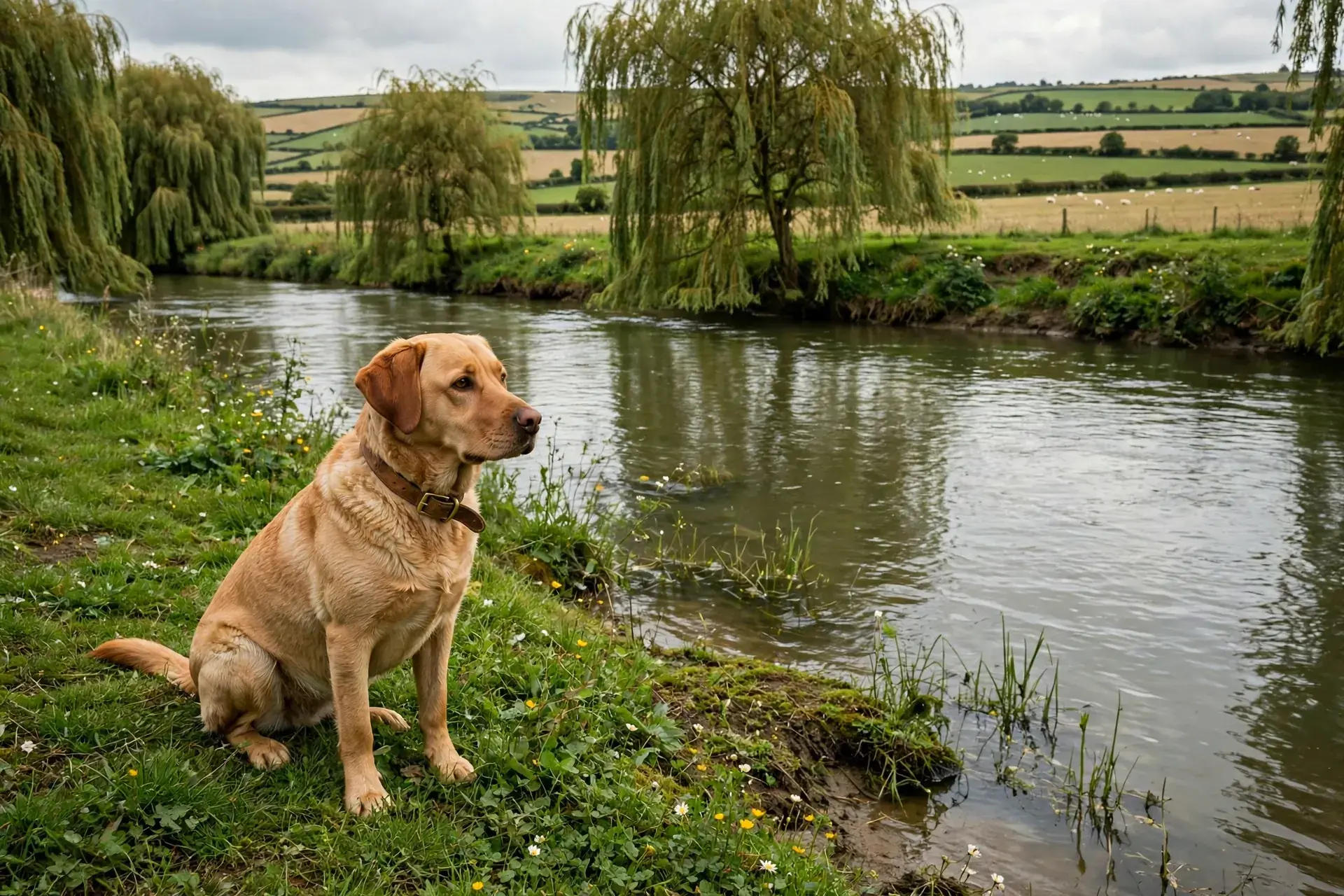
What you will find at the river depends on the season, and that is half the pleasure of it. In summer the Axe runs low and clear over gravel, with willows leaning over the banks, kingfishers flashing along the channel, and dragonflies working the still pools. In winter it runs fast and brown after rain, and the meadows beside it flood in the way valley meadows have always flooded. Herons stand motionless in the shallows at any time of year, and dippers work the faster stretches where the water runs over stone. The Axe is also known for its salmon and sea trout, which is why you will see anglers on the banks in season, and why the river has the quiet, cared-for look of a river that people take seriously. Give anglers a wide berth, keep the dog on a lead when you pass them, and do not let a dog splash through a pool someone is fishing.
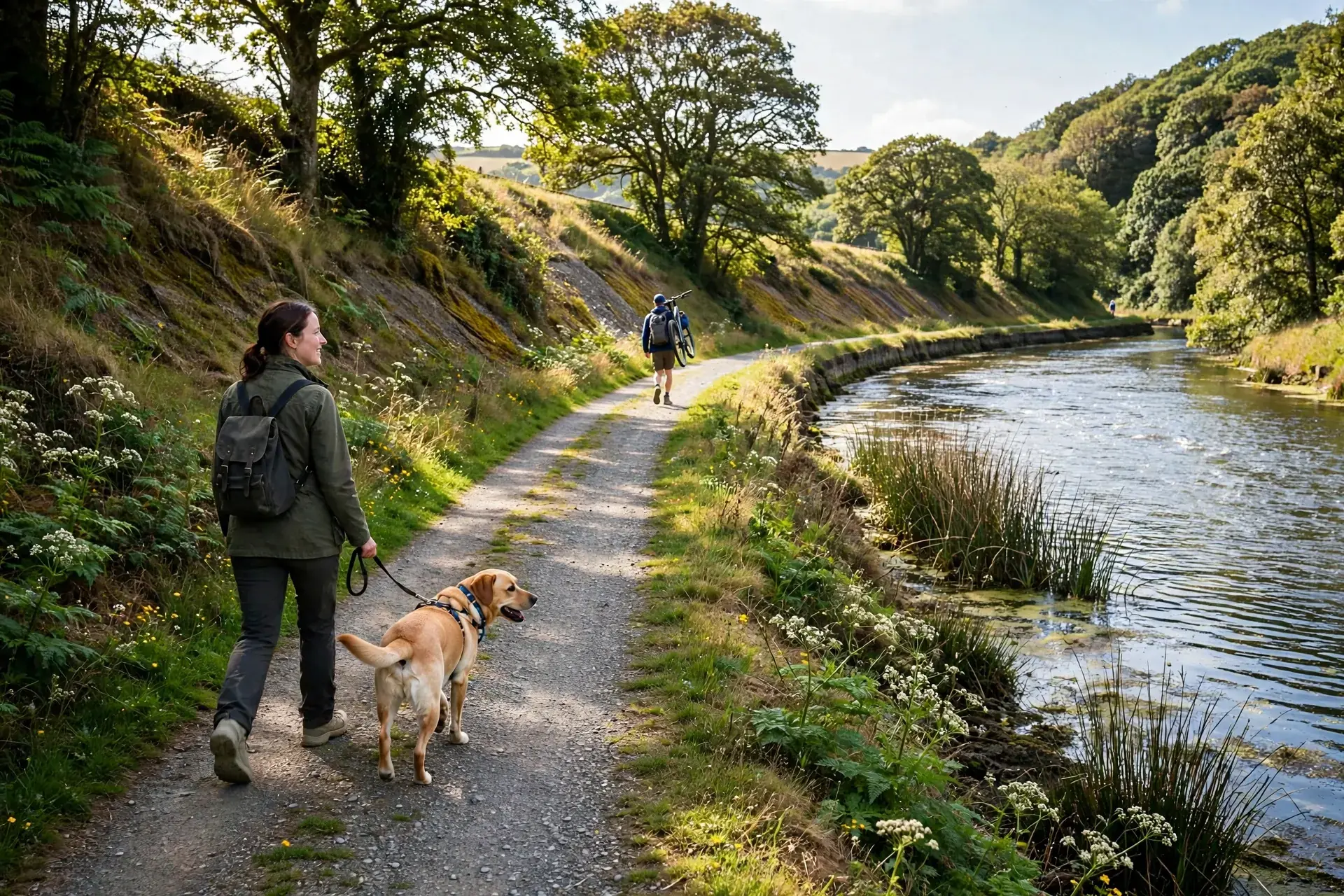
The practical way to meet the river is to start in the town centre and follow the water rather than the roads. The riverside paths and meadows around Axminster are flat, which matters more than it sounds: a level walk beside water suits older dogs, puppies, dogs recovering from injury, and owners who would rather watch a heron than climb a hill. The ground is a mix of surfaced paths and grass, so after heavy rain the grassy stretches can be soft and muddy, and the banks themselves can be slippery. Bring a towel for the car and a drying coat for the dog in winter, and keep the dog on a lead where the path runs close to the road or where the bank drops steeply to the water. The river can rise quickly after rain in the Dorset hills upstream, so do not let a dog swim in fast water, and do not assume that a river that looked gentle in the morning will still be gentle in the afternoon.
Starting at the river also gives you the town's geography for free. Stand on a bridge over the Axe and you can see the shape of Axminster at a glance: the town centre on one side, the meadows and the valley opening out on the other, the railway line running along the valley floor, and the hills rising on both sides. It is a small town — around six thousand people — and it is a working town rather than a show town, which is exactly why it works as a dog base. There are no crowds to fight through, no seafront queues, and no pressure to see everything in an afternoon. The river sets the pace, and the pace is slow. If you like a town shaped by its river, our guide to Wadebridge with a dog covers another Cornish river town built the same way, with a flat trail, a tidal estuary and a food-focused centre — a useful comparison if you are choosing between the two for a longer break.
River walks, nature and the Axe Valley
The Axe Valley is the walking that makes Axminster worth more than a single afternoon. The valley is broad and gentle rather than steep and dramatic, with the river winding through water meadows, pastures and small woods, and with footpaths that follow the water for miles in either direction. The most useful route to know is the East Devon Way, a waymarked long-distance trail of about forty miles that runs from Exmouth on the south coast to Lyme Regis, passing through Axminster on the way. You do not need to walk the whole of it — almost nobody does — but knowing that it passes through the town tells you two things: the walking here is properly signposted, and you can use it in sections. Walk out along the Way for an hour, turn round, and walk back; the dog gets a real walk, you get a real landscape, and nobody has to arrange a lift back from the far end.
A short riverside walk from the town centre is the easiest way to start. Allow thirty to forty-five minutes for a gentle out-and-back along the river and the meadows, which is enough for a morning leg-stretch or an evening wind-down, and enough for a puppy or an older dog without overdoing it. The ground is mostly level grass and surfaced path, so it suits dogs that struggle with hills, and there are places to sit and watch the river while the dog sniffs the bank. For a longer walk, follow the valley upstream or downstream for an hour or two, where the paths run through farmland and small woods and the river is the constant companion. Distances here are honest and easy to judge: a flat valley walk of two miles out and two miles back takes most people and most dogs about ninety minutes with sniffing stops, and the valley is never far from a road or a lane, so cutting a walk short is always an option.
Wildlife is the reward for walking slowly along the Axe. Kingfishers are the prize — a flash of blue and orange low over the water, usually gone before you have pointed it out — and they are seen regularly on the quieter stretches away from the town. Grey herons are common, little egrets visit the valley, and dippers bob on the stones where the water runs fast. Otters have returned to the River Axe in recent years, though they are shy and mostly active at dawn and dusk, so a sighting is a matter of luck and patience rather than something to plan a walk around. Water voles live along the banks, and the meadows in spring and summer hold butterflies, damselflies and wildflowers. A dog that can walk quietly and watch is a better wildlife companion than one that charges every heron, so this is a walk where a calm dog earns its keep — and where a long lead gives a dog freedom to sniff without disturbing the birds.
There are rules worth knowing before you set out into the valley. Much of the riverside walking crosses farmland, and that means livestock: sheep and cattle graze the valley meadows, and dogs must be kept on a lead near them, as the law requires. Stiles, gates and kissing gates are part of the route, so a dog that cannot manage a stile needs lifting over or a route that avoids them — check the official guidance before you travel if you are planning a longer valley walk and need to know the access. The ground after rain is the other thing to plan for: the valley floor is clay in places, and the riverside paths can be deep in mud in winter, which is hard work for small dogs and for pushchairs. Waterproof boots for you, a drying coat for the dog, and a towel in the car turn a muddy walk into a good one rather than a miserable one.
The valley walk also leads naturally towards the coast, and the lower Axe is worth a look on its own. Downstream from Axminster the river runs through Colyton and out to the estuary at Seaton, where the Seaton Wetlands nature reserve protects the marshes and reedbeds of the Axe estuary. The Wetlands are a good dog walk with a difference: flat, surfaced paths, bird hides, and the wide open sky of an estuary, with dogs welcome on leads. It is a very different landscape from the wooded upper valley, and it shows what the river becomes when it meets the sea. Check the official guidance before you travel for the current access rules at the Wetlands, because reserve rules can change, and keep the dog on a lead around the hides and the reedbeds where ground-nesting birds are easily disturbed.
Carpets, the town centre and Axminster's making history
Axminster's name is known around the world for one reason: carpets. In 1755 Thomas Whitty, a local cloth weaver, set up a carpet factory in the town and began making hand-knotted carpets in the Turkish style, and within a few decades Axminster carpets were being supplied to grand houses and royal residences across Britain. The name stuck so firmly that "Axminster" became a word for a kind of carpet, not just a place — which is why people who have never been to Devon have still heard of the town. The factory's heyday is long past, but the craft has not left: carpet-making continues in Axminster today, and the town's identity is still woven, quite literally, into its streets, its buildings and its museum.
The place to start is the town's heritage centre, which tells the carpet story from Whitty's first looms to the present day, with looms, tools, pattern books and examples of the carpets themselves. It is a small, focused museum rather than a grand one, and an hour there gives you the whole story: how the wool was dyed, how the patterns were drawn, how a carpet that took months to knot was priced, and how the factory's fortunes rose and fell with fashion, war and the arrival of machine-made rivals. Dogs are not welcome inside every museum, and policies can change, so check the official guidance before you travel if you want to take the dog in — if the dog cannot go inside, the centre is still worth a visit while one person waits outside with the dog, and the town centre is small enough that this is easy to arrange. Either way, the story is worth knowing before you walk the town, because it explains the solid Georgian buildings and the confident look of a town that once made something the whole country wanted.
Give the middle of Axminster an unhurried hour and walk it as a loop rather than a straight line. St Mary's minster stands at the heart of it, Norman in origin, with a churchyard where a dog on a lead can pause in the shade while you look up at the tower — the 'minster' half of the town's name, paired with the Axe. From there the streets fan out in Georgian frontages and narrow side passages, and the weekly market fills the centre with stalls of vegetables, bread, plants and local crafts. Market morning is the liveliest time to be there, so if your dog dislikes crowds, come at opening time, keep the lead short past the food stalls, and let the dog sniff the edges of the square rather than the middle of it. The centre is compact enough to cover on foot in one slow circuit, and every turning eventually leads back toward the river meadows, which makes a good place to finish: ten minutes of grass and water after the pavements, with the dog's energy spent before you head for lunch.
Shopping here works best when you treat the dog as part of the errand, not as luggage to be parked. A few of the independent shops will let a dog come in with you, and you can usually tell by a bowl or a mat just inside the doorway — but plenty will not, and on a solo trip that means choosing: either the shop or the dog waits. Bring a second person if you can, so one of you browses while the other stays outside with the dog, and keep any solo browsing short. The main road through the centre carries the A35, so the pavements are busier and narrower than the side lanes, and a dog should stay on your pavement side at every junction rather than nosing into the road. Slip down the quieter back lanes instead and you find the older cottages, small front gardens and glimpses across the valley that the main road hides. And if you do tie a lead to a rail while you pop inside, keep it to a minute or two and never on a warm day — a dog left alone outside a shop in a strange town is a dog that will bark, tangle, or worry.
The difference between Axminster and a resort is that the town carries on being itself all year. Its supermarket, pharmacy, post office and library exist for the people who live here, so a self-catering week runs the way a week at home runs: walk to the shops in the morning, cook in the evening, take the dog down to the river after supper, repeat. That sounds dull next to a seaside postcard, and for a dog owner it is the whole point — no hunting for an open cafe out of season, no shuttered streets in February, no drive just to buy dog food. The town also keeps its working rhythm through the winter, when the river meadows flood and the lanes turn muddy and the pubs fill with locals rather than visitors. Stay here and you get a base that behaves like a home address for a few days, with the coast fifteen minutes away whenever the weather turns in your favour, rather than a holiday set that only works in July.
East Devon lanes, villages and countryside walks
Step out of Axminster in any direction and you are in the lanes: narrow, high-hedged, winding lanes that are the real East Devon, and the walking that most visitors miss because they drive straight through them to the coast. The lanes are beautiful and they are not to be taken lightly. Many have no pavement and no verge, which means a dog walk along a lane is a walk in the road, with cars coming round blind bends and nowhere to step aside except into a gateway or a hedge. The rule is simple and worth stating plainly: walk facing the traffic, keep the dog on a short lead on your inside, wear something bright, and use the field paths and bridleways wherever they exist instead of the lanes. The best lane walking is done by car: drive to a village, park, and walk the footpaths from there, rather than walking the lanes themselves.
The villages around Axminster are worth the drive. Colyton, about four miles to the south, is a small historic town with a fine church, a tram terminus and a village feel that makes it a good short stop with a dog — walk the main street, look at the old buildings, and take the riverside path along the Coly. Musbury, two miles to the south-west, is a quiet village under Musbury Castle, an Iron Age hillfort whose ramparts still shape the hill above the village. Dalwood, to the north, sits in a wooded valley with a village green and a pub, and Kilmington and Shute to the east are small, unhurried places with churches and lanes that reward a slow look. None of these villages is a destination in itself, and that is the point: they are places to pass through on a walk, to stop for a drink, or to use as the starting point for a footpath, rather than places to tick off a list.
The hillforts are the high points, literally and figuratively. Musbury Castle is a short, steep climb from the village, and the reward is a wide view across the Axe Valley and the sense of a landscape that has been walked for thousands of years. Lambert's Castle, on the ridge above Marshwood Vale a few miles to the east, is another Iron Age hillfort, with views that run from the Blackdown Hills to the sea on a clear day. Both are open, grassy places where a dog can run and sniff, but both are also exposed, with no shelter and no water, so bring water for the dog, keep the dog on a lead near the edges and near any livestock, and do not expect a cafe at the top. These are walks for a dry day with a packed lunch, not for a wet afternoon with a tired dog.
To the north-west of Axminster lie the Blackdown Hills, a National Landscape of high, open ridges, beech hangers and quiet lanes, and a very different kind of walking from the valley floor. The hills are not high by national standards, but they feel high, because the views open out in every direction and the walking is on open heath and woodland rather than enclosed fields. Staple Hill, near the Somerset border, is the highest point, and the area around it has waymarked walks through woods and across open ground. The Blackdowns are also one of the quieter parts of the south-west for walking, which suits nervous dogs and owners who would rather meet a buzzard than a crowd. Check the official guidance before you travel for the current access and parking at the main Blackdown Hills car parks, because the area is large, the car parks are small, and the best walks start from them.
Practical countryside walking around Axminster comes down to a few habits. Wear boots with a good grip, because the field paths are clay in places and slippery after rain, and the stiles can be steep and worn. Carry water for the dog, because the valley streams are not always safe to drink from and the hilltops have no water at all. Check for ticks after every walk, especially in the long grass and bracken of summer, and carry a tick remover. Keep the dog on a lead near livestock and near ground-nesting birds in spring, and pick up after the dog even on a remote footpath — the next walker will be along it sooner than you think. And download an offline map before you set out, because mobile signal is patchy in the valleys and on the ridges, and a paper map or a downloaded one is the difference between a good walk and a long detour.
Day trips: Lyme Regis, Seaton and the Jurassic Coast
Axminster's best trick as a base is its position. Lyme Regis is about six miles to the south, Seaton about seven, and both sit on the Jurassic Coast, the World Heritage coastline that runs from Exmouth to Studland. That means the coast is a fifteen-minute drive rather than a day's expedition, and you can treat it the way locals do: a morning at the beach, lunch in town, and home for an evening walk along the river. It also means you can choose your coast day by the weather rather than by a booking: a calm, dry morning is a Lyme Regis morning, a windy one is better spent in the sheltered Axe Valley, and a wet one is a day for the town's cafes and the heritage centre.
Lyme Regis is the bigger day out, and it is worth planning rather than improvising. The Cobb, the great curving harbour wall, is the town's landmark, and a walk along it with a dog on a lead is one of the classic Dorset experiences — but the Cobb is exposed, with a sheer drop to the sea on one side and no railings along much of its length, so keep the dog close and do not let it jump up onto the wall. The harbour and the Marine Parade are easy, level walking, and the town centre has cafes and pubs that welcome dogs. For the beach, Monmouth Beach, to the west of the Cobb, is the reliable choice: it allows dogs all year, it is a shingle and sand beach with rock pools at low tide, and it is where the fossil hunting happens. The main Front Beach has seasonal dog restrictions in the summer months, so check the current signs and the official guidance before you travel, because the dates and the exact area covered can change. Parking in Lyme Regis is the hard part — the town is popular, the car parks fill early in summer, and the streets are steep — so arrive before ten in the morning or come in the evening, when the light on the Cobb is at its best and the crowds have gone.
Seaton is the quieter coast day, and for many dogs it is the better one. The town sits at the mouth of the River Axe, where the river meets the sea at Seaton Bay, and its beach is a long sweep of shingle with sand at low tide. Seaton is less crowded than Lyme Regis, the seafront is flat and easy to walk, and the Axe Estuary Wetlands at the edge of town give you a nature reserve walk as well as a beach. The Seaton Tramway is the town's other attraction: narrow-gauge trams run the three miles from Seaton to Colyton through the Axe Valley, and dogs are welcome on the trams on a lead, which makes it a rare chance to ride with your dog rather than walk. Check the official guidance before you travel for the current dog policy, timetable and fares, because they can change with the season, and book ahead in school holidays because the trams are popular. A good Seaton day is a morning on the beach, a tram ride to Colyton for lunch, and a walk back along the valley if the dog is up to it.
Beer, a few miles west of Seaton, is the third coast village worth knowing. It is a working fishing village in a steep-sided cove, with a shingle beach, fishing boats drawn up on the shore, and a village of whitewashed cottages behind it. Beer Beach is a good dog beach, and the coastal path from Beer runs east towards Seaton and west towards Branscombe, with views across Lyme Bay that are among the best on this coast. The path is a proper cliff walk, with steep sections and no fences in places, so it suits fit, confident dogs on a lead and owners who are happy with heights — it is not a walk for a nervous dog or a dog that pulls. Check the seasonal dog rules at Beer Beach before you go, and check the official guidance before you travel for the current access, because cliff path closures after landslips are not uncommon on this coast.
Each beach on this stretch of coast writes its own dog rules, and the rules move with the calendar, so a beach that welcomes dogs in February can turn them away on a July afternoon. Monmouth Beach at Lyme Regis, west of the Cobb, stays open to dogs through the year and is the safe default for a summer visit, with rock pools at low tide and room to walk; the main Front Beach, by contrast, shuts dogs out during the summer daytime, and the exact dates and the stretch of sand covered can shift from year to year. Seaton's long shingle bay and Beer's cove beach have their own seasonal arrangements again, different from Lyme's. The notice board at the top of the steps is the authority, not a website you read in March, and wardens do enforce the summer bans. Read the board before you let the dog off the lead, and if the sign is ambiguous, keep the lead on. Our guide to dog-friendly beaches in the UK explains how the seasonal bans and public space protection orders work, so you can see why the same beach can be open in winter and closed in August. Tide times matter just as much: check them the night before, because a beach that stretches for half a mile at low water can shrink to a strip of shingle at high water, and a dog chasing a ball at the water's edge needs room to run without being cut off.
Eating and drinking with a dog in Axminster
Eating out in Axminster is a small-scale pleasure, and it suits a dog because nothing here is grand or hurried. The town has a handful of traditional pubs and a scatter of cafes, plus a bakery or two and the weekly market, and between them they cover a long weekend without repetition. You will not find a restaurant that needs booking weeks ahead, and you will not need one: the best meals here come after a walk, when the dog is tired and the food is simple. A pub lunch after an hour along the Axe, a coffee and a cake while the dog dries off under the table, a sandwich from the market eaten on a bench by the river — that is the shape of it. Everything is within a few minutes' walk of everything else, so if one place is full or its dog rules do not suit the day, the next one is round the corner and the dog has barely noticed the change of plan.
Start with the walk, not the menu. A dog that has spent an hour along the Axe will curl up under a pub table and sleep through lunch; a dog that has spent the morning in the car will spend lunch trying to get out from under it. That is the first rule, and it matters more in Axminster than the choice of pub, because the town's pubs and the village pubs around it — toward Colyton, Musbury and Dalwood — all run on roughly the same pattern. Gardens and terraces take dogs without question, and bar areas usually do too; the dining room is a different matter, and it can change between lunchtime and the evening, so ask at the door instead of guessing. Settle the dog on its own mat or blanket from home, somewhere out of the walkway, and keep the lead short and tucked under your chair so nobody trips over it. Order food that arrives at a steady pace rather than in a rush, and if the dog starts whining at every passer-by, take the meal outside or take it away — a bench by the river with a takeaway beats a stressed dog in a crowded bar. One more thing: pub dog rules shift with the season, and a place that welcomed dogs through the winter can tighten up when the summer crowds arrive, so if a particular pub is the plan for the evening, ring ahead or check its own listing that day rather than relying on last year's visit.
Cafes in Axminster do their dog-welcoming quietly, and you notice it in the small things rather than in a sign on the door. A bowl of water just inside, a biscuit offered before the menu, a member of staff who says hello to the dog first — those are the tells, and they are worth more than a 'dog friendly' sticker. In warm weather the easiest tables are the ones outside, on a terrace or a stretch of pavement where the dog can lie in the shade and watch the street; in cold or wet weather, pick a corner table near the door, lay the mat from home down, and order straight away so the dog settles while you wait. The market doubles as a food shop for a self-catering stay or a picnic: stalls of vegetables, cheese, bread, cakes and plants, and a crowd that is used to dogs threading between the legs of shoppers. Arrive early if your dog is uneasy in a crowd, because the stalls fill by mid-morning, and keep the dog close where food is laid out at nose height — a sample snatched off a stall is funny exactly once. Buy the makings of lunch at the market and eat it on a bench beside the Axe, with local bread and cheese and the river doing the entertaining, and you will have had the best meal in town for the price of a sandwich. Check the market's day and hours before you set off, because they can move with the season and with local events.
A few habits keep cafe and pub meals calm. Give the dog its own meal before you leave, or bring a small portion of its usual food to offer under the table, so it is not watching your plate for an hour. Carry water and a folding bowl of your own, because a cafe's spare bowl may already be in use on a busy morning, and a puppy will need a chew or a stuffed toy to stay occupied. Keep the lead short — long enough for the dog to lie down, short enough that it cannot wander to the next table. Watch the dog, not the menu, for the first five minutes: if it is settling, you can relax; if it is barking, pulling or whining at everyone who passes, do not push through it. Pack the food up, eat it outside on a bench by the river, or take it back to your stay. A bad day is not a failed day — it is just a day for a takeaway eaten with the dog at your feet, and the riverbank is a better dining room than a crowded cafe when the dog is not in the mood.
Staying over, parking, vets and practical details
Getting to Axminster is straightforward, and the town's position on the main routes is part of its usefulness as a base. By road, the A35 runs through the town on its way from Honiton to Dorchester, and the A358 connects it to Chard and Taunton to the north. By rail, Axminster station sits on the West of England line between London Waterloo and Exeter St Davids, served by South Western Railway, and the station is a short walk from the town centre. Dogs are welcome on trains in the UK, on a lead and under control, and a train journey to Axminster is a realistic option for a dog owner without a car — though you will want to check the official guidance before you travel for the current timetable, because services on this line are less frequent than on the main line and the last train leaves early. If you are driving, allow extra time in summer, when the A35 through the town can be slow, and when the coast roads to Lyme Regis and Seaton are busy with holiday traffic.
Plan the car before you plan the walk, and the rest of the day falls into place. West Street and Coombe Street hold the town-centre car parks, and from either one you can be on the pavements of the centre in a couple of minutes and down at the river meadows not long after — that short walk is the reason to choose them over anywhere else. The station car park is the fallback: handy if you arrive by train, and useful when the centre car parks are full on a market morning or a summer Saturday. Charges and maximum stays apply in the main car parks and they do change, so check the current board at the entrance or the council's own page before you pay, rather than trusting a figure you read months ago. On market days and through the summer, the car parks nearest the river fill by mid-morning, so an early start buys you both a space and a quiet riverside walk before the town wakes up. And once you are parked, the dog comes with you: a car in sunshine heats up far faster than anyone expects, and even a few minutes is too long to leave a dog in one.
Where you sleep in Axminster depends less on the kind of place and more on the questions you ask before you book. The town and its villages hold bed and breakfasts, small hotels, self-catering cottages and, out in the countryside, holiday parks and campsites — and every one of those categories has somewhere that takes dogs, but 'takes dogs' can mean very different things. Start with the room itself rather than the property: is a dog welcome in the exact room or cottage you are booking, or only somewhere on the site? How many dogs can come, is there an extra charge, and is that charge per dog or per stay? Is there a size or breed condition tucked into the terms? Then ask about the outside space, because that decides your mornings: is the garden enclosed, how high is the fence, does the gate latch properly, is there a gap a small dog could slip through? Ask whether a dog may be left alone in the room, and for how long, because the answer decides whether you can go out for dinner at all. Ask about the floors — after a muddy walk along the Axe, hard floors and a ground-floor room are worth more than a view, and an older dog will thank you for no stairs. Self-catering often suits Axminster best: a kitchen of your own, a garden or terrace to sit in with the dog, and no hotel timetable to work around when the river walk runs long. Whatever you choose, get the answers in writing before you pay, because a friendly 'dogs welcome' on a listing can hide a long list of conditions.
Know where the vet is before you need one, and the rest of the practical side takes care of itself. Axminster has a veterinary practice of its own in the town, so when you arrive, save its number in your phone and note its opening hours — a two-minute job that feels pointless until the day it is not. Out of hours, the nearest emergency cover sits in the bigger towns nearby, Honiton and Exeter among them, so save that number too, and check its current details before you travel rather than assuming last year's arrangement still holds. The town's pet shops and supermarket stock dog food, so an empty bag is an inconvenience rather than a crisis, but bring the dog's usual food and any medication from home anyway — a change of diet on a walking holiday is a recipe for an upset stomach. If the dog has an ongoing condition, carry the vet's notes and the insurance details, and check that the microchip points to your current phone number before you leave home. A dog that slips its lead in a strange town is found a great deal faster when the chip leads straight to you.
Pack for two landscapes at once: the river and the lanes. That means two leads — a short one for the A35 pavements, the lanes with no verge, and the town centre, and a long one for the meadows and the valley paths where a dog can range and sniff without getting under anyone's feet. A harness that fits well, a spare lead in the car in case one comes back caked in Axe mud, and water with a folding bowl, because the long valley stretches have no tap and the hilltops above Musbury and Lambert's Castle have no water at all. A towel and a drying coat live in the car through the winter, when the riverside grass is soft and the clay paths are slick, and a blanket keeps the seats dry on the drive home. Poo bags — more than you think you need, plus a way to carry them — and a tick remover for the summer lanes and the bracken. A coat for a short-coated dog in wind or rain is worth the space it takes. Put the kit together and a weekend here almost plans itself. Friday afternoon: arrive, park near the river, and take a short evening stroll along the Axe so the dog learns the smell of the place before dark. Saturday: an early start for Lyme Regis, a low-tide walk on Monmouth Beach, lunch in the town, and back for a quiet evening beside the river. Sunday: a morning walk up the Axe Valley, a wander round the market and a cafe lunch, then a short drive to Colyton or Musbury before the journey home. That gives the dog a river day, a beach day and a town day, with no drive longer than about fifteen minutes. If the weather turns, swap the days: the beach wants a calm, dry morning, the wooded valley is the best wet-weather walk in the area, and the town's cafes and shops are a genuine fallback rather than a consolation prize. Nothing here depends on one plan working perfectly, and that flexibility is exactly what a trip with a dog needs.
Practical questions
Before you go
Can dogs walk along the River Axe near Axminster?
Yes. Riverside paths and meadows around the town give dogs a flat walk on a lead, and the valley paths run on in both directions for longer outings. Keep the lead on near livestock and where the path meets a road, take care on soft ground after rain, and keep the dog out of the water when the Axe is running fast after heavy rain. Access and local rules can change, so look at the current guidance for the area before you set off.
What is there to do in Axminster with a dog?
Walk the River Axe and the Axe Valley, follow sections of the East Devon Way, explore the market town centre and its weekly market, visit the carpet heritage in the town, and drive the quiet East Devon lanes to villages such as Colyton and Musbury. Lyme Regis and Seaton on the Jurassic Coast are both a short drive away for beach and harbour days.
Are dogs welcome in pubs and cafes in Axminster?
In most cases, yes. Dogs are usually welcome in the gardens and terraces of Axminster's pubs and cafes, and in the bar areas of the pubs; quite a few places let dogs into the main seating area as well. Each venue sets its own rules, and they can tighten up in the summer, so it is worth checking the venue's own listing or ringing ahead before you rely on one place for a meal.
Is Axminster a good base for the Jurassic Coast with a dog?
Yes. Lyme Regis is about six miles away and Seaton about seven, so the Jurassic Coast is a fifteen-minute drive rather than a day's expedition. Axminster is quieter and cheaper than the coastal towns, has shops, a vet and a railway station, and works well as a base for beach days, harbour walks and the Seaton Tramway. Check the seasonal dog rules at each beach before you go.
Where is the best place to park in Axminster with a dog?
West Street and Coombe Street are the handiest starting points: their car parks sit a short walk from the town centre and from the riverside paths, which makes them the natural choice for a dog walk. The station car park is a useful fallback when the centre is full, and it suits anyone arriving by train. Get there early on market days and in summer, check the current charges and time limits at the entrance, and take the dog with you rather than leaving it in the car.