This guide is independent and contains no paid placement. If affiliate links are added later, they will be clearly marked and will not change our editorial checks.
Liskeard is a working market town on the south-east edge of Bodmin Moor, and that position is exactly what makes it good for dogs. From one base you can walk open moorland at Minions, ride the Looe Valley line down to the coast with your dog, and come back to a proper town with shops, cafes and parking. Keep dogs on a lead around livestock, check train times before you travel, and treat the market square as the start of the day, not an afterthought.
The market square and the moor's south-east door
Most visitors to Cornwall drive straight past Liskeard on the A38, and that is their loss. The town sits on a ridge in south-east Cornwall, roughly halfway between Bodmin Moor and the south coast, and it still works the way a Cornish market town is supposed to work. There is a proper town centre with a market hall, a scatter of independent shops, butchers and bakers, and streets that climb and dip enough to give a dog a decent walk before breakfast. The moor begins a few miles to the north-west, the River Looe winds south through wooded valleys to the sea at Looe, and the railway station on the edge of town connects the two with one of the prettiest branch lines in Britain.
That geography shapes every decision in this guide. Liskeard is not a resort, and that is the point. There is no seafront promenade to fight over, no honeypot car park filling by nine in the morning, and no long queue of holiday traffic on a summer Saturday. What there is, instead, is a town that functions all year round, which matters more than it sounds when you are travelling with a dog. Supermarkets stay open in February. Vets are a short drive away rather than a forty-minute emergency dash. Cafes serve locals as well as visitors, so a muddy dog at the door is unremarkable rather than an event. If your dog is nervous, reactive or simply not a fan of crowds, a base like this removes a whole layer of friction from the holiday before you have even chosen a walk.
Start the day in the town centre, around the market area and the streets that run off it. The market hall and the open market space give the town its rhythm: stalls on market days, a covered hall for everyday trading, and a cluster of small shops that reward a slow browse rather than a dash. Arrive early and the square belongs to delivery vans, dog walkers and the first customers of the day. By late morning it fills with shoppers, and a dog that is comfortable in crowds will enjoy the smells and the attention, while a dog that is not will be happier if you take the quieter side streets and save the square for a calmer hour. Either way, the square is worth a proper look, because it tells you what kind of town you have come to: granite buildings, slate roofs, a church tower over the rooftops, and a high street that still sells things people actually need.
The second thing to understand about Liskeard is that it is a gateway rather than a destination in itself. The moor's south-east edge is close enough that you can be standing among granite tors within twenty minutes of leaving the town centre, and the coast at Looe is close enough that a train ride doubles as a sightseeing trip. That makes the town an unusually flexible base for a dog. A big moor walk in the morning, a quiet valley stroll in the afternoon and a cafe stop in between is a realistic day here, with no long drives and no need to plan the whole week in advance. If the weather turns, and in Cornwall it will, you can swap a moor walk for a valley walk or a train ride without rewriting the day.
Before you set out, get the practicalities sorted in town. Pick up supplies while you are here rather than in a smaller village: dog food, treats, poo bags, a spare lead and a towel for the car are all easier to find in Liskeard than on the moor. Fill the water bottle, check the weather forecast for the moor separately from the forecast for the coast, because the two can differ by several degrees and a whole weather system, and make sure your phone is charged. Mobile signal is good in town and patchy on the moor, so download an offline map of the Minions area before you drive up there. These are small preparations, but they are the difference between a relaxed walk and a walk that ends with a wet dog, a dead phone and a long drive home.
One more thing worth saying early: Liskeard rewards dog owners who treat it as a town to live in for a few days rather than a place to tick off. The best walks here are not signposted with glossy boards. They are the footpaths out of the villages, the old railway line, the lanes down to the river and the open moor tracks that locals have used for generations. This guide covers the ones that work best with a dog, including where to keep a lead on, where to find water, and where to turn back if the weather closes in. Check the official guidance before you travel for any access rules that may have changed, and remember that on the moor, conditions can change faster than the forecast suggests.
Bodmin Moor's south-east edge: Minions and the Cheesewring
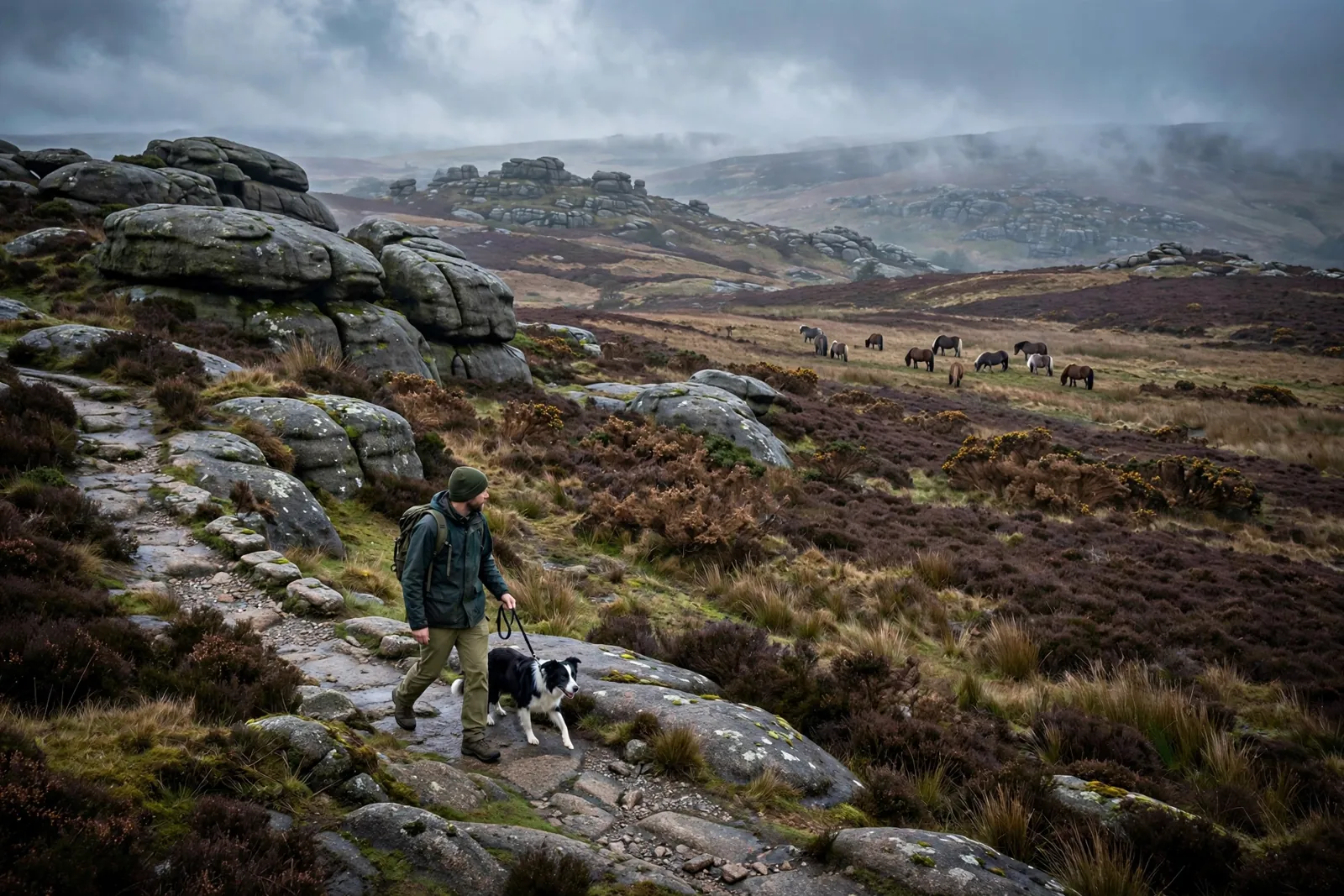
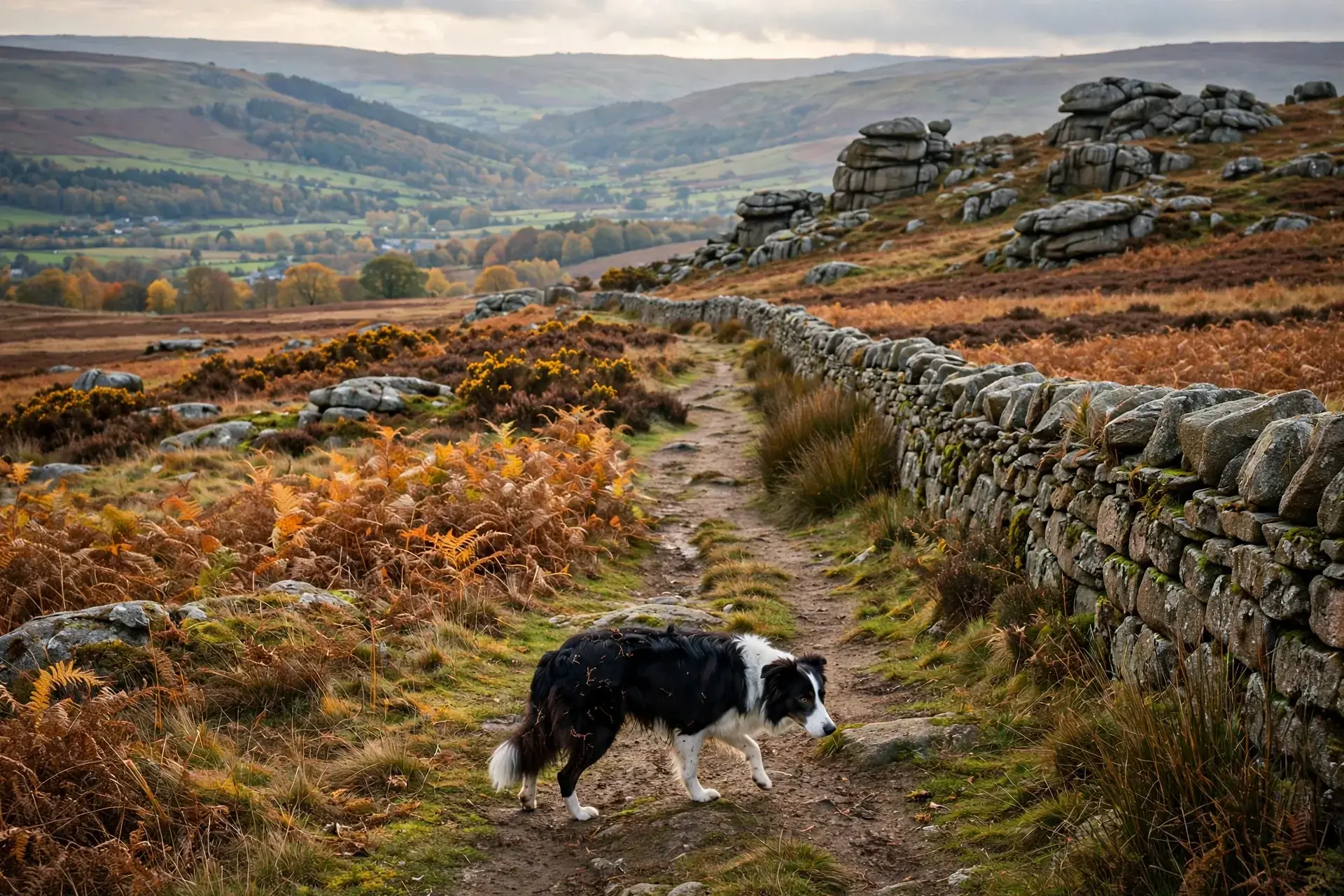
The moor begins properly at Minions, a small village perched on the south-east edge of Bodmin Moor about four miles north-west of Liskeard, and it is the single best dog walk within easy reach of the town. The village sits at around 300 metres, high enough that the air feels different and the views open out across south-east Cornwall, and the landscape changes the moment you step out of the car: granite tors, rough grass, gorse, dry stone walls and the wide, empty sky that makes Bodmin Moor feel bigger than it is. The Cheesewring, a stack of granite slabs balanced on top of each other like a pile of giant cheese rounds, is the landmark everyone comes to see, and the walk up to it from the village is short, steep in places and entirely achievable with a fit dog.
Start from the village car park and follow the track towards the Cheesewring, keeping the village behind you and the open moor ahead. The path climbs gently at first, then more steeply as you approach the tor, and the ground underfoot is a mix of grass, granite grit and the occasional boggy patch after rain. Good walking boots matter here, for you and, in the sense of paw care, for your dog: check paws after the walk for grit and small cuts, and carry water, because there is no reliable drinking water on the open moor and a dog working hard in the wind will drink more than you expect. On a clear day the view from the Cheesewring stretches for miles, and on a misty day the tor looms out of the fog like something from a storybook. Both are worth experiencing, but the misty version demands more care: visibility can drop to a few metres in minutes, and a dog that runs ahead can vanish from sight before you have finished calling.
Livestock is the first rule of moor walking, and it applies here more than almost anywhere else in this guide. Sheep graze freely around Minions, cattle wander the lower slopes, and the famous Bodmin Moor ponies drift across the tracks in small groups. Your dog must be under close control at all times, and that means a lead whenever livestock are in sight, even if your dog has never chased anything in its life. A dog that has never seen a sheep can still decide, in a single exciting second, that it wants to investigate one. Farmers are entitled to protect their animals, and the consequences for a dog that worries sheep can be severe. If your dog cannot be recalled instantly and reliably away from livestock, keep the lead on for the whole walk. A long line gives a dog room to explore while keeping you in control, and it is a sensible compromise on open ground where a short lead feels restrictive.
The second rule is ground-nesting birds. The moor is home to skylarks, meadow pipits and other birds that nest on the ground in spring and early summer, and a dog running through rough grass can destroy a nest without ever knowing it was there. From roughly March to July, keep your dog on paths and under close control, and be particularly careful in areas of long grass and heather. This is not a minor courtesy: it is the difference between a moor that still has skylarks next year and one that does not. The same care applies to adders, which bask on warm rocks and sunny banks from spring onwards. Keep your dog away from sun-warmed stone walls and rock piles, stick to clear paths in warm weather, and know the signs of an adder bite — sudden pain, swelling and distress — so you can get to a vet quickly if the worst happens. Our guide to adder bites in dogs covers what to do in the first minutes after a bite.
Beyond the Cheesewring, the walking opens out. The Hurlers, a group of three Bronze Age stone circles on the moor just outside the village, make a natural extension to the walk, and the track between the circles and the tor gives a dog a long, satisfying stretch of open ground. The Caradon Hill area, with its old mine workings and engine houses, adds industrial history to the landscape, but the mine shafts and spoil heaps demand care: keep your dog away from fenced shafts and unstable ground, and do not let a curious dog explore the ruins. The moor is an ancient landscape and a working one, and the safest way to enjoy it is to treat the marked paths and the obvious landmarks as your route, and the fenced and ruined areas as places to admire from a distance.
A practical word on what to pack for a moor walk from Liskeard: a long line as well as a short lead, a collapsible water bowl and at least a litre of water for the dog, a towel and a drying coat for the car, poo bags and a small bag to carry them in, and a basic first-aid kit with a tick remover and a bandage. A whistle can be useful if your dog is trained to recall to it, because a whistle carries further than a shout in moorland wind. And because the moor has no bins, everything you take up must come back down with you — including the poo bags, which should never be left hanging on a fence or a gate, however tempting that might be on a long walk.
Weather is the third rule, and it deserves as much respect as the livestock. Bodmin Moor makes its own weather, and a bright morning in Liskeard can turn into wind, rain and low cloud on the high ground within half an hour. Always check the forecast for the moor specifically, not just for the town, and carry a waterproof layer and a warm layer even on a day that looks settled. A dog that is wet and cold on a windy moor will lose heat fast, especially a small, short-coated or older dog, so pack a drying coat or a towel in the car and plan a shorter walk if the wind is strong. If the mist comes down, turn back rather than pressing on: the tors all look alike in fog, and a missed turn can add an hour to a walk that was supposed to take forty minutes. Check the official guidance before you travel for any temporary access restrictions, and let someone know your route if you are walking alone.
For a longer day, combine Minions with Siblyback Lake, a reservoir a short drive from the village with a circular path around the water. The lake walk is flatter and more sheltered than the moor, which makes it a good option when the wind is up, and the water gives a dog a place to paddle on a warm day. Keep your dog out of the water if there are algae warnings, and keep a lead on near the car park and the dam, where the ground falls away steeply. The contrast between the open moor in the morning and the sheltered lake in the afternoon is one of the best days you can have with a dog in south-east Cornwall, and it is entirely doable from a Liskeard base without a long drive in either direction.
The Looe Valley line and the walks beside it
The Looe Valley line is one of those small British railways that feels like a gift to dog owners. It runs from Liskeard station down through the wooded valley of the East Looe River to the fishing port of Looe, a journey of about thirty minutes through a landscape that changes from farmland to steep wooded slopes to estuary and harbour. Dogs travel free on the line, and the train itself is part of the experience: the carriages are small, the windows frame the river, and the whole journey feels unhurried in a way that the main line never does. For a dog that is comfortable on trains, it is one of the easiest and most enjoyable days out in Cornwall. For a dog that has never been on a train, it is a gentle introduction — short, slow and scenic — and a good first railway trip.
Getting there is straightforward. Liskeard station sits on the edge of town, a short walk or drive from the centre, and the branch-line platform is separate from the main-line platforms. Arrive in good time, because the branch line runs to its own timetable and services are roughly hourly, with fewer trains in winter. Check the official guidance before you travel, as timetables change seasonally and engineering work can replace trains with buses, which may have different rules for dogs. Buy your ticket before you board or from the guard, keep your dog on a lead on the platform at all times, and choose a seat with floor space so your dog can lie down rather than blocking the aisle. A mat or blanket helps a nervous dog settle, and a chew or a stuffed Kong can keep a restless one occupied for the half-hour ride.
At Looe, the walk begins at the harbour. The town is built around the river, with quays, narrow streets and a small beach, and it is at its best early in the morning or late in the afternoon, when the day-trippers have thinned out. Dogs are welcome on the quays on a lead, and the harbour is a wonderful place for a dog to watch the world: fishing boats, gulls, the smell of the sea and the comings and goings of a working port. The beach at Looe has seasonal dog restrictions, so check the official guidance before you travel and plan your visit around the rules for the time of year. In the months when dogs are allowed on the beach, it is a small, sheltered stretch of sand that suits a paddle and a game of fetch. When restrictions apply, the quays and the riverside paths still give a dog a satisfying walk without breaking any rules.
The walks beside the line are as good as the train ride itself. The valley path between Liskeard and Looe follows the river through woodland that is cool and shaded in summer, and the path is mostly flat, which makes it suitable for older dogs and for dogs that struggle with steep moorland climbs. You do not need to walk the whole valley in one go: pick a section, walk down to a riverside spot, let the dog paddle in a shallow stretch, and walk back or catch the train from a station along the line. The stations at Coombe Junction, St Keyne, Causeland and Sandplace are all small halts with their own character, and each one is a starting point for a short valley walk. Sandplace, in particular, has a level path beside the river that works well for a gentle afternoon stroll, while St Keyne is close to the village and its famous wishing well, with lanes that suit a quiet wander.
There are practical points worth knowing before you plan a valley day. The river can rise quickly after rain, and the paths beside it can flood in winter, so check conditions before you set out and do not let your dog swim in fast water. The valley is also home to ticks, which thrive in the long grass and bracken along the riverside paths from spring to autumn, so check your dog thoroughly after every walk and remove any ticks promptly. Bring water for the dog, because the river is not a reliable drinking source after heavy rain, and pack a towel for the train ride home, since a dog that has paddled in the river will want to dry off before settling on a seat. If you are walking the valley path rather than riding the train, plan your route so that you finish at a station with a train back to Liskeard, and check the last departure time before you leave — missing it means a long walk back up the valley in the dark.
Getting to Liskeard by train with a dog is easier than many visitors expect. The town sits on the Great Western main line between Plymouth and Penzance, and dogs travel free on those services too, so a rail-based holiday is entirely realistic: main-line train to Liskeard, branch-line train to Looe, and your feet or a local bus for everything else. On main-line trains, keep your dog on a lead, choose a seat with floor space, and avoid the busiest peak services if your dog is nervous in crowds. The station itself is a useful landmark for planning: it sits on the edge of town, so the walk from the platform to the centre is short but uphill, and it is worth knowing that before you arrive with luggage and a tired dog. Taxis from the station will usually take a dog, but it is polite to mention the dog when you book, and to bring a blanket for the seat. Check the official guidance before you travel for the latest rules on dogs on trains, as conditions can change.
One of the nicest ways to use the line is to combine it with a walk on the coast path from Looe. From the harbour, the coast path climbs east towards Polperro, a fishing village that is one of the prettiest on the south coast, and the path between the two towns is a classic Cornish coast walk: cliffs, coves, gorse and sea views that open out with every step. It is a longer and steeper walk than the valley paths, and it is not suitable for every dog — the path is narrow in places, the drops are real, and a dog must be on a lead throughout. But for a fit, confident dog with a reliable recall, it is a memorable day: train down, coast path to Polperro, and train or bus back. Check the official guidance before you travel for the current path conditions, and carry more water than you think you will need, because there is no shade on the cliff tops and the sun can be strong even on a day that starts grey.
Market stalls, independent shops and cafes
Liskeard's town centre is at its best on market days, when the stalls fill the market area and the streets around it with produce, plants, crafts and the smell of fresh baking. The town's market is a proper working market rather than a tourist attraction: local growers, butchers and bakers sell alongside stalls for household goods, and the regulars know the stallholders by name. For a dog owner, the market is a good test of how your dog copes with a busy, sensory place. A confident dog will enjoy the attention and the smells; a nervous one will do better if you visit early, before the crowds build, and keep to the edges of the market rather than pushing through the middle. Either way, keep the lead short, keep your dog close to your side, and watch for food on the ground, dropped packaging and the hot surfaces of stalls in summer.
The market hall itself is worth a look, and the streets around it hold the town's independent shops. Liskeard has resisted the high-street homogenisation that has flattened so many British towns: there are still butchers, bakers, a greengrocer, a hardware shop, bookshops and a handful of gift and craft shops that are worth browsing. Many of these shops welcome a calm dog, and the general rule is to look for a sign at the door or to ask before you go in. Some shops keep a jar of treats behind the counter, and a dog that behaves well will often be remembered on a second visit. If a shop does not allow dogs inside, a travel companion can hold the lead outside while you browse, and the town centre is compact enough that this is rarely an inconvenience. The important thing is to ask rather than assume: a shopkeeper who says no to a dog inside is not being unfriendly, and a dog left tied outside a shop is vulnerable to theft, so never leave your dog unattended on a busy street.
Cafes are where the town really earns its keep for dog owners. Liskeard has several cafes with outdoor seating, and a few that welcome dogs indoors as well, and the best approach is to treat the cafe stop as part of the walk rather than an afterthought. A dog that has walked for an hour will settle under a table far more happily than a dog that has been in the car all morning, so plan the cafe for the middle or the end of a walk rather than the start. Bring a mat for the dog to lie on, order water for the dog as well as for yourself, and be ready to leave promptly if your dog cannot settle. Outdoor seating is the easiest option on a busy day, and in summer the shaded tables are a blessing for a dog that overheats. In winter, the cafes that welcome dogs indoors are worth knowing about, and it is worth asking at the first one you find, because dog-friendly policies change and the most reliable information is usually the one you get by asking in person.
Wet weather is not a reason to stay in, but it is a reason to change the plan. On a rainy day, the wooded valley walks hold up far better than the open moor, because the tree cover breaks the worst of the rain and the paths stay walkable even when the high ground is lashed by wind. The town itself offers a useful fallback: a slow browse of the shops, a long cafe stop with a dog that can settle, and the covered market hall all keep a day moving without a long drive. Pack a drying coat for the dog and a spare towel for the car, and accept that a wet-weather day in Cornwall is not a failed day — it is simply a different kind of day, and the valley in the rain, with the river running high and the woodland smelling of wet earth, is one of the most atmospheric walks in the area.
Beyond food and shopping, the town centre offers a handful of quieter pleasures. The parish church of St Martin, with its tall tower, is a landmark worth walking past, and the churchyard gives a dog a calm, grassy pause in the middle of town. The streets climbing away from the centre, particularly towards the north and west, give good views back over the rooftops and towards the moor, and they are quiet enough for a dog that needs space. If you are staying in the town for several days, take the time to learn the side streets: the shortcut from the centre to the station, the lane that avoids the busiest junction, the patch of grass where a dog can have a quick toilet stop before a long car journey. These are the details that turn a town from a place you visit into a place you can actually use, and they are worth more than any single attraction.
One practical note about the town centre and dogs: Liskeard is a working town with traffic, delivery vans and buses, and the pavements in the older streets can be narrow. Keep your dog on the inside of the pavement, away from the road, and be careful at junctions where parked cars block the view. The town is also home to a weekly rhythm that is worth respecting: market days are busy, school-run times bring extra traffic, and the early evening is quiet. Plan your town walks around that rhythm, and you will find that the town is easy to enjoy with a dog at almost any hour.
Villages and river valleys around the town
The countryside around Liskeard is a patchwork of small villages, wooded valleys and farmland, and it is here, rather than in the town itself, that many of the best dog walks are found. Each village has its own character, and the walks that start from them are the kind that locals use every day: footpaths across fields, lanes down to the river, and tracks through woodland that are rarely crowded and often beautiful. The trick is to pick one village, park sensibly, walk a loop and finish with a drink or a sit on a bench, rather than trying to see them all in a single day.
St Keyne, a village a short drive south of Liskeard, is a good place to start. It sits above the Looe Valley, close to the little railway halt of the same name, and the lanes around the village give gentle walks with views down into the valley. The village is also home to the famous St Keyne well, where tradition says that whichever partner drinks first from the well will rule the household, and the walk down to the well is a pleasant short stroll that suits a dog of any age. Keep your dog on a lead in the village, where the lanes are narrow and cars come around corners faster than you expect, and let them off only on the open paths where you can see what is ahead. The churchyard and the village green give a calm place to pause, and the valley views from the lanes above the village are among the prettiest in the area.
To the east, the village of Menheniot and the lanes around it offer a different kind of walk: open farmland, hedgerows full of birdsong, and the occasional glimpse of the railway line that runs through the valley below. This is arable country rather than moorland, and the walks here are gentler, with fewer steep climbs and more shade in summer. The footpaths are well used but rarely busy, and a dog that likes to sniff its way along a hedgerow will be happy for an hour here. Remember that this is working farmland: keep to the marked footpaths, close gates behind you, keep your dog on a lead near livestock and crops, and do not let a dog run through a field of standing corn or newly sown ground. The farmers here are generally welcoming to walkers who respect the land, and the walks repay that respect with quiet and space.
To the south-west, the valley of the River Fowey at Golitha Falls is one of the finest wooded walks in Cornwall, and it is only a short drive from Liskeard. The falls themselves are a series of cascades and pools in a steep, oak-wooded valley, and the path follows the river through a landscape that feels ancient and enclosed. This is a walk for a dog that is comfortable on uneven ground and steps: the path is rough in places, the rocks beside the river are slippery, and the drops into the pools are real. Keep your dog on a lead on the steeper sections and near the water, and let them paddle only in the slow, shallow stretches. In summer the woodland is cool and shady, which makes it a good choice on a hot day, and in autumn the colours are spectacular. After heavy rain the river runs high and fast, and the path can be treacherous, so check the official guidance before you travel and do not attempt the walk if the river is in spate.
Further afield, the village of St Neot, north of Liskeard on the edge of the moor, offers a combination of village green, moorland edge and river valley that is worth a half-day. The village has a pub that welcomes dogs, a church with a fine tower, and lanes that lead out onto the lower slopes of the moor. The walks here are quieter than at Minions, and they suit a dog that finds the open moor a little too exposed: there is more shelter, more variety and more places to turn back if the weather changes. The river that runs through the village gives a dog a place to paddle, and the village green is a good spot for a picnic. As with every village in this area, park considerately, keep your dog on a lead in the village itself, and respect the residents, who live here all year round and share their lanes with visitors only because walkers behave well.
One more route worth knowing about is the old mineral railway line that once carried granite and copper from the moor down towards the coast. Parts of the old trackbed survive as a multi-use trail through the countryside between Minions and the Looe Valley, and the sections that are open to walkers give a flat, easy walk through a landscape of old engine houses, spoil heaps and woodland that is very different from both the open moor and the river valley. The surface is generally firm and level, which suits older dogs and dogs that struggle with steep ground, but the route is shared with cyclists, so keep your dog on a lead and to one side of the track, and be ready for a bike coming around a bend. Check the official guidance before you travel for which sections are open and where to join the trail, as access can change with land management work, and carry water, because the trail has long stretches with no facilities at all.
A final note on the villages: the best walks in this area are often the ones that are not in any guidebook, and the way to find them is to talk to people. Ask in a cafe, ask at a village shop, ask a dog walker you meet on a path. Local knowledge is worth more than any map, and the people who live around Liskeard are generally happy to share it, especially if you ask about dogs. The question to ask is not "where is the best walk" but "where do you walk your dog" — the answer will usually be a footpath you would never have found on your own, and it will be the walk your dog remembers.
Where to stay and where to park
Liskeard makes a practical base for a dog-friendly stay because it is a town with real infrastructure rather than a village with a single pub and a seasonal car park. Accommodation in and around the town ranges from cottages and farm stays in the surrounding villages to bed and breakfasts and small hotels in the town itself, and the dog-friendly options are generally easier to book, and often better value, than equivalent places on the coast. The trade-off is that you will drive or take the train to the beach rather than walking out of your front door onto the sand, and for many dog owners that is a fair exchange for a quieter base and a lower price.
When you book, ask the questions that matter before you pay, and get the answers in writing. How many dogs are allowed, and is there a charge per dog or per stay? Are dogs allowed in all the rooms or only in specific ones, and are there rooms with direct access to a garden or an enclosed area? Can the dog be left alone in the room, and for how long, and what happens if the dog barks? Is there an enclosed garden, and how high is the fence? Where is the nearest place for a late-night toilet walk, and is it lit? These questions sound fussy, but they are the ones that separate a stay that works from a stay that falls apart on the first evening. A property that answers them clearly and specifically has thought about dogs properly; a property that answers with a vague reassurance has not. Our broader guide to dog-friendly holiday parks in the UK covers the same questions in detail for park stays, and the same logic applies to cottages and bed and breakfasts.
Think about the layout of the place you book as well as its rules. A ground-floor room with a door onto a garden is worth more than a pretty room up two flights of stairs when you have a dog that needs to go out at midnight. A cottage with a secure garden is worth more than a cottage with a view if your dog is a jumper or a digger. Check whether the garden is genuinely enclosed — a low wall, a gap under a gate or a hedge with a hole in it can all be escape routes for a determined terrier — and ask whether the garden is shared with other guests, which matters if your dog is reactive. Inside, look for hard floors that are easy to clean, a place to dry a wet dog, and somewhere to store muddy leads and boots out of the way. These are the details that make a stay comfortable rather than merely tolerable.
Parking in Liskeard is straightforward, and it is one of the town's quiet advantages. There are several public car parks in and around the town centre, including longer-stay options that suit a full day out, and on-street parking on the roads around the centre. Charges apply in the main car parks, so check the official guidance before you travel for the current tariffs and time limits, and keep coins or a payment app ready. The station car park is useful if you are taking the train to Looe, and the car parks on the edge of town are a good choice if you want to walk into the centre with your dog rather than driving through the narrow streets. On market days and at weekends the central car parks fill earlier, so arrive before ten if you want a space close to the shops, or use a car park on the edge of town and enjoy the walk in.
For moor and valley walks, parking is a different matter. The car park at Minions is small and fills quickly on fine weekends and school holidays, so arrive early or visit on a weekday if you can. Park only in marked spaces, never on the grass verge or across a gate, and remember that farm vehicles need access to the lanes at all times. At Golitha Falls the car park is also small, and the lanes approaching it are narrow, so arrive early and be prepared to turn around if the car park is full rather than blocking the lane. At the small railway halts in the valley, parking is minimal or non-existent, so use the train from Liskeard rather than driving to a halt and hoping for a space. In every case, leave nothing visible in the car: a rural car park is not a safe place for a bag, a phone or a lead left on the seat.
Finally, know where the nearest vet is before you need one. Liskeard has veterinary practices in the town, and the surrounding area has practices in the nearby towns, but opening hours vary and out-of-hours cover may be some distance away. Save the number of the nearest practice in your phone when you arrive, and know the route to it. If your dog is on medication, bring more than you need for the stay, and keep a copy of the prescription and the vaccination record in the car. These are the preparations that nobody thinks about until they need them, and by then it is too late to do them properly.
Planning a longer Cornwall trip around this base? Our three-day Cornwall dog itinerary shows how to combine south-coast harbours, north-coast beaches and inland gardens from a single base, and our guides to Bude with a dog and Fowey with a dog cover two very different Cornish towns that pair well with a Liskeard stay. If the moor has given your dog a taste for open ground, our Dartmoor dog walks guide covers the tors, ponies and safety rules of the bigger moor across the border in Devon.
Practical questions
Before you go
Can I take my dog on the Looe Valley line?
Yes, dogs are welcome on the Looe Valley line between Liskeard and Looe, and they travel free. Keep your dog on a lead on the platform and in the carriage, sit where there is floor space, and bring a mat or blanket so your dog can settle. Check the official guidance before you travel, as timetables change seasonally and engineering work can replace trains with buses.
Do dogs need to be on a lead on Bodmin Moor near Liskeard?
On the open moor there is no blanket lead law, but you must keep your dog under close control at all times, and a lead is the sensible choice whenever sheep, cattle or ponies are in sight. Ground-nesting birds are vulnerable in spring and early summer, so keep your dog on paths and under control during the breeding season. If your dog cannot be recalled reliably away from livestock, keep the lead on for the whole walk.
Are dogs allowed in Liskeard's market and shops?
Dogs are welcome in the outdoor market area on a lead, and many of the town's independent shops are happy to welcome a calm, well-behaved dog. Policies vary from shop to shop, so look for a sign at the door or ask before you go in. Cafes with outdoor seating are the easiest option on a busy day, and a few welcome dogs indoors too, so check the official guidance before you travel if a particular cafe matters to your plans.
Where can my dog swim or paddle near Liskeard?
The River Looe and its tributaries offer shallow paddling spots in summer, and Golitha Falls has wooded river pools a short drive from the town. After heavy rain the river runs fast and deep, so only let your dog paddle where the water is slow and shallow, and never after flooding. Check the official guidance before you travel, and watch for blue-green algae warnings in warm weather before letting your dog in any still water.
Is Liskeard a good base for a dog-friendly holiday in Cornwall?
Yes, Liskeard works well as a base because it sits between three kinds of walking: the open moor to the north, the wooded Looe Valley to the south, and the south coast at Looe a short train ride away. Accommodation here is usually quieter and better value than in the honeypot villages, and the town has supermarkets, vets and parking that make a longer stay easy. Book dog-friendly places early for school holidays, and confirm the pet rules in writing before you pay.