This guide is independent and contains no paid placement. If affiliate links are added later, they will be clearly marked and will not change our editorial checks.
Wadebridge is one of the easiest Cornish towns to visit with a dog: the Camel Trail gives you a flat, traffic-free walk or ride straight from the town centre, the River Camel estuary offers quiet low-tide walks and birdwatching, the town itself is compact and food-focused, and the nearest dog-friendly beaches are a ten-minute drive away. Plan around the tide, the summer crowds on the trail, and the seasonal rules at Polzeath.
Start on the trail, not in the town
The best way to understand Wadebridge with a dog is to arrive at the river first and the town second. The Camel Trail runs right through the town on the bed of a former railway line, and the River Camel slides alongside it, wide and tidal, carrying the whole place with it. Stand on the old railway bridge at the edge of town on a clear afternoon and the shape of a day here becomes obvious: cyclists and walkers moving in both directions, dogs trotting beside bikes, herons standing motionless in the shallows, and the estuary opening out towards Padstow in one direction and narrowing into wooded valley towards Bodmin in the other.
Wadebridge grew up as a crossing point. The bridge over the Camel gave the town its name and its reason to exist, and for centuries this was a working river town — barges, quays, warehouses and a railway that carried china clay and slate down to the sea. The railway closed, the trackbed was turned into a trail, and the town quietly reinvented itself as the gateway to one of the most popular traffic-free routes in the south-west. That history matters for dog owners because it explains why the walking here is so forgiving: the old railway gradient is gentle, the surface is surfaced and mostly level, and the route is wide enough for a dog on a lead, a cyclist and a family with a pushchair to pass each other without anyone having to step into a hedge.
The town itself sits at the head of the estuary, where the river stops being properly tidal in the way it is further downstream and starts to feel like a Cornish river again — narrower, greener, bordered by trees and fields. This is the point where two kinds of trip meet. Turn one way and you are on the estuary, with big skies, mudflats, wading birds and the long flat run to Padstow. Turn the other and you are in a wooded valley, with the trail threading between trees towards Bodmin and the moor beyond. A dog that likes open space and a dog that likes shade and cover can both be happy here on the same day, which is rarer than it sounds in Cornwall, where many walks are either exposed cliff-top or narrow lane with nowhere to step aside.
What follows is organised the way a visit actually unfolds. The trail comes first, because it is the reason most dog owners come and because getting it right shapes everything else. Then the river itself, which rewards a slower look and a check of the tide times. Then the town, which is small enough to explore on foot with a dog and serious enough about food to deserve a proper section rather than a passing mention. Then the beaches, because Wadebridge is not itself a beach town and the best sand is a short drive away. Finally the practical details — where to stay, where to park, what to pack — that decide whether a good day becomes a good weekend.
A few honest notes before the detail. Wadebridge is popular, and the Camel Trail in July and August is busy, especially the Wadebridge to Padstow section. If your dog is reactive, nervous around bicycles, or uncomfortable in crowds, come early in the morning, walk in the opposite direction to the main flow, or choose the quieter stretch towards Bodmin instead. The estuary is tidal and the mud can be deep and soft in places, so keep dogs off the mudflats unless you know the ground and the tide. And the weather here changes fast: a sunny morning on the trail can turn into a Cornish downpour by lunch, so pack a drying coat and a towel even when the forecast looks kind. Rules, charges and opening times change, so where this guide is unsure it says so plainly — check the official guidance before you travel.
Riding and walking the Camel Trail with a dog
The Camel Trail is an 18-mile traffic-free route that follows the old railway line from Padstow to Bodmin, passing through Wadebridge roughly in the middle. For dog owners the most useful fact is that the two halves feel completely different. The Wadebridge to Padstow stretch, about five and a half miles, runs beside the estuary on open, flat ground with wide views, little shade and plenty of company. The Wadebridge to Bodmin stretch, about five miles the other way, runs inland through trees and farmland, is quieter, shadier and often feels like a different trail altogether. Knowing which half suits your dog — and your plans for the day — is the single most useful decision you will make in Wadebridge.
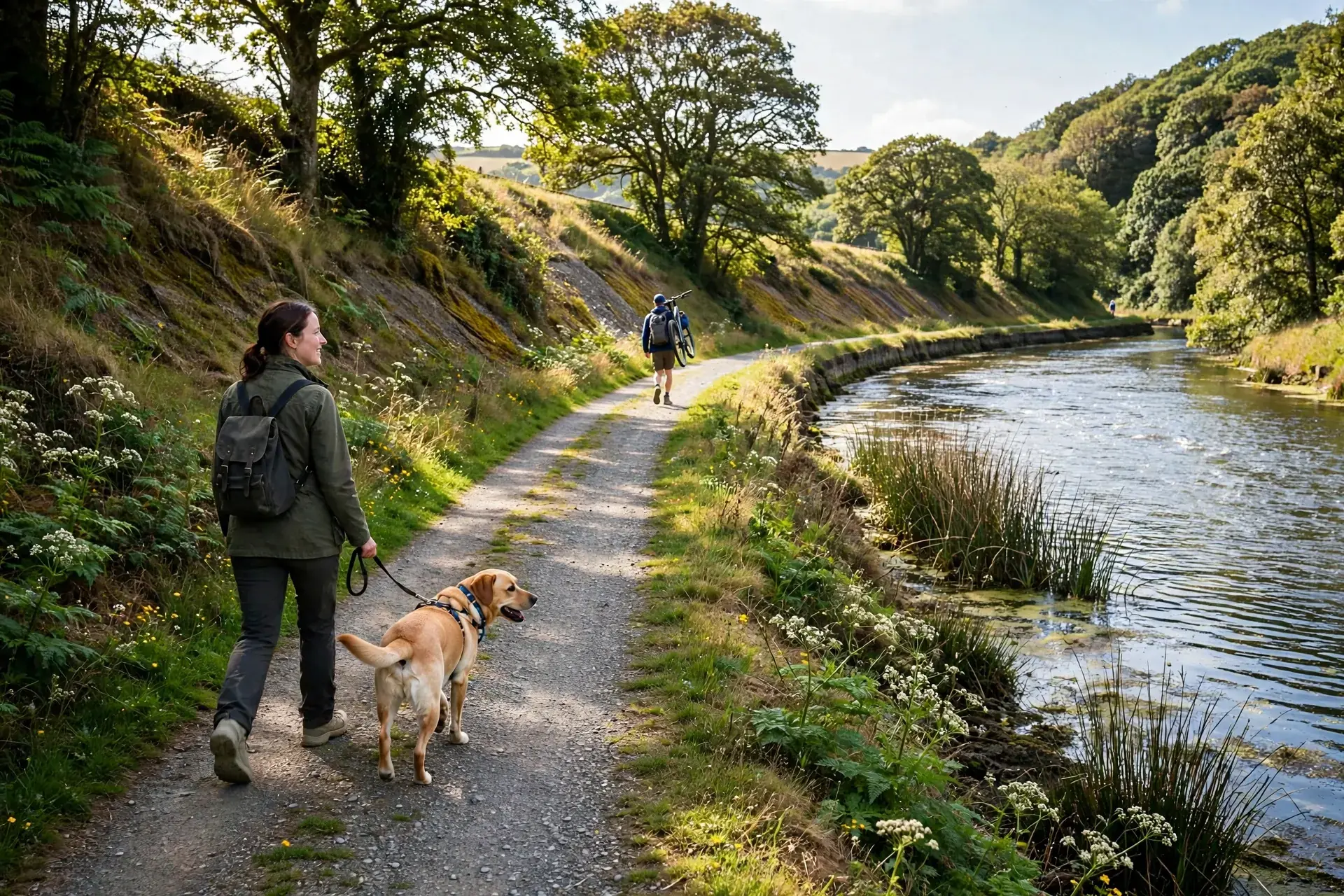
Walking the Wadebridge to Padstow section with a dog takes most people between two and two and a half hours one way at a comfortable pace with sniffing stops, and the path is surfaced well enough for pushchairs and for dogs of all sizes. The surface is mostly compacted gravel and tarmac, which is kind to paws in dry weather but can be hard and hot underfoot on a warm summer day, so check the ground with the back of your hand and stick to the grassy edges where you can. There are no cars, which removes the biggest risk on many Cornish walks, but there are plenty of bicycles, and that is the risk to manage instead. Cyclists come up behind you quietly and often fast, especially on the long straight sections where the old railway runs dead level. Keep your dog on a short lead, keep to the left, and teach your dog to move to the side when you hear a bell or a voice behind you. A brightly coloured lead or a hi-vis band on the dog helps cyclists see you earlier, and it costs almost nothing.
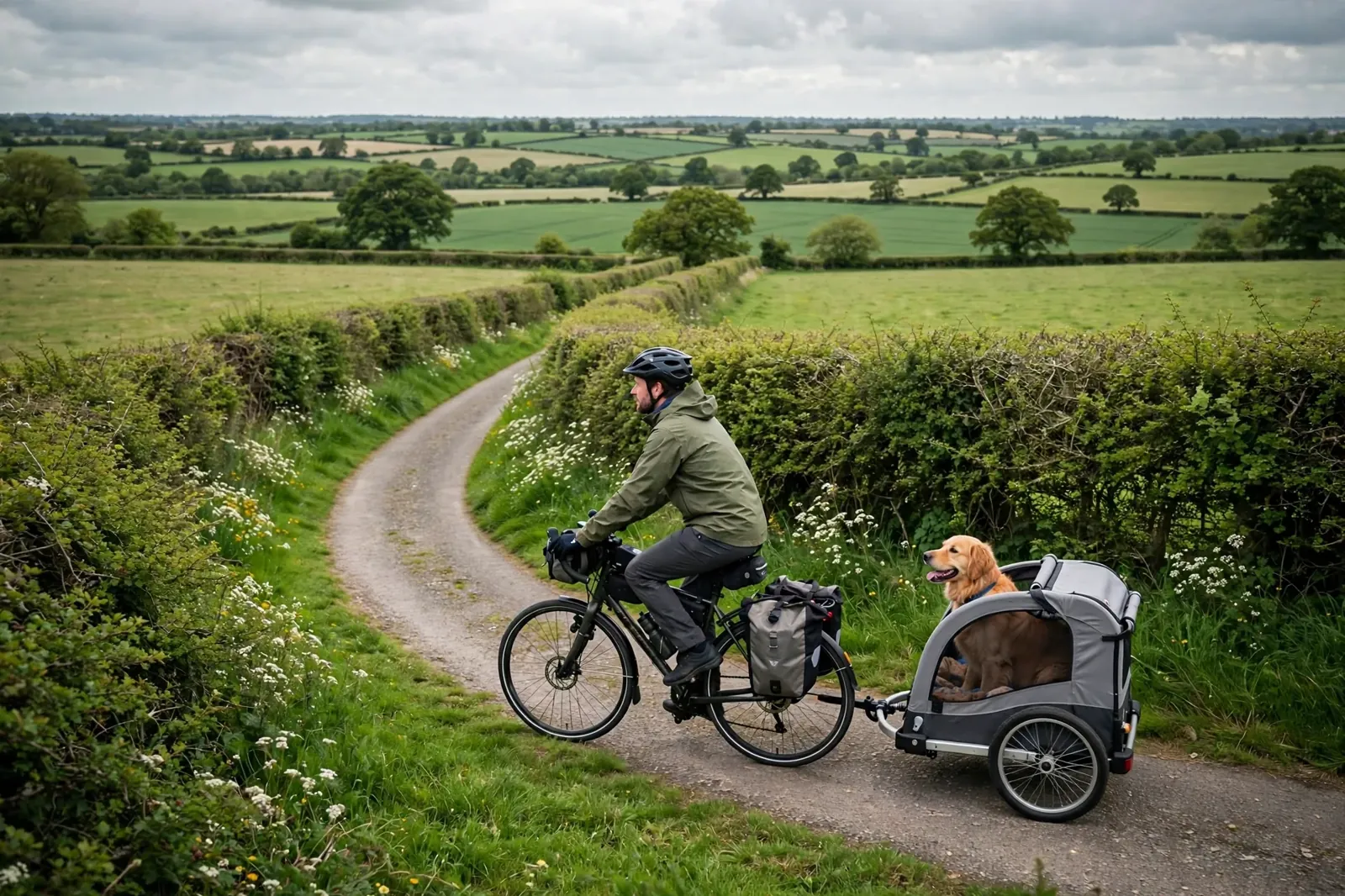
Cycling the trail with a dog is one of the great Cornish dog days, but it needs preparation rather than improvisation. Our guide to cycling with a dog in the UK covers the three ways to ride together — a dog running alongside, a trailer, and a basket or carrier — and the training steps that make each one safe. The short version for the Camel Trail is this: only let a dog run alongside your bike if the dog is fit, well trained to stay on one side, and used to the pace; a trailer is the safer choice for smaller dogs, older dogs and puppies; and a basket only works for very small dogs in a properly secured carrier. The trail is flat, which helps, but five and a half miles each way is eleven miles in total, and that is a long run for most dogs. Build up distance over several weeks before you attempt the full length, carry water for the dog, and stop regularly in the shade. If you are hiring a bike, several hire shops in Wadebridge and Padstow offer trailers and tag-alongs — check the official guidance before you travel, as hire stock, prices and booking rules change through the season, and book ahead in school holidays because trailers in particular sell out.
Hiring is the practical choice for most visitors, because it avoids transporting your own bikes to Cornwall and lets you choose the right setup for the dog you have. Wadebridge has hire shops close to the trail, and Padstow has several too, which opens up the useful trick of hiring at one end and being collected at the other, or hiring in Wadebridge, riding to Padstow for lunch, and riding back when the crowds have thinned. Ask the hire shop about dog trailers, about child seats if you need one, and about what happens if you want to turn back early — most shops are used to dog owners changing plans mid-ride. Check the bike before you leave: brakes, bell, tyre pressure and the trailer hitch if you are towing. A wobbling trailer on a busy trail is a problem for everyone, and five minutes of checks at the shop saves an hour of trouble on the path.
The quieter Wadebridge to Bodmin stretch deserves more attention than it usually gets. It is shorter in feeling than in miles, because the trees close in and the river narrows, and the number of cyclists drops sharply once you leave town. This is the better half for nervous dogs, for dogs that bark at bikes, for hot days when shade matters, and for anyone who wants a walk rather than a procession. The surface is similar, the gradient is just as gentle, and there are places to stop and let the dog sniff in the hedgerows without blocking the path. Bodmin itself is a market town rather than a seaside resort, so the destination is less of a draw than Padstow, but the walk is arguably the better dog walk — and you can always turn back at the halfway point and be in Wadebridge in time for lunch.
Trail etiquette is simple and worth stating plainly, because most friction on the Camel Trail comes from people not knowing it rather than not caring. Walkers keep left. Cyclists pass on the right and should ring a bell or call out in good time. Dog owners keep dogs on a short lead when the trail is busy, pick up after them, and carry the bags to a bin rather than leaving them by the path — there are bins at the main access points, but not along every mile, so bring a spare bag and a way to carry a full one. Horses use the trail too, though less often; if you meet a horse, move to the side, keep the dog close and quiet, and let the rider pass. And if your dog is off lead anywhere on the trail, it should only be where you can see a long way ahead, where there are no cyclists approaching, and where you are certain the dog will come back on first call. On a busy summer day that may mean nowhere at all, and that is fine — a long lead gives a dog plenty of freedom without the risk.
Season and timing change the trail more than most people expect. In winter the trail is quiet, the light on the estuary is low and beautiful, and you may have long stretches to yourself, but the surface can be muddy after rain and the wind off the estuary is cold. In spring the hedgerows fill with wild garlic and the first bluebells, and the birdlife along the river picks up. In summer the trail is at its busiest, the cafes at both ends are full, and the heat on the open estuary section can be serious for dogs — start before nine in the morning or after four in the afternoon, carry more water than you think you need, and watch for the signs of overheating: heavy panting, drooling, a dog that suddenly wants to lie down in the shade. In autumn the crowds thin, the light softens, and the trail is at its most pleasant for long walks. Whenever you go, check the forecast, check for any temporary closures or maintenance works, and check the official guidance before you travel.
The River Camel and the estuary shore
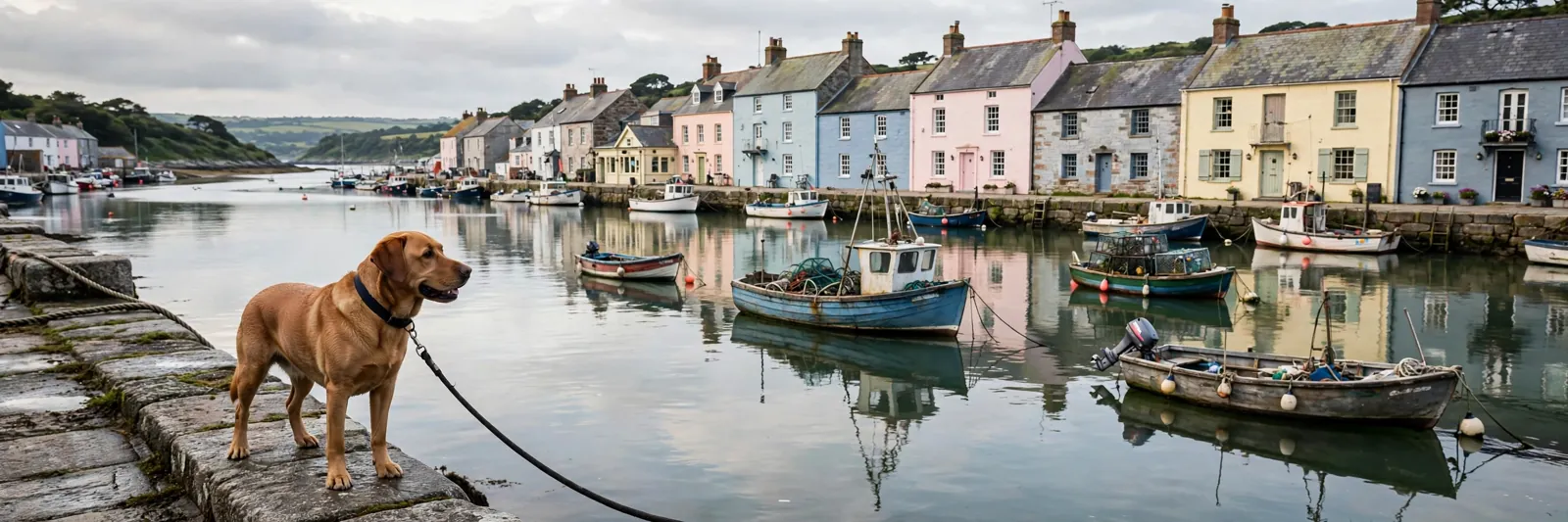
The River Camel is the reason Wadebridge exists and the reason the town feels different from the inland market towns around it. It rises on Bodmin Moor, runs through the wooded valley to Wadebridge, and then opens into a broad tidal estuary that runs down to Padstow and the sea. The tide reaches Wadebridge, which means the river here changes its character twice a day: at high tide it is a wide sheet of water lapping at the quay walls, and at low tide it shrinks back to a narrow channel winding between mudflats and sandbanks. Both states are worth seeing, and the low-tide river is the more interesting one for dog owners, because it is when the estuary shows its working life — wading birds, fishing boats resting on the mud, and the long pale flats that stretch towards Padstow.
The riverside walk from the town centre follows the water downstream along the trail and the shore paths, and it is an easy, level stroll that suits dogs of all ages. Older dogs and puppies manage it well because there are no steep climbs, and there are benches and places to sit at intervals. The best time to walk it is on a falling tide, when the mud is freshly exposed and the birds come in to feed, or on a rising tide, when the water creeps back across the flats and the light changes minute by minute. Check the tide times before you set out — a tide table for Padstow or Wadebridge is easy to find online — and plan your walk so that you are not caught out by a tide that turns faster than you expect. The estuary looks gentle, but the tide here moves quickly and the channels fill first, so do not walk out onto the mudflats and do not let your dog chase birds across them.
Birdwatching is one of the quiet pleasures of the Camel estuary, and it is a good reason to slow down rather than march the trail end to end. Little egrets, grey herons, curlews, oystercatchers, redshanks and shelducks are all regulars along the river, and in winter the estuary holds larger numbers of waders and wildfowl. A dog that can settle and watch is a better birdwatching companion than one that lunges at every heron, so this is a walk where a calm, well-exercised dog earns its keep. Bring binoculars if you have them, keep the dog on a lead near the water, and teach the dog that birds are to be watched and not chased — the birds are protected, and a dog chasing waders across the mud is a problem for the wildlife and a risk to the dog. If you are lucky you may see a kingfisher on the narrower upper river towards Bodmin, where the water runs clearer and the banks are wooded.
Swimming in the river is a question that comes up often, and the honest answer is to be careful. The Camel is tidal, the current can be strong, and the water quality varies, especially after heavy rain. Some dogs love a paddle in the shallow edges at low tide, and a brief splash on a warm day is usually harmless, but do not let a dog swim in the main channel, do not let a dog drink large amounts of river water, and rinse the dog off afterwards if it has been in the estuary mud. Dogs that swim in tidal water can pick up stomach upsets, and dogs that chase sticks into a fast current can get into trouble quickly. If your dog is a keen swimmer, the beaches at Daymer Bay and Polzeath are a much better place for a proper swim, and they are covered in the beach section below. Check the official guidance before you travel for any current advice on water quality or access.
The old bridge and the quays are worth a look in their own right, and they give a dog walk a destination. The bridge is a handsome stone structure with wide pavements, and from it you can see the river in both directions — upstream towards the wooded valley and downstream towards the estuary and the sea. The quays below the bridge are a reminder of the town's working past, and on a summer evening they are one of the pleasantest places in Wadebridge to sit with a dog and watch the light change on the water. Keep dogs on a lead around the quay edges, because the drop to the water is real and the walls are not fenced everywhere. The town's riverside paths connect to the trail in both directions, so you can build a short loop — bridge, riverside path, trail, back through town — that takes an hour and suits a morning or an evening stroll without needing a car at all.
One more practical point about the river: the weather on the estuary is not the weather inland. A calm morning in Wadebridge can be windy on the open trail towards Padstow, and sea mist can roll up the estuary on a summer afternoon and drop the temperature several degrees. Dogs feel this too — a short-coated dog that is comfortable in town may shiver on the exposed estuary in a wind, and a dog that is happy in the sun may be miserable in driving rain with no shelter. Pack a dog coat for small or short-coated dogs, bring a towel for the car, and have a plan for cutting a walk short if the weather turns. The trail is flat and the town is never far away, so bailing out is easy, and a short walk in good weather is worth more than a long one in a storm.
Eating well in a small food town
Wadebridge has earned a reputation as a food town out of proportion to its size, and that reputation is the second reason — after the trail — to come here with a dog. The town is compact enough to walk end to end in fifteen minutes, but it holds a surprising density of good cafes, bakeries, delis, pubs and restaurants, and many of them welcome dogs. The practical result is that a dog owner can have a proper lunch, a good coffee and a browse of the shops without once having to leave the dog in the car or tie it up outside. That is not true of every Cornish town, and it is worth appreciating.
Start with the cafes. Wadebridge has several cafes that are genuinely dog-friendly rather than merely dog-tolerant, and the difference shows in the details: water bowls by the door, dog biscuits on the counter, staff who greet the dog before they greet you, and seating where a dog can settle under a table without blocking the aisle. The best approach is to look for the signs — a water bowl outside is usually a reliable signal — and to ask before you sit down if you are unsure. Outdoor seating is the easiest option in summer, and the town has several terraces and pavement tables that work well with a dog. Indoors, choose a table near the door or in a corner, settle the dog on a mat or blanket from home, and order quickly so the dog has something to look forward to. A dog that has just walked five miles on the trail will usually sleep through lunch; a dog that has been in the car all morning will not, so walk first and eat second.
The pubs are the other half of the story. Wadebridge has traditional Cornish pubs that welcome dogs, and a pub lunch after a trail walk is one of the classic Cornish dog days. Look for pubs with a garden or a terrace, because those are the easiest places to sit with a larger dog, and ask about the bar area if the weather is bad — many pubs allow dogs in the bar but not in the restaurant, and the rules can differ between lunch and dinner. A dog that can lie quietly under a pub table is a dog that gets invited back, so bring a familiar blanket, order food that does not arrive in a rush, and keep the dog on a lead even if the pub feels relaxed. Pubs change their dog policies, especially in peak season, so check the venue's own listing or call ahead before you go, and check the official guidance before you travel if you are relying on a particular pub for dinner.
The farmers' market is the town's weekly showcase and a good dog outing in its own right. Wadebridge holds a regular farmers' market where local producers sell vegetables, meat, cheese, bread, cakes, plants and crafts, and it is the kind of market where a dog on a lead is part of the scene rather than an exception. Go early if your dog is nervous in crowds, because the market fills up by mid-morning, and keep the dog close around food stalls — a dog that helps itself to a sample is funny once and embarrassing twice. The market is also a good place to stock up for a self-catering stay or a picnic: Cornish cheese, fresh bread, pasties and fruit from a market stall make a better trail lunch than anything bought in a hurry at a service station. Check the market day and times before you go, because they can change with the season and with local events.
Beyond the market, the town's food shops are worth a browse. There are delis and farm shops selling local produce, a good bakery or two, and shops selling Cornish food gifts that make a better souvenir than a fridge magnet. A dog can come into some of these shops and will need to wait outside others, so a second person helps if you want to shop properly — one to hold the dog and one to browse. If you are on your own, keep the shopping short, tie the dog where you can see it and where it is safe, and never leave a dog tied up outside a shop for long. The town centre is small and the pavements are mostly wide enough for a dog and a pushchair to pass, but the main street can be busy with traffic, so keep the dog on the pavement side and watch the junctions.
For a longer stay, the food town angle becomes a real reason to base yourself in Wadebridge rather than pass through it. The town is well placed for a self-catering break: you can walk to the shops, cook with local produce, and eat out when you feel like it, all without getting in the car. There are restaurants in town that are worth booking ahead, especially on Friday and Saturday nights in summer, and some of them welcome dogs in certain areas — ask when you book, and be honest about the size and temperament of your dog, because a restaurant that says yes to a quiet spaniel may say no to a large, excitable dog in a small dining room. And if you are heading to Padstow for the day, remember that Padstow is also a serious food town, with its own harbour restaurants and cafes — our guide to Padstow with a dog covers the harbour, the ferry and the beach rules at that end of the trail, and it pairs naturally with this guide if you are planning to ride the trail in both directions.
A word on the practicalities of eating out with a dog, because it is the difference between a relaxing lunch and a stressful one. Feed the dog before you go, or bring a small portion of its normal food to give under the table. Bring water and a portable bowl, because not every cafe has one to spare on a busy day. Bring a mat or blanket so the dog has a defined place to lie, and bring a chew or a stuffed toy for a puppy that needs occupying. Keep the lead short and under your chair, not stretched across a walkway. And if the dog is having a bad day — barking, whining, pulling at every passer-by — take the food away or eat outside rather than forcing it. There is no shame in a takeaway eaten on a bench by the river, and the dog will thank you for it.
Beach days: Polzeath and Daymer Bay
Wadebridge is not a beach town, and that is part of its charm — but the beaches are close enough that a beach day is a short drive rather than an expedition. The two names that matter most are Polzeath and Daymer Bay, and they are different enough that choosing between them is a real decision. Polzeath is the big, popular surfing beach on the north coast, wide and sandy at low tide, with a village behind it, surf schools, cafes and a lively summer scene. Daymer Bay is the quieter, flatter beach on the estuary side, close to Padstow and Rock, with gentle water, a long sweep of sand at low tide, and a much calmer feel. Both are within about fifteen minutes' drive of Wadebridge, and both are worth knowing properly before you choose.
Polzeath is the beach to pick if your dog loves open sand, big skies and the energy of a busy beach, and if you are happy to plan around the rules. The main beach at Polzeath has seasonal dog restrictions in the summer months, which means dogs are not allowed on the main beach during the day in peak season — check the current signs and the official guidance before you travel, because the dates and the exact area covered can change. Outside the restricted season, and on the quieter stretches of sand away from the main beach, dogs have much more freedom, and a winter or autumn visit to Polzeath with a dog is a different experience from a summer one: empty sand, long walks, and a dog that can run properly. If you do go in summer, go early in the morning or in the evening, when the beach is quieter and the restrictions may be different, and always check the signs at the beach entrance before you let the dog off the lead. Our guide to dog-friendly beaches in the UK explains how seasonal bans and public space protection orders work, and how to check a beach before you go — it is worth reading before any summer beach trip in Cornwall, because the rules are not the same everywhere and the fines are real.
Daymer Bay is the beach to pick if you want reliability. It is generally open to dogs all year, it is flat and sandy, and at low tide it joins up with a long stretch of sand that runs towards Rock and the mouth of the estuary. The water here is calmer than at Polzeath because it is sheltered by the estuary, which makes it a better choice for dogs that are nervous swimmers, for puppies having their first proper swim, and for families with small children and a dog in the same group. There is a car park close to the beach, a cafe nearby, and a coastal path that runs along the shore towards Rock in one direction and towards Trebetherick in the other. The sand at Daymer Bay is fine and pale, and at low tide the beach is enormous — a dog can run for a long time here without ever reaching the water's edge, which is exactly what a high-energy dog needs after a day in the car or a morning on the trail.
Getting the most out of a beach day from Wadebridge is a matter of timing. Check the tide times the night before, because both Polzeath and Daymer Bay change completely between high and low tide — at high tide Polzeath is a narrow strip of sand and Daymer Bay is mostly water, while at low tide both are vast. Arrive two or three hours before low tide and you will have the best of the sand and the most time before the water comes back. Check the weather and the wind, because the north coast can be wild even when Wadebridge is calm, and a windy beach is hard work for a small dog. Bring fresh water for the dog, because dogs that drink seawater get sick, and bring a towel and a drying coat for the journey home. Check the car park charges and the dog rules at the entrance, and do not leave a dog in a parked car in warm weather, even for a few minutes.
There are other beaches within easy reach of Wadebridge if you want variety. Trevone and Harlyn, near Padstow, are both worth a visit, though both have seasonal dog rules to check. The smaller coves along the coast towards Port Isaac are beautiful but often involve steep paths and steps, which may not suit older dogs or dogs with joint problems. The estuary shore itself, around Rock and the Camel estuary, offers quiet walks at low tide, though the mud and the tide demand care. If you are staying for several days, a good pattern is to alternate: a trail day, a beach day, a town day, and then a beach day at a different beach. The dog gets variety, you get variety, and nobody gets bored of the same walk.
Beach safety for dogs deserves a paragraph of its own, because the Cornish coast is beautiful and unforgiving in equal measure. Keep dogs away from cliff edges and from the base of cliffs, where rockfalls happen. Do not let a dog swim in strong currents or near rocks, and be careful with the surf at Polzeath, which can be powerful even on a calm-looking day. Watch for fishing hooks and broken glass on the sand, for dead fish and other things a dog will want to eat, and for the signs of a dog that has swallowed too much seawater — vomiting, diarrhoea and lethargy mean a vet visit. After a beach day, rinse the dog with fresh water, check its paws for cuts and its ears for sand, and dry it properly before the drive home. A dog that has had a good beach day will sleep all the way back to Wadebridge, and that is the best sign the day went well.
Staying over and parking
Wadebridge works well as a base for a longer stay, and it works well for a reason that has nothing to do with scenery: it is practical. The town has shops, a supermarket, vets, a pharmacy, cash machines and places to eat, all within walking distance of the centre, which means a self-catering stay here is easy in a way that a stay in a small coastal village is not. You can arrive, park the car, walk to the shops, cook dinner, walk the dog along the river in the evening, and do it all again the next day without ever needing to drive. For dog owners, that practicality is worth as much as any view.
Accommodation in and around Wadebridge covers the usual range: hotels and bed and breakfasts in the town, self-catering cottages and apartments, holiday parks and campsites in the surrounding countryside, and farm stays a short drive away. Dog-friendly options exist in all of these categories, but the details vary widely and the details are what matter. Ask whether dogs are welcome in the specific room or cottage you are booking, not just in the property in general. Ask how many dogs are allowed, whether there is a charge, whether the charge is per dog or per stay, and whether there are any size or breed conditions. Ask about the garden or outdoor space — is it enclosed, how high is the fence, is there a gate that a dog can push open? Ask whether dogs can be left alone in the accommodation, and for how long, because the answer affects whether you can go out for dinner. And ask about the floor — a cottage with hard floors is easier to clean after a muddy walk than one with pale carpets, and a ground-floor room is easier for an older dog than a room up a flight of stairs.
Self-catering is often the best choice for a dog stay in Wadebridge, because it gives you a kitchen, a garden or terrace, and the freedom to come and go on the dog's schedule rather than a hotel's. Look for cottages with an enclosed garden, a washing machine for muddy towels, and a location within walking distance of the trail or the river — a cottage on the edge of town with a direct path to the trail is worth more than a prettier cottage that needs a drive to every walk. Holiday parks and campsites around Wadebridge can also work well, especially for families, but check the same questions: dog limits, charges, enclosed space, and the rules about leaving dogs unattended. If you are staying in a caravan or a lodge, check the steps and the decking, because a dog that struggles with steps will struggle every time it needs to go out.
Hotels and bed and breakfasts in Wadebridge are a good option for a shorter stay, and several welcome dogs, but the arrangement is usually more restricted than in a cottage. Expect the dog to be welcome in your room but not in the dining room, and expect to eat breakfast without the dog or to take it in your room. Ask whether there is a charge, whether there is a size limit, and where you can walk the dog first thing in the morning — a hotel near the river or the trail is a much better choice than one on a busy road. Book directly where you can, and get the dog arrangements confirmed in writing, because a booking site's "pet-friendly" filter is not a promise about your particular dog.
Parking in Wadebridge is straightforward if you plan for it. The main town car parks, including the ones near the river and the Camel Trail access points, are the most practical choice, because they put you within a short walk of both the trail and the town centre. There are also smaller car parks around the town and on-street parking in some areas. Charges and time limits apply in the main car parks, and they change, so check the official guidance before you travel for current prices and maximum stays. Arrive early in summer, on market days and on bank holidays, when the town fills up quickly and the car parks nearest the trail are full by mid-morning. If you are cycling the trail, the car parks near the trail access points are the obvious starting point, and some of them have space for bike racks and for loading and unloading a trailer.
A few final practical points. There is a vet in Wadebridge, and it is worth knowing where it is before you need it — save the number in your phone when you arrive. There are pet shops and a supermarket that sells dog food, so running out of food is not a disaster. The town has public toilets, including some near the trail, but they are not everywhere, so plan accordingly. Mobile signal is generally good in the town but patchy on the more remote stretches of the trail, so download an offline map before you set out. And if you are visiting in winter, check that the places you want to visit are open — some cafes, pubs and attractions reduce their hours outside the summer season, and the trail itself can be quiet and muddy after heavy rain. A little planning goes a long way here, and Wadebridge rewards the visitor who plans around the tide, the trail and the town in that order.
Packing for Wadebridge is mostly a matter of packing for the trail and the beach together. Bring a short lead and a long lead, a harness that fits well, and a spare lead in case one breaks or gets muddy. Bring water and a collapsible bowl, because there are long stretches of the trail with no water for dogs. Bring a towel, a drying coat and a blanket for the car. Bring poo bags — more than you think you need — and a way to carry them. Bring a dog coat for a short-coated dog in wind or rain, and bring sunscreen for a dog with a pale nose or thin coat if you are visiting in summer. Bring the dog's normal food and any medication, and bring the vet's number and the dog's insurance details. And bring a sense of patience: the trail is shared, the town is busy in summer, and the best days here are the unhurried ones.
One more thing worth knowing before you set out is how the town changes through the day. Early morning is the quietest time on the trail and the river, and it belongs to dog walkers, fishermen and the birds. Mid-morning brings the cyclists and the day visitors, and by lunchtime the town centre is at its busiest, with the cafes full and the trail flowing in both directions. Late afternoon is the golden hour here in every sense: the light on the estuary turns warm, the crowds thin out, and the trail becomes a local walk again rather than a visitor attraction. If you can shape your day around that rhythm — an early start, a long lunch, and a slow evening walk — you will get the best of Wadebridge with the least friction, and your dog will get the walks it enjoys most at the times it enjoys them most.
A sample weekend shows how the pieces fit together. Arrive on Friday afternoon, park near the river, and take a short evening stroll along the estuary shore so the dog learns the smells of the place before dark. On Saturday morning, start early and walk or ride the Camel Trail to Padstow, have lunch there, and ride back in the afternoon when the trail is quieter. On Sunday, drive to Daymer Bay for a low-tide beach morning, stop in Wadebridge for a market browse and a cafe lunch, and finish with a short wooded walk on the Bodmin stretch of the trail before the drive home. That pattern gives the dog a long trail day, a beach day and a town day, and it gives you a different kind of scenery each day without ever driving more than fifteen minutes. If the weather turns, swap the days around: the beach works best on a calm dry morning, the wooded Bodmin stretch is the best wet-weather walk in the area, and the town's cafes and shops are a genuine fallback rather than a consolation prize. The point of basing yourself in Wadebridge is that nothing is far away and nothing depends on a single plan working perfectly, which is exactly the kind of flexibility a trip with a dog needs.
Practical questions
Before you go
Can dogs go on the Camel Trail between Wadebridge and Padstow?
Yes. The Camel Trail is a traffic-free multi-use path shared by walkers, cyclists and horse riders, and dogs are welcome on it. Keep your dog on a short lead near cyclists and other users, stay to the left, and use a longer lead or let your dog off only where it is safe and legal to do so. Check the official guidance before you travel, as local rules and temporary closures can change.
Is the Camel Trail suitable for dogs that pull on the lead?
It can be, with the right setup. The surface is mostly flat and surfaced, which helps, but a strong puller beside passing bikes is a genuine hazard. Use a well-fitted harness, a short lead, and walk the quieter Wadebridge to Bodmin stretch first if your dog is still learning. Build up distance gradually and carry water, because there is little shade on the open estuary sections.
Which beaches near Wadebridge allow dogs all year?
Daymer Bay is the most reliable year-round option near Wadebridge, and it is a short drive from the town. Polzeath has seasonal dog restrictions on its main beach in the summer months, so check the current signs and the official guidance before you travel. Trevone and Harlyn near Padstow also have seasonal rules, while many smaller coves and the estuary shore are less restricted outside peak season.
Can I take my dog into restaurants and cafes in Wadebridge?
Many cafes and pubs in Wadebridge welcome dogs, especially in outdoor seating areas and on terraces, and a good number allow dogs inside too. Policies vary from place to place and can change with the season, so check the venue's own listing or call ahead before you go. The farmers' market and most of the town centre streets are easy to explore with a dog on a lead.
Where is the best place to park in Wadebridge with a dog?
The main town car parks, including the ones near the river and the Camel Trail access points, are the most practical choice, because they put you within a short walk of both the trail and the town centre. Arrive early in summer and on market days, when the town fills up quickly. Check the official guidance before you travel for current charges and time limits, and never leave a dog in a parked car in warm weather.