This guide is independent and contains no paid placement. If affiliate links are added later, they will be clearly marked and will not change our editorial checks.
Start at the castle car park, drop to the beach at the foot of the castle, walk the sand south, then loop back through the dunes. Bamburgh beach is generally open to dogs all year, dogs stay on a lead around the castle grounds and the dunes, and the village has dog-friendly pubs and places to stay — check the official guidance before you travel for current rules and charges.
The castle to dunes route, step by step
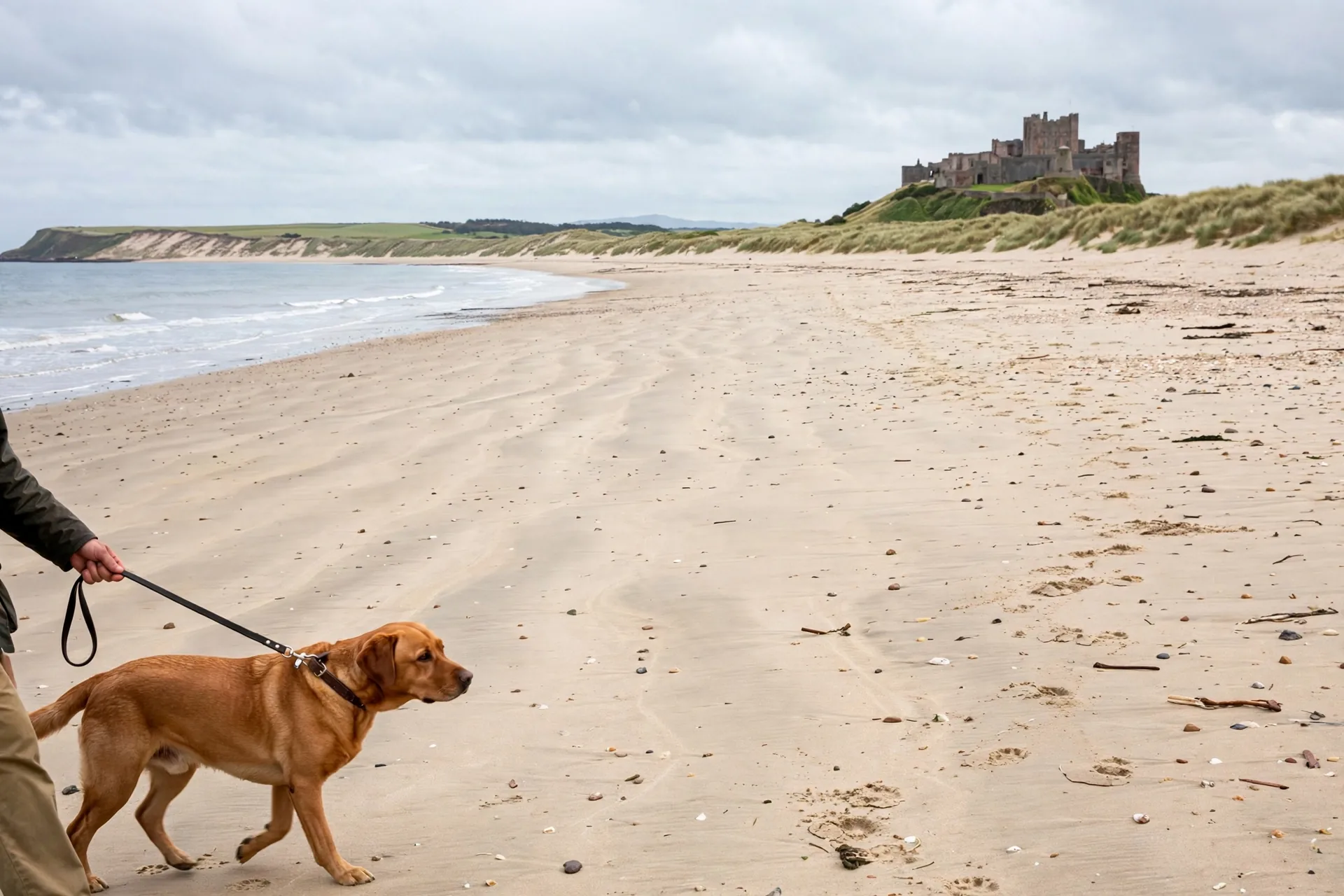
You switch the engine off in the castle car park and the first thing you notice is the wind. It comes off the North Sea with nothing to slow it down, and it carries the smell of salt and wet sand up the slope to the car park. Clip the lead on before you open the boot, because the castle green and the road below are both busy with people who are looking up at the castle rather than down at a dog. Give your dog a minute to sniff the grass verge and settle, then walk to the edge of the car park and look down: the castle stands on its rocky outcrop ahead of you, the beach curves away to the south in a long pale sweep, and the dunes rise behind it like a second, softer skyline. That view is the whole walk in miniature. Everything in this guide follows one line from here to the dunes and back.
Step one is the short descent from the car park towards the castle and the beach access. Keep your dog on a short lead for this stretch. The slope is grassy and uneven in places, the path narrows near the castle walls, and families with children and pushchairs use the same route. If your dog pulls towards other dogs, hold the lead with both hands and step to the side to let people pass. This is not the place for a long line or an extendable lead. A harness with a front clip or a short fixed lead gives you the control you need on a slope where a sudden lunge could pull you both off balance.
Step two is the beach itself. Bamburgh beach runs for roughly a mile and a half of open sand below the castle, and at low tide the firm, flat sand stretches so far towards the sea that the castle looks small behind you. Once you are past the busiest patch of sand nearest the access point, you can let a reliable dog off the lead if the beach rules allow it and your recall is solid — but read the section on beach rules first, because the freedom here comes with conditions, and summer weekends change the picture. Walk south along the wet sand, where the surface is firmest and easiest on paws. The dry sand higher up the beach is softer and more tiring, especially for small dogs and older dogs, so save it for short detours. Let your dog paddle at the water's edge if they like, but watch the tide: the North Sea is cold all year, the waves can be strong, and a dog that chases the surf can tire quickly in cold water.
Step three is the turn into the dunes. About halfway along the beach, look for the gaps and waymarked paths that lead up through the dunes. Do not cut straight up the steepest face. Take the established path, keep your dog on a lead from here on, and walk slowly. Dune sand is deep and loose, and a dog that charges up a dune face will be exhausted in minutes and may disturb nesting birds or the fragile grasses that hold the whole system together. The path climbs gently, the sound of the sea drops away, and suddenly you are walking between grassy hollows where the wind is softer and the air smells of marram grass. This is the quietest part of the walk, and it is where your dog will want to sniff everything. Let them. A slow sniffing walk through the dunes tires a dog out far more effectively than a flat-out run on the beach.
Step four is the return leg along the top of the dunes and back towards the village. The paths here run roughly parallel to the beach, and they give you a completely different view of the castle — lower, more distant, framed by grass rather than sea. Keep your dog on the path. The dunes are a protected habitat, and the areas off the path are where ground-nesting birds and rare plants live. If your dog is a keen digger, this is the stretch where you need to be most watchful, because dune sand invites digging and a single enthusiastic hole can damage a plant community that takes years to recover.
Step five is the descent back to the village and the car park. The paths drop back down towards the village green and the church, and the wind picks up again as you leave the shelter of the dunes. This is the point in the walk where tired dogs start to lag, so slow down, offer water, and let your dog set the pace for the last stretch. There is no fresh water on the beach or in the dunes, so carry a bottle and a collapsible bowl from the start. A dog that has run on the beach, climbed the dunes and sniffed every hollow will drink a surprising amount.
The whole loop takes most dogs between ninety minutes and two and a half hours at a relaxed pace, depending on how much beach running and dune sniffing you allow. Treat that as a flexible shape rather than a fixed distance. The route works because it is linear in character — castle, beach, dunes, village — even though it loops back to where you started. If your dog is young and full of energy, add a second run along the wet sand before you turn into the dunes. If your dog is older or less mobile, cut the dune section short and stay on the beach, which is the flattest and kindest part of the whole walk. The route also works in reverse if the wind is behind you on the beach, but the castle-to-dunes direction is the one that puts the best views in front of you and the wind at your back on the way home.
Before you set off, run through a short kit check. You need a lead and a long line if you plan to give your dog beach freedom, a harness that fits well over a coat, poo bags, water and a bowl, a towel for sandy paws, and a drying coat or an old towel for the car. In winter, add a dog coat for a short-coated or older dog, because the wind on Bamburgh beach cuts through a wet dog fast. In summer, add sun protection for a pale-nosed dog and check the sand temperature with the back of your hand before you let your dog run on it — dark wet sand can be surprisingly warm on a sunny day, though Northumberland rarely reaches the scorching temperatures of the south coast. Finally, save the number of the nearest vet before you start. The closest practices are in Seahouses and Alnwick, and both are a short drive away, but you do not want to be searching for a number with a lame dog and a phone full of sand.
One more practical point about timing. The tide shapes this walk more than anything else. At low tide the beach is enormous and the walking is easy; at high tide the sand narrows, the waves reach the base of the dunes, and the beach section becomes a thin strip that is harder to enjoy with a dog. Check the tide times for Bamburgh before you travel and aim to arrive two to three hours before low tide, so the tide is still going out while you walk and the beach is at its widest. If you arrive at high tide, start with the dunes instead and drop to the beach later as the water retreats.
Beach rules and seasonal restrictions
Bamburgh beach is one of the more dog-friendly beaches on the Northumberland coast, and that is exactly why it is worth understanding the rules properly. At the time of writing, Bamburgh beach is generally open to dogs all year round, with no seasonal ban of the kind that applies to some beaches further south in England. That is the position most visitors report, and it is one of the reasons the beach is so popular with dog owners. But beach rules are set locally and can change, signage on the day is the final word, and you should check the official guidance before you travel rather than relying on any single guide, including this one.
The absence of a seasonal ban does not mean the absence of rules. Dogs must be under control at all times, which in practice means a reliable recall if they are off the lead, and a lead on if they are not. Owners are expected to pick up after their dogs everywhere on the beach, and there are bins at the main access points — carry spare bags anyway, because the bins near the castle end can fill up on busy days. Dogs should not be allowed to worry other beach users, chase wildlife, or run through groups of people. On a summer weekend, when the sand near the castle is crowded with families, picnics and children building sandcastles, the sensible choice is to keep your dog on a lead until you have walked well away from the crowds, or to walk the quieter southern end of the beach instead.
Seasonal restrictions do apply to some other Northumberland beaches, and it is worth knowing the pattern so you do not assume Bamburgh's rules apply everywhere you visit on the same trip. Several beaches in the county have dog exclusion zones or seasonal restrictions between May and September, usually around the busiest access points and bathing areas. The details vary by beach and by year, and the county council publishes the current position — check the official guidance before you travel if you plan to visit Seahouses, Beadnell or Alnmouth on the same holiday. Our county guide to Northumberland with a dog sets out the wider picture across the county, including castle rules, Holy Island tide safety and Hadrian's Wall walks, and it is the best place to start if Bamburgh is one stop on a longer trip.
Wildlife adds another layer of seasonal rules. The Northumberland coast is important for breeding and wintering birds, and the stretch of coast around Bamburgh includes areas where ground-nesting birds breed in spring and summer. Little terns, ringed plovers and oystercatchers nest on the ground on open beaches and in the dunes, and a single off-lead dog running through a nesting area can destroy a nest in seconds. The birds are well camouflaged, so you will not necessarily see them before your dog does. During the breeding season, roughly April to August, keep your dog on a lead near any signed nesting areas, watch for temporary fencing and signs, and give roped-off areas a wide berth. In winter, the same coastline hosts large numbers of wading birds and wildfowl feeding on the shore, and dogs chasing them burn the energy the birds need to survive the cold months. The rule is the same in every season: if birds are feeding or resting on the sand ahead of you, give them space.
Horses are another regular presence on Bamburgh beach. Horse riders use the same wide sand, often in groups, and a dog that chases horses is a serious danger to the rider, the horse and itself. If you see riders approaching, put your dog on a lead well in advance, move to the side, and keep the dog close until the horses have passed. The same applies to the occasional vehicle: beach access for fishing boats and maintenance vehicles is limited, but it does happen, and a dog running loose on a wide empty beach can be hard for a driver to see.
Finally, remember that the sea itself has rules. Bamburgh beach has no lifeguard cover for most of the year, and the North Sea is cold, with strong currents and a steep drop-off in places. Never let your dog swim far out, and never follow a dog into the water if they get into difficulty — call for help instead. Dogs that drink seawater can become ill, so offer fresh water regularly and discourage drinking from rock pools and the sea. After the walk, rinse your dog's paws and coat to remove salt and sand, and check between the toes for sand irritation, which is common after a long beach run.
Dune ecology and lead etiquette
The dunes behind Bamburgh beach look like empty grassland, but they are one of the most fragile habitats on the whole walk. The system works because marram grass and other dune plants trap wind-blown sand and hold it in place, building the ridges and hollows that shelter everything living behind them. When feet, paws and digging break the plant cover, the sand starts to move again, the dune erodes, and the habitat behind it loses its protection. That is why the advice in this section is not a nice extra: it is the core of walking responsibly through the dunes with a dog.
Stay on the established paths. The waymarked routes through the dunes exist for a reason, and they are the only surfaces that can take regular foot traffic without damage. Cutting corners, climbing steep dune faces and letting a dog crash through the grass off the path all cause the same kind of damage, just at different scales. If your dog is a strong puller, this is where a short lead and a harness earn their keep. A dog on a long line can still wander off the path and into the grass, so keep the line short through the dunes, or clip the dog to a fixed lead for this stretch and save the long line for the beach.
Lead etiquette in the dunes is also about the other people using the paths. The dune paths are narrow, and walkers, runners and families with pushchairs all share them. A dog on a long lead across a narrow path is a trip hazard, and a dog that bounds up to strangers in a confined space can frighten people who have nowhere to step aside. Keep your dog on your side of the path, on a short lead, and step off the path onto bare sand or short grass to let others pass where you can do so without damaging plants. If you meet another dog on a narrow path, the polite move is to shorten the lead, move to the side, and pass quickly without letting the dogs greet nose to nose in a space neither can escape from.
Digging deserves a special mention, because dune sand is almost irresistible to many dogs. A dog that digs on the beach is a minor nuisance; a dog that digs in the dunes can destroy the root mat that holds a whole slope together. If your dog starts to dig, interrupt calmly, move them back onto the path, and redirect them with a sniffing game or a treat scatter on firm ground. Puppies and young dogs are the most enthusiastic diggers, so watch them particularly closely in the dunes and consider keeping them on a lead even if they are reliable off the lead on the beach.
The dunes are also home to wildlife that is easy to miss. Ground-nesting birds use the hollows and the edges of the dune grass in spring and summer, rabbits and small mammals live in the burrows that riddle the older dunes, and adders are present on parts of the Northumberland coast, including dune and grassland habitats. Adders are shy and will usually move away, but a dog that noses into warm, sheltered hollows on a sunny spring day can surprise one. Keep your dog on the path, do not let them push into dense vegetation, and know the signs of an adder bite — sudden pain, swelling and distress — and the route to the nearest vet. Our wider guide to Northumberland with a dog covers the county's wildlife seasons in more detail, and it is worth a read before a spring visit.
Grazing animals are another consideration. Parts of the dune system and the coastal grassland are grazed to keep the habitat in good condition, and you may meet sheep or cattle on or near the paths. Keep your dog on a lead around livestock at all times, and never let a dog chase sheep — it is an offence, it can cause sheep to abort lambs or injure themselves, and farmers are entitled to act to protect their animals. If you are walking with a dog that has a strong chase instinct, choose the beach route rather than the dune route on days when livestock are visible.
Leave nothing behind in the dunes. Poo bags belong in a bin, not tucked behind a tuft of grass, and food waste attracts rats and gulls that disturb nesting birds. The dunes have no bins along most of their length, so carry bags out to the bins at the beach access points or the village. The same applies to tennis balls and other toys: a lost ball in the dunes becomes litter, and a dog that chases a ball into the grass will trample far more than a dog walking calmly on a path.
Visiting the castle with a dog
Bamburgh Castle dominates the walk, and it dominates the village too. The fortress on its rocky outcrop has guarded this stretch of coast for centuries, and it is one of the most photographed castles in England — which is part of the problem when you arrive with a dog. Everybody wants the same photograph, the same viewpoint and the same patch of grass, and a dog adds a layer of planning to a visit that other visitors do not have to think about.
The key fact is that dogs are not normally allowed inside the castle buildings, with the exception of assistance dogs. That is the standard position for historic houses and castles across Britain, and it applies here too. Dogs on leads are generally welcome in the castle grounds, which is where the best views are anyway: the lawns and paths around the castle give you the full sweep of the beach, the Farne Islands on a clear day, and the castle walls rising above you. But castle policies can change, and the grounds may be restricted during events, so check the official guidance before you travel, and check the signs at the entrance on the day.
If you are visiting as a group, the simplest arrangement is to take turns. One person tours the castle interior while the other walks the dog in the grounds or down on the beach, then you swap. This works better than it sounds, because the castle interior deserves unhurried attention and the dog will be far happier outside anyway. If you are visiting alone with a dog, plan the castle as a grounds-only visit: enjoy the views, walk the paths, take your photographs, and save the interior for a return trip or a day when the dog can stay with someone else. Do not leave a dog unattended in a car while you tour the castle, even on a cool day — cars heat up quickly, and a dog left alone in a strange car park is stressed and unsafe.
Tickets and opening times vary by season. The castle is generally open daily in the main season with reduced hours in winter, and it can close for private events, so check the opening times on the castle's own website before you travel rather than relying on a guidebook. Allow at least an hour for the grounds and the views, and two to three hours if you are touring the interior as well. The paths around the castle are steep in places and the ground is uneven, so wear proper walking shoes and keep your dog on a short lead near the edges and the walls.
Photography around the castle deserves a note of its own, and it is covered in more detail in the photography section below. For now, the practical point is that the best castle photographs are taken from the beach and the dunes, not from the castle itself — so your dog can be in the picture too, and you do not need to choose between the castle and the dog.
St Aidan's Church, at the other end of the village from the castle, is worth a quiet stop on the way back. The church has links to St Aidan and St Cuthbert, and its churchyard is a peaceful place to sit with a dog on a lead. Dogs are not normally allowed inside churches, so treat it as an outside visit, keep your dog on a lead, and be respectful of anyone using the churchyard. The village green between the church and the castle is a good place for a final rest before the drive home, with benches and shade in summer.
Eating, staying and stocking up in the village
Bamburgh village is small, and that is part of its charm. There are no chain restaurants, no supermarkets and no crowds of shops — just a handful of pubs, a couple of places to stay, a village store and the castle. For a dog owner, small is good: everything is within a short walk, the pubs know their regulars, and a well-behaved dog on a lead is a normal sight rather than an exception. But small also means limited capacity, so book ahead in summer and do not assume you can turn up and find a table or a room.
The Lord Crewe Arms is the village's best-known pub, a historic inn on the village green with rooms as well as a bar and restaurant. Dogs are generally welcome in the bar area and in some of the rooms, but policies can vary by season and by room, so confirm the dog policy, any pet charge and the areas where dogs are allowed when you book. The Victoria Hotel, on the other side of the village, also welcomes dogs in parts of the hotel and has a restaurant and bar that are popular with walkers. Both pubs are used to muddy boots and wet dogs, but that is not a reason to arrive with a soaking dog and no towel — bring a drying coat or a towel, settle your dog under the table, and keep the lead short so they are not tripping up staff carrying food.
Pub etiquette with a dog is simple but worth stating plainly. Book a table and say you are bringing a dog, so you are seated somewhere suitable rather than in the middle of the dining room. Keep your dog on a lead under the table, not wandering between tables. Bring a mat or a blanket for your dog to lie on, and a chew or a stuffed Kong to keep them settled while you eat. Do not feed your dog from the table, and do not let them beg from neighbouring tables — it is the fastest way to turn a dog-friendly pub into a pub that quietly stops welcoming dogs. If your dog barks at other dogs or gets stressed in busy rooms, choose a quieter time to eat, ask for a corner table, or take a takeaway back to your accommodation instead.
Staying overnight in Bamburgh with a dog is straightforward if you plan ahead. The village has dog-friendly cottages, bed and breakfasts and a campsite, and the surrounding area has a much wider choice, including farm stays and holiday parks between Bamburgh and Seahouses. The pattern is the same everywhere: dog-friendly accommodation sells out first in summer, pet charges vary, and the number of dogs allowed is usually capped at one or two. Confirm the dog policy in writing before you pay, ask whether dogs can be left alone in the room, and check whether there is a secure garden or a nearby toilet walk for last thing at night. If you are staying in a cottage, ask about the garden boundary — a low wall or an open hedge is not a secure boundary for a determined terrier.
For supplies, the village store covers the basics: dog food in a limited range, treats, poo bags and the essentials you forgot to pack. Do not rely on it for a specialist diet, a particular brand of food or veterinary supplies — bring those with you. The nearest larger shops are in Seahouses, about three miles south, and the nearest supermarkets are in Alnwick, about fifteen miles away. If your dog is on a prescription diet or takes regular medication, pack more than you need for the trip, and carry the medication in your day bag rather than leaving it in the car.
Water is worth a special mention. There is no fresh drinking water on the beach or in the dunes, and the village taps are not always conveniently placed when you are mid-walk. Carry a bottle and a collapsible bowl, and fill up before you leave the car park. In summer, a dog that has run on the beach will drink far more than you expect, and a dog that drinks seawater because no fresh water is available can develop an upset stomach. The same applies to the drive home: offer water before you set off, and stop for a toilet break on the way if the journey is long.
If something goes wrong, know where to go. The nearest veterinary practices are in Seahouses and Alnwick, and both are a short drive from Bamburgh. Save the number of the nearest practice and the nearest out-of-hours emergency vet before you start the walk, and keep the details in your phone rather than in a guidebook in the car. For minor problems — a cut paw, sand in the eyes, a mild limp — a basic first-aid kit in the car is worth its weight: saline solution for flushing eyes and wounds, a bandage, tweezers for thorns, and the number of your own vet for telephone advice.
Longer walks: north and south
The castle-to-dunes loop is the heart of a Bamburgh day, but the village sits on one of the best stretches of coastal walking in England, and the route extends naturally in both directions. To the south, the England Coast Path and the Northumberland Coast Path run from Bamburgh towards Seahouses, Beadnell and beyond, following the shoreline past Budle Bay and the wide sands at Ross. To the north, the coast path runs towards Holy Island and the causeway, with views across to the Farne Islands and the open sea. Both directions are worth knowing about, even if you only walk a short way along them.
South is the easier extension. From the southern end of Bamburgh beach, the coast path continues towards Seahouses, roughly three miles away, on a mix of beach, dune paths and field edges. It is a straightforward walk for a fit dog, with the sea on your left and the farmland on your right, and Seahouses at the end has pubs, cafes, fish and chip shops and a harbour to explore. The walk can be done as a one-way trip with a bus or a lift back, or as an out-and-back if your dog has the energy. Check the tide times, because parts of the route are easier at low tide, and keep your dog on a lead where the path runs beside fields with livestock. Budle Bay, about halfway to Seahouses, is a wide tidal bay that is important for wading birds, so give the birds space and keep your dog under close control there, especially in winter when the bay is full of feeding birds.
North is more dramatic and needs more care. The coast path from Bamburgh runs north towards the Holy Island causeway, with views of the island and its castle across the water. This is beautiful walking, but it is not a walk to improvise. The tides here are fast and the causeway to Holy Island is covered by the sea twice a day, and people are caught out by the tide every year. The Pilgrims' Route across the sands to Holy Island is a marked route for experienced walkers with a guide, not a casual dog walk, and it should never be attempted with a dog. If you want to visit Holy Island with your dog, drive there separately at a safe tide time, check the official tide tables and the safe crossing times before you travel, and allow plenty of margin. Holy Island itself welcomes dogs on leads in many areas, and the village and the walks around the island are rewarding — but the crossing is the part that demands respect. Our county guide to Northumberland with a dog covers Holy Island tide safety in detail, and it is essential reading before any trip that includes the island.
Inland, the options are quieter. St Oswald's Way, a long-distance trail that runs from Holy Island to Hadrian's Wall, passes through Bamburgh, and its inland sections offer a complete change of scene: farmland, woodland edges and quiet lanes, with far fewer people than the beach. A short inland loop from the village is a good choice for a second day, or for a dog that has had enough sand. The paths are generally well marked, but they cross farmland, so keep your dog on a lead around livestock and close gates behind you. If you want a longer inland challenge, the full St Oswald's Way is around 97 miles, and most walkers tackle it in stages over several days — Bamburgh makes a good base for the coastal stages.
If you are travelling further afield in the region, the contrast between Bamburgh and the cities to the south is worth experiencing. Durham with a dog is a completely different kind of day: a cathedral above the river, a full River Wear loop, woodland walks and city pubs, all within a compact historic centre. Bamburgh gives you open space and sea air; Durham gives you shade, river paths and a change of pace. Together they make a good two-centre trip, with Bamburgh for the coast and Durham for a rest day from the wind.
Whatever extension you choose, the same principles apply. Check the tide times for coastal sections, carry water, keep your dog on a lead near livestock and nesting birds, and have a plan for getting back. A one-way coastal walk is only enjoyable if the return journey is sorted before you start, and a dog that has walked three miles to Seahouses still needs to get home. The bus services along the coast are limited, especially in winter, so check the timetable before you set off, or arrange a lift.
Summer crowds and winter emptiness
Bamburgh in August and Bamburgh in January are effectively two different places, and the dog walk changes with them. Understanding the seasonal shift is the difference between a day that feels spacious and a day that feels crowded, and it is worth planning your visit around the season that suits your dog rather than the season that suits your diary.
Summer is the busy season. From late May to early September, the castle car park fills up by late morning, the beach near the castle is crowded with families, and the village pubs need booking. The weather is at its best — long days, warm sun, and the sea at its least forbidding — but the crowds change the dog walk. Keep your dog on a lead near the castle end of the beach, walk further south to find space, and aim to arrive early or late in the day when the beach is quieter. Early morning is the best time in summer: the light is soft, the sand is empty, and your dog can run freely before the crowds arrive. Late evening works too, with the added bonus of the castle silhouetted against the sunset. Midday in August is the hardest time: hot sand, crowded beach, and a dog that needs shade and water. If you visit in summer, plan a long lunch break in the shade and a second, shorter walk in the evening.
Summer also brings the wildlife season. Ground-nesting birds are breeding from April to August, the dunes are at their most fragile, and the grass is tall enough to hide ticks. Check your dog for ticks after every walk in summer, especially around the ears, the neck and the belly, and remove any you find promptly. Adders are most active on warm spring and summer days, so keep your dog on the path through the dunes and out of dense vegetation. The sea is at its warmest in late summer, which makes paddling more appealing, but the currents are no weaker — keep the same rules all year.
Winter is the opposite. From November to February, Bamburgh is quiet, the car park is half empty, the beach is yours, and the village feels like a place people live in rather than a place people visit. The light is low and golden, the castle looks dramatic against grey skies, and a dog that loves to run will have the whole beach to itself. But winter brings its own challenges. The wind is stronger and colder, the days are short, and the sea is at its roughest. A short-coated dog needs a coat, an older dog needs a shorter walk, and you need to be off the beach well before dark — there is no lighting on the beach or in the dunes, and the paths are hard to follow in the dark. Check the weather forecast before you travel, and do not attempt the walk in a storm: the wind on Bamburgh beach can be strong enough to knock a small dog off its feet, and wind-blown sand is painful for eyes.
Spring and autumn are the sweet spot for many dog owners. April, May, September and October offer mild weather, long days, fewer crowds and the beach largely to yourself. Spring brings the first nesting birds and the dunes in fresh green; autumn brings the clearest light, the emptiest car park and the best walking temperatures. These are the months when the full castle-to-dunes loop is at its best, and when a dog can run on the beach, sniff through the dunes and settle in a pub garden without competing with a crowd. If you can choose your dates, choose the shoulder seasons.
Whatever the season, the wind is the one constant. Bamburgh is exposed to the North Sea, and the wind rarely drops completely. Dress for it, bring a windproof layer for yourself, and watch your dog for signs of cold — shivering, reluctance to move, or seeking shelter behind you. A dog that is wet from the sea and standing in the wind will chill fast, so dry them off and get them moving or into the car promptly after a swim.
Photography and wind-blown sand
Bamburgh is one of the most photographed places in Northumberland, and with good reason. The castle on its rock, the wide beach, the dunes and the Farne Islands on the horizon combine into a landscape that looks good in almost any light. But photographing a dog in this landscape takes a little planning, and the wind-blown sand that makes the place so dramatic is also the thing most likely to ruin your pictures — and irritate your dog's eyes.
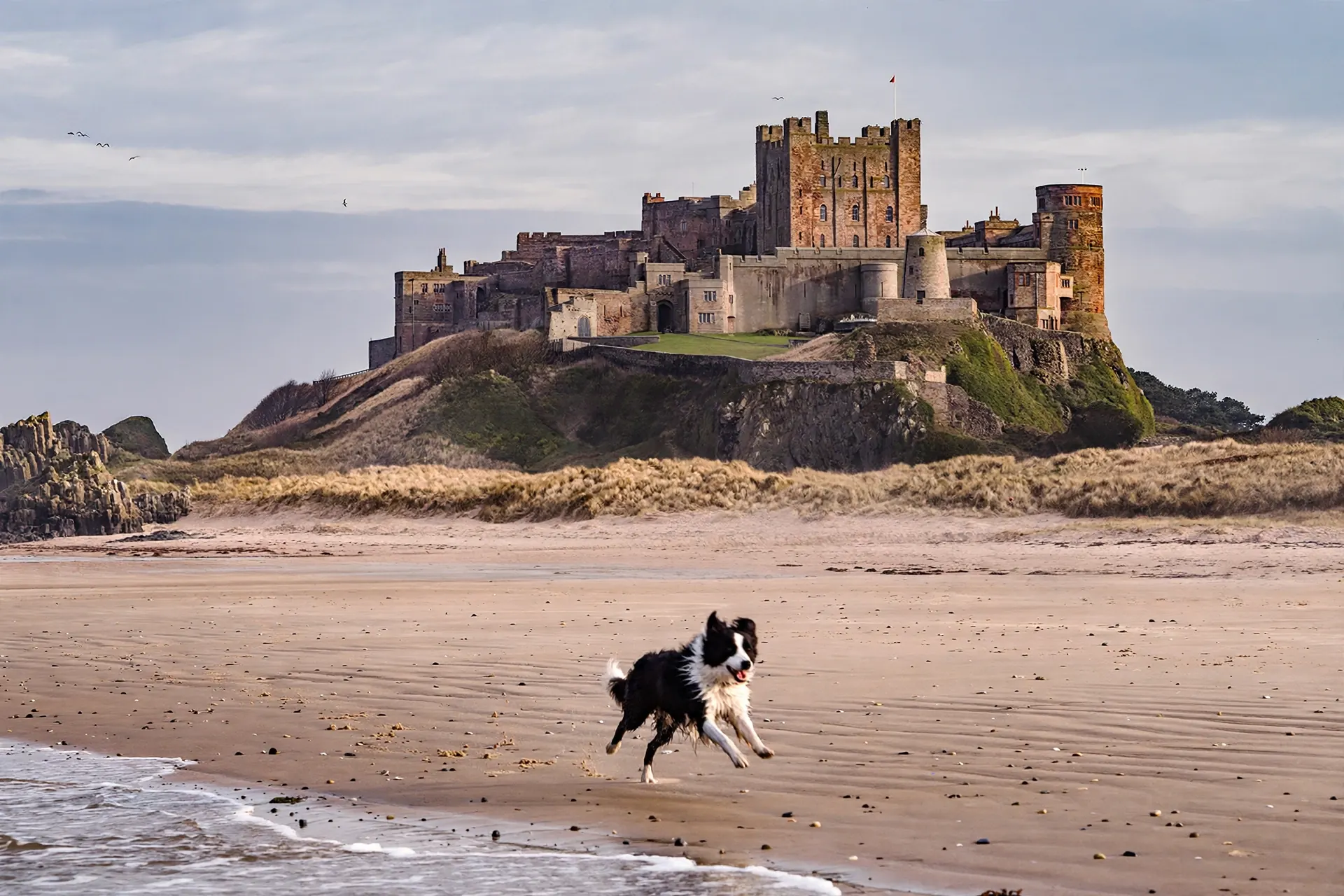
The best photographs come from the beach looking back at the castle. Position yourself on the wet sand at low tide, with the castle behind your dog and the light coming from the side or behind you. Early morning gives you soft light from the east, which lights the castle walls and the sand without harsh shadows. Late afternoon gives you warm light and long shadows, and the castle turns gold as the sun drops. Midday light is flat and unflattering, and the castle can look washed out against a bright sky — save midday for the walk itself and take your photographs at the start or the end of the day.
For the dog, the key is to work quickly and reward generously. Ask your dog to sit on the firm sand with the castle behind them, take a few shots, then release them with a treat and let them run. A dog that is asked to hold a pose for too long will look miserable, and the photograph will show it. The best dog photographs at Bamburgh are often the action shots: a dog running towards the camera along the wet sand, ears up, with the castle in the background. To get those, have someone hold the dog a short distance away while you crouch low with the camera, then call the dog towards you. Use a fast shutter speed and take a burst of shots — most of them will be blurred or badly framed, and one or two will be perfect.
Wind-blown sand is the practical enemy. On a windy day, sand gets into everything: your camera, your phone, your dog's eyes and your own eyes. Protect your camera by keeping it in a bag or under your coat when you are not shooting, and wipe the lens with a clean cloth rather than your sleeve, which may itself be sandy. Shield your phone the same way, and keep it in a pocket rather than in your hand while you walk. For your dog, watch for squinting, pawing at the eyes, or reluctance to face into the wind — all signs that sand is irritating their eyes. Turn the dog so their back is to the wind, wipe their eyes gently with a damp cloth, and move into the shelter of the dunes if the wind is strong. If the irritation persists after the walk, flush the eyes with saline solution and seek veterinary advice if the eye stays red or the dog keeps it closed.
Sand in the coat is the other issue. A long-coated dog will pick up sand in every part of their coat on a beach walk, and the sand will find its way into the car, the house and the bed. Brush your dog out before you get in the car, and bring an old towel or a blanket to protect the car seat. A quick rinse with fresh water at the end of the walk helps, but there are no dog-wash facilities on the beach, so the practical solution is a good brush, a towel, and a shake outside the car before you drive home.
Finally, respect the other people in your photographs. The beach is a public place, and other visitors may not want to be in your pictures — frame your shots to keep strangers out, or ask before you photograph anyone else's dog or children. The same applies to the castle grounds and the village: a little courtesy goes a long way in a small place where everyone notices everything.
Practical questions
Before you go
Can dogs go on Bamburgh beach all year round?
Bamburgh beach is generally open to dogs all year, with no seasonal ban in force at the time of writing, but rules can change and local signage is the final word. Keep your dog under close control near the castle end in summer, pick up after them, and check the official guidance before you travel.
Are dogs allowed inside Bamburgh Castle?
Dogs are not normally allowed inside the castle buildings, with the exception of assistance dogs. Dogs on leads are generally welcome in the castle grounds, which still gives you the views and the picnic spots. Check the official guidance before you travel, and plan for one person to stay with the dog if your party wants to tour the interior.
Where can I park in Bamburgh with a dog?
The castle car park at the foot of the castle is the most convenient starting point for the castle, beach and dunes route, and there is a village car park near St Aidan's Church. Both fill up on summer weekends, so arrive early, pay attention to the tariff boards, and check the official guidance before you travel for current charges.
Can I walk from Bamburgh to Holy Island with a dog?
Not along the sands. The crossing to Holy Island follows a tidal causeway that is dangerous when the tide covers it, and the Pilgrims' Route across the sands is not a casual dog walk. Visit Holy Island separately by road at a safe tide time, check the official tide tables before you travel, and never attempt the crossing with a dog.
Are there dog-friendly pubs and places to stay in Bamburgh village?
Yes. The village has dog-friendly pubs, including the Lord Crewe Arms and the Victoria Hotel, plus cottages, bed and breakfasts and a campsite that welcome dogs. Book ahead in summer and confirm the dog policy, any pet charge and the number of dogs allowed in writing before you pay.
Is the Bamburgh dunes walk suitable for older or less mobile dogs?
The beach itself is mostly firm and level, but the dunes are soft, steep in places and tiring for older, small or arthritic dogs. Stick to the beach and the surfaced paths through the dunes, keep the dune section short, and let an older dog set the pace. Carry water, as there is no fresh water on the beach.