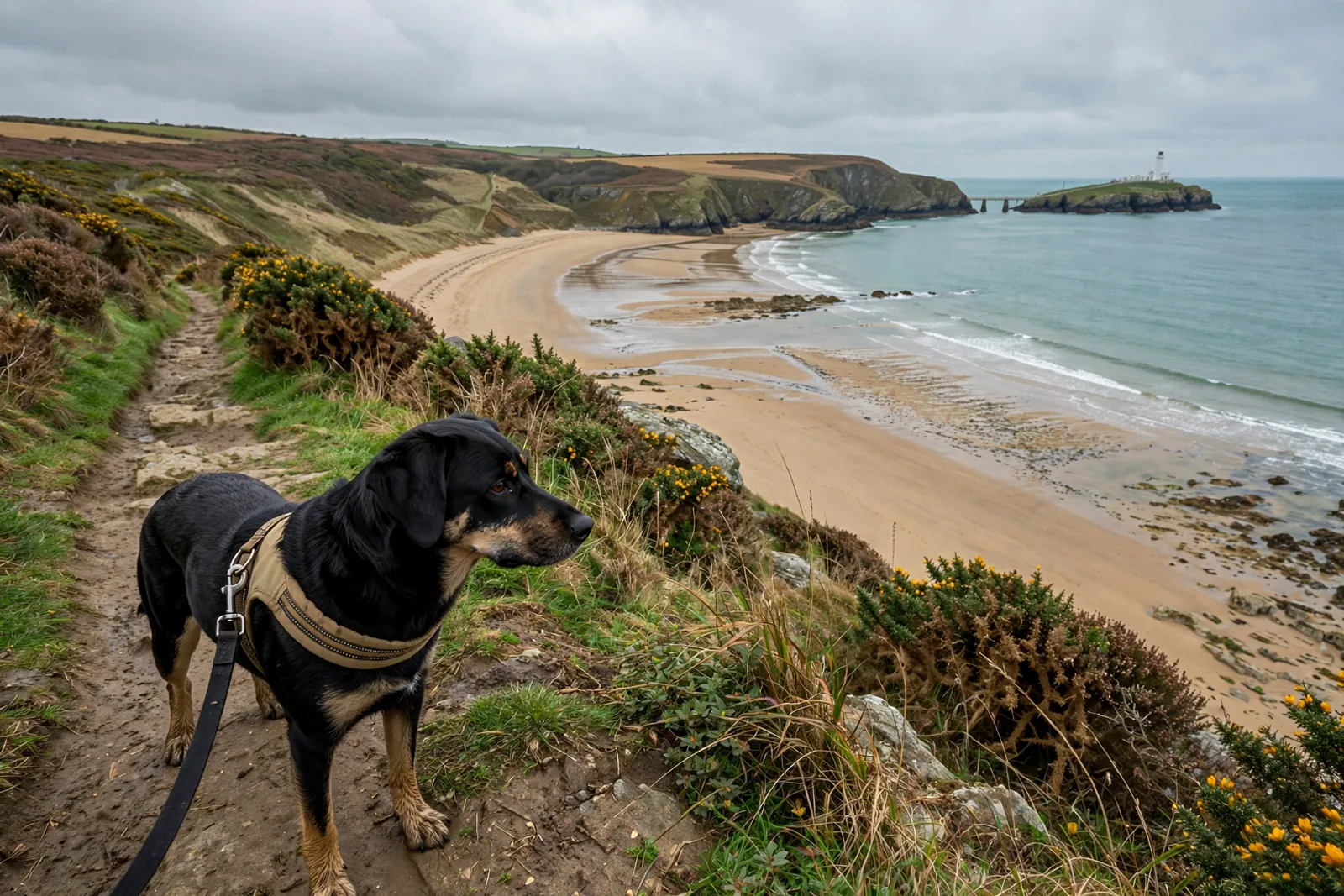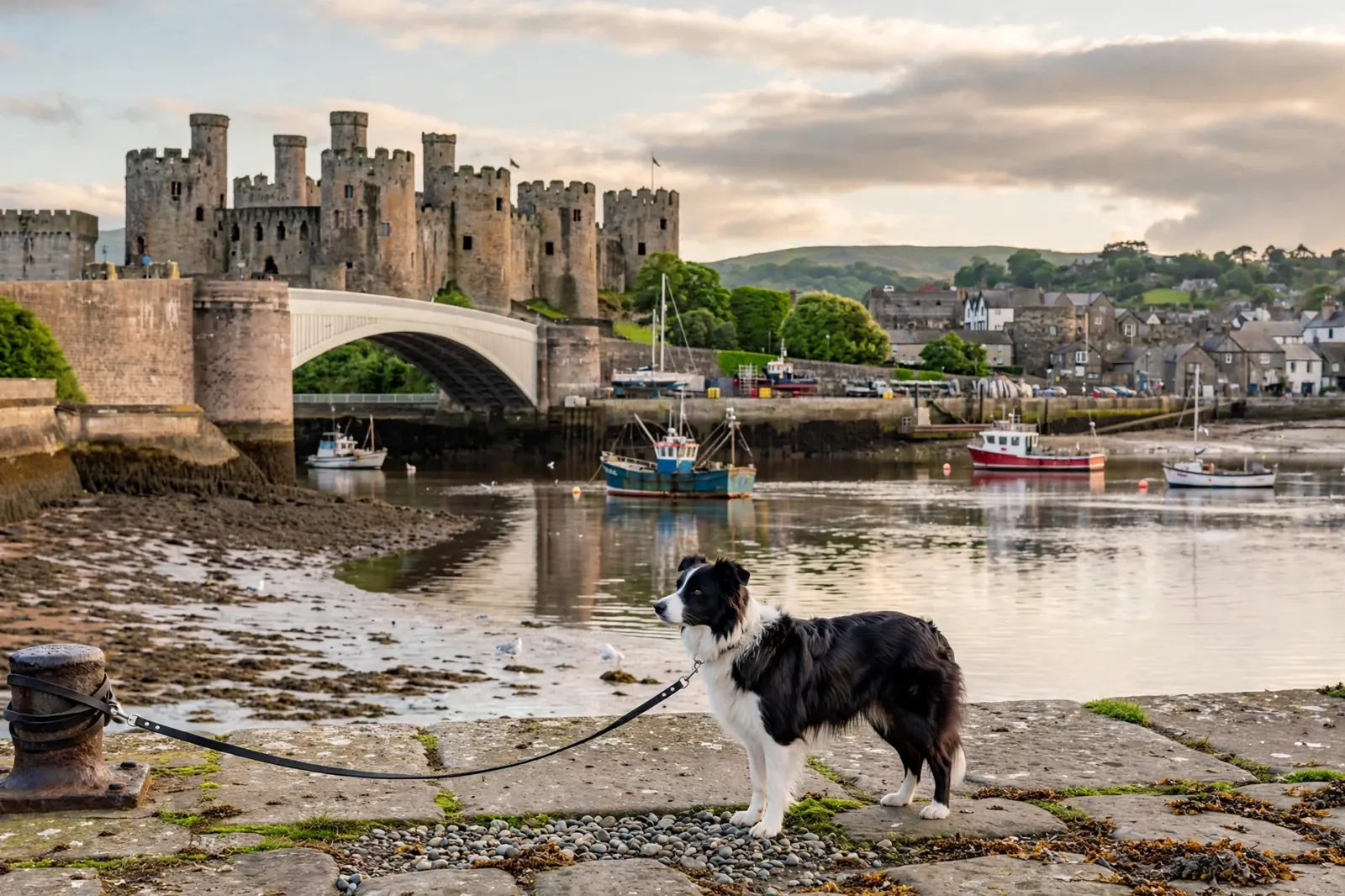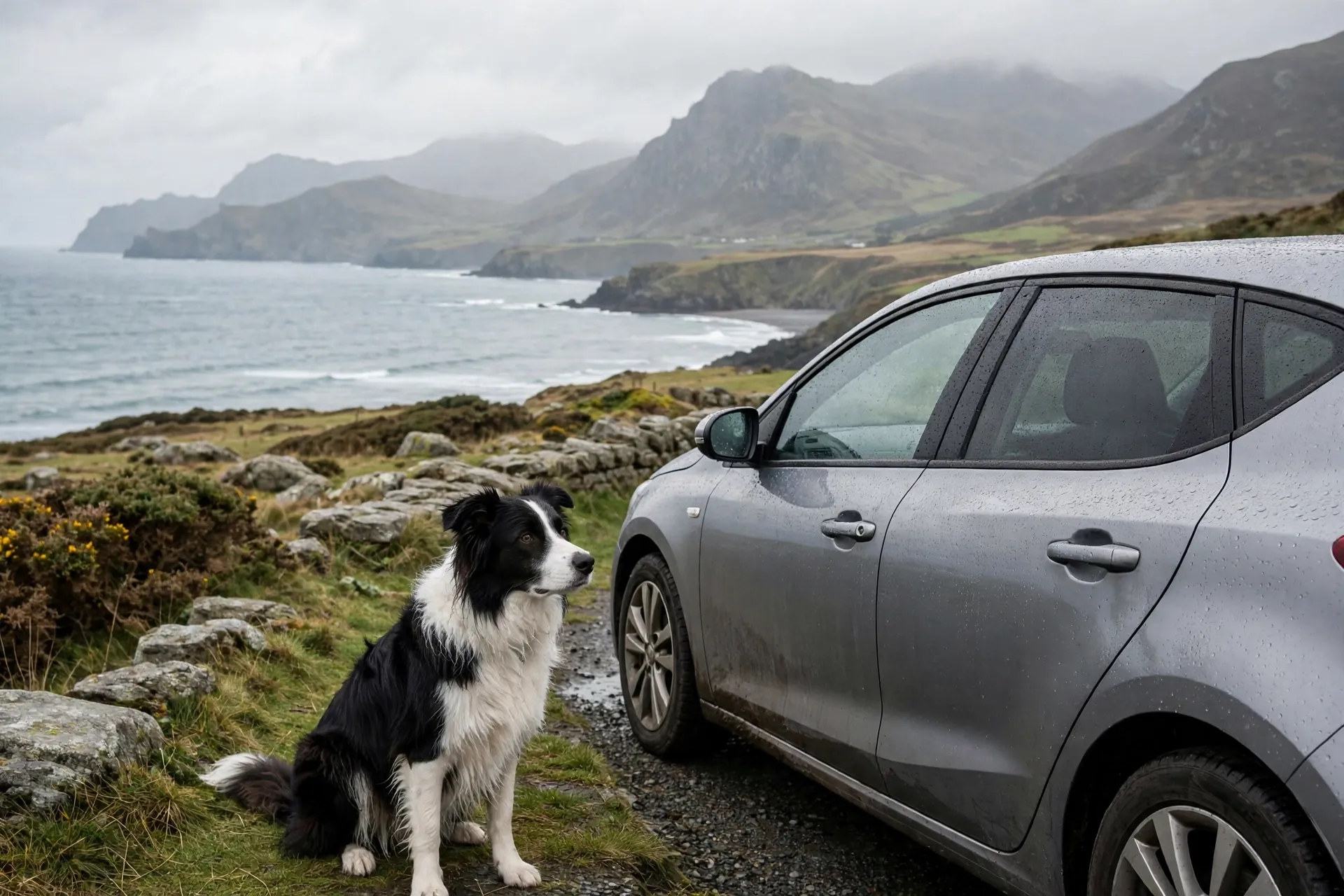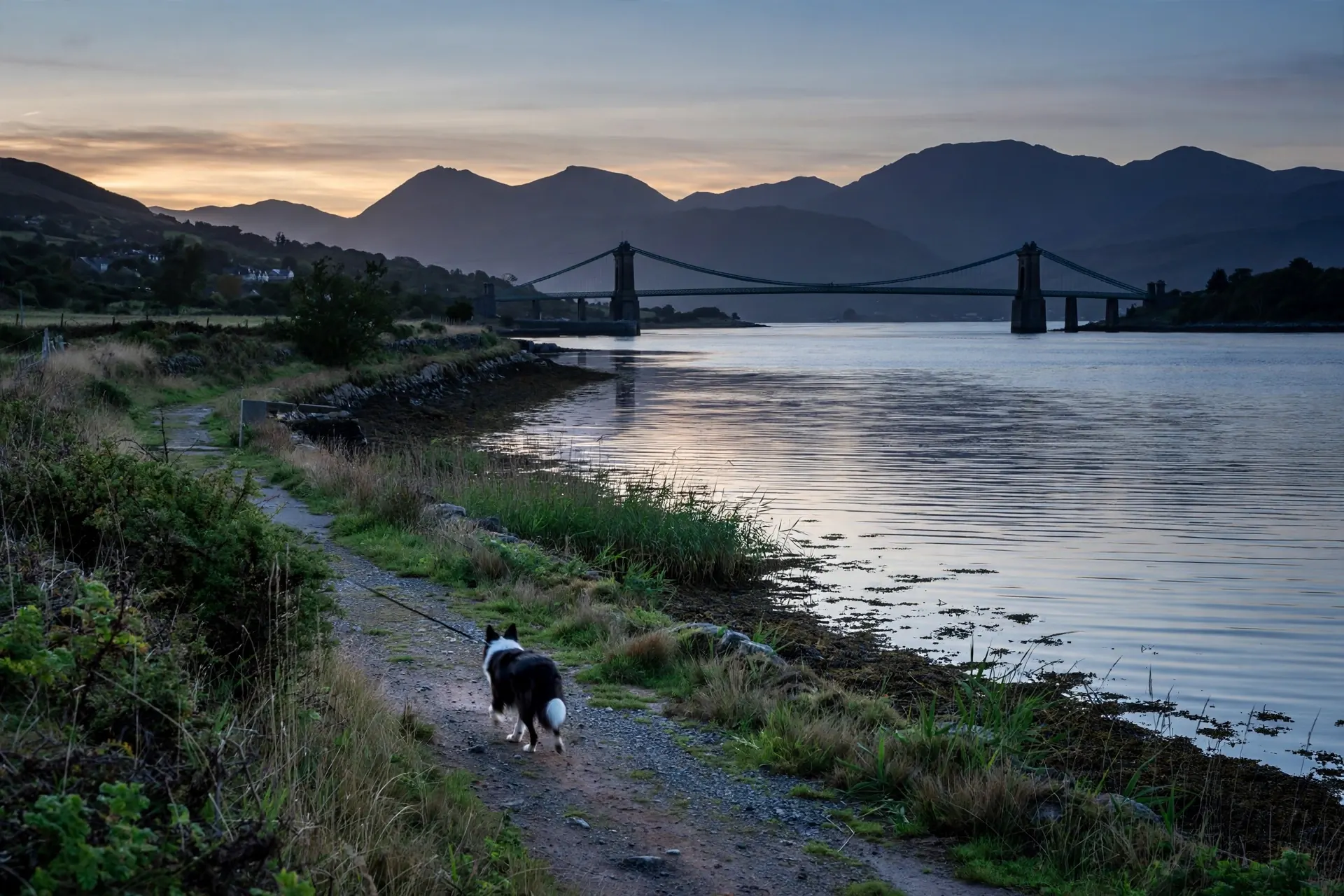
This guide is independent and contains no paid placement. If affiliate links are added later, they will be clearly marked and will not change our editorial checks.
Bangor works brilliantly as a dog trip because everything is close together: a flat waterfront walk along the Menai Strait, Garth Pier stretching out over the water, a compact cathedral quarter to wander, and the mountains of Eryri half an hour away. Keep your dog on a lead near the strait and around sheep, check beach rules before you travel, and use Bangor as a base rather than trying to see everything in one afternoon.
Bangor in one walk: the shape of the city
Bangor is one of the smallest cities in Britain, and that is exactly why it suits a dog trip. Nothing is far apart. You can stand on the waterfront in the morning, wander up to the cathedral by lunchtime, and be on a mountain path or an Anglesey beach before the afternoon is out. The city sits on the southern shore of the Menai Strait, the narrow stretch of tidal water that separates mainland Wales from the island of Anglesey, with the mountains of Eryri (Snowdonia) rising behind it. On a clear day the view across the strait, with the Menai Suspension Bridge in the middle distance and the peaks beyond, is the single image that defines the place.
The most useful way to understand Bangor with a dog is to think of it as three overlapping areas. First comes the waterfront: Garth Pier, the marina, and the flat promenade path along the strait. Second is the old town around the cathedral, a quieter pocket of streets, churchyards and old stone walls a short climb above the shore. Third is the modern High Street, the university quarter and the shops, which is where you will find supplies, cafes and the practical side of the trip. A dog that is happy on a lead and comfortable with traffic noise will enjoy all three; a dog that is nervous around crowds or loud vehicles will be happiest if you keep the High Street short and spend most of your time on the waterfront and the quieter paths.
Start your first morning at the waterfront rather than in the town centre. The strait is calmest and quietest early, the light is kind, and the dog gets a proper walk before the day warms up or the traffic builds. Walk out along Garth Pier if it is open, come back along the shore path, and let the dog sniff the seaweed and watch the boats. Then head uphill to the cathedral quarter while the dog is still fresh, and save the High Street for the practical jobs: water, treats, a cafe stop and anything you forgot to pack. This order matters more than it sounds. Dogs that have already had a good waterfront walk are far more settled when you ask them to wait outside a shop or lie under a cafe table, and you will see the best of Bangor before the crowds arrive.
Bangor is also a university city, home to Bangor University, and that shapes the rhythm of the place. Term time brings students, bicycles and a busier High Street; university holidays are noticeably quieter. Neither is a problem for a dog trip, but the difference is worth knowing when you choose your dates. If your dog is easily overstimulated, a weekday outside term time will feel calmer. If you like a bit of life around you and do not mind crowds, term time adds energy and more cafes are open. Either way, the waterfront stays the same, and the waterfront is where you will spend most of your time.
The Menai Strait: piers, paths and tides
The Menai Strait is the heart of a dog trip to Bangor, and it deserves to be understood rather than just admired. It is a narrow channel, roughly 25 kilometres long, between the Welsh mainland and Anglesey, and it is famous among sailors for its strong tidal currents. The water can run fast, swirl around the bridge piers, and change direction with the tide. None of this affects a dog walking on the shore path, but it matters the moment you think about paddling, swimming or letting a dog off the lead near the water. Never let a dog swim in the strait. The currents are far stronger than they look from the shore, and a dog that is a confident swimmer in a lake or a calm bay can be pulled sideways very quickly here. Keep to the paths, keep the lead on near the water, and treat the strait as a view rather than a swimming spot.
Garth Pier is the best-known walk in Bangor and the easiest one to enjoy with a dog. It is the second-longest pier in Wales, stretching about 460 metres out into the strait, and it offers an open, flat walk with views in every direction: back towards the city, across to Anglesey, and along the strait towards the two bridges. Dogs on leads are generally welcome on the pier, and it is a good choice for older dogs and puppies that cannot manage steep hills, because there is no climb at all. Keep the lead short, because the pier is narrow and shared with anglers, other walkers and the occasional cyclist. Anglers cast lines from the pier, so watch for hooks and bait on the decking, and do not let your dog investigate tackle boxes or bait buckets. The railings are not a complete barrier for a small dog, so keep small dogs on the inner side of the walkway and do not let them climb or squeeze through gaps. Check the official guidance before you travel for opening times and any temporary closures, because the pier can close in very high winds.
The shore path beside the pier is just as rewarding and often quieter. From the pier you can walk along the waterfront towards the marina and the boatyards, where the ground is flat and the views stay open. This is the best stretch for a dog that wants to sniff and mooch rather than march: there is plenty to smell, boats to watch, and benches where you can sit while the dog watches the water. At low tide the exposed shore reveals mud and seaweed. Dogs love it and owners should be ready for it. Bring a towel, and do not let your dog eat shellfish, dead fish or anything washed up on the shore, because it can make them ill. Rinse muddy paws before you get back in the car, and check between the toes for small stones and grit after a beach or shore walk.
Two bridges cross the strait near Bangor, and both are worth knowing about. The Menai Suspension Bridge, designed by Thomas Telford and opened in 1826, is the older and more famous of the pair, with its tall stone towers and sweeping chains. There is a pedestrian walkway, and dogs on leads can cross it on foot. It is a memorable walk, but be honest about your dog before you set off. The walkway is beside traffic, the noise is constant, cyclists pass close by, and the wind can be strong. A confident dog will enjoy the views; a nervous or sound-sensitive dog may find it stressful. If in doubt, drive across instead and walk on the quieter Anglesey side. Our Anglesey guide covers the walks, beaches and ferries you will find once you are over the water. The Britannia Bridge, further along the strait, carries the main road and railway to Holyhead, and it is not a pedestrian crossing for a dog walk, so plan your route accordingly.
One more strait habit is worth building into your day: check the tide times. The strait looks different at high and low water, and the shore paths that are generous at one tide can be narrow at the other. Low tide exposes more shore for sniffing but also more mud; high tide pushes the water up against the sea wall and makes the promenade feel closer to the boats. Neither is dangerous for a lead walk, but knowing the tide helps you choose when to walk the pier and when to head inland instead. Tide tables for the Menai Strait are published online and at the waterfront, and they are worth a quick look over breakfast.
Cathedral, old town and the High Street
Bangor Cathedral, dedicated to Saint Deiniol, is one of the oldest cathedral sites in Britain. A religious community was founded here in the sixth century, and the present building, much of it medieval with later restoration, stands on a low rise above the strait. For a dog owner, the cathedral matters in two ways. The building itself is the landmark that gives Bangor its status as a city and its sense of history, and the streets around it are among the quietest and most pleasant in town for a lead walk. Dogs are not generally admitted inside the cathedral, apart from assistance dogs, so plan for one person to visit the interior while the other stays outside with the dog, or admire the outside and move on. Check the official guidance before you travel for current access rules and service times, because the cathedral is a working church and opening hours vary around services, concerts and events.
The cathedral grounds and the surrounding lanes reward a slow wander. The churchyard is enclosed and green, the stone walls are old, and the view back down towards the strait opens up between the buildings. Keep your dog on a lead here out of respect for the setting and for other visitors, and do not let them dig or foul in the churchyard. There are bins nearby, but it is wise to carry your own bags and use them, because the quieter streets have fewer bins than the waterfront. If your dog is the sort that pulls towards every new smell, this is a good place to practise a slow heel: the streets are short, the traffic is light, and there is always a bench or a wall to pause at.
From the cathedral quarter, the High Street runs downhill towards the station and the waterfront. It is a practical street rather than a pretty one, and that is fine. This is where you buy what you need: a pet shop for food and treats, a supermarket for supplies, a pharmacy, and the cafes where you can sit with the dog. Bangor's High Street has changed over the years like many British high streets, and some units stand empty, but the essentials for a dog trip are all there. The pavements are wide enough for a dog on a lead, though they can be busy at lunchtime and on Saturdays. If your dog is reactive to other dogs, keep to the edges of the pavement, cross the road early when you see another dog coming, and avoid the busiest stretch at peak times. A short lead and a pocket of treats will do more for you here than any amount of planning.
Look out for the smaller details as you walk. Bangor has Welsh-language signage throughout the city, and you will see the Welsh name of the city, also Bangor, alongside English on street signs and shop fronts. The university buildings sit above the town and give the skyline its distinctive shape, with the Main Arts Building and its clock tower visible from the waterfront. The city also has a museum, Storiel, which tells the story of Gwynedd and its people. Dogs are not generally admitted inside museums, so treat it as a human-only stop and plan a dog walk around it. The point of the old town is not to tick off attractions but to enjoy a compact, walkable quarter where the dog is welcome on the streets and the history is simply part of the walk.
Beaches within a short drive
Bangor itself is a strait city rather than a beach town, so the best sand is a short drive away rather than on the doorstep. That is not a drawback. Within twenty to forty minutes you can reach several very different beaches, and the choice of which one to visit is part of the pleasure of using Bangor as a base. The key rule for all of them is the same: check the official guidance before you travel. Dog rules on Welsh beaches vary from beach to beach, and seasonal restrictions usually apply from May to the end of September on the most popular stretches. Signs at each beach entrance are the final word, and they override anything you read online.
Across the strait on Anglesey, the options are the most generous. Traeth Llanddwyn at Newborough is one of the most famous dog beaches in Wales, a long sweep of sand backed by dunes and pine forest, with views towards the mountains. It is the kind of beach where a dog can run properly, and it is worth the short drive across the Menai Suspension Bridge or the Britannia Bridge. Our Anglesey guide lists the year-round beaches, the seasonal restrictions and the practical details for Newborough, South Stack and the Holyhead area, so use it to choose your beach before you set off rather than guessing on arrival. On Anglesey, remember that the dunes and the forest are protected habitats, so keep your dog under control, stick to the marked paths through the dunes, and take all litter home with you.
Along the mainland coast towards Conwy, the beaches are closer and easier to reach for a short visit. Llanfairfechan and Penmaenmawr both have long shingle and sand shores with mountain views, and they suit a dog that likes a steady walk along the waterline rather than a wild run. These beaches can be quieter than the Anglesey favourites, which makes them a good choice for a reactive dog or for a first beach visit with a puppy. Our Conwy guide covers the town, the quay and Morfa beach in detail, and it pairs naturally with a Bangor stay, because Conwy is an easy drive along the coast. Check the seasonal rules at each beach, because some stretches restrict dogs in summer while others welcome them all year.
Whichever beach you choose, the practical habits are the same. Bring fresh water and a bowl, because dogs should not drink seawater. Bring a towel and a drying coat if the weather is cool, because a wet dog in a car is a cold dog. Check the tide times before you let a dog off the lead on a wide beach, because a rising tide can cut off the route back along the shore. Watch for fishing lines, hooks and bait on beaches near piers and harbours, and keep your dog away from dead fish and shellfish. On rocky shores, check paws for cuts after the walk. And on every beach, take your bags with you and use the bins provided, because a beach that stays clean is a beach that stays open to dogs.
Snowdonia on the doorstep
Bangor's other great advantage is that Eryri, the Snowdonia National Park, starts almost at the edge of the city. The Ogwen Valley, with its lakes, crags and waterfalls, is about a twenty-minute drive from Bangor, and it offers some of the finest dog walking in Wales. Llyn Ogwen, a long lake between the mountains, has a flat path along its shore that suits most dogs, while the lower slopes of Tryfan and the Glyderau rise steeply above it. This is not a landscape to underestimate. The weather changes fast, the ground is rocky, and the paths can be steep and exposed. Choose routes that match your dog's fitness and your own experience, and turn back early if the weather closes in.
For most dogs, the best Snowdonia walks from Bangor are the lower ones. The shore of Llyn Ogwen, the paths around Llyn Idwal, and the gentler valley walks in the lower Ogwen Valley all give you mountain scenery without a long climb. Llyn Idwal is a small lake in a hanging valley, reached by a well-made path, and it is a good choice for a first mountain walk with a dog. Keep dogs on leads around sheep, which graze freely across the hills, and keep them close on paths where the ground falls away. The Welsh name for the national park is Eryri, and the highest mountain, Yr Wyddfa, is the peak most visitors know as Snowdon. Climbing Yr Wyddfa with a dog is possible for fit dogs on a good day, but it is a long, steep and crowded route, and the summit is often busy. Many dog owners have a better day choosing a lower peak or a valley walk and saving the summit for a human-only trip.
Sheep are the single most important safety issue for dogs in Eryri. Farmers have the legal right to protect their livestock, and a dog that chases sheep can be shot. That sounds blunt, but it is the reality of walking in a working farming landscape, and it is why the rule is simple: keep your dog on a lead whenever sheep are in sight, even if your dog has never chased anything before. The same applies on the lower slopes and in the valleys, where sheep graze on open ground. A long line gives the dog freedom to explore while keeping you in control, and it is a better choice than an off-lead run in open sheep country. If your dog has a strong prey drive, keep them on a short lead for the whole walk and choose routes that stay on marked paths away from grazing land.
Practical details matter as much as route choice. Parking at the popular valley car parks fills early on fine weekends and in school holidays, so arrive before ten in the morning or choose a weekday. Some car parks charge a fee, and some are small, so have a backup plan in mind. Carry water for the dog and for yourself, because mountain streams are not always safe to drink from, and carry a lead, a towel, a first-aid kit and a phone with a charged battery. Mobile signal is patchy in the valleys, so download your route before you set off. In hot weather, start early and avoid the middle of the day, because dogs overheat faster than people and there is little shade on the open hills. In winter, check the forecast for ice and snow, and do not take a dog onto steep ground in icy conditions. Our North Wales road trip guide sets out a loop through the coast, the foothills and the Llyn Peninsula that works well as a longer trip from a Bangor base.
Eating and drinking with your dog
Bangor's cafes and pubs are used to dogs, but the welcome varies from place to place, so the golden rule is to ask before you sit down. The most dog-friendly spots tend to be the ones with outdoor seating, a terrace or a garden, where the dog can lie down without blocking a walkway. On the waterfront and around the marina there are cafes with outside tables that suit a dog perfectly on a dry day. In the town centre, several cafes welcome dogs inside, usually in a specific area near the door, and some keep a water bowl and a jar of treats behind the counter. None of this is guaranteed, so check the official guidance before you travel, and always ask the staff on arrival rather than assuming.
A little preparation makes cafe stops much easier. Bring a mat or a blanket for the dog to lie on, because it gives them a clear place to settle and keeps them off cold floors. Bring a chew or a stuffed Kong to keep them occupied while you eat, and order something that arrives quickly rather than a long meal if your dog is restless. Sit at a table near the edge of the room rather than in the middle, so the dog is not in the path of every waiter and customer. If the cafe is busy and your dog is already tired, consider a takeaway instead: buy a sandwich and a coffee, and eat it on a bench by the strait while the dog watches the boats. That is often a better lunch than a crowded cafe, and it costs less too.
For evening meals, pubs are usually a better bet than restaurants. Many pubs in and around Bangor welcome dogs in the bar area, and some have a garden or a terrace for summer evenings. The same habits apply: ask first, keep the dog on a lead, settle them under or beside the table, and do not let them wander between tables. If you are staying in a cottage or a holiday park, a takeaway eaten back at your base is often the most relaxing option of all, because the dog can settle in familiar surroundings while you eat. Bangor has takeaway options on the High Street and in the surrounding villages, and a short drive will take you to more pubs and restaurants in the nearby towns and villages along the coast.
One more practical point: carry water and a collapsible bowl everywhere in Bangor, not just on mountain walks. The waterfront is exposed to wind and sun, the High Street has few public water points, and a dog that has walked the pier and the shore path will be thirsty. A bottle of water and a bowl weigh almost nothing and save you from having to find a shop every time the dog needs a drink. The same goes for poo bags: carry more than you think you need, because the waterfront bins can be full on busy days, and you may need to carry a used bag until you find the next bin.
Where to stay with a dog
Bangor is a practical base for a dog trip, and the accommodation that suits dog owners best is usually a self-catering cottage, a holiday park or a dog-friendly hotel on the edge of the city rather than a room in the centre. The reason is simple: a dog needs outdoor space, a place to dry off after a wet walk, and a quiet spot to sleep. A cottage with a garden or a ground-floor room with direct access outside is worth more than a smart room on the third floor with a long corridor. When you book, ask the exact questions that matter: how many dogs are allowed, what the pet fee is, whether there is a garden and whether it is enclosed, where the nearest toilet walk is after dark, and what happens if the dog barks. Get the answers in writing with your confirmation.
Holiday parks and cottages in the surrounding villages are worth considering alongside places in the city itself. The villages along the strait and the coast, such as Menai Bridge, Beaumaris and Llanfairfechan, are all within a short drive of Bangor and offer quieter stays with easier access to walks. A cottage in one of these villages can be a better base than a city-centre room if your dog is nervous around traffic or crowds. The trade-off is that you will drive more: a village base means a car journey for every meal out and every trip into Bangor. Weigh that against the benefit of stepping out of the front door straight onto a quiet lane or a coastal path.
Check the details that are easy to miss. Ask whether the garden fence is secure and how high it is, because a "fenced garden" photographed from one angle may have a gap that a small dog can slip through. Ask about flooring: hard floors are easier to clean after a muddy walk than pale carpets. Ask where you can dry the dog after a wet day, and whether there is an outdoor tap or a utility room. Ask about the check-in time, because arriving in daylight gives you time to walk the boundary, check the garden and settle the dog before dark. And ask about the cancellation terms, because a dog's illness or a change in the weather can force a change of plan. A clear, written answer to each of these questions is worth more than a friendly "we love dogs" on a listing.
For a longer stay, think about the weekly rhythm. A week in Bangor gives you time to walk the strait, visit the cathedral quarter, spend a day on Anglesey, a day in the Ogwen Valley, and a day along the coast towards Conwy, with rest days in between. A weekend gives you time for two of those, so choose the two that suit your dog best. Either way, book early for school holidays and summer weekends, because the best dog-friendly cottages in North Wales are booked months ahead. If your first choice is full, ask to be put on a waiting list, and check again a few weeks before your dates, because cancellations do happen.
Getting there, parking and buses
Bangor is well connected by road and rail, which makes it an easy base even without a car, though a car makes the beaches and the mountains far easier to reach. The A55, the main road along the North Wales coast, runs close to the city and connects Bangor to Chester, the motorway network and the ferry port at Holyhead. The Britannia Bridge carries the A55 across the strait to Anglesey, and the Menai Suspension Bridge carries the A5, the older road that runs through the city. If you are driving from England, the A55 is the straightforward route, and it is worth allowing extra time on summer weekends and bank holidays, when the road can be slow near the bridges.
Bangor station is on the North Wales Coast Line, with trains to Chester, Crewe, Holyhead and the ferry port. Dogs are allowed on trains in Britain, usually free of charge, provided they are kept on a lead and do not occupy a seat. Check the official guidance before you travel for the current rules of the train operator you are using, because conditions can vary. A dog that travels well on a train will find Bangor station easy to use: it is a short walk from the station to the High Street and the waterfront, and the route is mostly flat. If your dog is nervous on trains, drive instead, because a stressed dog at the start of a trip sets the tone for the whole weekend.
Parking in Bangor is straightforward if you arrive early. There are several pay-and-display car parks close to the High Street and the waterfront, including parking near Garth Pier and the marina area. Charges and time limits vary, so check the official guidance before you travel for current prices and any changes to car park layouts. On summer weekends and university term-time Saturdays, the central car parks fill quickly, and you may need to use a car park a short walk from the centre. That is not a problem for a dog trip: a ten-minute walk from the car park to the waterfront is a perfectly good start to the day. Never leave a dog in a parked car, even for a few minutes, because a car heats up quickly in sun and cools fast in winter, and a dog left alone in a car is at risk in both seasons.
Local buses connect Bangor to the surrounding towns and villages, including Menai Bridge, Beaumaris, Caernarfon and Conwy. Dogs are generally allowed on local buses at the driver's discretion, usually on a lead and on the floor rather than on a seat. Check the official guidance before you travel for the current rules of the bus operator, and be ready to wait for the next bus if the driver decides the bus is too full. Buses are a useful option for a linear walk: take the bus to one end of a coastal path and walk back to Bangor, or take the bus out to a village and walk back along the shore. For a first visit, though, a car gives you the freedom to change plans when the weather changes, and the weather in North Wales changes often.
Tides, weather and strait safety
The weather in Bangor is changeable, and a dog trip that is planned around the weather will always be better than one that ignores it. The city sits on a tidal strait with mountains behind it, which means the wind can pick up quickly, rain can arrive from the sea, and a bright morning can turn into a wet afternoon. Pack for all of it: a waterproof coat for the dog, a drying coat for after the walk, a towel, and a spare lead. Check the forecast the night before and again in the morning, and have a wet-weather plan ready. A rainy day in Bangor is not a wasted day: the pier walk is still enjoyable in light rain, the cathedral quarter is atmospheric, and a cafe with a dog-friendly corner is a perfectly good way to spend an hour.
Wind deserves special attention. The strait funnels the wind, and the pier and the bridge walkways are exposed. In strong winds, keep a small dog on a short lead and be ready to cut the walk short. The pier can close in very high winds, so check the official guidance before you travel if the forecast looks rough. On the mountains, the wind is stronger still, and the weather on the tops can be very different from the weather in Bangor. If the forecast for the Ogwen Valley mentions high winds, low cloud or heavy rain, choose a low-level walk instead. The mountains will still be there tomorrow.
Water safety is the most serious issue in Bangor, and it comes back to the strait. The currents in the Menai Strait are strong, and the water is cold even in summer. Never let a dog swim in the strait, and keep dogs on leads near the water's edge. The same caution applies to the rivers and lakes in the mountains: a dog that jumps into a fast river can be swept downstream, and a dog that drinks from a stream can pick up stomach bugs. Carry fresh water and a bowl on every walk, and do not let your dog drink from standing water or puddles near roads. If your dog does get into difficulty in water, do not jump in after them unless you are trained and equipped to do so, because cold, fast water is dangerous for people too.
Finally, know where the nearest vet is before you need one. Bangor has veterinary practices in and around the city, and there are emergency vets in the wider area. Save the number in your phone when you arrive, and note the opening hours and the out-of-hours arrangements. If your dog has a medical condition, bring enough medication for the whole trip plus a spare day, and carry the details of your vet at home. A dog that eats something on the beach, cuts a paw on a rock, or gets stung by an insect will need help quickly, and knowing where to go in advance saves precious minutes. Keep a basic first-aid kit in the car: bandages, saline, tweezers, a towel and the number of your vet.
Three ready-made day plans
A half day in Bangor is enough to see the best of the city, and it is the right choice if you are passing through or if your dog is older and tires easily. Start at Garth Pier, walk out to the end and back, then follow the shore path towards the marina for a gentle thirty to forty minutes. Stop for a coffee at a waterfront cafe, then walk up to the cathedral quarter for a slow wander around the churchyard and the old streets. Finish with a short stroll down the High Street for supplies, and drive home before the afternoon traffic. The whole plan is flat, easy and unhurried, and it gives the dog a proper walk without a long drive or a climb.
A full day adds the mountains or the island. Start early with the pier and the waterfront, then drive to the Ogwen Valley for a valley walk beside Llyn Ogwen or up to Llyn Idwal. Keep the walk to two or three hours, carry water and a packed lunch, and be back in Bangor by mid-afternoon for a rest. Alternatively, drive across the Menai Suspension Bridge to Anglesey and spend the afternoon on a beach at Newborough, using our Anglesey guide to choose the right stretch. Either version of the full day gives the dog a real adventure and still leaves time for a quiet evening. The key is to do one big thing rather than two: a mountain walk and a beach in the same day is too much for most dogs, and it leaves you driving when you should be resting.
A rainy day needs a different plan, and it is worth having one ready before you arrive. Start with a short pier walk in the rain, because a wet dog on a short walk is happier than a bored dog indoors all day. Then drive to a covered attraction or a dog-friendly cafe for a long, slow lunch. Penrhyn Castle, just outside Bangor, has extensive grounds where dogs on leads are welcome to walk, though the house itself is not open to dogs, so check the official guidance before you travel for current access rules. The castle grounds are a good wet-weather walk because the trees give shelter and the paths are surfaced. Finish the day with a drive along the coast towards Conwy, stopping for a short walk at the quay if the rain eases. Our Conwy guide covers the town walls, the harbour and Morfa beach, and it is an easy addition to a Bangor stay. A rainy day done well is still a good day, and the dog will not remember the rain, only the walk.
Practical questions
Before you go
Can dogs walk on Garth Pier in Bangor?
Yes, dogs on leads are generally welcome on Garth Pier, and it is one of the easiest flat walks in Bangor. Keep your dog on a short lead because the pier is narrow, anglers fish from it, and the railings are not a barrier for a small dog that can squeeze through. Check the official guidance before you travel, as opening times and any temporary closures can change.
Is Bangor Cathedral dog-friendly?
Dogs are not generally admitted inside Bangor Cathedral, apart from assistance dogs. The cathedral grounds and the surrounding streets are pleasant for a lead walk, and you can take turns visiting the interior while one person stays outside with the dog. Check the official guidance before you travel for current access rules and service times.
Which beaches near Bangor allow dogs all year?
Several beaches within a short drive of Bangor allow dogs all year, while others apply seasonal restrictions, usually from May to the end of September. Rules change from beach to beach and from year to year, so check the official guidance before you travel and look for the signs at each beach entrance. Our Anglesey guide lists year-round options across the strait.
Can I take my dog across the Menai Suspension Bridge on foot?
Yes, there is a pedestrian walkway on the Menai Suspension Bridge and dogs on leads can cross it. Keep your dog on a short lead, stay on the footway, and be ready for traffic noise, wind and cyclists passing close by. Nervous dogs may find the crossing stressful, so if yours is sound-sensitive, consider driving across instead and walking on the quieter Anglesey side.
Where can I park in Bangor with a dog?
Bangor has several pay-and-display car parks close to the High Street and the waterfront, including parking near Garth Pier and the marina area. Arrive early on summer weekends and university term-time Saturdays, when the central car parks fill quickly. Check the official guidance before you travel for current charges, time limits and any changes to car park layouts.
Is Bangor a good base for Snowdonia walks with a dog?
Yes, Bangor is one of the most practical bases for dog walks in Eryri (Snowdonia). The foothills and lakes of the Ogwen Valley are about a twenty-minute drive away, and the coast path and Anglesey beaches are in the other direction. Choose lower, shorter routes in bad weather, keep dogs on leads around sheep, and check the official guidance before you travel for path closures and parking.