This guide is independent and contains no paid placement. If affiliate links are added later, they will be clearly marked and will not change our editorial checks.
Do North Wales as a loop, not a straight line: start on the Conwy coast, cross into the Eryri foothills, return through the Llyn Peninsula, and never let one driving leg carry two big walks. Give the dog a proper stop in every leg, and keep a coastal alternative ready for every mountain plan.
The coast-or-mountains dilemma
Almost every North Wales road trip starts with the same argument, and it is a good argument to have before you leave rather than in a car park halfway through the holiday. One side of the car wants the coast: wide beaches, harbour towns, fish and chips eaten on a wall while the dog watches the gulls, and walks that can be shortened without drama. The other side wants the mountains: steep valleys, waterfalls, forest tracks and the feeling that you have properly been somewhere, not just driven past it. Both sides are right about North Wales, and both are wrong if they try to win outright. A trip that only follows the coast misses the interior valleys that give the region its character, while a trip that only chases mountain summits turns the dog into a passenger between car parks and leaves little time for the slower pleasures that most dogs actually enjoy: sniffing, paddling, resting and watching the world go by.
The dilemma is sharper with a dog than without one, because dogs experience a road trip in legs, not in landscapes. A human can admire a mountain pass from the car and feel satisfied. A dog cannot. A dog needs to get out, toilet, stretch, sniff and settle again, and that cycle takes time at every stop. If the route strings together three spectacular viewpoints with no proper walk between them, the dog gets the worst version of the trip: long confinement, brief excitement, then confinement again. If the route strings together three long walks with long drives between them, the dog gets the other worst version: tired legs, a wet coat, a car seat that never quite dries, and a second walk that starts before the first one has been recovered from. The planning question, therefore, is not which scenery is prettier. It is how to arrange coast and mountain so that each day contains one satisfying walk, one unhurried town or harbour stop, and driving that stays short enough for the dog to enjoy the evening.
A loop solves this better than a there-and-back route because it removes repetition. Driving the same road twice doubles the dull stretches and halves the new ground, and dogs notice repetition in a practical way: the same service area, the same layby, the same car park queue. A loop also gives you a natural escape valve. If mountain weather closes in, you can cut across to the coast without retracing your steps. If a beach is crowded, windy or subject to a seasonal dog restriction, you can move inland to a forest or valley walk instead of turning round and driving back the way you came. And if one base town does not suit your dog — too busy, too steep, too far from a practical evening walk — the next base on the loop is a different kind of place, not just the same place approached from the other direction.
This guide therefore treats the trip as four driving legs that form a rough circle through the north-west corner of Wales. It starts near the English border, follows the coast to Conwy, turns inland into the Eryri foothills, crosses towards the Llyn Peninsula, and returns along the coast to close the loop. You can run it in either direction, you can base yourself in one town and drive sections as day trips, or you can move base every night or two. What matters is the logic inside each leg: a starting point the dog can leave calmly, a driving time that leaves room for a walk, a stop where the dog can properly get out, and an arrival that does not require another long drive to find an evening toilet walk. Where rules are seasonal or site-specific — beach restrictions, castle admission for dogs, car park charges, livestock controls — check the official guidance before you travel, because those details change and this guide cannot replace the notice at the gate.
One more decision belongs at the planning stage, before any route is drawn: what kind of dog are you travelling with? A young, fit dog that can handle a steep forest climb and a long beach run needs a different loop from an older dog with stiff joints, a small dog that chills quickly in mountain wind, a reactive dog that struggles with crowded promenades, or a puppy still learning to settle in the car. The loop in this guide is deliberately built from short, flexible pieces so that it can be shortened without breaking. Every leg has a short version and a long version, and the notes on car stops and weather splits explain how to choose between them on the day. That flexibility is not a compromise. It is the whole point of a dog road trip: the route should bend around the dog, not the other way round.
The loop at a glance
Think of the loop in four legs rather than in days, because days stretch and shrink with weather, traffic and how the dog slept. Leg one runs from the border area towards the Conwy coast and is the gentlest introduction: coastal towns, a walled town, a harbour and beaches where the dog can get its travelling legs back. Leg two turns inland into the Eryri foothills, where the scenery steepens, the walks become forest and valley walks, and the driving needs more care. Leg three crosses from the mountains towards the Llyn Peninsula and brings the sea back into view, with a different coastline: quieter, more exposed, and more dependent on wind and tide. Leg four closes the circle back towards the starting coast, and it is deliberately the easiest leg, because the last day of a road trip should not ask the dog for its hardest walk.
As a rough scale, each leg is best treated as one to two hours of driving in total, split by at least one proper dog stop, rather than as a single uninterrupted drive. That sounds slow, and it is meant to be. Two hours of driving with a forty-minute walk in the middle feels like a holiday day. Two hours of driving without a break feels like a chore, and three hours without a break can unsettle even a dog that normally travels well. If a leg looks short on the map, resist the temptation to add another destination to it. Use the spare time for a longer sniffing walk, a slower lunch in a town where the dog can lie under a table, or an earlier arrival at the next base so the evening is calm. The loop rewards slack. It punishes packing.
Accommodation shapes the loop as much as roads do. Moving every night gives variety but costs settling time: each new place means new smells, new stairs, new garden boundaries and a new evening toilet routine to learn. Staying in one base for the whole trip saves that cost but adds daily driving, especially to the Llyn Peninsula, which is a long out-and-back from the Conwy coast. The middle path suits most dogs: two bases, one on the Conwy coast and one in or near the Eryri foothills, with the Llyn Peninsula as a long day trip from the second base or as a third short stay if the trip lasts five days or more. Section by section, this guide notes which base suits each leg, so you can choose the pattern that fits your dog rather than copying a pattern that fits someone else.
Finally, keep the loop honest about seasons. In summer, the coast is busiest and some beaches restrict dogs during daytime hours, so early-morning and evening beach walks matter more and inland forest walks become valuable shade. In winter, the coast is quieter and often more enjoyable for dogs, but daylight is short and mountain roads and paths need a more cautious approach. In spring and autumn, the loop is at its most flexible: fewer crowds, longer evenings than winter, and a better chance of walking both coast and foothills in the same week. Whatever the season, the same rule applies throughout: plan the walk first, then fit the driving around it, and never let a viewpoint, a castle or a restaurant booking force a driving day the dog cannot enjoy.
Leg one: border to the Conwy coast
Leg one is the arrival leg, and arrival legs should be kind. Coming from the east, the road into North Wales changes character quickly: motorway gives way to coastal road, the hills close in on one side and the sea opens on the other, and it is tempting to stop at the first dramatic viewpoint and declare the holiday started. Resist that for one more junction. The first proper stop should be somewhere the dog can toilet, drink and walk without traffic noise, steep steps or a crowded car park. A quiet coastal town, a harbour-side car park with a level walk to the water, or a park-and-walk at the edge of town all work better than a layby on a fast road, where lead handling is awkward and the dog cannot relax enough to toilet properly. Give the dog twenty to thirty minutes here, even if the drive has only been an hour. The point is to reset the car journey, not to tick off a sight.
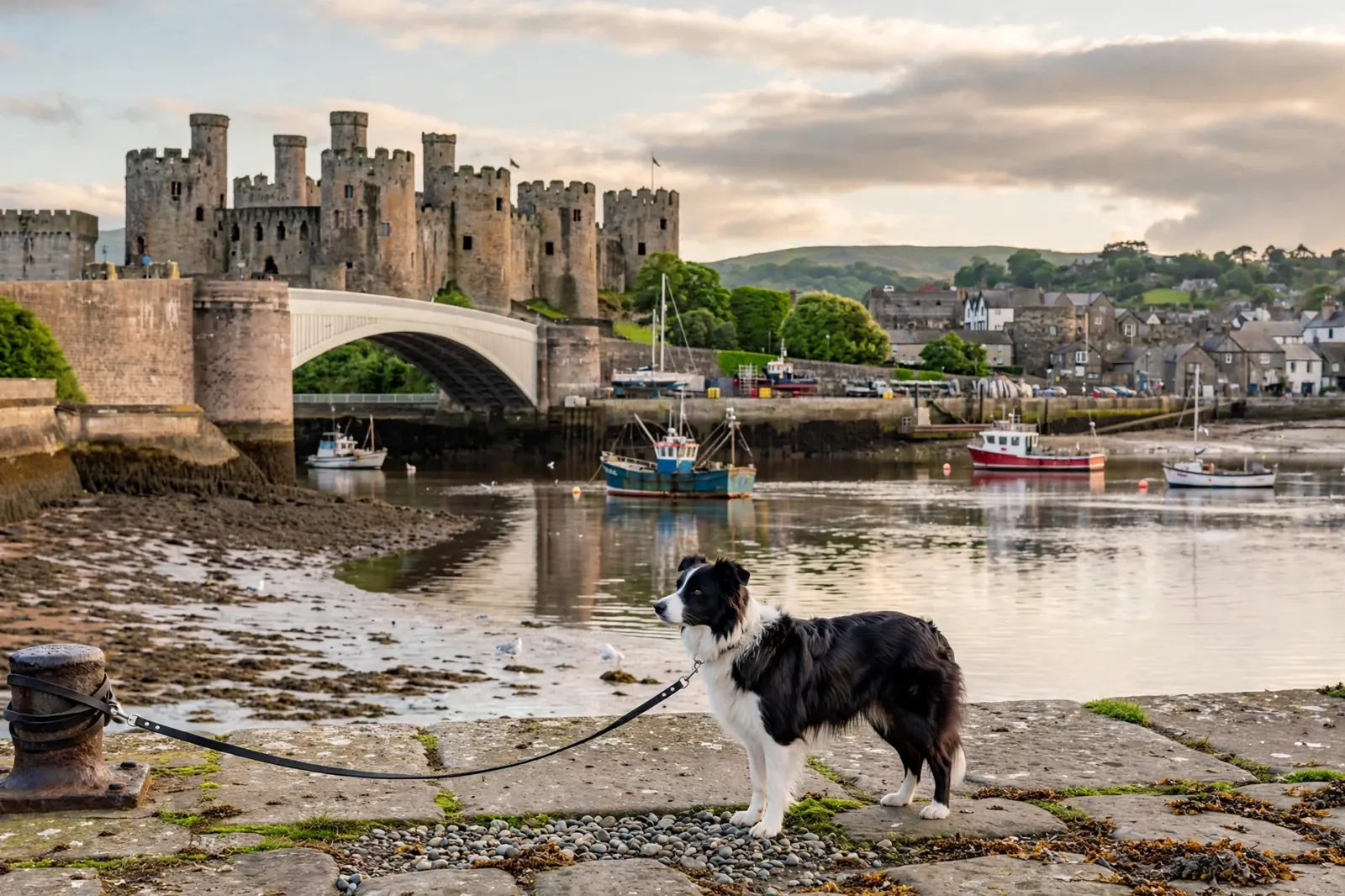
Conwy is the natural anchor for this leg, and it repays a slow approach. The town combines a castle, town walls, a harbour and a small beach area within a walkable centre, which means you can park once and do several things without moving the car. That single-park logic matters for dogs: every extra car move is another settling and unsettling cycle, another search for shade or a safe parking bay, and another chance for a tired dog to be asked to wait in a warm car while someone checks a sign. In Conwy, the practical order is to walk first and sightsee second. Start with the quay and the harbour area, where the dog can sniff, watch boats and settle into the town at ground level, then decide whether the walls walk, the castle exterior or a beach walk fits the dog you have. Our separate Conwy dog guide covers castle rules, the town walls walk, the quay and nearby beach and parking detail, so use it to check the current position before you travel rather than assuming a rule from a previous visit.
Driving time on this leg should be kept deliberately short, even though the coastal road invites a longer run. From the border area to Conwy is a comfortable half-day once stops are included, and that leaves the afternoon for a proper coastal walk rather than a second drive. If you are arriving from further away, split the journey the night before or treat the first night as a staging night near the coast, not as a sightseeing night. Dogs that arrive tired travel badly the next day, and the most common road-trip mistake is to spend the first day's energy on driving and then wonder why the dog is restless, unsettled or reluctant to walk on day two. A short first leg protects the rest of the loop.
Where to stop the car on this leg depends on what the dog needs most. If the dog needs to run, look for a beach or open green space where off-lead exercise is permitted at that time of year, and check the official guidance before you travel for seasonal restrictions. If the dog needs to calm down after motorway driving, a quiet harbour walk on a lead is better than a busy beach, because it gives movement without social pressure from other dogs. If the dog needs to toilet quickly, a level grass area near parking beats a steep promenade every time. Carry water, a bowl, poo bags and a towel even for a short stop, because coastal wind dries a dog's mouth quickly and sandy paws belong in the boot, not on the back seat, on the way to the next base.
Two practical cautions belong to this leg. First, coastal car parks fill early on sunny weekends and bank holidays, and a full car park can turn a planned dog stop into a slow circuit of the town with a dog waiting in the car. Arrive early, have a second car park in mind, and be willing to walk ten minutes from a quieter car park rather than queue for the closest one. Second, gulls, fishing boats and harbour smells are exciting for many dogs and overstimulating for some. Keep the lead short around the quay, watch for dropped fish, hooks and lines, and do not let a dog drink from harbour water. A calm first leg sets the tone: the dog learns that stops mean water, sniffing and a predictable routine, and that lesson pays off on every later leg.
Leg two: into the Eryri foothills
Leg two is where the trip changes gear. Leaving the Conwy coast and turning inland, the road narrows, climbs and bends, the hedges give way to stone walls and open hillside, and the dog's world changes from sand and salt to forest floor, river sound and sheep. This is the leg to drive slowly, not because the road demands it in every place, but because a dog that is already a little travel-tired will feel every bend more keenly. Keep the total driving for this leg under ninety minutes if you can, and put the main walk at the end of the drive rather than in the middle, so the dog arrives at the walk fresh and can rest afterwards at the base without another drive.
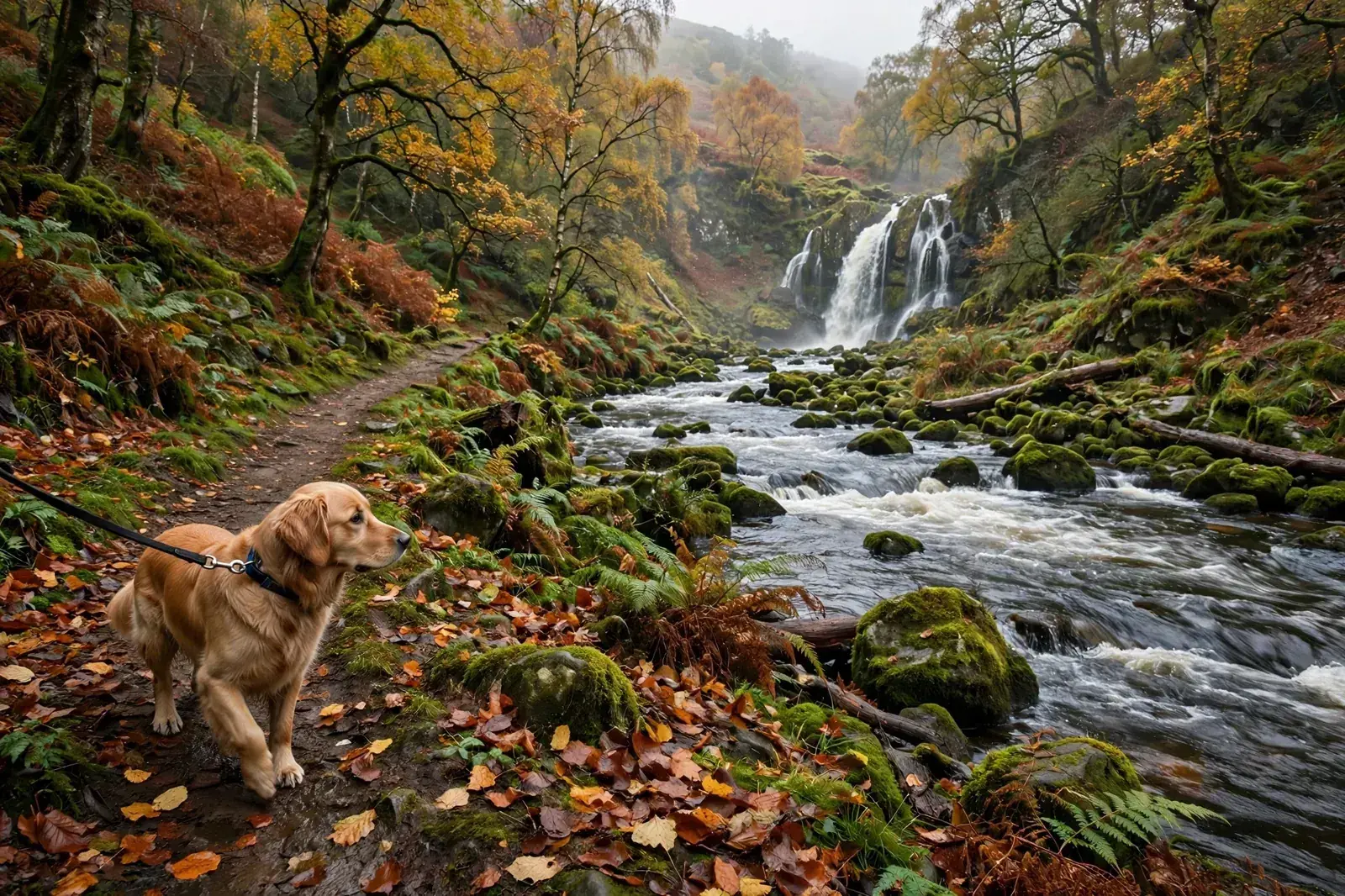
Betws-y-Coed is the obvious foothill base, and its appeal for dog owners is practical as much as scenic: forest walks, river paths, waterfalls and village facilities within a short distance of each other. That closeness matters, because foothill weather can change a long mountain walk into a short valley walk at short notice, and a base with several short options is far more useful than a base with one famous long route. Our Betws-y-Coed dog guide covers falls, forest and village walks, parking and lead advice in detail, and it is worth reading before this leg because forest car parks, river paths and waterfall viewpoints each have their own lead, livestock and water-safety considerations. In general, keep dogs on a lead near rivers in spate, near livestock, and on narrow paths where cyclists and other walkers pass closely.
The walk to choose on this leg should be a foothill walk, not a summit attempt dressed up as a foothill walk. That distinction is the most important safety point in the whole guide. Eryri's high mountains are serious terrain: exposed ridges, sudden cloud, steep descents and long distances between safe stopping points. They are not a casual add-on to a driving day, and they are not suitable for every dog, especially older dogs, brachycephalic breeds, dogs with joint problems, or dogs that have never walked on rocky ground. A forest track, a valley riverside path or a low hill with a clear return route gives most dogs a better day than a summit push: more sniffing, more shade, more water, less wind, and a car journey home that does not start with an exhausted dog. If a summit walk is genuinely the goal, plan it as its own day, with its own weather check, its own early start and no other driving leg attached to it.
Car stops on this leg need a different eye from coastal stops. Forest car parks are often gravel, muddy after rain and busy at midday, so arrive early or late, park where the dog can step out onto grass rather than straight into traffic, and check for ticks after forest and bracken walks, especially in warmer months. River stops are beautiful and deceptive: a calm-looking river can be fast and cold after rain, and a dog that swims happily in a lake may struggle in a current. Keep swimming to places you can enter and exit safely, keep the lead on until you have assessed the water, and dry the dog before the next drive. A wet dog in a car on a winding road is a recipe for travel sickness, so build drying time into the stop, not just walking time.
Sheep country starts in earnest on this leg, and it changes lead rules completely. Even a dog with excellent recall at home can behave differently around sheep, and a moment of chasing can have serious consequences for livestock, for the dog and for the owner. The safe rule is simple: if you can see sheep, or if you are on open hillside where sheep may be over the next rise, the dog stays on a lead. Short leads, not long lines, work best on narrow paths and near walls and gates. Close gates behind you, keep to marked paths where they exist, and check the official guidance before you travel for any local livestock controls or seasonal restrictions that apply to the specific walk you have chosen.
Leg three: mountains to the Llyn Peninsula
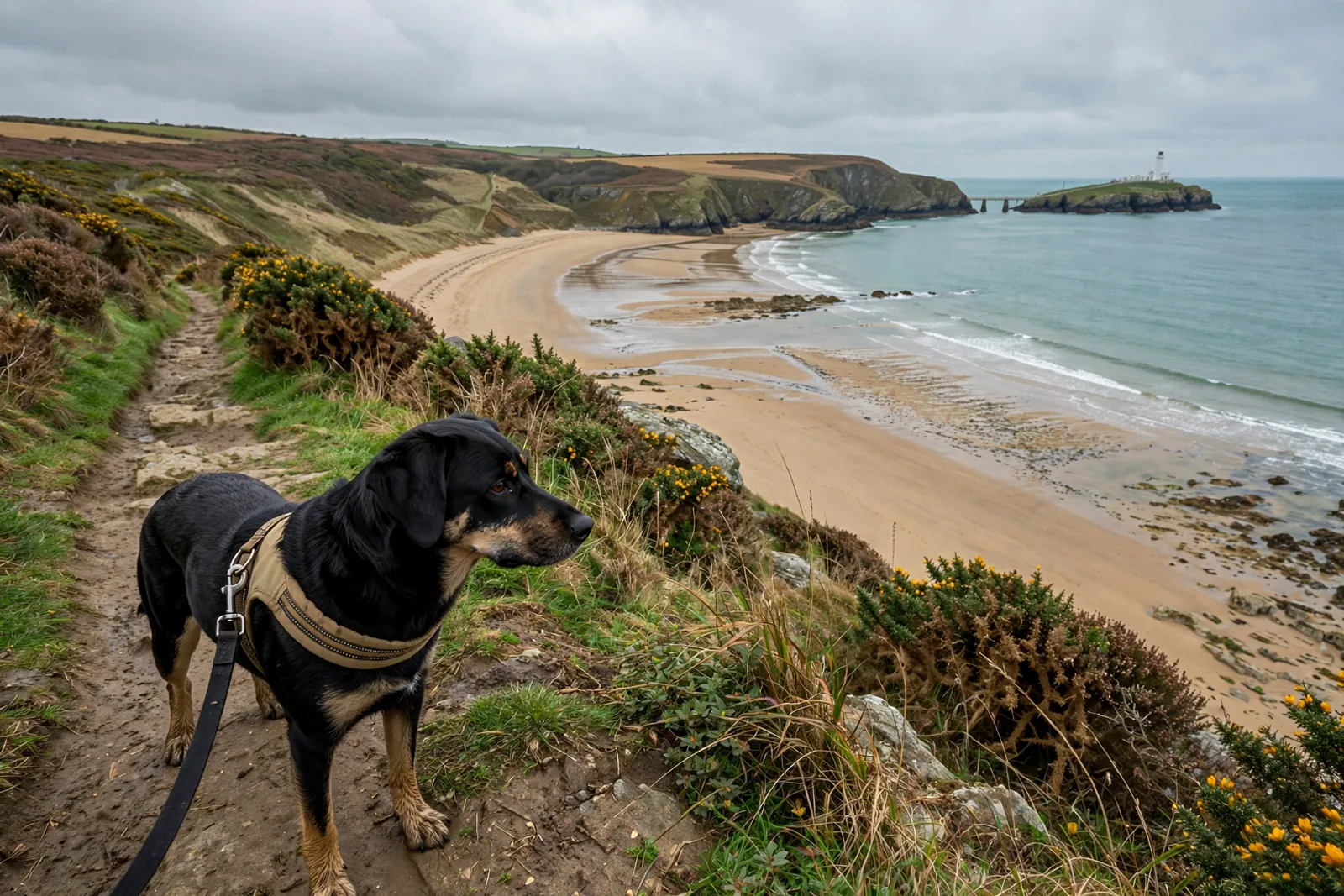
Leg three is the longest-feeling leg, even when the mileage is not the longest, because it crosses from enclosed valleys to open peninsula coastline. The landscape opens out, the wind picks up, and the dog's walking changes again: from forest shade to coastal grass, sandy coves and cliff-top paths. This is a good day for a single, well-chosen coastal walk rather than for trying to see the whole peninsula. The Llyn Peninsula rewards slow driving and one long stop far more than it rewards a tour of five beaches in one afternoon, each with its own car park search and each with a dog that has barely settled before being loaded again.
Choose the Llyn stop by wind and tide, not by photograph. A west-facing beach that looks perfect in a picture can be a wind tunnel on a westerly day, while a sheltered cove a few miles away can be calm. Tide matters too: some beaches shrink to a narrow strip at high tide, leaving little room for a dog to run without disturbing other beach users, while others offer firm sand and space at low tide. Check tide times and any seasonal dog restrictions before you set off, and have a second beach in mind so that a crowded or restricted first choice does not become a wasted drive. If you are extending the trip towards Anglesey instead of, or as well as, the Llyn Peninsula, our Anglesey dog guide covers beaches, coast path walks, tides and seasonal bans for that island coastline, which follows similar logic but with its own ferry, bridge and causeway considerations.
Driving on the peninsula needs patience. Roads narrow, passing places require courtesy, and farm traffic, walkers and cyclists share stretches where a dog owner might expect a clear run. Drive at a speed that lets you stop safely if a dog or sheep appears, and never let a dog travel unrestrained on a peninsula road where a sudden stop is likely. Car parks near popular beaches can be small, so again arrive early or late, and be prepared to walk from a village car park rather than from the beach car park itself. That walk is often the best part of the day for the dog anyway: a quiet lane, hedgerows to sniff, and a gradual arrival at the sea rather than a sudden burst from car to sand.
Cliff-top paths deserve a specific warning. They are exhilarating for humans and risky for dogs that pull, chase or have poor recall near edges. Keep dogs on a lead on cliff paths, keep well back from unfenced edges, and avoid cliff walks in high wind, fog or heavy rain, when a path that is easy in sunshine becomes slippery and disorienting. A beach-level walk or a sheltered inland path is a better choice on such days, and it is not a lesser walk: dogs generally prefer sand, rock pools and shallow water to a windy cliff top, and they will tell you so by settling happily afterwards instead of pacing in the car.
This leg also tests the dog's stamina in a quiet way. A peninsula day often combines a longer drive, a longer walk and a longer evening drive back to base than a coast or foothill day. Watch for the signs that the dog has had enough: lagging, lying down, disinterest in sniffing, heavy panting that does not settle, or reluctance to get back in the car. Those signs are information, not disobedience. Cut the walk short, offer water, find shade or shelter, and let the dog rest. The loop still works if you see one beach properly. It does not work if the dog ends the day exhausted and dreads the car the next morning.
Leg four: closing the loop
Leg four should be the easiest leg to plan and the easiest leg to drive, because its job is to bring everyone home calmly. Returning along the coast towards the starting area, the temptation is to add one last castle, one last beach and one last viewpoint, as if the trip needs a grand finale. It does not. The finale of a good dog road trip is a dog that walks willingly to the car, settles quickly, and sleeps well that night. Plan leg four around that outcome: a short morning walk near the base, a relaxed brunch or harbour stop, a single coastal drive with one proper dog stop, and an arrival home or at the final night's accommodation with daylight to spare.
Castles fit naturally into this closing leg, because North Wales has some of the most impressive castle towns in Britain and because a castle exterior, town walls or castle grounds walk can be enjoyed without committing the dog to a long indoor visit. Dog admission rules vary by site, by season and sometimes by area within a site, so check the official guidance before you travel and do not assume that a dog welcome in the grounds is welcome inside, or vice versa. Our guide to dog-friendly castles in Wales explains how castle rules differ and what to check before you arrive, and it is a useful companion to this leg if castles are part of your plan. As a general approach, treat castles as an outdoor walk with history attached, not as a museum visit with a dog attached, and always have a plan for who stays with the dog if part of the group wants to go inside a restricted area.
The closing leg is also the right time to revisit a place the dog already enjoyed, rather than to discover a new one. Dogs settle faster in familiar ground: the same beach at a quieter time, the same harbour walk in the opposite direction, the same forest path with different light. Revisiting gives the dog confidence, gives you a reliable toilet and water stop, and removes the risk of a last-day surprise such as a closed car park, a restricted beach or a path that turns out to be unsuitable. If the trip has been a loop, the closing leg can still feel new by approaching a familiar town from a different road or by walking a different section of the same coast path.
Finally, use leg four to reset the car for the journey home. Shake out sand, dry towels, check that water, bowls and leads are accessible for the final drive, and give the dog a last proper toilet walk before any motorway stretch. If the final drive is long, plan it as a separate leg with its own stop, not as an extension of the sightseeing day. A dog that has walked, drunk and toileted before a motorway run travels far better than a dog that has been rushed from a beach to a motorway service area. The loop ends well when the last memory is a calm walk, not a queue.
Choosing base towns
Base towns decide how much driving the dog actually does, even when the route looks the same on paper. A base on the Conwy coast keeps coastal walks easy and foothill walks as day trips, but adds a return drive after every mountain day. A base in the foothills keeps forest and valley walks easy and coastal walks as day trips, but adds a return drive after every beach day. A base on the Llyn Peninsula keeps peninsula walks easy but makes every other leg longer. There is no base that makes everything short, so choose the base that makes the walks your dog enjoys most the shortest, and accept longer drives for the walks that matter less.
Conwy suits dogs that love towns, harbours and level walking. The centre is compact, the quay walk is level, and there are cafés and pubs where dogs are welcome in at least some areas, though policies vary by venue and should be checked before you travel. The trade-off is summer crowds: narrow streets, busy walls and a popular castle draw visitors, and a reactive or nervous dog may find peak hours stressful. Early-morning and evening walks solve much of this, and a base just outside the town centre, with a quiet evening walk from the door, can be calmer than a central base with a busy street outside. Look for accommodation with a secure garden or a nearby green space for last-outing walks, because a midnight walk through a busy town centre is not a relaxing end to the day.
Betws-y-Coed suits dogs that love forest, rivers and cooler walking. The village is a walking hub, with multiple short routes starting close to the centre, which means a dog can have a satisfying walk without a drive at all on a rest day. The trade-off is that the village is popular, parking can be tight, and river paths can be busy at weekends. A base on the edge of the village, or in a nearby valley village with a forest walk from the door, often suits dogs better than a central base, provided the evening toilet walk does not require a drive. Check the garden boundary carefully for smaller dogs and for dogs that chase: forest edges bring squirrels, birds and other wildlife that test recall even in a garden.
For the Llyn Peninsula, consider a smaller coastal village or a rural base with a beach walk within driving distance rather than a single famous resort. Smaller bases tend to offer quieter evening walks, easier parking and less social pressure for the dog, but they may have fewer dog-friendly eating options and fewer facilities if the weather turns. Balance that by choosing a base with a village shop, a pub or café that welcomes dogs, and a vet practice within reasonable driving distance, and save the practice details in your phone before you need them. Whatever base you choose, ask the accommodation provider directly about dog rules: maximum number of dogs, garden security, stairs, flooring, cleaning charges and whether dogs can be left briefly and under what conditions. Get the answers in writing with the booking, because a verbal assurance at enquiry stage is hard to rely on if the policy changes.
If the trip is three days, one base is usually enough, and the loop becomes a series of day trips from that base. If the trip is five days or more, two bases work better: two or three nights on the coast, then two or three nights in the foothills or on the peninsula. Moving base mid-trip costs a settling evening, but it saves repeated long drives and gives the dog two different evening walks to learn. Whichever pattern you choose, keep the moving day itself light: drive, settle, short walk, early night. Do not combine a base move with a long walk and a long drive, because that is three demands in one day and the dog will feel all three.
Where to stop the car for the dog
A good car stop is not just a place to park. It is a place where the dog can do four things in order: toilet, drink, walk and settle. If a stop only allows one of those, it is a pause, not a break, and it should not be counted as the dog's break for that leg. Laybys on fast roads fail this test: they are noisy, exposed, often without grass, and lead handling near traffic is stressful. Motorway services pass the test for toileting and drinking but rarely for a satisfying walk, so use them as a functional stop and add a proper walk at the next town, park or beach. The best stops combine parking, grass, water and a walk of at least twenty minutes, and they are worth driving a few minutes out of your way to reach.
On the Conwy coast, harbour car parks, town-edge car parks with a level walk to the quay, and beach car parks with a grass area before the sand all work well, provided you arrive before the busiest period. In the foothills, forest car parks with waymarked trails, village car parks with a riverside path, and viewpoint car parks with a short, level loop are better than remote mountain car parks where the only walk is steep, exposed or livestock-heavy. On the Llyn Peninsula, village car parks with a lane walk to the beach beat beach car parks that fill early and leave no shade for a parked car. In every case, park with shade in mind, even on an overcast day, because sun through cloud still warms a car and a dog should never be left in a car that could overheat. Never leave a dog alone in a parked car on a warm day, and on any day keep absences brief, shaded and ventilated, with water available.
Timing a stop matters as much as choosing it. Stop before the dog asks, not after. Most dogs travel best when breaks are regular and predictable: every two hours at most, with a longer break in the middle of a long driving day. Puppies, older dogs and dogs with medical needs may need stops every hour, and that is not a failure of planning; it is the plan. At each stop, follow the same routine so the dog knows what to expect: lead on before the door opens, toilet walk first, water second, sniffing walk third, then a few minutes of calm standing or sitting before returning to the car. That routine teaches the dog that stops are safe and predictable, which in turn makes the dog settle faster on the next leg.
What to carry for stops is simple but worth listing, because a missing item can spoil an otherwise good stop. Carry water and a bowl, poo bags, a spare lead, towels, a drying coat in wet or cold weather, a blanket for the car, and a small first-aid kit including tick removal tools if you will walk in forest or bracken. Keep a spare set of towels in the boot, not in a suitcase at the accommodation, because a wet dog needs drying at the car park, not an hour later. For dogs that travel nervously, a familiar blanket, a chew or a lick mat for rest stops, and a calm, unhurried loading routine help more than any gadget. Our dog car safety guide covers restraints, temperature, travel sickness and loading routines in more detail, and it is worth reading before the first long leg.
One stop per leg is the minimum. Two stops are better on any leg that combines driving with a walk, because the dog needs a break before the walk as well as after it. That sounds like a lot of stopping, and it is, but road trips with dogs are not about covering ground efficiently. They are about giving the dog enough good ground, in small enough pieces, that the car never becomes a place the dog dreads. If you find yourself skipping stops to save time, the route is too ambitious for the day. Shorten the route, not the stops.
Mountain and coast weather splits
North Wales weather is not one weather. It is at least two weathers happening at once: coastal weather and mountain weather, separated by a few miles and a few hundred metres of height. The coast can be bright, windy and dry while the foothills are in cloud and drizzle, or the mountains can be clear and still while the coast is battered by a sea wind. Planning for a single forecast for the whole region will mislead you on many days. Instead, check a coastal forecast and a mountain forecast separately, look at wind direction and speed for both, and decide each morning which half of the loop fits the day. The route in this guide is built to allow that daily switch: if the mountains are in cloud, drive to the coast; if the coast is too windy for a beach walk, drive inland to a sheltered forest.
Mountain weather changes faster than coastal weather and punishes poor preparation more severely. Cloud can descend quickly, temperature drops with height, wind increases on exposed ridges, and rain that is a nuisance on the coast can become a safety issue on a steep, rocky descent. For dogs, the practical effects are cold wind, wet coats, slippery rock, reduced visibility and longer, harder walks than planned. The safe response is to choose low-level walks on doubtful days: valley floors, forest tracks and lakeside paths that can be shortened at any point, rather than ridges or summits that commit you to a long return. Carry extra layers for the dog as well as for yourselves if the dog is small, short-coated, older or prone to chilling, and carry towels so a wet dog can be dried before the car journey. Check the official guidance before you travel for any mountain-specific safety advice that applies to your chosen route.
Coastal weather has its own splits. A westerly wind brings waves, spray and sand in the eyes on west-facing beaches, while an easterly wind can make the same beach calm. Sea fog can sit on the coast while inland valleys are clear, and a sunny coastal morning can turn to a cold sea breeze by afternoon even when the inland temperature stays warm. For dogs, coastal wind means sand in ears and eyes, salt water drinking if not watched, and chilling after swimming, especially for smaller dogs. Rinse sandy paws and coats where facilities allow, offer fresh water frequently so the dog does not drink sea water, and dry the dog after paddling or swimming before the next drive. A beach walk that ends with a dry, warm dog in the car is a success; a beach walk that ends with a shivering, sandy dog and a wet car seat is a lesson for next time.
Rain deserves its own plan, not just a hope that it will pass. A rainy day in North Wales can still be a good dog day if the walk is chosen for rain: a forest path with canopy cover, a town walk with sheltered stops, a valley path on a surfaced track rather than a muddy hillside. Avoid river paths in spate, cliff paths in high wind, and exposed ridges in cloud and rain, and accept that a rainy day walk may be shorter than a dry day walk. Dogs often enjoy rainy walks more than their owners expect, provided they are dried afterwards and can rest in a warm, dry place. Pack a drying coat, two towels, a waterproof car seat cover and a change of clothes for yourselves, and treat the rainy day as a different kind of day, not as a failed sunny day.
Heat, though less common, needs a plan too. On warm days, walk early or late, choose shade and water, carry extra water, and never leave a dog in a parked car. Coastal car parks with no shade can become dangerously hot even when the air feels mild, because a car heats quickly in sun. If the dog is panting heavily, slowing down or seeking shade, stop the walk, offer water, find shade and let the dog cool before driving. Brachycephalic breeds, overweight dogs and older dogs overheat faster and need shorter walks and more frequent water stops. The weather split to remember is simple: mountains punish exposure, coasts punish wind and sun, and both reward a plan that can change at breakfast without ruining the day.
Driving days that work for dogs
A driving day that works for a dog has a shape: a calm start, a short first drive, a proper walk, a relaxed middle, a second short drive if needed, and an early finish. A driving day that fails has the opposite shape: a rushed start, a long drive, a rushed walk, another long drive, and a late arrival when everyone is tired. The difference is rarely the total mileage. It is the order of things. Put the walk before the longest drive when you can, so the dog travels with tired legs and a settled mind. Put the town stop after the walk, so the dog can lie under a table while you eat, rather than waiting in the car while you queue. And finish early enough that the evening toilet walk is unhurried and familiar.
Fuel, food and toilet planning belong in the same conversation as scenery, because a missed fuel stop or a closed café can force a detour that eats the dog's walk time. Fill up before leaving a base for a rural leg, because petrol stations thin out on the peninsula and in the foothills, and a fuel search with a dog in the car is a poor use of a walking window. Carry snacks and water for yourselves as well as for the dog, so a delayed lunch does not become a hungry, rushed stop. And know where the next toilet stop is for both humans and dogs: a town with public toilets and a green space is a better lunch stop than a viewpoint with a café but nowhere for the dog to toilet properly.
Traffic and roadworks are part of North Wales driving, especially in summer and on bank holiday weekends. Build buffer time into every leg, and treat buffer time as dog time, not as wasted time. If traffic delays you, use the delay to extend the next walk rather than to shorten it. If a road is closed, take the diversion calmly and re-plan the walk at the new arrival point, rather than trying to recover the original plan by driving faster. Dogs do not care about itineraries. They care about regularity, water, sniffing and rest, and a calm driver delivers all four better than a fast driver.
Finally, plan the return journey home as carefully as the loop itself. Dogs that have travelled well all week can still travel badly on the last day if the return drive is treated as an afterthought. Break the return drive into legs, stop at a familiar place if possible, and give the dog a proper walk before any long motorway stretch. Arrive home with time to unpack, settle the dog, wash bedding and check for ticks, grass seeds and sore paws after a week of varied walking. That final check matters: grass seeds between toes, ticks after forest walks, and sore pads after rocky or sandy ground are all easier to deal with on the day they happen than a week later. A road trip ends well when the dog is checked, fed, watered and resting in its own bed, ready to do it all again.
Practical questions
Before you go
How long should a dog-friendly North Wales road trip take?
Allow at least three days for the full coast-to-mountain loop, and five days if you want unhurried walks and a rest day. Shorter trips work if you cut one leg, but driving the whole loop in one day leaves almost no time for the dog to walk, toilet and settle.
How often should we stop the car for the dog?
Plan a proper break every two hours at most, and more often for puppies, older dogs and dogs that travel nervously. Each stop should include water, a toilet walk on a lead, and a short sniffing walk before the dog goes back in the car.
Is the North Wales loop suitable in winter?
It can be, with shorter days and a flexible plan. Coastal roads are often calmer than mountain passes, daylight is limited, and mountain weather can change quickly, so keep mountain walks low-level, carry extra layers and towels, and check the official guidance before you travel.
Do dogs need to be on a lead throughout the route?
Not everywhere, but assume a lead is needed near livestock, on castle and town-wall routes, on busy coastal paths, in car parks and wherever signs require it. Even on open ground, recall must be reliable before you let a dog off lead, and sheep country is no place to test it.
What if the mountain weather turns bad mid-trip?
Swap the mountain leg for a coastal leg. The coast is often drier, windier and easier to shorten, while a valley walk, a harbour town or a sheltered forest path gives the dog exercise without exposed ridges, deep cloud or a long descent in rain.
Can we do this loop in the opposite direction?
Yes. Running the loop clockwise or anticlockwise both work, and the better choice depends on wind, tide times for any beach stop, and where you have booked. The driving logic stays the same: short legs, a dog stop in every leg, and no leg that depends on perfect weather.