This guide is independent and contains no paid placement. If affiliate links are added later, they will be clearly marked and will not change our editorial checks.
Barnard Castle is a castle-first, river-second town for dogs: the ruins and their grounds are the morning, the riverside path below them is the long walk, Market Place is the pause, and the Teesdale Way westwards is the full day out. Dogs on leads are welcome in the castle grounds and on the riverside paths, but not inside the castle buildings, so plan the day around the outside views and the river rather than the interior.
Begin with the castle, not the town
Most visitors to Barnard Castle start in the wrong place. They park, drift towards the shops, and only look up at the castle when the light is already going. With a dog, the order matters more: start at the castle, because it sets the shape of the whole day. The ruins stand on a high rock above the River Tees at the eastern edge of the old town, and everything else — the river walk, the market square, the road west into Teesdale — follows from that one piece of high ground.
The castle is a Norman foundation, raised in the twelfth century and named for Bernard de Balliol, and it later passed through the hands of the Nevilles and of Richard, Duke of Gloucester, the future Richard III. What stands now is a ruin in the care of English Heritage: broken curtain walls, a great hall reduced to its shell, and a round tower that still reads clearly against the sky. It is the kind of ruin that rewards a slow circuit rather than a quick photograph, because the interest is in the edges — the way the walls meet the cliff, the view down into the gorge, the sudden quiet on the far side of the site away from the town.
For dogs, the practical position is straightforward and worth knowing before you arrive. Dogs on leads are generally welcome in the castle grounds, which is where the best views are anyway, but dogs are not usually admitted inside the castle buildings themselves, apart from assistance dogs. That split suits most dogs fine: the grounds give them space to sniff, stone to investigate and shade in summer, while the interior is a short visit that one person can do while the other stays outside with the dog. Check the official guidance before you travel, because rules can change for events, filming or conservation work, and opening times vary by season.
Walk the grounds in a full loop rather than stopping at the first viewpoint. The eastern side looks back over the town roofs towards the market square, and the southern side drops towards the river, where the sound of the Tees comes up through the trees. The ground underfoot is a mix of grass, gravel and worn stone, with steps in places and uneven surfaces near the walls, so an older dog or a small dog may need a hand on the steeper stretches. Keep the lead short near the drops: the castle sits above a real gorge, not a gentle bank, and a dog that lunges at birds or squirrels needs a firm hold at the unfenced edges.
Time the castle visit for the morning if you can. The site is quietest in the first hour after opening, the light comes over the river from the east, and your dog will still have energy for the riverside walk afterwards. Arriving later means sharing the grounds with coach parties and school groups, which is manageable but changes the mood entirely. If the castle is closed on the day you visit, the outside view still repays the walk: the approach from the town along the castle walls gives a strong sense of the place, and the riverside path below offers the classic view of the ruins from the water.
The Tees gorge walk below the walls
The walk that defines Barnard Castle for a dog is not in the town at all. It is the riverside path below the castle, where the River Tees cuts through a wooded gorge and the ruins appear and disappear between the trees. Drop down from the castle end of town to the river and the whole character of the day changes: the traffic noise falls away, the air cools, and the dog gets the kind of varied ground — leaf litter, river gravel, tree roots, open grass — that tires a dog out far faster than a pavement walk of the same length.
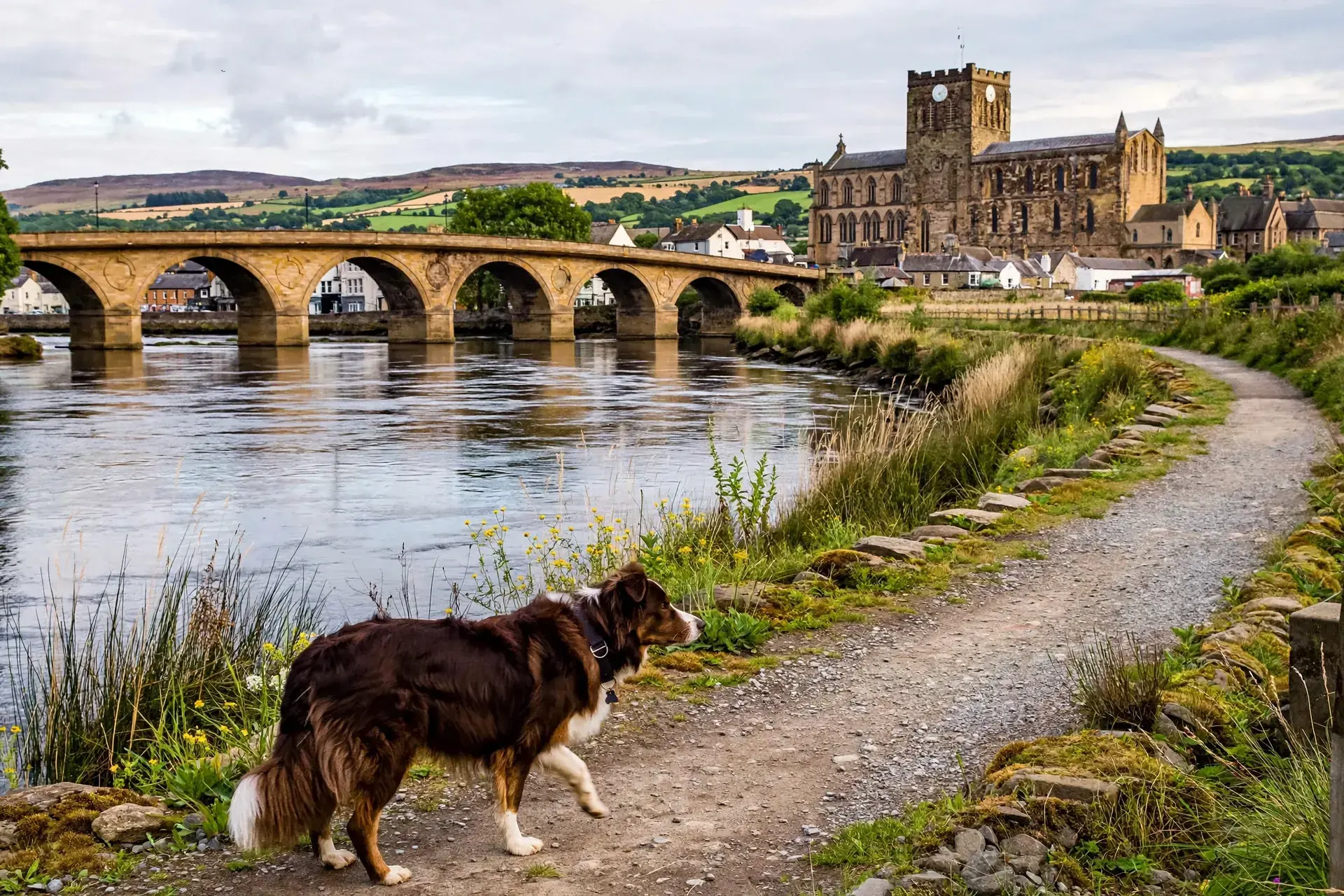
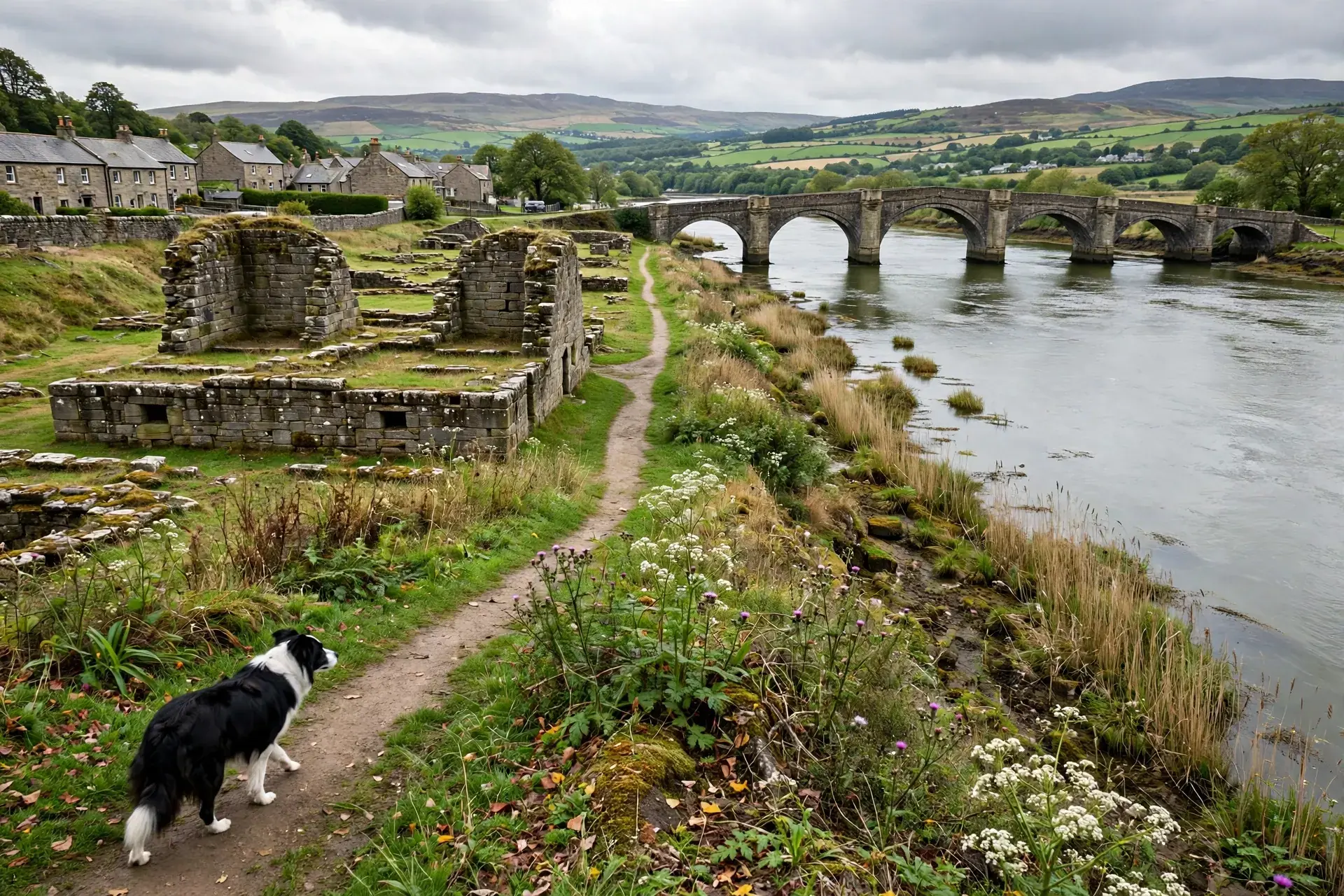
The path follows the Teesdale Way, the long-distance route that runs the length of the dale, so it is waymarked and easy to follow in either direction. Downstream, the walk heads east out of town through riverside woodland, with the river on one side and fields and gardens on the other. Upstream, it heads west towards Eggleston and deeper into Teesdale, growing quieter with every mile. For a first visit, the short loop is the sensible choice: down to the river below the castle, along the bank for a mile or so, and back up through the town. That gives the dog a proper river walk without committing to a long valley day.
Underfoot, expect a natural path rather than a surfaced promenade. In dry weather it is firm and easy, but after rain the riverside stretches turn muddy and slippery, especially on the slopes down from the castle and on the tree-root sections. Good walking shoes matter more than they do in the town, and a dog that pulls on the lead can be a genuine hazard on the steeper banks. A harness with a handle gives you something to hold onto if the dog slips, and a long line is better than a flexi-lead here, because the path is narrow in places and other walkers, runners and dogs appear around blind bends.
The river itself is the main thing to respect. Below the castle the Tees runs fast through a rocky gorge, with deep pools and sudden drops that are invisible from the bank. This is not a paddling river at this point, whatever the dog thinks. Further along, where the valley opens out, there are shallow gravel edges where a dog can splash safely in low water, but even there the level can rise quickly after rain upstream in the Pennines, and a river that was ankle-deep in the morning can be dangerous by the afternoon. Keep your dog on a lead near the gorge, and only let them into the water where you can see the bottom and the current is slow.
Wildlife is part of the walk, and it is worth expecting rather than being surprised by it. Kingfishers work the quieter stretches, herons stand motionless in the shallows, and grey squirrels run the woodland edge above the path. A dog with a strong chase instinct needs to be on a short lead through the wooded sections, not because the wildlife is at risk from one passing dog, but because a dog that bolts after a squirrel on a narrow bank above fast water is in real danger. The same applies to the sheep and cattle in the riverside fields: the Teesdale Way crosses farmland, so keep dogs on leads through fields with livestock and close every gate behind you.
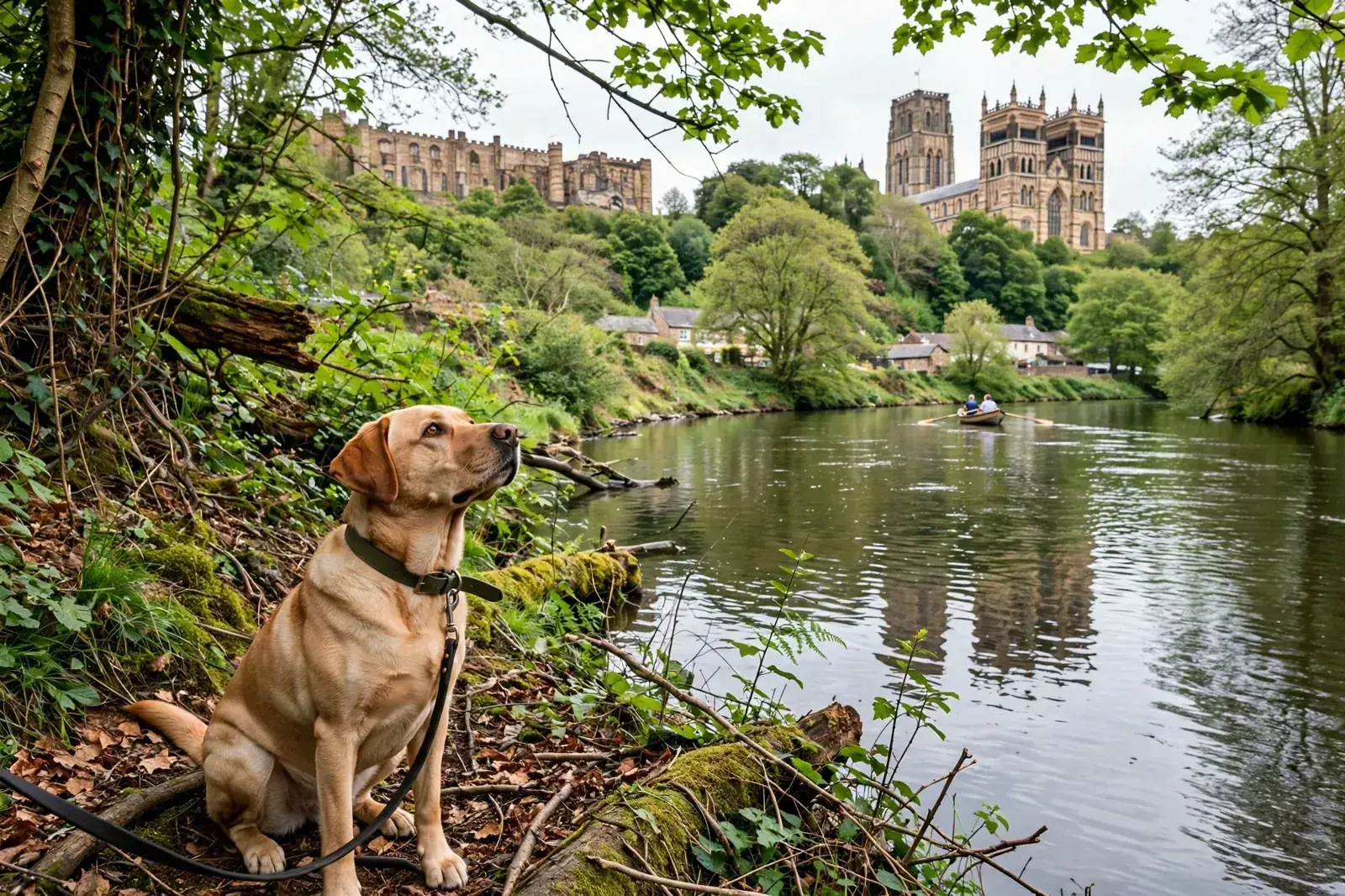
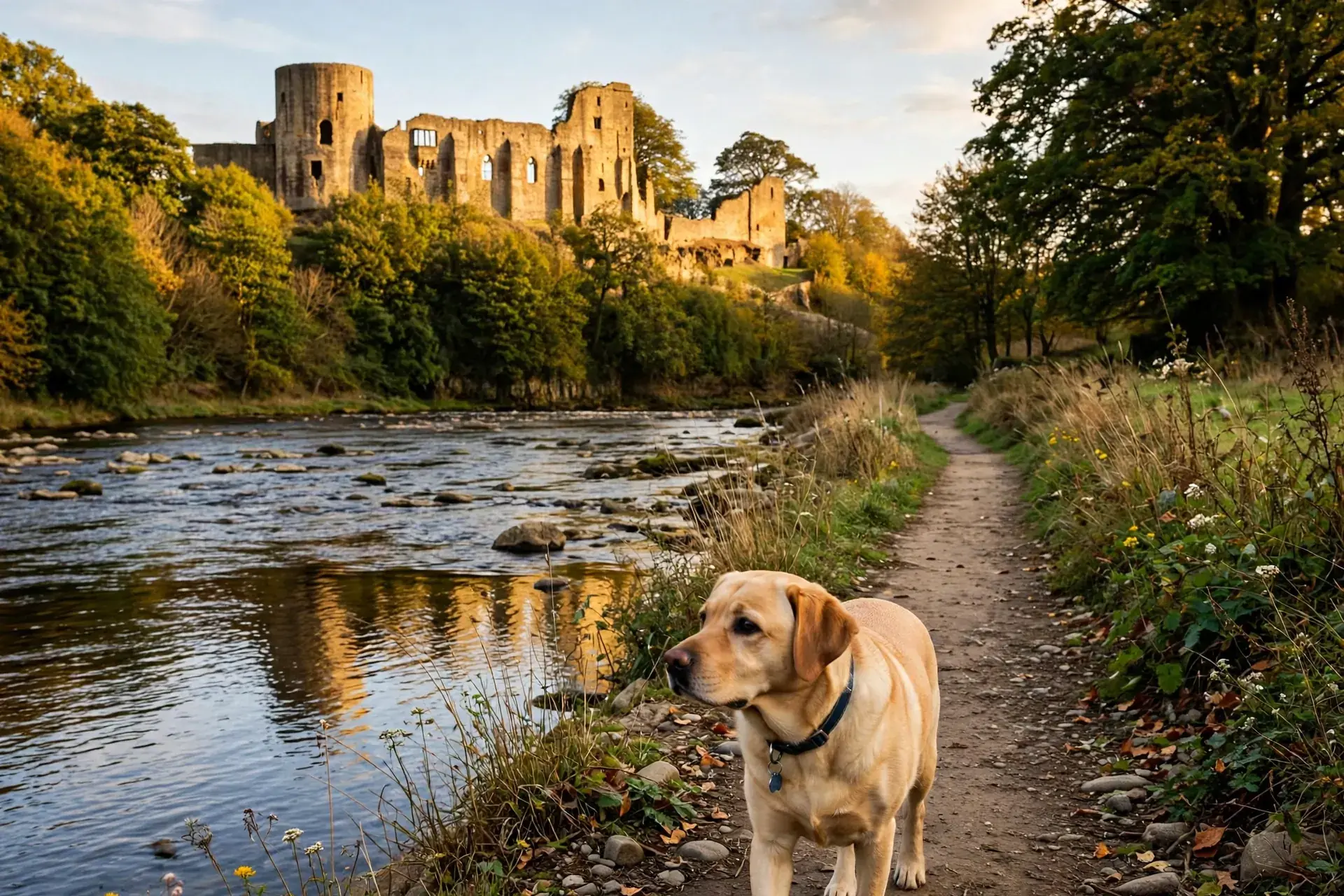
Plan the gorge walk as the middle of the day, between the castle in the morning and the town in the afternoon. Two hours is a generous allowance for the short riverside circuit, including stops for the dog to sniff and for you to stand and look at the castle from below. That view — the ruined walls on the rock above, the river running dark green beneath them, the trees leaning over the water — is the image most people carry home from Barnard Castle, and it is better from the path than from any car park.
Market Place: the town at dog height
Barnard Castle the town is small enough to cross on foot in ten minutes, and that is exactly its charm with a dog. Market Place sits at the top of the town, a broad open space anchored by the Butter Market, the octagonal market cross built in 1747 that still marks the centre of town life. Around it are the shops, cafes and pubs that make the town work as a base: an outdoor shop, a bookshop, a butcher, a bakery, and the kind of independent stores that are worth a slow browse while the dog waits outside or, in the friendlier ones, comes in with you.
Market day changes the square completely. The stalls go up, the crowds thicken, and the noise level rises with the number of dogs, children and shopping trolleys in a small space. Some dogs love it; many do not. A nervous or reactive dog is better walked through Market Place early, before the stalls are fully open, or late, after the crowds thin. A confident, social dog will enjoy the attention, but even then, keep the lead short and watch for dropped food, which is everywhere on a market morning. If your dog is the sort that hoovers up anything on the ground, a basket muzzle is worth considering for the square, not as a punishment but as insurance against a stolen sausage roll or a dropped grape.
The streets that run off Market Place are where the town shows its age. Galgate runs down towards the river and the old bridge, Horse Market and Newgate carry the town east and west, and the narrow lanes between them hold the older houses, the church and the quieter corners. Walking these streets with a dog is easy: pavements are wide enough in most places, traffic is slow, and there are enough doorways and walls for a dog to sniff without blocking anyone. The one thing to watch is the slope. Barnard Castle is built on a hill, and the walk from the river back up to Market Place is a steady climb that an older dog will feel. Build in a pause at the top rather than rushing the dog up the hill after a long riverside walk.
The town also rewards the dog owner who looks up. The parish church of St Mary, the old school buildings, the stone facades along Newgate and the view east along the main street all tell the story of a market town that has been trading on this spot for centuries. None of it needs a ticket or a queue, and all of it is best seen at a dog's pace: stop, look, let the dog sniff the wall, move on. That is the whole point of a town like this. It is not a checklist of attractions; it is a place to be unhurried in, and a dog is the best excuse for exactly that.
Shopping with a dog in Barnard Castle is a mixed picture, and it is worth being honest about it. Some independent shops welcome dogs inside, especially the outdoor and country shops, and many will have a water bowl by the door. Others, particularly food shops, cannot allow dogs inside for hygiene reasons, so one person waits outside while the other goes in. That is normal in a small town and nobody minds, but it works better if you plan for it: agree who goes in first, keep the wait short, and never tie a dog up outside a shop and walk away for a long browse. If the weather is hot or cold, take turns rather than leaving the dog waiting in either extreme.
Out into Teesdale: Eggleston and beyond
Barnard Castle sits at the eastern gateway to Teesdale, and the valley westwards is the reason many dog owners choose the town as a base rather than a day trip. The Teesdale Way runs from the town along the river towards Eggleston, a small village a few miles upstream, and continues on towards Middleton-in-Teesdale and the upper dale. The landscape changes as you go: the wooded gorge gives way to open riverside meadows, then to the wider, emptier valley floor with the North Pennines rising on both sides. It is one of the best long valley walks in northern England for a fit dog, and it is also a walk that punishes poor planning, so the details matter.
The walk to Eggleston is the natural first step. It is a few miles of riverside path, mostly level, with the river on one side and farmland on the other, and it makes a satisfying half-day out and back from Barnard Castle. Eggleston itself is a quiet village with a church, a village hall and a pub, and it is a good turning point for dogs that have had enough. The return along the same path is not a drawback: the river looks different walking the other way, and the dog will find new scents on the way back. If you want a shorter version, walk out for an hour and turn back; the valley is generous enough that even an hour of it feels like a proper walk.
Going further, towards Middleton-in-Teesdale, turns the outing into a full day. Middleton is roughly nine miles from Barnard Castle along the valley, and the walk there and back is too much for most dogs in a single day unless you arrange transport one way. The practical approach is to drive to Middleton, walk a section of the dale, and drive back, or to walk one way and catch a bus back. Bus services in the dale are infrequent, especially on Sundays, so check the timetable before you set off rather than assuming a bus will appear. Check the official guidance before you travel for current bus times, because rural services change with the seasons.
High Force, the great waterfall further up the dale, is the famous destination, but it deserves a realistic assessment with a dog. The falls are spectacular — the Tees dropping over a wide rock shelf into a deep pool — and the walk in from the road is short and manageable. What makes it harder with a dog is the combination of crowds, fences, steps and fast water. The viewing areas are fenced and busy in summer, the paths are steep in places, and the river above and below the falls is genuinely dangerous for a dog that gets loose. Go early or late to avoid the crowds, keep the dog on a short lead throughout, and treat the falls as a viewpoint, not a swimming spot.
Between Barnard Castle and the upper dale there are also smaller, quieter options that suit dogs better than the headline destinations. The riverside meadows around Eggleston have space for a dog to run on a long line, the woodland paths on the valley sides offer shade on hot days, and the network of public footpaths around the villages gives endless short loops for a morning or evening walk. Ask at your accommodation or in the town for the current state of the paths: after wet weather, some of the lower riverside stretches flood, and a path that was fine last week can be impassable this week. Local knowledge is worth more than any map for these details.
One warning applies to the whole dale: the weather changes fast. Teesdale runs west into the Pennines, and rain that falls on the high moors reaches the river quickly, while the valley itself can be sunny in Barnard Castle and wet ten miles upstream. Pack a waterproof for yourself and a drying coat for the dog even on a fine morning, and check the forecast for the upper dale, not just for the town. If the river is running high and brown, keep the dog out of the water entirely and stick to the higher paths away from the bank.
The Bowes Museum grounds
A mile west of Barnard Castle, on the road towards Eggleston, stands the Bowes Museum, and it is worth a visit with a dog even if you never go inside. The building is a French chateau in the middle of County Durham, built in the nineteenth century by John Bowes and his wife Josephine to house their collection of art and objects, and it dominates the landscape for miles around. The architecture alone is worth the walk: the steep roofs, the towers, the formal gardens and the long drive up to the entrance make it one of the most photographed buildings in the north of England.
For dogs, the museum works the same way the castle does: the outside is the point. Dogs on leads are generally welcome in the grounds, where there are lawns, trees and paths to explore, but dogs are not usually admitted inside the museum itself, apart from assistance dogs. That is a fair trade, because the grounds are generous and the views back towards Barnard Castle are excellent. One person can visit the museum interior — the Silver Swan automaton is the famous exhibit — while the other walks the dog around the grounds, and then you swap. Check the official guidance before you travel for current rules and opening times.
The walk from Barnard Castle to the Bowes Museum is itself a pleasant outing with a dog. It follows the road west out of town, with a pavement for most of the way, and takes around twenty to thirty minutes at a dog's pace. It is not the prettiest walk in the area — the road carries traffic and the pavement is narrow in places — but it is direct, and it gives a dog a destination with space at the end of it. An alternative is to drive and use the museum car park, which is large and makes a good starting point for the walks west into Teesdale as well.
The museum grounds also work well as a wet-weather fallback. The trees give shelter in light rain, the paths are surfaced and stay passable when the riverside paths turn to mud, and the cafe terrace is a reasonable place to sit with a dog when the weather breaks. In summer, the lawns are a good spot for a picnic with the dog, and the shade from the trees keeps the grass cool at midday. Bring water for the dog in hot weather, because there is little shade on the open lawns and the walk back to town is uphill.
Events at the museum change the picture, so check before you go. Summer fairs, Christmas markets and special exhibitions bring crowds and sometimes change the dog policy for the day. A quiet weekday visit is a different experience from a busy event weekend, and a nervous dog will be much happier on the quiet day. If you arrive and find an event in full swing, the riverside path is a better choice that day, and the museum will still be there tomorrow.
Where to stay with a dog
Barnard Castle works well as a base for a dog-friendly break because it is small enough to be walkable and large enough to have real choice. The options fall into three groups: pubs with rooms in the town, self-catering cottages in and around the town, and the campsites and holiday parks in the wider dale. Each suits a different kind of dog, and the right choice depends more on the dog than on the price.
Pubs with rooms are the simplest option for a short stay. Several pubs in and around Market Place offer rooms, and many welcome dogs in some or all of them, often for a small nightly charge. The advantage is obvious: the dog can come downstairs with you in the evening, the food is on site, and the morning walk starts at the front door. The trade-off is space and noise. Pub rooms are usually compact, the bar below can be lively until late, and a dog that barks at unfamiliar sounds may struggle. Ask specifically which rooms accept dogs, whether there is a charge, and whether the dog can join you in the bar or only in the room. Get the answer in writing with the booking.
Self-catering cottages give a dog more room and a more normal routine, and they are the best choice for a longer stay or for a dog that needs its own space. Barnard Castle and the villages around it have cottages of every size, from small terraces in the town to larger houses on the edge of the dale. When you book, check the garden properly: is it enclosed, how high is the fence, and is there a gate the dog can push open? A cottage that says "dog-friendly" but has an open garden onto a road is not dog-friendly for a dog that wanders. Also check the flooring, the cleaning charge and the rules about leaving the dog alone in the property, because these vary widely.
Campsites and holiday parks in Teesdale suit dogs that are happy outdoors and owners who want the dale on the doorstep. There are sites within a short drive of Barnard Castle, some with direct access to riverside walks and others with their own fields. The practical checks are the same as anywhere: how far is the toilet walk at night, is there a dog-wash or an outdoor tap, and what are the rules about barking and leads on site? A site with a dedicated dog exercise field is worth more than a site with a longer list of facilities, because a dog that can run safely off the lead in the morning is a calmer dog for the rest of the day.
Whatever you book, the questions to ask before you pay are the same. How many dogs are allowed, and is there a charge per dog or per stay? Which rooms or units accept dogs, and is the dog allowed in the bar, restaurant or breakfast room? What happens if the dog barks, and is there a place to dry a wet dog? And what is the cancellation policy if the dog is ill? A property that answers these questions clearly and promptly is usually a property that has thought about dogs properly. One that answers with a vague "we love dogs" and nothing else has probably not.
If you are combining Barnard Castle with a longer tour of the north-east, our Durham guide covers the cathedral city an hour to the east, with a full riverside loop and the same kind of practical detail on stays, pubs and parking. The two towns make a natural pair: Durham for the city day, Barnard Castle for the dale.
Pubs, cafes and a place to sit down
Eating out with a dog in Barnard Castle is generally straightforward, and the town has enough choice that you will not go hungry. The pubs around Market Place and along the main streets are the backbone of it: several welcome dogs in the bar area, some have a specific dog-friendly section, and most will bring a water bowl without being asked. The pattern to expect is that dogs are welcome in the bar and on the terrace but not in the formal dining room, so if you want a full meal with the dog, ask for a bar table rather than a restaurant table.
Cafes are more variable. Some welcome dogs inside, especially the ones with tiled floors and a relaxed atmosphere, while others allow dogs only outside on the pavement seating. The distinction often depends on the time of day: a cafe that welcomes dogs at a quiet mid-morning may ask you to sit outside at a busy lunchtime when the room is full. That is reasonable, and it is worth going with the flow rather than arguing the point. Bring a mat or a blanket for the dog to lie on, because cafe floors are hard and cold, and a dog that has somewhere comfortable to settle is a dog that stays quiet.
The practical rules for eating out with a dog apply here as they do everywhere. Feed the dog before you go in, so it is not hungry and restless at the table. Bring a chew or a stuffed Kong to keep a young dog occupied while you eat. Keep the lead short and under the table, not trailing across the walkway where a waiter carrying hot food can trip over it. And watch the dog's behaviour: a dog that is whining, pacing or staring at other tables is telling you it has had enough, and the kindest thing is to finish up and leave rather than pushing through a second course.
For self-catering, the town's food shops cover the essentials well. There is a supermarket on the edge of town, a butcher and a bakery in the centre, and a small grocer for the things you forgot. If you are staying in a cottage, stock up on arrival rather than assuming the village shop will have everything: the shops in the smaller dale villages have limited hours and limited stock, especially on Sundays. And remember the dog's food too: a familiar diet matters more on holiday than at home, because a change of food plus a change of water plus a long walk is a reliable recipe for an upset stomach.
One local habit is worth adopting: the early dinner. Barnard Castle's pubs and restaurants can be busy on Friday and Saturday evenings, especially in summer, and a table at six o'clock is a calmer experience for a dog than a table at eight. Eating early also leaves time for an evening walk along the river while the light is still good, which is a better end to the day than sitting in a crowded bar with a tired dog under the table. If you are visiting in winter, the same logic applies in reverse: eat early, walk while it is still light, and be back before the dark and the cold settle on the valley.
Parking and arrival
Barnard Castle is reached by road, and for most visitors that means the A67, which runs through the town from Darlington in the east and on towards Bowes and the A66 in the west. The drive from Darlington takes around half an hour, and from Durham around fifty minutes, depending on traffic. The roads are good but narrow in places, and the approach into town from the east is a steady climb that gives a first view of the castle from the road. If you are towing a caravan or driving a large motorhome, check your route and your parking in advance, because the town centre streets are tight and not every car park suits a long vehicle.
The town has public car parks a short walk from Market Place and the castle, and the Bowes Museum has its own parking just west of town. The central car parks fill quickly on market days, in summer and on bank holidays, so arriving before ten in the morning makes the whole day easier. If the central car parks are full, the museum car park is a practical alternative: it is a twenty-minute walk back into town, mostly downhill, and it puts you in a good position for the Teesdale walks as well. Check the official guidance before you travel for current charges, time limits and payment methods, because these change and the machines do not always take cards.
For the dog, the arrival routine matters as much as the parking space. A dog that has been in the car for an hour needs a toilet break and a stretch before anything else, so build in ten minutes at the car park before you head for the castle or the river. Bring water for the car journey and for the walk, because the town's public water points are not always obvious, and a dog that arrives thirsty will drink from the river, which is not ideal. In summer, never leave a dog in a parked car, even for a few minutes: the car parks around Barnard Castle are exposed, and the temperature inside a car rises far faster than most people expect.
Arriving without a car is possible but takes planning. The nearest railway stations are at Darlington and Bishop Auckland, and buses connect both to Barnard Castle, though services are infrequent, especially on Sundays and in the evenings. Dogs are generally allowed on local buses, but the rules vary by operator, so check before you travel and be ready to keep the dog on the floor at your feet. If you are relying on public transport, base yourself in the town rather than in a dale village, because the town has the shops, the pubs and the walks within easy reach, while the villages depend on a car.
For a longer tour, Barnard Castle pairs naturally with the Tyne valley to the north. Our Hexham guide covers the abbey town on the River Tyne, and our Corbridge guide covers the Roman village a few miles further east — both are within an hour's drive and both work the same way, with a river walk, a market square and a historic core to explore at a dog's pace.
Seasons, river levels and weather
Barnard Castle changes with the seasons more than most small towns, because the river and the dale amplify every change in the weather. Spring is the gentlest season for a dog: the riverside paths dry out, the woodland fills with wild garlic and bluebells, and the town is quiet before the summer visitors arrive. The river is usually at a moderate level, the temperatures are comfortable for walking, and the lambs in the riverside fields are a reminder to keep dogs on leads and to close every gate. Spring is also the season when the paths are at their muddiest after winter rain, so waterproof footwear is still worth packing in April.
Summer is the busiest season, and it brings the two things that matter most for a dog: heat and crowds. The town centre and the castle grounds can be hot at midday, with little shade on the open stone, so walk the riverside path in the morning and the town in the late afternoon, when the light is better and the crowds have thinned. The river is at its lowest and warmest in summer, which makes the shallow gravel edges more inviting for a paddling dog, but the gorge below the castle stays dangerous even in low water, and the current in the deeper pools is stronger than it looks. Carry water for the dog on every walk, and watch for the signs of overheating: heavy panting, a dry mouth, a dog that stops and lies down in the shade.
Autumn is, for many dog owners, the best season in Barnard Castle. The woodland above the river turns gold and red, the crowds drop away after the school holidays, and the light in the late afternoon makes the castle look its best. The riverside paths are usually firm underfoot, the temperatures are ideal for long walks, and the town's pubs are at their most welcoming, with fires lit and dogs settling under the tables. The one thing to watch is the river level: autumn rain in the Pennines can raise the Tees quickly, and a path that was dry in the morning can be flooded by the afternoon. Check the river before you let the dog near the water, and be ready to change your route.
Winter in Teesdale is beautiful and serious in equal measure. Frost on the castle walls, snow on the Pennines, and a low sun over the river make for extraordinary photographs, but the paths are icy, the daylight is short, and the wind in the valley is cold enough to chill a short-coated dog quickly. Shorten the walks, dress the dog in a coat if it is thin-coated or elderly, and carry a towel and a drying coat for the car. The town itself is quiet in winter, which suits a nervous dog, but some cafes and attractions reduce their hours, so check opening times before you travel rather than assuming everything is open.
Whatever the season, the practical rule is the same: check the forecast for the upper dale, not just for the town, and check the river level before any walk that involves the water. A fine day in Barnard Castle can follow a wet night in the Pennines, and the river will tell you the truth about the weather upstream long before the sky does. If the water is high and brown, stay on the higher paths, keep the dog on a lead, and save the riverside walk for another day. The river will still be there tomorrow.
Kit, river safety and practical details
The kit list for Barnard Castle is short, but every item on it earns its place. A sturdy lead and a harness with a handle are the foundation: the castle grounds, the gorge path and the farmland all reward a dog that is under control, and a harness gives you something to hold onto if the dog slips on a steep bank. A long line is useful for the open meadows west of town, where a dog can run and sniff without being off the lead entirely. Bring two towels and a drying coat, because the river, the rain and the mud will find your dog sooner or later, and a wet dog in a car is a miserable end to a good day.
Water is the item most people forget. Bring a bottle and a collapsible bowl for the dog on every walk, even a short one, because the town's public water points are not always where you expect them to be, and the river is not a safe drinking source in the gorge. Poo bags are the other essential: the riverside paths and the castle grounds are well used, and leaving waste behind is the fastest way to lose access for all dogs. Carry more bags than you think you need, and use the bins in the town and the car parks rather than leaving bags by the path.
River safety deserves its own paragraph, because the Tees at Barnard Castle is a beautiful river that can hurt a dog. The gorge below the castle has fast water, deep pools and rocks that are invisible from the bank. A dog that jumps in after a stick can be swept downstream before you can react, and the banks in the gorge are steep enough that a dog that gets out of the water may not be able to climb back up. Never throw a stick into the river in the gorge, never let a dog swim there, and keep a lead on any dog that is excited by water. The shallow gravel edges further along the valley are a different matter, but even there, check the depth and the current before you let the dog in, and keep the session short.
Livestock, ticks and adders are the three countryside hazards to plan for. The Teesdale Way crosses fields with sheep and cattle, so keep dogs on leads through farmland and never let a dog chase livestock. Ticks are common in the riverside woodland and the long grass from spring to autumn, so check your dog after every walk, paying attention to the ears, the belly and between the toes, and remove any tick promptly with a tick remover. Adders live in the drier, sunny spots on the valley sides, and while bites are rare, a dog that disturbs one is at risk: keep dogs out of dense bracken on hot days, and know the number of the nearest vet before you need it.
Finally, the vet. Before you travel, save the number of a veterinary practice in Barnard Castle and the number of an out-of-hours emergency vet, because rural practices close early and the nearest emergency cover may be in Darlington or Bishop Auckland. Keep the dog's vaccination record and any medication with you, and bring the details of your own vet in case the local practice needs to call them. None of this is dramatic; it is the same preparation you would make for any rural break, and it is the difference between a small problem and a ruined day.
That is the whole of it. Barnard Castle is not a town that needs to be conquered or ticked off. It is a castle, a river, a market square and a valley, and the best way to enjoy all four with a dog is to take them slowly, in that order, and let the dog decide when to stop and sniff. Do that, and the town will give you the day it is best at: a morning at the castle, a long walk by the river, and an evening in a pub with a tired dog asleep at your feet.
Practical questions
Before you go
Can dogs go into Barnard Castle itself?
Dogs on leads are generally welcome in the castle grounds, where the best views of the ruins and the river are, but dogs are not usually admitted inside the castle buildings themselves, apart from assistance dogs. Check the official guidance before you travel, as rules can change for events and conservation work.
Where is the best riverside walk with a dog in Barnard Castle?
Start at the castle end of town and drop down to the riverside path below the ruins, then follow the Teesdale Way downstream or upstream for as far as your dog wants. The stretch directly below the castle gives the classic view of the walls above the gorge, while the longer riverside sections are quieter and better for a proper leg-stretch.
Are dogs welcome in the pubs and cafes around Market Place?
Several pubs and cafes around Market Place welcome dogs, often in the bar area or on a specific dog-friendly section, and some offer water bowls and treats. Policies vary by venue and by season, so check the door sign or ask before settling in, and keep your dog on a lead in busy market-day crowds.
Can I walk from Barnard Castle to Eggleston or Middleton-in-Teesdale with a dog?
Yes, the Teesdale Way links Barnard Castle westwards along the river towards Eggleston and on towards Middleton-in-Teesdale, but it is a long, exposed valley walk, so treat it as a full day out rather than a casual stroll. Check the official guidance before you travel, carry water, and plan your return transport before you set off.
Is the River Tees safe for dogs to swim in at Barnard Castle?
The Tees below the castle runs fast through a rocky gorge in places and can rise quickly after rain upstream, so it is not a safe paddling spot for most dogs. Use the calmer, shallow edges well away from the gorge, keep your dog on a long line if you are unsure, and never let a dog swim below the castle after heavy rain.
Where can I park with a dog in Barnard Castle?
The town has public car parks a short walk from Market Place and the castle, and the Bowes Museum has its own parking just west of town. Arrive early on market days and in summer, when the central car parks fill quickly, and check the official guidance before you travel for current charges and time limits.