This guide is independent and contains no paid placement. If affiliate links are added later, they will be clearly marked and will not change our editorial checks.
Time your visit around the Tuesday and Saturday markets, walk the Abbey and Market Place early, then give your dog the space it needs in The Sele and along the River Tyne. Hexham rewards a slow, lead-on plan: town first, river second, and a pub or cafe that genuinely welcomes dogs to finish.
A market-day timetable for one day
Hexham is at its best, and at its busiest, on market days. The town holds its general market on Tuesdays and Saturdays in the Market Place, in the shadow of Hexham Abbey, and the rhythm of those two days shapes almost every decision a dog owner has to make. Arrive at the wrong time, and you will be threading a lively dog through shoulder-to-shoulder shoppers, food stalls and pushchairs. Arrive with a plan, and the same market becomes the highlight of the trip: a short, scent-rich wander, a coffee on the edge of the square, and then open space by the river before the crowds peak.
The timetable below is built for a dog that is comfortable in town but not endlessly patient with crowds. It assumes a Saturday, when the market is usually at its fullest, and it works just as well on a Tuesday with a little less pressure. The core idea is simple: do the town while it is still waking up, do the river while the town is at its busiest, and come back to the Market Place when the stalls are thinning and the pavements have room again.
Before 9am: arrive and settle. Park on the edge of the centre if you can, and give your dog a calm ten minutes before the market starts in earnest. Walk a quiet side street, let your dog toilet on grass rather than in the Market Place, and check your kit: short lead, water, poo bags, a treat pouch and, for a nervous dog, a familiar mat for cafe stops. Early morning in Hexham is usually quiet enough for a reactive dog to get its bearings, and the Abbey tower above the rooftops makes a useful landmark if you lose your sense of direction in the lanes.
9am to 10.30am: the Market Place, done gently. This is the best window for the market itself. Stalls are open, the square is busy but not yet packed, and you can walk the edges of the Market Place rather than cutting through the middle. Keep your dog on a short lead, on your inside away from the stalls, and keep moving. Dogs do best at markets when they are walking, sniffing and being rewarded for calm behaviour, not when they are asked to stand still for twenty minutes while their owner compares cheese. If your dog is small, be especially careful around feet, trolley wheels and low stall tables. If your dog is large, be careful about its tail in narrow gaps between stalls. Buy what you need, then move on. The market will still be there later, and your dog will thank you for not treating it as a morning-long endurance test.
10.30am to midday: The Sele and the river. As the Market Place fills, head downhill towards The Sele, the broad green space just south of the town centre, and then on to the River Tyne. This is the pressure valve in the whole plan. Grass, trees, longer sightlines and room to move change a dog's mood completely after an hour of pavements. Let your dog sniff properly, offer water, and sit on a bench for ten minutes while the town does its busiest trading without you. If the weather is warm, this is also the point to think about shade and the river bank: dogs cool down slowly, and a town dog that has been working hard in a crowd needs a proper rest, not another attraction.
Midday to 1.30pm: lunch where dogs are welcome. Come back up into town for lunch, but choose your spot for the dog, not just for the menu. A pub with a dog-friendly bar area, a terrace with space under the table, or a cafe that expects dogs is worth more than a prettier room where your dog has to lie in a doorway. Order simply, keep your dog settled on its mat, and do not feed it from the table. A dog that has walked, sniffed and rested will usually settle well for forty minutes. A dog that has been dragged from stall to stall without a break will not, and no amount of coaxing will fix that at the table.
Early afternoon: the Abbey precinct and a second, quieter look. After lunch, the Market Place is often a little easier again, and this is the right time for a slow circuit of the Abbey precinct. The Abbey itself is a working church, so treat it with the same respect you would give any place of worship: keep your dog on a lead, keep noise down, and do not assume you can take the dog inside. The outside of the building, the grounds and the streets around it give you most of what a visit needs, including the scale of the tower and the way the old town folds around it. Photographs from the Market Place, with the Abbey behind the stalls, are the classic Hexham image for a reason.
Late afternoon: a riverside loop, then home. Finish the day where the dog is happiest, back by the River Tyne. A gentle out-and-back along the riverside, rather than a forced march, lets your dog wind down before the drive home. If you are staying overnight, this is also the time to find your accommodation's nearest evening toilet spot in daylight, so the last walk of the day is not a search in the dark. On a non-market day, the same timetable still works, just with less urgency: the Market Place becomes a quiet square to cross, the Abbey precinct is calmer, and the river takes centre stage from the start.
Two practical notes apply to every market visit. First, check the official guidance before you travel for current market days and times, because seasonal markets, special events and Christmas trading can change the pattern. Second, know your own dog. A confident, social dog that loves people may enjoy a full hour in the Market Place. A nervous rescue, an older dog with sore joints, or a puppy in its first busy town will do better with twenty minutes in the square and a long spell on the grass. Hexham is small enough that you never have to choose between the market and the dog's comfort: the river is always ten minutes away.
Hexham Abbey and the Market Place
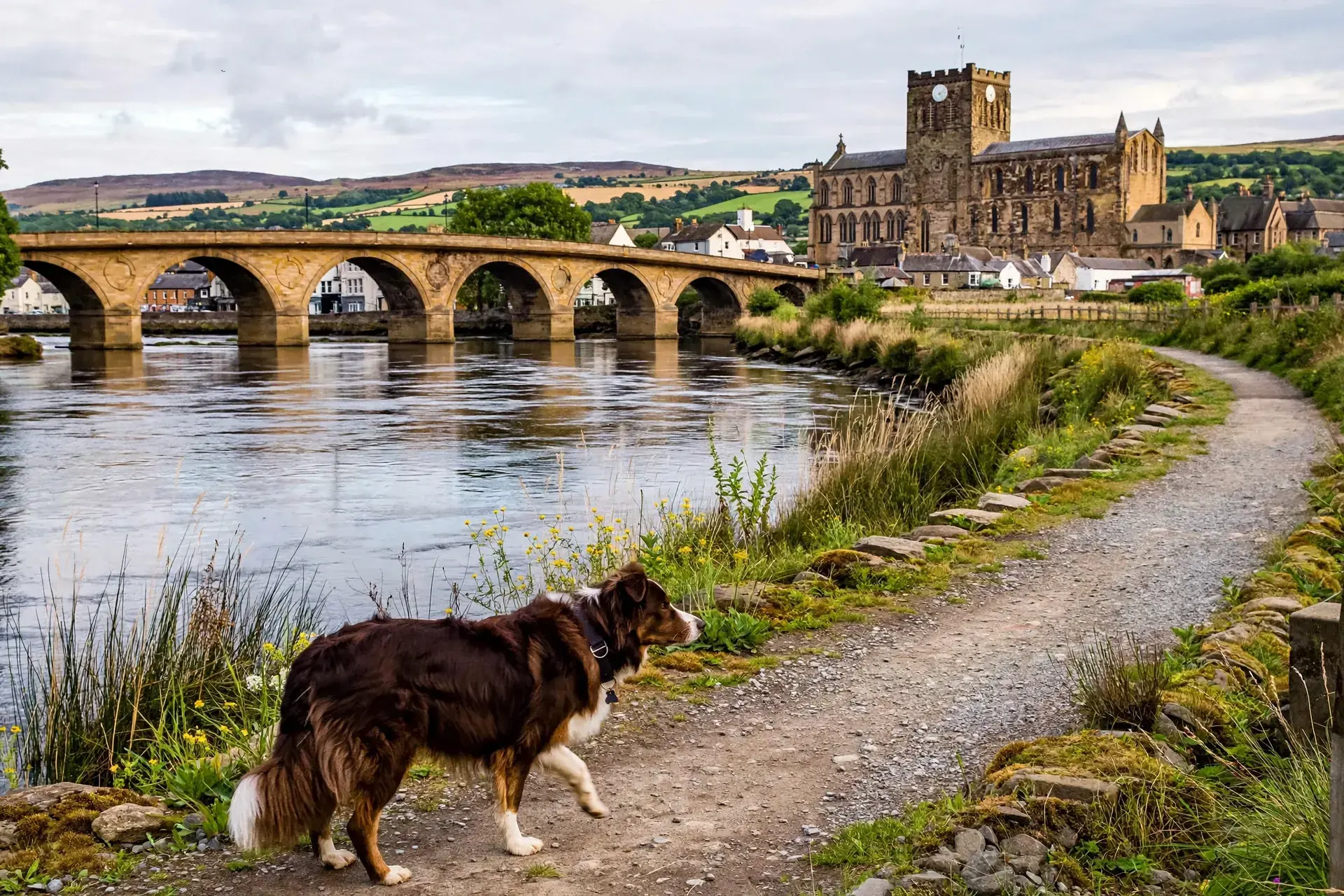
Hexham Abbey dominates the town in the best sense. Its tower rises above the Market Place, its stonework carries more than a thousand years of history, and the streets around it are the oldest and most atmospheric part of Hexham. For a dog owner, the Abbey is best understood as an outdoor visit with a respectful indoor question mark, rather than as a conventional attraction with a published dog policy to tick off. It is a working church first, a historic building second, and a visitor destination third, and that order matters when you plan.
The Abbey's origins reach back to the seventh century, when St Wilfrid founded a church on this site, and the crypt from that early building still survives beneath the present church. The building you see today is largely medieval, with later restoration, and it has served as the parish church of Hexham for centuries. That long, continuous use is part of its character: this is not a roped-off ruin, but a place where services, concerts, community events and quiet prayer happen week by week. Dogs fit into that picture on the outside, on a lead, as part of ordinary town life. Inside, the position is different, and visitors should check the official guidance before you travel rather than assume a dog will be welcome through the door.
Plan the Abbey as a precinct walk. Start in the Market Place, where the Abbey tower frames the stalls on market days and the square on quieter days. Walk the streets that run off the square, including the narrow lanes and the historic buildings that cluster around the church, and give your dog time to sniff the stone walls and old doorways. The ground is mostly paved, so this is a short-lead walk, and it suits dogs that are comfortable with town surfaces and passing people. In wet weather the stone can be slippery, especially for older dogs, so slow down and keep your dog close on the slopes around the precinct.
The Abbey grounds and the green spaces nearby give a dog somewhere to pause without leaving the historic centre. Use them for a water break and a rest, not as an exercise field. Keep your dog on a lead in the precinct, keep it off planted areas and graves, and clean up promptly. The same courtesies apply in every churchyard in England, and they are what keep these spaces open and welcoming for dog owners. If a service or event is under way, give the building a wide berth and keep your dog quiet: a barking dog outside a church door during a service is the kind of thing people remember for the wrong reasons.
If going inside the Abbey matters to you, plan for it honestly. One person can go in while the other stays outside with the dog, which is often the simplest solution for couples and families. Alternatively, time your visit for a moment when the church is open for quiet visiting rather than during a service, and ask a steward or member of staff about the current position for dogs. Policies can change for concerts, exhibitions and special events, and a rule that applies on an ordinary Tuesday may not apply on a busy festival day. What you should not do is tie a dog up outside the Abbey and leave it unattended while you go in. Apart from the stress it causes the dog, an unattended dog outside a busy church is at risk of being approached, fed or untied by well-meaning strangers, and Hexham's Market Place is busy enough that this is a real concern.
The streets around the Abbey reward a slow look. The Shambles, the covered market area, the old gaol building now housing the museum, and the historic houses that line the lanes all sit within a few minutes of each other, and they give a dog walk a sense of place that a generic high street never will. Keep the circuit short, keep your dog on a lead, and save the longer walking for The Sele and the river, where the dog can properly stretch. The Abbey is the reason many people come to Hexham, but it is the combination of Abbey, market and river that makes the town work as a dog day out, and the precinct walk is only the first third of that combination.
The Sele: the town's green lung
The Sele is the open green space that sits just south of Hexham town centre, between the town and the River Tyne, and for dog owners it is the single most useful piece of ground in Hexham. It is not a grand park with formal gardens and a cafe on every corner. It is a broad, sloping stretch of grass with trees, paths and long views, the kind of place where a dog can breathe after the pavements of the Market Place, and where an owner can sit on a bench and let the town slow down. On a market day it is the escape hatch. On a quiet day it is the walk itself.
Getting there is straightforward. From the Market Place, head south through the town centre and downhill towards the river, following the signs for The Sele. The walk takes only a few minutes, and the change in atmosphere is immediate: traffic noise fades, the ground turns to grass, and the sightlines open up. That transition is worth noticing, because dogs read it too. A dog that has been tense on a short lead in a crowd will often relax visibly once it reaches grass and has room to move, and The Sele gives you that release without needing a car or a long hike.
Use The Sele as a flexible space rather than a fixed route. There is no single correct circuit, and that is part of its appeal. Walk the paths, let your dog sniff the trees and hedges, and find a bench with a view back towards the town or out towards the Tyne Valley. If your dog needs a proper run, this is the place to think carefully rather than simply unclipping the lead. The Sele is a shared public space used by families, joggers, children playing and other dog owners, so off-lead play depends on your dog's recall, its behaviour around other dogs and children, and how busy the park is at that moment. A long line is often the best compromise: it gives a dog room to explore and sniff without the risk of a chase across a busy path or into a picnic.
The Sele also works as a training ground for town dogs. The paths bring gentle distractions: other dogs at a distance, people walking through, children on scooters, the occasional cyclist. For a young dog or a rescue still learning to cope with the world, ten minutes of calm, rewarded walking here is worth more than an hour of chaotic off-lead play. Bring treats, keep sessions short, and leave while your dog is still succeeding rather than waiting for the moment it tips over into over-excitement. The park is close enough to the town centre that you can use it twice in a day, once in the morning and once in the late afternoon, and that repetition is often what settles a dog into a new place.
Seasonal conditions change how The Sele feels. In spring and summer, the grass is dry, the trees give shade, and the park is at its most inviting, but it is also at its busiest, especially on market Saturdays and school holidays. In autumn, fallen leaves and damp grass make it a scent-rich place for dogs, and the lower light across the Tyne Valley is at its best. In winter, the ground can be wet and muddy, the paths can be slippery, and the wind across the open grass is colder than the sheltered streets of the town. Pack a towel and a drying coat in the colder months, and think about your dog's paws: wet grass and muddy paths are fine for most dogs, but a dog with sore paws or a recent injury will need a shorter visit and a clean-up afterwards.
Clean up after your dog, every time, and use the bins provided. The Sele is used by families with small children, and nothing damages the reputation of dog owners faster than mess left on a town park. Carry more bags than you think you will need, and if the nearest bin is full, carry the bag with you until you find another one. It is a small effort, and it is the reason places like The Sele stay welcoming. The park's role in a Hexham visit is simple: it is where the town lets the dog be a dog, and a visit that skips it is missing the easiest part of the day.
The River Tyne: riverside walks
The River Tyne runs along the southern edge of Hexham, and the riverside paths are the natural second half of any dog walk in the town. After the Market Place and The Sele, the river gives you length, water, birds and the wide Tyne Valley landscape, all without needing to drive anywhere. The Tyne at Hexham is a substantial river, fast in places after rain, and it deserves respect, but the paths beside it are among the most pleasant town walks in Northumberland, and they suit almost every kind of dog.
A practical riverside route starts at The Sele and follows the paths down towards the river, then along the bank for as far as your dog's energy and the conditions allow. The exact distance is less important than the shape of the walk: an out-and-back route that lets you turn around at any point is better for most dogs than a long one-way march with a tired return. Walk out for twenty minutes, rest, offer water, and walk back. That is a proper walk for most dogs, and it leaves energy in reserve for the town afterwards. If your dog is young, old, or unfit, shorten the outward leg and spend more time sniffing and resting on the bank.
Keep your dog on a lead near the river unless you are certain of the ground and your dog's recall. The bank can be steep or slippery in places, the water can be fast and cold after rain, and there are stretches where a dog that chases birds or splashes into the shallows can get into trouble quickly. A long line gives a dog freedom to explore the bank safely, and it is the right tool for most riverside walks. Never let a dog swim in the Tyne without knowing the depth, the current and the exit points, and never assume a calm-looking stretch is safe after heavy rain upstream. The river rises quickly in the Tyne Valley, and a path that was dry in the morning can be wet by the afternoon.
The riverside is also a wildlife walk. Herons, ducks, wading birds and, in the right season, salmon moving upstream are all part of the Tyne at Hexham, and dogs notice them long before their owners do. Keep your dog under control around birds, especially during the breeding season, and do not let it disturb nests or chase wildlife along the bank. The same rule applies to livestock: fields beside the riverside paths may hold sheep or cattle, and a dog must be on a lead near livestock at all times. Farmers in the Tyne Valley are understandably protective of their animals, and a dog worrying sheep is a serious matter, not a minor embarrassment.
Ground conditions on the riverside paths change with the seasons. In summer, the paths are usually firm and dry, the grass is short, and the walk is straightforward. In autumn and winter, the paths can be muddy, the grass long and wet, and the river bank slippery underfoot. Good footwear matters as much for the owner as for the dog, and a towel in the car is worth carrying all year round. After heavy rain, check the path before committing to a long route: if the first hundred metres are waterlogged, the rest of the route is unlikely to improve, and a shorter walk on The Sele is a better choice.
The riverside also gives Hexham its sense of scale. Looking up and down the Tyne Valley from the bank, with the town behind you and the hills on either side, you understand why Hexham works as a market town: it sits where the valley narrows, where the river can be crossed, and where routes from the north, south and west meet. That geography is still visible in the town's streets, and it is the reason the riverside walk feels like a proper countryside walk rather than a token town path. For a dog, the difference is simple: the river walk is where the smells change, the ground softens, and the walk becomes about exploring rather than navigating. Build your day around that, and Hexham will feel like a dog town rather than a town that tolerates dogs.
Wentworth and the town's green edges
Wentworth Leisure Centre sits on the southern side of Hexham, close to The Sele and the river, and it is worth understanding what it is and is not for a dog owner. It is a leisure centre, not a dog attraction: swimming pools, sports halls, a gym and fitness classes are indoor, people-focused facilities, and dogs do not belong inside them. That does not make the area useless to a visitor with a dog. It makes it a landmark and a neighbourhood to walk around, rather than a destination to enter with a dog at your side.
The value of the Wentworth area is its position. The leisure centre, the playing fields and the green spaces around it form part of the town's southern edge, where Hexham loosens into open ground. The streets here are quieter than the Market Place, the pavements are wider, and there is easier access to grass and to the paths that lead towards the river. If you are staying in this part of town, or parking nearby, it is a useful place for a morning toilet walk and a calm start to the day before the market crowds build. If your dog is nervous in traffic, the quieter roads around the leisure centre and the nearby housing are a gentler introduction to Hexham than the town centre itself.
Do not plan to leave a dog outside the leisure centre while you go in to swim or use the gym. Dogs should not be left tied up outside public buildings, and a leisure centre entrance, with its steady flow of people, children and sports equipment, is a poor place to leave a dog unattended. If you want to use the leisure centre, plan it as a human-only activity while your dog rests at your accommodation, or split your party so one person stays with the dog. The same principle applies to any indoor attraction in Hexham: assume the dog stays outside, and plan accordingly.
Beyond Wentworth, Hexham's green edges reward a little exploration. The town is compact, and the countryside starts quickly in every direction. To the north, the land rises towards the moors and the villages of the North Tyne. To the east and west, the Tyne Valley opens out along the river, with lanes, bridleways and public footpaths that connect Hexham to its neighbouring villages. To the south, across the river, the valley sides rise towards open farmland and woodland. These edges are where a Hexham stay becomes a walking holiday rather than a town visit, and they are the reason the town works as a base for longer walks, covered in the section below.
For a short visit, the practical point is simple: do not try to see all of Hexham's green edges in one walk. Choose one direction, walk it properly, and save the others for another day or another visit. A dog that has walked the riverside in the morning does not need a second long walk to the northern moors in the afternoon. What it needs is rest, water and a familiar place to settle. Hexham's size is an advantage here: everything is close, nothing requires a long drive, and a good day is usually a short day done well rather than a long day done tired.
Getting there and parking
Hexham is easy to reach by car, and that is how most visitors with dogs arrive. The town sits on the A69 between Newcastle and Carlisle, with the A68 running north towards the Scottish Borders, and the drive through the Tyne Valley is part of the pleasure of the trip. The A69 is a fast road in places, so give your dog a break before the final stretch into town, and arrive with a plan for where you will park rather than circling the Market Place looking for a space.
Hexham has several car parks in and around the town centre, including longer-stay car parks a short walk from the Market Place and smaller car parks closer to the shops. On a non-market day, parking is usually straightforward. On a Tuesday or Saturday market day, it fills early, and the car parks closest to the Market Place can be full by mid-morning. Arriving before 9am is the simplest way to avoid the problem, and it also gives your dog the quiet start described in the market-day timetable. If you arrive later, expect to park further out and walk in, which is not a hardship in a town as compact as Hexham, but is worth knowing before you set off.
Check the official guidance before you travel for current parking charges, time limits and payment methods, because these change and because different car parks have different rules. Some car parks suit a short market visit, others suit a full day, and choosing the wrong one can mean either a rushed walk or an unnecessary fee. Pay attention to maximum stay limits and to whether you need to display a ticket or pay by phone. Keep your parking ticket or payment confirmation with you, and set a reminder for when your time runs out, so a relaxed riverside walk does not turn into a hurried dash back to the car.
Never leave a dog in a parked car, in any weather, for any length of time. This rule applies year-round in Hexham, not just in summer. Cars heat up quickly in sunshine, even on a mild day, and they cool down quickly in winter. A dog left in a car is also at risk of distress and theft, and in a busy market town car park, a barking dog in a car attracts attention for all the wrong reasons. If your plans include a place where the dog cannot go, such as an indoor attraction or a restaurant that does not welcome dogs, plan for the dog to stay at your accommodation or with another member of your party, not in the car.
Hexham also has a railway station, on the Tyne Valley line between Newcastle and Carlisle, and trains are a practical alternative to driving for visitors from the north-east. Check the official guidance before you travel for current timetables and for the train operator's rules on dogs, which generally allow dogs on leads but may restrict them during busy times. The station is a walkable distance from the town centre, and the walk from the station to the Market Place gives a dog a useful first stretch after the train. If you arrive by train, pack light: a dog, a lead, water and a day bag are enough, and a heavy bag will make the walk into town harder than it needs to be.
Bus services connect Hexham with Newcastle, Carlisle and the villages of the Tyne Valley, and they can be useful for linear walks, where you walk in one direction and catch a bus back. Check the official guidance before you travel for current routes and for each operator's rules on dogs, because these vary and because rural services can be infrequent. For most visitors, the car remains the most flexible option, but the train and bus are worth knowing about, especially if you want to walk a stretch of the Tyne Valley without retracing your steps.
Where to stay with a dog
Hexham works well as an overnight base, and the range of dog-friendly places to stay reflects its position as a market town rather than a resort. You will find hotels and inns in the town centre, bed and breakfasts in the surrounding streets, self-catering cottages in Hexham and the nearby villages, and holiday parks and rural stays a short drive away in the Tyne Valley. The right choice depends less on the star rating than on the dog: a town-centre hotel with a small room and a busy bar suits a calm, social dog, while a cottage with a garden and a quiet lane suits a dog that needs space and routine.
When you search for a place to stay, read the dog policy in full rather than trusting a filter. The questions that matter are specific: how many dogs are allowed, is there a charge per dog per night or per stay, which rooms or cottages accept dogs, are dogs allowed in the bar, restaurant or breakfast room, and is there an enclosed garden or a nearby toilet area? A property that says dogs welcome may mean one small dog in selected rooms, with a charge and a set of rules that only become clear when you read the small print. Ask for the answers in writing before you pay, and keep the confirmation with your booking.
Location matters as much as policy. A stay near the Market Place puts you within a few minutes of the Abbey, the shops and the pubs, but it also puts you in the busiest part of town, with traffic, deliveries and market noise on Tuesday and Saturday mornings. A stay on the southern edge of town, near The Sele or the river, gives you a quieter night and a quicker morning walk, at the cost of a slightly longer walk into the centre. A stay in a nearby village gives you countryside on the doorstep and a quieter night still, but it means driving into Hexham for the market and the Abbey. None of these is wrong. The right one is the one that fits your dog's temperament and your plans for the day.
Self-catering cottages are often the best fit for dogs that need routine. A cottage gives you a kitchen, a garden or yard, and the freedom to feed and walk your dog on your own timetable, without negotiating a hotel's breakfast room or a bar full of strangers. Look for a cottage with an enclosed garden, check the height and condition of the fences, and ask about the nearest walk from the door. A cottage that looks perfect in photographs but opens directly onto a busy road is a poor choice for a dog that bolts. Also check the cleaning expectations: most cottages ask you to leave the place as you found it, and a dog that sheds or brings in mud will need extra cleaning time at the end of the stay.
Hotels and inns suit dogs that are comfortable in busier settings. A dog-friendly hotel in Hexham will usually have a set of rooms designated for dogs, often on the ground floor and near an exit, and a bar area where dogs are welcome. Ask whether your dog can be left alone in the room, and for how long, because policies vary widely. Some hotels allow a settled dog to be left for a short period, others prohibit it entirely, and breaching the rule can end a stay. Plan as if the answer is no, and choose a hotel where the dog can come with you to the bar or terrace, so the question rarely arises.
For a longer stay, Hexham also works as a base for exploring the wider county. Our Northumberland dog guide covers castles, beaches, Holy Island and Hadrian's Wall in one place, and it is worth reading alongside this guide if you are planning more than a night or two. The practical point for accommodation is the same whether you stay one night or one week: book the place that suits the dog you have, not the dog you wish you had, and confirm every dog-related detail before you pay. A good stay is one where the dog settles quickly, sleeps well, and is ready for the next day's walk, and that depends on the room, the garden, the noise and the routine, not on the view from the window.
Dog-friendly pubs and cafes
Hexham has a good range of pubs and cafes, and many of them welcome dogs, but the welcome is rarely uniform across the whole building. The pattern most visitors will find is familiar from market towns across England: dogs are welcome in the bar area and on the terrace, sometimes in a designated dog-friendly room, and less often in the main restaurant. That distinction matters, because it decides where you sit, what you order and how comfortable your dog will be.
The best approach is to ask before you sit down, every time, even in a place you have visited before. Policies change, managers change, and a pub that welcomed dogs in the bar last year may have changed its layout or its rules. A quick question at the door, a look at the room, and a decision based on what you see will save an awkward move halfway through a meal. Look for a table with space for your dog to lie down out of the way, ideally against a wall and away from the main route to the bar or the toilets. A dog that has to lie in a thoroughfare will be stepped over, patted by strangers and disturbed every few minutes, and will not settle.
Bring what your dog needs for a pub or cafe visit. A water bowl or a collapsible bowl, a familiar mat or blanket, and a chew or a stuffed food toy for a longer meal all help a dog settle. Keep your dog on a lead throughout, even if it is lying quietly, and do not let it wander to other tables. Most pubs are happy to provide a bowl of water if you ask, but do not rely on it. Feed your dog before you go in, so it is not hungry and restless at the table, and do not feed it from your plate. A dog that learns to beg in pubs will beg in every pub, and the habit is hard to undo.
Terraces and outdoor seating are often the easiest option in good weather, especially for larger dogs or dogs that are still learning to settle indoors. Hexham's Market Place and the streets around it have outdoor seating in the warmer months, and a dog on a lead under a table outside is usually comfortable and out of the way. In colder weather, the bar area is warmer and more sheltered, but it is also busier and noisier, so judge your dog's tolerance honestly. A dog that copes well with a quiet weekday lunch may struggle with a packed Saturday evening, and the kindest choice is sometimes a takeaway eaten on a bench in The Sele rather than a crowded bar.
Cafes follow a similar pattern. Many Hexham cafes welcome dogs, particularly those with tiled floors, outdoor seating or a dog-friendly corner, but a small cafe with closely packed tables is a difficult place for a large dog. If you are visiting with a puppy or a nervous dog, choose a cafe with space and a calm atmosphere, visit at a quiet time, and keep the visit short. A successful twenty-minute coffee, with the dog settled and rewarded, is worth more than an hour-long struggle that ends with both of you stressed.
Finally, remember that a dog-friendly pub is a privilege maintained by good behaviour, not a right. Clean up any mess promptly, keep barking under control, and leave if your dog is clearly unhappy. Other customers, including those without dogs, are entitled to enjoy their meal in peace, and a single badly behaved dog can change a pub's policy for every dog owner who follows. Hexham's pubs have welcomed dogs for years, and the reason they still do is that most owners behave well. Keep that record intact, tip the staff who bring your dog water, and the town will stay welcoming.
Longer walks: Tyne Valley and the Wall
Hexham's real strength as a dog destination is its position. The town sits in the Tyne Valley, close to the central section of Hadrian's Wall, and within easy reach of the Northumberland countryside, the North Pennines and the coast. A day in Hexham can be a town day, but a longer stay can be a walking holiday, with a different landscape every day and the town as a comfortable base to return to. The key is to choose walks that fit your dog, not walks that fit a guidebook's idea of a good day out.
Hadrian's Wall is the obvious longer walk, and it needs careful planning with a dog. The wall itself runs across open countryside north of Hexham, through fields, over crags and past Roman forts and museums. The walking is superb: long views, open moorland, stone walls and a sense of history that is hard to match anywhere in Britain. But the terrain is exposed, the weather changes quickly, and the ground can be steep and rocky in places. Dogs must be on leads near livestock, which is common along the wall, and the rules for dogs differ between the open wall walks, the managed sites and the museums. Check the official guidance before you travel for each site you plan to visit, and do not assume that a dog welcome on the wall path is welcome inside a fort or museum.
For a first wall walk from Hexham, choose a short, well-known section rather than a long-distance stretch. Housesteads, Vindolanda and the section around Steel Rigg are among the best-known starting points, all within a reasonable drive from Hexham, and each offers a different combination of wall, crags and views. Walk a short out-and-back section, rather than a linear route that leaves you far from the car with a tired dog, and carry more water than you think you will need. There is little shade on the wall, and a dog working hard in sun and wind will need regular water and rest. In summer, check the ground temperature and the wind, and in winter, check the forecast for ice and snow on the crags, where a slip can be dangerous for both dog and owner.
The Tyne Valley itself offers gentler longer walks. The riverside paths east and west of Hexham follow the Tyne through farmland and woodland, linking the town to neighbouring villages such as Corbridge, Wark and Haydon Bridge. These walks are flatter, more sheltered and easier on older dogs than the wall, and they suit dogs that enjoy water, woodland and village pubs. A linear walk with a bus or train back is possible on some routes, but check the official guidance before you travel for current public transport rules for dogs, and have a plan for getting back if the bus does not come. A circular route from Hexham, even a short one, is often simpler and less stressful than a linear walk that depends on a timetable.
Further afield, the Northumberland coast and the North Pennines are both within a day trip from Hexham, and our Newcastle with a dog guide covers the city, the Quayside and the Metro trip out to the coast at Tynemouth, which pairs well with a Hexham stay if you want a city day in the middle of a countryside break. The coast brings its own rules, especially seasonal dog restrictions on some beaches, so check the official guidance before you travel for each beach you plan to visit. The North Pennines bring open moorland, reservoirs and long, quiet lanes, and they suit dogs that need space and owners who enjoy solitude, but they also bring exposed weather and long distances between facilities, so plan water, food and shelter carefully.
Whatever longer walk you choose, the same principles apply. Check the route before you set off, tell someone where you are going if you are walking alone in remote country, carry a phone with charge, and carry enough water, food and first-aid supplies for your dog. Know your dog's limits: a dog that copes well with a two-hour riverside walk may struggle with a four-hour wall walk over crags, and a dog that is fit in summer may be less fit in winter after a quiet season. Build up distance gradually over a stay, rest properly between long days, and remember that a good walking holiday is one where the dog is still keen on the last morning, not one where it is exhausted by the third day.
Rainy days and winter in Hexham
Hexham is a Northumberland market town, and its weather is part of its character. Rain is common in every season, winter brings cold, wind and short days, and the Tyne Valley can be misty and damp when the coast is clear. None of this makes Hexham a bad place to visit with a dog. It makes it a place where the plan needs a wet-weather version, and where the right clothing, for dog and owner alike, changes the whole trip.
On a rainy day, shorten the town walk and lengthen the rest. The Market Place and the Abbey precinct are still worth a visit in the rain, but they are best done in a short, purposeful circuit rather than a long wander. The Sele and the riverside paths will be wet, muddy and slippery, so choose your route with care: surfaced paths first, grass second, and the river bank only if the ground is firm enough to walk safely. A drying coat for your dog, a towel in the car, and waterproofs for yourself are not optional extras in Hexham. They are the kit that lets you enjoy a rainy day rather than endure it.
Indoor options with a dog are limited in any market town, and Hexham is no exception. The Abbey, the museums and the shops each set their own rules, and many do not admit dogs indoors. That is why the pub and cafe plan matters so much on a wet day: a dog-friendly bar with a fire, a dry floor and a bowl of water is the best wet-weather shelter in town. Choose a place where your dog can settle and dry off, order a long lunch, and let the rain pass. If the rain is persistent, a drive through the Tyne Valley, with short stops at viewpoints and village pubs, can be a better use of the day than a forced walk in a downpour.
Winter in Hexham brings shorter days, colder mornings and the chance of frost, ice and snow. The town centre is usually gritted and walkable, but the paths on The Sele and along the river can be icy, and the higher ground towards Hadrian's Wall can be snowy when the town is clear. Check the forecast before a winter walk, and be prepared to change your plans if conditions worsen. Dogs cope with cold better than their owners often assume, but they still need protection: a coat for a short-coated, small or older dog, paw care after walking on gritted pavements and salted roads, and a warm, dry place to rest afterwards. Never let a dog walk on a frozen river or pond, and keep it on a lead near icy water.
Winter also brings quieter streets, lower prices and a different atmosphere. The Christmas markets, if they are running, add stalls, lights and crowds to the Market Place, and they are worth a visit if your dog copes well with busy, noisy environments. If your dog does not, visit early, keep the visit short, and retreat to the river or to your accommodation when the crowds build. Check the official guidance before you travel for seasonal market dates and times, because these vary from year to year, and because a special event can change the town's rhythm completely.
The practical lesson of Hexham in rain and winter is simple: plan for the weather you are likely to get, not the weather you hope for. Pack for rain even if the forecast is dry, plan a pub lunch even if you hope to eat outside, and keep a shorter walk in reserve for the day the weather turns. A dog does not mind rain, as long as it is warm, dry afterwards and not asked to walk further than its legs and paws can manage. An owner who is wet, cold and miserable will cut a walk short. An owner who is warm and dry will enjoy it. Dress for the weather, and Hexham will reward you in every season.
A practical checklist for Hexham
A good Hexham visit is mostly a matter of packing the right things and making the right decisions before you arrive. The checklist below covers the points that catch people out most often, and it is worth running through it the night before you travel.
For the dog: a short lead and a long line, a harness that fits well, a collar with an identification tag, water and a collapsible bowl, poo bags, treats, a familiar mat or blanket for pub and cafe stops, a drying coat and a towel, and any medication your dog needs. If your dog is on a special diet, bring its food with you, because Hexham's shops may not stock the brand you need. If your dog has a health condition, carry the vet's phone number and know where the nearest vet is before you need it.
For the walk: check the official guidance before you travel for market days, Abbey opening times, parking charges and any seasonal dog restrictions on the routes you plan to walk. Download or print a map of the town and the riverside paths, and carry a charged phone. Wear footwear with grip, because Hexham's stone pavements, grassy slopes and riverside paths can all be slippery when wet. Pack waterproofs for yourself, even in summer, and a warm layer for the evening.
For the town: arrive early on market days, park on the edge of the centre if the central car parks are full, and give your dog a calm start before the crowds build. Keep your dog on a lead in the Market Place, the Abbey precinct and near the river and livestock. Clean up promptly, everywhere, and carry spare bags. Ask before entering any pub, cafe, shop or attraction with your dog, and respect the answer, even if it is no.
For the stay: confirm your accommodation's dog policy in writing, including the number of dogs, the charge, the rooms that accept dogs and the rules for leaving a dog alone. Ask about the nearest evening toilet spot and the nearest vet. On arrival, walk the garden or the nearest green space before unpacking, check fences and gates, and settle your dog with its familiar bed and water before you explore the town. Keep the first evening quiet: a settled first night makes a better second day.
For the unexpected: know what to do if your dog is injured, lost or unwell. Keep your phone charged, keep your dog's identification up to date, and carry a recent photograph of your dog on your phone. If your dog goes missing in Hexham, check The Sele and the riverside first, then the town centre, and contact local vets, the council and local social media groups promptly. The town is small, and a lost dog is usually found quickly if people know to look, but that depends on acting fast and having a clear description and photograph ready.
Hexham rewards the visitor who plans around the dog rather than in spite of it. The market, the Abbey, The Sele and the River Tyne are all within a short walk of each other, and a day that moves gently between them, with rest, water and a pub lunch in between, is a day that suits almost every dog. Keep the walks short enough to enjoy, the town visits calm enough to cope with, and the evenings quiet enough to rest, and Hexham will do what good market towns do best: it will feel like a place you could come back to, with the same dog, in a different season, and find something new.
Practical questions
Before you go
Can dogs go inside Hexham Abbey?
As a working church, Hexham Abbey sets its own rules for dogs, and those rules can change for services, concerts and special events. Do not assume a dog can go inside. Plan to enjoy the Abbey from the Market Place and the Abbey grounds with your dog on a lead, and check the official guidance before you travel if going inside matters to your visit.
Is Hexham market dog-friendly?
Yes, in the practical sense that dogs on leads are a normal sight around the Market Place on Tuesdays and Saturdays, but it is a busy working market, not a dog event. Keep your dog on a short lead, stay to the edges of the stalls, avoid food stalls at nose height, and take a break in The Sele or by the river if your dog starts to look tired or overwhelmed.
Where is the best dog walk in Hexham?
For most visitors the best all-round walk is the loop from the Market Place down to The Sele and then along the River Tyne, because it mixes town, open grass and riverside paths in one short route. If your dog needs more space, extend along the riverside or head out towards the Tyne Valley countryside, and always keep your dog on a lead near roads, livestock and the river bank.
Where can I park in Hexham with a dog?
Hexham has several town-centre and edge-of-town car parks, and the practical choice depends on whether you want a short walk to the Market Place or a quieter start near the river. Arrive early on market days, check the official guidance before you travel for current charges and time limits, and never leave a dog in a parked car.
Are there dog-friendly pubs and cafes in Hexham?
Hexham has pubs and cafes that welcome dogs, most often in bar areas, on terraces and in designated dog-friendly rooms, but policies change and individual pubs set their own rules. Ask before you sit down, keep your dog on a lead and settled under the table, and carry water and a mat so your dog has a comfortable spot.
Is Hexham a good base for Hadrian's Wall with a dog?
Yes. Hexham sits in the Tyne Valley close to the central section of Hadrian's Wall, so it works well as a base for wall-country walks, Roman sites and the wider Northumberland countryside. Check the official guidance before you travel for each site, because dog rules differ between open wall walks, museums and managed attractions.