This guide is independent and contains no paid placement. If affiliate links are added later, they will be clearly marked and will not change our editorial checks.
Corbridge works beautifully as a half-day or full-day dog trip: start at Corbridge Roman Town, walk the flat River Tyne riverside loop, cross the old stone bridge, then wander the village streets and finish in a dog-friendly pub. Keep dogs on a lead around the ruins, the river and livestock, and check the official guidance before you travel for opening times and river conditions.
Corbridge Roman Town and Hadrian's Wall
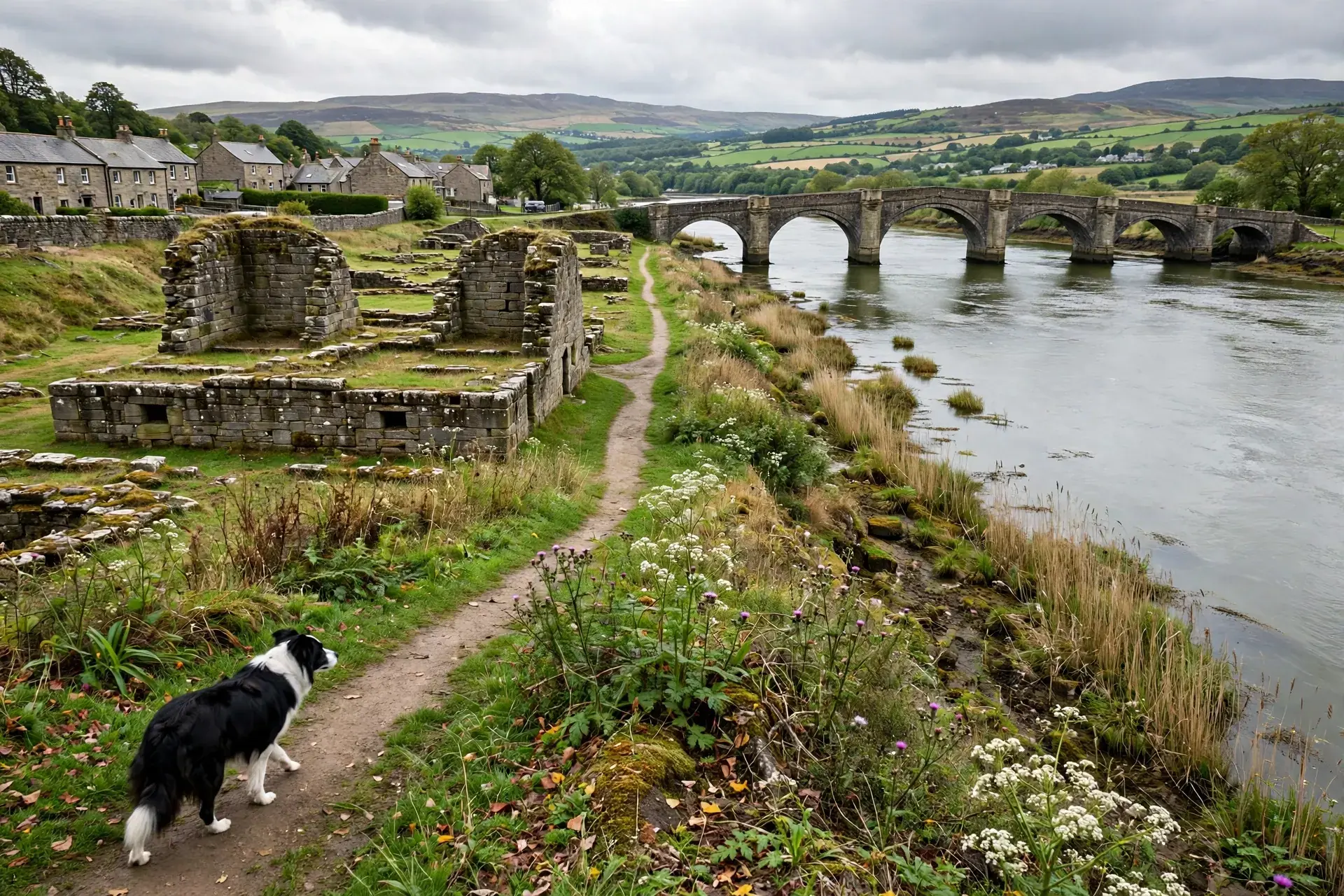
Corbridge begins with a contrast that is hard to find anywhere else in England: a modern village of stone houses, independent shops and pubs, standing almost exactly where a Roman town once stood. The ruins of Corbridge Roman Town, known in Roman times as Corstopitum, sit just west of the present village, and the comparison between the two settlements shapes every walk you take here. The Romans chose this spot for the same reasons people still love it: a crossing point over the River Tyne, a junction of roads running north towards Hadrian's Wall, and flat, workable land on the river's south bank.
Corstopitum began as a fort and supply base around AD 79 or 80, when Roman armies were pushing north, and it grew into a busy civilian town with streets, granaries, workshops and houses. It supplied the garrisons along Hadrian's Wall, which runs a few miles to the north, and the town's prosperity came from that role: soldiers, traders and craftsmen all passed through, and the excavated remains still show the grid of streets, the foundations of large granary buildings, a fountain house and a military compound. Walking the site with a dog, you are walking across open grass and low stone walls rather than through reconstructed buildings, which is exactly why it suits dogs so well. There is space to move, long sightlines so you can see other visitors coming, and little of the crowding that makes some heritage sites stressful for nervous dogs.
Dogs are welcome in the outdoor areas of Corbridge Roman Town on a lead, while only assistance dogs are allowed inside the museum building. That division works well in practice: one person can look around the museum, which displays finds from the site including the famous Corbridge Hoard of armour and other objects, while the other stays outside with the dog, then you swap. Check the official guidance before you travel for current opening times, admission prices and any temporary changes to the dog policy, because English Heritage sites do update their rules. The museum is small and well worth the visit on a wet day, when the outdoor ruins are at their least inviting and the dog can wait under the shelter of the entrance area.
The site's connection to Hadrian's Wall is the part most visitors miss, and it is the key to planning your day. Corbridge was never on the Wall itself; it was the supply town behind it, roughly three miles south of the nearest stretch of Wall. That distance matters for dog owners. A walk from Corbridge to the Wall is possible, using lanes and public footpaths heading north, but it is a long outing of several miles each way, with road sections and livestock fields, and it is best treated as a full-day walk for fit dogs and fit owners rather than a casual stroll. The more practical approach is to split the two: spend the morning at Corbridge Roman Town and on the riverside, then drive north to a Wall car park in the afternoon and walk a short section of Hadrian's Wall Path, where the views open out over the Northumberland countryside and the dog can enjoy open ground on a lead.
If you do combine the two in one day, the nearest Wall sites to Corbridge are around Chesters Roman Fort and the village of Chollerford, roughly five miles to the north-west, and the stretch of Wall around Halton Chesters to the north-east. Both are reached by narrow country lanes where parking is limited, so arrive early on a summer weekend and keep the dog on a lead near the road. Hadrian's Wall Path itself is a National Trail, and dogs are welcome on it on a lead, but sheep graze the fields alongside much of its length, so a reliable recall or a short lead is essential. For a wider look at the county's Wall walks, beaches and castle rules, our Northumberland dog guide covers the whole county in one place.
The practical advice for the Roman Town site itself is straightforward. Keep the dog on a short lead among the low walls and excavated foundations, because the stonework is uneven and a dog scrambling over it can damage both the archaeology and its own paws. Bring water in warm weather, as there is little shade on the open site, and avoid the middle of the day in a heatwave. The ground is grass and gravel, so most dogs cope well, but after heavy rain the paths can be muddy and the site can be slippery underfoot. The car park for the site is close to the entrance, which makes it easy to return to the car for a rest, a drink or a change of lead before heading into the village.
The River Tyne riverside loop
The River Tyne is the reason Corbridge exists where it does, and the riverside paths are the best dog walk in the village. The river runs along the southern edge of Corbridge, broad and unhurried here, with grassy banks, mature trees and long views up and down the valley. The main riverside loop starts near the village centre, follows the bank downstream and upstream in turn, and returns through the village streets, giving you a walk of roughly two to three miles depending on the exact route you choose. It is mostly flat, which makes it a good option for older dogs, puppies building up their stamina, and owners who would rather look at the river than climb a hill.
The character of the walk changes with the direction you take. Heading downstream from the bridge, the path runs through riverside meadow and wooded bank, with the river on one side and fields on the other, and the sound of the water stays with you for most of the way. Heading upstream, the banks rise slightly and the trees close in, giving shade in summer and shelter in a light shower. Either way, the ground underfoot is a mix of grass, earth and gravel, with occasional tree roots and muddy patches after rain. A long line gives a confident dog more freedom to sniff along the bank, but switch to a short lead near the water's edge, near the road crossings at either end, and whenever you meet other walkers, cyclists or dogs coming the other way.
River safety deserves a serious paragraph, because the Tyne looks gentle in summer and can be deceptively strong after rain. The river level rises quickly following heavy rainfall in the Pennines upstream, and the current near the bridge piers and the weir is stronger than it appears from the bank. Do not let your dog swim in the Tyne at Corbridge unless you know the spot well and the conditions are calm, and never throw a ball into fast-moving water. Dogs that love to paddle should be kept to the shallow, slow edges in dry weather, and even then watched closely. In winter, when the river is high and cold, the safest rule is simple: admire the river from the bank and keep the dog on a lead at all times.
Wildlife is part of the riverside experience, and it is worth preparing for. Herons fish the shallows, kingfishers flash along the bank in summer, and ducks and swans are common on the slower stretches. A dog with a strong chase instinct will need a short lead through the sections where birds gather, and the same applies where the path passes fields with sheep or cattle. The riverside is also popular with local dog walkers, especially in the early morning and late afternoon, so expect to meet other dogs. Most are friendly and well socialised, but keep yours on a lead until you can see the other dog's body language, and give nervous or reactive dogs plenty of space by stepping off the path onto the grass.
What to pack for the riverside loop is simple but worth listing: water and a collapsible bowl, poo bags, a towel for wet paws, and a drying coat in cold or wet weather. There are bins in the village, but not always along the river itself, so carry bags until you reach one. In summer, the riverside trees give good shade, but the open meadow sections can be hot at midday, so walk early or late and watch for signs of overheating, especially in flat-faced breeds and older dogs. In winter, the path can be icy in shaded spots and muddy near the bank, so grippy footwear for you and a check of your dog's paws afterwards are both sensible.
One of the pleasures of the Corbridge riverside is that it connects naturally to everything else in this guide. You can start at the Roman Town, walk down to the river, follow the bank to the bridge, cross into the village, and finish with a coffee or a pub lunch, all without getting back in the car. That is the shape of a good Corbridge day: the river gives the dog its exercise, the village gives you yours, and neither of you has to rush.
Village streets and independent shops
Corbridge village is small enough to explore on foot in an hour and interesting enough to fill a morning. The heart of it is the Market Place, a broad, handsome square of stone buildings around a market cross, with the church of St Andrew nearby and a cluster of independent shops, cafes and pubs radiating out along Front Street and Middle Street. The architecture is the first thing you notice: warm sandstone, slate roofs, and shopfronts that have changed little in decades. The second thing is the pace. Corbridge is a working village rather than a tourist showpiece, and the streets feel calm even on a busy Saturday, which makes it a comfortable place to walk a dog that finds crowded town centres stressful.
The Market Place itself is a good place to start. It is wide and open, so you can give other dogs space, and the market cross makes an obvious meeting point if your party splits up. St Andrew's Church, just off the square, is one of the oldest churches in Northumberland, with parts dating back to the Saxon period and Roman stones reused in its walls — a quiet reminder that this village has been continuously inhabited for well over a thousand years. Dogs are not generally allowed inside the church, so admire the exterior, the churchyard and the old stonework from outside, keeping the dog on a lead and away from any graves that are being tended.
Corbridge is known for its independent shops, and that reputation is deserved. Along Front Street and Middle Street you will find a butcher, a baker, a deli, a bookshop, gift shops, a florist and several small food shops, many of them in buildings that have traded for generations. Dogs are welcome in some shops and not in others, and the rule is usually posted on the door or obvious from the layout: a small shop with food on low shelves is unlikely to welcome dogs inside, while a gift shop or bookshop often will. The polite approach is to ask before entering, keep the dog close to your side, and never let it sniff food displays. If a shop does not allow dogs inside, one person can browse while the other waits outside with the dog — the streets are pleasant enough that waiting is no hardship, especially with a coffee from a takeaway counter.
The weekly market, held in the Market Place, is worth timing your visit around if you enjoy that sort of thing, but it does change the feel of the village for dogs. Market days bring more people, more noise, more food smells and more dogs, which can be stimulating for a confident dog and overwhelming for a nervous one. If your dog is reactive or easily over-aroused, visit on a quieter weekday instead, or arrive early before the market is in full swing. Either way, keep the dog on a short lead through the market stalls, watch for dropped food, and be aware that the ground can be slippery if it has been raining.
Walking the village streets with a dog is mostly a matter of common sense. The pavements are generally wide enough, but some of the older streets narrow, and delivery vehicles use the same roads, so keep the dog on the pavement side and on a short lead. The village is on the A69 corridor, and traffic on the main road through Corbridge can be busy at peak times, so cross at the obvious crossing points and do not let the dog wander onto the road. The reward for that care is a village that is genuinely enjoyable to wander: there are benches to sit on, a riverside to return to when the streets feel busy, and enough variety in the shopfronts to make a slow stroll interesting for the humans too.
Corbridge Bridge
Corbridge Bridge is the village's most photographed landmark, and it is also the hinge on which every Corbridge walk turns. The present bridge, built in the late seventeenth century and completed in 1674, crosses the Tyne on seven stone arches just south of the village centre, replacing earlier bridges that the river had repeatedly washed away. It is a handsome, solid structure, wide enough for two lanes of traffic, with pedestrian refuges built into its parapets where walkers can step aside and look up and down the river. For dog owners, it is both a crossing and a viewpoint: the best views of the Tyne at Corbridge are from the middle of this bridge.
Crossing the bridge on foot with a dog needs a little care. The pavement is narrow, traffic uses both lanes, and large vehicles pass close to the parapet, so keep the dog on a short lead on the inside, away from the road, and walk steadily without stopping in the narrowest sections. The refuges are the place to pause, take a photograph and let the dog look at the river, but even there, keep a firm hold of the lead: the parapet is low enough that a dog jumping up could startle, and the noise of traffic can unsettle a nervous animal. If your dog is frightened of traffic, cross at a quiet time — early morning or late evening — when the bridge is at its calmest.
South of the bridge, the road climbs gently towards the village of Dilston and the countryside beyond, and the view back towards Corbridge, with the church tower and the rooftops above the river, is one of the prettiest in the Tyne Valley. North of the bridge, you are straight into the village, with the Market Place a short walk away. That position makes the bridge the natural link between the riverside walk and the village streets, and most visitors will cross it at least twice in a day: once to reach the river, once to return for lunch.
The bridge also tells the story of the river itself. Earlier bridges at Corbridge were destroyed by floods, and the 1674 bridge was built high and strong precisely because the Tyne in spate is a formidable river. After heavy rain, stand in one of the refuges and watch the water push against the piers: it is a useful reminder of why the riverside paths can be closed or impassable in winter, and why swimming is never a casual decision here. Check the official guidance before you travel if you are visiting after a period of heavy rain, as path conditions along the river can change quickly.
Towards Aydon Castle
For a longer walk from Corbridge, the footpaths heading north-east towards Aydon Castle offer a different landscape from the riverside: rolling farmland, wooded denes and the ruins of a thirteenth-century fortified manor house. Aydon Castle, managed by English Heritage, stands about a mile from Corbridge as the crow flies, but the walking route is longer, following lanes and field paths through the countryside, and it makes a good half-day outing for a fit dog. The castle itself is one of the finest examples of a medieval manor house in England, built in the 1200s and later fortified against Scottish raids, with a great hall, solar and courtyard that survive remarkably well.
The walk to Aydon Castle is a country walk, not a village stroll, and it needs to be planned as one. The route uses public footpaths and quiet lanes, with stiles and gates, fields that may hold sheep or cattle, and stretches with no shade and no water, so carry water for the dog and check the official guidance before you travel for the current path conditions. Keep the dog on a lead through all livestock fields, and be ready to lift a small dog over a stile or find the gate beside it — many stiles in this area have a dog gate or a gap, but not all of them do, and a large dog that cannot be lifted will need a route that avoids stiles altogether.
At the castle, dogs are welcome in the outdoor areas on a lead, while only assistance dogs are allowed inside the buildings, following the usual English Heritage pattern. The grounds are compact, with grassy areas around the manor house and views across the valley, and they make a pleasant place for a rest and a picnic before the walk back. Check the official guidance before you travel for opening times, as Aydon Castle has more limited hours than Corbridge Roman Town and is closed on some days of the week. If the castle is shut when you arrive, the walk itself is still worthwhile, and the lanes around Aydon offer quieter walking than the village riverside on a busy weekend.
An alternative longer route from Corbridge heads west along the Tyne towards Hexham, following the river valley through farmland and riverside woods. This is a longer and more ambitious walk, best done as a one-way trip with a bus or a lift back, and it suits dogs that are used to distance walking. The Tyne Valley railway line runs through Corbridge station, which opens up linear walks: walk one way along the river, then catch a train back from the next station. Check the official guidance before you travel for train times and the railway's rules on dogs, which generally allow dogs on a lead, and confirm the walking route in advance, as riverside paths can be diverted after flooding.
Parking and arriving
Corbridge is easy to reach by car, sitting just off the A69 between Newcastle and Hexham, and the village has a public car park close to the centre, with on-street parking on the roads around the Market Place. On a quiet weekday you will usually find a space without difficulty, but on market days, summer weekends and during school holidays, the car park fills early and the on-street spaces go quickly. Arriving before ten in the morning is the simplest way to guarantee a space, and it also gives you the riverside at its quietest, before the day's walkers arrive.
When you park, think about the dog first. In warm weather, choose a shaded space and never leave a dog in a parked car, even for a few minutes: a car heats up far faster than most people expect, and a dog left inside can overheat quickly. In cold weather, the same car park is a useful base: you can return to the car for a rest, a drink and a change of lead between the Roman Town and the village. Check the official guidance before you travel for current parking charges and time limits, as these can change, and keep your ticket or pay-by-phone confirmation until you leave.
Arriving by train is a practical alternative, and it suits Corbridge well. Corbridge station is on the Tyne Valley line between Newcastle and Carlisle, with regular trains from both directions, and the station is a short walk from the village centre and the riverside. Dogs are generally allowed on trains on a lead, and the short walk from the station to the Market Place is flat and easy. Arriving by train also solves the parking problem on busy days and makes a linear riverside walk possible: walk west towards Hexham, then catch a train back. Check the official guidance before you travel for the latest train times and the operator's rules on dogs.
Bus services also connect Corbridge with Hexham and Newcastle, though they are less frequent than the trains, and the same advice applies: check the timetable before you travel, confirm that dogs are allowed on the service, and keep the dog on a lead and out of the aisle. Whatever way you arrive, the village is compact enough that you will do most of your exploring on foot, and the car, train or bus is only the means of getting there, not part of the day itself.
Where to stay with a dog
Corbridge itself has a small number of places to stay, including inns with rooms, bed and breakfasts and self-catering cottages, and the surrounding Tyne Valley has many more, from farm stays to holiday cottages near Hexham and along the Wall. The village's size means that dog-friendly rooms in Corbridge itself are limited and book up early, especially for summer weekends, so if you want to stay in the village, book well ahead and confirm the dog policy in writing before you pay. The wider area gives you more choice: Hexham, a short drive to the west, has hotels, guest houses and cottages, and the countryside around Corbridge has self-catering properties that welcome dogs, often with enclosed gardens.
When you book, the questions to ask are the same ones that matter anywhere: is there a charge per dog, is there a limit on the number or size of dogs, are dogs allowed in the bedroom, and is there somewhere to dry a wet dog and somewhere for a last outing at night? A self-catering cottage with an enclosed garden is often the easiest option for a dog that needs space and a secure toilet area, while a pub with rooms suits owners who want to eat on site and keep the dog nearby. In Corbridge, the pubs with rooms are in the heart of the village, which is convenient for the riverside and the shops but can be noisier in the evening than a cottage on the edge of the village.
For a longer stay, Corbridge makes a good base for exploring the whole of Northumberland with a dog. Hadrian's Wall, the Northumberland coast, the market town of Hexham and the city of Newcastle are all within an hour's drive, and the village itself is a pleasant place to return to in the evening after a day out. Our Northumberland dog guide covers the county's castles, beaches and Wall walks, and if you want to extend the trip into a city break, our Durham dog guide covers the cathedral city to the south, with its own river loop and dog-friendly pubs.
Whatever you book, confirm the details in writing: the pet fee, the number of dogs allowed, any breed or size conditions, and the rules about leaving a dog alone in the room. Many places prohibit leaving a dog unattended, so plan as if the dog comes with you everywhere, and choose accommodation where that is easy — a pub with a dog-friendly bar, a cottage with a garden, or a guest house near the riverside where an evening walk is part of the routine.
Eating and drinking with a dog
Corbridge has several pubs and cafes, and dogs are welcome in many of them, usually in the bar area or on a terrace rather than in the main dining room. The village's best-known pubs sit around the Market Place and along Front Street, and they range from traditional inns with open fires to more modern bars with a food menu. The pattern is familiar to anyone who travels with a dog in Britain: the bar is dog-friendly, the restaurant may or may not be, and the terrace is the safest bet in good weather. Ask before you sit down, keep the dog on a lead, and bring a mat or blanket so the dog can settle quietly under the table.
Lunch in Corbridge is best planned around the dog's needs as much as your own. A pub lunch after the riverside walk works well if the dog can lie down and rest, but a dog that is still full of energy after a short walk will find an hour under a table difficult. The practical order is: walk first, eat second. Give the dog a good riverside walk, let it settle in the car for a few minutes if needed, then go in for lunch when the dog is ready to rest. Order water for the dog as well as for yourself, and ask the staff if there is a quieter corner where the dog will be less disturbed by people coming and going.
Cafes in the village follow a similar pattern. Some welcome dogs inside, some offer outdoor seating where dogs are welcome, and some are takeaway only. A coffee and a cake from a takeaway counter, eaten on a bench in the Market Place or down by the river, is often the easiest option with a dog, and it keeps the dog outside in the fresh air. The village also has a deli and food shops where you can buy picnic supplies, and a riverside picnic is one of the pleasures of a Corbridge day: find a grassy spot away from the main path, keep the dog on a lead, and take all your rubbish with you.
Evening eating is worth planning if you are staying in the village. Pubs can be busy on a Friday or Saturday evening, and a dog that copes well with a quiet lunchtime may struggle with a crowded bar. If you are staying overnight, ask your accommodation whether you can eat in the bar with the dog, and consider booking a table for an early sitting, when the room is calmer. If the dog is tired after a day of walking, an early supper and an early night suit everyone.
Seasons, weather and river levels
Corbridge is a year-round destination, but the experience changes with the seasons, and the river is the main reason why. Late spring and early autumn are usually the best times to visit with a dog: the weather is mild, the riverside paths are firm, the village is quiet, and the light on the river is at its best. May and June bring long evenings and wildflowers along the bank, while September and October bring autumn colour to the riverside trees and cooler walking weather that suits dogs well. These shoulder months are also the quietest for parking and for the pubs, which makes the whole day easier.
Summer brings longer days and busier weekends. The riverside is at its most inviting in warm weather, with shade under the trees and the sound of the river, but the open meadow sections can be hot at midday, and the village can be crowded on a sunny Saturday. Walk early or late in the day, carry water, and watch for signs of overheating, especially in older dogs and flat-faced breeds. Summer is also the season for the village market and for events in the area, which add atmosphere but also add people and noise, so check what is happening on the day you visit and plan around it if your dog is sensitive to crowds.
Winter in Corbridge is quiet and atmospheric, with frost on the riverside grass, low light on the stone buildings, and the pubs at their cosiest. The trade-offs are real, though: the riverside paths can be muddy and slippery, the river can be high after rain, and the days are short. A winter visit works best as a short walk followed by a long pub lunch, rather than a full day outdoors, and a drying coat and a towel in the car are essential. Check the official guidance before you travel for opening times in winter, as some attractions and cafes reduce their hours outside the main season.
Whatever the season, the river level is the variable to watch. The Tyne rises quickly after heavy rain upstream, and a path that was dry in the morning can be wet by the afternoon. If the river is high, keep to the higher paths, keep the dog on a lead, and do not attempt to cross any flooded sections. The Environment Agency publishes river level information for the Tyne, and it is worth checking before you travel if there has been heavy rain in the days before your visit.
A relaxed day plan
A good Corbridge day with a dog does not need to be complicated. The village is small, the walks are short, and the pleasure is in taking your time rather than ticking off a list. The plan below is for a full day, but it can be shortened to a half day by dropping the Aydon Castle walk or the Roman Town museum, and it works in any season with a few adjustments for weather.
Start at Corbridge Roman Town in the morning, when the site is at its quietest and the light is good for photographs. Allow an hour for the outdoor ruins, and longer if you want to visit the museum. Keep the dog on a lead, give it water, and let it sniff its way around the low walls and grassy areas. From the Roman Town, walk down to the river and follow the bank towards the bridge, taking the riverside loop at a leisurely pace and giving the dog time to explore the scents along the bank.
Cross Corbridge Bridge in the middle of the day, pause in one of the refuges to look up and down the river, then walk into the village for lunch. Choose a pub with a dog-friendly bar or a terrace, order for the dog as well as for yourself, and let the dog rest under the table while you eat. After lunch, wander the village streets and the Market Place, browse the independent shops, and visit St Andrew's Church from the outside. If you still have energy, take the footpaths towards Aydon Castle for an afternoon walk, or simply return to the riverside for a second, shorter loop before heading home.
The alternative plan, for a shorter visit, is simpler: park in the village, walk the riverside loop, cross the bridge, and have lunch in the village. That takes three to four hours and gives the dog a good walk, the river, the bridge and the village, without any rushing. Either way, the rule is the same: let the dog set the pace, build in rests, and leave time to sit by the river and do nothing for a while. Corbridge rewards a slow visit, and the dog will enjoy it more if you do too.
Practical questions
Before you go
Can dogs visit Corbridge Roman Town?
Dogs are welcome in the outdoor areas of Corbridge Roman Town on a lead, but only assistance dogs are allowed inside the museum building. The site is mostly open ground and low walls, so it suits a calm dog on a short lead. Check the official guidance before you travel, as rules and opening times can change.
Is the River Tyne riverside walk suitable for dogs on a lead?
Yes, for most dogs. The riverside paths around Corbridge are generally flat and easy, with grassy banks and shade in summer. Keep your dog on a lead near the water, watch the river level after rain, and carry water in warm weather. Some stretches can be muddy after wet spells, so boots or a drying towel are worth packing.
Where can I park in Corbridge with a dog?
Corbridge has a public car park close to the village centre, and there is on-street parking on the roads around the Market Place. Arrive early on market days and summer weekends, when spaces fill quickly. Park in the shade where possible, never leave a dog in a hot car, and check the official guidance before you travel for current charges and time limits.
Are dogs welcome in Corbridge pubs and cafes?
Several pubs and cafes in Corbridge welcome dogs, usually in the bar area or on a terrace rather than in the main dining room. Policies vary by venue and can change with the season, so ask before you sit down and keep your dog on a lead. Bring a mat or blanket so your dog can settle quietly under the table.
Can I walk from Corbridge to Hadrian's Wall with a dog?
You can reach Hadrian's Wall from Corbridge on foot, but it is a long walk of several miles each way, mostly on lanes and footpaths, and it is best planned as a full day out. Shorter options include driving to a Wall car park and walking a section of Hadrian's Wall Path. Check the official guidance before you travel for path conditions and livestock.
What is the best time of year to visit Corbridge with a dog?
Late spring and early autumn are usually the best times: mild weather, firm riverside paths and quieter streets. Summer brings longer days and busier weekends, while winter can be cold and the riverside muddy. Whenever you visit, check the official guidance before you travel for opening times and river conditions.