This guide is independent and contains no paid placement. If affiliate links are added later, they will be clearly marked and will not change our editorial checks.
Start at the Pannier Market, cross the Long Bridge, then let the Tarka Trail do the walking: flat and traffic-free west towards Fremington and Braunton, or south towards Bideford. Barnstaple works best as a base town — stock up here, walk from the door in the morning, and drive out to the coast or Exmoor for the afternoon.
Market day in the Pannier Market
Time your first morning in Barnstaple for market day, and bring the dog. The Pannier Market is the town’s great Victorian hall, built in the 1850s with a high timber roof, and it still fills with stalls selling local vegetables, bread, cheese, plants, crafts and second-hand finds. The hall sits at the top of the town centre, a short walk from the High Street, and on a busy morning the whole area hums: stallholders calling out, shoppers stopping to compare cauliflowers, and dogs weaving between legs on short leads. It is the single best introduction to Barnstaple, because everything the town is — a working market town rather than a polished resort — is on show in one building.
Go early if your dog is nervous in crowds. The hall is at its busiest late morning, when the aisles narrow and the smell of hot food, flowers and fresh bread thickens the air. Arriving soon after opening gives you room to move, a calmer dog, and the best pick of the stalls. Keep the lead short and your dog close to your heel rather than letting them trail behind you, because a long lead across a busy aisle trips people and tangles around stall legs. Watch for dropped food under the food stalls and for crates and boxes at ankle height; market halls are full of things a curious nose will find before you do.
Rules about dogs inside the covered hall can vary by stall and by day, so check the official guidance before you travel. If the hall itself is not an option on the day you visit, you lose very little by staying outside: the open-air stalls spill into the streets around the market, and the pavement cafes and shopfronts of the surrounding streets carry the same atmosphere with far more space. The market building is also worth a look from the outside, where its arched entrances and the clock above the hall frame the top of the town.
Use the market as your supply run, not just a sightseeing stop. A dog holiday runs on small purchases — a spare lead, a bag of treats, a cheap towel for muddy paws — and the market and the shops around it cover most of them in one walk. Pick up local cheese and bread for a picnic, then save the picnic for the riverside, where the dog has space to settle. If you are staying self-catering, the market is also the best place to stock the fridge for the first two days before you make a bigger supermarket trip.
Market day also sets the rhythm for the rest of the town. The streets below the hall — Butchers Row, with its narrow covered passage, and the High Street running down towards the river — are at their liveliest when the market is on, and the cafes fill with shoppers taking a break. Plan the morning around the market, then let the afternoon drift down to the river, where the dog gets the open space that a crowded hall cannot offer.
The historic centre on foot
Barnstaple is one of the oldest towns in Devon, a Saxon settlement that grew into a busy port on the Taw, and the centre still shows that history in its street pattern. The High Street runs in a gentle slope from the market down to the river, lined with a mix of Georgian frontages, Victorian shopfronts and older timber-framed buildings. It is a compact centre, and almost everything worth seeing is within a ten-minute walk, which makes it easy to explore with a dog without planning a route in advance. Start at the market, walk down the High Street, and let the side streets pull you towards the river.
Look out for the small details as you walk. Butchers Row is a narrow covered lane off the High Street where butchers once traded, and its low roof and stone walls give a sense of how tight the old town was. The Guildhall stands near the top of the town, and St Peter’s Church, with its tall tower, anchors the lower end of the centre near the river. The castle mound, a grassy Norman motte just off the main streets, is a short climb with a view over the rooftops and the Taw; the ground is uneven and the steps are steep in places, so it suits a steady dog on a lead rather than a hurried scramble, and it is best saved for a dry day when the grass is not slippery.
The Museum of Barnstaple and North Devon sits beside the river at the bottom of the town, and it is a good wet-weather stop for the humans in the party — although dogs are not generally admitted inside museums, so plan for one person to stay outside with the dog or skip it on this trip. The streets around the museum, including the quayside, are quieter than the High Street and make a pleasant loop back towards the centre, with views across the water to the far bank and the houses beyond.
Shopping streets and dogs mix better here than in many towns, because the centre is flat and the pavements are wide along the main routes. The Green Lanes shopping centre and the larger stores on the edge of the centre are less dog-friendly than the independent shops, so treat those as a humans-only errand and leave the dog with a companion or back at the accommodation. The independent shops along the High Street and in the side lanes are often happy to have a well-behaved dog pop in, but always ask at the door rather than assuming, and never tie a dog up outside a shop in a busy street.
A sensible centre loop takes about an hour with a dog, including stops. Market to High Street, down to the quayside, along the river to the Long Bridge, back across the bridge and up through the quieter streets on the far side, then over again into the centre. That loop gives the dog a mix of smells, surfaces and open space, and it puts you back near the cafes when you are ready for a break. If your dog is reactive to other dogs, walk the loop early in the morning or late in the afternoon, when the pavements are quieter and the other dogs are fewer.
The River Taw and the Long Bridge
The Taw is the reason Barnstaple exists, and it is the town’s best dog-walking asset. The river runs wide and tidal past the town, and the riverside paths on both banks give you level walking with big skies and constant movement — boats, herons, gulls and the tide coming and going. Rock Park, the town’s riverside green space just upstream of the centre, is the easiest place to start: lawns, mature trees, a children’s play area and open views along the water, with benches where you can sit while the dog sniffs the grass. It is a short, easy walk rather than a hike, which makes it ideal for the first and last walk of the day, for older dogs, and for puppies that need a gentle introduction to a new town.
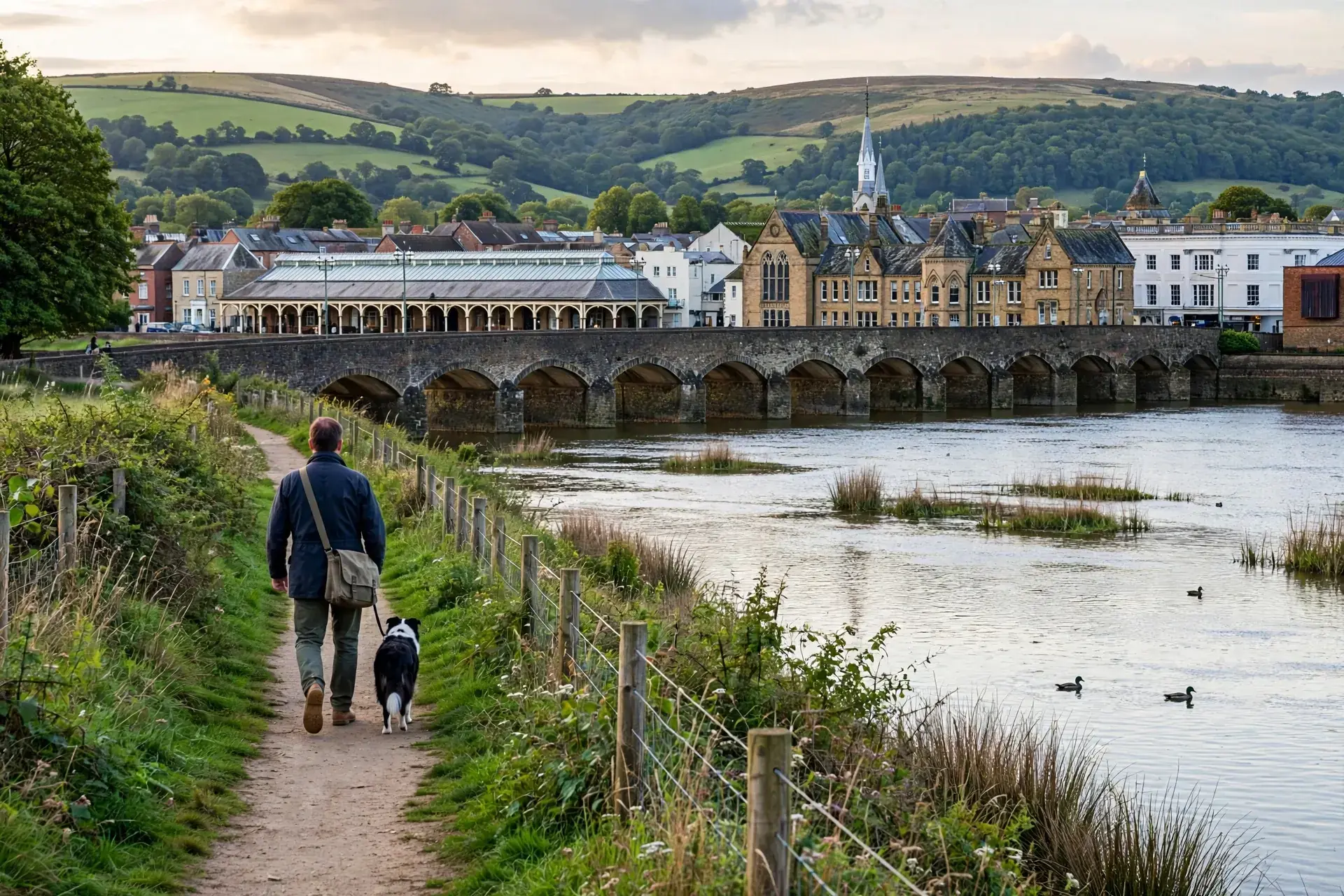
The Long Bridge is the town’s landmark crossing, a stone bridge with a long history — the current structure dates in part to the medieval period, rebuilt and widened over the centuries — and it carries the main road across the Taw. Walking across it on the pavement gives you the best view in town: upstream towards the bend of the river and the hills beyond, downstream towards the estuary and the open country. The pavement is narrow in places and the traffic is constant, so keep the dog on a short lead on the side away from the road, and do not stop in the middle of the bridge to take photographs with the dog loose. Cross briskly, then linger on the far bank, where the paths are quieter.
From the far bank you can follow the riverside path back towards the town or out towards the open country, and the change of scene is immediate: fewer people, more birds, and long stretches of grass where a dog on a long line can work through a whole field of smells. The estuary is tidal, and the mud at low water is deep and sticky, so keep dogs out of the mudflats — the mud can trap a small dog, and the river current on a rising tide is stronger than it looks. Stick to the surfaced paths and the firm grass, and carry water, because there is little shade on the open stretches in summer.
The quayside near the town centre is worth a slow wander in the evening, when the light drops over the water and the town quiets down. Fishing boats and small craft moor along the quay, and the smell of the estuary — salt, mud and seaweed — is strong at low tide. Dogs usually love this stretch, but the quay edge is unfenced in places, so keep a firm hold of the lead and do not let a dog jump down onto the slipways or the boats. If your dog is a swimmer, do not let them into the Taw here: the current, the tide and the boat traffic make it a poor swimming spot, and there are far better places to swim on the coast.
For a longer riverside outing, follow the path upstream from Rock Park towards the countryside, where the river narrows and the banks turn wooded. The path is level and easy underfoot, and it gives a dog a proper walk without leaving the town behind. Turn back when you have had enough — the beauty of a riverside out-and-back is that the distance is entirely up to you — and finish with a loop through Rock Park, where the dog can have a last sniff before you head back to the accommodation.
The Tarka Trail in both directions
The Tarka Trail is the single best reason to bring a dog to Barnstaple. It is a long-distance walking and cycling route that follows old railway lines through North Devon, and Barnstaple sits at its hub, which means you can set off from the town in three directions without touching a car. The surface is mostly flat, firm and traffic-free, the gradients are gentle because the path was built for trains, and the route is waymarked, so navigation is simply a matter of following the trail and turning back when you have had enough. For a dog, that combination — flat ground, no traffic, long sightlines and endless smells — is hard to beat.
West from Barnstaple, the trail runs out towards Fremington and then on to Braunton, following the estuary with wide views over the water and the marshes. This is the most scenic direction, and the one most visitors choose first. The stretch to Fremington is an easy out-and-back of a few miles, level all the way, with the river on one side and fields on the other. Fremington Quay, a former port with a cafe and open ground, makes a natural turning point: a place to sit, give the dog water, and decide whether to push on towards Braunton or head back. Beyond Fremington the trail continues through quiet countryside to Braunton, the large village at the edge of the dunes, where you can turn towards the coast at Saunton or Croyde. The full walk to Braunton is a proper half-day outing, so save it for a day when the dog is fit and the weather is settled.
South from Barnstaple, the trail follows the Taw downstream towards Bideford, another historic port town. This direction is quieter than the westward route, with long stretches of riverside path, reed beds and open fields, and it suits dogs that find busy paths stressful. The walk to Bideford is long — a full day on foot for most people — so most dog owners walk an hour or two out and turn back, or arrange a lift or a bus back from Bideford. The trail surface is good and the route is flat, but there is little shade on the open stretches, so carry water and plan around the heat of the day in summer.
Inland from Barnstaple, the third arm of the trail heads east and then south towards the countryside around South Molton and Meeth, following the river valley into quieter, wooded country. This is the least walked direction, and it rewards the effort with empty paths, birdsong and a sense of getting away from the town without any real climbing. It is also the best direction on a hot day, because the tree cover is better than on the open estuary stretches. Whichever direction you choose, the same rules apply: keep your dog on a lead, because the trail is shared with cyclists who approach quietly from behind, and because livestock graze in fields alongside parts of the route. A long line gives a dog room to sniff on the wider stretches, but reel it in whenever cyclists approach, at road crossings, and anywhere the path narrows.
Cyclists are the main thing to manage on the Tarka Trail. The path is popular with families on bikes, and a dog on a long lead stretched across the trail is a hazard for everyone. Walk on the left, keep the dog on the same side as you, and teach the dog to move to the edge when you hear a bell or a voice behind you. Early mornings are the quietest time on the trail, and they are also the best time for wildlife: herons along the river, egrets in the marshes, and hares in the fields beside the path. Take a lead, water, a bowl, poo bags and a towel — there are few facilities once you leave the town, and the nearest bin may be a mile behind you. And remember that the trail is a working path through farmland in places, so close gates behind you, keep dogs out of fields with livestock, and pick up after your dog every time.
For dogs that need more than a flat walk, the Tarka Trail is a base, not the whole holiday. Use it for the morning exercise, then drive out to the coast or the moor for the afternoon. That split — a calm, flat walk in the morning and a bigger adventure after lunch — works well for most dogs, because it gives them a predictable start to the day and a proper tired-out finish. Older dogs and puppies can stick to the short stretches near the town and still have a satisfying holiday, while fitter dogs can build up to the longer sections over several days.
Parking, vets and supplies
Barnstaple works as a base because the practical things are easy. The town has several car parks in and around the centre, including long-stay options on the edge of town that suit a full day out, and short-stay parking near the shops for quick errands. Parking charges and time limits change, so check the official guidance before you travel, and look for the car parks on the river side of the town if you want to start a walk straight from the car. On market days and summer Saturdays the central car parks fill early, so arrive before ten in the morning or park a little further out and walk in — the walk from the edge of town into the centre is short and flat, and the dog will be glad of it.
If you are staying in the town, ask your accommodation about parking before you arrive. Some guesthouses and cottages have their own spaces, others rely on street parking or a nearby public car park, and the difference matters when you are unloading a dog, a crate and a week of luggage in the rain. A space close to the door is worth more than a space close to the centre. If you are driving in for the day, leave the car in one place and walk: the centre is compact, the Tarka Trail starts in the town, and you will see far more on foot than you will by moving the car between stops.
Vets are one of the reasons Barnstaple makes a reassuring base. The town has several veterinary practices, and out-of-hours emergency cover is available in the area, so save the number of the nearest practice into your phone on arrival, along with the number of an emergency vet. If you are staying in a village outside the town, save the practice nearest your accommodation as well, because a twenty-minute drive feels very long when a dog is unwell. Bring your dog’s vaccination record and any regular medication, and keep a note of your own vet’s number in case the local practice needs to call them for history. A small first-aid kit — tick remover, saline, bandage, tweezers and any prescribed medicine — belongs in the car for every day out, not just the long ones.
Supplies are straightforward. Barnstaple has large supermarkets on the edge of town, a pet shop in the centre, and the market for fresh food, so there is no need to pack the car with a week of dog food before you leave home. Buy the bulky things — food, litter for a cat travelling with you, a spare towel — at the supermarket on arrival, and use the market and the independent shops for treats and the interesting extras. If your dog eats a specialist diet, check before you travel that the local supermarkets stock it, and bring a few days’ supply as a buffer in case they do not. A collapsible water bowl, a spare lead and a drying coat are the three items most often forgotten, and all three are worth buying on the first day if you have left them at home.
Getting to Barnstaple is part of the planning. The town sits at the end of the Tarka Line railway from Exeter, which runs through the Devon countryside and arrives at Barnstaple station, a short walk from the centre and the Tarka Trail. Trains on this line are small and can be busy, so check the official guidance before you travel if you plan to bring a dog by rail, and travel outside peak hours where possible. By road, the A361 North Devon Link Road connects the town to the M5, and the drive from the motorway takes you through rolling farmland that gets steadily more rural. Bus services run from the town to the coast and to nearby villages, but they are less practical with a large dog, so a car makes the whole trip easier — especially for the day trips to the coast and Exmoor.
Finally, think about the dog’s routine before you arrive. A new town, new smells and new sounds are exciting but tiring, so keep the first day gentle: a short walk in Rock Park, a wander around the market, and an early night. Feed at the usual times, keep the dog’s bed in the same place relative to yours, and give the dog a familiar-smelling blanket or toy. Dogs settle faster when the routine stays the same even though the scenery has changed, and a calm first day pays off for the rest of the week.
Where to eat and drink with a dog
Barnstaple’s cafes and pubs are used to dogs, because the town sits on a long-distance trail and a walking holiday route, and muddy boots and wet dogs are a normal sight. The best places for a dog owner are the ones with a clear dog policy — a water bowl by the door, a dog-friendly corner, or a garden where dogs are welcome — rather than the ones that merely tolerate a dog under the table. Look for the signs at the entrance, and ask the staff if you are unsure: a quick question at the door is always better than an awkward move halfway through a meal.
The High Street and the streets around the market have the widest choice of cafes, and many of them have pavement seating in good weather where a dog can settle beside your chair. A pavement table works well for a calm dog that is happy to lie down and watch the world, but it is a poor choice for a dog that lunges at passing dogs or begs from strangers, so judge your own dog honestly. Inside, the dog-friendly cafes tend to be the smaller, independent ones, where the owner sets the rules and the staff know the regular dogs by name. Bring a mat or a blanket for the dog to lie on, a chew to keep them occupied, and a bowl — many cafes will fill a bowl with water, but having your own means you never have to ask.
Pubs are the backbone of the North Devon dog-friendly scene, and the town and the surrounding villages have plenty of them. The best pub for a dog is one with a flagstone floor, a log burner in winter, and a corner where the dog can curl up out of the way — and the villages around Barnstaple, including Fremington, Instow and the villages towards Exmoor, are full of exactly that kind of pub. Order food at the bar, settle the dog first, and keep the lead short and under your chair rather than stretched across the room. If your dog barks at strangers or other dogs, choose a table at the edge of the room, visit at a quiet time, and keep the visit short. A dog that has had a long walk first is a far better pub companion than a dog that has been in the car all day.
For a longer lunch, the pubs and cafes along the Tarka Trail are worth planning a walk around. Fremington Quay has a cafe that makes a natural stop on the westward trail, and the villages along the trail each have their own options, although opening hours vary by season, so check the official guidance before you travel. A walk that ends at a pub is a good way to structure a day out, but always have a backup plan: a cafe that is closed on a Monday, or a garden that is full on a sunny Saturday, should not leave you with a hungry dog and nowhere to sit. Carry a snack and water for the dog, and a sandwich for yourself, on every longer walk.
Evening meals need a little more thought. Some restaurants welcome dogs in a bar area but not in the dining room, and some welcome dogs only at lunchtime, so check before you book a table. If your accommodation allows it, the simplest evening is often a takeaway eaten back at the cottage or guesthouse with the dog beside you, especially after a long day out. Barnstaple has takeaways of most kinds in and around the centre, and the market can supply the makings of a simple supper. Whatever you choose, keep the dog’s feeding time consistent — a dog fed at the usual hour is a dog that settles, and a settled dog makes the evening easier for everyone.
Where to stay with a dog
Staying in Barnstaple itself is the practical choice, and the town offers the full range: guesthouses and bed and breakfasts in the centre, self-catering cottages in the streets around the market, and larger holiday properties on the edge of town. A central stay means you can walk to the market, the river and the Tarka Trail without starting the car, which matters more than it sounds — the first walk of the day is the one that sets the dog up, and a walk that starts at your front door happens far more reliably than one that needs a drive. If you are choosing between two places, pick the one with the shorter walk to open ground.
Self-catering works particularly well for dog owners in Barnstaple. A cottage with a small garden or yard gives the dog somewhere to stretch its legs first thing, and a kitchen means you can feed the dog at the usual time without negotiating a dining room. When you book, ask the specific questions that matter: is the garden enclosed, and how high is the fence; is there a hard floor or a washable rug for a wet dog; where is the nearest place for a late-night toilet trip; and is there a charge per dog, per stay, or per night. Get the answers in writing with the booking, and confirm the number of dogs, because a limit of two dogs is common and a third dog can be a problem if it is not agreed in advance.
Guesthouses and bed and breakfasts can be just as welcoming, but they need a different conversation. Ask whether the dog can stay in the room alone for a short time while you eat breakfast, whether there is a garden or a quiet corner for the dog, and whether the dog is welcome in any shared areas. Some guesthouses have a dog-friendly room on the ground floor with direct access to the garden, which is ideal; others put dogs in an upstairs room with no easy exit, which makes the night-time toilet trip a long one. A ground-floor room with a door to the outside is worth asking for, and it is worth booking early, because there are usually only one or two such rooms.
If you prefer to stay outside the town, the villages around Barnstaple offer cottages and farm stays with more space and quieter nights, and the coast at Braunton, Croyde and Woolacombe is a short drive away. The trade-off is that every walk starts with a car journey, and the dog’s morning routine depends on you driving somewhere first. For a dog that is happy in the car, that is no problem at all; for a dog that gets car sick or anxious, a town-centre stay is the kinder choice. Holiday parks and campsites in the area also accept dogs, and they suit families who want space and facilities, but check the park’s rules on leads, noise and leaving dogs unattended, because they vary widely.
Whatever you book, pack for the accommodation as well as the walks. Bring the dog’s own bed or blanket, so the room smells familiar from the first night, and a towel or drying coat for the walk back from the river. Bring a stair gate or a travel crate if the dog needs a boundary, and a few familiar toys. Keep the dog’s routine as close to home as possible — same food, same feeding times, same last walk — and the dog will treat the cottage or guesthouse as a second home within a day or two. And before you book anything, read the cancellation terms, because a dog that falls ill the week before a holiday is the most common reason plans change.
Day trips: Lynton, Exmoor and the coast
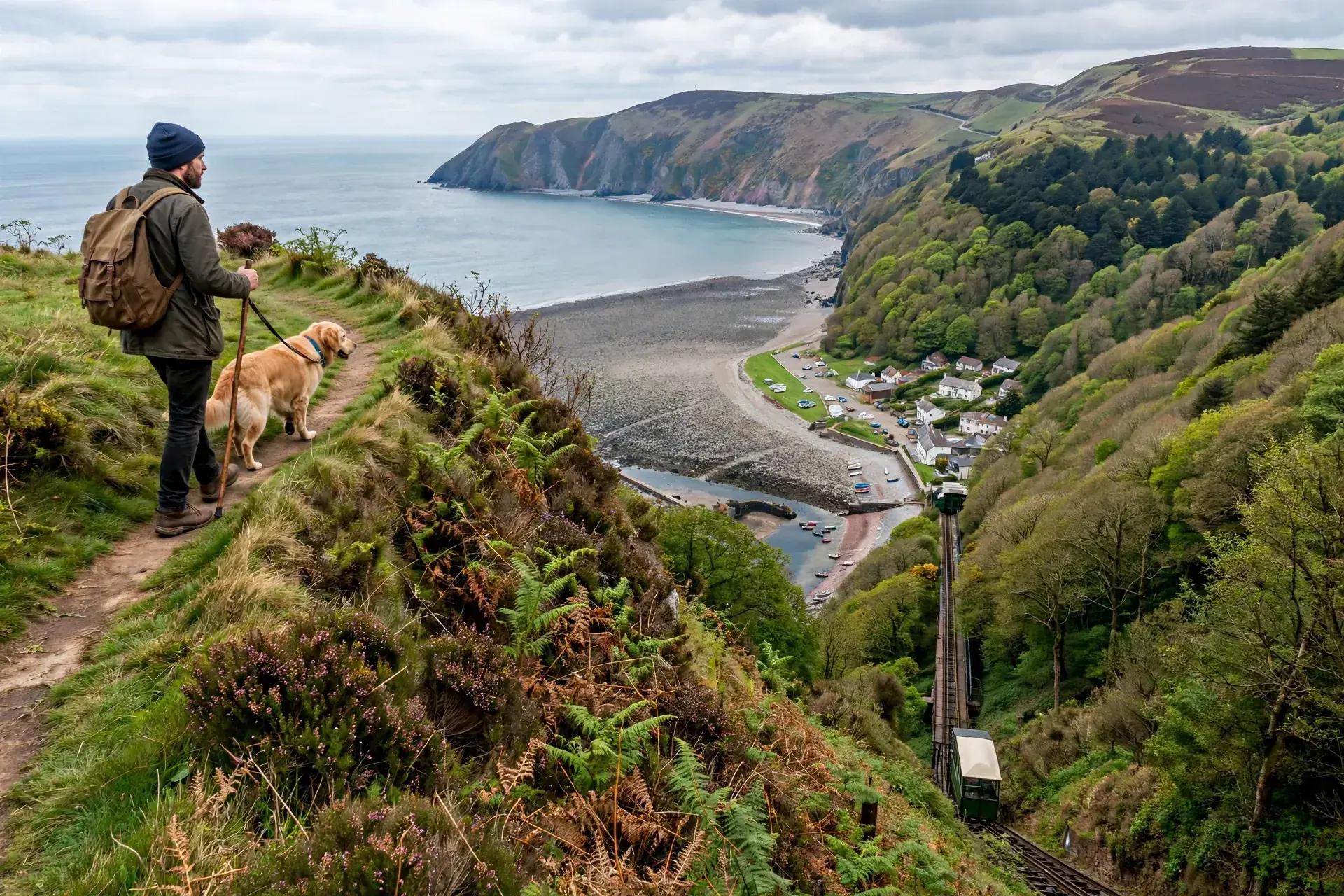
Barnstaple earns its keep as a base on the days you drive out, and the best day trip is north to Lynton and Lynmouth. The drive takes you through the hills of Exmoor’s western edge, past villages and open moorland, to the twin towns at the top and bottom of a steep wooded cliff. Lynton sits on the clifftop, Lynmouth in the valley below, and the two are joined by the famous cliff railway, a water-powered lift that has carried passengers up and down since 1890. Dogs are welcome on the cliff railway, although you should check the official guidance before you travel, and the ride itself is short, steady and — for most dogs — unremarkable once the initial movement passes. Our guide to Lynton with a dog covers the cliff railway, the Valley of Rocks and the steep paths in detail, and it is worth reading before you go, because the gradients around Lynton are the one thing that catches people out.
The Valley of Rocks, a dry valley of strange rock formations along the clifftop west of Lynton, is one of the finest dog walks in North Devon: a level clifftop path with huge views over the Bristol Channel, wild goats on the slopes below, and a cafe at the far end for a well-earned stop. Keep the dog on a lead here, because the cliff edges are unfenced and the goats are a powerful distraction. Watersmeet, the wooded valley east of Lynmouth where two rivers meet, is the gentler alternative — a shaded riverside walk through National Trust woodland to a tea garden, with stepping stones and flat rocks that dogs love to paddle around. Both walks are worth a full day, and both are an easy drive from Barnstaple.
Exmoor itself is the second great day trip, and Barnstaple sits on its western edge. The moor rises quickly from the town: within half an hour you can be on open moorland with red deer, wild ponies, deep wooded valleys and big skies. The villages on the moor’s edge — Simonsbath, Exford, Withypool — make good starting points for short walks, and the moor’s pubs are famously dog-friendly. Exmoor’s rules are simple and strict: keep dogs on leads around livestock, especially during lambing and when ponies and cattle are grazing, and keep dogs under close control near ground-nesting birds in spring and summer. The moor is not a place for a dog to run free, but it is a wonderful place for a dog on a long line, with miles of open ground and a new smell every few steps.
The coast is the third option, and it is the one most dogs will vote for. Braunton Burrows, the vast dune system behind Saunton Sands, offers miles of sand and grass where dogs can run properly, while Croyde and Woolacombe are classic North Devon surf beaches with wide sands and dramatic headlands. Dog rules on these beaches change with the season, so check the official guidance before you travel — summer restrictions apply on the main beaches, and the quieter stretches are often the better choice for a dog in any case. Instow, the village across the estuary from Appledore, is a gentler coastal option: a sandy beach at low tide, a long promenade, and a relaxed atmosphere that suits older dogs and families. The drive from Barnstaple to any of these beaches is short, which means you can be on the sand within half an hour of leaving the town.
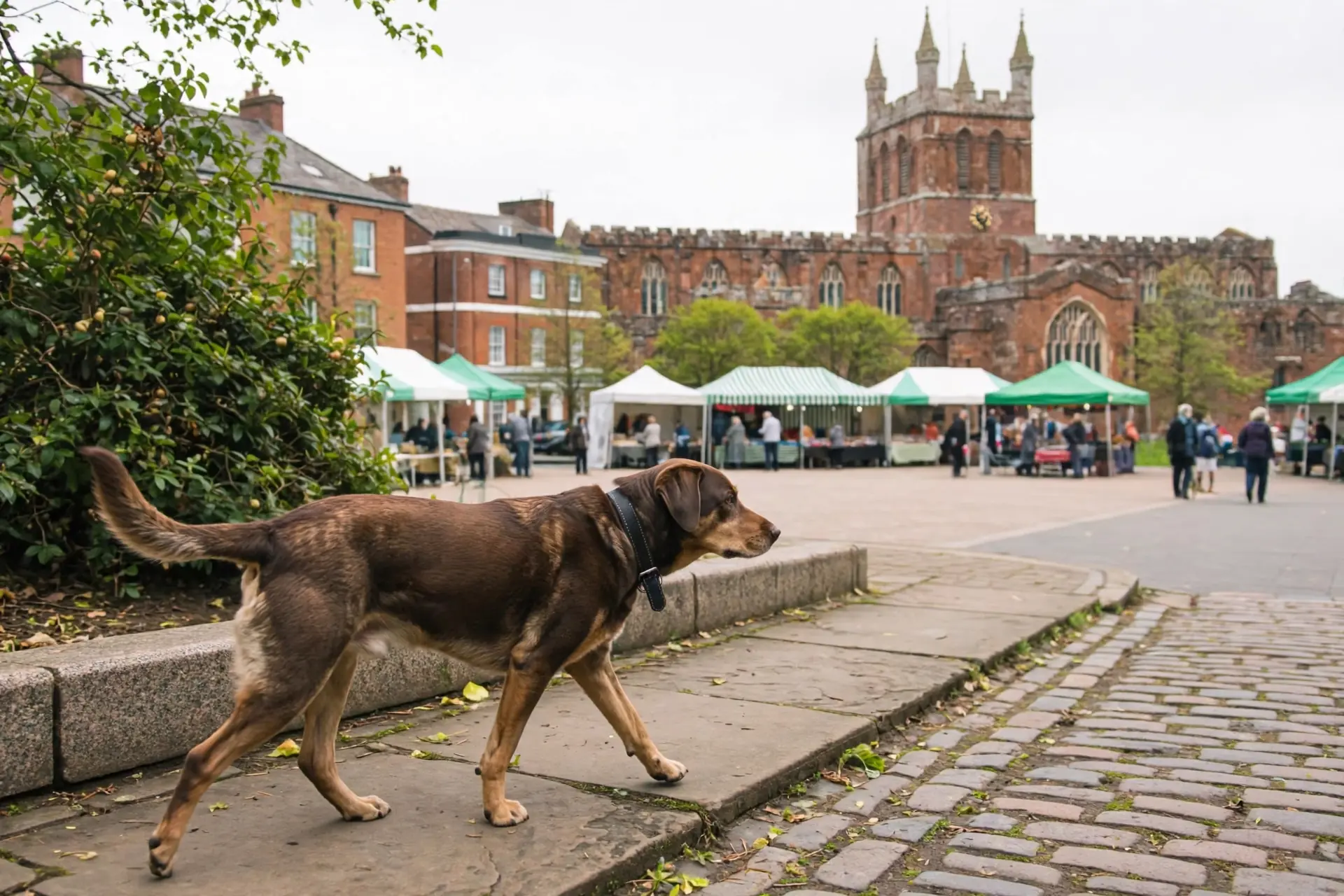
Closer to home, Crediton with a dog makes a pleasant half-day trip inland, through the lanes of Mid Devon to a smaller market town with its own church, market days and Creedy Valley walks. It is a good choice for a rainy day or a quiet day, when the coast is too wild and Exmoor too exposed, and it shows a different side of Devon — red soil, dairy farms and a slower pace. The same applies to Bideford, the town downstream on the Taw, which has its own quayside, pannier market and riverside walks, and which can be reached on foot along the Tarka Trail for the very fit, or by a short drive for everyone else. Plan one big day trip, one coastal day and one quiet day, and Barnstaple will give you a full week without ever feeling rushed.
Seasons and wet weather
Barnstaple is a year-round town, which is part of its appeal as a base, but the seasons change the trip in real ways. Spring is the best all-round season: the Tarka Trail dries out, the hedgerows fill with wild garlic and bluebells, the market stalls turn to asparagus and new potatoes, and the beaches are still quiet before the summer restrictions begin. Lambing season runs through spring on the farms around the town, so keep dogs on leads near fields with ewes and lambs, and be ready to turn back if a footpath crosses a lambing field. The weather in spring is changeable — sunshine, showers and a cold wind can all appear in one walk — so pack a waterproof and a drying coat even on a bright morning.
Summer is the busiest season, and the one that needs the most planning. The town centre and the coast fill up, the car parks fill early, and the beaches have their seasonal dog restrictions, so check the official guidance before you travel. Heat is the real concern for dogs: the Tarka Trail has little shade on the open estuary stretches, the pavements in the town centre get hot underfoot, and a car parked in the sun becomes dangerous in minutes. Walk early in the morning and late in the evening, carry water and a bowl everywhere, and never leave a dog in a parked car. The long evenings are the reward — a riverside walk at eight in the evening, with the light low over the Taw and the town quiet, is one of the best walks of the year.
Autumn is the connoisseur’s season in North Devon. The crowds thin, the beaches open up to dogs again as the summer restrictions lift, the woods around the Taw turn gold, and the market fills with apples, pumpkins and game. The Tarka Trail is at its best in autumn: firm underfoot, cool enough for a long walk, and full of smells as the leaves fall. Rain returns in earnest, though, and the riverside paths can get muddy after heavy rain, so bring boots, a drying coat and a towel for the car. Fireworks season around early November can unsettle noise-sensitive dogs, so ask your accommodation whether displays are planned nearby, and keep the dog indoors with the curtains drawn and the radio on if fireworks are expected.
Winter in Barnstaple is quiet, grey and often wet, but it has its own pleasures. The town is at its most itself when the visitors have gone: the market is for locals, the pubs have fires lit, and the Tarka Trail belongs to the dog walkers. The trail stays usable through most of the winter because the surface is firm, although the riverside stretches can flood after prolonged rain, so check the official guidance before you travel if the Taw has been high. Short days mean planning walks around daylight — a long walk needs to start by mid-morning — and a torch is worth carrying for the last walk of the day. Christmas in the town centre, with its lights and late-night shopping, is a pleasant evening out, but keep the dog’s walk short and the crowds at arm’s length.
Wet weather deserves its own plan, because North Devon gets plenty of it. The town centre itself is the best wet-weather asset: the covered Pannier Market, the shops along the High Street, and the cafes with room to dry off. The Tarka Trail stays walkable in the rain because the surface is firm and flat, and a wet walk on the trail followed by a proper dry-off is a perfectly good morning. Pack two towels and a drying coat, keep a spare set of clothes in the car, and accept that the dog will get muddy — the trick is not to avoid the mud but to manage it, with a towel by the door and a washable bed. And if the rain is truly horizontal, take the car to a sheltered woodland walk on Exmoor’s edge or to a pub with a fire, and let the storm pass over the Taw while you wait it out in the dry.
Practical questions
Before you go
Can dogs go into the Pannier Market in Barnstaple?
Dogs are commonly seen around the market building and the surrounding streets, but rules inside the covered hall can vary by stall and by day, so check the official guidance before you travel. If the hall is busy, the open-air stalls and the streets around Butchers Row and the High Street give you the same market atmosphere with more room to move. Keep the lead short, watch for dropped food, and plan a quieter riverside walk afterwards.
Where is the best place to walk a dog in Barnstaple itself?
The Tarka Trail out of the town is the easiest answer: flat, traffic-free and long enough for any dog. Rock Park beside the river is the best short option for a quick leg-stretch, and the riverside path towards the Long Bridge works well for a gentle loop. For a longer outing, head west towards Fremington and Braunton, or south towards Bideford on the same trail.
Is Barnstaple a good base for a dog-friendly holiday in North Devon?
Yes, because it combines the practical things a dog trip needs with the scenery. Barnstaple has supermarkets, pet supplies, vets, a railway station and the Tarka Trail running through it, and the coast at Braunton, Croyde and Ilfracombe is a short drive away. Staying in town means shorter drives and a proper walk from the door each morning, which suits dogs that settle better with a routine.
Can I walk the Tarka Trail from Barnstaple with a dog off the lead?
Keep your dog on a lead on the Tarka Trail. The path is shared with cyclists and walkers, runs beside the river and crosses roads and farmland, and livestock graze in fields alongside parts of it. A lead keeps your dog safe from bikes coming up quietly behind, and it avoids trouble with grazing animals. Use a long line on the wider, quieter stretches if your dog needs more room to sniff.
Which beaches near Barnstaple allow dogs?
Dog rules on North Devon beaches change with the season and differ from beach to beach, so check the official guidance before you travel. Saunton, Croyde and Woolacombe all have seasonal restrictions in the summer months, while other stretches stay open to dogs all year. Outside the summer season most of the coast is far more relaxed, and the estuary at Instow and the sands at Braunton Burrows are worth checking for off-season walks.
What should I do if my dog needs a vet while we are in Barnstaple?
Barnstaple has several veterinary practices in and around the town, including out-of-hours cover, so save the number of the nearest practice and an emergency vet before you need it. If you are staying outside the town, note the practice closest to your accommodation as well. Bring your dog's vaccination record and any regular medication, and keep a note of your own vet's number in case the local practice needs to call them.