This guide is independent and contains no paid placement. If affiliate links are added later, they will be clearly marked and will not change our editorial checks.
Crediton rewards a slow, ordinary sort of visit: arrive for the farmers' market on the first or third Saturday of the month, walk the compact town centre to the Church of the Holy Cross, then follow the River Yeo or the River Creedy out into the valley. It is an excellent base for Exeter and the edge of Dartmoor, and a poor place to expect a beach, a promenade or a resort crowd.
Plan around market day
Crediton is best understood on a market morning. The town sits in the narrow vale of the River Creedy, about seven miles north-west of Exeter, in low, rolling farmland of red soil that has fed a farming community for most of its history. It is a working town first and a visitor destination second: three supermarkets, a railway station, a hospital, schools, a library and a High Street of independent shops, all within a compact centre that can be walked end to end in well under half an hour. A dog fits into that rhythm easily, because almost everything worth doing here happens outdoors, on a lead, at walking pace.
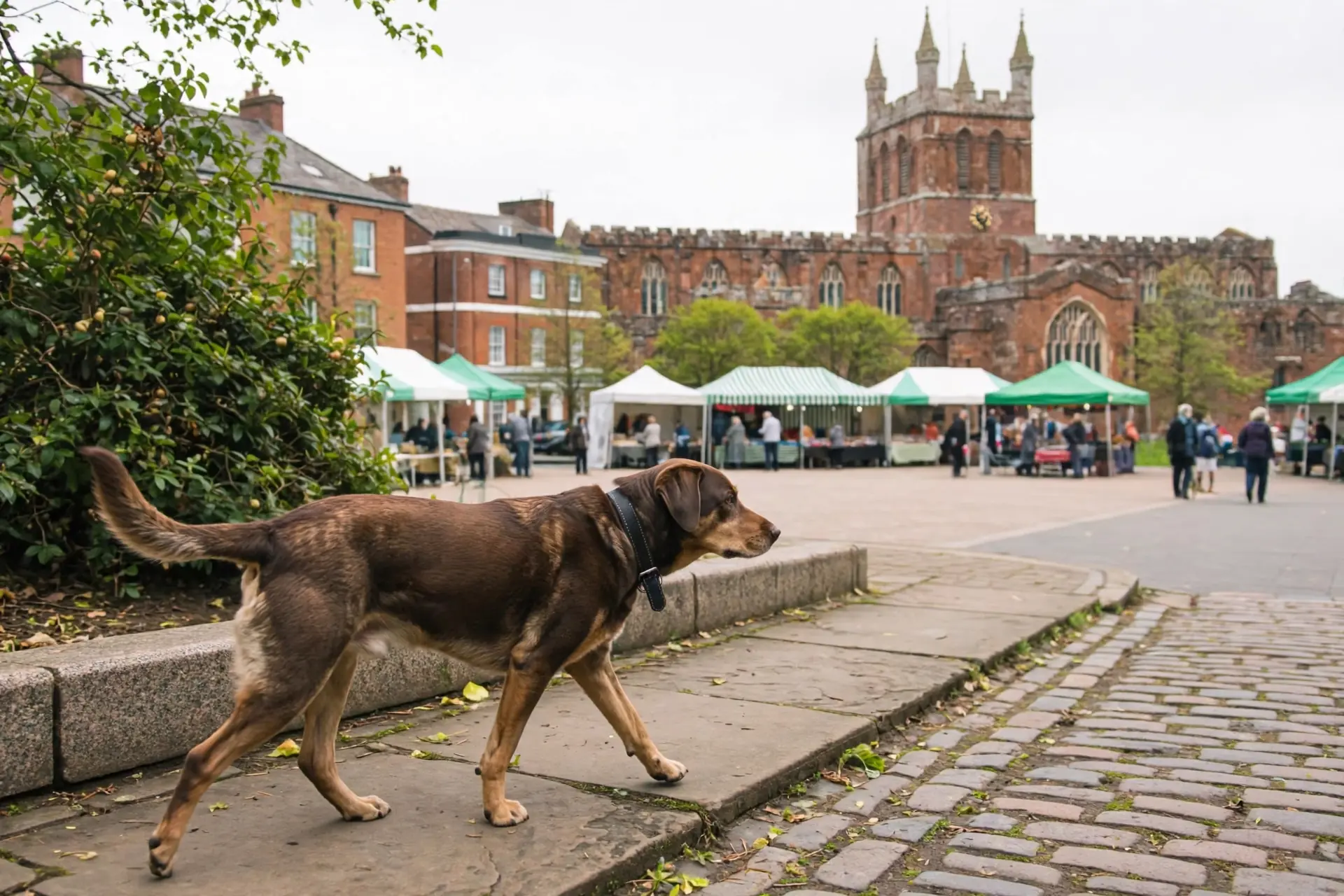
Pick a Saturday and the town hands you its best morning. The farmers' market sets up in the Town Square, a step off the High Street, on the first and third Saturday of each month, usually from ten until one, and the stalls are filled by growers and makers from the parishes around the Creedy Valley rather than by traders who travel the country with the same stock. That is why the square smells of bread and cut herbs instead of hot dogs and fudge, and why the same faces are behind the same stalls month after month. The market has collected awards in Devon, but the more useful sign of quality is the queue: people from Crediton itself come here to do their weekly shop, not to browse. Arrive while the stalls are still being laid out and you will have room to move; by late morning the square is full, and a lead tangles easily around table legs and shopping bags. Keep the dog at your heel past the cheese and cake stalls, where a snatched sample lands you in an apology, and use the quieter edge of the square nearest the church to let the dog settle while you queue.
A market Saturday changes the whole town, and that is the point of planning around it. The High Street is busier, the cafes are fuller, the car parks fill earlier, and the atmosphere is noticeably warmer and louder than on a wet Tuesday in February. That is also when Crediton shows what it is for: neighbours meeting, producers talking about their own food, and a town square doing the job it has done for centuries. On a non-market day the same streets are quieter and easier with a reactive dog, the shops are just as open, and the church and the valley walks are just as good. Neither day is the wrong choice; they are simply different trips, and you should pick the one that suits your dog. A sociable dog that loves people and noise will enjoy market day. A nervous dog, a dog in training, or a dog that barks at crowds will have a much better time on a weekday morning, when the pavements are wide, the pace is slow, and there is room to step aside.
The practical shape of a market day is simple. Arrive before 10am, park in one of the town-centre car parks, and walk the dog first, while the streets are still quiet. A short loop through Newcombe's Meadow or People's Park, both a couple of minutes from the High Street, takes the edge off a dog that has been in the car, and gives you a first look at the town before the stalls open. Then browse the market at a dog's pace, which means stopping often, letting the dog sniff, and accepting that you will not see every stall in one pass. Buy what you need for lunch or for a self-catering stay — bread, cheese, something for a picnic — and then find a cafe with outdoor seating, or a bench in the square, and let the dog settle. After lunch, when the market is packing up, is the time for the church and the longer walk, when the centre has quietened again and the light in the valley is at its best.
Crediton is one of a run of working market towns across the south-west, and it helps to know what kind of town it is before you compare it with the others. It has no seafront, no harbour and no grand Georgian crescent, and it does not pretend otherwise. Its pleasures are smaller and more everyday: a good market, a remarkable church, a High Street that still sells useful things, and countryside that starts at the edge of town. If that sounds like your kind of trip, you will also enjoy the same rhythm elsewhere in the region — our guide to Liskeard with a dog covers another working Cornish market town with a similar mix of town centre, food and valley walks, and it makes a useful comparison when you are choosing where to spend a weekend. Rules, stallholders and opening times change, so where this guide is unsure it says so plainly — check the official guidance before you travel.
The church, the town walk and Crediton's history
The Church of the Holy Cross dominates Crediton for a reason. It is a large, red-sandstone parish church with a central tower, built on the site of a Saxon minster and cathedral, and it is one of the finest historic churches in the south-west. Its full dedication is the Collegiate Church of the Holy Cross and the Mother of Him Who Hung Thereon, one of the longest church dedications in England, and the building itself is Grade I listed. The stone is local red sandstone, from quarries at Posbury, Spencecombe and Knowle, which gives the church its warm, deep colour in low sun and makes it easy to spot from the valley roads as you approach the town.
The history is longer than that of Exeter Cathedral, and it is worth knowing before you walk around the building with a dog. In the early tenth century Crediton was chosen as the site of a cathedral for Devon and Cornwall, with a cathedral built here around 910. In 1050 the see was transferred to Exeter, and the bishop's throne moved with it, which was a blow to the town — but a college of canons remained at Crediton, and the church continued as a collegiate church until the Reformation. A Norman church was built on the present site in the 1130s, the dedication to the Holy Cross came into use after the 1230s, the Lady Chapel and Chapter House were added in the late thirteenth century, and the nave and chancel of the present building date largely from a Perpendicular rebuilding in the fifteenth century. The lower stages of the central tower still show massive Norman work. In 1545 the college was surrendered to Henry VIII, and the townspeople bought the church and its buildings for the town for £200 — a fact that still shapes how Crediton thinks of the building, as something the town owns rather than something it merely visits.
Crediton is also tied to St Boniface, the eighth-century missionary who became the patron saint of Germany and the Netherlands. Tradition holds that he was born here, at Tolleys at the bottom of East Street, around 680, although historians note that the birthplace claim was first made much later and remains a matter of debate rather than settled fact. Either way, the connection is woven into the town: the church, the statue, the veterinary practice and the town's sense of itself all carry the name, and the Boniface story is part of why the church matters beyond its architecture. A dog walk that starts at the church, passes the statue and the bottom of East Street, and then climbs one of the steep streets out of the valley gives you the town's history in about an hour, without needing a ticket or a timetable.
Walk the town itself on foot, and keep the dog on a lead throughout. The centre is compact, but the High Street carries traffic on the A377, the main road between Exeter and Barnstaple, and the pavements are narrow in places. Start at the Town Square and the church, walk the High Street slowly, and look up: the town's interest is in its rooflines, its red brick and sandstone, its shopfronts and its side streets, rather than in any single attraction. The streets climb steeply out of the valley on both sides — Crediton sits between two steep hills — so an older dog or a dog with joint problems will find the flat centre and the parks much easier than the hills. Newcombe's Meadow, with surfaced footpaths, and People's Park, both close to the High Street, are the best places for a gentle, level walk and a toilet stop before you head for the valley.
Dogs are not generally taken inside the church, and you should not assume that a dog will be welcome at a service, a concert or an event inside the building. The churchyard and the streets around the church are the dog's part of the visit: the outside of the building, the tower, the churchyard paths and the views across the town are all best appreciated from outdoors anyway. If you want to go inside, go in turns if there are two of you, or leave the church for a return visit without the dog. Check the official guidance before you travel for opening times, services and any events, because the church is a working parish church first and a visitor attraction second, and its hours follow the parish calendar rather than the tourist season.
River Creedy and valley walks
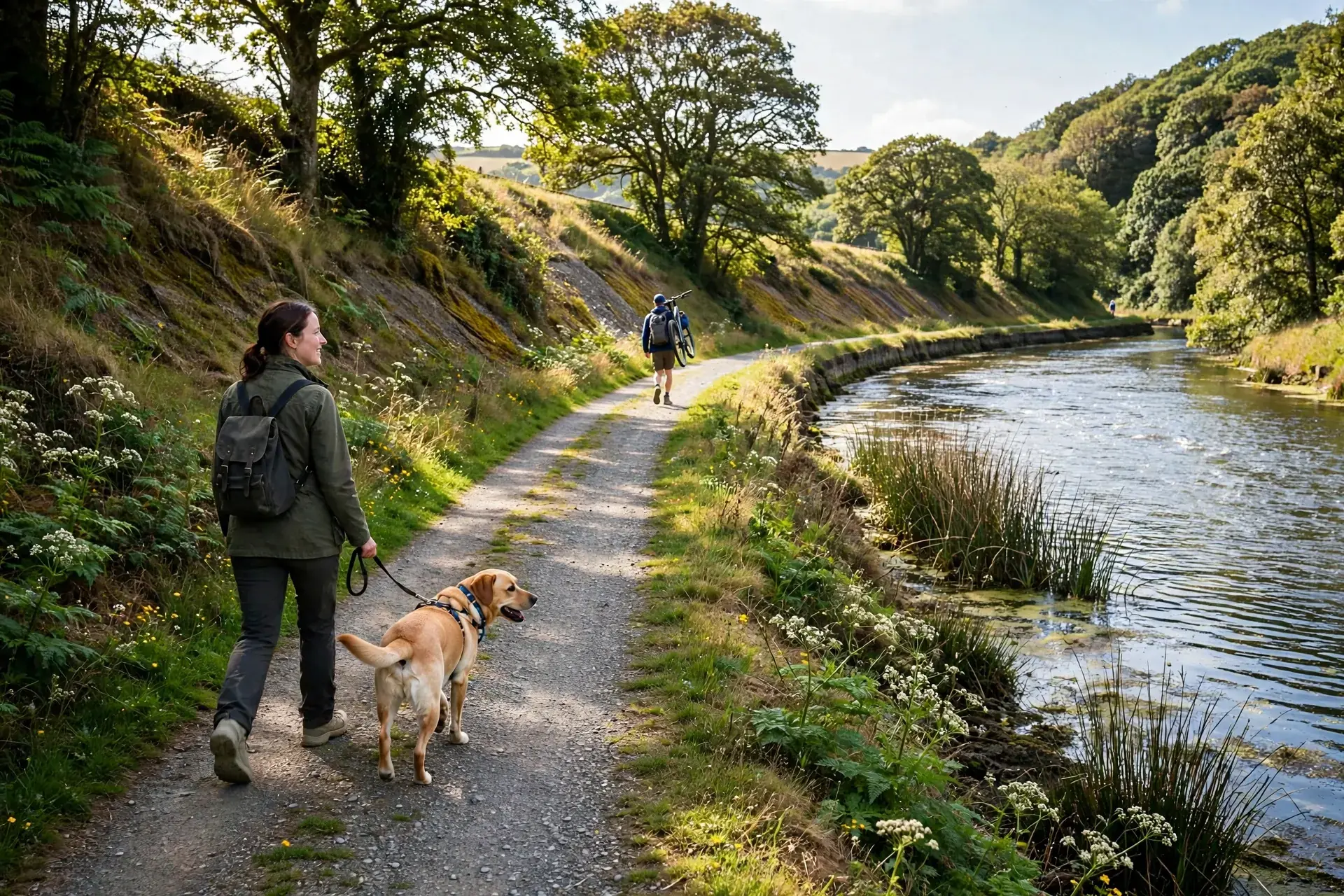
The walking around Crediton is valley walking: rivers, meadows, woodland, lanes and hills, rather than open moor or coast. Two rivers frame the town. The River Creedy runs through the narrow vale to the north and east, and the River Yeo flows to the south, and the town sits in the low ground between them. That geography gives you a choice on any day. The valley bottoms are gentle and sheltered, good for older dogs, puppies and hot days. The hills above them are open and exposed, with wide views across Mid Devon towards Dartmoor, and they are the better choice on a clear, cool day when your dog has energy to burn.
The easiest riverside walk starts in the town itself. A circular route from Newcombe's Meadow heads west along the High Street and then south across the fields to the River Yeo, following riverside footpaths with views across the Yeo Valley, before returning to the town. It is a short, level walk on surfaced paths in the park and field paths beyond, and it suits a morning or an evening stroll, a first walk after a car journey, or a dog that does not need a long hike. Take care where the path crosses fields, keep the dog on a lead near livestock, and expect the field sections to be muddy after rain. The river itself is not a swimming spot for dogs: the banks are steep in places, the current can be strong after rain, and a dog that jumps in may struggle to get out. A paddle at a shallow edge is one thing; a swim in the main channel is another, and the safer choice is to keep the dog on the bank and save swimming for a proper beach day.
For a longer valley walk, head north to Sandford, a village just north of Crediton with its own Millennium Green. The Green has a traffic-free footpath and cycleway that runs from the village towards Crediton, through a mosaic of habitats — pond, orchard, wildflower areas, coppiced woodland and streams that run into the River Creedy — and it is one of the most pleasant short walks in the area. The Ramblers describe a circular route from Sandford village hall car park, high above the River Creedy through fields and along quiet country lanes, at 5.3 miles and about two hours and three quarters, rated moderate. That is a proper half-day walk, not a stroll, and it needs water, a map and a dog that is fit for distance and for hills. The Millennium Green path itself is gentler and shorter, and it is the better choice for a family walk or a dog that is still building fitness.
Another well-used local route runs from Crediton station to Hookway and back, about 3.3 miles and about an hour and a half. It starts at the station car park, crosses the golf course between an avenue of trees, crosses the Yeo at Kersford Bridge, climbs through Hookway Down Wood and along farm tracks with views towards Newton St Cyres and Killerton, and returns by a green lane and field paths to Fordton Cross and the station. It is a good example of what Crediton walking is like: a mix of surfaced paths, farm tracks, woodland and quiet lanes, with stiles, gates and livestock along the way. Some of the stiles on the valley routes are awkward, and large dogs may struggle with them, so if your dog cannot be lifted over a stile, or will not jump one, choose a route that stays on lanes and surfaced paths instead. A longer group route, the Ramblers' exploration of the Yeo and Creedy valleys, runs about eight miles in a circular from the station, taking in Sandford and its church and returning along the River Creedy — a full day out that is best attempted only by a fit dog and a walker who is comfortable reading a map.
Walk the valley with the Countryside Code in mind, and with the practical details that make the difference between a good walk and a miserable one. Keep dogs on a lead around livestock, especially sheep and cattle, and around horses. Close gates behind you. Pick up after your dog and carry the bags to a bin; there are bins at the main access points, but not along every mile of field path, so bring a spare bag and a way to carry a full one. Expect mud: the clay soils of Mid Devon hold water, and a valley path that is firm in August can be churned and slippery in February. Wear boots with grip, bring a towel and a drying coat for the dog, and have a change of shoes for the car. Check the ground with your hand on a warm day, because a sun-baked lane can be hot underfoot, and carry water for the dog on any walk over an hour, because there is no reliable drinking water on the field paths. Check the official guidance before you travel for path closures, because valley paths can be closed for maintenance, flooding or farming work without much notice.
Cafes, pubs and food shopping with a dog
Crediton eats well for a town of its size, and the reason is the same as the market's: the farmland around it produces good food, and the town has kept the shops and cafes that sell it. The High Street and its side streets hold cafes, bakeries, delis and takeaways, along with the supermarkets for a self-catering stay, and the practical result for a dog owner is that you can walk to breakfast, to lunch and to the shops without getting in the car. That matters more than any single venue, because a dog trip that needs a drive for every meal is a tiring trip.
Start with the cafes. Many cafes in Crediton welcome dogs, most reliably at outdoor tables, on pavements and in gardens, and a good number allow dogs inside as well, often in a particular area near the door. The signs to look for are the same as in any British town: a water bowl by the door, a dog biscuit on the counter, staff who greet the dog first, and seating where a dog can lie under a table without blocking the aisle. Do not assume that a cafe that welcomed dogs last summer still does, or that a cafe that welcomes dogs at a pavement table will welcome a large dog into a small dining room at lunchtime. Policies vary from place to place and can change with the season and with the management, so check the venue's own listing or call ahead before you go, especially if you are relying on a particular cafe for a meal.
After a valley walk, the pubs around the High Street and the streets just off it are where a Crediton day usually ends, and the town's pubs are old-fashioned in the useful sense: low ceilings, a bar you can stand at with a dog at your feet, and a garden or a paved yard out the back where a muddy dog is nobody's problem. On a market Saturday those gardens fill by midday, so a walk that finishes at one o'clock lands you in a queue for a table, while a walk that finishes at eleven still leaves you a corner. Ask at the bar before you sit down in the dining room, because the line in most of these pubs is drawn between the bar side, where dogs are part of the furniture, and the tables laid for food, where they are not — and that line can move between a quiet Tuesday and a packed Saturday lunch. A dog that has already been walked, fed and watered will curl up under a bar table and sleep through a long lunch; a dog that arrives full of energy will spend the meal pulling towards every plate that passes. Order something that does not need to be eaten in a hurry, keep the lead tucked under your own chair leg, and if the dog starts to whine at strangers, take the meal outside or take it away — the benches in the square and the grass in Newcombe's Meadow make a better dining room than a pub full of people who did not invite a barking dog to lunch.
Buying food with a dog in Crediton is a matter of using the town's size to your advantage. Everything is within a few streets: the market stalls in the square, the bakers and delis along the High Street, and the supermarkets a short walk from the centre, so you can do a whole shop on foot and never leave the dog waiting in a car. The market is the easiest part, because the stalls are outdoors and the dog can stand beside you while you buy bread and cheese for a picnic or for a cottage kitchen. Inside the High Street shops the rules are mixed — some welcome a dog through the door, some prefer the dog to wait outside — so a second person turns a proper browse into a relaxed one, while on your own the sensible move is a short list and a quick circuit. Tie the dog only where you can watch it from the shop door, on a wide stretch of pavement away from the A377 traffic, and never for longer than a few minutes. On a market Saturday the pavements carry delivery vans, prams and shopping trolleys within a foot of a tied dog's nose, and a short errand is the only kind worth doing that way.
The order of the day matters more than any single trick. Walk first, eat second. A dog that has already had its run along the Yeo or through Newcombe's Meadow arrives at a cafe table ready to sleep; a dog that has been sitting in a car all morning arrives ready to investigate every plate in the room. Feed the dog its own meal before you sit down to yours, or bring a portion of its normal food to hand over once you are seated, so it has something to do while you eat. Not every cafe keeps a water bowl spare on a busy market Saturday, so carry your own bowl and a bottle — the dog will need it after a valley walk in any case. A mat or blanket gives a dog a place that is its own under a table, and a chew or a stuffed toy keeps a puppy occupied while the food arrives. Keep the lead short and under your chair, never stretched across a walkway where a waiter or another customer will trip on it. And read the dog honestly: if it is barking at every passer-by, whining, or pulling at the lead, the lunch is not working. Take the food to go and eat it on a bench in the square or on the grass in the Meadow — nobody will mind, and the dog will settle far faster outdoors than it will in a room full of strangers.
Day trips: Exeter, Dartmoor's edge and the coast
Crediton's greatest strength as a base is its position. It sits about seven miles from Exeter, on the railway line between Exeter and Barnstaple, on the A377, and within easy reach of Dartmoor's eastern edge, the National Trust estate at Killerton, and the south Devon coast. That means a stay here can be a different trip every day without ever driving for hours, and it means a dog that needs variety — a town day, a valley day, a moor day, a beach day — can have it all from one base. The trick is to plan the day trips in the right order, and to leave the car or the train to do the work that the dog's legs should not have to do.
Exeter is the easiest day trip of all, and the train is the best way to do it. Crediton station is about three quarters of a mile from the town centre, on the Tarka Line between Exeter St Davids and Barnstaple, and the journey to Exeter takes about twelve minutes. Dogs can travel on the train, and a well-behaved dog on a lead is a normal sight on this line, but check the operator's rules before you travel, keep the dog off the seats, and avoid the busiest commuter trains if your dog is nervous in crowds. In Exeter, the cathedral green, the quayside and the riverside paths are the dog's part of the city, and the city centre is compact enough to walk with a dog on a lead. Go early, walk the river first, and treat the city as a morning out rather than a full day, because a city centre is tiring for a dog in a way that a valley walk is not.
Killerton, the National Trust estate at Broadclyst near Exeter, is the best easy walk within a short drive of Crediton. Its dog walk is a circular route of about 2.5 miles, taking forty-five minutes to an hour, with wide open space where dogs can be on and off the lead in places, and far-reaching views over rolling Devon countryside. A second route, the Plains walk, is about two miles and takes an hour and a half to two hours, through parkland with veteran trees, open spaces and wildlife. Dogs need to be on a short lead in some areas, and cattle often graze on the estate, so keep your dog in sight and under control, and put the dog on a lead whenever cattle are present. Normal admission charges apply, and National Trust members go free, so check the official guidance before you travel for current prices, opening times and the areas where dogs must be on a lead. Killerton is the right choice for a day when you want a proper walk without a long drive, and it is especially good in autumn, when the parkland colours are at their best and the crowds have thinned.
Dartmoor is the day trip that needs the most care, and the most honest planning. Crediton is a practical base for the eastern edge of the moor rather than for the high moor itself. Moretonhampstead, Chagford and Drewsteignton are a short drive away, and they give you wooded valleys, riverside paths, village pubs and gentler moor-edge walks that suit most dogs. The open moor beyond them is a different place: exposed, boggy in places, crossed by livestock and ponies, and changeable in weather, with mist that can come down fast and hide the path. Do not take a dog onto the open moor without a map, water, a lead and a plan for getting back, and do not let a dog chase ponies, sheep or cattle. The moor-edge villages are the better choice for a first Dartmoor day with a dog, and they are also the better choice for a dog that is still learning recall, because a wooded valley gives you a path to follow and a village to return to. Check the official guidance before you travel for the Dartmoor access rules, the livestock seasons and any temporary restrictions.
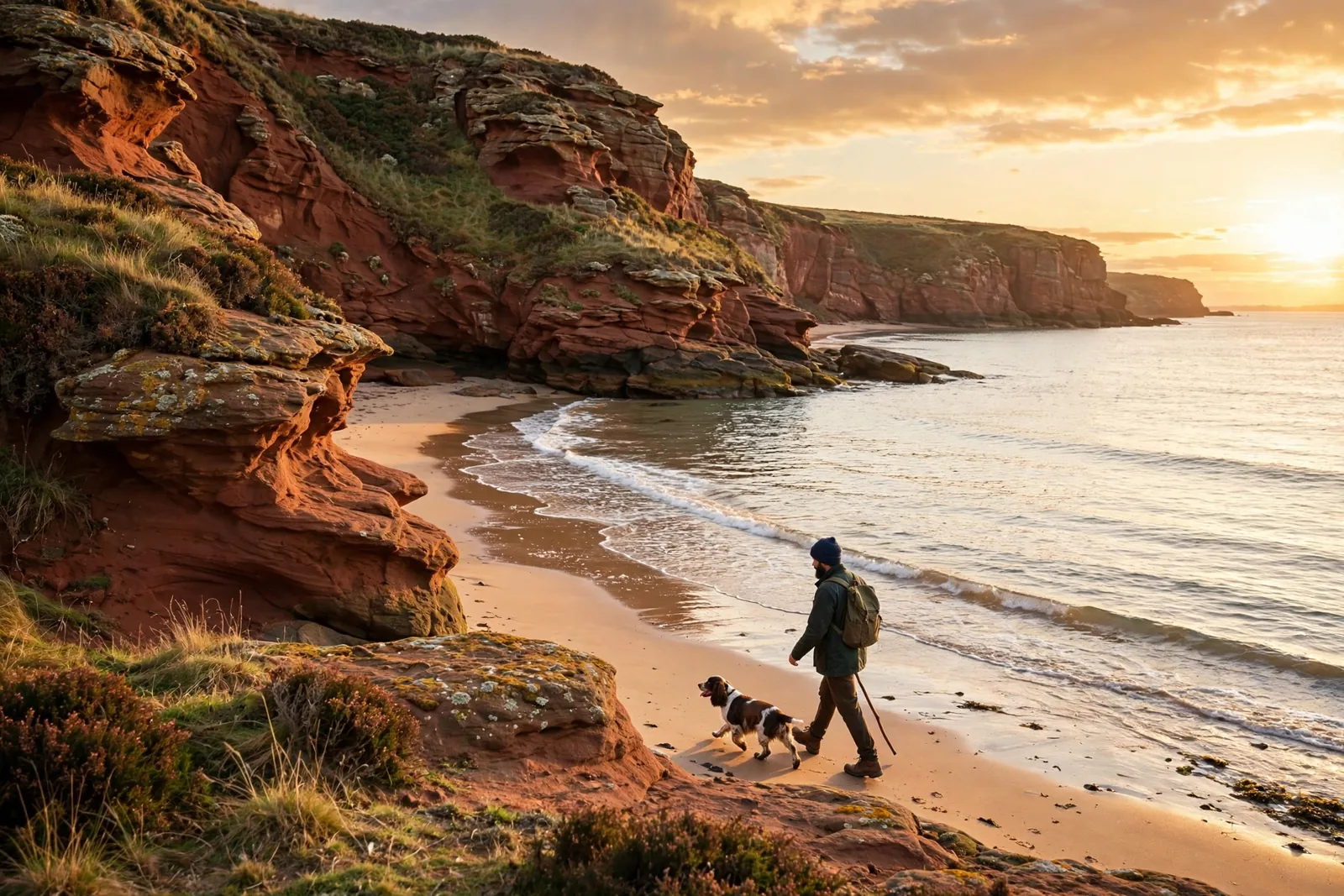
When the dog needs a beach, the coast is the farthest of Crediton's day trips, and it is still an easy one. Head south through Exeter to the Exe Estuary and on to Exmouth, and the valley gives way to sand, sea wind and open sky in under an hour's drive. The estuary paths and the beach at Exmouth follow their own seasonal rules, and those rules are the first thing to look up before you set out, because a beach that welcomes dogs in February may ban them in July, and the fine print changes from one stretch of sand to the next. A good rhythm from Crediton is to take the trips in turn: a valley walk one day, the market and the church the next, a moor-edge village after that, and the coast when the forecast is calm and dry. The wooded valleys around Sandford and Hookway are the best answer to a wet day, the beach is the best answer to a still one, and the cafes and shops on the High Street cover the day when the rain settles in for good. That is the real advantage of staying here: nothing is far enough away to need a perfect plan, and a change of weather is a change of destination, not a ruined day.
Staying over and parking
A longer stay in Crediton works because the town is built for living in, not just for visiting. The shops, the supermarkets, the pharmacy, the cash machines and the vets are all within a short walk of the centre, so a week here runs on foot: park the car on arrival, walk to the shops for dinner, walk the dog along the Yeo in the evening, and repeat the next day. That is a different kind of holiday from a stay in a pretty coastal village where every loaf of bread means a drive, and for a dog owner it matters more than a view from a window. The town is also on the railway line and the A377, so a base here keeps Exeter, the moor edge and the coast all within reach without moving house halfway through the week.
Places to stay in and around Crediton fall into a few shapes, and the shape matters more than the star rating. In the town itself there are small hotels and bed and breakfasts within a short walk of the High Street, which suits a night or two when you want to step out for breakfast and be at the market by ten. On the edges of town and in the villages around it — Sandford, Newton St Cyres, the lanes towards Hookway — there are self-catering cottages and farm stays, some with gardens that back onto fields and footpaths, which suit a longer stay when the dog needs space and a routine. Further out there are holiday parks and campsites in the Mid Devon countryside. Whatever shape you choose, the questions are the same, and they are worth asking before you pay: is a dog welcome in the exact room or cottage, or only somewhere on the property; how many dogs, and is there a charge per dog or per stay; is the garden fenced all the way round, and can a determined dog push the gate open; can the dog be left alone in the room, and for how long; and is the floor hard or carpeted, because a valley walk in February leaves mud on everything. A ground-floor room spares an older dog the stairs, and a cottage within walking distance of a river path beats a prettier one that needs a drive to every walk.
For a stay of more than a couple of nights, a cottage or apartment of your own usually fits a dog better than a hotel room, and Crediton is a town where that choice pays off. A kitchen means you can cook with market produce instead of eating every meal out, a garden or terrace means the dog has somewhere to stretch its legs first thing in the morning without a drive, and your own front door means you come and go on the dog's timetable rather than a hotel's. The details to check are practical ones: a garden that is actually enclosed, with a fence a dog cannot jump and a gate that shuts properly; a washing machine for towels that have mopped up valley mud; and a location that lets you walk to the river or the park from the front door. A cottage on the edge of town with a path to the Creedy is worth more than a smarter one in the middle of nowhere. If a holiday park appeals instead, the same checks apply — dog limits, charges, fencing, and the rules on leaving a dog alone — and our guide to dog-friendly holiday parks in Devon sets out the coast and moor options and the drive times from a base like Crediton.
A hotel or bed and breakfast in Crediton suits a short stay, and several in the town take dogs, but the arrangement is narrower than in a cottage. The dog is usually welcome in your own room and not in the dining room, so breakfast is eaten without the dog or taken back to the room — worth knowing before you book, not after. Ask about a charge and about any size limit, and ask where the dog can be walked first thing in the morning: a place a few minutes from the parks or the river paths is a far better start to the day than one on the A377, where the first walk of the morning is along a pavement beside traffic. A short email to the owner that names the dog, the room and the charge, and gets a reply in writing, is worth more than any pet-friendly filter on a booking site — filters describe a property, not your dog.
Parking in Crediton is straightforward if you plan for it, and it is worth planning because the town is small and the centre fills up on market days. The town-centre car parks, including Market Street and St Saviour's, are the most practical choice for a visit to the High Street, the church and the Town Square. Market Street car park is a medium-stay car park with 27 spaces, two disabled bays and a motorcycle bay, and its charges are set by Mid Devon District Council, with an overnight rate as well as daytime rates — check the official guidance before you travel for current prices and time limits, because charges change and this guide cannot promise a price that may have moved. The station car park, with 78 spaces, suits walks that start at the railway station and the valley paths to the east, and it is also the obvious choice if you are arriving by train and need to leave a car. There is also on-street parking in some central locations, but it is short-term and in demand, and residential streets near the centre can be busy at school drop-off times and during town events.
Market Saturdays set the timetable for parking. The car parks closest to the Town Square are full by mid-morning on the first and third Saturday of the month, so arrive before the stalls open or park a little further out and walk in — the walk from the station car park to the square takes about fifteen minutes and is usually quicker than circling the centre. If you are staying overnight, ask your host about parking before you arrive: some cottages and hotels have a space of their own and some rely on the town car parks, and the overnight rules are not the same as the daytime ones. And never leave a dog in a parked car in warm weather, even for a few minutes while you browse the market or eat lunch — a car in the sun heats fast, a dog cannot tell you it is in trouble, and a short errand that runs long is a risk the trip does not need.
Vets, kit list and practical details
Crediton is well served for veterinary care, which is reassuring on a trip with a dog, and it is worth knowing where the vets are before you need them. St Boniface Veterinary Clinic is on Exeter Road in Crediton, and it is a long-established, independent mixed practice with small-animal, farm and equine teams, and with emergency care available. Save its number in your phone when you arrive, along with the number of your own vet at home, and keep your dog's insurance details and any medication in the same place. If your dog needs regular medication, bring more than you need for the trip, and keep it in its original packaging with the prescription label, because a pharmacy or a vet in an unfamiliar town will need to see what the drug is. For an emergency out of hours, call the practice first rather than driving straight there, because the out-of-hours arrangements may direct you to a different site, and check the official guidance before you travel for the current emergency number.
What you pack for Crediton depends on the ground, and the ground here is clay. The valley paths hold water after rain, the field paths churn to mud in winter, the lanes are steep out of town, and the stiles on the longer routes are not built for a dog that cannot be lifted. A short lead for the High Street and the market, a long lead for the valley paths, and a spare in the car cover most days, with a harness that fits well enough to lift the dog over a stile if you have to. Water matters more than it looks: there is no tap on a field path, and a dog that has walked two hours through the valley will be thirsty long before you are back at the car, so carry a bottle and a collapsible bowl on anything over an hour. A towel and a drying coat earn their place after every wet walk, a blanket keeps the car seat dry on the way home, and poo bags need to be counted generously — the bins are at the car parks and the park gates, not along every mile of path, so bring a way to carry a full bag until you reach one.
- Leads and harness: a short lead for the High Street, the market and livestock, a long lead for the valley paths, and a spare lead in the car.
- Water and food: a collapsible bowl, water for any walk over an hour, the dog's normal food, and any medication in its original packaging.
- Drying and cleaning: two towels or a drying coat, a waterproof mat for the car, and a lidded box by the door for muddy leads.
- Weather and safety: a dog coat for a short-coated dog in wind or rain, a torch for evening walks on unlit lanes, and a hi-vis band if you walk on lanes at dusk.
- Paperwork and numbers: the vet's number, your own vet's number, insurance details, and a note of the dog's microchip number.
Getting to Crediton is part of the planning, and the town is easier to reach than many Devon market towns. By car, the A377 runs through the town and links south-east towards Exeter and north-west up the Taw valley towards Barnstaple and the north Devon coast. The surrounding lanes are narrow and winding, so journeys to villages can take longer than the map suggests, and you should allow extra time for a lane with a tractor, a horsebox or a delivery van coming the other way. By train, Crediton station is on the line between Exeter St Davids and Barnstaple, with regular services, and the station is about three quarters of a mile from the town centre — a walk of about fifteen minutes, or a short taxi ride if you have luggage and a dog. By bus, services link Crediton with Exeter and the surrounding villages, but they are less frequent than the train, so check the timetable before you rely on a bus for a day trip. If you are not driving, the train is the most reliable way in and out, and the town centre is compact enough to walk once you are there.
Crediton changes with the season, and the change is big enough to choose around. Spring brings green valleys, wild garlic and bluebells along the hedgerows, and the market fills with the first local produce of the year — the best time for a long valley walk with a dog that likes cool air. Summer is the busiest season: the market is full, the valley paths are firm, and the heat on the open hills can be serious for a dog, so start early, carry more water than you think you need, and watch for heavy panting, drooling, and a dog that suddenly wants to lie down in the shade. Autumn thins the crowds and softens the light, and the parkland at Killerton is at its best then, which makes it the easiest season for long walks. Winter is quiet — the church, the market and the valley paths are still there, and you may have a mile of path to yourself — but the clay is muddy after rain, the wind in the valley is cold, and some cafes and pubs shorten their hours outside summer. Whatever the season, read the forecast and look for temporary closures or maintenance on the paths before you set out.
The town runs on a rhythm of its own, and a day that follows it is an easier day. Early morning belongs to dog walkers and commuters: the streets are quiet, the parks are empty, and a nervous dog can have the pavements to itself. By mid-morning the shoppers arrive, and on a market Saturday the Town Square fills with stalls and crowds, which is the best time to be somewhere else with a dog that dislikes noise — out on a valley path, or up at the church while the square is at its loudest. Lunchtime is when the cafes and the High Street are at their busiest, and a table with a dog is hardest to find. Late afternoon is the sweet spot: the light turns warm on the red sandstone, the crowds thin, and the valley paths go back to being local walks. A day that fits the pattern looks like this: park in the centre, give the dog a run in Newcombe's Meadow, browse the market while the stalls are still quiet, eat lunch somewhere with outdoor seating, walk the church and the High Street in the afternoon, and finish with a slow walk towards Sandford or Hookway before the drive home. Town walk, market, church, cafe and valley walk in a single day, with barely any driving — and a good way to find out whether Crediton suits you and your dog.
Practical questions
Before you go
What is there to do in Crediton with a dog?
Walk the town centre and the Church of the Holy Cross, time your visit for the farmers' market on the first and third Saturday of the month, use the parks and the River Yeo and River Creedy paths for shorter walks, and use Crediton as a base for Exeter, Killerton and the edge of Dartmoor. Most of the best of Crediton is outdoors and on a lead, so plan for the weather and the livestock on the valley paths.
Can dogs walk along the River Creedy near Crediton?
Yes, on the public footpaths and permissive paths in the Creedy Valley, including the traffic-free path from Sandford's Millennium Green towards Crediton and the longer valley routes towards Hookway. Keep your dog on a lead near livestock, on narrow lanes and where the path crosses farmland, and expect stiles, muddy ground after rain and some sections that are not suitable for dogs that struggle with steps. Check the official guidance before you travel for path closures.
Are dogs welcome in cafes and pubs in Crediton?
Most cafes and pubs in Crediton are happy to have a dog, above all at an outdoor table, in a garden, or in the bar, while a dining room laid for food is a different matter and varies from place to place. House rules shift with the season and with the landlord, so look at the venue's own listing or ring ahead before you count on a particular table. Pick a spot where the dog can lie out of the way, and bring a mat, water and a chew for a restless dog.
Is Crediton a good base for Dartmoor walks with a dog?
Crediton is a practical base for the eastern edge of Dartmoor rather than for the high moor itself. Moretonhampstead, Chagford and Drewsteignton are a short drive away and give you wooded valleys, riverside paths and gentler moor-edge walks, while the open moor needs a longer drive, a map, and care around livestock, boggy ground and changeable weather. Stay in Crediton for the town, the market and the valley walks, and treat Dartmoor as a day trip.
Where is the best place to park in Crediton with a dog?
Park in the town centre for the High Street, the church and the Town Square — the Market Street and St Saviour's car parks put you a few minutes' walk from all three — and use the station car park for walks that start at the railway station and the valley paths to the east. On farmers' market Saturdays, come before the stalls open, because the centre fills up quickly. Look up the current charges and time limits before you travel, and never leave a dog in a parked car in warm weather.