This guide is independent and contains no paid placement. If affiliate links are added later, they will be clearly marked and will not change our editorial checks.
Beaumaris suits a calm, unhurried dog day. Start with the tide times, walk the flat promenade, enjoy the castle grounds on a lead, and save the beach for low water. The town is small enough to explore on foot, and the views across the Menai Strait to Snowdonia do most of the work.
Plan around the tide first
Most British seaside towns reward an early start. Beaumaris rewards a tide check. The Menai Strait is a narrow, fast-moving channel between Anglesey and the mainland, and the water beside the promenade can look calm one hour and busy the next. A dog that loves to paddle needs a plan that respects that movement, and a dog that prefers dry paws needs a route that never depends on the shore being there at all. Before you set off, look up the tide times for the day of your visit and build the day around them, not around a fixed list of stops. If low tide falls in the morning, make that your beach window. If high tide covers the middle of the day, treat the castle, the pier and the town streets as the main event and leave the sand for later.
This one habit changes the whole shape of the visit. On a rising tide, the sensible order is promenade first, castle second, lunch third, and a beach walk only if the water has dropped enough by the afternoon. On a falling tide, the order reverses: take the beach while it is open, then come back to town as the water returns and the light changes over the strait. Either way, keep the dog on a lead near the water, watch for slippery seaweed and wet stone, and do not let a dog chase the edge of the tide. The strait can move faster than it looks, and a dog that runs after receding water can quickly find itself further out than its owner intended. A long line gives a keen swimmer freedom without giving the current a chance to decide the route.
The tide also affects what you will see. At high water, boats sit close to the pier and the strait looks wide and silver, with the mountains of Snowdonia clear across the water on a good day. At low water, the shore reveals sand, rock pools and wading birds, and the town feels closer to the water. Neither state is better in itself; the mistake is arriving with a plan that only works in one of them. Pack for both. Bring a towel and a drying coat even if you do not expect your dog to get wet, because a single enthusiastic paddle can soak a coat in seconds, and a wet dog in a car is a familiar end to an otherwise good day. Bring drinking water too, because seawater is not a substitute and a dog that has been running on sand will be thirsty long before you reach a cafe.
Finally, use the tide as a way to pace the dog rather than as a timetable to fight. Beaumaris is a small town, and the best version of a day here is unhurried: a short walk, a long sit with a view, another short walk, and a rest. Dogs that are pushed from one highlight to the next without a pause often become restless by mid-afternoon, while dogs that are given time to sniff, watch boats and settle beside a bench tend to enjoy the same places far more. If the tide is wrong for the beach, do not force it. The promenade, the castle green and the town itself are enough for a satisfying day, and the beach will still be there on the next visit, at a better hour.
The first hour: parking, toilets and settling in
Beaumaris is compact, and that is its greatest advantage for dog owners. Once you have parked, almost everything worth seeing is within a short, flat walk. That matters most in the first hour, when a dog is still reading a new place: new smells, new sounds, gulls overhead, boats moving on the water, and other dogs passing on narrow pavements. Give that first hour a simple job. Park, let the dog out calmly, offer water, take a short toilet walk, and let the dog settle before you ask it to queue, pose for photographs or walk through a busy street. A dog that has had a chance to sniff and empty itself will cope far better with the castle, the pier and a cafe than a dog that is still holding everything in.
Parking in Beaumaris is centred on the seafront and the town centre, with car parks a short walk from the promenade. Charges, time limits and payment methods can change, so check the official guidance before you travel and read the signs at the machine or on the parking app before you walk away. On busy summer weekends and bank holidays, arrive early or be prepared to park a little further out and walk in. That extra walk is rarely a problem in itself — the approach into town is part of the visit — but it is worth knowing about if your dog struggles with distance, heat or crowds. If you are travelling with an older dog, a puppy or a dog that finds busy car parks stressful, choose a quieter arrival time and a parking spot that lets you unload without crossing a stream of traffic.
Public toilets and dog-waste bins are part of the same first-hour check. Locate the nearest bins before you need them, carry your own bags as a backup, and never assume a bin will be exactly where you expect it. The promenade and the castle area are well used, so keeping to the paths and clearing up promptly matters more here than on a quiet country walk. If your dog is reactive, the first hour is also the time to learn the town's pinch points: narrow stretches of pavement, corners with poor sightlines, and places where dogs meet head-on. Crossing to the wider side of the promenade, pausing to let another dog pass, or taking a quiet side street for a few minutes can prevent a tense encounter before it starts.
Settling in also means thinking about the car. On a warm day, never leave a dog in a parked car, even for a short stop, and remember that a car parked in sun by the seafront can heat up quickly while you are admiring the view. Plan your stops so the dog is with you, and keep shade, water and ventilation in mind whenever you pause. On a cold or wet day, the opposite problem applies: a dog that has been standing on a windy promenade will cool down fast, so a drying coat and a warm car or cafe stop are worth building into the plan. The first hour is not wasted time. It is the foundation for the rest of the day, and a calm start in Beaumaris pays off in a calmer dog at the castle, on the pier and at lunch.
Beaumaris Castle with a dog
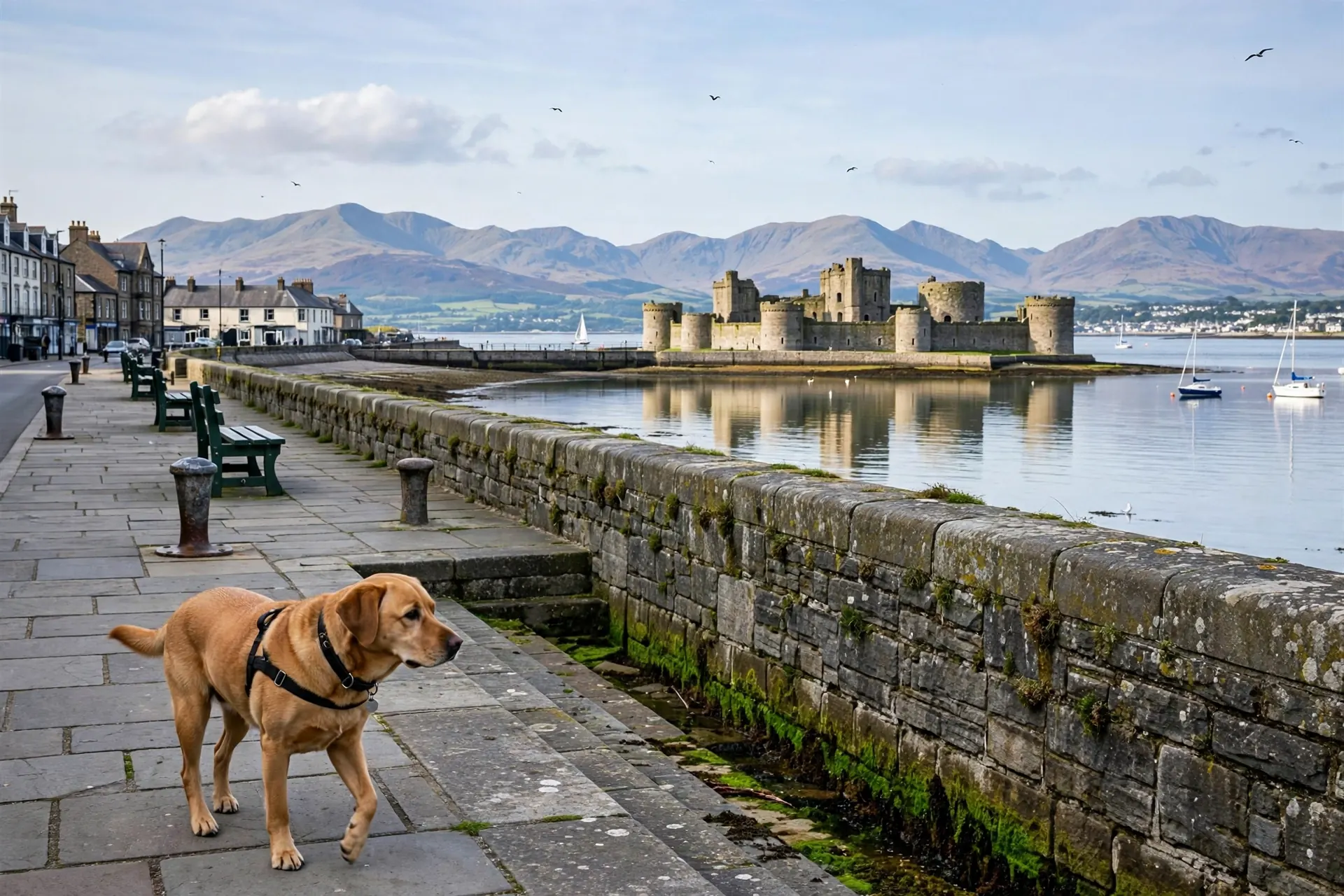
Beaumaris Castle is the town's great landmark, and it is also the stop that most visitors plan first. Built in the late thirteenth century as part of Edward I's ring of castles in North Wales, it is a low, wide, moated fortress rather than a tall tower on a hill. That shape suits dogs well. There is no long climb to reach it, the grounds are open, and the views from the walls and the surrounding green give a dog plenty to look at without a steep walk. The castle is managed by Cadw, the Welsh historic environment service, and the practical rules for dogs can change, so check the official guidance before you travel rather than relying on a general impression that castles are either dog-friendly or not. Our wider guide to dog-friendly castles in Wales explains how different sites handle dogs, and why the rules often vary between the grounds, the indoor rooms and the visitor centre.
In general, dogs are welcome in the outdoor areas of many Welsh castles on a lead, while indoor spaces are more restricted. That distinction matters in Beaumaris, because the pleasure of the visit is largely outdoors: the moat, the curtain walls, the towers, the green spaces and the views across the strait. A dog on a short lead can enjoy all of that without needing to enter a small indoor room. Keep the lead short around other visitors, children and the water, and be ready for the moments when a dog meets a stranger on a narrow wall walk or a stone staircase. Some dogs are confident on stone steps and uneven surfaces; others are not. If your dog hesitates on stairs, do not force the climb. The ground-level views are excellent, and a dog that is comfortable on the grass will enjoy the visit far more than a dog that has been coaxed up a staircase it did not want to climb.
Allow at least an hour for the castle, and longer if you like to read the information panels and take your time. The site rewards slow looking: the symmetry of the walls, the way the moat reflects the stone, the gaps in the towers where the building was never finished, and the views back towards the town and across the water. For a dog, the interest is simpler and just as real: new smells, open grass, the sound of water, and the chance to watch people and birds. Bring water, because there is little shade on a hot day, and keep an eye on the ground in summer, when stone surfaces can become warm underfoot. In wet weather, the stone can be slippery, so shorten the lead and walk at the dog's pace rather than hurrying between viewpoints.
After the castle, the green beside it makes a natural pause. It is a good place to let the dog settle, offer a drink, and decide what comes next. If the dog is still full of energy, the promenade is waiting. If the dog is already tired, a shorter loop back through town is the wiser choice. The castle does not need to be rushed, and it does not need to be combined with a long walk in the same hour. Treat it as one chapter of the day, not as a race to the next attraction, and the dog will remember it as a calm, interesting place rather than as a crowded stop on a busy itinerary.
The seafront, the pier and the strait
The Beaumaris seafront is the heart of a dog day in the town. It is flat, paved, and long enough to feel like a proper walk without ever becoming a hike. The promenade runs beside the water with the castle at one end and the pier reaching out into the strait, and the views across to the mainland are the reason many people come here in the first place. On a clear day, the mountains of Snowdonia rise beyond the water, and the whole scene changes with the light: bright and sharp in the morning, softer in the afternoon, and often at its best in the early evening when the water turns gold. For a dog, the seafront is a sensory walk — gulls, boats, fishing smells, other dogs, and the constant movement of the water — so keep the lead on and let the dog take it in at its own pace.
The pier is a short, pleasant extension of the promenade, and it is worth including if your dog is comfortable on a pier. The surface, the railings and the open water below can unsettle some dogs, especially small dogs and dogs that are nervous about heights or gaps. Watch your dog's body language on the first few steps. A dog that walks confidently can continue to the end for the view; a dog that freezes, pulls back or tries to turn around should be allowed to do so without fuss. There is no prize for reaching the end of a pier, and the view from the promenade is nearly as good. If you do walk out, keep the lead short, keep the dog away from the edge, and be careful with fishing lines and hooks, which can be present near anglers. A dog that sniffs at the ground near fishing gear needs close supervision.
Boats are part of the seafront's character. Beaumaris has a long maritime history, and the strait is still a working waterway with pleasure boats, fishing boats and, in season, boat trips. Some dogs are fascinated by boats; others are startled by engines and movement. If your dog is noise-sensitive, give passing boats a little distance and do not stand directly beside a loud engine while it starts. If your dog loves watching boats, the pier and the benches along the promenade are good places to sit and watch together. Either way, the seafront is a place to pause, not just to pass through. Sit for ten minutes, let the dog settle beside you, and the town will feel less like a checklist and more like a place you have actually visited.
The practical rules for the seafront are simple but worth stating. Keep your dog on a lead, clear up after it, and keep it off the road where traffic passes close to the pavement. In summer, check the paving temperature with your hand before a long walk, and offer water regularly. In winter, the wind off the strait can be sharp, so a coat helps a short-haired or older dog, and a sheltered bench or a cafe stop makes a sensible break. The seafront is at its best when it is not crowded, so an early morning or late afternoon walk often feels calmer than the middle of a busy summer day. If you are staying overnight, that quieter hour is the one to remember.
Beaches within an easy drive
Beaumaris itself is a town for promenade walking rather than a long beach day, so most dog owners who want sand will drive a short distance to a nearby beach. The good news is that Anglesey has a remarkable range of beaches within easy reach, from wide sandy bays to quieter coves, and the choice depends on the dog you have rather than on a single best beach. A dog that loves to run needs space and a reliable recall; a dog that loves to paddle needs shallow water and a gentle slope; a dog that is nervous around other dogs needs a quieter stretch and a time of day when the beach is less busy. Our Anglesey guide covers the island's beaches, coast path walks, tides and seasonal rules in more detail, and it is worth reading alongside this page if you are planning more than one beach stop.
Before you choose a beach, check the seasonal rules. Some Anglesey beaches have dog restrictions during the summer months, and the dates and zones can differ from one beach to another. The safest approach is to check the official guidance before you travel, look for the signs at the beach entrance when you arrive, and respect any zoned areas even if other dogs seem to be ignoring them. A beach that is dog-friendly in October may have a restricted zone in July, and a beach that welcomes dogs all year may still have a section where dogs are not allowed. Do not rely on memory or on a single online comment. The sign at the car park is the rule that matters on the day, and a ranger or warden will expect you to follow it.
When you arrive at a beach, take a minute to read the ground before you let the dog run. Check the tide direction, the slope of the sand, the presence of other dogs, and any livestock or birds nearby. Beaches near estuaries and inlets can have soft mud, fast channels and strong currents, so keep a dog on a long line until you are sure of the conditions. Watch for hazards that are easy to miss: sharp shells, fishing hooks, broken glass, and the remains of barbecues or picnics. A dog that eats whatever it finds on the sand needs closer supervision, and a dog that chases birds needs to be kept away from nesting or roosting areas, especially in spring and early summer.
Pack for the beach as if the dog will get wet, sandy and tired, because it probably will. A towel, a drying coat, fresh water, a bowl, a spare lead and a bag for wet gear will all earn their place in the car. Rinse salt and sand off the dog's coat and paws after the walk, check between the toes for grit, and offer water before the drive home. If the dog has been swimming, watch for tiredness on the way back; swimming is hard work, and a dog that has been in the water for twenty minutes may be more tired than a dog that has walked for an hour. A short, calm walk after the beach, a drink, and a rest in the car or at your accommodation will help the dog recover. The beach is a highlight, not a test of endurance, and the best beach days end with a settled dog rather than an exhausted one.
Longer walks from town
Beaumaris is a good starting point for longer walks, but the best of them are not about distance for its own sake. They are about variety: a stretch of coast path, a wooded climb with a view, a quiet lane, and a return along the water. The Anglesey Coastal Path runs around the island, and the sections near Beaumaris offer a mix of seafront, shore and countryside that suits a fit dog and an owner who enjoys a proper walk. The path is waymarked, but conditions vary with the weather and the season, so check the official guidance before you travel, wear suitable footwear, and carry water for both of you. A walk that is easy in dry weather can become muddy and slippery after rain, and a path that is fine for a confident walker may be too exposed for a dog that is nervous near drops or livestock.
One of the most rewarding options near town is a walk that climbs gently away from the water for a view back over the strait. Woodland and hillside paths offer shade in summer and shelter in wind, and they give a dog a different kind of walk from the promenade: softer ground, more smells, and fewer people. Keep your dog on a lead where the path passes through farmland or near livestock, and be ready to shorten the lead on narrow stretches where walkers, cyclists or other dogs may appear suddenly. Sheep and cattle are a normal part of the Anglesey countryside, and a dog that chases livestock is a serious problem. Even a friendly dog can cause distress, and the law is clear that a farmer may act to protect livestock. A lead is not a restriction on a good walk; it is what makes the walk possible in the first place.
For a shorter option, a loop that combines the promenade, the castle green and a quiet residential street gives a dog a satisfying walk without leaving town. This is the right choice for older dogs, puppies, dogs recovering from injury, and dogs that are visiting Beaumaris for the first time. It is also the right choice on a hot day, when a long exposed walk would be too much, and on a wet day, when a short loop with a cafe stop is more enjoyable than a long muddy path. Do not judge a walk by its length. Judge it by how the dog feels at the end of it. A dog that comes home relaxed, drinks, and settles quickly has had a good walk, whether it covered two miles or six.
Whatever route you choose, build in a rest. Dogs need water, shade and a pause, especially on a warm day or a long walk. Carry a collapsible bowl, offer water at regular intervals, and watch for signs of tiredness: lagging behind, panting heavily, seeking shade, or lying down. If the dog shows those signs, stop, rest, and shorten the route. The coast path will still be there tomorrow, and a dog that is pushed too far on one walk may be reluctant to walk at all the next day. A good walk ends with the dog still keen to go out again, not with a dog that has to be carried back to the car.
Where to eat and drink with a dog
Beaumaris has a good range of cafes, pubs and places to eat for a small town, and many of them welcome dogs, at least in part. The details vary: some venues welcome dogs throughout, some welcome them on a terrace or in a defined area, and some welcome them only outside. Policies can also change with the season, the time of day and how busy the venue is. The practical approach is to check the official guidance before you travel where a venue publishes its policy, and otherwise to ask at the door before you settle in with a dog. A quick question — "Is it all right to bring our dog in, and where would you like us to sit?" — saves an awkward moment later, and it shows the staff that you are a considerate owner.
Terraces and outdoor seating are often the easiest option, especially in summer. A dog can settle under a table, watch the street, and enjoy the fresh air without the constraints of an indoor room. Bring a mat or blanket for the dog to lie on, a water bowl, and something to keep the dog occupied if it is the sort that becomes restless while you eat. A chew or a stuffed toy can help, but avoid anything that smells strongly or makes a noise that disturbs other diners. Keep the lead short and the dog out of the walkway, and be ready to move if the dog becomes unsettled. A meal that ends early because the dog is unhappy is better than a meal that ends with a complaint from another table.
Indoor dog-friendly areas need a little more preparation. A dog that is calm at home may still find a busy pub challenging: new smells, food on tables, children, other dogs, and the sound of glasses and cutlery. If your dog is not used to indoor venues, start with a short visit — a drink rather than a full meal — and build up from there. Choose a table in a corner or against a wall, where the dog has a clear space to settle and fewer people passing close by. Order food that is easy to eat without a long wait, and keep the dog's attention on you rather than on the plates around it. If the dog barks, paces or tries to climb onto furniture, take it outside for a break rather than trying to manage the behaviour at the table.
Takeaway food is a useful fallback, and Beaumaris has options that suit a dog day well. Fish and chips, sandwiches and pastries can be eaten on a bench by the seafront, on the castle green, or back at your accommodation, and they avoid the question of indoor access altogether. If you choose this option, be careful with food that is dropped on the ground: bones, wrappers and hot food can all be hazards for a dog, and gulls can be bold around outdoor food. Keep the dog on a lead while you eat, keep food out of reach, and clear up afterwards. A takeaway lunch on the seafront, with the dog settled beside you and the strait in front of you, is often the most memorable meal of the day.
Staying overnight in Beaumaris
Beaumaris works well as an overnight base, not just as a day trip. Staying overnight changes the rhythm of the visit: you can walk the seafront early, before the day visitors arrive, and again in the evening, when the light is softer and the town is quieter. You can also use Beaumaris as a base for wider Anglesey exploring, returning each evening to a familiar place rather than driving to a new town every night. That familiarity matters for a dog. A dog that sleeps in the same place for two or three nights will settle faster, eat better, and cope better with new walks than a dog that is moved every day.
Accommodation in and around Beaumaris includes hotels, guest houses, bed and breakfasts, self-catering cottages and holiday lets, and the dog rules vary widely. Some places welcome dogs throughout, some welcome them only in selected rooms, and some charge a fee per dog per night. Others have limits on the number or size of dogs, or ask that dogs are not left alone in the room. Ask the specific questions before you book: how many dogs are allowed, what the fee is, whether dogs can be left alone, whether there is a garden or a nearby toilet area, and whether dogs are welcome in the dining room or only in the bedroom. Get the answers in writing with your confirmation, and keep them with your booking details. A verbal reassurance is easy to forget; a written confirmation is easy to check.
When you arrive at your accommodation, give the dog the same calm first hour you gave the town. Walk the garden or the nearby toilet area, check gates and fences, move anything chewable or dangerous out of reach, and set up the dog's bed in a quiet corner. Bring the dog's own bedding, food and bowls from home, because familiar smells help a dog settle in a new room. If the accommodation has a garden, check it before you let the dog off the lead: look for gaps in fences, low walls, and gates that do not close properly. A garden that looks enclosed in a photograph may have a side gate that a determined dog can push open, and a dog that escapes into an unfamiliar town is a stressful situation for everyone.
Evening routines matter as much as arrival routines. Take the dog for a last walk before dark, along a route you already know, and keep the lead on if the streets are unfamiliar. Feed the dog at its usual time, offer water, and settle it in its bed before you go to dinner or to bed yourself. If you are eating out in the evening, plan for the dog: either choose a venue that welcomes dogs, arrange for the dog to stay settled in the room if the accommodation allows it, or eat early and return to the dog. A dog that is left alone in a strange room for a long evening is likely to bark or become anxious, and that can affect other guests as well as your own stay. A short, calm evening is a better end to the day than a long, restless one.
A wet-weather version of the day
Beaumaris in the rain is a different town, but it is still a good town for a dog day. The key is to shorten the outdoor stretches, add indoor pauses, and treat the weather as a reason to slow down rather than as a reason to cancel. The castle grounds are still worth visiting in light rain, provided you wear waterproofs and keep the dog on a lead on slippery stone. The promenade is still walkable, although the wind off the strait can make it feel colder than the forecast suggests. A short walk, a cafe stop, another short walk, and a rest is a better pattern than a single long walk in heavy rain, and it gives the dog a chance to dry off between outings.
Drying is the practical heart of a wet-weather day. Pack two towels and a drying coat, and use them after every outdoor stretch. Towel the dog down in a sheltered spot — a porch, a car boot with the tailgate up, or the entrance of your accommodation — before you go indoors. Check the dog's paws for grit and salt, and dry between the toes, where damp can cause soreness. If the dog is wet through, a warm room and a dry bed will help it recover far faster than another walk in the rain. Keep the dog's bedding dry, ventilate the room if you can, and avoid leaving wet gear in a heap, where it will stay damp and smell.
Wet weather also changes what to look for on the ground. Puddles can hide deep holes, drains and sharp objects. Grass can become slippery, and paths near the shore can be muddy. Keep the dog on a lead where the ground is uncertain, and avoid letting it drink from puddles, which can contain road runoff, chemicals or bacteria. If the rain is heavy and the wind is strong, consider staying in town rather than heading for an exposed coastal path. A walk that is enjoyable in a drizzle can become miserable in a storm, and a dog that is cold, wet and tired will not enjoy the views, however beautiful they are.
Finally, use wet weather as an excuse to enjoy the town itself. Beaumaris has shops, galleries and places to browse, and a slow wander through the streets, with pauses to look in windows and sit in a cafe, can be just as satisfying as a long walk. Some shops welcome dogs; others do not, so ask before you enter with a dog, and be ready to wait outside while one person looks around. A wet day in Beaumaris does not need to be a lost day. It needs a different plan, a little more patience, and a dog that is kept warm, dry and comfortable between outings.
Practical details: vets, water and safety
Before you travel, save the details of the nearest veterinary practice and an out-of-hours emergency vet number. Rural and island practices can have limited opening hours, and a vet that is a short drive away on a weekday may be further away at the weekend. Keep the number in your phone and on a piece of paper in the car, so you can find it even if your phone battery dies. If your dog takes regular medication, bring more than you need for the trip, keep it in its original packaging, and carry a note of the dose and the prescribing vet's details. A dog with a known health condition — epilepsy, diabetes, a heart problem, or a recent operation — needs a plan for what to do if the condition flares up away from home.
Water is the simplest safety measure and the one most often forgotten. Bring fresh water and a bowl on every walk, even a short one, and offer it regularly. Dogs can become dehydrated quickly on a warm day, especially after running on sand or climbing a hill, and seawater is not a safe substitute. If your dog drinks seawater, watch for vomiting, diarrhoea or lethargy, and seek veterinary advice if the symptoms persist. On a hot day, walk early or late, seek shade, and watch for signs of heatstroke: heavy panting, drooling, confusion, or a dog that will not move. If you suspect heatstroke, move the dog to shade, cool it with water, and contact a vet promptly.
Lead and recall discipline is the other safety habit that matters most in Beaumaris. The town is small, but it has traffic, other dogs, livestock on nearby walks, and water that moves quickly. A reliable recall is the foundation of any off-lead time, and it must work when there are distractions: gulls, other dogs, food on the ground, and the smell of the sea. If the recall is not reliable in those conditions, keep the dog on a lead or a long line. That is not a failure; it is responsible ownership, and it keeps the dog safe while still giving it freedom to explore. A long line is a useful compromise on a beach or an open field, provided you keep it clear of other people and dogs.
Finally, think about the journey home. A tired dog that has had a good day in Beaumaris will often sleep in the car, but it still needs water, ventilation and a stop on a long drive. Plan a comfort break part-way home, offer water, and let the dog stretch its legs in a safe place before the final stretch. Check the dog over when you get home: paws, coat, ears and any cuts or scrapes from rocks or shells. Rinse off salt and sand, dry the coat properly, and let the dog rest. A good day in Beaumaris ends with a dog that is tired in the right way — content, settled, and ready to go again.
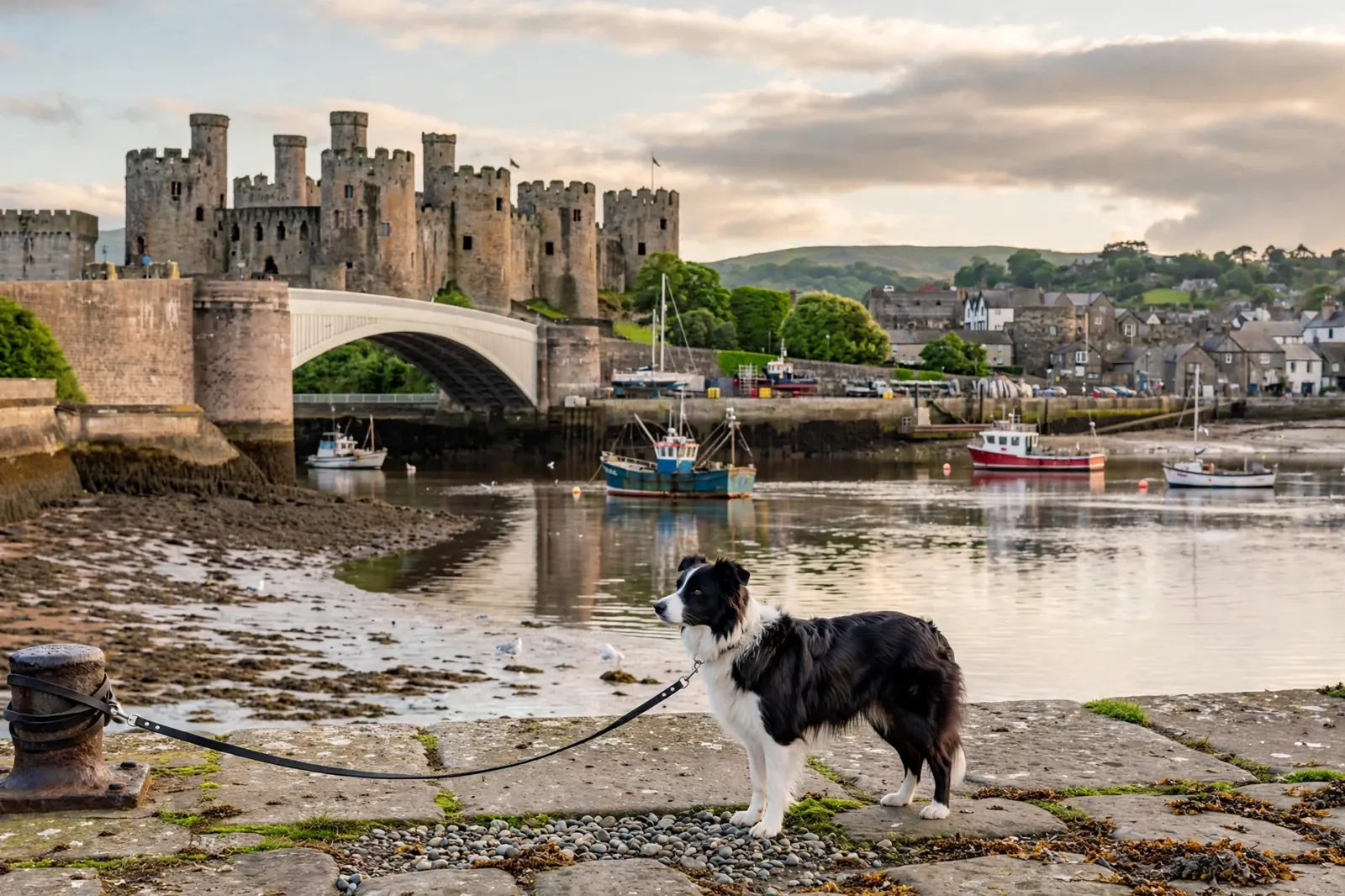
Beaumaris is also a natural starting point for a wider North Wales trip. If the castle has whetted your appetite for more, our guide to dog-friendly castles in Wales will help you plan the next stop, and Conwy with a dog makes a good companion day on the mainland, with its own castle, walls and harbour walks. Together, the two towns show how different a castle day can feel from one side of the strait to the other.
Practical questions
Before you go
Can dogs go into Beaumaris Castle?
Dogs are generally welcome in the castle grounds on a lead, but access to indoor spaces and the visitor centre can be more restricted, so check the official guidance before you travel. Assistance dogs are treated separately. Keep your dog on a lead around the moat, walls and other visitors, and plan the castle as an outdoor visit rather than assuming you can take your dog everywhere inside.
Is Beaumaris a good town for a first visit to Anglesey with a dog?
Yes, it is one of the easiest first stops on the island. The town is compact, the seafront is flat, parking and cafes are close together, and the castle, pier and promenade give you a full morning without a long drive. It also works well as a base for wider Anglesey walks and beaches, which are covered in our Anglesey guide.
Where can my dog go off the lead near Beaumaris?
Keep your dog on a lead on the promenade, around the pier and in the castle grounds. For off-lead time, use a suitable beach or open area away from livestock, roads and other dogs, and only where local signs allow it. Check the official guidance before you travel, because seasonal beach rules can change, and recall must be reliable before you unclip.
Is the Beaumaris seafront walk suitable for older or small dogs?
Yes, the promenade is flat, paved and easy to shorten or extend, which makes it a good choice for older dogs, small dogs and dogs that tire quickly. There are benches and places to pause, and you can turn back at any point. Bring water on warm days, watch for hot paving in summer, and choose a shorter loop if your dog is stiff after the first stretch.
What should I do if the tide is in when we arrive?
Treat a high tide as a reason to enjoy the promenade, pier and castle rather than the shore. Stay off wet rocks and mud, keep your dog away from the water's edge, and check the tide times before you plan a beach walk. Low tide opens up more sand, but it also exposes slippery surfaces and fast-changing water, so never let a dog chase the outgoing tide.
Are there dog-friendly places to eat in Beaumaris?
Several cafes and pubs in Beaumaris welcome dogs, often on outdoor terraces or in defined indoor areas, but policies vary by venue and by season. Check the official guidance before you travel, or ask at the door before you settle in. Bring a mat and water bowl, keep your dog settled under the table, and have a takeaway plan ready for busy times.