This guide is independent and contains no paid placement. If affiliate links are added later, they will be clearly marked and will not change our editorial checks.
Start on the Embankment, walk the river loop across both banks, then work through the chain of parks. The Ouse is a lead-only river and not a swimming spot; the parks are where a dog gets to run, and the quiet edges beyond the town are where a nervous dog gets to breathe.
The Embankment is the town’s living room
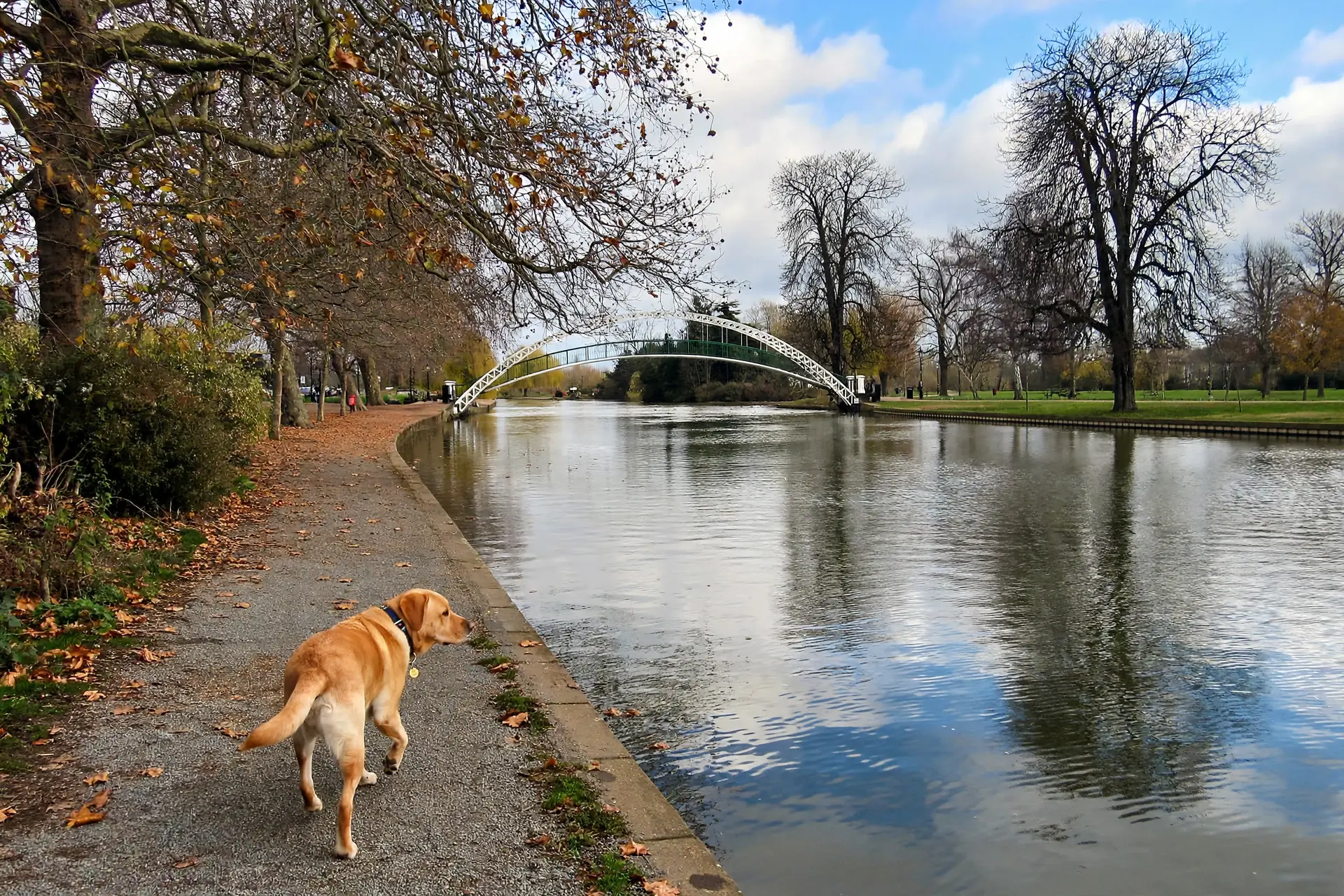
Every town has a place where its people go to be outside together, and in Bedford that place is the Embankment. The long, tree-lined walk along the River Great Ouse runs through the heart of the town, past the town bridge, the suspension bridge, the rowing clubs and the riverside gardens, and on any fine day it is full of walkers, runners, cyclists, families and dogs. It is Bedford’s living room, and a dog that can cope with a busy, sociable walk will love it.
The Embankment works so well for dogs because it is wide, flat and visible from all sides. A reactive dog can be given space, a nervous dog can watch the world from a safe distance, and a confident dog can enjoy the sheer variety of smells and encounters. The path is surfaced and level throughout, which makes it a good option for older dogs, for puppies, and for visitors who want a proper walk without committing to a long, rough route. The river is always there on one side, the gardens and the town on the other, and the walk never feels like a corridor.
Timing matters. The Embankment is at its best early in the morning, when the rowers are training on the river, the light is low over the water, and the dog walkers have the path mostly to themselves. By midday on a summer weekend it is a promenade, and a dog that is possessive of its space or nervous around children will find it hard work. The evening is the other good hour: the crowds thin, the light softens, and the river catches the last of the sun. Plan the Embankment for the morning or the evening, and use the middle of the day for the parks.
One thing the Embankment is not is a swimming spot. The Ouse at Bedford is busy with rowing boats, launches and moored craft, the current is stronger than it looks near the bridges and the weirs, and the banks are steep in places. A dog that falls in may struggle to climb out, and a dog that jumps in after a duck may find itself in the path of a racing eight. Keep the dog on a lead on the Embankment, always, and save the swimming for a quieter stretch of river outside the town.
The river loop: both banks, one walk
The best way to walk Bedford’s river is as a loop, crossing from one bank to the other at the bridges and seeing the town from both sides. Start on the Embankment on the town side, walk downstream past the suspension bridge, cross at the next bridge, and come back along the far bank. The loop is about three miles, it is flat throughout, and it shows the river at its most varied: the formal gardens and the town on one side, the quieter, greener bank on the other.
The far bank is the quieter half of the loop, and it is the half that dogs tend to prefer. The path is narrower and less formal, the trees come closer to the water, and the crowds thin out quickly once you are past the bridge. It is also the half where a long line works well: the sightlines are good, the path is broad enough in places, and you can see other walkers coming from a long way off. The far bank has its own hazards, though — the path is closer to the water in places, and after rain it can be muddy and slippery underfoot.
Crossing the bridges is the part of the loop that needs the most care. The town bridge is busy with traffic, the pavements are narrow, and a dog on a lead needs to be kept on the inside, away from the road. The suspension bridge is a different experience: it is a footbridge, it moves slightly underfoot, and some dogs dislike the feeling. Walk it briskly, keep the dog close, and do not stop in the middle to admire the view — the bridge is a crossing, and the views are better from the bank below.
The loop’s rhythm is what makes it work. The town side is sociable and busy, the far bank is calm and green, and the return to the Embankment feels like coming home. A dog that has walked both banks has seen Bedford properly, and the flat ground means the loop is achievable for almost any dog. In summer, bring water — the Embankment has little shade at midday — and in winter, bring a towel, because the far bank path stays muddy for days after rain.
Bridges, weirs and the places to be careful
Bedford’s river is shaped by its bridges and its weirs, and both need respect from a dog owner. The town bridge carries the main road across the Ouse, and the pavements are narrow enough that a dog and a pedestrian coming the other way have to pass closely. Keep the dog on a short lead, on the inside, and move briskly. The suspension bridge, further downstream, is a footbridge with a light, springy deck that some dogs find unsettling — walk it without stopping, and do not let the dog linger in the middle where the movement is most noticeable.
The weirs are the more serious hazard. The Ouse is a navigable river, and the weirs that control its level create fast, confused water that is dangerous for a swimming dog. The weir pools look inviting on a hot day, but the currents below a weir are unpredictable, and a dog that swims into one may not be able to get out. Never let a dog swim near a weir or a lock, and keep the dog on a lead on the paths that run beside them. The lock areas are working places, with gates, balance beams and water rushing through the paddles — all things a dog should meet on a lead, not loose.
The moorings are the third hazard. The Embankment has moored boats along much of its length, and the gaps between the boats, the mooring rings, the chains and the occasional fishing line all need attention. A dog that is interested in boats will find the moorings endlessly fascinating, and a dog that is not may find them intimidating. Either way, keep the dog on a lead and on the path, not on the quayside edge.
None of this makes the river off-limits — it makes it a place to walk attentively, with the dog close and the lead short near the structures. The river is the reason Bedford exists, and the bridges and weirs are part of its character. Walk them carefully, and they add to the day rather than spoiling it.
The chain of parks
Bedford’s parks form a chain along the river, and together they give a dog far more running room than the Embankment alone. Russell Park, beside the river near the town centre, is the smallest and the calmest: a green, open space with trees, a bandstand and a cafe, and a good place for a short, gentle walk with a dog that needs to settle. The park is popular with families, so keep the dog on a lead near the play area and the cafe terrace, but the open grass suits a dog with reliable recall.
Further along the river, the parks grow larger and wilder. The open spaces between the river and the town’s edge hold playing fields, wooded corners and the kind of rough grass that dogs love to sniff through. These are the parks where a dog gets its proper exercise: a long line on the open grass, a run on the playing fields when they are empty, and a slow sniff through the wooded edges. The parks are connected by paths and by the river walk, so a dog can move from one to the next without ever meeting a road.
The parks’ seasons matter. In spring the trees are fresh and the grass is soft underfoot; in summer the open grass can be hard and hot, and the shade under the trees is the place to be. Autumn is the parks’ best season, when the leaves turn and the paths are quiet, and winter brings the parks’ least forgiving side: the grass stays wet, the paths get muddy, and the low-lying areas near the river can flood. Pack a towel in the colder months, and accept that a winter park walk will end with a muddy dog.
The parks are also where Bedford’s dog community gathers. The regulars know each other, the dogs know each other, and a visitor’s dog will be greeted with interest. If your dog is sociable, the parks are a pleasure; if your dog is reactive, the parks need the same care as the Embankment — space, a short lead, and a willingness to turn away from a group of dogs rather than push through it. The parks are big enough that there is always a quieter corner, and the dog that finds it will have a better walk.
Bedford Park, properly walked
Bedford Park, north of the town centre, is the largest park in the town and the one that rewards a proper walk. It is a Victorian park, laid out with formal gardens, a lake, wooded paths and open grass, and it has the variety that makes a park walk interesting for a dog: formal beds to sniff around, woodland to explore, and open grass to run on. The park is big enough that a dog can have a genuine walk inside it, not just a lap of the lawn.
Walk the park in a loop, starting at the main entrance and working around the edges before cutting through the middle. The outer paths are the quietest, and they give the dog the longest stretch of walking without meeting other dogs. The formal gardens in the centre are the prettiest part of the park, but they are also the busiest, and a dog on a lead needs to be kept on the paths rather than on the beds. The lake is the park’s centrepiece, and it is also its main hazard: the water is deep, the banks are steep, and the ducks are a powerful temptation for a dog. Keep the dog on a lead near the lake, always.
The wooded paths at the park’s edges are the best part for a dog. They are shaded, quiet, and full of smells, and they give a dog the feeling of being in a wood without leaving the town. The paths are rough underfoot in places, with tree roots and mud after rain, so they are not a walk for a dog with sore joints — save the woods for a fit dog and choose the surfaced paths for the others.
The park’s cafe, near the main entrance, is a good place to finish. It has outdoor seating that welcomes dogs, and a coffee after a park walk is part of the rhythm of a Bedford morning. Sit outside, let the dog settle, and watch the park go by. A dog that has walked the park properly — the edges, the woods and the lake — has had a full morning, and it will be ready for a rest.
The quiet edges of town
Beyond the parks and the Embankment, Bedford has quiet edges that suit a dog that needs space. The river paths upstream and downstream of the town become wilder and less formal within a mile of the centre, and the fields and woods on the town’s edge offer the kind of walking that the town centre cannot. These are the places to go when the Embankment is too busy, or when the dog has had enough of people and needs a quieter hour.
Upstream, the Ouse runs through water meadows and past the villages west of Bedford, and the riverside paths here are broad, flat and empty on weekdays. The walking is easy, the birdlife is good, and the river is at its most peaceful. Downstream, the river runs through a flatter, more open landscape towards the villages east of the town, and the paths are longer and quieter still. Either direction makes a good half-day walk, and both are reachable on foot from the Embankment.
The woods on the town’s northern edge are the other quiet option. They are small, but they are proper woods, with beech and oak, leaf litter underfoot and the kind of smells that keep a dog busy for an hour. The paths are rough and muddy after rain, so they are a dry-weather walk, and the woods are popular with local dog walkers at weekends — go early, or on a weekday, for the quietest experience.
The quiet edges need the usual countryside care. Livestock grazes the meadows along the river, and the fields are working farmland, not parkland. Keep the dog on a lead near stock, close gates behind you, and check the official guidance before you travel if you are planning a longer riverside route, because access along the Ouse changes with maintenance work and seasonal closures. The quiet edges reward the dog owner who checks conditions before setting out rather than assuming the walk will be the same as last time.
Food and drink: riverside tables and park cafes
The Embankment sets the table in Bedford. The pubs and cafes along the river serve through the day, and their outdoor seating is made for a dog that has just walked the loop: a bench in the sun, a bowl of water, and a view of the boats going past. The riverside tables are the most popular seats in town, which means they are also the busiest — on a summer weekend, the best tables go early, and a dog that needs space will be happier a little further from the bridge, where the crowds thin out.
Bedford Park’s cafe is the other natural stop. It sits near the main entrance, it has outdoor seating that welcomes dogs, and a coffee there after a park walk is part of the rhythm of a Bedford morning. The cafe is calmer than the riverside, the tables are spaced out, and a dog on its mat is a normal sight. It is the place to go when the Embankment is too busy, or when the dog has had enough of people and needs a quieter hour.
Pub gardens are the third option, and the best of them are the ones a short walk from the river rather than on it. The pubs on the streets behind the Embankment have gardens that are smaller and calmer, with regulars who know the dogs by name. Their welcome changes when the management does, so a quick phone call before you settle in is worth the minute it takes — and your accommodation host’s recommendation is usually the most reliable in town.
When none of those fits, takeaway is a genuine pleasure in Bedford rather than a compromise. Buy a sandwich, find a bench on the Embankment or a patch of grass in Russell Park, and eat with the dog at your feet and the river in front of you. It is often a better lunch than a crowded dining room, and the dog, frankly, prefers it.
Staying over: a room off the Embankment
The question to ask about any Bedford room is not how close it is to the river, but how far it is from the noise. A room facing the Embankment has the view and the sound of the towpath, the moorings and the pubs late into the evening; a room a street back is quieter, darker and easier for a dog to sleep in. For most dogs, the back-street room is the better choice, and the river is a two-minute walk away in the morning.
Ask about the last walk of the night before you book. Is there somewhere enclosed near the door — a courtyard, a small garden — or does the dog have to cross a car park and a road to reach the grass? An older dog, or a puppy, will feel that difference at midnight in the rain. Then ask whether dogs are allowed in the dining room or only in the bedroom, and whether the dog can be left alone in the room, and for how long. Get the answers by email and keep them with your confirmation.
Charges are worth pinning down early. Some places charge per dog per night, which adds up on a longer stay; others charge a flat fee per stay. Ask for the all-in total, including any cleaning charge, and compare that figure rather than the room rate. And ask how many dogs are allowed — a two-dog household can find itself turned away by a limit it never thought to ask about.
The cottages on the edge of town suit a longer stay. They usually have a garden and a kitchen, and the freedom to come and go without passing through a lobby, which suits a dog that needs space and a routine — but they are a drive from the river, so you will be using the car for the Embankment walks. Bedford also works as a base for wider trips: Bath is a longer drive west for a city day, and Bristol is further still for a harbourside break.
Getting there: London trains, the A421 and the river car parks
The train is the easy way into Bedford. Fast services from London St Pancras reach the town in well under an hour, and the station is a short, flat walk from the centre and the Embankment. A dog that travels well on trains will manage the journey easily, but the fast services are busy at peak times, so travel off-peak if you can — a quiet carriage and a dog that can lie down are worth more than an earlier arrival.
By car, Bedford is reached from the A6 and the A421, and the approach is straightforward until the town centre, which can be slow on a Saturday morning when the market and the shops draw visitors. Follow the signs to the riverside car parks rather than aiming for a particular street: the car parks near the Embankment fill first, and the ones a little further out are a pleasanter walk in along the river than a slow circle through the centre.
Once you are parked, leave the car alone. Bedford’s centre is walkable, the river is the route, and driving between stops only means fighting the town’s traffic twice. The riverside car parks have almost no shade, so in summer get the dog out straight away and walk to the water, where the trees and the river keep the air cooler; in winter the same car parks are exposed and windy, so have a warm coat ready for the dog’s first walk out of the car.
Flooding is the one thing to check before you travel. The Ouse rises after heavy rain, and the riverside paths — especially on the far bank — can be under water, with detours that are not always signposted. Check the official guidance before you travel if there has been recent rain, and carry a towel in the car: a wet river walk ends with a wet dog. Our guide to Windsor covers another great Thames-side town if you are planning a longer riverside trip.
Practical questions
Before you go
Can dogs walk the Embankment in Bedford?
Yes, the Embankment is a public riverside walk and one of the best dog routes in Bedford, but it is busy with walkers, runners and cyclists, and the river edge is unfenced in places. Keep dogs on a lead, especially near the bridges and the moorings, and use the quieter stretches away from the town bridge on a busy weekend.
Is the River Great Ouse safe for dogs to swim in at Bedford?
Swimming in the Ouse at Bedford is not something to plan around. The river is busy with rowing boats and moored craft, the current is stronger than it looks near the weirs, and water quality varies. Dogs that love water are better off at a quieter stretch away from the town centre, on a long line with a safe exit.
Which parks in Bedford are best for dogs?
Bedford Park is the largest and most popular, with open grass, wooded paths and a cafe, while Russell Park beside the river is smaller and calmer. Both welcome dogs on leads, and the open areas suit dogs with reliable recall, but keep dogs on a lead near the play areas, the ponds and the formal gardens.
Can dogs go on the river boats in Bedford?
The pleasure boats that run from the Embankment have their own rules, and dogs are usually only allowed by prior arrangement or on specific trips. Check the official guidance before you travel rather than turning up with a dog and hoping, and plan to enjoy the river from the bank if the boats do not take dogs.
Where do I park in Bedford with a dog?
Bedford has several town-centre car parks within a short walk of the Embankment, and the riverside car parks fill earliest on summer weekends. Get there before ten in the morning, or use a car park further out and enjoy the riverside walk in, which beats driving in circles while the dog waits.
What is the best time of year to visit Bedford with a dog?
Spring and autumn are the easiest: the Embankment is quieter, the parks are at their best, and the river paths are firm underfoot. Summer brings busy riverside crowds and hot, exposed stretches, while winter can leave the river paths muddy and the parks waterlogged, so pack a towel and a drying coat.