This guide is independent and contains no paid placement. If affiliate links are added later, they will be clearly marked and will not change our editorial checks.
Start with the Elizabethan town walls: a roughly hour-long circuit with river, sea and rooftop views. Then drop to the Quay for a flat riverside walk, cross to Spittal Beach for a proper run, and finish in the old town for food and a slow wander. Keep your dog on a lead on the walls, check beach and tide guidance before you travel, and plan split visits for indoor museums.
The walls that changed hands three times
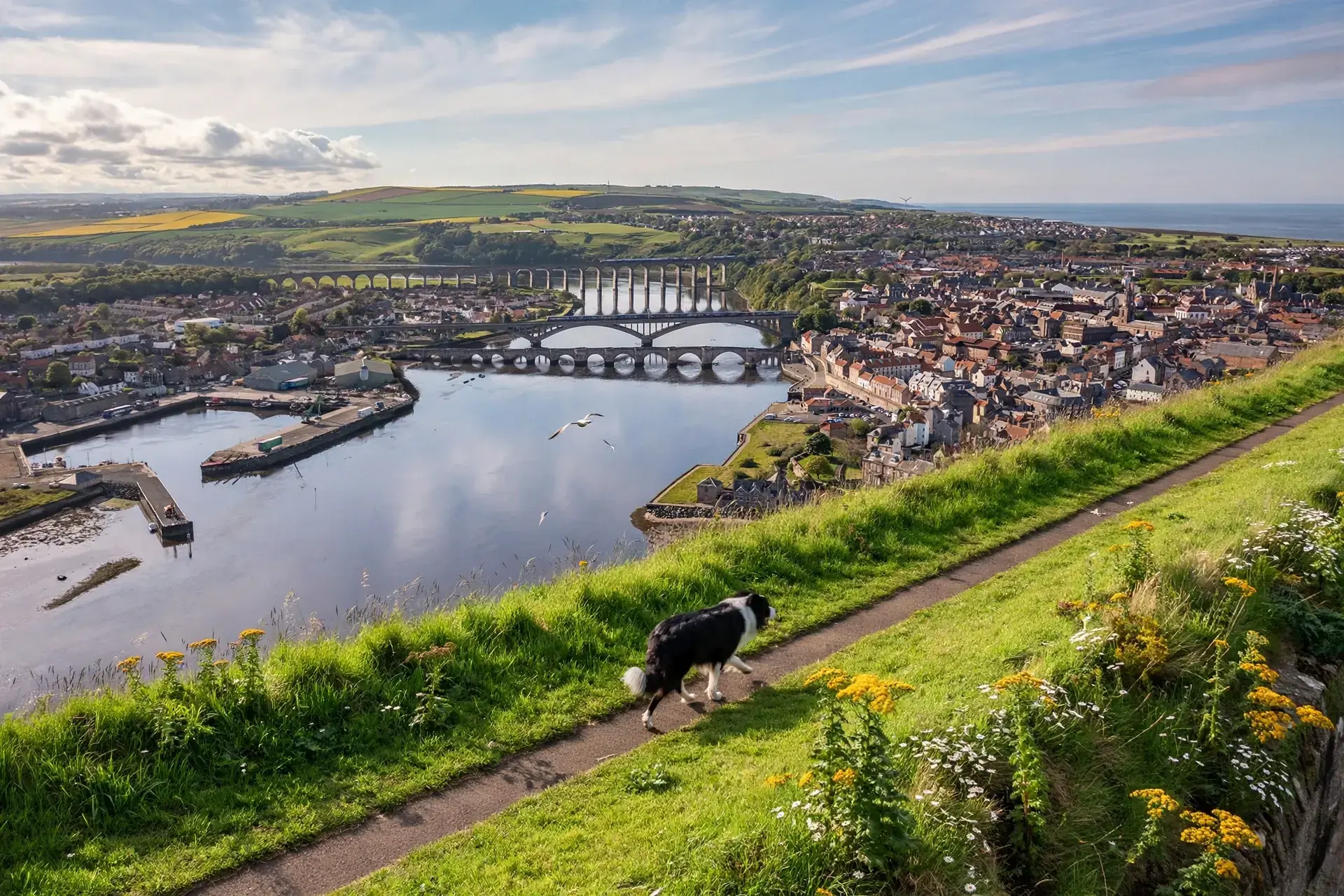
Berwick-upon-Tweed is the town that could not decide which country it belonged to. It changed hands between England and Scotland thirteen times, and the walls that still ring the old town are the physical record of that argument. The medieval walls came first, built when Berwick was a wealthy Scottish port. The Elizabethan walls followed in the sixteenth century, when England rebuilt the defences in stone and earth to hold a border town that had already been fought over for centuries. Walking them with a dog is not a detour from the town. It is the town, seen the way its builders intended: from above, with the River Tweed on one side, the North Sea on the other, and the roofs of the old town tucked safely inside.
That history matters for practical reasons, not just for atmosphere. The walls are a circuit, so you can start almost anywhere and finish where you began, which suits dogs that need a clear route rather than an out-and-back retrace. The full loop takes most walkers between forty-five minutes and an hour and a half, depending on how often you stop, how many photographs you take, and how interested your dog is in every new smell along the parapet. Allow longer on a first visit. The views change every few minutes: the river bends below the eastern walls, the harbour and the bridges appear to the west, and the sea opens up along the northern stretch. A dog that walks well on a lead will enjoy it enormously. A dog that pulls, lunges at other dogs, or is nervous about heights and narrow paths will find parts of it demanding, and that is worth knowing before you climb the first steps.
Start at the Quay end if you want the gentlest introduction. The climb is manageable, the river is immediately below you, and you can bail out into the town at several points if your dog decides the height is not for them. The eastern walls run above the Tweed with long views downriver towards the estuary, and this is often the quietest stretch in the morning. The northern walls face the sea and can be exposed to wind, so a small or light dog may need a shorter lead and a steadier pace there. The western walls, around the castle remains and the railway station, bring you back towards the town centre and the gentler ground-level streets. Each section has its own character, and none of them needs to be rushed.
Keep your dog on a lead throughout the walls walk, even if your dog is normally reliable off lead. The drops are real, the parapet is not a fence in the modern sense, and other walkers, runners and children use the same narrow path. A short lead gives you control at the pinch points and lets you step aside easily. Watch the surface underfoot as well: the stone can be uneven, worn smooth in places, and slippery after rain or frost. Dogs with sensitive paws, older dogs, and dogs recovering from injury may prefer the lower riverside paths, which give you much of the same scenery without the steps. If you are travelling with two dogs, walk them on separate leads or use a coupler only if both dogs are calm and used to it, because a sudden lunge on a narrow wall walk is harder to manage than the same lunge on a beach.
Timing the walls walk well changes the whole experience. Early morning is the calmest time, with soft light on the river and few other walkers, and it is the best choice for reactive dogs. Late afternoon brings long shadows and a quieter town, but the light fades quickly in winter, so carry a torch and a reflective lead if you are out after dusk. Midday in summer can be hot on the stone, so bring water for your dog and check the surface temperature with your hand before you set off. There is little shade on the walls themselves, and no water points along the circuit, so a collapsible bowl and a bottle are essential kit rather than optional extras. If your dog is a keen sniffer, let them sniff. The walls are full of scents carried up from the river, the harbour and the town, and a slow, sniff-heavy circuit will tire most dogs far more effectively than a brisk march around the loop.
The three-times-changed-hands story also explains why Berwick feels different from other Northumberland towns. It is English now, and has been since 1482, but its football team plays in Scotland, its street names and architecture carry both traditions, and its position at the mouth of the Tweed made it a prize worth fortifying twice over. That is why the walls are so complete, and why they are still the best way to understand the town in a single walk. Do the circuit first, while you and your dog are fresh, and everything else in this guide — the quay, the beach, the old town streets — will make more sense, because you will already have seen how the river, the sea and the town fit together.
The Quay and the River Tweed
Below the eastern walls, the Quay is Berwick at its most working and most relaxed at the same time. This is where the River Tweed meets the town, where fishing boats and small craft still tie up, and where the wide river opens towards the North Sea. For dogs, the Quay is the perfect counterpoint to the walls: flat, open, easy underfoot, and full of interesting smells. It is the walk to choose when your dog needs a gentle start, when the walls feel too much, or when you want a slow evening stroll after a long drive north.
Walk the Quay from the town end towards the river mouth and back, and you will see Berwick from water level. The three bridges — the old stone bridge, the railway viaduct and the modern road bridge — frame the river in a way that photographs well and gives dogs plenty to look at. Gulls, waders and the occasional seal draw the eye, and many dogs will stand and watch the water for far longer than you expect. Keep your dog on a lead near the water's edge, especially at high tide or after rain, when the river runs fast and the stonework can be slippery. The Quay is not a beach, and the drop into the river is not a place for a dog to scramble down. A long line gives a confident dog more freedom on the open stretches, but reel it in near moored boats, fishing gear and other walkers.
The Quay also works as a practical base for the rest of your day. There is parking nearby, the walk to the town centre is short, and the flat ground suits older dogs, puppies that are still building stamina, and dogs that struggle with steps. If your dog is nervous around traffic, the Quay is calmer than the main roads through town, although vehicles do use the Quay itself, so stay alert at the road edge. Early morning brings fishermen, dog walkers and the first light on the water. Lunchtime brings more people and the smell of food from nearby cafes, which is a useful distraction for a food-motivated dog and a good moment to practise calm settling on a bench. Evening brings a quieter mood, with the river darkening and the town lights coming on across the water.
From the Quay, the riverside paths lead in both directions, and both are worth knowing about. Upstream, the paths run towards the bridges and the greener stretches of the Tweed, where the walking is level and the river feels calmer. Downstream, the path follows the estuary towards the sea, where the landscape opens out and the wind picks up. Neither direction needs to be a long expedition. A twenty-minute out-and-back is enough to give a dog a proper stretch, and you can extend it if the weather and your dog's energy allow. Check the official guidance before you travel if you plan to walk the estuary edge at low tide, because mud, soft ground and fast-rising water can turn a pleasant riverside walk into a difficult one.
One more practical point: the Quay is where Berwick's working character is most visible, and that means occasional noise, moving vehicles and unfamiliar smells that some dogs find exciting and others find unsettling. If your dog is noise-sensitive, visit first in the quiet morning rather than at a busy weekend lunchtime, and let them watch from a distance before you walk through the busiest stretch. Bring water, because there are no dog water bowls guaranteed along the Quay itself, and bring bags, because bins are present but not always exactly where you need them. A calm Quay walk, done well, sets the tone for the whole trip: unhurried, flat, and full of river air.
Spittal Beach
Spittal Beach, just south of the river mouth, is where Berwick's dogs get to be dogs. It is a wide, sandy beach with room to run, space to play, and a long shoreline that suits dogs who need distance rather than a crowded patch of sand. From the town centre it is a short drive or a longer walk across the old bridge to Tweedmouth and then to Spittal, and the journey is part of the pleasure: you cross the river, leave the walled town behind, and arrive at a beach that feels open and unhurried even on a busy day.
The beach itself is generous. At low tide the sand stretches a long way, with firm, flat areas for running and softer sand near the dunes for digging and sniffing. Dogs that love water will find the shallows at the river mouth and the sea edge, but take care here: the Tweed estuary has strong currents, and the water near the mouth can move faster than it looks. Keep a close eye on your dog, call them back before they go too far out, and avoid the area entirely if the tide is turning or the sea is rough. Check the official guidance before you travel for the latest beach rules and tide times, because local restrictions can change and the safest swimming spots vary with the weather and the season.
Spittal is also the beach to choose if your dog needs space from other dogs. The beach is long enough that you can walk away from the main access points and find a quiet stretch, even in summer. That matters for reactive dogs, for dogs in training, and for owners who simply prefer a calmer walk. Walk to the far end, let your dog run on a long line first to judge their recall, and only let them off lead when you are confident they will come back past other dogs, children and beach users. Bring a ball or a favourite toy if your dog is toy-motivated, but be ready to share the space: other dogs may want to join the game, and not every owner welcomes an enthusiastic stranger in the middle of their picnic.
Facilities at Spittal are modest, so plan as if you are self-sufficient. There is parking near the beach, but it fills on warm weekends, so arrive early or visit later in the day when the crowds thin. Bring fresh water for your dog, because seawater is not a substitute and drinking it can make dogs ill, and bring a towel and a drying coat for the journey back to the car. Sand gets everywhere, especially in long coats and between toes, so a quick rinse or a thorough brush before the drive home will save your car and your accommodation. Check your dog's paws after a beach walk, particularly if they have been running on wet sand or near the dunes, where sharp shells and debris can hide.
The dunes and the promenade behind the beach add variety to the walk. The promenade is a good option for dogs that prefer a firm surface, for older dogs that find soft sand tiring, and for wet days when the beach itself is windswept. The dunes are more fragile, so keep your dog on the paths where signs ask you to, and watch for nesting birds in spring and early summer. If you are staying for a few days, Spittal rewards repeat visits at different tides: low tide gives you the widest beach and the longest run, while high tide brings the sea right up to the promenade and a completely different atmosphere. Either way, it is the beach that makes Berwick work as a dog holiday rather than just a historic day out.
Walking the old town streets
Inside the walls, Berwick's old town is compact enough to explore on foot with a dog, and interesting enough that a slow wander is more rewarding than a route-marched tour. Marygate, the main shopping street, runs through the heart of the town, with independent shops, cafes and the Town Hall at its centre. The streets around it — narrow lanes, Georgian terraces and the roads that climb towards the walls — reward dogs that like to sniff their way through a town rather than stride through it. Pavements are generally wide enough for a dog on a lead, but some of the older lanes are narrow, so be ready to step aside for other pedestrians, pushchairs and delivery vehicles.
Plan your town walk around your dog's tolerance for people and noise. Berwick is not a big, overwhelming city, and even on a Saturday the crowds are manageable compared with Edinburgh or Newcastle, but market days and summer weekends do bring more footfall, more children, and more tempting smells from food stalls. If your dog is reactive or easily overstimulated, walk the town early in the morning, when the shops are just opening and the streets are quiet, and save the busier midday period for a beach or riverside walk instead. If your dog is sociable and calm, the town is a good place to practise polite greetings, settling outside a cafe, and walking past other dogs without fuss.
The Town Hall and the Main Guard, at the top of Marygate, are useful landmarks and good meeting points if you are travelling with others. The streets around the Town Hall are also where you will find many of the town's cafes and places to eat, which are covered in more detail later in this guide. For now, the practical point is that the old town is best explored in short loops rather than one long march. Walk one street, stop for a sniff and a drink, walk another, and let your dog set the pace. Dogs that are forced to keep walking past interesting smells without a break will pull harder and settle less well later in the day.
Look up as you walk, as well as down at your dog. Berwick's Georgian architecture is one of its quiet pleasures: plain, elegant facades, sash windows, and the occasional plaque that explains who lived here and when. The town's history as a garrison town is visible in the Barracks and in the street names, and the sense of a border town that has seen soldiers, merchants and fishermen all pass through is still present in the mix of buildings. Your dog will not care about the architecture, but you will, and a walk that interests you is a walk you will do slowly and happily, which is exactly what most dogs prefer.
Street safety deserves a brief note. Berwick's old town streets are generally quiet, but cars and delivery vans do use them, and some junctions have limited visibility. Keep your dog on a short lead near roads, teach a reliable wait at kerbs if you can, and avoid letting your dog walk on the road side of the pavement. In wet weather, the stone pavements can be slippery, so watch your footing and your dog's footing together. In hot weather, the stone and tarmac can heat up, so check the surface with your hand and stick to shaded streets or the riverside if the ground feels too warm for paws. A town walk that is planned around shade, water and rest stops will always beat a longer walk that leaves your dog hot, footsore and reluctant to go out again in the evening.
Museums, barracks and castle remains
Berwick's indoor history is rich, but it needs a different plan when you are travelling with a dog. The Berwick Barracks, the town museum and the other indoor attractions generally do not allow dogs inside, apart from assistance dogs, and that rule is worth respecting rather than testing. The good news is that the outdoor history — the walls, the castle remains, the Barracks parade ground from outside, and the riverside defences — is extensive, free to walk, and fully accessible to dogs on leads. You can see a great deal of Berwick's story without ever going through an indoor door.
The castle remains, at the western end of the walls near the railway station, are a good example. Little of the medieval castle survives above ground, but the site itself is evocative: a grassy, open area with views over the river and the town, where dogs can walk on a lead and owners can imagine the fortress that once guarded the Tweed crossing. The railway station now occupies part of the castle site, which is a useful reminder of how the town has kept reinventing itself. Walk the castle area slowly, let your dog sniff the grass and the stonework, and use it as a rest point on the walls circuit rather than a destination in its own right.
The Barracks, built in the early eighteenth century and among the earliest purpose-built barracks in England, are impressive from the outside, with their parade ground and plain, solid architecture. If you want to visit the museum inside, plan a split visit: one person goes in while the other walks the dog around the walls or down to the Quay, then swap. This works well in Berwick because the outdoor alternatives are genuinely good, not a consolation prize. A dog that has just had a walls walk will usually settle happily for twenty minutes on a bench while their owner takes a turn indoors, provided they have water, shade and a familiar mat or blanket to lie on.
Other historic sites follow the same pattern. Holy Trinity Church, the town's parish church, is worth a look from outside, and the churchyard is a quiet, green space for a short, respectful walk on a lead. The bridges themselves are historic structures, and walking across the old bridge with your dog gives you a different perspective on the river and the town. The Elizabethan walls are, in the end, the main museum in Berwick, and they are open all day, free, and dog-friendly in a way that no indoor gallery can match. Treat the indoor attractions as optional extras, and check the official guidance before you travel for current opening times and dog policies, because both can change for exhibitions, events and seasonal closures.
If your dog is comfortable waiting outside a building for a short time, bring a settle mat and practise the routine before your trip. A dog that can lie calmly on a mat while you pop into a shop or a museum entrance will have a far better holiday than a dog that is left tied up and anxious. Never leave a dog tied up outside a building for more than a few minutes, never leave them in a place where they could be approached by strangers without you there, and never leave them if they are distressed. In Berwick, the better answer is almost always to take turns, or to enjoy the outdoor history together and save the indoor visits for a trip without the dog.
Longer walks from Berwick
Berwick is a good base for longer walks, and its position on the border makes it a natural starting point for both Northumberland and the Scottish Borders. The Northumberland Coast Path runs south from Berwick towards Bamburgh, Alnwick and beyond, and the first stretches are accessible as a day walk or as part of a longer multi-day route. The Berwickshire Coastal Path runs north into Scotland, towards Eyemouth and St Abbs, and offers a completely different landscape of cliffs, coves and fishing villages. Both paths are waymarked, both reward dogs that are fit and used to coastal walking, and both need the same care with cliffs, livestock and tides that any coastal path demands. For a wider plan of the county, our Northumberland dog guide covers castles, beaches and dark-sky stays across the region, and helps you decide which stretches are worth a drive and which are best saved for a return trip.
For a first longer walk, try the coast south from Berwick towards Cocklawburn Beach, a quieter stretch of sand that many local dog walkers prefer to the busier beaches further south. The walk is level in places and gently undulating in others, with views back towards Berwick and the Tweed mouth that make the effort worthwhile. Keep your dog on a lead near cliff edges and where livestock graze, and carry water, because there are no shops or cafes along the wilder stretches. A walk of this kind suits dogs that are used to two or three hours on the move, with breaks for sniffing and resting, and it is a good test of whether your dog is ready for a longer coastal day.
North into Scotland, the walk towards Eyemouth is shorter and more sheltered, with a harbour, a town and cafes at the far end, which makes it a good choice for a first cross-border walk. The path climbs gently, the views open up over the sea, and the sense of walking from England into Scotland on foot is a small thrill that is worth the effort. If you are planning a longer Scottish trip, our Edinburgh with a dog guide covers hills, parks and a workable city plan for the capital, about an hour north by train, and helps you plan a city day that still puts your dog first.
Inland, the River Tweed offers quieter, greener walking. The riverside paths upstream from Berwick run through farmland and woodland, with fewer people and more wildlife, and they suit dogs that prefer a calm, sniff-heavy walk to a windswept coastal march. Watch for livestock, keep your dog on a lead through fields with sheep or cattle, and close gates behind you. The Tweed is a salmon river, and anglers use the banks in season, so give them space and keep your dog from disturbing the water near their lines. A riverside walk is also a good wet-weather fallback, because the paths are often more sheltered than the exposed coast, although they can be muddy after rain.
Whatever longer walk you choose, plan it like a dog owner, not like a hiker who happens to have a dog. Check the distance, the height gain, the surface, the water points, the livestock and the escape routes back to the car or the train. Carry more water than you think you will need, a first-aid kit for paws, and a lead that gives you control on cliffs and near roads. Tell someone where you are going if you are walking alone in a remote stretch, and check the official guidance before you travel for path closures, diversions and tide times. A longer walk that is planned well will be the highlight of your Berwick trip. A longer walk that is planned badly will be the reason your dog spends the next day asleep on the sofa.
Parking and arrival
Arriving in Berwick with a dog is straightforward if you plan your parking around your first walk, rather than around the town centre alone. The most useful car parks are those near the Quay, the town centre, and Spittal, and each suits a different start. Quay parking puts you straight onto the flat riverside walk and the lower end of the walls circuit. Town-centre parking puts you in the middle of the old town streets and close to cafes and shops. Spittal parking puts you straight onto the beach, which is the best choice if your dog has been cooped up in the car and needs a run before anything else. Choose the car park that matches your dog's first need, not the one that looks closest on the map.
Parking in Berwick is generally easier than in larger tourist towns, but it still fills on summer weekends, market days and bank holidays, so arrive early if you can. Morning arrival also gives you the quietest walls and the coolest stonework, which is a double benefit. Check the signs at each car park for charges, maximum stays and any restrictions on overnight parking, because rules vary between car parks and can change. Some car parks are free for limited periods, others charge by the hour, and a few have height or size restrictions that matter if you are travelling in a larger vehicle or with a roof box. Check the official guidance before you travel if you need accessible parking, a longer stay, or overnight parking for a campervan.
If you arrive by train, Berwick-upon-Tweed station is well placed for a dog-friendly visit. It sits at the western end of the old town, close to the castle remains and the walls, and the walk from the station into the town centre is short and mostly level. Trains from London, Edinburgh and Newcastle stop here, which makes Berwick a practical car-free destination, provided your dog is comfortable on a train and you have planned your walks from the station rather than from a car park. Bring a mat for your dog to lie on during the journey, water for the trip, and a lead that keeps them close in a busy station. If you arrive by bus, the main stops are in the town centre, and the same walking plan applies.
Car safety deserves a clear note, because Berwick's summer sun can heat a parked car quickly even on a mild day. Never leave your dog in a car in warm weather, even with the windows open, and never leave them in a car while you walk the walls or visit a museum. If you need to pop into a shop, take it in turns, or choose a shop that welcomes dogs inside. In winter, the opposite problem applies: a car left in shade can be cold, and a wet dog left in a cold car will chill quickly. Plan your arrival so that your dog goes straight from the car to a walk, with water, a towel and a drying coat ready, rather than waiting in the car while you sort out tickets, maps and lunch.
Finally, think about your arrival routine as a whole. A long drive north is tiring for a dog, even if they sleep most of the way, so give them a toilet break, water and a short, sniff-heavy walk before you ask them to do the walls circuit or a long beach run. Let them stretch, sniff the new smells, and settle into the town at their own pace. A calm arrival — car park, short walk, water, rest — will make the rest of the day easier for both of you, and it is the simplest way to avoid the overtired, overexcited dog that pulls, barks and refuses to settle in the evening.
Where to stay with a dog
Berwick has a good range of dog-friendly places to stay, from hotels and bed and breakfasts in the old town to self-catering cottages, holiday lets and caravan sites on the edge of town and in Spittal. The right choice depends less on the star rating than on the practical details: where the dog will sleep, where the nearest toilet walk is at night, whether there is enclosed outdoor space, and how the property handles muddy paws after a beach walk. Ask those questions before you book, and get the answers in writing, because a property that is genuinely dog-friendly will answer them clearly, while a property that merely tolerates dogs will be vague.
Old-town hotels and bed and breakfasts suit dogs that are calm indoors and happy to settle in a bedroom. Check whether dogs are allowed in the bedroom, whether there is a charge, whether there is a limit on the number or size of dogs, and whether dogs can be left alone in the room while you eat. Many small properties prefer you to eat with your dog on a terrace or in a dog-friendly dining area rather than leaving them alone, and that is often the better option anyway. Ask about the flooring, the stairs, and the route to the nearest outdoor space, because a third-floor room with no lift and a long corridor is a poor fit for an older dog that needs frequent toilet breaks at night.
Self-catering cottages and holiday lets suit dogs that need more space, a garden, or a routine that is close to home. An enclosed garden is the single most useful feature, especially for a first night in a new place, because it lets your dog toilet and explore safely without a lead. Check the height and security of the fence, the gaps under gates, and whether the garden is genuinely private or shared with other guests. Check the kitchen floor, the sofa covers, and the cleaning charge, because a property that expects muddy paws will have washable floors and a dog towel by the door, while a property that does not will have white carpets and a long list of rules.
Caravan sites and holiday parks near Berwick offer another option, especially for families with dogs that need outdoor space and a straightforward routine. Look for a pitch or unit close to a practical toilet walk, away from the main pedestrian route if your dog watches every passer-by, and with parking beside the unit so you are not carrying a nervous dog across a busy site at dusk. Ask about the dog exercise area, the rules for dogs on leads, and the nearest beach or riverside walk that does not need a car. A site that is well run for dogs will have clear rules, a sensible layout, and staff who can tell you which local walks hold up best in wet weather.
Wherever you stay, pack for the property as well as for the dog. Bring your dog's own bed or blanket, so the smell of home helps them settle, a familiar bowl, their usual food, and a drying coat and towels for after the beach. Bring a stair gate or a travel crate if your dog uses one at home, and a chew or a lick mat for the first evening, when a new place can feel strange. Tell the host or the hotel in advance that you are bringing a dog, even if the listing says dogs are welcome, because a property that knows you are coming will have the right room ready, and a property that is surprised may not. Check the official guidance before you travel for any local rules on dogs in holiday accommodation, and keep your booking confirmation with the dog policy saved on your phone.
Eating and drinking with a dog
Eating out with a dog in Berwick is easier than in many towns, provided you choose the right places and the right times. Many cafes and pubs welcome dogs, particularly on terraces, in bar areas, and in rooms where dogs are explicitly allowed. The Quay and the old town both have places where a well-behaved dog can settle under a table while you eat, and a dog that has just had a walls walk or a beach run will usually settle far better than a dog that has been waiting in the car. Call ahead if you are unsure, and ask the specific question — are dogs allowed inside, on the terrace, or in the bar — rather than relying on a generic dog-friendly label.
The best strategy is to eat at dog-friendly times. Mid-morning coffee and a late lunch are often quieter than the midday rush, and a dog that can settle on a mat during a calm hour will have a better experience than a dog that is asked to settle in a crowded room full of food smells and passing feet. Choose a table at the edge of the room, away from the main walkway, and bring a mat or blanket for your dog to lie on, so they have a clear place to settle. Order food that is easy to eat with one hand free for a lead, and keep your dog's lead short enough that they cannot wander to other tables, but long enough that they can lie comfortably.
Berwick's food scene is modest but rewarding. You will find cafes serving breakfast, lunch and coffee, pubs serving classic pub food, and fish and chip shops that are ideal for a takeaway eaten on a bench by the Quay. Fish and chips are a particularly good dog-owner meal in Berwick, because you can buy them, walk to the riverside, and eat with your dog beside you, without worrying about indoor rules. If you do eat inside, keep your dog's food separate from yours, do not feed them from the table, and be aware that dropped food, other dogs, and children can all distract a dog that is trying to settle. A chew or a stuffed Kong, brought from home, can keep a dog occupied while you eat, provided the cafe is happy for you to use it.
Water is the most important thing to ask for. Most dog-friendly cafes will bring a bowl of water without being asked, but do not assume it. Bring your own collapsible bowl and water, and offer your dog a drink before you order, so they are not thirsty and restless while you wait for food. If your dog is nervous in busy places, choose a cafe with outdoor seating, even in cooler weather, because the open air and the space to move are often calmer than a crowded indoor room. If your dog is reactive to other dogs, ask for a table away from other dogs, and be ready to move or to take your food away if the situation becomes too much.
Finally, respect the places that welcome dogs, because their welcome depends on dogs behaving well. Clean up after your dog, keep them off the furniture unless the cafe explicitly allows it, and do not let them beg from other tables. A dog that settles quietly, stays on its mat, and does not bark will be welcomed back, and will help keep Berwick's cafes dog-friendly for the next visitor. A dog that jumps up, barks, or steals food will make the next dog owner's visit harder, so train the settle, practise it at home, and use it every time you eat out in Berwick.
Seasons, tides and weather
Berwick's weather is coastal weather: changeable, windy, and capable of four seasons in a single afternoon. That is part of its charm, and part of the reason to pack properly. Spring brings longer days, wildflowers on the coastal paths, and quieter streets before the summer visitors arrive. It is a good season for the walls, because the stone is not yet hot, the light is soft, and the town feels calm. Watch for nesting birds on the coast and in the dunes, and keep your dog on the paths where signs ask you to, because the breeding season is short and the birds need the space.
Summer is Berwick at its liveliest. The Quay is busy, the beaches are warm, and the long evenings are perfect for a slow walk after dinner. It is also the season when planning matters most. Parking fills early, the walls can be hot underfoot at midday, and the beach can be crowded at the main access points. Walk early or late, carry extra water, and use shade and the riverside paths to keep your dog cool. Check the ground temperature with your hand, watch for signs of overheating — heavy panting, drooling, reluctance to walk — and move your dog to shade and water immediately if you see them. Never leave a dog in a car in summer, even for a few minutes.
Autumn is, for many dog owners, the best season in Berwick. The crowds thin, the light turns golden, the beaches empty, and the walls feel like they belong to you again. September and October often bring the most settled weather, with crisp mornings and long, quiet afternoons. It is the best time for longer coastal walks, for Spittal Beach at low tide, and for a slow town wander without the summer crowds. Pack a waterproof coat for you and a drying coat for your dog, because autumn rain can arrive quickly, and the coastal paths can be muddy after a wet week. Fireworks season, around early November, can unsettle noise-sensitive dogs, so check whether local displays are planned and plan a quiet evening indoors if your dog is affected.
Winter in Berwick is quiet, atmospheric and rewarding, provided you plan for short days and cold wind. The town is at its most peaceful, the walls are empty, and the river and sea look dramatic in winter light. Walks should be shorter, with more frequent breaks, and a drying coat is essential after a beach or riverside walk. Check the official guidance before you travel if storms, high tides or icy conditions are forecast, because the walls can be slippery in frost, the coastal paths can be exposed in high winds, and the Quay can be affected by spray and high water. A winter visit that is planned around a warm cafe, a short walls walk and a beach run at low tide will feel like a proper break, not a test of endurance.
Tides deserve a section of their own, because they shape every beach and estuary walk in Berwick. The difference between high and low tide is dramatic, and the river mouth in particular can change quickly. Always check tide times before a beach walk, allow plenty of time to get back to the car or to higher ground, and never walk on the estuary mud at low tide. Mud can be soft, deep and difficult to escape from, and the tide can return faster than you expect. If you are unsure, ask a local dog walker, check the official guidance before you travel, and choose the promenade or the higher beach rather than the wet sand near the water. A tide-aware dog owner is a safe dog owner, and in Berwick that awareness is the difference between a great beach day and a difficult one.
Practical kit, vets and dog etiquette
Packing for Berwick is packing for a coastal border town in changeable weather, and the kit list is simple but important. Bring a lead and a long line, a harness that fits well and does not rub on a long walk, a collapsible water bowl and a bottle, poo bags, a towel and a drying coat, and a first-aid kit that includes paw balm, a tick remover, and bandages for a cut pad. Bring your dog's usual food, any medication, and a familiar bed or blanket for the accommodation. Bring a torch and reflective gear if you plan to walk after dusk, and a waterproof coat for you, because a wet owner is a reluctant walker, and a reluctant walker cuts a dog's walk short.
Before you travel, save the number and address of the nearest vet, and check their opening hours. Berwick has veterinary practices in the town, and there are emergency vets in the wider area, but rural practices can close early and emergency cover can be some distance away. Save the number on your phone, and keep a note of your dog's insurance details, vaccination record and any medication, in case you need to visit a vet you have never met before. If your dog has a health condition, bring a summary of their history, and tell your accommodation host in advance, so they know what to expect and can help if needed.
Dog etiquette in Berwick follows the same rules as everywhere else in Britain, but the town's narrow walls, busy quay and popular beach make them particularly important. Keep your dog on a lead where signs ask you to, and on the walls at all times. Pick up after your dog, every time, even on the beach and on quiet paths, and use the bins provided. Keep your dog under close control near livestock, wildlife and other dogs, and ask before you let your dog greet another dog, because not every dog wants to say hello. If your dog is reactive, use a yellow lead or a clear signal, give other walkers space, and choose quieter times and places for your walks.
Finally, remember that Berwick is a small town, and dog owners who visit well are remembered well. A dog that is calm on the walls, polite in a cafe, and under control on the beach will be welcomed everywhere, and will help keep the town's dog-friendly reputation intact. A dog that is allowed to run wild, bark at other walkers, or chase wildlife will make the next visitor's trip harder. Train the basics before you travel — recall, a reliable wait, a calm settle — and use them every day in Berwick. The town rewards good manners with open spaces, friendly locals, and a walk that feels like it was made for dogs.
If you are planning a longer Northumberland trip, Berwick is the ideal first or last stop. It is close enough to Bamburgh, Alnwick and the Holy Island causeway for day trips, and far enough north to feel like a proper border town rather than a suburb of Newcastle. Use it as a base for a few days, explore the walls, the quay and Spittal Beach at your dog's pace, and then venture further south or north as your dog's energy allows. A Berwick trip that is planned around the dog, rather than around a checklist of sights, will always be the better trip, and it is the trip your dog will remember, even if they cannot tell you about it in words.
Practical questions
Before you go
Can dogs walk the full Elizabethan town walls circuit?
In most conditions, yes, on a lead. The walls form a walkable circuit around the old town, but the route includes steps, narrow sections, steep drops and uneven stone, so it suits confident dogs and steady walkers better than very young puppies, very old dogs or dogs that pull hard. Keep your dog on a short lead, give way at narrow points, and choose the lower riverside paths if the height or the steps look too much.
Is Spittal Beach dog-friendly all year?
Spittal Beach is generally welcoming to dogs, and it is one of the best places in Berwick for a long off-lead run when conditions allow. Local rules can change, and other beaches nearby may have seasonal restrictions, so check the official guidance before you travel, keep your dog under close control near other beach users, and take particular care around the river mouth, where tides and currents can change quickly.
Where can I park in Berwick-upon-Tweed with a dog?
The most useful choices are the car parks near the Quay, the town centre and Spittal, depending on whether you plan to start on the walls, at the river or on the beach. Arrive early in summer and on market days, check the signs for charges and maximum stays, and leave shade, water and ventilation in mind if your dog waits in the car for even a few minutes. Never leave a dog in a hot car.
Are dogs allowed in Berwick's museums and historic sites?
Dogs are generally welcome on the outdoor historic sites, including the town walls and the castle remains, but they are not usually allowed inside museums and indoor attractions, apart from assistance dogs. Plan split visits if you want to go inside: one person stays with the dog on a nearby walk while the other visits, then swap. Check the official guidance before you travel, because rules can change for exhibitions and events.
What is the best time of year to visit Berwick-upon-Tweed with a dog?
Late spring and early autumn usually give the best balance: long daylight, milder temperatures, quieter streets and beaches, and fewer crowds on the walls. Summer brings the liveliest quayside and the warmest beach days, but also busier parking and hotter stonework. Winter can be wonderfully quiet and atmospheric, but plan shorter walks, bring a drying coat, and check the official guidance before you travel if storms or high tides are forecast.