This guide is independent and contains no paid placement. If affiliate links are added later, they will be clearly marked and will not change our editorial checks.
There is no single best dog car seat for every dog. A hammock suits medium and large dogs that travel on the back seat, a booster suits small dogs that need height to see out, and a secured crate suits dogs that settle best in an enclosed space or travel in the boot. Whichever type you choose, pair it with a proper restraint, size it from real measurements rather than breed labels, and check the crash-test evidence before you pay.
Start with the law: Rule 57 and why restraint matters
Every dog car seat decision in the UK starts with the same rule. Highway Code Rule 57 says that when you travel in a vehicle, you must make sure dogs or other animals are suitably restrained so they cannot distract you while you are driving or injure you, or themselves, if you stop quickly. The rule names a seat belt harness, a pet carrier, a dog cage or a dog guard as suitable options, and it exists because an unrestrained dog is both a distraction and a projectile. A 20-kilogram dog in a collision at 30 miles per hour carries far more force than most people imagine, and a dog that lands on a front-seat passenger or wedges under a brake pedal can turn a survivable stop into a serious crash.
The legal consequences are practical, not theoretical. Driving without due care and attention, or driving in a way that could be judged careless because a dog was loose in the car, can bring a fine and penalty points, and in serious cases a court appearance. The amounts and the exact charge depend on the circumstances, so check the official guidance before you travel if you need the current figures for your situation. Insurers add a second layer of risk: if an unrestrained dog contributed to a collision, an insurer may question the claim, reduce a payout or argue that the driver failed to take reasonable care. Keeping a receipt for a car seat is not enough on its own; the restraint has to be fitted, used and suited to the dog on that journey.
Rule 57 does not name a particular product, and that is worth understanding before you shop. The law asks for suitable restraint, not for a specific brand or style, which means a hammock alone, a booster alone or a crate alone does not automatically satisfy it. What matters is the combination: the seat or carrier, the way it is anchored to the car, and the harness or tether that connects the dog to that anchor. A beautifully made booster that is never clipped in is worse than a plain harness used correctly, because it gives the owner false confidence while offering the dog almost no protection in a sudden stop.
There are also duties beyond the Highway Code. Dogs must not be left in a hot car, even with a window open, and on a warm day the temperature inside a parked vehicle can climb dangerously in minutes. A car seat does not change that, and neither does a sunshade or a bowl of water. Plan stops so the dog is never left alone in a parked car on a warm day, and on long journeys build in breaks every two hours for water, a toilet stop and a short walk. For a fuller explanation of the legal duties, fitting and insurance points, read our guide to the dog seat belt harness law before you buy anything.
Hammock seats explained: the back-seat sling
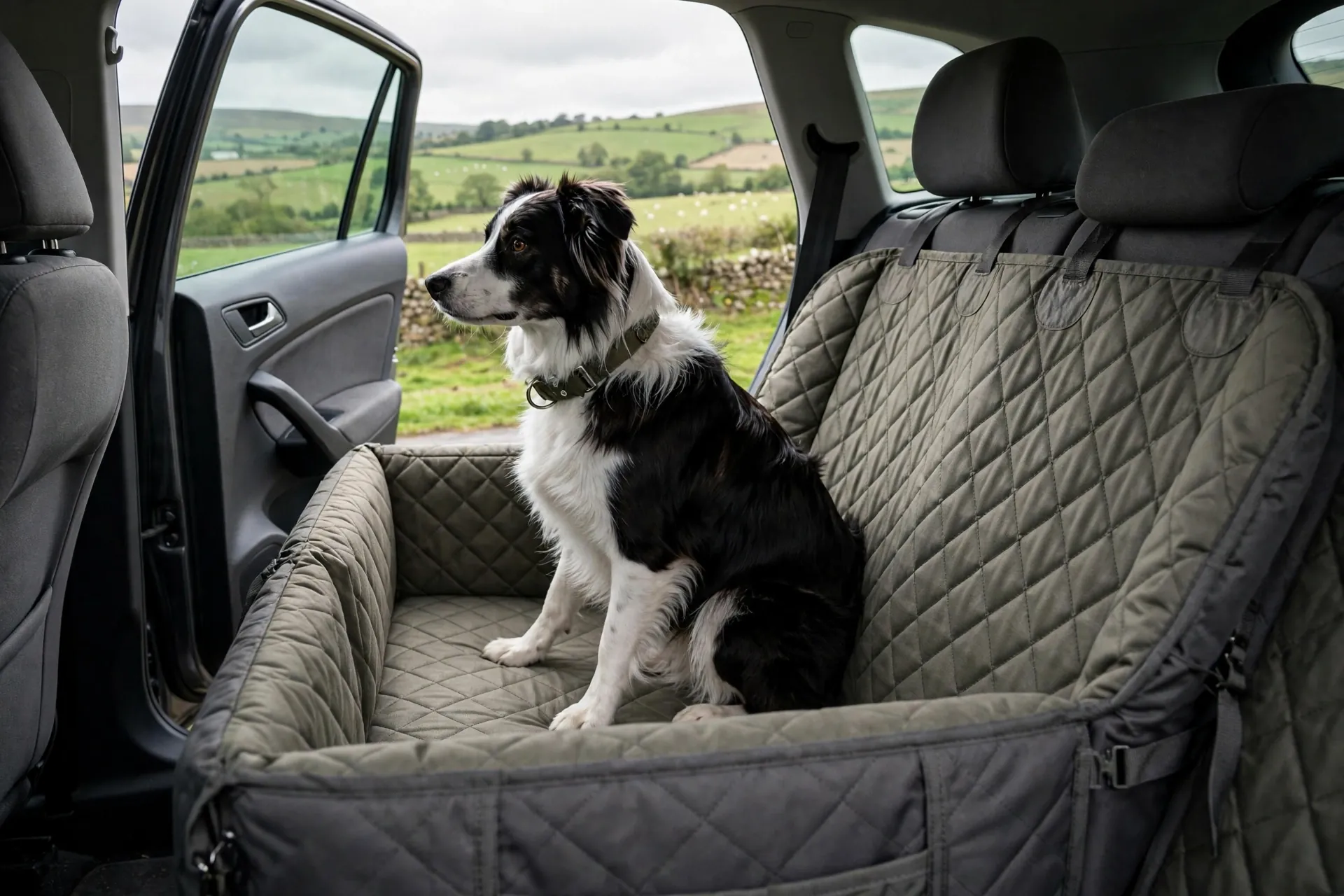
A hammock seat is a fabric sling that hangs between the front and rear headrests, covering the back seat and the gap above the footwell. Most designs are a single sheet of quilted, waterproof fabric with straps that loop over all four headrests, side flaps that protect the doors, and a non-slip base. Some split into a bench cover for one dog, or fold down to leave part of the seat free for a passenger. The dog sits or lies on the flat hammock surface, usually clipped to a harness and a short tether that attaches to a seat belt buckle or an anchor point.
Hammocks suit medium and large dogs best, especially dogs that like to lie flat and stretch out on longer journeys. A Labrador, spaniel or lurcher that sprawls across the back seat will usually settle faster on a hammock than in a small enclosed seat, because the surface is wide, the dog can shift position, and there is no raised wall pressing against its shoulders. They also suit multi-dog households, since one wide hammock can carry two medium dogs more comfortably than two separate boosters, and they suit owners who want to protect leather or fabric upholstery from claws, mud and wet fur. Dogs that travel frequently to beaches, woods and muddy walks benefit most, because the hammock catches the mess that would otherwise work its way into the seat seams.
The main weakness of a hammock is that it is not, by itself, a safety device. The fabric stops a dog sliding into the footwell, which is a genuine benefit in a sudden stop, but it does not restrain the dog in a collision unless a harness and tether are also used. Cheap hammocks can also sag in the middle, slide on smooth leather, or pull the headrest straps loose, and a sagging hammock leaves the dog unbalanced on corners. Look for a rigid or semi-rigid base panel, a non-slip underside, wide straps with solid buckles, and a weight rating that comfortably exceeds your dog. Mesh viewing windows, which let the dog see the driver and let air circulate, are worth having on warm days, and a split design is worth having if a passenger sometimes needs the back seat too.
Fitting quality varies more than the price suggests. Measure the width of your back seat between the door panels and the distance between the front and rear headrests before ordering, because a hammock made for a small hatchback will not span the back of a large estate or SUV, and an oversized one will bunch and crease. Check whether your car has rear headrests that can be removed or adjusted, because some hammocks rely on them for anchoring, and check whether the seat belt buckles are accessible once the hammock is in place. If you cannot reach the buckle to clip in the tether, the hammock is the wrong size or the wrong design for that car.
Booster seats explained: a raised seat for small dogs
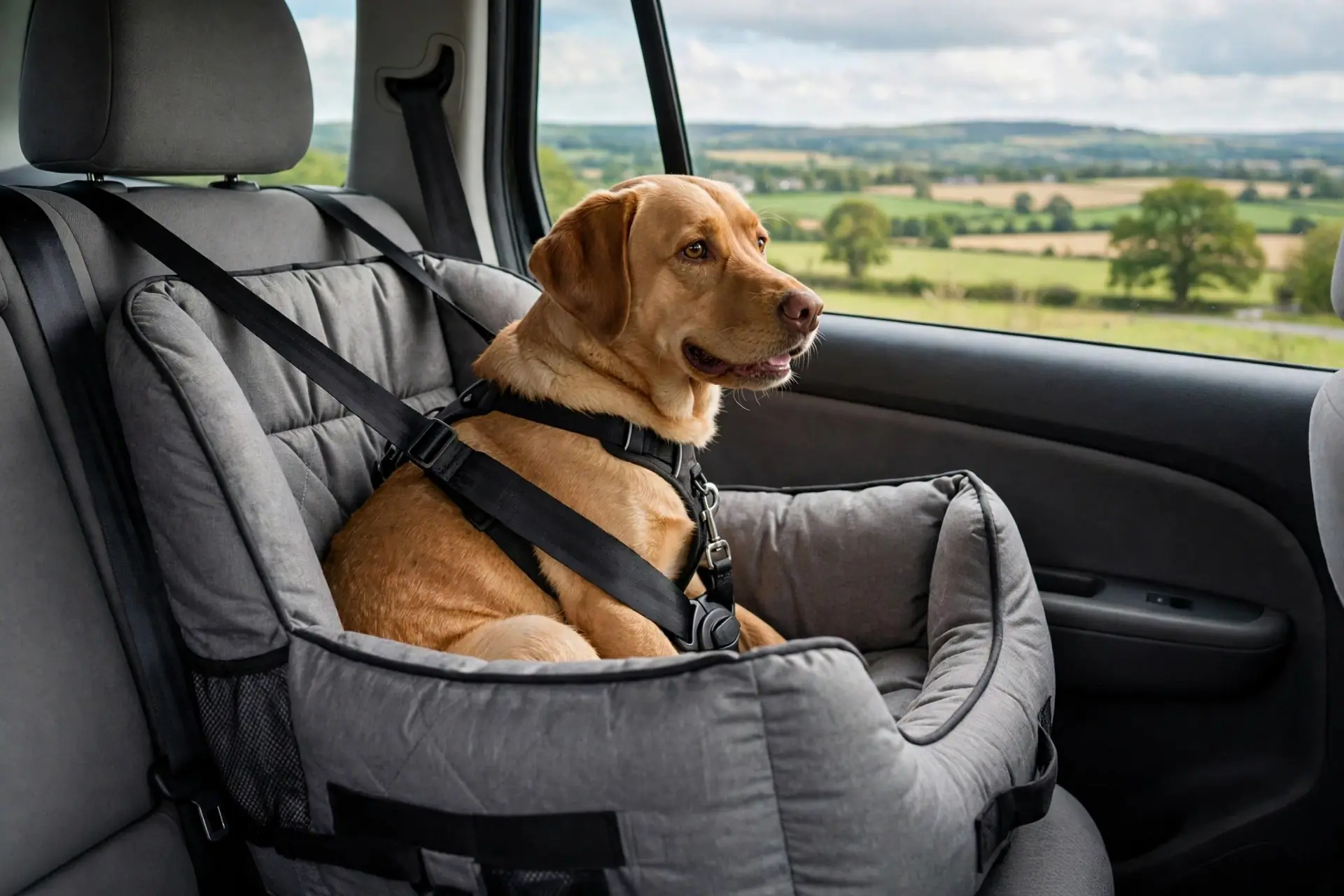
A booster seat is a raised, box-like seat that sits on the back seat and lifts a small dog high enough to see out of the window. Most designs have a rigid or semi-rigid frame, padded walls, a cushion, a short internal tether, and straps that loop around the headrest and fasten to the seat belt. Some are open-topped baskets; others have higher walls and a front opening so the dog can step in. The idea is simple: small dogs get anxious or carsick when they cannot see the horizon, and a raised seat gives them a view, a defined space of their own, and a feeling of security.
Boosters suit small and toy breeds best, generally dogs under about 10 to 12 kilograms, although the exact limit depends on the model. A Chihuahua, Pomeranian, small terrier or miniature dachshund that trembles on the back seat often settles noticeably faster in a booster, because the raised position reduces motion sickness and the walls give the dog something to lean against on corners. They also suit dogs that are nervous in the car for the first time, since the enclosed shape feels more like a bed than an open seat. Owners who carry one small dog and want a tidy, removable seat that doubles as a bed at a destination will find a booster more convenient than a full hammock.
The limits of a booster need honest attention. A booster is a comfort and positioning device first and a safety device second, and its crash protection depends entirely on how it is anchored and whether the tether is used with a proper harness. A booster that is only looped over a headrest can become a projectile in a collision, and a tether clipped to a collar can injure the neck. Never buy a booster by breed name alone: a stocky 9-kilogram French bulldog and a long, lean 9-kilogram whippet need different internal shapes, and a booster that is too narrow will force the dog to sit upright for the whole journey. Also check the seat belt routing: the car seat belt must pass through the booster's designated belt path and lock firmly, with no slack and no twist.
Material and construction matter more in a booster than in a hammock because the dog's weight sits on a smaller area. Look for a firm base that does not flex under the dog, walls that hold their shape when the dog leans on them, a removable and washable cover, and a tether that is short enough to stop the dog climbing out but long enough to let it lie down. Avoid boosters with a single thin strap as the only anchor, and avoid any model whose stated weight limit is close to your dog's actual weight, because a growing puppy or a dog that gains weight over winter can cross that limit without you noticing. If your dog is near the top of the range, move to the next size or consider a different type of seat.
Crate and carrier seats explained: the enclosed option
A crate seat is a rigid or soft-sided enclosed carrier that sits on the back seat or in the boot, giving the dog a den-like space of its own. Rigid crates are usually made from moulded plastic or metal-framed panels with a latched door, ventilation slots and a removable tray; soft crates use a folding fabric frame with mesh windows and a padded base. Some are designed specifically for car use, with anchor points for straps and a shape that fits a boot; others are general-purpose carriers that can also be used at a holiday cottage or a vet waiting room. The dog travels inside, with the door closed and latched, and the crate itself is strapped to the car.
Crates suit dogs that settle best in an enclosed space, dogs that are anxious in open cars, and dogs that need to be kept separate from passengers or from another dog. A nervous rescue that paces the back seat may sleep soundly in a crate, and a dog recovering from surgery may need the restricted movement a crate provides. They also suit larger dogs in estate cars and SUVs, where a properly sized boot crate gives the dog room to lie down without taking up the back seat at all. For multi-stop journeys, a crate has a practical advantage: the dog stays contained while you open the boot to load luggage, and there is no risk of the dog bolting out at a service station.
The safety case for a crate is strong when it is done properly, and weak when it is not. A rigid crate that is strapped to the car's anchor points or held by a boot divider can protect the dog in a collision and keep it away from passengers, but a crate that is simply placed on the back seat with no anchoring is a heavy object waiting to slide. Soft crates offer less crash protection than rigid ones, and their main value is containment and comfort rather than impact resistance. Ventilation is the other critical factor: a crate needs airflow on at least two sides, and on a warm day a dark fabric crate in a sunny boot can heat up quickly, so check the temperature and the airflow before every journey.
Sizing a crate is less forgiving than sizing a hammock, because the dog cannot stretch beyond the walls. The crate should be long enough for the dog to lie flat on its side, tall enough for it to sit without its ears touching the roof, and wide enough for it to turn around comfortably. A crate that is too large is also a problem in a car, because the dog can be thrown around inside it, so the common advice to buy the biggest crate available does not apply to car travel. Measure the boot as well as the dog: check the width at the narrowest point, the depth with the seats up, and the height under the parcel shelf, and remember that a crate that fits a saloon boot may not fit a hatchback at all.
Hammock vs booster vs crate: a side-by-side comparison
The three types solve different problems, so the honest way to compare them is against the same five questions: how much protection does it offer in a sudden stop, how comfortable is it for the dog, how easy is it to clean, how much does it cost, and how hard is it to fit. No type wins on all five, and the best choice is the one that scores well on the questions that matter most for your dog and your car. A large, calm dog that travels twice a week to muddy walks has different priorities from a tiny puppy making its first short trip to the vet.
| Feature | Hammock | Booster | Crate |
|---|---|---|---|
| Safety in a sudden stop | Moderate: stops sliding into the footwell, but needs a harness and tether to restrain the dog | Moderate: raises the dog and contains it, but only as safe as its anchoring and tether | Good when rigid and strapped down: contains the dog and shields passengers |
| Comfort | High for medium and large dogs that like to stretch out | High for small dogs that want height and a view | High for dogs that like a den; poor for dogs that dislike enclosed spaces |
| Cleaning | Easy: shake out, wipe down, machine-wash most covers | Easy: removable cover, but cushion and walls need regular washing | Moderate: rigid trays wipe clean; soft fabric needs washing and drying time |
| Typical price range | Low to mid-range | Mid-range | Mid to high-range for rigid crash-rated models |
| Installation difficulty | Easy: four headrest straps, a few minutes | Moderate: seat belt routing and tether length need care | Moderate to hard: needs measuring, anchoring and boot fitting |
| Best for | Medium and large dogs, muddy walks, two-dog households | Small dogs under about 12 kg, nervous dogs, carsickness | Anxious dogs, post-surgery rest, boot travel, escape-prone dogs |
Read the table as a starting point, not a verdict. A hammock with a crash-tested harness can be safer than a cheap crate that is never anchored, and a well-anchored booster can be safer than a rigid crate that is too small for the dog inside it. The product type sets the ceiling; the fitting and the harness set the result. If you are choosing between two types and the price difference is small, spend the difference on the better harness or the better anchoring straps, because those are the parts that actually hold the dog in a collision.
Your car narrows the choice as well. A two-door car with a small back seat may not take a wide hammock or a rigid crate at all, while a large estate with a flat boot may make a crate the obvious answer. A car with leather seats needs a non-slip base to stop a hammock sliding, and a car with fixed rear headrests may not suit a hammock that relies on headrest straps. Before you order, sit in the back seat of your own car, look at the headrests, the seat belt buckles, the ISOFIX points and the boot shape, and picture the seat in place. That five-minute check prevents more returns than any review.
Measuring your dog for the right size
Most sizing mistakes come from guessing by breed. Breed labels are averages, and individual dogs vary widely: a 25-kilogram Labrador can be long and lean or short and stocky, and a 10-kilogram terrier can be taller than a 12-kilogram spaniel. The only reliable method is to measure your own dog, on the floor, with a soft tape measure, and to compare those numbers with the maker's internal dimensions. Do the measuring when the dog is calm and standing squarely, and ask someone else to hold a treat at nose height so the dog stands still for the few seconds you need.
Take three measurements and one weight. Length runs from the front of the chest to the base of the tail, not the tip, and it determines whether the dog can lie down without its head or tail pressing against a wall. Height runs from the floor to the top of the shoulders while the dog is standing on all fours, and it determines whether the dog can sit upright in a booster or crate without hunching. Width runs across the widest part of the chest, and it determines whether the dog can turn around. Weigh the dog on bathroom scales by weighing yourself first, then weighing yourself holding the dog and subtracting, or use the vet's scales at the next visit. Write all four numbers down and keep them in your phone, because you will need them again when you buy a bed, a coat or a replacement seat.
Compare your numbers with the internal dimensions, not the external ones. A booster that measures 60 centimetres across on the outside may only offer 45 centimetres of usable space once the walls and padding are counted, and a crate's stated length may include the door frame rather than the floor. Add a few centimetres for a bed, a blanket or a non-slip mat, and add more if your dog likes to sleep stretched out rather than curled up. If your dog falls between two sizes, choose the larger one when the weight limit and your car's dimensions allow it, because a seat that is slightly too large can be padded with a blanket, while a seat that is slightly too small cannot be stretched.
- Length: chest to base of tail, plus a few centimetres for a bed or blanket.
- Height: floor to top of shoulders while standing, plus headroom for sitting upright.
- Width: across the widest part of the chest, plus room to turn around.
- Weight: the actual weight on scales, not the breed average, checked against the stated limit.
- Car space: back-seat width, headrest spacing and boot dimensions, measured with a tape, not estimated.
Re-measure growing puppies every few weeks and older dogs after any significant weight change. A puppy that fitted a small booster at twelve weeks may outgrow it by five months, and a dog that loses weight after an illness may suddenly have too much room in a crate that once fitted well. A seat that no longer fits is not a minor inconvenience: a dog that cannot lie down properly will fidget, pant and distract the driver, and a dog that is too large for its tether length may be able to climb out of a booster altogether.
Safety standards and crash testing: how to read the claims
Dog car safety has no single UK legal standard that every product must pass, which means marketing claims vary wildly in quality. Some makers test their harnesses and crates in controlled crash simulations and publish the results; others use words such as crash-tested, safety-approved or heavy-duty without naming a test, a speed, a weight or an independent laboratory. The difference matters, because a strap that holds at walking pace can fail at 30 miles per hour, and a buckle that looks solid can deform under the load of a large dog in a sudden stop.
When you read a product page, look for specifics. A credible claim names the test method or standard, the test speed, the weight of the test dog or dummy, and whether the test was carried out by an independent laboratory or in-house. Look for the failure mode as well as the pass: a good test report says what broke, what stretched and what held, not just that the product survived. Be wary of phrases such as tested to 30 mph without a named standard, because without a method the number means very little, and be wary of crash-test videos that show a product in a stationary car or at walking pace. If a maker cannot answer a simple email asking which standard was used and who carried out the test, treat the claim as unproven.
For harnesses, the most useful evidence is a dynamic crash test with a weighted dummy, where the harness, the tether and the seat belt anchor are tested together as a system. A harness that passes on its own but is sold with a weak tether is not a safe system, and a tether that is too long lets the dog build up speed before the harness catches it, which increases the force on the chest. For crates, look for evidence that the crate was tested as a complete unit, including its door, latches and anchor points, rather than a claim about the strength of one panel. A crate door that pops open in a collision is worse than no crate at all, because the dog is then loose inside a hard box.
Price is a rough guide but not a guarantee. A cheap harness with published independent test data is a better buy than an expensive one with no data, and a mid-priced rigid crate with a clear weight limit and solid latches is a better buy than a premium-looking soft crate that folds flat under pressure. Check the official guidance before you travel if you need to confirm which standards apply to your situation, and remember that no product can compensate for a loose fitting, a worn strap or a dog that is allowed to ride unrestrained for part of the journey.
Fitting a hammock seat, step by step
Start with a clean, empty back seat. Remove child seats, loose items and anything that could slide under the hammock, and vacuum the seat so the non-slip base can grip. Check that all four headrests are present and can be adjusted, because most hammocks anchor to them, and check that the seat belt buckles are accessible. If your car has rear air vents or seat heaters, note where they are so the hammock does not block them completely.
Attach the rear straps first, looping them over the rear headrests and tightening them until the fabric sits flat across the seat with no deep sag in the middle. Then attach the front straps to the front headrests, pulling the hammock taut enough to bridge the footwell without lifting the rear edge off the seat. The hammock should form a flat, level surface: if the middle dips more than a few centimetres under the dog's weight, tighten the straps or add a rigid base panel underneath. Fasten any side flaps to the door handles or seat edges, and check that the hammock does not cover the seat belt buckles you need.
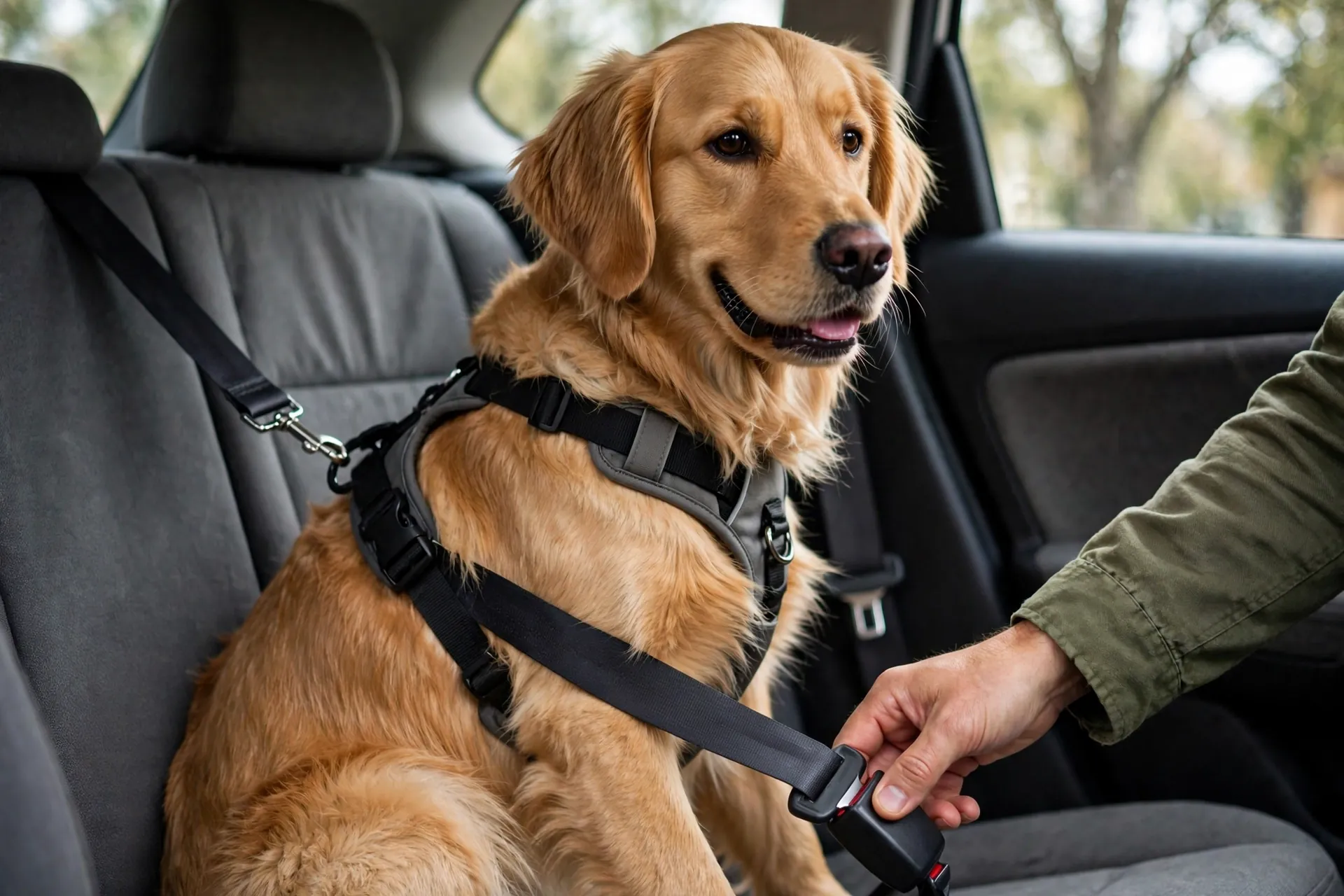
Now fit the restraint, not just the fabric. Put the dog's harness on, place the dog on the hammock, and clip the short tether to the harness and to the seat belt buckle or the designated anchor. The tether should be short enough to stop the dog climbing into the front seat or jumping out of an open door, but long enough to let the dog lie down and turn around. Test it by asking the dog to lie down and stand up: if the dog can reach the front seats, shorten the tether; if it cannot lie flat, lengthen it by one notch and re-test. Finally, do a short test drive around the block, then stop and check every strap and buckle again, because fabric settles and straps loosen on the first journey.
The common hammock mistakes are all avoidable. Do not anchor the hammock to a headrest that is loose or missing, do not use a tether clipped to a collar, and do not let the hammock cover the seat belt buckles so tightly that you cannot unclip the dog quickly in an emergency. Check the straps monthly, because repeated tightening stretches fabric, and wash the cover according to the maker's instructions so the waterproof layer keeps working. A hammock that is fitted once and never checked again will slowly sag, slide and lose its shape, and a sagging hammock is both uncomfortable and less safe.
Fitting a booster seat, step by step
Place the empty booster on the back seat and check that it sits flat, with its base fully supported and no part hanging over the edge of the seat. A booster that overhangs the seat cushion will tip on corners, and one that sits on a sloped seat base will lean to one side. If the base rocks, add the maker's non-slip mat or a thin folded blanket underneath, and re-check. The booster should not press against the front seat in a way that stops the front passenger adjusting their seat, and it should not block the rear seat belt buckles for other passengers.
Route the car seat belt through the booster's designated belt path, not around the outside, and buckle it in. Pull the belt tight until the booster barely moves when you push it firmly from side to side: if it slides more than a few centimetres, the belt is not tight enough or the belt path is wrong. Loop the headrest strap over the headrest behind the booster and tighten it as a second anchor, if the design provides one. Check that the seat belt is not twisted, that the buckle is fully engaged, and that the belt retracts normally when you unbuckle it.
Put the dog in last, not first. Settle the dog into the booster, attach the short internal tether to the back of the harness, and check that the dog can sit, lie down and turn around without the tether going taut. The tether should stop the dog climbing out over the wall, so test it gently: if the dog can get its front paws over the edge, the tether is too long or the walls are too low for that dog. Add the cushion or blanket the dog will actually travel with, because a thick bed changes the dog's height and the tether length. Take a short test drive, then stop, lift the booster and check that the seat belt is still tight and the base has not shifted.
Watch for the signs that a booster no longer fits. If the dog's head is above the wall when it sits, if its body fills the seat so tightly that it cannot turn, or if its weight is close to the stated limit, it is time to move up a size or change type. Never add a second tether to a collar to stop a dog climbing out, and never place a booster on the front passenger seat, where an airbag can injure a dog in a collision. If the car has a passenger airbag that cannot be switched off, the back seat is the only safe place for a booster.
Fitting a crate seat, step by step
Measure the boot before you buy, and measure it again before you fit. Check the width at the narrowest point between the wheel arches, the depth from the boot lip to the back of the rear seats, and the height under the parcel shelf or the boot lid. Remove the parcel shelf if the crate needs the height, and check whether the rear seats can be folded or moved to give more depth. A crate that fits with a centimetre to spare on the showroom floor may not fit once the boot mat, the dog's bed and the spare wheel cover are back in place.
Place the empty crate in the boot with the door facing the rear of the car, so the dog enters and exits without climbing over luggage. Anchor it using the car's tie-down points, load hooks or ISOFIX anchors, with straps rated for the crate's weight plus the dog's weight. Pull the straps tight and push the crate firmly from each side: it should barely move. If the boot has no suitable anchor points, use a boot divider or a purpose-made crate restraint, and check the official guidance before you travel if you are unsure which anchor points are safe to use in your car model. Never rely on luggage, a bungee cord or the weight of the crate alone to hold it in place.
Add bedding, ventilation and a familiar scent before the dog's first journey. A non-slip mat on the crate floor stops the dog sliding, a thin bed or blanket gives it something to settle on, and a worn item of your clothing can help a nervous dog relax. Check the airflow: the crate needs ventilation on at least two sides, and on a warm day you should be able to feel air moving through it when the boot is closed. Put the dog in at home first, with the door open, and let it explore the crate for a few minutes before closing the door for a short, calm drive.
For a crate on the back seat rather than in the boot, the same anchoring rules apply, with one addition: the crate must be strapped through the seat belt path or to the seat's anchor points, and it must not block the driver's view or the rear window. A back-seat crate also needs a door that opens fully without hitting the front seat, so the dog can get in and out without being lifted at an awkward angle. Check the latches after every journey, because vibration loosens them over time, and inspect the crate for cracks, bent bars or worn hinges after any hard braking or collision.
Car seat vs harness alone: which protects better?
A harness on its own, clipped to a seat belt, is a strong and simple restraint, and for many dogs it is all that is needed. A crash-tested harness spreads the force of a sudden stop across the chest and shoulders, keeps the dog on the seat, and costs less than a full seat system. It also works in any car, takes seconds to fit, and can be used with a hammock, a booster or a plain back seat. For a large, calm dog that lies down and stays put, a good harness plus a hammock for protection and comfort is often the best value combination.
A car seat adds something a harness alone cannot: a defined space, a raised position, or an enclosed den. A booster gives a small dog a view it would not otherwise have, which can reduce carsickness and anxiety, and a crate gives an anxious or restless dog a boundary that stops it pacing, climbing into the front or distracting the driver. A hammock adds protection for the car and stops the dog sliding into the footwell, which a harness alone does not do. The seat is therefore not a replacement for the harness; it is a complement to it, and the safest setups use both together.
The comparison changes with the dog. A small dog in a harness alone sits low on the back seat, cannot see out, and may be thrown sideways on corners even if it is restrained, because the harness allows more lateral movement than a booster wall. A large dog in a crate may be safer in a collision but may also be hotter, less able to see out, and more stressed on a long journey than the same dog on a hammock with a harness. A dog that chews straps may defeat a harness in minutes, while the same dog may settle in a rigid crate where there is nothing to chew within reach. Our comparison of dog car harness vs crate choices goes deeper into fitting, crash claims and boot setups if you are weighing those two options.
The practical answer is to match the system to the journey. For a ten-minute trip to the vet, a harness alone is usually enough. For a two-hour drive to the coast with a small dog that gets carsick, a booster plus a harness is worth the extra fitting time. For a dog that paces, barks at passing traffic or tries to climb into the front, a crate may be the only setup that keeps the driver safe. Whatever you choose, test it on a short, calm journey before a long one, and be honest about whether the dog is actually settled: a dog that pants, whines or paces for the whole journey is telling you the setup is wrong, even if the product page says it is right.
Puppies and older dogs: special considerations
Puppies need a seat that grows with them, and a plan that expects the first seat to be temporary. A puppy's bones and joints are still developing, so the seat should support the body without forcing it into a curled or upright position for long periods, and journeys should be short: fifteen to twenty minutes at first, building up gradually as the puppy gains confidence. A booster with high walls can help a puppy feel secure, but it must be checked every few weeks, because a puppy that fitted perfectly at twelve weeks can be too large for the same seat at five months. A hammock with a harness is often the more flexible choice for a growing puppy, because it does not have a fixed internal size to outgrow.
Toilet breaks matter more for puppies than for adult dogs. Plan a stop every hour or so on longer journeys, and carry cleaning supplies, spare bedding and a bag for waste. Never feed a puppy a large meal immediately before a journey, because carsickness is common in young dogs and usually improves with age and with short, positive trips. Keep the car cool and well ventilated, and avoid strong air fresheners, because a puppy's sense of smell is far more sensitive than yours. If the puppy is sick on every journey despite short trips and a raised seat, ask a vet for advice before the next long drive.
Older dogs need the opposite emphasis: easy access, joint support and warmth. A dog with arthritis may struggle to jump into a high booster or climb into a boot crate, so a low hammock on the back seat, a ramp, or a step may be essential. A thick, supportive bed inside the seat helps stiff joints, and a blanket over the seat keeps an older dog warm on a cold morning. Older dogs also need more frequent stops, more water and a slower pace at service stations: a dog that once managed three hours without a break may now need one every ninety minutes.
For both age groups, the fitting check is the same but the tolerance is lower. A puppy that can climb out of a booster is at risk, and an older dog that cannot get comfortable will become restless and distract the driver. Watch the dog, not the product: if the dog settles, sleeps and travels quietly, the setup is working; if it pants, shivers, whines or tries to escape, change something. A vet can advise on carsickness, anxiety and joint pain, and a behaviourist can help with a dog that is genuinely frightened of the car, because no seat can fix fear on its own.
Cleaning, care and lifespan
A dog car seat lives a hard life: mud, wet fur, hair, sick, sand and the occasional accident all end up on the same surface, and a seat that cannot be cleaned properly will smell, stain and wear out fast. Before you buy, check how each part is cleaned. A hammock cover that unclips and goes in the washing machine is far more practical than one that must be sponged by hand, and a booster with a removable, washable cushion is far more practical than one with a fixed foam pad. Check the washing instructions too: some waterproof layers lose their coating if washed too hot or tumble-dried, and some non-slip backings crack if washed too often.
Build a simple cleaning routine and stick to it. Shake the seat out after every muddy walk, vacuum the hair weekly, and wash the cover as soon as it smells rather than waiting for a deep clean. Wipe rigid crates with a pet-safe cleaner and dry them thoroughly, because damp fabric and trapped moisture breed smells and can irritate a dog's skin. Check the straps and buckles while you clean: look for fraying, cracked plastic, bent metal and stitching that is coming loose, and replace any part that looks worn rather than hoping it will hold for one more journey.
Lifespan depends on use, material and care. A fabric hammock used daily for a large, muddy dog may last two to three years before the waterproof layer fails or the straps stretch; the same hammock used once a week for a small, clean dog may last five years or more. A booster with a rigid frame and a washable cover often lasts three to four years, while a rigid crate can last a decade if its door, latches and ventilation stay sound. After any collision, even a minor one, inspect every strap, anchor and buckle and replace anything that looks stretched or damaged, because crash damage is not always visible. A seat that has done its job in a collision has earned its replacement.
Store the seat properly between journeys if you remove it. Keep it dry, out of direct sunlight and away from sharp objects that can puncture a waterproof layer. Fold a hammock loosely rather than creasing it tightly, and store a soft crate open so the fabric can air. A seat that is left screwed up in a damp boot will smell, mildew and wear out far faster than one that is hung up to dry after a wet walk, and a dog that refuses to settle on a smelly seat is giving you useful information about its condition.
Budget: what to spend at each level
Dog car seats span a wide price range, and the right budget depends on how often you travel, how large your dog is and how much protection you need. At the lower end, a simple waterproof hammock with headrest straps and a basic tether can be bought for the price of a few tanks of fuel, and for a calm, medium-sized dog that travels short distances, it may be all you need. Spend the saving on a proper crash-tested harness, because the harness is the part that actually restrains the dog, and a cheap hammock plus a good harness is safer than an expensive seat plus a weak harness.
In the middle range, you can expect better materials, a rigid or semi-rigid base, a non-slip underside, wider straps with solid buckles, and a washable cover that survives repeated washing. This is the sensible level for most owners: a mid-priced hammock or booster that fits well, lasts several years and is easy to clean will serve a weekly traveller far better than a budget model that sags after a month. At this level, look for a clear weight limit, a stated internal size and honest fitting instructions, and be wary of any product that hides those details behind vague claims.
At the higher end, you are paying for crash-test evidence, rigid construction, better anchoring and longer durability. A rigid, crash-tested crate or a booster with published independent test data costs more, but for a large dog, a frequent traveller or a dog that travels on motorways, the extra cost buys real protection rather than just a nicer fabric. The same logic applies to a second car: if the dog travels in two cars, a second mid-priced seat that is always fitted is safer than one expensive seat that is moved between cars and fitted in a hurry.
Whatever your budget, avoid the false economies. Do not buy a seat by price alone, do not buy a size up to save money on a replacement, and do not reuse a seat that has been in a collision without inspecting it. Check the returns policy before you order, because a seat that does not fit your car is not a bargain at any price, and keep the receipt and the fitting instructions with the car's documents. The cheapest seat that fits properly and is used on every journey is worth more than the most expensive seat that stays in the cupboard because it is too fiddly to fit.
Practical questions
Before you go
Do I legally need a dog car seat in the UK?
No single product is named in the law, but Highway Code Rule 57 requires dogs to be suitably restrained so they cannot distract the driver or injure themselves or others if the vehicle stops quickly. A car seat, a crash-tested harness or a secured crate can all meet that duty if they are fitted correctly and suit the dog. An unrestrained dog can lead to a fine, penalty points and problems with an insurance claim, so the restraint matters more than the label on the box.
What is the safest type of dog car seat?
For most dogs, a well-fitted crash-tested harness used with a suitable seat, or a secured crate in the boot, offers stronger crash protection than a soft booster or an unanchored hammock. Hammocks mainly protect the car and limit movement, while boosters mainly raise small dogs. Check for independent crash-test evidence, a clear weight limit and honest fitting instructions, and treat a seat with no test data as comfort equipment rather than safety equipment.
How do I measure my dog for a car seat?
Measure length from chest to base of tail, height from floor to top of the shoulders while standing, and width across the widest part of the chest, then weigh the dog on bathroom scales. Add a few centimetres for a bed or blanket, and compare all three measurements with the maker's internal dimensions rather than the overall size. If your dog falls between sizes, choose the larger one when the weight limit allows, because a seat that is too small forces the dog to curl up or perch on the edge.
Can a puppy use a booster seat?
A puppy can use a booster once it is settled enough to stay inside it and the seat's minimum weight and size limits are met, but keep early journeys short and always use the tether or harness attachment. Puppies grow fast, so measure again every few weeks and move up a size before the seat becomes cramped. Never leave a puppy unsupervised in a car seat, and stop for toilet breaks far more often than you would with an adult dog.
Is a hammock safer than a dog seat belt on its own?
A hammock and a seat belt do different jobs, so the comparison is misleading. The hammock protects the upholstery and stops a dog sliding into the footwell, while the belt or harness is what actually restrains the dog in a sudden stop. The safest combination is a hammock plus a crash-tested harness clipped to a seat belt anchor, not a hammock on its own. Never clip a lead or tether to a collar for car travel, because the force in a crash can injure the neck.
How often should I replace a dog car seat?
Replace a seat when straps fray, buckles crack, stitching fails, foam collapses, the waterproof layer leaks, or the dog has outgrown the stated weight or size limit. After any collision, even a minor one, inspect every strap, anchor and buckle and replace anything that looks stretched or damaged. As a rough guide, a daily-use fabric seat often lasts two to four years, while a rigid crate can last much longer if its door, latches and ventilation are still sound.