This guide is independent and contains no paid placement. If affiliate links are added later, they will be clearly marked and will not change our editorial checks.
Highway Code Rule 57 says a dog in a vehicle must be suitably restrained so it cannot distract the driver or injure anyone if the car stops quickly. A properly fitted, car-tested seat belt harness meets that test for many dogs, but a loose walking harness, a dangling lead clip, or a dog loose on the back seat does not. Fit the harness to the dog, keep the tether short, and check the official guidance before you travel.
Rule 57 in one sentence
Rule 57 of the Highway Code says, in essence: when in a vehicle, make sure dogs or other animals are suitably restrained so they cannot distract you while you are driving or injure you, or themselves, if you stop quickly. That single sentence is the whole starting point for this guide, and it is worth reading slowly, because almost every argument about dog car seats, harnesses and boot guards comes back to those two tests: no distraction, and no injury in a sudden stop.
Notice what the sentence does not say. It does not name a particular product. It does not say that every dog must wear a seat belt harness, and it does not say that a harness alone is automatically enough. The test is practical, not brand-based. A restraint is suitable only if it works for the dog, the car and the journey in front of you. A harness that holds a calm terrier on a ten-minute drive to the vet may still fail a strong, anxious spaniel on a three-hour motorway trip, because the dog, the duration and the forces involved are different.
The Highway Code itself is not a single criminal law, and this distinction matters for drivers. Some of its rules restate legal requirements, using words such as must, while others give advice, using words such as should. Breaking an advisory rule is not automatically an offence in itself, but it can be used as evidence in court proceedings, for example to support a charge of driving without due care and attention, or another driving offence, if the facts support it. That is why treating Rule 57 as a vague suggestion is a mistake. The question after a crash or a roadside stop is rarely whether you owned a harness. It is whether the dog was actually restrained in a way that prevented distraction and injury. Check the official guidance before you travel if you want the current wording, because Highway Code guidance is updated from time to time and secondary summaries can go out of date.
Rule 57 also sits alongside the ordinary duty every driver already has: to keep proper control of the vehicle, to keep a proper lookout, and to avoid anything that takes attention away from the road. A dog is not a phone or a sandwich, but the distraction risk is similar in one important respect. A loose dog can climb into the footwell, block a mirror, nudge an arm, bark at a passing cyclist, or slide across the seat when you brake. Any of those events can turn a routine stop into a loss of control. Restraint is therefore not only about protecting the dog in a crash. It is about keeping the driver free to drive from the moment the doors close.
Finally, remember that Rule 57 applies to the whole vehicle, not only to the back seat. A dog in the front passenger seat, a dog on a lap, a dog loose in a van cab, and a dog loose in an estate boot are all covered by the same principle. The right answer changes with the vehicle, but the test does not. If the dog can reach the driver, interfere with the controls, or become a projectile in a sudden stop, the restraint has not done its job.
What counts as suitably restrained
Suitably restrained means three things at once. First, the dog cannot move freely around the car. Second, the dog cannot distract the driver. Third, the dog is protected, as far as the restraint can manage, from being thrown forward, sideways or into hard surfaces if the car stops quickly or is hit. A product that only achieves one of those three is not a complete answer. A short lead tied to a headrest may stop a dog wandering, for example, but it may still let the dog fall off the seat, strangle on a collar, or swing into the door. A comfortable bed on the back seat may settle a dog beautifully, but it restrains nothing at all.
Think in terms of movement, not equipment. Can the dog get into the front seats? Can it put its head out of a fully open window? Can it stand on the seat and slide when you brake? Can it reach the gear lever, handbrake, steering wheel or pedals? Can it climb over a low boot divider? If the answer to any of those is yes, the setup needs to change before you drive, even if the dog looks calm while the car is parked. Dogs behave differently once the car moves, the road noise rises, and another dog appears at a junction.
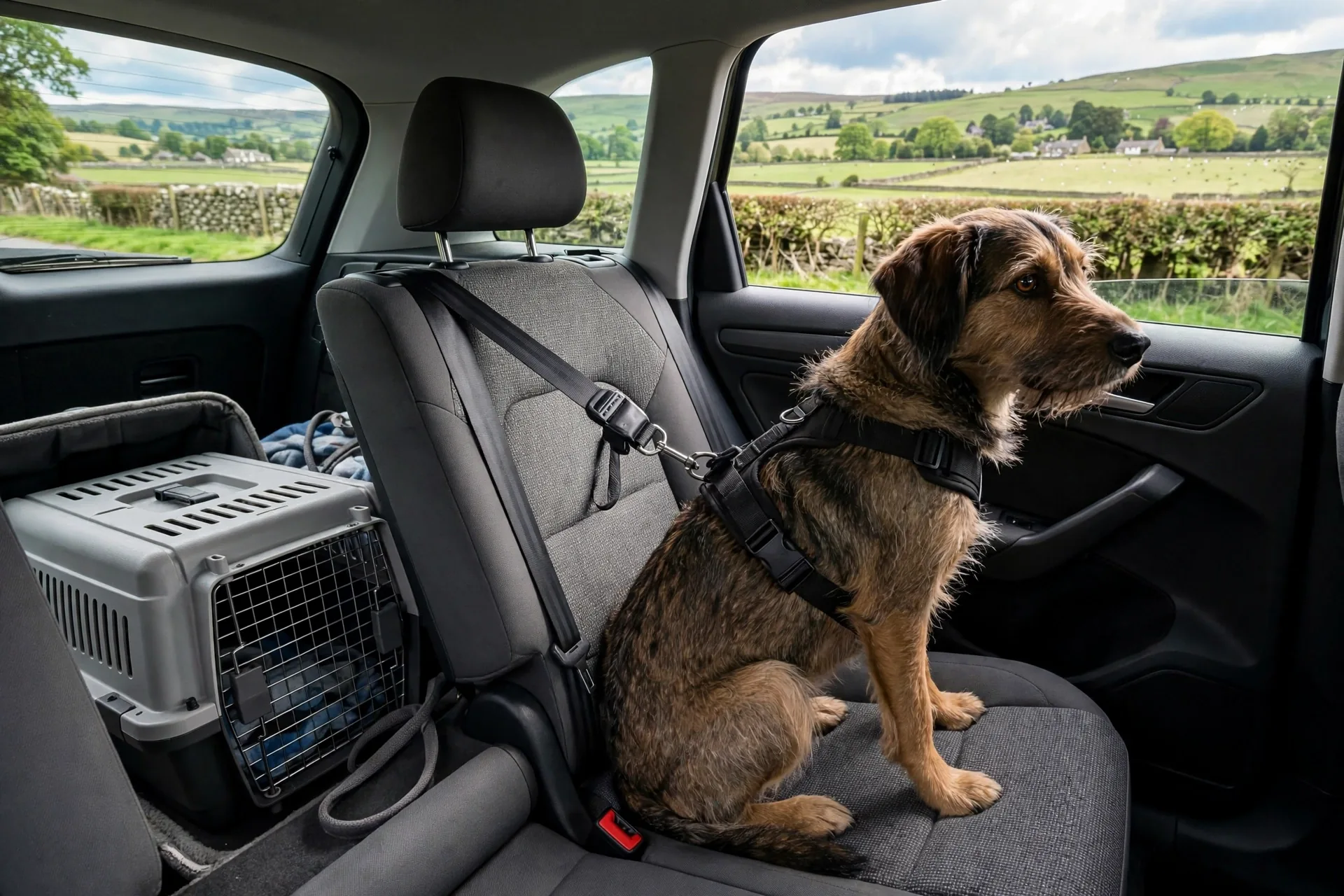
Attachment point matters as much as the harness itself. A harness attached to a collar, to a loose lead, or to a seat belt that is not locked in place is not a system. It is a collection of parts that may fail separately. The harness should connect to the car through the route its maker designed: usually a seat belt threaded through the harness, a short tether clipped to a proper anchor, or a belt insert that locks into the buckle. Follow the maker's instructions for that exact model, because different harnesses route the belt differently, and a belt threaded through the wrong loop can concentrate force on the dog's neck or belly instead of spreading it across the chest.
Comfort is part of safety, not a luxury added on top. A dog that is pinched, overheated or terrified by a harness will chew, twist, bark and try to escape, and that behaviour itself becomes a distraction. The harness should allow the dog to sit, lie down, turn its head, pant and settle, without allowing it to stand on the seat, climb forward or hang off the edge. That balance is the practical meaning of suitable. If you have to choose between a harness the dog tolerates and one it fights every minute, the tolerated one, properly fitted, is usually the safer starting point, provided it is still a car-rated design and not merely a walking harness.
It is also worth checking the restraint after the first few minutes of every journey. Straps settle, dogs shift position, and a buckle that felt secure in the driveway can work loose on a bumpy road. Pull over safely, check the fit, offer water if the dog needs it, and only then continue. That two-minute check is not fussiness. It is the difference between a restraint that was suitable when you left home and one that is still suitable twenty miles later.
Harness, crate or boot guard: which restraint fits your setup
A seat belt harness suits many cars and many dogs, but it is not the only lawful and sensible option. The best choice depends on the dog's size and temperament, the car's layout, the length of the journey, and whether you also need to carry luggage. Understanding the trade-offs stops you buying the wrong solution for your car and then blaming the dog when it does not work.
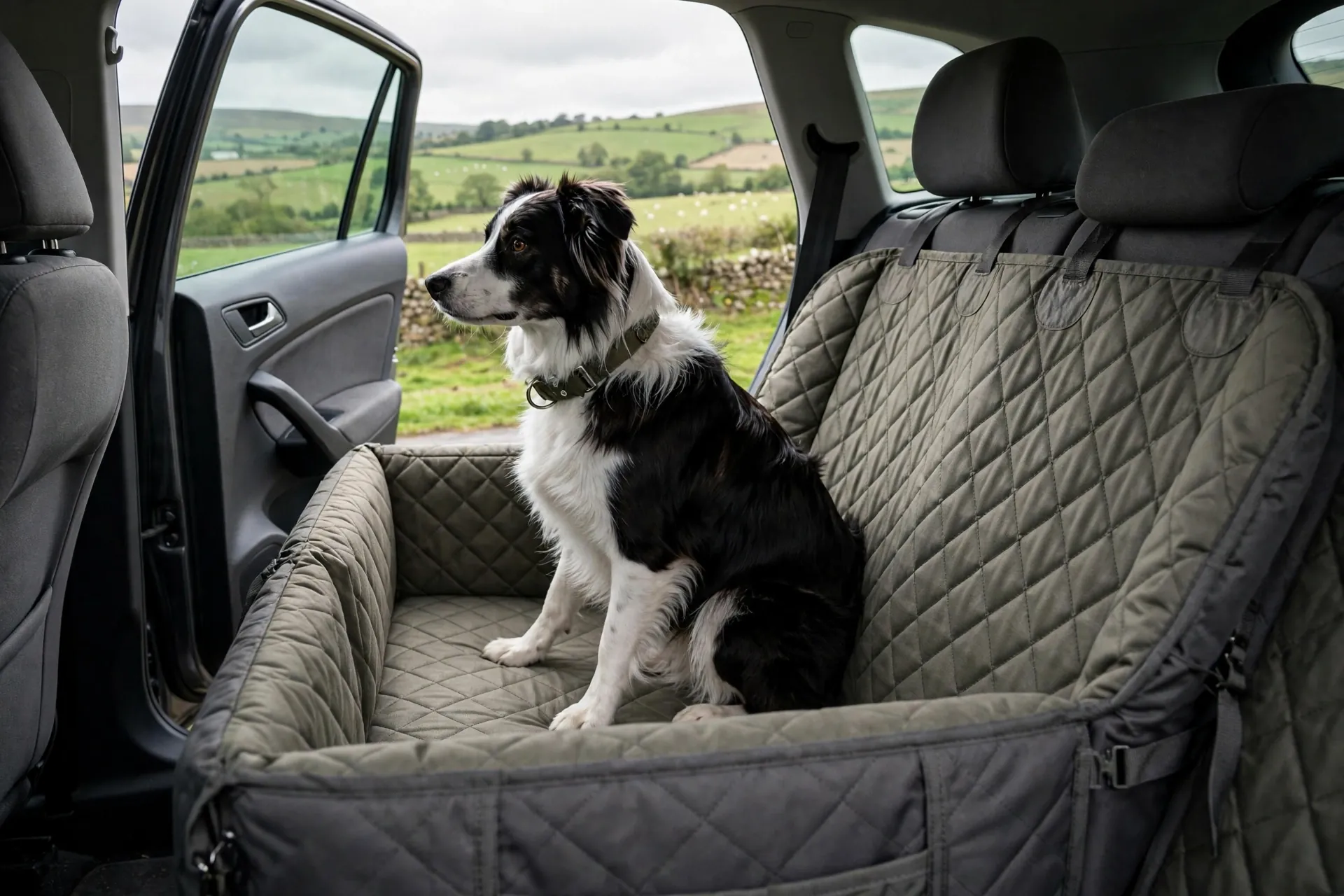
A car harness keeps the dog on a seat, usually the back seat, and connects it to the seat belt system. Its strengths are visibility, easy access at stops, and a familiar position for dogs that settle well beside people. Its weaknesses are space and mess: a large dog takes up a full seat, muddy paws meet upholstery, and a dog that cannot settle may still bark, pace on the spot, or try to climb. A seat cover can protect the upholstery, but it must not interfere with the harness or the belt. Our guide to car seat covers for dogs explains how to pair a cover with a restraint without covering buckles or creating a slippery surface.
A crate works well for dogs that already settle in a crate at home, for puppies learning car routines, and for cars where the boot or back seat can hold a crate securely. A crate contains the dog, keeps luggage separate, and gives an anxious dog a den-like space. It must still be secured so it cannot slide or tip, and it must be large enough for the dog to stand, turn and lie down, with ventilation on several sides. A crate that is too small, unsecured, or placed where exhaust heat or direct sun builds up is not a safer option merely because it has a door. Our broader comparison in dog car safety walks through harness versus crate decisions in more detail, including boot setups and longer journeys.
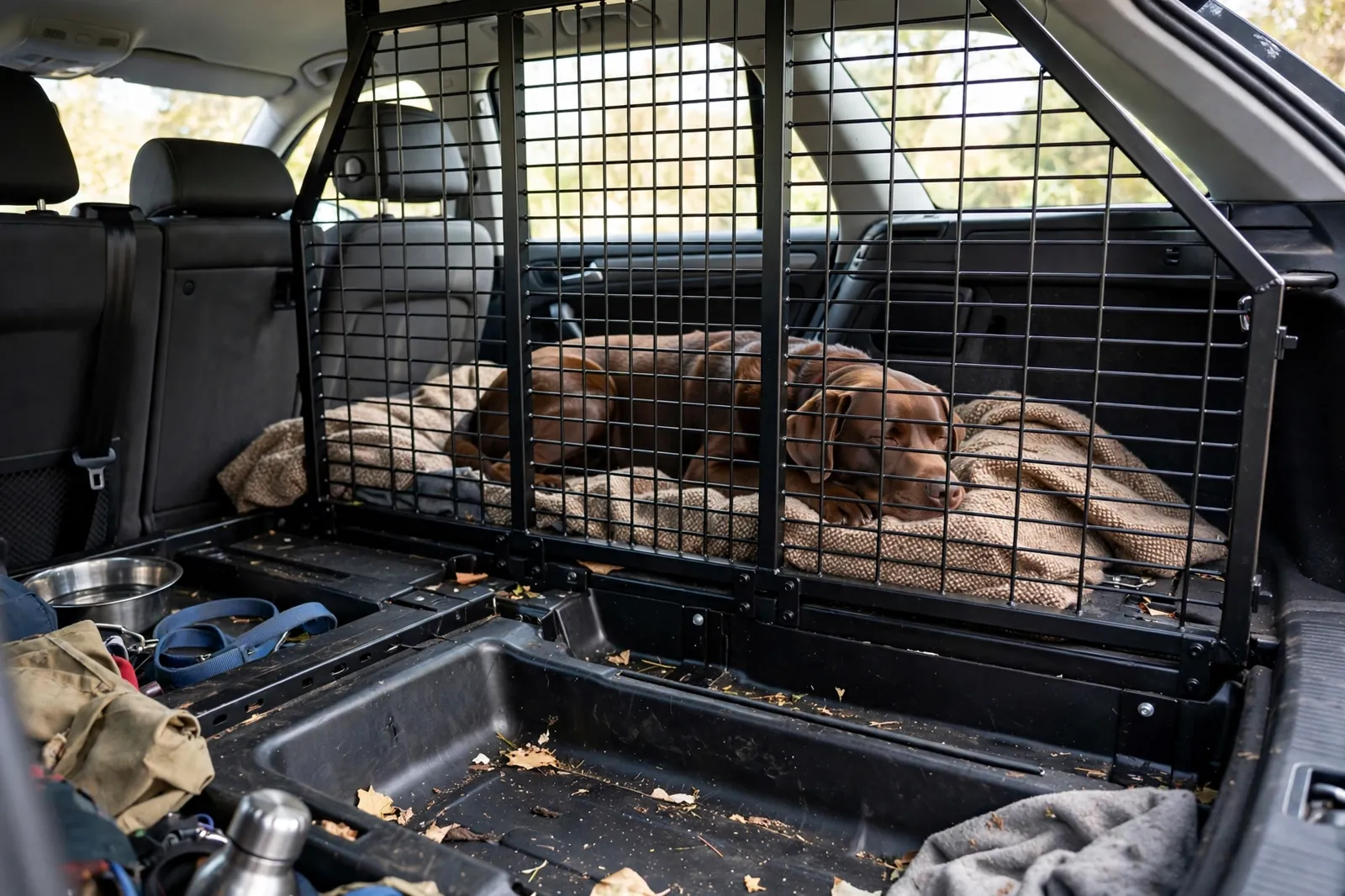
A boot guard or divider suits estate cars, hatchbacks and SUVs where the dog travels in the boot. The guard stops the dog climbing into the cabin, while the boot gives the dog room to lie down away from passengers. The guard must be fitted to the specific car model, fixed firmly, and checked for gaps at the sides and top. A universal guard that wobbles, leaves a terrier-sized gap, or is held only by pressure pads on a smooth surface is not a reliable restraint. For measuring and fitting detail, see how to choose and fit a boot guard, which covers vehicle-specific fitting and the interaction between guards, crates and harnesses.
Some drivers combine methods, and that can be sensible. A dog may wear a harness in the boot area with a guard in place, or travel in a crate behind a guard. Combination is fine, provided each part is used as designed and the combination does not create a new hazard, such as a tether long enough to let the dog strangle, a crate blocking the rear view, or luggage piled against a guard so that it cannot hold in a crash. Do not improvise with bungee cords, rope, or a lead wrapped around a headrest. Improvised restraints fail unpredictably, and they can injure a dog more severely than no restraint in some crash positions, because they concentrate force or create a strangulation risk.
Finally, think about emergencies. If you break down or are involved in a collision, rescuers and other drivers need to be able to see and reach the dog safely. A harness with a clear release, a crate with a door that opens easily, and a dog that is not loose and panicking in traffic all help. Keep a lead within reach of the driver's door, not buried under luggage in the boot, so you can secure the dog before opening its door on a busy road.
Choosing a car harness: testing, size and attachment type
Start with testing, because this is where car harnesses differ most from walking harnesses. A car harness should be designed and tested for vehicle use, with a maker that explains what test it passed and at what weight. Look for clear statements about crash testing, rather than vague words such as heavy duty, strong, or travel approved, which on their own mean very little. Some makers publish test speeds and dummy weights, others cite a recognised test method. If a listing gives no test information at all, treat that as a warning, not as a detail you can ignore. Check the official guidance before you travel if a maker claims legal compliance, because a product can be well made without being the product the law requires, and the law does not certify individual harnesses.
Next, measure the dog, not the breed. Breed size charts are a starting point, but chest depth, neck size and body length vary widely within a breed, especially in mixed breeds, puppies and dogs that have gained or lost weight. Use a soft tape measure around the widest part of the chest, just behind the front legs, and around the neck where the harness will sit. Weigh the dog as well, because many car harnesses give a weight range for their hardware and tether. Write the measurements down and compare them with the maker's size chart, paying attention to whether the dog sits near the top of a size range. A dog at the very top of a size often fits better, and more safely, in the next size up, provided the straps can still be adjusted snugly.
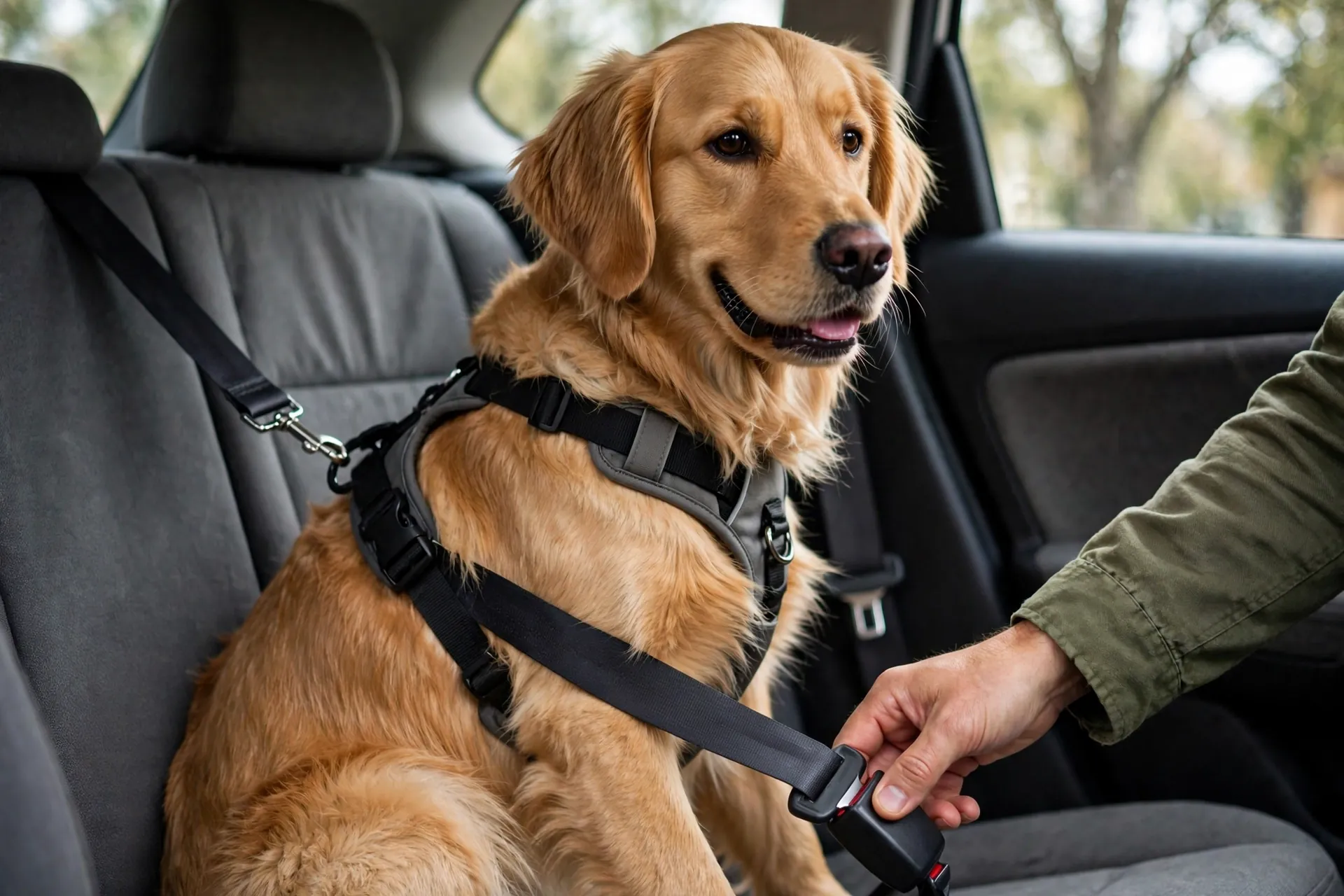
Attachment type is the third decision. Some harnesses thread the car's seat belt directly through loops or a chest panel. This uses the car's own restraint system and often gives the most secure result, but it can be slower to fit and may not work well if the belt geometry in your car puts the buckle in an awkward place. Other harnesses use a short tether that clips into the seat belt buckle or attaches to a headrest post or an ISOFIX-style anchor, depending on the design. A tether is faster at stops, but its length is critical: too long and the dog can climb, fall or reach the front; too short and the dog cannot lie down or turn its head comfortably. A third type combines a padded vest with a belt slot and a short tether for positioning. Whichever type you choose, use only the attachment method the maker designed for that harness, and never add an extra lead, extender or carabiner unless the maker explicitly approves it.
Strap width, padding and hardware deserve a close look. Wider chest straps spread force over a larger area, which matters in a sudden stop. Padding on the chest and belly helps a dog settle for long journeys, but padding that bunches, slides or traps heat can make the dog restless. Metal hardware should feel solid and close positively, with no sharp edges, and adjusters should stay put once set. Plastic buckles can be perfectly adequate on a small-dog harness, but they should be sized for the dog's weight, not merely for convenience. Try the harness on the dog indoors, walk around the house, and watch for rubbing behind the front legs, pressure on the throat, or a chest plate that rides up when the dog sits. Those problems will only get worse in a moving car.
Finally, consider the car itself. Seat belt length, buckle position, seat shape and the presence of side airbags all affect fit. A harness that works in a tall SUV with flat rear seats may sit differently in a small hatchback with sculpted seats and short belts. If possible, fit the harness in your own car before a long journey, with the dog in the position it will actually travel in, and check that the belt locks, the buckle is accessible for a quick release, and the dog cannot step on the buckle and release it. A harness bought for a different car, or for a dog that has since grown, should be rechecked, not assumed to still fit.
Fitting it properly: a step-by-step routine
Fit the harness indoors first, away from the excitement of the car. Put it on the dog calmly, reward settling rather than rushing, and adjust the straps in the order the maker gives, usually chest first, then belly, then any neck or back adjustment. The chest pad or strap should sit on the breastbone, not high on the throat and not low on the soft belly. The back strap should sit level, not twisted, and the harness should not rotate around the dog's body when you gently pull it from side to side.
Use the two-finger check as a starting guide, not as a law of physics. You should be able to slide two fingers flat under the straps without forcing them and without the strap gaping loose. If you can fit a whole hand underneath, the harness is too loose and the dog may slip out or slide in a stop. If you cannot fit one finger, it is too tight and will rub, restrict breathing, or make the dog panic. Different makers phrase this check differently, so follow the maker's own guidance where it differs, and recheck after the dog has moved around for ten minutes, because straps settle into fur and padding compresses.
Attach the harness to the car next, before you close the door and start the engine. Thread the belt or clip the tether exactly as instructed, then check that the belt is not twisted, the buckle has clicked fully, and the tether cannot wrap around a leg or the dog's neck. Sit the dog in its travelling position and ask it to lie down if that is how it will travel. The dog should be able to lie down, sit up, turn its head, and pant, without being able to stand on the seat, climb into the footwell, or reach the front seats. Shorten the tether one notch at a time until that balance is reached, rather than leaving a generous length for comfort that defeats the restraint.
Introduce the harness gradually if the dog is new to it. Short sessions at home, then sitting in a parked car with the engine off, then a drive around the block, then a slightly longer local drive, build tolerance far better than a first journey that is also a three-hour holiday drive. Reward calm settling, keep the car cool and ventilated, and avoid feeding a large meal immediately before travel if the dog is prone to sickness. If the dog chews the tether or harness, stop and address that before relying on it, because a chewed strap is a failed restraint waiting for a sudden stop to reveal itself.
Recheck the fit at every stage of a dog's life and at the start of each season. Puppies outgrow harnesses quickly, older dogs lose muscle or gain weight, winter coats add bulk under straps, and a harness washed many times can stretch or stiffen. A five-minute check before a holiday drive is cheap insurance against a harness that fitted last summer but no longer fits the dog in front of you. Keep the maker's size chart and the purchase date with your travel documents, so a replacement can be ordered in the right size without guessing.
Common mistakes that undo a good harness
The most common mistake is buying a walking harness and calling it a car harness. Walking harnesses are designed to distribute lead pressure and to be comfortable for hours of walking. They are not necessarily designed to withstand crash forces, and their straps, stitching and attachment points may fail in a sudden stop. A car harness may look similar, but its construction, testing and belt routing are different. If the product description never mentions vehicle testing, do not assume it is safe for car use because it feels sturdy in the shop.
The second mistake is leaving the tether too long. A long tether feels kind, because the dog can move, look out of the window, and greet passengers. It also lets the dog build up speed before the tether snaps taut, fall off the seat, or climb into the front. The tether should be as short as the dog's comfort allows, not as long as the packaging allows. If your dog cannot settle on a short tether, the answer is training and shorter journeys first, not a longer tether that restores the very movement Rule 57 is meant to prevent.
Attaching a harness to a collar is another serious error. A collar concentrates force on the neck, and a sudden stop can injure the trachea, neck or spine, especially in small dogs and in breeds with delicate necks. A harness spreads force across the chest, which is why a car harness is a harness, not a collar with a clip. Similarly, clipping a lead to a harness and then to a seat belt buckle with an improvised connector can twist, tangle, or release under load. Use the connector the harness maker supplies or approves, and replace it if it shows wear, cracking, or a buckle that no longer clicks firmly.
Letting the dog travel on a lap, in the front seat with an airbag, or with its head fully out of the window are all mistakes that a harness alone cannot fix. A lap dog becomes a distraction and a projectile, and a front airbag designed for an adult passenger can seriously injure a dog. A head out of a fully open window risks eye injury from debris, ear damage, and a dog jumping or falling out at a stop. Open a window only a crack for air, keep the dog restrained on the back seat or in the boot area, and disable rear window controls if the dog can step on them.
Other mistakes are quieter but still matter. Piling luggage around a harnessed dog can trap heat, block air, and turn bags into projectiles. Leaving a dog in a parked car in warm weather, even with a window cracked, can become dangerous quickly, and a harness does not change that. Forgetting to check the harness after a wash, a growth spurt, or a change of car can leave a dog in a harness that no longer fits. Finally, assuming that a calm dog does not need restraint is a mistake of reasoning, not of equipment. Restraint is for the sudden stop you did not expect, not for the calm drive you did expect.
Insurance, fines and what happens after a crash
Many drivers ask first about fines, but the more immediate risk is often insurance and liability. If a dog is unrestrained and the car is involved in a collision, an insurer may look closely at whether the dog distracted the driver, whether the restraint failed, and whether the driver took reasonable care. That does not automatically mean every claim is refused, and it does not mean a restrained dog guarantees a payout. It does mean that the restraint setup can become part of the claim discussion, alongside speed, lookout, road conditions and the other driver's actions. Keep your policy wording, note any clause about animals in the vehicle, and check the official guidance before you travel if you are unsure how your insurer treats unrestrained pets.
On the criminal side, the position is fact-dependent, which is why precise penalty figures in online summaries should be treated with caution. A driver whose loose dog causes a loss of control could face prosecution for an offence such as driving without due care and attention, depending on the evidence, and a court could consider the breach of Rule 57 as part of that evidence. Penalty points, fines and other consequences depend on the offence charged, the court's findings, and the driver's record, so no guide can safely promise a single figure for every case. If you receive a notice, a fine, or a court summons after an incident involving a dog in the car, take independent legal advice promptly rather than relying on a general guide.
After a crash, the practical steps matter as much as the legal ones. Do not open a door and let a frightened dog run into traffic. Secure the dog on a lead before opening its door, if it is safe to do so, and keep it away from the road while you exchange details and call for help. Photograph the restraint setup if it is safe and relevant, because insurers and investigators may ask how the dog was restrained. If the dog is injured, seek veterinary help urgently, even if the injury looks minor, because internal injuries and shock are not always visible. If the harness is damaged in the crash, replace it rather than continuing to use it, because hidden stitching or hardware damage may fail in the next sudden stop.
It is also worth telling your insurer accurately about how the dog travels if you are asked. Do not describe a walking harness as a crash-tested car harness, and do not claim a boot guard is fitted if it is only leaning in the boot. Accuracy at the proposal stage avoids a later argument that information was misleading. If your policy has a specific requirement about pet restraint, follow it exactly, and keep the maker's instructions and receipt for the harness with your insurance documents, so you can show what was used if a claim arises.
Puppies: small dogs, fast growth and short journeys
Puppies need restraint from the very first car journey, including the journey home from the breeder or rescue centre, but their needs differ from an adult dog's. A puppy is still learning that the car is safe, still growing, and still likely to chew anything within reach, including straps and tethers. The goal for a puppy is a harness that fits today, can be adjusted as the puppy grows, and is introduced so calmly that the puppy does not learn to hate the car before it learns to love the destination.
Buy for adjustability and remeasure often. A puppy can outgrow a harness in a few weeks, especially in larger breeds, so check the chest measurement every two to three weeks and move up a size before the straps reach their limit. A harness that is too small will pinch behind the legs and ride up on the throat, while a harness bought far too large in the hope of growing into it will gap, twist and let the puppy slip a leg through. If you are between sizes, follow the maker's guidance for puppies, and favour the size that can be adjusted snugly now, with room to grow, over a size that only fits on the loosest setting.
Keep early journeys short and positive. A five-minute drive to a quiet place for a sniff and a reward teaches more than a long drive to a busy destination that overwhelms the puppy. Avoid feeding a large meal just before travel, bring water and a familiar blanket, and keep the car cool and calm. If the puppy is sick in the car, do not punish it, clean up calmly, and shorten the next journey. Many puppies improve with age and gradual exposure, but a puppy that is repeatedly sick or distressed on long journeys should be discussed with a vet, because pain, anxiety and motion sickness can all look similar from the driver's seat.
Chewing is a practical safety issue, not merely a nuisance. A puppy that chews through a tether has removed its own restraint, and a frayed strap may fail without warning. Supervise the puppy, use a harness and tether material that resists chewing where possible, and consider a crate for very young puppies that chew persistently, provided the crate is secured and the puppy has already learned to settle in it at home. Never leave a puppy unattended in a car with a harness it can chew, and inspect straps before every journey, not only when you remember.
Finally, remember that puppies have legal and welfare needs beyond the car. They need toilet breaks, they cannot be left alone for long periods, and they need vaccination and socialisation plans that affect where they can go on arrival. Plan the journey around those needs: more frequent stops, a safe toilet spot away from traffic, and a destination that welcomes a young dog, rather than a timetable that treats the puppy as luggage. A calm puppy journey is usually a slower journey, and that is a feature, not a failure.
Large dogs: weight, force and seat space
Large dogs change the physics of a car journey. A 30-kilogram dog in a sudden stop carries far more momentum than a 5-kilogram dog, and that force has to go somewhere: into the harness, into the belt, into the seat, and, if the restraint fails, into the driver, the dashboard, or the dog itself. That is why large-dog harnesses need wider straps, stronger hardware, and a belt routing that spreads force across the chest, rather than a scaled-up version of a small-dog walking harness with a clip added.
Check weight ratings, not only size labels. A harness labelled large may still have a tether or buckle rated for a lower weight, or a size chart that groups dogs from 20 to 40 kilograms together without distinguishing their chest shapes. Compare the dog's actual weight and chest measurement with the maker's stated range, and be wary of a harness that fits on the tightest setting but has no adjustment left for a winter coat or a few kilograms of seasonal weight change. If the dog is near the top of the stated weight range, ask the maker whether a stronger model is recommended, and check the official guidance before you travel if you are unsure.
Seat space is a practical constraint that owners often discover too late. A large dog on the back seat may take up the whole seat, leaving no room for a passenger, and may still be able to reach the front if the tether is long. In many estate cars and SUVs, a secured crate or a boot area with a fitted guard gives a large dog more room to lie down properly, keeps the cabin free, and avoids a passenger sitting beside a dog that cannot settle. That is not a failure of the harness idea. It is a recognition that the best restraint for a large dog in a small car may be a different restraint altogether.
Large dogs also need more attention to getting in and out of the car safely. Jumping in and out of a high boot or back seat can injure joints, especially in older large dogs, and a dog that scrambles can damage the harness or the seat belt mechanism. A ramp, a low step, or a controlled lift, taught gradually, protects both the dog and the restraint. Once inside, the dog should be able to lie down with its head supported, not perched on the edge of the seat with its legs dangling, because a dog that cannot lie down comfortably will keep shifting, and shifting loosens straps.
Finally, large dogs are more likely to trigger the distraction test in Rule 57 simply by moving. A small dog shifting on a seat may be a minor distraction. A large dog standing, turning, or pushing into the front seats can block a mirror, nudge an arm, or unbalance the driver. That makes a short, well-fitted tether and a settled routine even more important for large dogs, not less. If a large dog cannot settle in a harness after gradual training, try a crate or boot setup before concluding that the dog simply cannot travel safely.
The journey itself: breaks, heat, sickness and settling
A harness is only part of a safe journey. The routine around it decides whether the dog arrives calm or distressed, and a distressed dog is a distraction risk even when it is technically restrained. Plan breaks every two hours on long journeys, or more often for puppies, older dogs, and dogs that need frequent toilet stops. A break is not merely a toilet stop. It is a chance to offer water, check the harness fit, let the dog stretch, and reset its arousal before the next stretch of road. Choose a safe stopping place away from fast traffic, keep the dog on a lead from the moment the car door opens, and never let a dog run loose in a service area car park.
Heat is a serious risk in a car, even on a mild day, and a harness does not protect against it. Keep the car ventilated, use air conditioning where available, and avoid leaving a dog in a parked car in warm weather. Dark upholstery, direct sun through a rear window, and a dog wearing a thick harness and a coat can combine to overheat a dog faster than the driver expects. Signs of overheating include heavy panting, drooling, restlessness, and a reluctance to settle. If you see those signs, stop safely, cool the dog gradually, offer water, and seek veterinary advice if the dog does not recover quickly. Do not pour ice-cold water over an overheated dog or force it to drink large amounts at once.
Motion sickness affects many dogs, especially puppies, and it can make a dog associate the car with nausea. Keep the car cool, avoid strong air fresheners, drive smoothly, and keep early journeys short. A dog that drools, licks its lips, yawns repeatedly, or vomits on every journey may need veterinary advice, and a vet may suggest strategies or medication for longer trips. Do not give human travel sickness medication to a dog without veterinary advice. If sickness is frequent, a crate with a low, stable position in the car sometimes helps, because the dog can lie still rather than watching the world move past a window.
Settling is a skill, not a personality trait. Some dogs settle immediately, others need a routine: a familiar blanket, a chew that is safe in a moving car and cannot become a choking hazard, a calm voice, and a consistent seat position. Avoid giving a dog a toy or chew that can break into pieces, roll under a pedal, or distract the driver if it is dropped. Keep the radio at a moderate volume, avoid sudden loud music, and talk calmly if the dog whines. If the dog barks continuously, pull over safely and check whether it needs a toilet break, water, or a harness adjustment, rather than shouting over it while driving.
Multi-dog journeys need extra planning. Two dogs on the back seat need two properly fitted harnesses, two attachment points, and enough space that they cannot tangle tethers or fight over a seat. A dog that is calm alone may be aroused by a travelling companion, and a tether that is safe for one dog may become a strangulation risk when two dogs cross leads. In many cars, two large dogs travel better in separate crates or in a divided boot area than side by side on a seat. Whatever setup you choose, test it on a short local drive before a holiday, because a tangle discovered on a motorway is far harder to fix than one discovered in your own street.
Finally, think about the end of the journey as part of the journey. A dog that arrives over-aroused, overheated, or desperate for a toilet break will be harder to settle at the destination, and may bolt when a door opens. Park safely, secure the dog on a lead before opening its door, offer water and a toilet break, and give the dog a few minutes to sniff and decompress before entering a new place. The last five minutes of a journey often decide the first hour at the destination, and a calm arrival is worth more than a few minutes saved by rushing.
Before you drive checklist
Use this checklist every time, not only on holiday. It takes two minutes and catches the mistakes that cause most problems. First, is the dog restrained by a method that suits the dog, the car and the journey, and is that restraint fitted and attached as the maker instructs? Second, can the dog sit and lie down comfortably without reaching the driver, the controls, or a fully open window? Third, is the harness or crate checked for wear, chewing, loose stitching, or a buckle that no longer clicks firmly? Fourth, is luggage secured so it cannot move in a sudden stop or trap the dog? Fifth, is a lead within reach of the driver for stops and emergencies, and is water available for the journey?
Next, check the dog itself. Has it had a toilet break, water, and a chance to settle before you set off? Is it too hot, too cold, or showing signs of sickness or distress that suggest the journey should be postponed or shortened? Is the car ventilated and at a comfortable temperature, with rear window controls disabled if the dog can reach them? Are all doors and the boot properly closed, and is the dog's position clear of airbags designed for adult passengers? If any answer is no, fix it before you drive, rather than hoping the problem will resolve itself on the motorway.
Finally, check the legal and practical paperwork for the journey, not only the harness. Is your insurance up to date, and have you told your insurer accurately about how the dog travels if asked? Do you know where the nearest vet is at your destination, and have you saved an emergency vet number for the route? Have you checked the official guidance before you travel if anything about Rule 57, your route, or your destination's dog rules has changed since your last trip? A harness does not replace those checks, but together they turn a legal requirement into a routine that protects the dog, the driver, and everyone else on the road.
If you are still unsure which restraint suits your dog, start with the comparison that weighs the dog, the car and the journey together, rather than with a single product review. Our dog car safety guide sets out that comparison, and our boot guard guide helps if your car lends itself to a boot setup. The right answer is the one you can fit correctly, check quickly, and use on every journey, not the one that looks best in a photograph.
Practical questions
Before you go
Does UK law require a dog seat belt harness specifically?
No, not a harness by name. Rule 57 requires a dog to be suitably restrained so it cannot distract you or injure you or itself if you stop quickly. A seat belt harness is one way to meet that test, and a crate or a boot guard can be another, provided the restraint is fitted properly and suits the dog and the car. Check the official guidance before you travel, because the wording and any related offences can change.
Is a normal walking harness clipped to a seat belt enough?
Not necessarily. A walking harness is designed for lead walks, not for crash forces, and a cheap seat belt clip can fail, tangle, or let the dog slide across the seat. Look for a harness tested for car use, attach it exactly as the maker instructs, and adjust it so the dog can sit or lie down without reaching the driver, the pedals, or an open window. If the harness twists, rides up, or lets the dog stand on the seat, it is not doing the job.
Can my dog travel in the boot instead of wearing a harness?
Yes, if the boot setup genuinely restrains the dog. A fitted boot guard, a secured crate, or a proper boot divider can meet the Rule 57 test, but an open boot with nothing to stop the dog climbing over the seats does not. The dog still needs air, a non-slip surface, room to lie down, and protection from loose luggage that could move in a sudden stop.
What happens to my insurance if my dog is unrestrained in a crash?
An unrestrained dog can complicate a claim even when another driver caused the crash. An insurer may argue that the dog contributed to the accident, increased the damage, or breached a policy condition about taking reasonable care. Read your own policy wording and check the official guidance before you travel, because insurers do not all apply the same test and the outcome can depend on the facts of the crash.
How do I fit a seat belt harness so it is safe and comfortable?
Measure the chest and neck, choose the maker's size for those measurements rather than for the breed label, and fit the harness indoors first. You should be able to slide two fingers flat under the straps, the chest pad should sit on the breastbone rather than the throat, and the tether should be short enough to stop the dog reaching the front seats. Recheck after ten minutes, because straps settle and a harness that felt snug at home can loosen on the move.
Do puppies and large dogs need different harnesses?
Yes. Puppies grow fast, chew straps, and need short, calm introductions, so buy an adjustable harness, remeasure every few weeks, and keep early journeys short. Large dogs carry far more weight in a sudden stop, so they need wider straps, stronger hardware, and a tether or belt routing rated for their weight. Never buy a large-dog harness on breed name alone, because two dogs of the same breed can differ greatly in chest size.