This guide is independent and contains no paid placement. If affiliate links are added later, they will be clearly marked and will not change our editorial checks.
Biggar works best as a slow market-town day: park once, walk the town centre, let the dog stretch its legs on open ground, then choose either a steady climb up Tinto Hill or a gentler Clyde Valley riverside walk. Keep the dog on a lead around livestock and roads, carry water on the hill, and check the official guidance before you travel for current venue policies and access rules.
Arrival and parking in Biggar
Biggar is a small market town in South Lanarkshire, in the Clyde Valley in southern Scotland. It sits close to the River Clyde and within easy reach of the Scottish Borders, Peebles, Lanark and the hills that rise to the south and east of the town. That position is the reason it works so well for a dog trip: the town itself is compact enough to explore on foot, while open hill ground and quieter valley roads are only a short drive away. Most visitors arrive by car, because public transport to a town of this size is limited and timetables change, so check the official guidance before you travel if you plan to arrive by bus or train and need to connect onwards with a dog.
Plan to park once and walk. Biggar has town centre car parks and on-street parking, and the centre is small enough that a single parking spot can serve the whole town walk, a cafe stop and the start of a longer walk. Arrive early on busy weekends, on market days and in good weather, when the most convenient spaces fill first and the pavements are busiest. Read the signs at the car park you use, because time limits and charges can change, and do not rely on a parking rule remembered from an earlier visit. If you are staying overnight, ask your accommodation about parking before you arrive, especially if you have a large car, a roof box or a dog crate that needs a flat, quiet place to unload.
Before you leave the car, do the small jobs that prevent the common problems. Put the dog on a lead before opening the door, even if the car park looks quiet, because a loose dog in a car park can reach a road in seconds. Offer water, especially after a long drive, and give the dog a short toilet walk on a lead before you head into the centre. Keep waste bags in a pocket, not only in the car, and carry a spare lead in case the first one fails. Never leave a dog in a parked car in warm weather, even for a few minutes, and on a cold day do not leave a dog unattended in a car while you go into a shop or museum. If the dog cannot come inside a place you want to visit, plan for one person to stay outside with the dog, or skip that stop and enjoy the town from the street instead.
Biggar is best approached as a place to slow down rather than rush through. The streets are not long, the traffic is usually light by city standards, and the town rewards a walking pace: independent shops, stone buildings, a museum, the Corn Exchange and glimpses of the surrounding hills at the end of many streets. Dogs that are used to busy pavements will cope well here, but dogs that are nervous around traffic, cyclists or other dogs still need a lead and a calm route. If your dog is reactive, walk the quieter side streets first, cross the main street at a quiet moment, and avoid the busiest stretch at the busiest time of day. A short settle in the car park, with a few minutes of sniffing and a drink of water, often makes the rest of the town walk much easier.
Think about the order of the day before you set off. A common mistake is to drive straight to the hill, climb for two hours and then try to fit the town in afterwards, when both the dog and the people are tired and hungry. A better order for most dogs is a short town walk first, a proper walk second, and a cafe or pub stop third, when the dog is ready to settle under a table. If you are only passing through, a thirty-minute loop of the centre plus a drink is still a worthwhile stop, and it gives the dog a break from the car without committing to a hill climb. If you are staying for a full day, keep the plan loose enough to shorten the hill walk if the weather turns, because the Clyde Valley weather can change quickly and a wet, windy hill is a very different walk from a dry, calm one.
A first walk around the town
Start with the town centre itself. Biggar has a traditional Scottish market-town layout, with a main street, smaller side streets, independent shops and cafes, and historic buildings that give the centre its character. Biggar Museum and the Corn Exchange are two of the landmarks visitors look for first, and they help to orient a first visit: the museum tells the story of the town and the surrounding area, while the Corn Exchange is a reminder of Biggar's history as a market and trading town. You do not need to go inside either building to enjoy the walk, and with a dog it is often simpler to admire them from outside and use the street as the attraction. Check the official guidance before you travel for current opening times and dog policies, because policies for indoor attractions can change and assistance dogs are treated separately from pet dogs.
Walk the main street slowly and let the dog sniff. A town walk for a dog is not about distance; it is about new smells, new sounds and new surfaces. Pavements in a market town can be narrow in places, so keep the dog on a short lead, on the side away from the road, and step aside to let pushchairs, wheelchairs and other dogs pass. If the dog pulls towards shop doorways, food smells or other dogs, shorten the lead and keep moving rather than stopping for a long greeting, unless the other owner clearly welcomes it. Many dogs find a short town walk surprisingly tiring, because the mental work of a new place is greater than the physical work of the same distance on a familiar path.
Look for the quieter streets as well as the main one. The side streets of Biggar are often calmer, with less traffic and more space to let a nervous dog relax, and they give a better sense of how the town fits together. A loop that goes out along the main street and back along a parallel side street is usually enough for a first visit, and it avoids retracing the same pavement twice. If the dog is small, older or less fit, keep the town loop short and save the energy for the open-ground walk later. If the dog is young and energetic, the town walk is a warm-up, not the main exercise, and it should be followed by a longer walk where the dog can move freely on a long line or, where permitted, off lead.
Use the town walk to judge the day. Is the dog relaxed and interested, or tense and scanning? Is the weather holding, or is the wind rising and the cloud lowering over the hills? Is the dog pulling towards the car, which can mean tiredness, or pulling towards every new smell, which usually means curiosity? These small observations matter more than any fixed itinerary, because they tell you whether to attempt Tinto Hill, choose a shorter riverside walk, or spend longer in the town and save the hill for another day. A good dog trip is not a test of endurance; it is a day that ends with a tired, content dog and no regrets about pushing too far.
Respect the town as a place where people live and work, not only as a visitor attraction. Pick up after your dog every time, including on grass verges and at the edge of the pavement, and carry the bag to a bin rather than leaving it by a wall or a fence. Keep the dog off private gardens, off shop displays and away from outdoor cafe tables that are not yours. If a shop or cafe welcomes dogs, thank the staff and keep the dog settled and out of the walkway. If a place does not welcome dogs, accept it without argument and move on; there are usually other places nearby that do. This is the behaviour that keeps small towns welcoming to dog owners, and it costs nothing.
Biggar Common and easy open ground
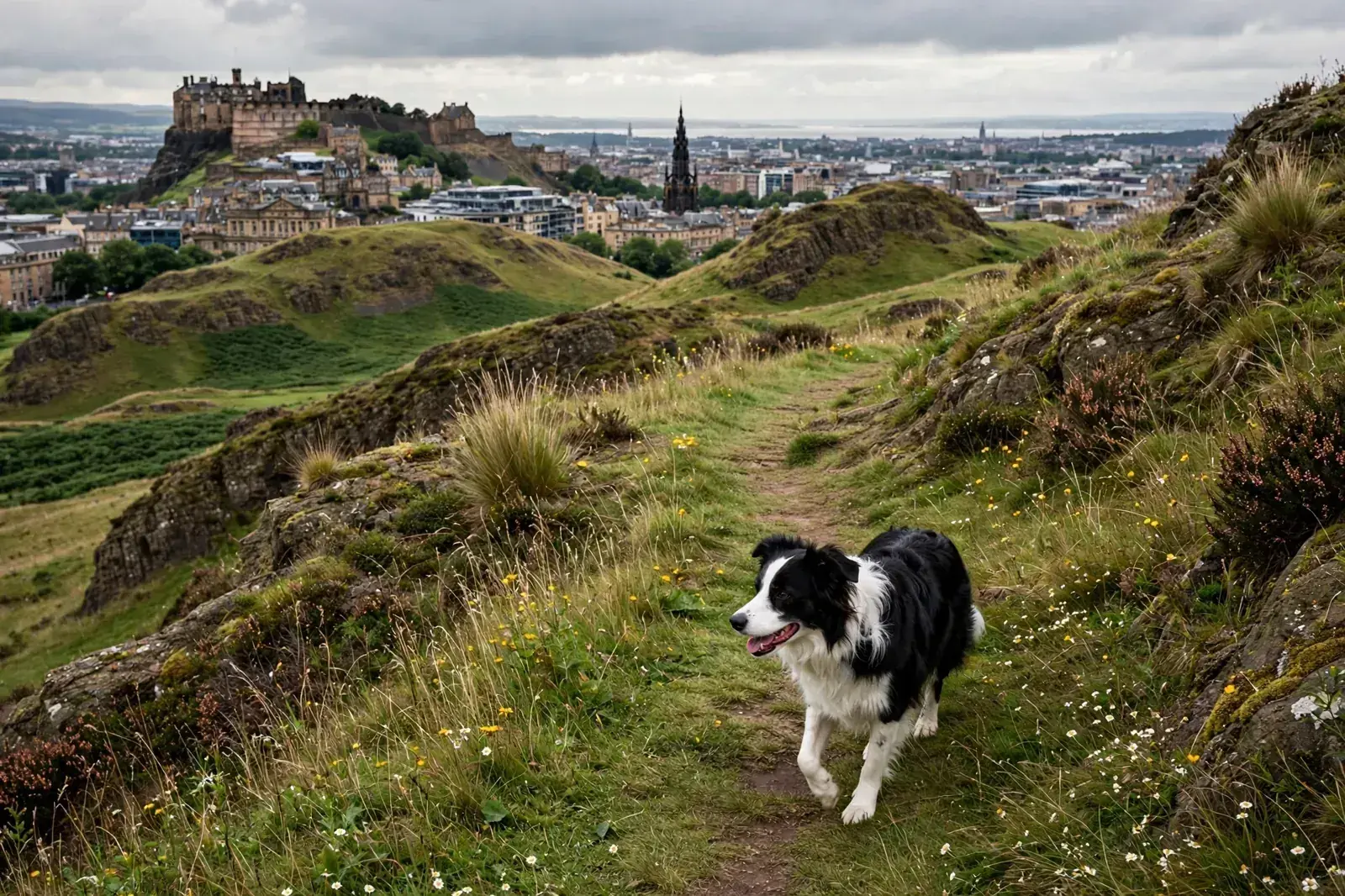
For many dogs, the most useful walk in Biggar is not the longest or the highest, but the easiest open ground close to the town. Biggar Common is the kind of open, grassy space that suits a first stretch after a car journey: room to move, softer ground than pavement, and a chance for the dog to sniff and decompress before a longer walk. It is also a good place to practise recall on a long line, to let a puppy experience open ground safely, and to give an older dog a gentle walk without a steep climb. Check local signs when you arrive, because access, grazing and lead rules on common land can change with the season.
Open ground needs a different lead strategy from a town pavement. A long line of ten metres or more gives the dog room to explore while keeping control, and it is a better choice than an extending lead on uneven ground, where the cord can tangle around legs, fences and other dogs. If you do let the dog off lead, do it only where it is clearly permitted, where you can see the ground ahead, and where the dog has reliable recall. Keep the dog in sight at all times, call it back before it reaches other walkers, other dogs or livestock, and put the lead back on well before you reach a road, a car park or a busy path. A dog that is out of sight is a dog you cannot protect from a hazard you have not seen.
Watch the ground underfoot, especially after rain. Common land and open grass can be soft, muddy and uneven, with hidden dips, rabbit holes and wet patches that can twist a paw or soak a small dog to the belly. In dry weather the same ground can be hard and dusty, with thistles, nettles and, in summer, ticks in longer grass. Check the dog for ticks after any walk through long grass or bracken, and carry a tick remover if you walk in these areas regularly. In winter, frost can make grass slippery and frozen puddles can cut paws, so shorten the walk and check the dog's feet afterwards.
Biggar Common and similar open spaces are also social spaces. Other dog walkers, families, runners and cyclists may all be using the same ground, and not every dog wants to say hello. Do not let your dog rush up to another dog, a child or a horse without checking with the owner first, and recall your dog promptly if the other person looks uncomfortable. If your dog is reactive, choose the quieter edge of the open ground, keep a good distance from other dogs, and use the space as a training walk rather than a free run. A calm, controlled walk on open ground is worth more than a chaotic off-lead chase that ends in a scuffle or a lost dog.
Use the easy walk as a test for the bigger walk. If the dog is moving freely, drinking normally and recovering quickly after a short run, it is probably ready for a longer hill or valley walk. If the dog is stiff, lagging, panting heavily or reluctant to move, take that as a clear signal to keep the day short and easy. Older dogs, overweight dogs, brachycephalic breeds and dogs recovering from illness or injury need shorter, flatter walks and more rest, even on a cool day. There is no prize for the longest walk; the best walk is the one the dog enjoys and recovers from well.
Tinto Hill with a dog
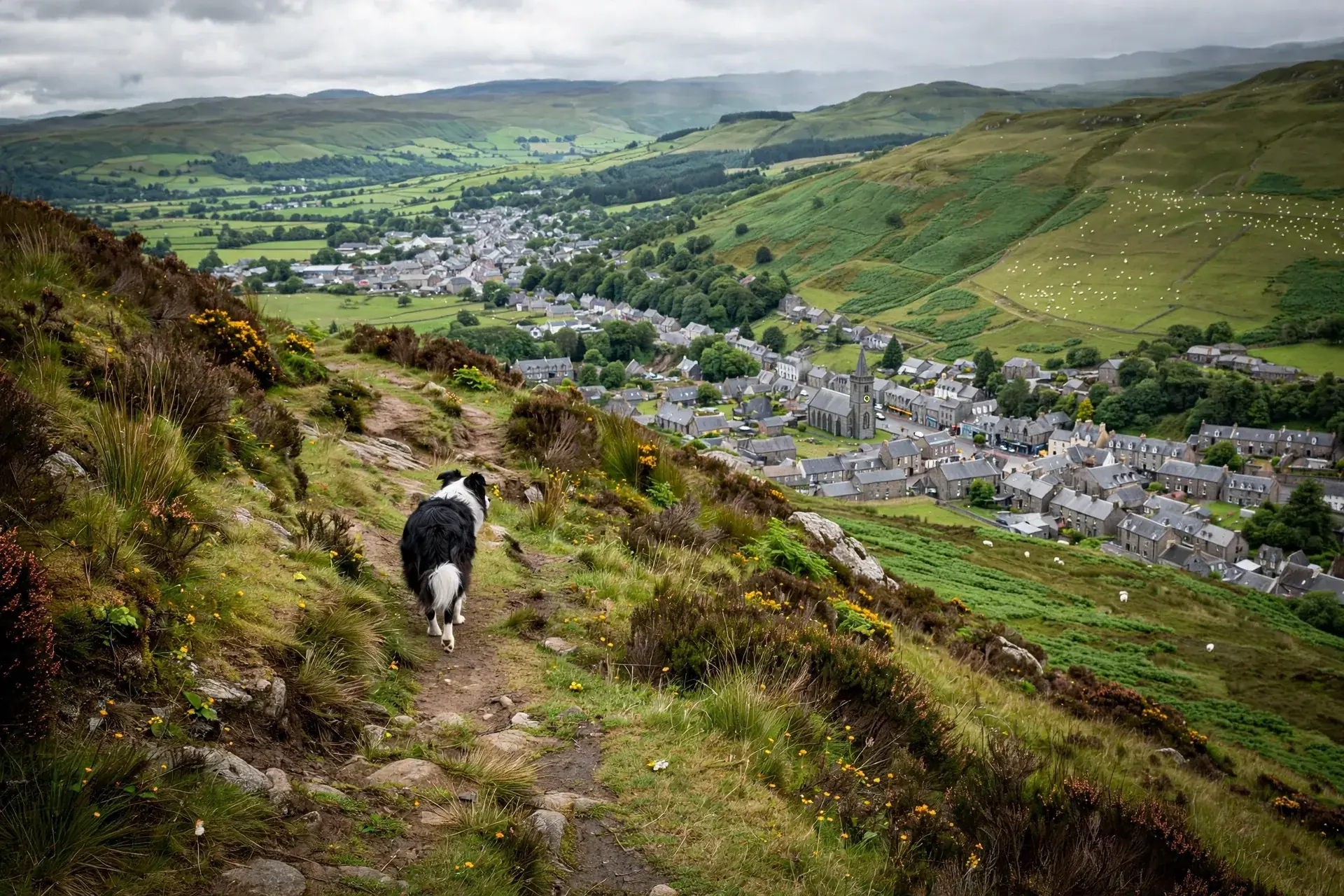
Tinto Hill is the best-known hill walk near Biggar, and for many visitors it is the reason to come. It is a distinctive, rounded hill that rises above the surrounding farmland and the Clyde Valley, with a broad summit and wide views on a clear day. The main path is a steady climb rather than a scramble, which makes it accessible to many walkers, but it is still a proper hill walk: open, exposed, often windy, and with no shelter, shade or water on the upper slopes. Dogs that are fit, healthy and used to hill walking will usually enjoy it; dogs that are unfit, very young, very old or unused to steep ground should not be pushed to the top.
Start the climb with the dog on a lead. The lower slopes cross farmland and open moorland, where sheep and other livestock may be grazing, and the path is shared with other walkers, including families with children and people walking in both directions. A lead keeps the dog close, prevents chasing, and makes it easier to step aside on a narrow section. Keep the dog on a lead for the whole climb if livestock are visible, if the dog has poor recall, or if the wind is strong enough to carry scent and sound away. Even a well-trained dog can be distracted by sheep, grouse or a sudden gust, and a hill is a poor place to discover that recall has failed.
Carry water for the dog, and carry more than you think you need. There is no reliable drinking water on the open hill, and dogs work hard on a climb, especially in warm weather or when the sun is on the slope. Offer water at regular intervals, not only at the summit, and watch for signs of overheating: heavy panting that does not ease at rest, a dry mouth, a glazed expression, or a dog that stops and refuses to move. If you see those signs, stop, find shade if you can, offer water, wet the dog's paws and belly, and head down at once. Do not wait for the dog to recover on the summit and then continue; overheating can become serious quickly, and the walk down is still a long way.
Wind and weather deserve respect on Tinto. The summit is exposed, and wind that feels moderate in the town can be strong and cold on the top, especially in winter and in changeable spring and autumn weather. A dog with a thin coat, a small dog or an older dog can chill quickly in wind and rain, even after working hard on the climb. Carry a dog coat for a dog that feels the cold, and be ready to turn back if the weather closes in, the cloud drops onto the hill, or the wind makes walking difficult. A summit in cloud and rain is not a better experience than a lower walk in sunshine, and turning back is a sensible decision, not a failure.
Allow enough time, and do not rush the descent. The way down is often harder on a dog's joints than the way up, especially for older dogs and larger breeds, and a steep descent on tired legs can cause a slip or a strain. Keep the dog on a lead, walk at a steady pace, and stop for water and rest. Check the dog's paws at the end of the walk for soreness, cuts or grit between the toes, and check for ticks if the route passed through bracken or long grass. If the dog is lame, unusually tired or off its food the next day, rest it and seek veterinary advice if the problem persists. A hill walk should leave the dog tired and satisfied, not sore and reluctant to move.
If Tinto feels too much for your dog, that is useful information, not a disappointment. A shorter walk on the lower slopes, a walk to a viewpoint part of the way up, or a gentler valley walk instead can still give the dog a good day and give you the hill views without the full climb. Many walkers enjoy Tinto as a half-day walk in its own right, with a slow ascent, a long pause at the top on a calm day, and a slow descent, followed by a rest and a meal in Biggar. That unhurried pattern suits dogs far better than a rushed climb fitted between other plans.
Clyde Valley and riverside paths
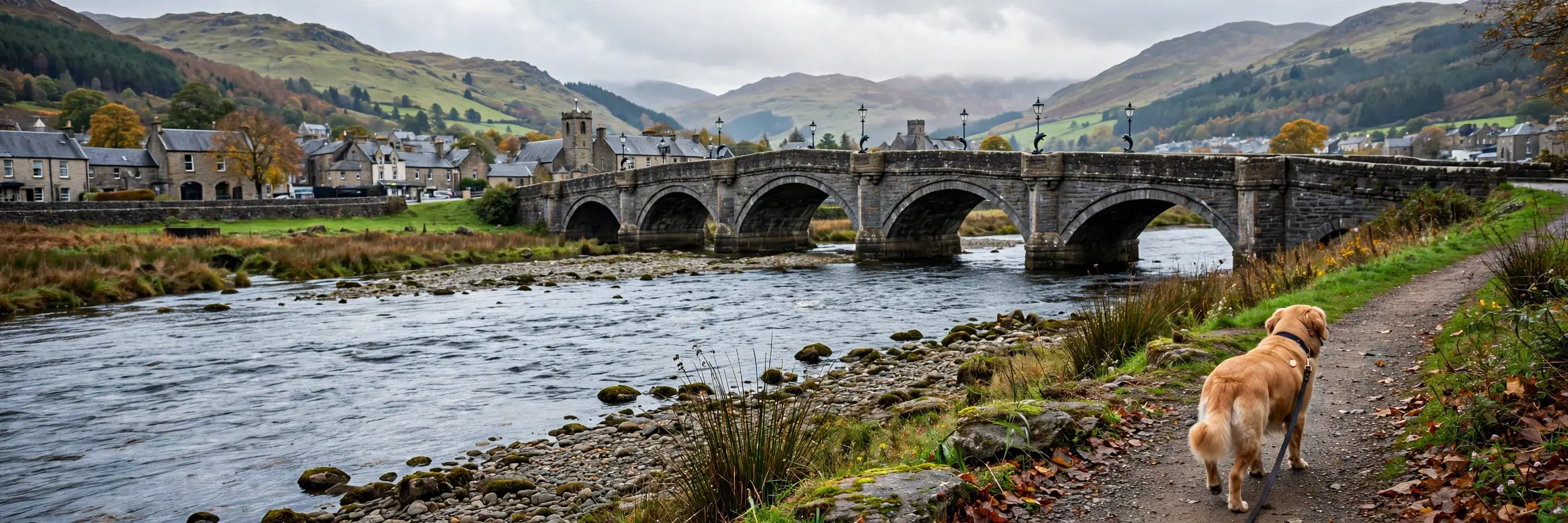
The River Clyde runs through the valley below Biggar, and the Clyde Valley offers a gentler contrast to the open hill. Riverside paths, quiet country lanes and valley woodland suit dogs that prefer a flat or gently undulating walk, dogs that need shade in summer, and walkers who want a longer walk without a steep climb. The valley is also a working landscape, with farms, fields, orchards and small villages, so the same lead and livestock rules apply here as on the hill, and access can change with farming, forestry work and river conditions.
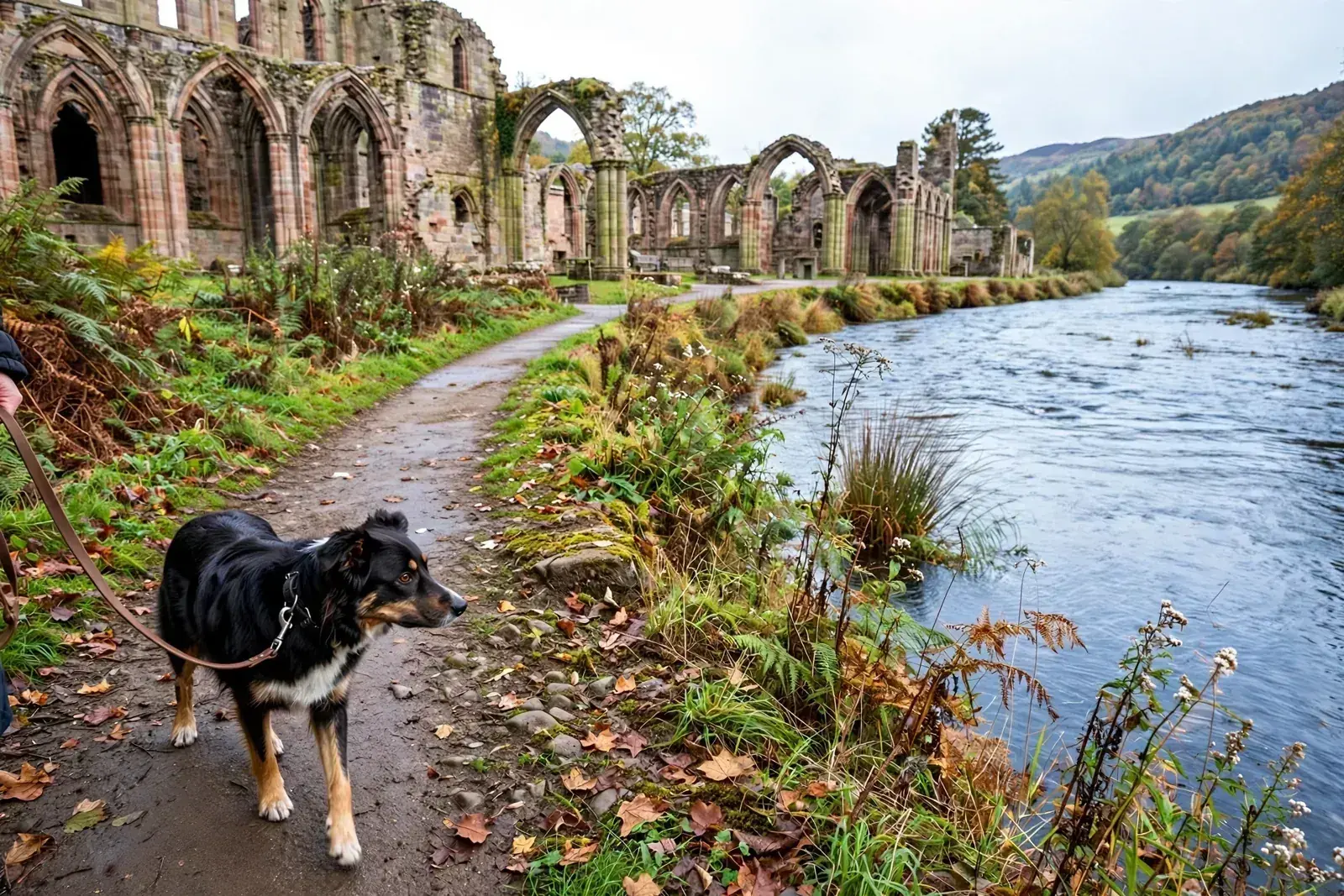
Riverside walking needs care around water. The Clyde can be fast and deep after rain, and banks can be steep, slippery or undercut. Keep the dog on a lead near the riverbank unless you are certain the bank is safe and the dog is a strong, controlled swimmer. Do not let the dog drink from stagnant pools or fast water without checking, and do not let it swim in a river you do not know, because currents, hidden obstacles and cold water can be dangerous even for a confident dog. After a riverside walk, check the dog for wet fur, mud and debris, and dry it thoroughly before the drive home, especially in cold weather.
The Clyde Valley is also a good area for a driving tour with short walks, rather than a single long walk. A common pattern is to drive to a village or a viewpoint, walk a short riverside or woodland loop, drive on to the next stop, and finish in Biggar for a meal. This suits dogs that travel well in the car and enjoy a series of short walks, and it suits families with children or older walkers who do not want a single long route. Keep each stop short enough that the dog stays fresh, and keep a lead, water and waste bags ready in the car so every stop is easy. If you are planning a longer valley walk, check the official guidance before you travel for current path closures, diversions and river levels.
For a wider day out, Biggar makes a useful base for exploring the Scottish Borders as well as the Clyde Valley. Our guide to Peebles with a dog covers Tweed riverside walks, Glentress Forest trails and town life in another historic market town to the east, while our broader guide to Scottish Borders dog walks covers abbeys, rivers and border towns, with lead rules, livestock seasons and where to stay. Both are worth reading if you are staying in the area for more than a day, because they help you choose between a second hill day, a riverside day and a town day without repeating the same walk.
Seasonal change is very visible in the valley. Spring brings lambs in the fields, nesting birds and fast-growing grass, and dogs must be kept under close control around livestock and ground-nesting birds. Summer brings shade in the woodland, but also midges, ticks and, on hot days, warm river water that can be unsafe to drink. Autumn brings fallen leaves, muddy paths and shorter days, and winter brings bare trees, frost and, after heavy rain, flooded riverside paths that may be impassable. The valley is beautiful in every season, but the walk you choose should match the season, the ground and the dog in front of you.
Dog-friendly cafes, pubs and shops
Biggar has independent cafes, pubs and shops, and many small towns in Scotland welcome well-behaved dogs in at least part of their premises. The pattern is usually the same: some cafes welcome dogs inside, some welcome dogs only in a garden, terrace or outdoor seating area, and some do not admit dogs at all except for assistance dogs. Pubs often welcome dogs in the bar area but not in the restaurant, or in one room but not another. Policies can change with the season, with a change of ownership, or with a busy day, so always check ahead rather than assuming a place you visited before still has the same rule. Check the official guidance before you travel, and if in doubt, telephone the venue before you set off.
When you arrive at a cafe or pub with a dog, ask before you sit down. A short question at the door, such as whether dogs are welcome and where the best place to sit is, saves an awkward move later and shows respect for the staff and other customers. Choose a table at the edge of the room, out of the main walkway, where the dog can settle under or beside the table without blocking a path. Keep the dog on a lead, settled on a mat or blanket if you have one, and do not let it beg from other tables, wander to the counter, or bark at people coming in and out. A dog that settles quickly is a dog that will be welcomed back; a dog that barks, paces or pulls is a dog that makes the next visit harder for everyone.
Order with the dog in mind. A drink and a snack that you can eat at a table is usually simpler than a long meal, especially if the dog is still excited after a walk. If you plan a longer lunch, give the dog a short walk and a toilet break first, offer water, and settle it before the food arrives. Bring a small chew or a stuffed food toy to keep a young dog occupied, but do not feed the dog from the table, and do not let it eat food dropped on the floor, because cafe floors can contain bones, hot food, cleaning products and allergens. If the dog cannot settle, take it outside for a short break rather than waiting for the problem to grow.
Shops in Biggar are generally small and independent, and many welcome dogs, but the rule is to ask first and keep the visit short. A dog on a short lead, close to your side, is usually fine in a shop with a wide aisle, but a large dog in a narrow shop full of breakable stock is a risk. If the shop is busy, if the dog is wet or muddy, or if the shopkeeper looks uncertain, it is kinder to wait outside with the dog while another person goes in, or to come back later. Do not tie a dog up outside a shop and leave it unattended, because a tied dog can be stolen, can become distressed, or can be approached by strangers and other dogs. If you need to shop, plan for one person to stay with the dog.
Takeaway food is often the simplest option with a dog in a small town. A sandwich, a coffee or a picnic bought in Biggar can be eaten on a bench, in a park or on open ground, where the dog can settle beside you without the constraints of an indoor room. If you choose a picnic, pick a spot away from livestock, away from a road, and away from other people's picnics, and take all litter and waste home with you. A picnic also suits dogs that are nervous indoors, dogs that bark in enclosed spaces, and dogs that simply prefer to be outside after a walk. It is not a lesser option; for many dogs, it is the best option.
Where to stay with a dog near Biggar
If you are staying overnight, Biggar and the surrounding Clyde Valley offer the usual mix of small hotels, bed and breakfasts, guest houses, self-catering cottages and holiday accommodation. Dog-friendly options exist, but they are not universal, and the details matter more than the label. A place that describes itself as dog-friendly may accept only one dog, only small dogs, only dogs in certain rooms, or only dogs that are left in a car or an outbuilding at night. Always confirm the exact rule for your dog, your dates and your room type in writing before you pay a deposit, and check the official guidance before you travel for current policies.
Ask the practical questions before you book. How many dogs are allowed, and is there an extra charge per dog, per night or per stay? Are dogs allowed in the bedroom, in the dining room, in the garden, and are they allowed to be left alone in the room, even briefly? Is there an enclosed garden, a nearby toilet walk, and a place to dry a wet dog? Is there a vet nearby, and what is the emergency number? A host who answers these questions clearly has usually thought about dogs properly; a host who answers vaguely may not have. Keep the reply with your booking confirmation, so there is no argument on arrival.
Self-catering accommodation often suits dogs best, because it gives you a kitchen, a private space and a routine close to home. Look for a ground-floor room or a cottage with direct access to a garden, a hard floor that is easy to clean, and a space where the dog can sleep without blocking a doorway. Check the garden boundary before you let the dog off lead in it, because a gap in a fence, a low wall or an open gate can let a dog out in seconds. Bring the dog's own bed, food, water bowl and a familiar blanket, because familiar smells help a dog settle in a new place. If the accommodation has a no-dogs-on-furniture rule, respect it, and bring a throw to protect a sofa if the dog is allowed on it.
Hotels and bed and breakfasts can work well too, especially for a single night, but they need a different routine. Arrive in daylight, walk the dog before check-in, and ask where the dog can toilet and where it can wait while you check in. Keep the dog on a lead in corridors and shared areas, keep barking to a minimum, and do not leave the dog alone in the room unless the host has explicitly agreed to it. If you go out for dinner, check whether the dog can come with you, whether it can stay in the room, or whether you need to eat at a dog-friendly pub nearby. A dog that is left alone in a strange room and barks is a common cause of complaints, and it is avoidable with a little planning.
For a longer stay, consider using Biggar as a base and exploring the wider area on different days. A hill day, a riverside day and a town day give the dog variety without repeating the same walk, and they give you a reason to return to the same cafe or pub, where the staff and the dog begin to recognise each other. If you are staying for several nights, build in a rest day or a half-day, because a dog that walks hard every day without a break can become sore, tired or reluctant. A quiet morning in the accommodation, a short local walk and an early night can be the most valuable part of a long trip.
Livestock, leads and the access rules
Biggar is surrounded by farmland, and livestock are a normal part of walking here. Sheep, cattle and horses may be grazing in fields crossed by paths, in open hill ground, and in valley meadows, and they may be present even when you cannot see them at first. In Scotland, the access rules give walkers a right of responsible access to most land, but that right comes with a responsibility to keep dogs under close control, especially around livestock. The practical rule is simple: if livestock are present, or could be present, keep the dog on a lead.
Sheep are the most common livestock you will meet, and they are easily stressed by dogs. A dog that chases, barks at or even runs towards sheep can cause them to panic, injure themselves on fences, separate lambs from ewes, or abort lambs in spring. Farmers have the right to protect their livestock, and a dog that worries sheep can be shot in serious cases, so this is not a minor rule. Keep the dog on a short lead, walk calmly past sheep without stopping to stare, and do not let the dog approach a fence line where sheep are grazing on the other side. If sheep are blocking the path, give them a wide berth or turn back; do not try to push through them with a dog.
Cattle need a different kind of care. Most cattle are curious rather than aggressive, but they are large, heavy animals, and a group of cattle, especially cows with calves, can be unpredictable if they feel threatened by a dog. Keep the dog on a short lead, keep yourself between the dog and the cattle if you can, and walk steadily through or around the group without running. If cattle approach you, do not run, do not shout, and do not let the dog bark; move slowly away and, if necessary, release the dog only if you are in immediate danger and the dog can escape safely on its own, which is a last resort. In practice, the best approach is to avoid cattle fields with a dog when there is an alternative route, and to choose a different path if cattle are close to the gate or the stile.
Horses, like cattle, can be startled by a dog, and a startled horse can kick, bolt or throw a rider. Keep the dog on a lead, keep a good distance, and do not let the dog run around a horse or approach it from behind. If you meet a rider on a path, step aside, keep the dog close and still, and let the rider pass. Speak calmly to the rider so the horse knows you are a person, not a threat, and wait until the horse is well past before you move on. The same care applies to cyclists and runners, who can appear suddenly on a shared path and startle a dog that is off lead.
Lead rules also apply near roads, in car parks, in towns and on busy paths, even when no livestock are present. A dog on a lead is a dog you can stop from running into traffic, from chasing a cyclist, or from approaching a child who is afraid of dogs. Use a lead that you can hold securely, with a harness or collar that fits properly, and check the clip and the stitching before a long walk. A long line is useful on open ground, but it should be shortened near roads, gates, stiles and other people, and it should never be left trailing where it can tangle. The access rules are not there to spoil a walk; they are there to keep dogs, livestock, wildlife and other people safe, and following them is part of being a welcome visitor in a farming area.
Weather, seasons and ground conditions
The Clyde Valley has a changeable Scottish climate, and Biggar can feel very different in January and in July. Winter days are short, cold and often wet or windy, with frost, ice and occasional snow on the hills. Spring is milder but still changeable, with lambs in the fields, nesting birds and paths that can be muddy after rain. Summer is the warmest and driest season, but it can still be cool and windy on the hill, and midges, ticks and warm ground can affect dogs. Autumn brings shorter days, fallen leaves, mud and the first frosts, and it is often one of the best seasons for walking, when the light is low and the hills are quiet.
Check the weather forecast before you travel, and check it again on the morning of the walk. A forecast for Biggar town may not match the conditions on Tinto Hill, where wind and cloud can be stronger and colder, so allow for a difference of several degrees and a stronger wind at height. If the forecast is for heavy rain, strong wind, snow or a storm, choose a shorter, lower walk, or spend the day in the town and save the hill for a better day. Do not rely on a single forecast; check a reliable source, look at the sky when you arrive, and be ready to change the plan if the weather is worse than expected. Check the official guidance before you travel for current weather warnings and access advice.
Dress the dog for the season as well as yourself. A dog with a thin coat, a small dog, an older dog or a dog that has been clipped may need a waterproof coat in rain and a warm coat in cold wind. A dog with a thick coat may overheat in summer, even on a cool day, if it is working hard on a hill. Offer water in every season, because dogs can become dehydrated in cold, windy weather as well as in heat, and they may not drink enough if the water is very cold. In winter, check the dog's paws for ice, grit and salt after a walk, and dry them thoroughly. In summer, check for ticks, grass seeds and sunburn on pale noses and ears, and avoid walking on hot pavements in the middle of the day.
Ground conditions change with the season and with recent rain. After heavy rain, riverside paths can flood, hill paths can become streams, and farmland can become deep mud that is hard for a small dog to walk through. After a dry spell, the same paths can be hard, dusty and rutted, with stones that can sore paws. In frost, grass and wooden stiles can be slippery, and in snow, a dog can lose scent, lose footing and become cold quickly. Choose the walk that matches the ground, not the walk you planned in advance, and be ready to shorten it if the ground is worse than expected. A walk that is too long on difficult ground can leave a dog lame for days, while a shorter walk on good ground leaves the dog ready for the next day.
Daylight is a practical limit, especially in winter. In December, daylight in southern Scotland is short, and a walk that starts in the afternoon can end in darkness. Start hill walks early, carry a torch and a charged phone, and plan to be off the hill well before dark. In summer, the long evenings are a gift for dog walkers, but they can also mean midges at dusk, so carry insect repellent for yourself and check the dog for bites afterwards. Whatever the season, tell someone where you are going and when you expect to be back, especially if you are walking alone on the hill, and keep your phone charged and in a waterproof pocket.
A half-day plan and a full-day plan
A half-day in Biggar can be satisfying without being rushed. Start with a short town walk, including the main street, the museum area and the Corn Exchange, and let the dog sniff and settle. Then choose one longer walk: either a gentle walk on Biggar Common and the surrounding open ground, or a short riverside walk in the Clyde Valley, depending on the weather and the dog's energy. Finish with a drink or a snack at a dog-friendly cafe or pub, or a picnic on open ground if the weather allows. This pattern gives the dog a town experience, an open-ground experience and a rest, all within three to four hours, and it leaves time to drive home in daylight.
A full day gives you room to add Tinto Hill. Start early with the town walk and a toilet break, then drive to the hill and climb at a steady pace, allowing time for water stops, photographs and a long pause at the top on a calm day. Descend slowly, check the dog's paws, and drive back to Biggar for a late lunch or an early dinner at a dog-friendly pub. If the dog is tired after the hill, skip a second long walk and spend the afternoon in the town, browsing shops and resting. If the dog is still energetic, add a short, flat riverside walk in the late afternoon, when the light is low and the valley is quiet. End the day with a short toilet walk before the drive home, and a drink of water for the dog.
Build in flexibility, because a rigid plan rarely survives contact with a real dog and real weather. If the dog is stiff in the morning, shorten the hill walk or replace it with a valley walk. If the weather turns, move the hill to another day and spend longer in the town. If the dog is unsettled in a cafe, take the food away and eat outside. If a path is closed, a field has livestock, or a car park is full, have a second option ready, such as a different walk, a different cafe or a different village in the valley. The best plan is one that can bend without breaking, and the best dog trip is one where the dog's needs come first.
For families, the plan needs to work for children as well as dogs. A short town walk, a hill climb with a clear goal at the top, and a cafe stop with food and a toilet are usually enough for a family day, and children often enjoy the same things dogs do: open space, a view, and a chance to explore. Keep the walk short enough for the youngest walker, carry snacks and water for everyone, and build in rest stops. If children and dogs are both tired, stop; a tired child and a tired dog together are a recipe for a bad end to the day. A shorter, happier walk is always better than a longer walk that ends in tears.
For a multi-day stay, use Biggar as a base and vary the walks. Day one can be the town and the common, day two can be Tinto Hill, and day three can be a Clyde Valley riverside walk or a trip to Peebles and the Scottish Borders. This gives the dog a different kind of walk each day, prevents overuse of the same joints and muscles, and gives you a reason to try a different cafe or pub each evening. Keep one day light, with only a short walk and a long rest, so the dog recovers properly. A dog that rests well will enjoy the next day's walk far more than a dog that is pushed every day.
What to pack for Biggar
Packing for Biggar is packing for a Scottish hill and valley day, not for a city break. The essentials are a lead, a long line, a harness or collar that fits, waste bags, water and a portable water bowl, and a towel for a wet or muddy dog. Add a dog coat for cold or wet weather, a tick remover, a small first-aid kit with a bandage and antiseptic wipes, and a familiar blanket or mat for settling in a cafe or in accommodation. Carry a charged phone, a map or a downloaded route, and a torch in winter. Keep the car packed with a spare towel, a spare lead and a change of clothes for yourself, because a wet dog in a car can make the drive home uncomfortable for everyone.
Food and treats deserve a little thought. Bring the dog's normal food if you are staying overnight, because a sudden change of diet can cause an upset stomach, and bring enough treats for training and recall without overfeeding. A stuffed food toy or a long-lasting chew can keep a dog occupied in a cafe or in accommodation, but do not give a chew to a dog that guards food, and do not leave a dog alone with a chew that could break into pieces. Carry a small bag of the dog's normal kibble as a training reward, rather than a pocket full of rich treats that can upset the stomach on a long walk.
Think about the car as well as the walk. A crate, a car harness or a boot guard keeps the dog safe on the drive to Biggar and on the drive home, and it prevents a wet, muddy dog from climbing into the front seat. A waterproof seat cover or a boot liner protects the car, and a towel on the seat makes the journey more comfortable. Never leave the dog in the car while you go into a shop, and never drive with a loose dog on your lap or on the dashboard. If the dog is nervous in the car, build up the journey with short trips before a long drive to Scotland, and stop regularly for toilet breaks and water.
Finally, pack patience. A dog trip to a new town, a new hill and a new valley will not go exactly to plan, and that is normal. A path may be muddy, a cafe may be full, a dog may be tired, or the weather may turn. The dogs that enjoy Biggar most are not the dogs that walk the furthest or climb the highest; they are the dogs whose owners read the dog, read the weather, and change the plan when it needs changing. Pack a flexible attitude, a willingness to turn back, and a sense that a short, happy walk is a successful day, and Biggar will reward you with a quiet market town, open hills and a valley that is worth returning to.
Practical questions
Before you go
Can dogs climb Tinto Hill near Biggar?
Yes, fit and healthy dogs can usually climb Tinto Hill on a lead, following the main hill path. It is a steady, open climb with no shade and often strong wind at the top, so carry water, keep the dog on a lead near livestock and other walkers, and turn back if the dog is tired, lame or overheating. Check the official guidance before you travel for current access and parking advice.
Is Biggar a good base for a dog-friendly day out in the Clyde Valley?
Yes. Biggar is a compact market town with a walkable centre, nearby hill and riverside walking, and easy road links to the wider Clyde Valley and the Scottish Borders. It suits a slow half-day or a full day best, with a town walk, a hill or riverside walk, and a cafe or pub stop in between. Check the official guidance before you travel for current opening times and dog policies.
Are dogs allowed in Biggar Museum and the Corn Exchange?
Policies for museums and historic buildings can change, and assistance dogs are treated separately from pet dogs. Check the official guidance before you travel, and contact the venue directly before your visit to confirm whether pet dogs are welcome inside, in the garden or grounds, or only outside. Plan your visit so one person can stay with the dog if dogs are not admitted.
Where can dogs walk off lead near Biggar?
Off-lead walking depends on the exact place, the season and whether livestock are present. Use a lead on farmland, near roads, near livestock and on busy paths, and only let a dog off lead where it is clearly permitted, the dog has reliable recall, and you can see the ground ahead. Biggar Common and quiet open ground can suit a controlled off-lead run when conditions allow, but check local signs first.
What should I do if my dog meets livestock on a walk near Biggar?
Put the dog on a short lead immediately, keep calm, and move steadily away without running or shouting. Do not let the dog chase, bark at or approach sheep, cattle or horses. If cattle block the path, give them a wide berth or retrace your steps. In Scotland, responsible access means keeping dogs under close control around livestock at all times.
Where is the best place to park in Biggar with a dog?
Use the town centre car parks and on-street parking in Biggar, then walk into the town centre on foot. Arrive early on busy weekends and market days, leave the dog in the car only very briefly if at all and never in warm weather, and keep a lead, water and waste bags ready before you set off. Check the official guidance before you travel for current parking signs and time limits.