This guide is independent and contains no paid placement. If affiliate links are added later, they will be clearly marked and will not change our editorial checks.
Peebles works because the river and the forest do different jobs: the Tweed gives you flat, easy riverside walking straight from the town centre, and Glentress Forest, a short distance away, gives you shaded trails and space when the town is busy. Stay in town, walk the river in the morning, head for the forest in the afternoon, and you will rarely need the car.
The Tweed comes first: planning your day around the river
Start at the water, not at the car park. The River Tweed runs right through Peebles, and the riverside path is the thread that ties the whole town together: the high street, the bridges, the parks and the quieter stretches upstream and downstream all connect to it. If you plan your day around the river first and fit everything else around it, you end up walking more and driving less, which is exactly what most dogs want from a town break.
The practical reason to lead with the river is simple. The Tweed path is flat, it is close to everywhere you will want to be, and it gives a dog the two things that matter most on a morning walk: interesting smells and room to move. A dog that has had a proper riverside walk before breakfast will settle happily under a cafe table afterwards, while a dog that has only had a quick pavement loop will be restless for the rest of the morning. Build the day in that order — river first, town second, forest third — and the whole trip feels calmer.
There is also a seasonal reason. The Tweed changes character through the year in a way that a forest trail does not. In summer the river is low and slow, with gravel banks where dogs can paddle and cool off. In autumn the water runs faster and the riverside trees turn, so the same path feels completely different. After heavy rain the river can rise quickly and the path can be closed or unsafe, which is when the forest becomes the better choice. Checking the river before you walk is a small habit that prevents most of the avoidable problems in Peebles, and it is worth doing every morning of your stay, even when the weather looks fine. Check the official guidance before you travel for current river conditions and any path closures.
Think of the town as three overlapping layers rather than one destination. The first layer is the river itself: the path, the bridges, the banks and the open green spaces beside the water. The second layer is the high street and the town centre, a compact grid of independent shops, cafes and pubs that is easy to cross on foot with a dog. The third layer is the forest edge — Glentress and the surrounding woodland — which sits close enough to reach by car in minutes or by a longer walk for energetic dogs and their owners. Most visitors only use one layer and miss the other two. The best days in Peebles use all three, in that order, and let the dog set the pace between them.
Riverside walks in and around Peebles
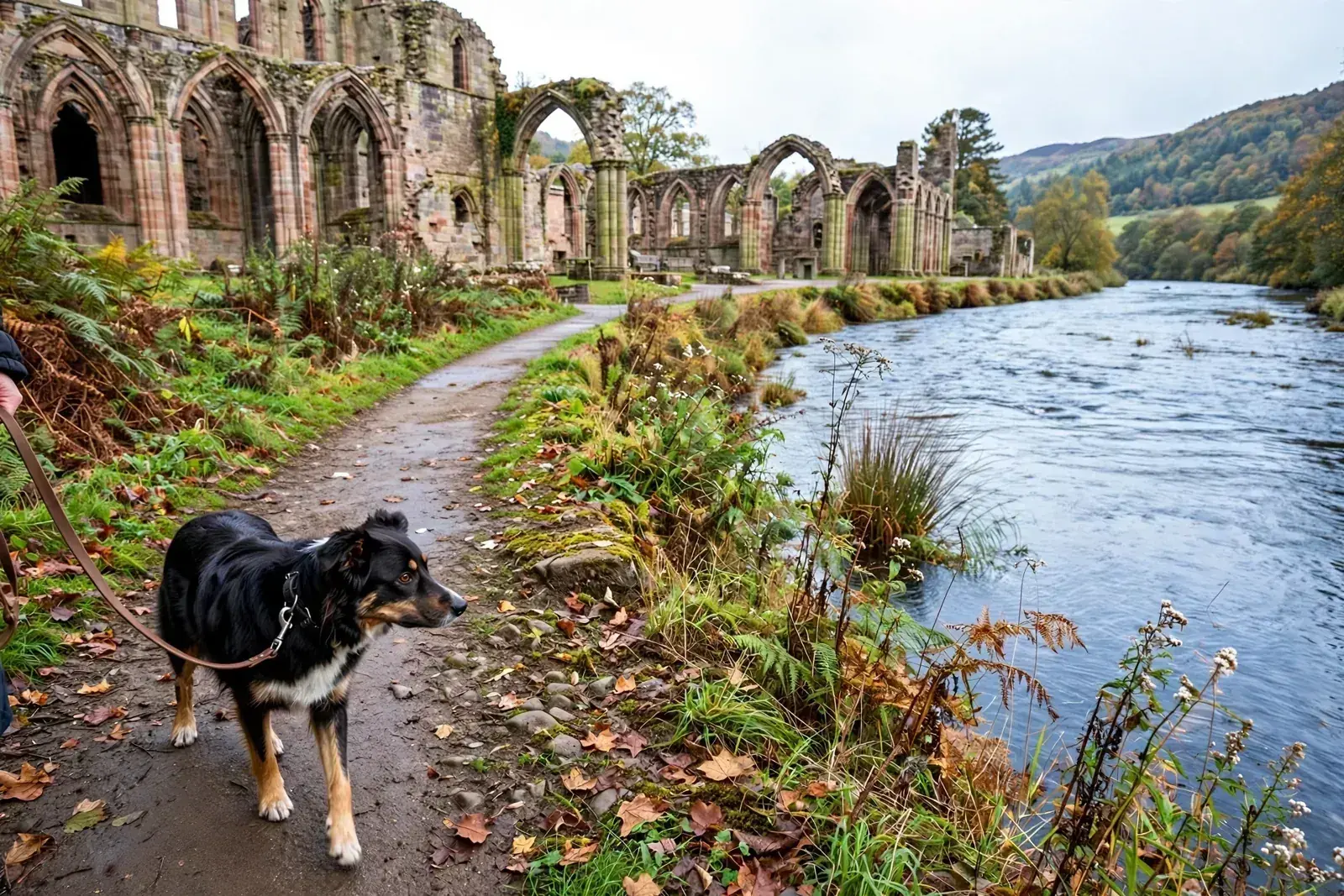
The most useful walk in Peebles is the one you can start from your accommodation without touching the car. The riverside path runs along the Tweed through the town, and a short out-and-back from the centre gives you a proper walk in under an hour: flat ground, water on one side, trees and grass on the other, and plenty of space for a dog to sniff. It is the walk you will repeat every day of your stay, and it is good enough that repeating it never feels like a compromise.
For a longer walk, head upstream or downstream along the Tweed and the path keeps going well beyond the town. Upstream the river narrows and the banks become quieter, with fewer people and more wildlife — herons, dippers and, in the right season, salmon moving through the pools. Downstream the path opens out towards the wider valley, with views across fields and woodland that make a two-hour walk feel unhurried rather than long. Either direction works, and the best choice depends on the time of day: upstream is quieter in the morning, downstream catches the afternoon light, and both are worth doing on different days.
There are a few practical points that matter on every riverside walk here. First, the Tweed is a famous salmon river, and anglers use the banks through much of the year. Give anglers a wide berth, keep your dog out of the water near anyone fishing, and do not let your dog chase or disturb fish in shallow pools. Second, livestock grazes in fields beside the river in places, so keep your dog on a lead wherever you see cattle or sheep, and always close gates behind you. Third, the path can be muddy after rain, especially on the unsurfaced stretches, so proper walking shoes and a towel in the car will save you a muddy drive home.
Off-lead time on the river needs judgement rather than a single rule. On wide, quiet stretches with good visibility and a dog with reliable recall, off-lead walking is normal and enjoyable. Near bridges, road crossings, anglers, livestock and other dogs, put the lead back on. A long line is a useful compromise on the river: it gives a dog freedom to explore the bank while keeping you in control near the water, and it is far better than letting a dog with uncertain recall run loose beside a fast river. If your dog is a strong swimmer, choose the shallow gravelly spots for paddling and avoid weirs, bridge pillars and fast water. If your dog is not a confident swimmer, keep them out of the river entirely — the Tweed is colder and stronger than it looks, even on a warm day.
Two smaller green spaces deserve a mention because they are the places where local dog owners actually go. The riverside parks and open ground near the town centre are good for a short evening walk and a game of fetch when they are quiet, and the paths around the town give you a flat, lit option after dark when the riverside feels too remote. Neither is a destination in itself, but both are the kind of useful, everyday space that makes staying in Peebles easy rather than just scenic. Ask locally about the current state of the paths after wet weather, and check the official guidance before you travel if you are planning a long riverside route.
Glentress Forest: trails, bikes and dogs
Glentress Forest sits just outside Peebles and is one of the best-known mountain-biking centres in Britain, which is both the reason to go and the reason to plan carefully with a dog. The forest has miles of waymarked walking trails as well as bike trails, a visitor centre, a cafe and a large car park, and on a weekday morning it can feel wonderfully empty. On a busy weekend, though, it is full of fast-moving bikes, and a dog off lead on the wrong trail can be in real danger.
The key to Glentress with a dog is choosing the right trail. Walking routes are waymarked separately from the mountain-bike trails, and the walking trails are the ones to use: they are designed for people on foot, they avoid the fastest bike descents, and they give you time to hear a bike coming. The shorter waymarked walks through the lower forest are a good starting point, especially for older dogs or first-time visitors, while the longer routes climb through the trees and reward you with views back over the Tweed Valley. Pick up a trail map at the visitor centre or check the route before you set off, and stick to the walking trails rather than improvising a shortcut across a bike route.
Lead discipline matters more at Glentress than anywhere else in Peebles. Even on walking trails, bikes can appear around bends with little warning, and a dog that darts across a path can cause a serious accident for the rider as well as for itself. Keep your dog on a lead or under very close control on busy trails, on narrow paths and near the trail centre, and only let your dog off lead on wide, quiet forest tracks where you can see a long way ahead. A brightly coloured lead and a hi-vis vest for your dog are genuinely useful here, because they help cyclists spot you early. If your dog chases bikes, wheels or runners, keep them on a lead for the whole visit — Glentress is not the place to work on that behaviour.
There are real rewards for getting it right. The forest is shaded in summer, which makes it one of the coolest places to walk a dog on a hot day, and the pine-scented air and soft forest floor are easy on paws and joints. In autumn the colours are superb, and in winter the forest shelters you from wind that would make the riverside miserable. Water is worth planning for: carry water for your dog, because streams in the forest are not always accessible from the trail, and a collapsible bowl weighs nothing in a day pack. After your walk, the trail centre cafe is a useful stop, though you should check the official guidance before you travel for current opening hours and dog rules.
One more practical note: Glentress is a working forest, so timber operations can close trails at short notice and change the routes you had planned. Forestry work, fallen trees after storms and seasonal trail maintenance all happen here, and the closures are signed at the car park and the trailheads. Check before you drive over, have a riverside walk as your backup plan, and do not duck under a closure sign — the risks are real, and the alternative walk is only ever a few minutes away. For a wider look at the region, our guide to Scottish Borders dog walks covers abbeys, rivers and border towns beyond Peebles.
Peebles town centre with a dog
Peebles town centre is compact enough to explore entirely on foot, which is the first thing that makes it work well with a dog. The high street runs through the middle of town with independent shops, bookshops, outdoor stores and delicatessens, and the side streets hold more cafes, galleries and small businesses. You can cross the centre in a few minutes, which means a dog never has to walk far between a riverside break and the next stop, and you can easily drop back to your accommodation if the dog needs a rest.
The town has a relaxed, unhurried feel that suits dogs. Pavements are generally wide enough for a dog on a lead, traffic is light compared with a city, and there are benches and green spaces where you can pause. The old town cross and the historic buildings give the centre character without making it a museum — this is a working market town, not a tourist set, and that is part of its charm. Dogs are a normal sight on the high street, and most shopkeepers are used to them, though you should always ask before taking a dog into a shop rather than assuming it is welcome.
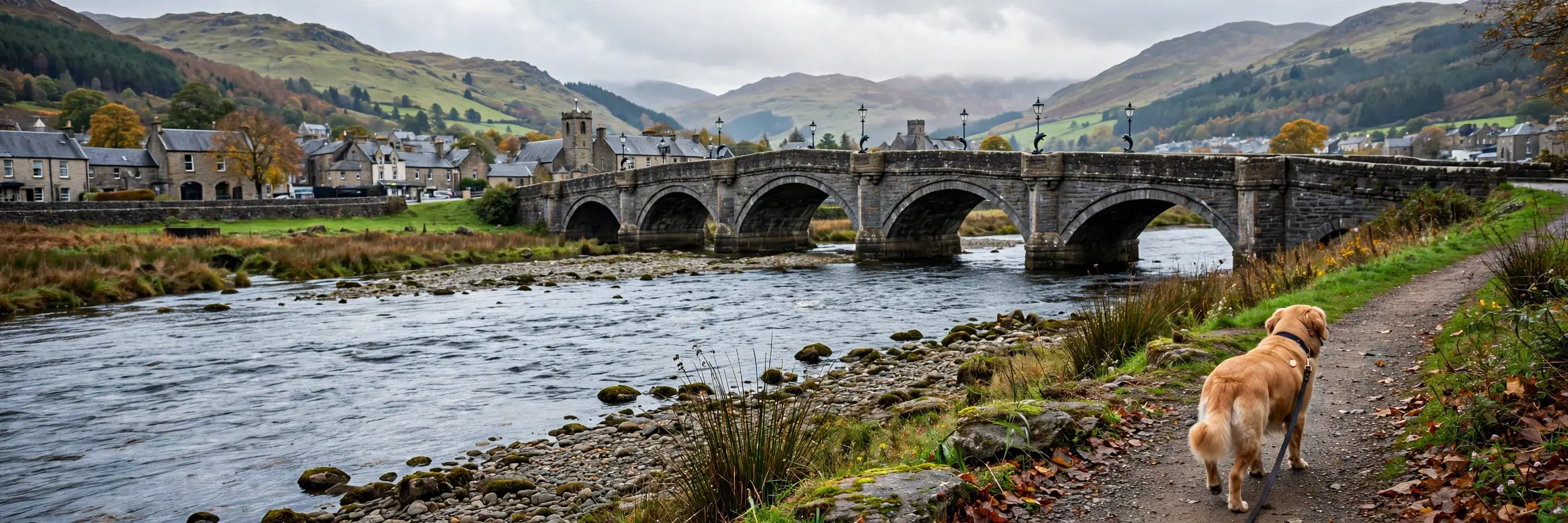
A good town-centre routine starts with the riverside walk, then crosses one of the bridges into the centre for a browse and a coffee. The bridges themselves are worth a moment: the Tweed Bridge is the historic crossing, and standing on it gives you a view up and down the river that explains why the town grew here. Dogs that are nervous of bridges should be walked across calmly on a short lead, with no stopping in the middle, because the traffic noise and the sight of water below can unsettle them. Once across, the high street rewards a slow wander rather than a route march — pop into the shops that welcome dogs, sit outside a cafe, and let the dog watch the town go by.
There are a few town-centre habits that make the day smoother. Carry poo bags and use the bins provided, because a small town notices a careless owner quickly. Keep your dog on a short lead on the high street at busy times, especially on market days or during festivals, when crowds and children can overwhelm even a confident dog. If your dog is reactive, walk the quieter side streets and the riverside rather than the main shopping street, and visit shops early in the day before they fill up. And remember that Peebles hosts events through the year — festivals, markets and the famous Beltane celebrations — which can change the feel of the town completely, so check the official guidance before you travel if your dates coincide with a big event.
For many visitors the town centre is also where the trip is supplied: outdoor shops for a forgotten lead or a new waterproof, food shops for picnic supplies, and a pharmacy and vet practice for the things nobody plans to need. Knowing where the nearest vet is before you need one is a small piece of preparation that matters, especially if you are staying for several days. Save the number in your phone on arrival, note the opening hours, and check the official guidance before you travel for the nearest out-of-hours service.
Cafes, pubs and places to eat with your dog
Eating out with a dog in Peebles is straightforward if you plan it the way the town expects you to: check first, choose places that genuinely welcome dogs, and help your dog settle. Several cafes and pubs in the town welcome dogs, and many more are happy to serve you outside, but policies change, and a place that welcomed dogs last year may have changed its rules. A quick check before you set off — a phone call, a look at the venue website, or a message on social media — saves an awkward moment at the door with a hungry dog.
Inside a cafe or pub, the routine that works is always the same. Walk your dog properly first so they arrive calm and ready to settle, choose a table at the edge of the room rather than in the middle of the foot traffic, and put a blanket or mat down so your dog has a defined place to lie. Keep the lead short and under your foot, offer water if the venue provides it, and bring a chew or a stuffed toy for a longer meal. Dogs that settle quickly are welcome back; dogs that bark at every passer-by or beg from neighbouring tables are not, however friendly the venue claims to be.
Terrace and outdoor seating deserve a special mention in Peebles because the town does them well. In good weather, sitting outside with a dog is the easiest option of all: the dog has space, the air is fresh, and nobody minds a dog lying under the table. In colder months, look for pubs with a fire and a dog-friendly corner, which are a genuine pleasure after a wet forest walk. Our guide to dog friendly cafes in the UK explains how to check before you go, what indoor etiquette looks like, and what your rights are with assistance dogs.
Picnics are the other half of eating in Peebles, and the riverside is made for them. Pick up supplies from the high street — bread, cheese, fruit and something warm from a bakery — and find a bench or a grassy bank beside the Tweed. A picnic gives a dog far more freedom than a restaurant meal: they can lie on the grass, watch the river and have their own food without anyone minding. Bring a bowl and water for the dog, a blanket to sit on, and bags to take everything home, and remember that the riverside is shared with other walkers, anglers and wildlife, so keep your dog close and your food out of reach of other animals.
Evening meals need a little more planning. Pubs in Peebles vary in their dog policies, and the ones that welcome dogs in the bar may not welcome them in the restaurant area, so ask specifically about the area where you will be sitting. Booking ahead is wise at weekends, and mentioning the dog when you book avoids surprises. If you cannot find a place that suits your dog in the evening, a takeaway eaten back at your accommodation is a perfectly good fallback — and often the most relaxing option after a long day of walking.
Where to stay in Peebles with a dog
Peebles has a good range of dog-friendly places to stay for a town of its size, from hotels and guesthouses in the centre to self-catering cottages and lodges on the edge of town and in the surrounding valley. The right choice depends on your dog more than on your budget: a nervous dog does better in a quiet cottage with a garden, a sociable dog may love a hotel where they can meet people, and a large or muddy dog needs somewhere with hard floors and space to dry off.
Self-catering is often the easiest option for dog owners in Peebles. A cottage or apartment gives you a kitchen, a private space for the dog to settle, and the freedom to come and go at the dog's pace rather than a hotel's schedule. Look for an enclosed garden or yard, which makes early-morning and late-night toilet trips simple, and check the floor surfaces: hard floors are far easier to clean after a muddy riverside walk than pale carpets. Ask about the pet policy in writing before you book, including the number of dogs allowed, any pet fee, and whether the dog can be left alone in the property for a short time.
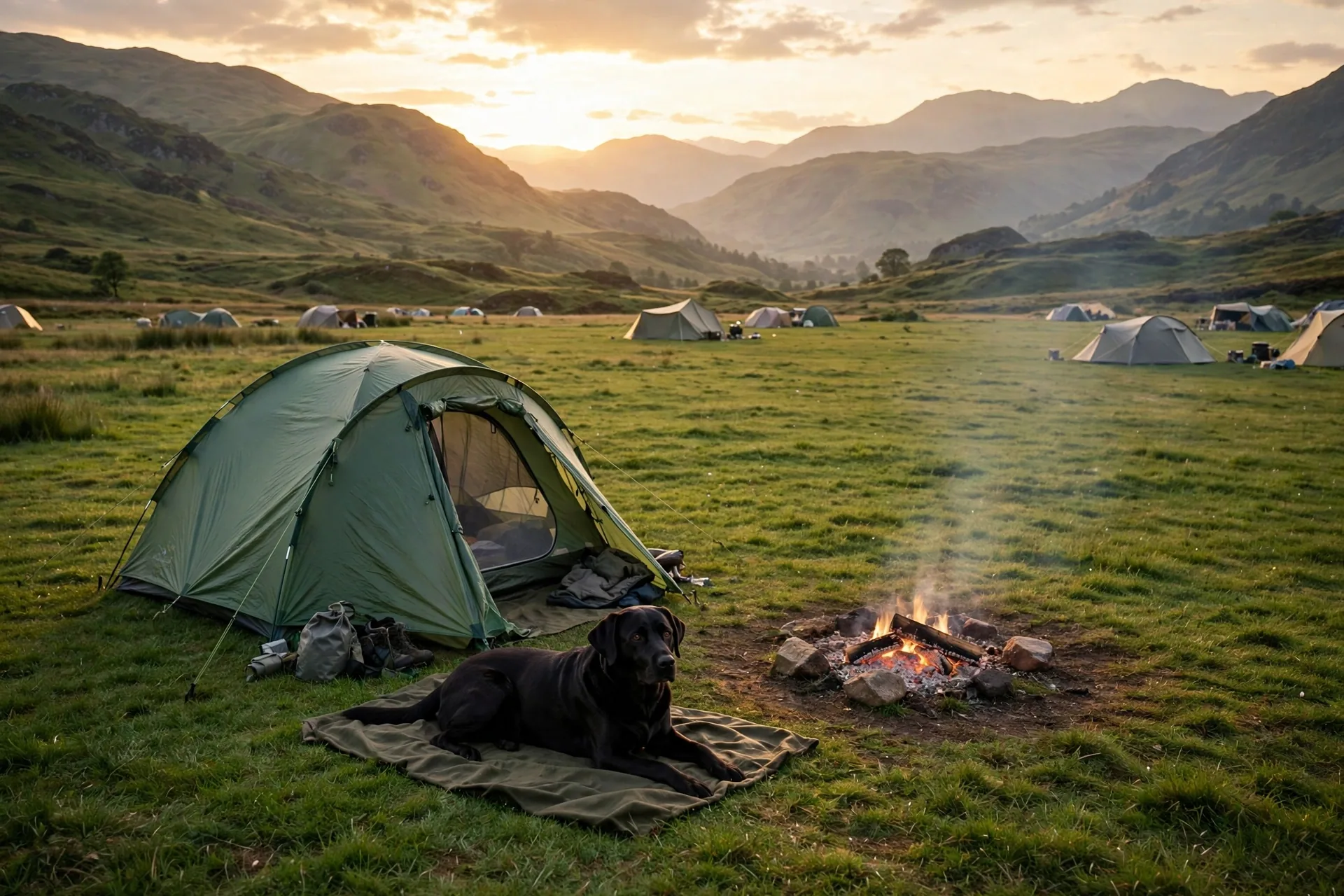
Hotels and guesthouses in the town centre suit shorter stays and dogs that are comfortable with people and noise. A central hotel means you can walk to the river, the shops and the restaurants without using the car, which is a real advantage on a wet evening. Ask whether dogs are allowed in the bar and restaurant as well as the bedroom, whether there is a charge per dog per night, and where the nearest practical toilet area is — a hotel beside a busy road is much less convenient at midnight than one near a quiet green. If you are considering camping with a dog in the UK, the sites around the Tweed Valley offer a different kind of stay, with more space and a lower cost, though you will need to be ready for Scottish weather and midges in summer.
Whatever you book, the questions to ask before payment are the same. How many dogs are allowed, and is there a size or breed condition? What is the pet fee, and is it per night or per stay? Is the garden genuinely enclosed, and how high is the fence? Where is the nearest walk from the front door? Can the dog be left alone briefly, and what happens if they bark? The answers tell you far more about a stay than a listing that simply says "dog-friendly". Get the answers in writing with your confirmation, and keep them with your booking details.
Booking early matters in Peebles, particularly for summer weekends, school holidays and the big festival dates. The best dog-friendly cottages and the most central rooms sell out months ahead, and the difference between booking early and booking late is often the difference between a cottage with a garden and a room that does not really suit a dog at all. If your dates are flexible, midweek stays and shoulder-season months such as May, June and September usually offer better availability, quieter walks and lower prices.
Seasons, river levels and what changes through the year
Peebles is a year-round destination, but the trip you have in spring is not the trip you have in autumn, and planning around the seasons makes every visit better. Spring brings longer days, lambs in the fields and the first green on the riverside trees, but also livestock with young, so lead discipline near fields matters more than ever. Paths can be muddy after winter rain, and the river can still be high, so check conditions before a long riverside walk and keep a towel and a change of shoes in the car.
Summer is the easiest season for a dog in Peebles, with warm days, low river levels and long evenings. It is also the busiest, with more walkers, cyclists and anglers sharing the same paths, so start early to enjoy the quiet hours and to avoid the heat of the day. Dogs can overheat quickly, especially on forest trails where the air is still, so carry water, walk in the shade, and use the river's shallow spots for cooling off — never let a dog swim in fast or deep water, and never leave a dog in a parked car. Midges can be a nuisance on still summer evenings near the river and in the forest, so a light repellent and a breeze make a real difference.
Autumn is many regular visitors' favourite season in Peebles. The forest turns gold and red, the riverside is quieter, and the light over the Tweed Valley is at its best. Salmon are moving upstream in the river, which makes the banks especially interesting for anglers and for dogs that like to watch the water. The weather turns quickly, though, and a bright morning can become a wet afternoon, so pack waterproofs for yourself and a drying coat for the dog. Autumn is also the season when the river can rise fastest after rain, so the morning river check becomes essential rather than optional.
Winter in Peebles is quiet, cold and beautiful, with frost on the riverside grass and sometimes snow on the hills above the town. The forest shelters you from wind, the town is calm, and accommodation is cheaper and easier to book. Short days mean planning walks around daylight, and icy pavements and bridges need care — dogs can slip just as people can, and grit and road salt can irritate paws, so rinse paws after a town walk and dry them properly. If you visit in winter, check the official guidance before you travel for current opening hours, because some cafes, attractions and forest facilities run reduced hours outside the main season.
Getting to Peebles and getting around
Peebles sits in the Scottish Borders, about an hour's drive south of Edinburgh, and most visitors arrive by car. The drive from Edinburgh follows the A703 or the A701 through the Pentland Hills, and the roads are scenic rather than fast — allow more time than the map suggests, especially on a summer weekend, and plan a stop so the dog can stretch their legs. If you are coming from the south, the route through the Borders from Carlisle or Newcastle is longer but just as attractive, with the Tweed Valley opening out as you approach the town.
By public transport, the nearest railway stations are in Edinburgh, and buses run from Edinburgh to Peebles through the day. Travelling with a dog by bus is possible, but it takes planning: check the operator's dog policy before you travel, keep your dog on a lead and on the floor rather than on a seat, and be ready for a journey that takes considerably longer than driving. For most dog owners, a car is the practical choice, because it gives you the freedom to reach Glentress, to carry wet-weather kit and drying towels, and to move on to other Borders towns without depending on bus times.
Once you are in Peebles, the car becomes optional for much of the stay. The town centre, the riverside path and the parks are all walkable, and a dog that is happy to walk can cover the whole town on foot. Driving is mainly useful for reaching Glentress Forest, for longer walks elsewhere in the valley, and for day trips to Melrose, Kelso or Innerleithen. Parking in the town centre is straightforward, with car parks within a short walk of the high street and the river, though they can fill up on busy weekends and festival days. Check the official guidance before you travel for current parking charges and any restrictions.
A practical point about driving in the Borders: the roads around Peebles are narrow in places, with single-track stretches, passing places and sheep on the road. Drive slowly, expect livestock around bends, and never let a dog out of the car on a road without a lead and a clear view of the traffic. If you are heading to a forest car park or a rural walk, arrive early on busy days, park considerately without blocking gates or passing places, and always take your rubbish — and your dog's — home with you.
Practical kit, safety and dog etiquette
The kit list for Peebles is short, but every item on it earns its place. A lead and a long line cover the river, the forest and the town between them. A harness is more comfortable than a collar for a dog that pulls, and it gives you better control near the water and around bikes. Water and a collapsible bowl are essential in the forest and on warm days, even though the river is always nearby — river water is not a reliable drinking source for a dog. Poo bags, a towel and a drying coat handle the muddy reality of a Borders walk, and a basic first-aid kit with a tick remover, antiseptic wipes and bandages covers the minor scrapes that forest trails and river banks produce.
Ticks deserve a specific mention. The Borders has ticks in grassland and woodland, particularly from spring to autumn, and a dog that walks through long grass or bracken should be checked after every walk. Run your hands over the dog's ears, neck, armpits and belly, remove any tick promptly with a proper tick remover, and speak to your vet about tick prevention before your trip if you are not already using it. The same after-walk check is a good moment to look for cuts on paws, thorns between toes and any sign of limping after a long forest day.
Dog etiquette in Peebles follows the same principles as anywhere in the countryside, but the town setting makes it more visible. Pick up after your dog everywhere, including on forest trails and riverside grass, and use the bins provided. Keep your dog under control around other dogs, children and livestock, and ask before letting your dog approach another dog — not every dog wants to say hello, and a dog on a lead may be on a lead for a reason. Around sheep and cattle, the rules are not optional: keep your dog on a lead, stay on the path, and close every gate. In Scotland, the right of responsible access applies to most land, but it comes with responsibilities, and a dog that chases livestock can be shot by a farmer — a sobering fact that every visitor should know. Check the official guidance before you travel for current access rules and livestock advice.
Water safety is the other essential topic. The Tweed looks gentle from the bank, but it has deep pools, strong currents and cold water, and dogs drown in rivers every year. Never throw a ball into fast water, never let a dog chase a stick into the river, and never go in after a dog that has got into trouble — call for help instead. If your dog loves water, choose the shallow gravelly spots, stay where you can reach them, and keep sessions short in cold weather. A dog that is wet and cold after swimming needs drying and warming up promptly, especially in autumn and winter.
Three ready-made dog days in Peebles
A slow first day sets the tone for the whole trip. Start with the riverside path from the town centre, walking upstream for an hour and back along the same route so the dog learns the way. Cross the bridge into the high street for a browse and a coffee, with the dog settling under the table, then spend the afternoon in one of the town's green spaces or on a short, easy walk. Finish with an early evening riverside stroll and a pub meal, or a takeaway back at your accommodation. The point of the first day is not to cover ground but to let the dog learn the town: where the river is, where the smells are, and where home is.
A forest day is the natural second day, once the dog is settled. Drive to Glentress in the morning, choose a waymarked walking trail that suits your dog's fitness, and take your time in the trees — the forest rewards a slow walk, with plenty of stops for sniffing and water. Have lunch at the trail centre or back in town, then spend the afternoon on a quieter riverside stretch downstream, where the dog can paddle in shallow water and you can watch the river. This combination of forest in the morning and river in the afternoon gives a dog two completely different kinds of walk in one day, which is more tiring and more satisfying than two walks in the same place.
A third day can be a Borders day out, using Peebles as a base. Drive to Melrose to walk the riverside and see the abbey town, or to Innerleithen and the wider Tweed Valley, or to Kelso for a different border town altogether. Each of these towns has its own riverside paths, cafes and character, and each is an easy drive from Peebles. The routine stays the same — river walk first, town second, a relaxed lunch with the dog — but the scenery changes, and a dog that has already settled in Peebles will take a new town in its stride. Come back to Peebles for the evening, finish with the familiar riverside loop, and the trip ends the way it began: beside the Tweed, with a tired, happy dog.
Peebles is not a place that shouts for attention, and that is exactly why it works so well with a dog. The river is always there, the forest is always close, and the town is small enough to feel familiar after a single day. Walk the Tweed in the morning, head for the trees when you want space, eat well in town, and let the dog set the pace — that is the whole plan, and it is enough for a very good break.
Upstream and over the hills from Peebles
Peebles sits at the western end of the Tweed, so the natural next stops are upstream and over the watershed: Innerleithen with a Dog continues the riverside walking a few miles east, while Biggar with a Dog and Lanark with a Dog open up the Clyde Valley side, including the Falls of Clyde gorge. The three guides use the same format as this one, with routes, parking and dog-friendly stops.
Practical questions
Before you go
Can dogs walk off lead on the riverside paths in Peebles?
On many stretches of the riverside path dogs can walk off lead when the path is quiet and your dog has a reliable recall, but keep a lead ready for bridges, road crossings, other walkers and any livestock nearby. Some sections run close to roads or through grazed fields, so use a lead there and always check the official guidance before you travel.
Is Glentress Forest suitable for dogs?
Yes, Glentress is very popular with dog owners, but it is a working forest shared with mountain bikers, runners and horse riders. Keep your dog under close control or on a lead on busy trails, choose quieter walking routes away from the main bike trails, and be ready for fast-moving bikes coming around bends. Check the official guidance before you travel for current trail closures.
Can I take my dog into cafes and pubs in Peebles?
Several cafes and pubs in Peebles welcome dogs, though policies vary and some are terrace-only or restrict dogs to certain areas. Always check the current policy before you set off, take a blanket for your dog to settle on, and keep your dog on a lead indoors. Our guide to dog-friendly cafes explains how to check before you go.
Where can my dog swim in the River Tweed near Peebles?
There are shallow gravelly spots along the Tweed where dogs paddle and swim, but the river is a working salmon river with strong currents in places, and water levels can rise quickly after rain. Choose slow, shallow water away from weirs and bridges, never let your dog swim after heavy rain, and check the official guidance before you travel.
Is Peebles a good base for a longer Scottish Borders trip with a dog?
Yes. Peebles sits in the heart of the Scottish Borders with easy drives to Melrose, Kelso, Innerleithen and the wider Tweed Valley, and it has a good range of dog-friendly places to stay, eat and walk. It works well as a base for three or four days, with a different riverside or forest walk each day.
What should I do if the River Tweed is high after rain?
Stay off the riverside path, keep your dog on a lead well back from the bank, and choose a forest or town walk instead. High water can undercut banks, hide fences and sweep a dog downstream in seconds. Check river levels and flood warnings online before you walk, and check the official guidance before you travel.