This guide is independent and contains no paid placement. If affiliate links are added later, they will be clearly marked and will not change our editorial checks.
Blaenau Ffestiniog suits dogs that like open ground, long walks and quiet evenings: ride the narrow-gauge railway to Porthmadog, walk the waymarked quarry and valley paths on a lead, and base yourself in town for easy access to the hills. Keep dogs away from quarry edges and standing water, and check the official guidance before you travel for current railway dog rules.
A slate town, not a resort town
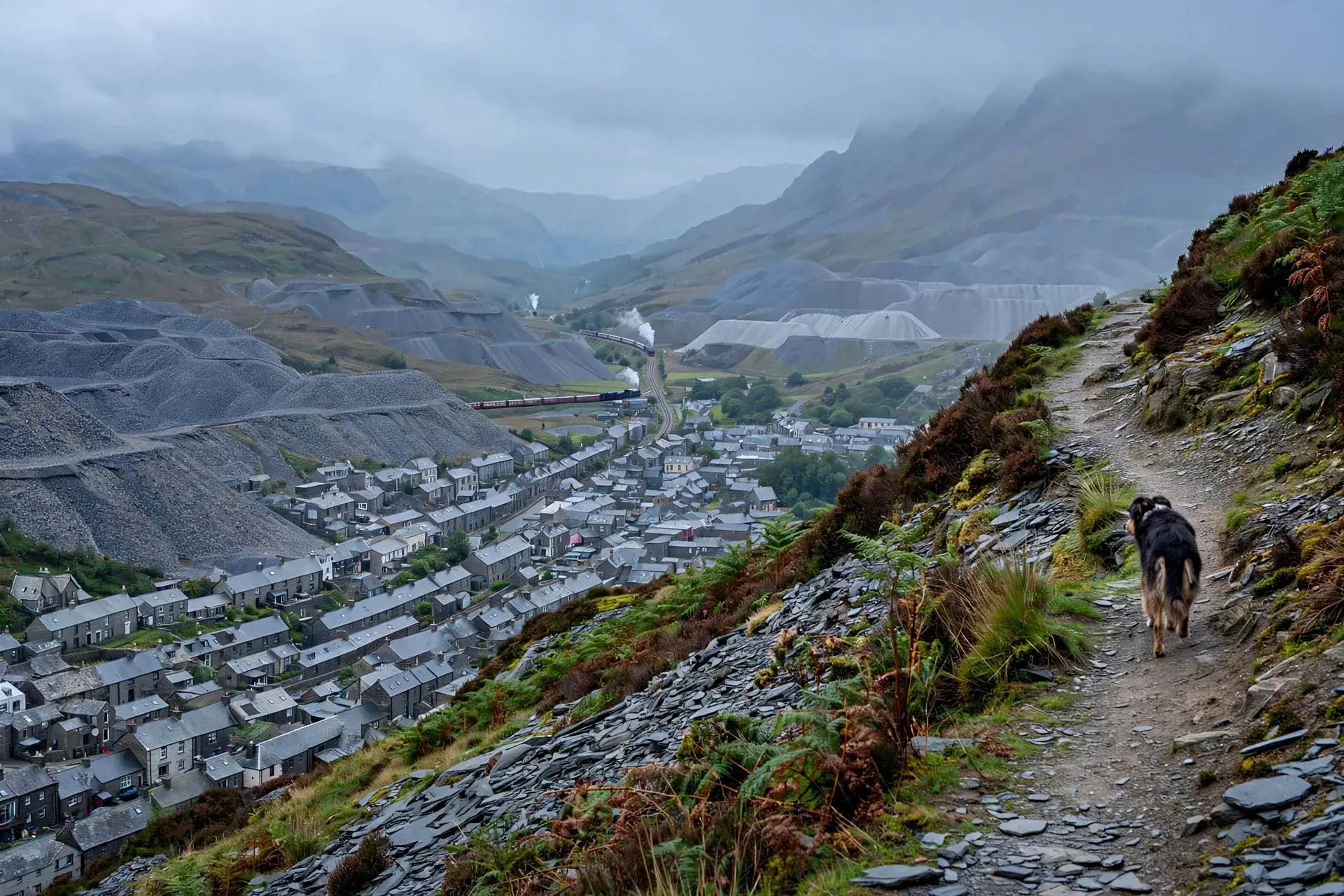
Blaenau Ffestiniog does not try to be pretty in the way that some Snowdonia villages are. It is a working slate town, built in a hollow between steep hillsides, where the roofs are grey, the spoil tips rise like man-made mountains, and the history of the place is written in stone rather than in gift shops. That honesty is exactly what makes it interesting, and it is also what makes it a good base for a dog break: this is a town for walking, looking and getting out into the hills, not for queuing outside attractions.
The town grew up around the slate quarries that once employed thousands of men and supplied roofing slate across Britain and beyond. The quarries shaped everything here — the terraced streets, the railway that carried slate down to the sea at Porthmadog, the chapels, the steep lanes and the very ground underfoot. In 2021 the Slate Landscape of Northwest Wales was inscribed as a UNESCO World Heritage Site, and Blaenau Ffestiniog sits at the heart of that story. You do not need to be a history enthusiast to enjoy it; the scale of the tips and the old workings is visible from almost anywhere in town, and it gives every walk a sense of place that a generic countryside stroll simply does not have.
For dog owners, the town has three practical advantages. First, it is small and walkable, so most things — the station, the shops, the pubs, the start of the paths — are within a short stroll of each other, which matters when you are juggling a lead, a bag and a dog that needs a toilet break. Second, it is quieter than the honeypot villages of Snowdonia. Betws-y-Coed and Llanberis can be crowded on a fine weekend, while Blaenau keeps a steadier, calmer pace, and a nervous or reactive dog will notice the difference. Third, it sits at a crossroads of routes: the railway runs down to the coast, roads lead to Harlech, Porthmadog and the Conwy Valley, and footpaths climb straight out of the town into the Moelwynion hills.
It is worth arriving with honest expectations. Blaenau is not a place of manicured gardens and cream teas on every corner, and the weather here can be wetter and windier than on the coast, because the town sits inland and high. Some visitors find the grey slate landscape stark at first; most find that it grows on them, especially in low autumn light or after rain, when the hills turn dark green and the mist sits in the valley. Dogs, for their part, tend not to care about the aesthetics at all. They care about smells, open ground, water and somewhere to sleep afterwards — and Blaenau delivers on all four, provided you plan around the quarry landscape rather than ignoring it.
The rest of this guide is built around that plan. It covers how to arrive and settle in, how to ride the railway with a dog, which walks suit dogs and which hazards to avoid, where to eat and sleep, and how to use the town as a base for day trips across the region. Where a detail might have changed — a railway policy, a path closure, a pub's dog rules — the guide says so and asks you to check the official guidance before you travel, because a guide that guesses at opening times is worse than one that admits it does not know.
Arriving with a dog
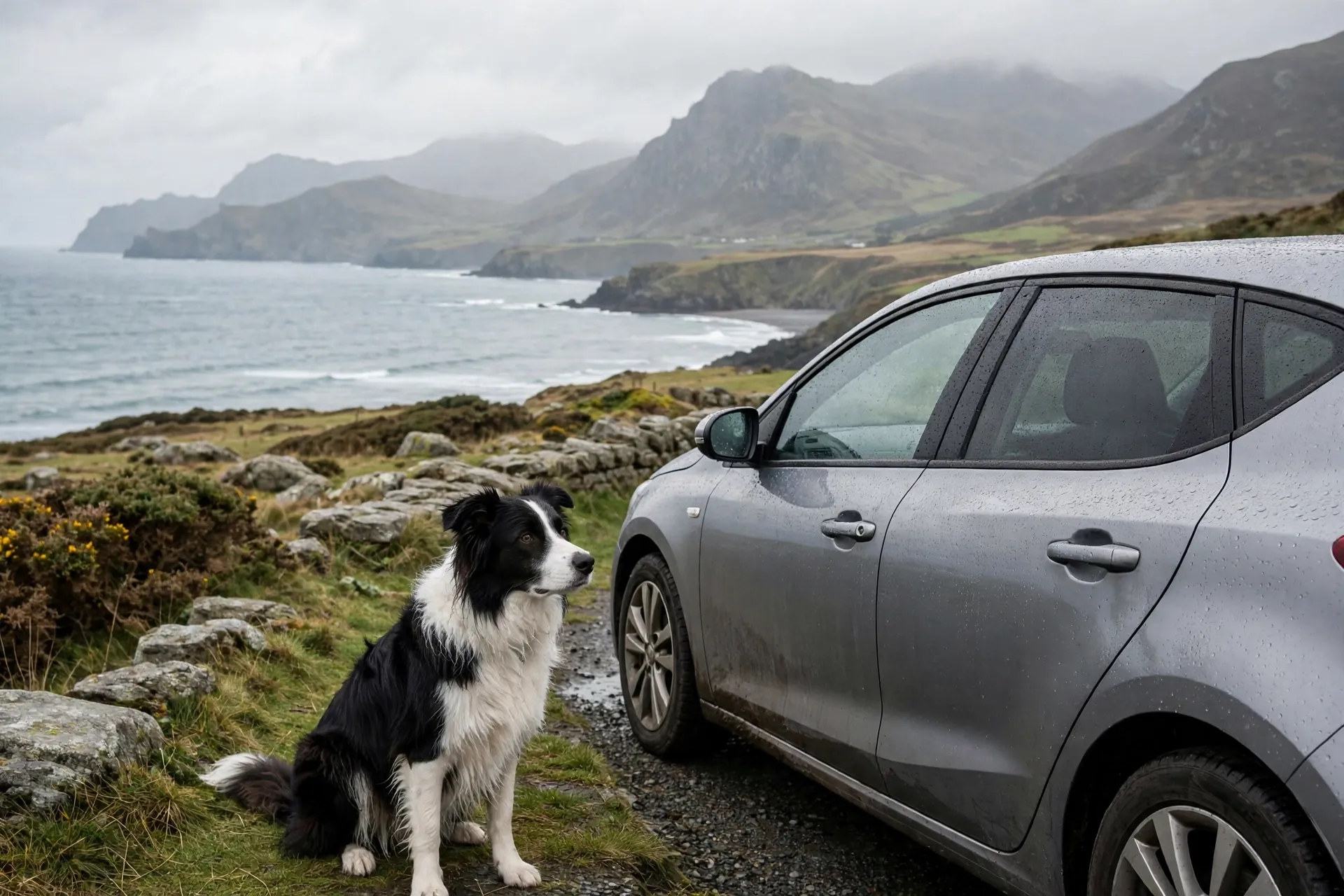
Most visitors reach Blaenau Ffestiniog by road on the A470 from the south or the A487 from Porthmadog, and the approach itself is part of the experience: the road climbs through the Vale of Ffestiniog, past the river Dwyryd and the wooded valley, before the town appears in its hollow between the hills. Drivers should allow extra time on narrow stretches and in poor weather, and keep an eye out for sheep on the roads around the town, which wander further than visitors expect. If you are arriving by public transport, the town has both a mainline station and the narrow-gauge Ffestiniog Railway station, and the two sit close together, which makes a car-free visit genuinely possible.
Parking is straightforward by Snowdonia standards. There are car parks in and around the town centre, and on-street parking on the main streets, but spaces can fill on busy weekends and during school holidays, so arriving earlier in the day is the simplest strategy. Check signs at the car park you use for any time limits or charges, and do not leave a dog in a parked car: even on a cool Welsh day, a car in the sun warms quickly, and the town's altitude does not protect against it. If you are staying in the town, ask your accommodation about parking before you arrive, because some terraced cottages have no parking of their own and you may need to use a public car park a short walk away.
The first hour in a new place sets the tone for the whole stay, and Blaenau rewards a slow start. Before you unpack, give your dog a proper toilet walk on a lead around the streets near your accommodation, and let them sniff the new smells properly — a rushed five minutes at the kerb is not the same as a real walk, and a dog that has not emptied itself will not settle. The area around the station and the main streets gives a gentle introduction: level ground, pavements, other dogs and people to observe from a comfortable distance. Keep the lead short here, because the streets are narrow and traffic, though light, moves through the town centre.
Use that first walk to learn the layout. The town runs roughly along a valley floor, with the railway station at one end and the main shopping streets in the middle, and the hills rise steeply on both sides. Note where the nearest shop is for dog food, treats or a forgotten poo-bag roll, where the closest green space is for a quick evening toilet trip, and which direction the footpaths leave the town. A paper map or an offline map on your phone is worth having, because mobile signal in the valleys around Blaenau can be patchy, and you do not want to be navigating a new hillside path on a single bar of signal.
If you arrive by train, the transition is even easier. Dogs travelling on the mainline railway to Blaenau Ffestiniog are generally welcome, and the walk from the station into the town centre is short and level. Give the dog water as soon as you arrive — train journeys and car journeys both dehydrate dogs, especially in warm weather — and let them rest for half an hour before the first proper walk. A dog that has travelled well deserves a calm arrival, and a calm arrival makes the first evening in a new place far easier for everyone.
The Ffestiniog Railway with a dog
The Ffestiniog Railway is the reason many visitors come to Blaenau, and it is also the town's best dog-friendly day out. The narrow-gauge line runs for about thirteen and a half miles from Blaenau Ffestiniog down through the Vale of Ffestiniog to the harbour town of Porthmadog, passing waterfalls, wooded valleys, lakes and the famous spiral at Dduallt, where the line loops over itself to gain height. It is one of the oldest narrow-gauge railways in the world, built to carry slate, and riding it with a dog feels like travelling through the town's history rather than just looking at it.
Dogs are generally welcome on the railway, which is good news, but the details matter and they can change between seasons, so check the official guidance before you travel. In practice, well-behaved dogs usually travel on the floor of the carriage rather than on seats, and there may be a small charge for a dog ticket. Some services, especially the busiest summer trains and special event services, may have different arrangements, so booking ahead is wise in peak season. If your dog is nervous about noise, steam or crowds, choose a quieter midweek service outside the school holidays, and sit near a door where you can step off at a station if the dog needs a break.
Preparing a dog for a steam train is mostly a matter of common sense. Walk the dog properly before boarding so they are not bursting, bring water and a bowl, and pack a blanket or mat for them to settle on — a familiar smell helps a dog relax in a strange carriage. Keep the lead short and the dog under the seat or at your feet, not in the aisle where other passengers trip over it. Some dogs love the window and the moving scenery; others find the steam, the whistle and the tunnels stressful, and if yours is in the second group, there is no shame in taking a shorter ride or skipping the train altogether in favour of a walk. A dog that has a miserable time on the railway will remember it, and the hills will still be there tomorrow.
The stations along the line are part of the pleasure. Tan-y-Bwlch, roughly halfway, has a station building and a short walk to a lake, and it is a natural place to break the journey, stretch the dog's legs and have a drink before continuing. Smaller halts serve quiet valleys and footpaths, and a one-way ride with a walk back — or a walk one way and a ride back — is a satisfying way to structure a day. Just make sure you know the timetable before you set off walking, because services are not frequent, and a missed train in a valley with no bus can mean a long walk back to Blaenau.
A practical tip: the railway is a working heritage line, not a theme park, and its staff are usually happy to answer questions about dogs, carriages and the best services for a nervous animal. Ask at the booking office rather than guessing. If you plan to combine the train with a walk at the Porthmadog end, read the day-trips section of this guide first, and remember that dogs must be on a lead at stations and on platforms at all times. The railway is one of the great dog-friendly experiences in Wales — but only if the dog actually enjoys it, so watch your dog, not just the scenery.
Walks among the slate tips
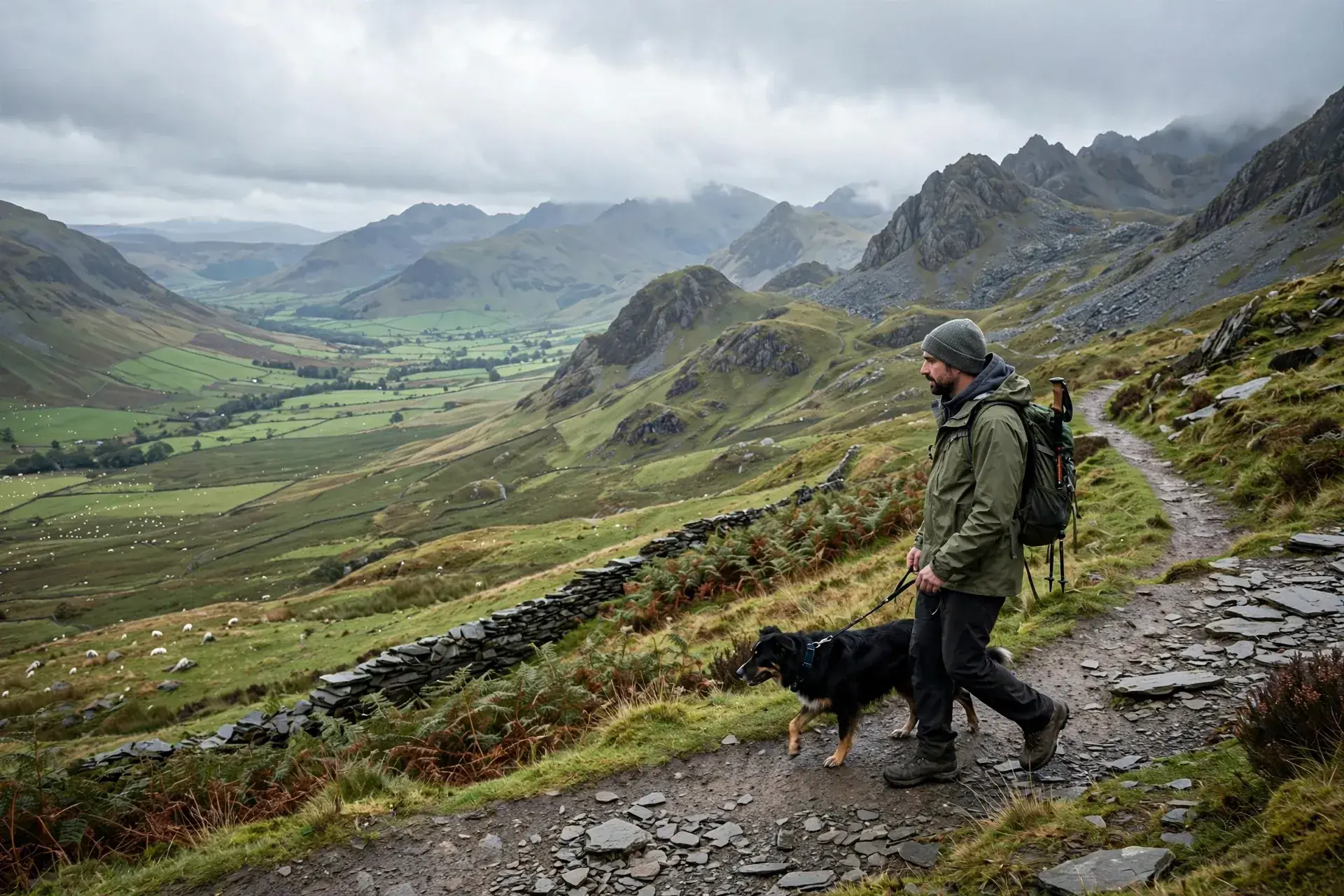
The most distinctive walks around Blaenau Ffestiniog are the ones that take you into the slate landscape itself: the paths that climb past the spoil tips, follow old quarry tramways and open out onto views across the Moelwynion. These are not manicured park paths. They are working-landscape routes, sometimes rough underfoot, sometimes steep, and always more rewarding for a little care. The key is to choose waymarked routes and to treat the quarry workings with respect.
One good starting point is the network of paths around the town's edges, where the streets give way to open hillside surprisingly quickly. Within a few minutes of leaving the town centre you can be on paths that look out over the slate roofs and the tips, with the mountains beyond. These short climbs suit a first morning: enough height to earn the view, short enough to get back for lunch, and easy to shorten if the weather turns or the dog tires. Keep the dog on a lead on these paths, because the ground near the tips can be loose and steep, and because sheep graze the hillsides around the town. A dog that chases sheep is a danger to the sheep, to itself and to your wallet, since livestock worrying is a serious matter under the law.
Longer routes lead out towards the old quarries themselves, including the area around Llechwedd, where the slate caverns and the old workings tell the story of the industry. Some quarry attractions welcome dogs in outdoor areas and on certain tours, but rules vary and underground sections are generally not suitable for dogs, so check the official guidance before you travel rather than assuming. Even if you do not go inside, the paths around the quarry sites are worth walking for the scale of the place: the vast chambers, the tips, the old inclines and the tramway routes that once carried slate down to the railway.
The ground itself deserves attention. Broken slate is sharp, and dogs that run hard over it can cut their pads, so check paws at the end of every walk and carry a small first-aid kit with a bandage and a boot or sock for emergencies. Wet slate is also slippery, and the tips are steep in places, so keep dogs close and do not let them scramble up loose slopes that could give way. Fences, warning signs and barriers around old workings are there for a reason: never climb over them, and never let a dog through a gap in a fence that is there to keep people and animals out.
Standing water in the quarries is another hazard that catches visitors out. Old quarry pools can look inviting on a hot day, but they may be deep, cold and steep-sided, and the water quality is not something you can judge by looking at it. Do not let dogs drink from or swim in quarry pools; carry fresh water and a bowl instead, and offer it regularly. The same goes for the reservoirs and lakes in the wider area: check local guidance and watch for algae, which can be harmful to dogs. A dog that drinks from a dubious pool can be ill for days, and the vet bill will cost far more than the bottle of water you should have carried.
Lakes, rivers and valley walks
For a change of scenery from the slate tips, the valleys and lakes around Blaenau Ffestiniog offer gentler walking and a different kind of beauty. The Vale of Ffestiniog, which runs south-west from the town towards Porthmadog, is a wooded river valley with the Afon Dwyryd running through it, and the paths here are softer underfoot, greener, and often sheltered from the wind that rattles the high tips. A valley walk after a day on the hills feels like a different holiday altogether, and most dogs prefer it.
One of the most satisfying valley routes follows the river and the railway line down towards Maentwrog and the lower valley, where the landscape opens out into meadows and oak woodland. These are not high mountain paths, so they suit older dogs, puppies and anyone who wants a walk that is about distance rather than height. Keep dogs on a lead near the river in spate after heavy rain, because the Dwyryd can rise quickly and the banks can be slippery, and watch for livestock in the riverside fields. In dry weather the riverbanks are also a good place for a paddle, but check the current and depth first, and never let a dog swim in fast water.
The lakes around Blaenau are quieter still. Llyn Tanygrisiau, to the north-east of the town, sits in a dramatic setting beneath the mountains and the slate workings, and the walk around it gives long views and a sense of space that the town itself does not have. Llyn Ystradau, closer to the town, is smaller and more intimate, and makes a good short walk for a first or last day. Both are working reservoirs as well as beauty spots, so the rules are straightforward: keep dogs under control, do not let them disturb anglers or wildlife, and take all litter home. A lake walk at dawn, when the water is still and the mist is lifting, is one of the best experiences in the area — and dogs that have been cooped up in a cottage all night will love it.
Further afield, the wider Snowdonia landscape opens up. The Moelwynion hills that ring the town offer proper mountain walking for fit dogs and experienced walkers, with summits, ridges and long views across to Yr Wyddfa and the sea. These are serious walks, not strolls: the ground is rough, the weather changes fast, and there is little shelter. Our Snowdonia with a dog guide covers lead rules, sheep safety, parking and easier mountain walks in detail, and it is worth reading before you attempt any high route from Blaenau. The short version is this: plan the route, check the forecast, carry more water and food than you think you need, and turn back early rather than late if the weather or the dog tells you to.
Whatever valley or lake you choose, the rhythm of a good walking day is the same. Start early, while the light is good and the paths are quiet. Walk for an hour or two, then stop somewhere with a view and let the dog rest — dogs need rest on a walk just as people do, and a dog that is pushed too far will pay for it the next day. Carry water for the dog even on a short walk, because streams and lakes are not always safe to drink from, and bring a snack for both of you. And finish the day with a proper check: paws, coat, ears and ticks, because the hills around Blaenau are tick country in the warmer months and a tick found early is a tick dealt with easily.
Pubs, cafes and practical stops
After a day on the hills, a dog-friendly pub is one of the great pleasures of a Welsh walking holiday, and Blaenau Ffestiniog has several places where a well-behaved dog is welcome. The pattern is the usual one for small Welsh towns: dogs are most often welcome in the bar area and on outdoor seating, less often in formal dining rooms, and always on the understanding that they settle quietly and stay on a lead. Policies change from venue to venue and from season to season, so check before you travel or ask at the door — and take a "no" gracefully, because arguing with a landlord helps no dog owner.
A few habits will make your dog welcome anywhere. Bring a blanket or mat for the dog to lie on, because a cold slate or tiled floor is not comfortable and a dog that has its own place will settle faster. Order your drinks first and settle the dog before the food arrives, so you are not juggling a lead, a menu and a restless animal at the same time. Keep the dog on a short lead, out of the walkways, and do not let them beg from other tables or sniff other people's dogs without asking. A dog that lies quietly under a table and is rewarded with a treat for doing so will be remembered fondly by the staff; a dog that barks at every person who walks past will not be invited back.
Cafes in the town are a good option for breakfast or a mid-walk coffee, and many have outdoor seating where dogs are welcome in good weather. Some also allow dogs inside, particularly in the quieter months, but again it is worth checking first. If the weather is bad and you need a warm, dry place with a dog, a takeaway eaten back at your accommodation is often the simplest solution, and the town has takeaway options that suit a tired walking party very well. Pack a few dog treats in your pocket before you go out, because a pub or cafe visit is a training opportunity as much as a rest: every quiet five minutes under a table is worth rewarding.
Practically, the town covers the basics. There are shops for groceries, dog food and forgotten supplies, a pharmacy, and cash machines, though it is worth carrying some cash as well as cards, because small rural businesses and car parks do not always take cards. For veterinary care, the nearest practices are in the surrounding towns rather than in Blaenau itself, so before you travel, save the number of the nearest emergency vet and note its opening hours — if your dog is injured or unwell on a Sunday evening, you do not want to be searching for a number for the first time. The same applies to your own dog's details: keep a photo of your dog on your phone, note any medication and the name of your usual vet, and make sure your dog's tag and microchip details are up to date before you leave home.
One more practical point: Blaenau is a small town, and many businesses keep shorter hours outside the main season. In winter, some cafes and attractions close or reduce their days, and the railway runs a reduced timetable, so check the official guidance before you travel if you are visiting between November and March. None of this is a reason not to visit in winter — the town is quieter, the light is beautiful and the pubs are warmer — but a little checking in advance saves a wasted walk to a closed door.
Where to stay with a dog
Blaenau Ffestiniog offers the usual Snowdonia mix of places to stay: self-catering cottages, bed and breakfasts, small hotels and campsites within a short drive, plus holiday parks and lodges in the wider area. The best choice depends on your dog. A young, energetic dog that needs a garden to burn off energy in the morning will be happier in a cottage with an enclosed garden than in a first-floor flat, while an older dog that mostly sleeps will be content almost anywhere warm and quiet. Think about your dog's needs first and the view second, because you will spend far more time managing the dog than admiring the view.
When you book, ask the questions that actually matter. Is the garden genuinely enclosed, and how high is the fence — a "fenced garden" photographed from one flattering angle may have a gap a terrier can walk through. How many dogs are allowed, and is there a charge per dog or per stay? Are dogs allowed in all rooms, or only in certain ones, and are they allowed on the furniture or in the bedrooms? Is there somewhere to dry a wet dog, and is there a hose or an outside tap for muddy paws? These are the questions that decide whether a stay works, and a host who answers them clearly is usually a host who has thought about dogs properly.
Terraced cottages in the town itself have a particular charm: thick slate walls, a fire in winter, and the hills at the end of the street. They also have particular quirks. Stairs can be steep and narrow, which matters for an older dog or a very small one, and the front door may open straight onto the pavement, so a dog that bolts at the sight of another dog needs careful management at the threshold. Ask about the layout before you book, and bring a stair gate or a travel crate if your dog is used to one at home — familiarity helps a dog settle in a strange house far more than any amount of space does.
Campsites and touring pitches around Blaenau suit dogs that are happy outdoors, but check the site's dog rules before you book: some sites have dog-free areas, some require dogs to be on a lead at all times, and some have a dedicated dog-walking field. A pitch near the edge of the site is usually calmer than one beside the play area or the reception, and a pitch with a hedge or fence to one side gives a reactive dog one less direction to watch. If you are camping with a dog for the first time, a single night close to home is a better test than a week in the mountains.
Whatever you book, arrive with a plan for the first night. Set up the dog's bed in the same place you would at home, put out water and a familiar toy, and keep the evening routine as close to normal as you can: same feeding time, same last walk, same bedtime. Dogs read routine as safety, and a dog that sleeps well on the first night will walk well on the first morning. And when you leave, do the courtesy checks that keep dog-friendly places dog-friendly: clean up the garden, report any damage honestly, and leave the place as you found it. Every dog owner who leaves a cottage clean makes it easier for the next dog owner to book one.
Day trips from Blaenau
One of the best things about Blaenau Ffestiniog is how much of North Wales sits within an easy drive or train ride, which means you can use the town as a quiet base and still see the coast, the castles and the mountains. The trick is to plan one outing a day rather than trying to see everything, because the roads here are slow, the car parks fill up, and a dog that has spent five hours in a car will not enjoy the sixth.
The easiest day trip is the railway to Porthmadog. Ride down in the morning, walk the harbour and the estuary paths, and take the train back in the afternoon — the dog gets a train ride, a harbour walk and a change of scenery without a long drive. Porthmadog's harbour is a working place with boats, gulls and the smell of the sea, and the flat paths around the harbour suit dogs of all ages. From Porthmadog you can also reach the beaches of the Llyn Peninsula and the coast around Black Rock Sands, where the sand is wide and the sea is never far away. Check seasonal dog restrictions on individual beaches before you travel, because some beaches limit dogs in the summer months.
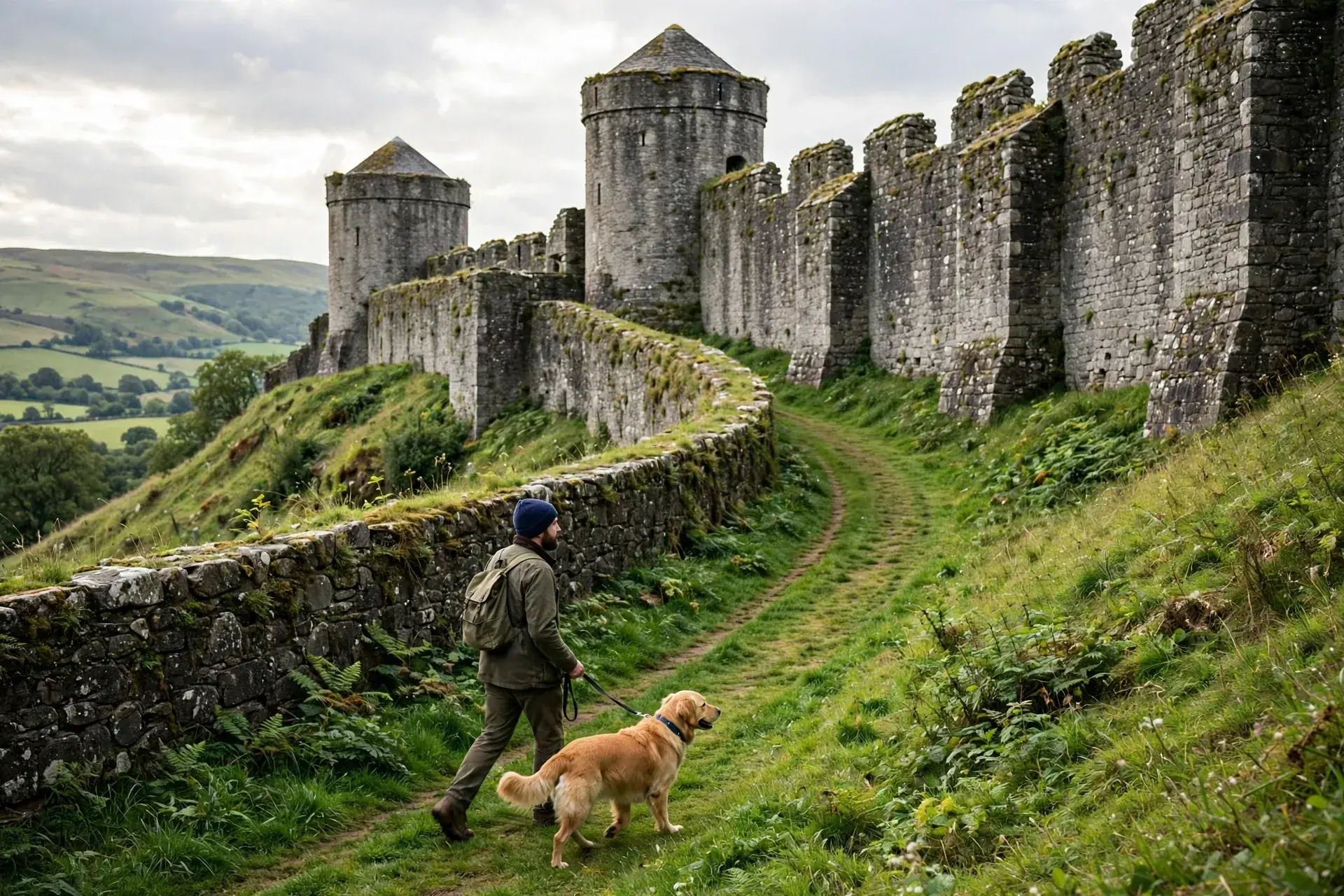
Harlech is another easy drive, and it pairs a castle with one of the great beaches of Wales. The castle itself has its own dog rules — our guide to dog-friendly castles in Wales explains which sites welcome dogs and where leads are required — and the beach below the castle is a vast expanse of sand that dogs love. Go at low tide for the full effect, keep an eye on the tide times, and bring a towel, because a dog that has been on a Welsh beach will be wet, sandy and delighted, usually in that order.
Betws-y-Coed, to the north-east, is the classic Snowdonia village: waterfalls, forest walks, tea rooms and a good deal of bustle. It is worth a visit, but it is also the place where a dog break can turn into a queue, so go early or go out of season, and use the forest trails rather than the main street for your walking. The forest around Betws-y-Coed has waymarked trails of every length, and the river walks are beautiful in autumn. If you are planning a longer driving loop through the region, our dog-friendly North Wales road trip guide covers drive times, dog stops and base towns in detail, and it is the best starting point for building a multi-day route that starts or ends in Blaenau.
For a quieter day, stay closer to home and explore the smaller villages of the Vale of Ffestiniog, or drive the coast road to Criccieth, where the castle and the beach make a gentle half-day out. The point of a base like Blaenau is not to tick off a list but to have options: a mountain day, a coast day, a railway day and a doing-nothing day, each within reach. Dogs are very good at telling you which kind of day they need — a dog that flops down after breakfast is asking for the doing-nothing day, and you should listen.
Weather, seasons and slate ground
Snowdonia is famous for its weather, and Blaenau Ffestiniog, sitting inland and high, gets its full share. The town is one of the wetter places in Wales, and the rain can arrive quickly, stay for hours, and then clear to bright sunshine in the space of a single walk. This is not a reason to stay away — it is a reason to pack properly and to plan flexibly. A waterproof jacket, waterproof trousers, a dog drying coat and a towel in the car will do more for your holiday than any amount of hoping for sunshine.
Spring, from late March to May, is a good time to visit with a dog. The days lengthen, the hills turn green, lambs appear in the fields — which means dogs must be on a lead near livestock, without exception — and the railway and attractions are back to fuller timetables. Paths can still be muddy after winter, and the weather can be cold on the high ground, so pack layers and check the forecast the night before a big walk. Summer brings the longest days and the warmest weather, but also the busiest trains, the fullest car parks and the highest chance of a dog overheating on a hard walk. Walk early in the day in summer, carry plenty of water, and never leave a dog in a car.
Autumn is, for many dog owners, the best season in Blaenau. September and October bring cooler walking weather, quieter paths, autumn colour in the valley woodlands and long, low light across the slate tips. The railway is still running a good timetable, the pubs are warm, and the dogs are happier in the cooler air. Winter, from November to February, is the quietest season: short days, cold winds, rain and sometimes snow on the high ground, and some attractions on reduced hours. A winter visit can be atmospheric and rewarding, but it needs more planning — check opening times, carry a head torch for the early dark, and keep walks shorter and closer to the town.
The slate ground itself changes with the weather, and this matters more than most visitors realise. Dry slate is grippy underfoot; wet slate is slippery, and the tips and quarry paths can be treacherous after rain. Dogs that run confidently on dry ground can slip on wet slate, so slow down, keep the lead short on steep sections, and choose valley paths over high quarry routes in wet weather. Mist is another feature of the area: the cloud can come down over the hills and the town itself, reducing visibility to a few metres. If you are walking high ground in mist, stay on waymarked paths, carry a map and compass or a charged phone with offline maps, and turn back if you are unsure of the route. A walk in the mist can be beautiful, but it is not the day to explore a new ridge.
Packing and quarry safety
A dog break in a slate town needs a slightly different packing list from a beach holiday, and the differences are all about the ground, the weather and the livestock. Start with the basics: a lead and a spare, a long line for open ground, a harness that fits well, poo bags, a water bottle and a collapsible bowl, food and treats, a towel and a drying coat, and any medication your dog needs. Then add the Blaenau extras: a paw balm or boot for sharp slate, a small first-aid kit, tick tweezers, a head torch, and a blanket for pub visits and train rides.
The long line deserves a special mention. Around Blaenau, the ground is a patchwork of open hillside, sheep pasture, quarry edges and forest, and a dog's freedom has to change with the ground. A long line — ten metres of light line on a harness — gives a dog room to explore on open ground while keeping you in control near sheep, roads and quarry edges. It is the single most useful piece of kit for this landscape, and it costs very little. Use it on a harness, not a collar, so a sudden stop does not jerk the dog's neck, and practise with it at home before you travel, because a tangled long line in a sheep field is no fun for anyone.
Paw care is the other Blaenau essential. Check paws at the end of every walk, looking for cuts, cracks, grit between the toes and any sign of limping. Wash muddy paws in clean water, dry them properly, and apply paw balm if the pads look dry or sore. If a pad is cut, clean it, bandage it and rest the dog — a small cut that is walked on for another three hours becomes a big problem. Dogs that are not used to rough ground should build up gradually: a short slate walk on the first day, a longer one on the second, rather than a ten-mile mountain day straight off the car journey.
Finally, think about the dog's ID and safety net. Make sure the tag has your mobile number on it and that the microchip details are up to date, because a dog that slips a lead on a hillside can cover a surprising distance. Keep a recent photo of your dog on your phone, and know the name and number of the nearest vet before you need it. If your dog is a known runner or has poor recall, consider a GPS tracker — the hills around Blaenau are big, and a tracker turns a panic into a walk to a known location. None of this is about expecting the worst; it is about making sure a good holiday stays a good holiday, even when a dog does something unexpected, which, sooner or later, every dog does.
If you are planning a wider trip around the region, the Snowdonia with a dog guide and the North Wales road trip guide both pair well with this one: the first for mountain safety and lead rules, the second for building a driving route that takes in the coast, the castles and the valleys from a Blaenau base. And if you take one idea away from this guide, let it be this: Blaenau Ffestiniog rewards the dog owner who slows down, walks the town's own paths, rides the little railway and lets the slate landscape set the pace. It is not a place to rush, and your dog will thank you for not trying.
Practical questions
Before you go
Can dogs ride the Ffestiniog Railway from Blaenau Ffestiniog?
In most cases, yes. The Ffestiniog Railway generally welcomes well-behaved dogs on its services between Blaenau Ffestiniog and Porthmadog, though dogs are usually expected to travel on the floor rather than on seats, and there may be a small charge. Policies can change between seasons, so check the official guidance before you travel, book ahead in busy periods, and choose a quieter midweek service if your dog is nervous around crowds or steam.
Are the slate quarry walks around Blaenau Ffestiniog safe for dogs?
The marked paths around the town are fine for most dogs, but the old quarry workings themselves need respect. Keep dogs on a lead near quarry edges, tips and old tramway cuttings, where ground can be loose, steep or fenced off, and do not let dogs drink from standing quarry pools. Stick to waymarked routes, carry water, and check paws afterwards, because broken slate is sharp underfoot.
Where can dogs go off lead near Blaenau Ffestiniog?
There is no single designated off-lead area in the town itself, so off-lead time depends on the walk you choose and the livestock around. Open hillside away from sheep, quiet valley paths and some wider forestry tracks can suit a dog with reliable recall, but sheep graze across much of the surrounding land and the law requires dogs to be under close control near livestock. Use a long line when you are unsure, and always return to the lead near roads, quarry edges and farm buildings.
Are there dog-friendly pubs and cafes in Blaenau Ffestiniog?
Several pubs and cafes in the town welcome well-behaved dogs, usually in the bar area or on outdoor seating rather than in dining rooms. Policies vary by venue and can change, so check before you travel or ask at the door, bring a blanket for your dog to settle on, and keep them on a lead indoors. A dog that can settle quietly under a table will get a much warmer welcome than one that wanders between tables.
What is the best time of year to visit Blaenau Ffestiniog with a dog?
Late spring and early autumn usually give the best balance: longer daylight, cooler walking weather and fewer crowds on the railway and the paths. Summer brings the busiest trains and the warmest days, while winter can be wet, windy and short on daylight, though the town is quiet and atmospheric. Whatever the season, pack waterproofs and check the official guidance before you travel, because mountain weather in Snowdonia can change within an hour.
Can I walk from Blaenau Ffestiniog to the coast with a dog?
Walking all the way to the coast is a long, demanding day that most visitors should not attempt on foot alone. The practical alternative is to take the Ffestiniog Railway down to Porthmadog and walk the harbour, estuary paths and nearby beaches from there, then ride the train back. If you do plan a long valley walk, carry enough water and food, check the route and daylight hours in advance, and have a plan for getting back if the dog tires.