This guide is independent and contains no paid placement. Boat operators, pub policies and seasonal restrictions change, so check the official guidance before you travel.
Book a seal trip if your dog is calm on boats, walk the quay and the marsh paths if not, and keep dogs on a lead around seals and nesting birds. Blakeney rewards a slow, tide-aware day far more than a rushed one.
The seal colony at Blakeney Point
Blakeney Point is a four-mile shingle spit that curves away from the Norfolk coast into the North Sea, and it holds one of England's largest grey seal colonies. The colony has grown dramatically over recent decades, and in winter the point becomes a pupping beach where hundreds of grey seal pups are born on the sand and shingle between roughly November and January. Common seals, also called harbour seals, use the same area and pup in the summer months. That means there is almost always something to see from a boat, but the character of the visit changes completely with the season, and the rules that protect the animals change with it.
The reason Blakeney works so well for dog owners is that the seal-watching is done from the water. A boat trip lets you see the colony at close range without walking a dog through a sensitive pupping beach, which is exactly the situation where disturbance does real harm. Boats approach slowly, keep a respectful distance, and turn so that passengers on both sides get a view. Seals are curious animals and often swim towards a stationary boat, so the best sightings frequently happen when the engine is idling and everyone is quiet. A dog that can settle on deck will enjoy the same spectacle, watching the dark heads bob in the water, though some dogs bark at seals and that changes the calculation.
It is worth understanding what the point actually is before you plan around it. The spit is managed as a nature reserve, and access to the far end is restricted during the pupping season to protect mothers and newborn pups. Walking the full length of the spit is a serious undertaking in any season: the surface is loose shingle, there is no shade or fresh water, and the return journey doubles the distance. For most dogs, and frankly for most people, the boat is the better way to meet the colony. The walk from Cley beach car park to the point is an option for fit walkers with fit dogs on a cool day, but it should be treated as a half-day expedition, not a casual stroll, and the dog's paws, water supply and energy all need planning.
Seal behaviour is also worth reading before you go. Grey seals are large, powerful animals that rest on the beach in groups, and mothers with pups are easily stressed by close approach. Common seals are smaller and shyer, hauling out on sandbanks at low tide. Both species are protected, and the guidance from conservation bodies is consistent: keep your distance, keep noise down, keep dogs on leads near haul-outs, and never try to touch or feed a seal. A seal pup alone on a beach is not necessarily abandoned; mothers leave pups while they feed at sea. If you find a pup that looks injured or in distress, contact a recognised seal rescue organisation rather than intervening directly, and keep dogs well away while you do it.
Choosing a seal trip with a dog
Several small operators run seal trips from Blakeney quay, and most use open boats that carry around ten to twelve passengers. Trips typically last about an hour, sailing out through the harbour channel, past the marshes and sandbanks, to the point where the seals haul out. The boats run around the tides rather than to a fixed timetable, because the channel is only navigable at certain states of the tide, so sailing times shift from day to day. This is the single most important practical point about Blakeney: check sailing times before you travel, and build your day around them rather than expecting a boat to suit your arrival.
Dog policies vary between operators and even between boats, so confirm at the time of booking rather than assuming. Many operators welcome well-behaved dogs, usually on a lead and sitting on a blanket or towel on deck, and some charge a small fee or nothing at all. A few restrict dogs at busy times or on particular sailings. Ask directly: is there a size limit, must the dog stay on a lead, is there shade or shelter on deck, and what happens if the sailing is cancelled for weather? Getting the answers in advance avoids an awkward conversation on the quay with a disappointed dog and a full boat.
Whether your particular dog should go on a boat deserves honest thought. The ideal boat dog is calm in new environments, unbothered by engine noise and vibration, comfortable sitting still for an hour, and not inclined to bark at strange animals in the water. Dogs that are nervous on moving platforms, that lunge at wildlife, or that bark when excited may be happier staying on the quay with one member of the party while the others sail. There is no shame in splitting the group: one person walks the dog along the quay and the marsh path while the others take the trip, then you swap stories over lunch. A miserable hour on a boat helps nobody, least of all the seals.
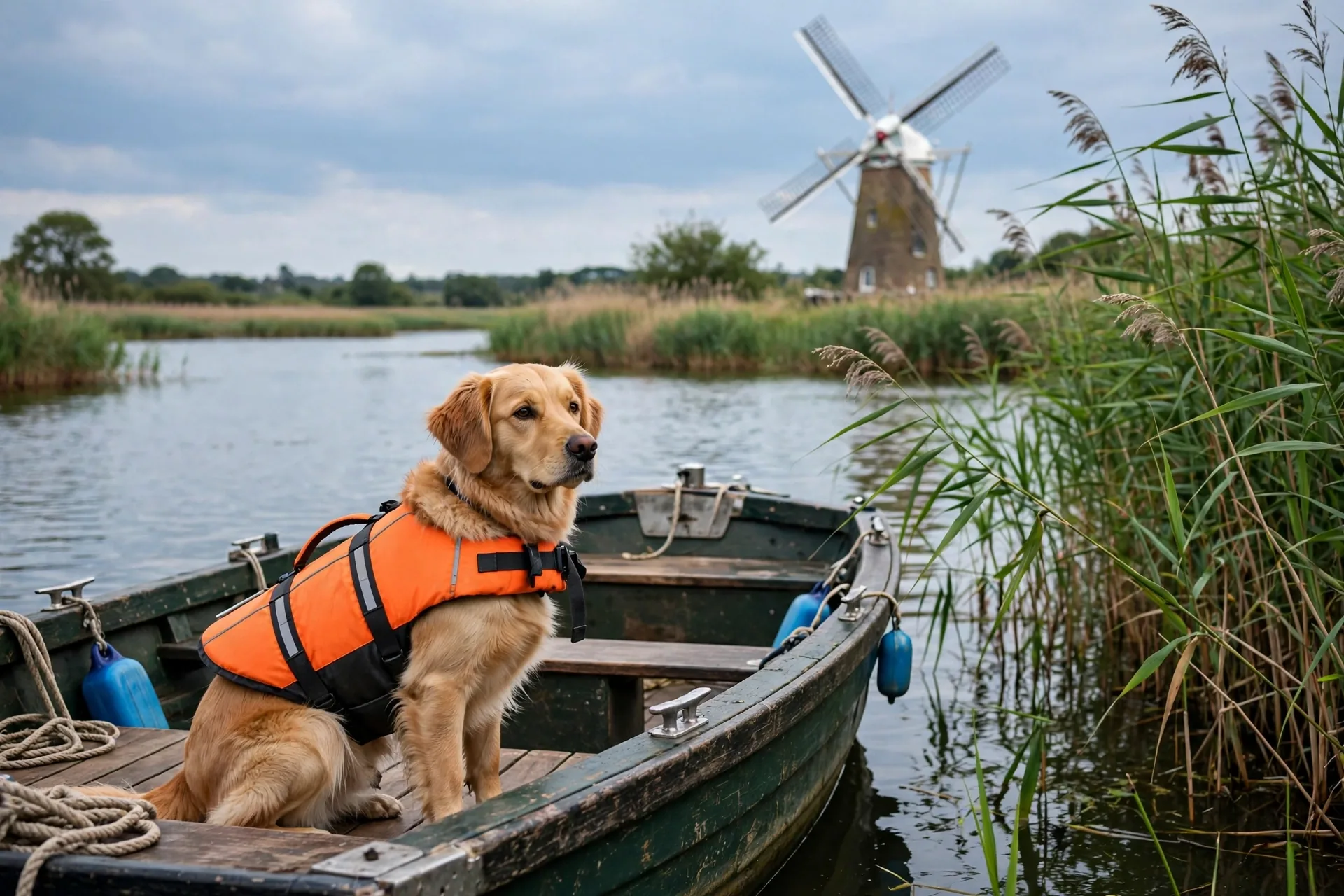
Pack for the boat as you would for a coastal walk with extras. Bring a non-slip blanket for the dog to lie on, a lead rather than a retractable one, water and a collapsible bowl, and a towel in case of spray. Life jackets for dogs are not usually required on these sheltered harbour trips, but if your dog is small, elderly or a poor swimmer, bringing their own buoyancy aid does no harm and may reassure you. Dress for wind even on a warm day: the breeze off the water is consistently cooler than the temperature in the village, and a dog that shivers on deck will not enjoy the seals. If the weather turns, operators cancel for safety, and a cancelled sailing is a sign of good judgement, not bad luck.
Booking ahead is strongly advised in school holidays and during the winter pupping season, when demand is highest. Outside those peaks, same-day tickets are often available from the quay, but arriving early still helps because boats fill in sailing order. If you are travelling with a larger dog or with two dogs, mention it when booking so the operator can seat you sensibly. And remember that the trip is wildlife watching, not a zoo visit: on some days the seals are hauled out in hundreds, on others they are mostly in the water or further along the point. The boat crew will explain what is happening, and a good crew makes the trip even when the seals are being elusive.
The quay, harbour and village
Blakeney quay is the heart of the village and the best place to start any dog visit. The quay is a working harbour: fishing boats, crab pots, sailing dinghies and the seal trip boats all share a compact waterfront, and the atmosphere is busy without being frantic. Dogs on leads are part of the daily scene, and the flat, level surface suits older dogs and puppies alike. Walk the length of the quay slowly, watch the boats, and let the dog take in the smells of salt, fish and marsh. Early morning and late afternoon are the quietest times, and the light on the marsh at those hours is the reason photographers love this coast.
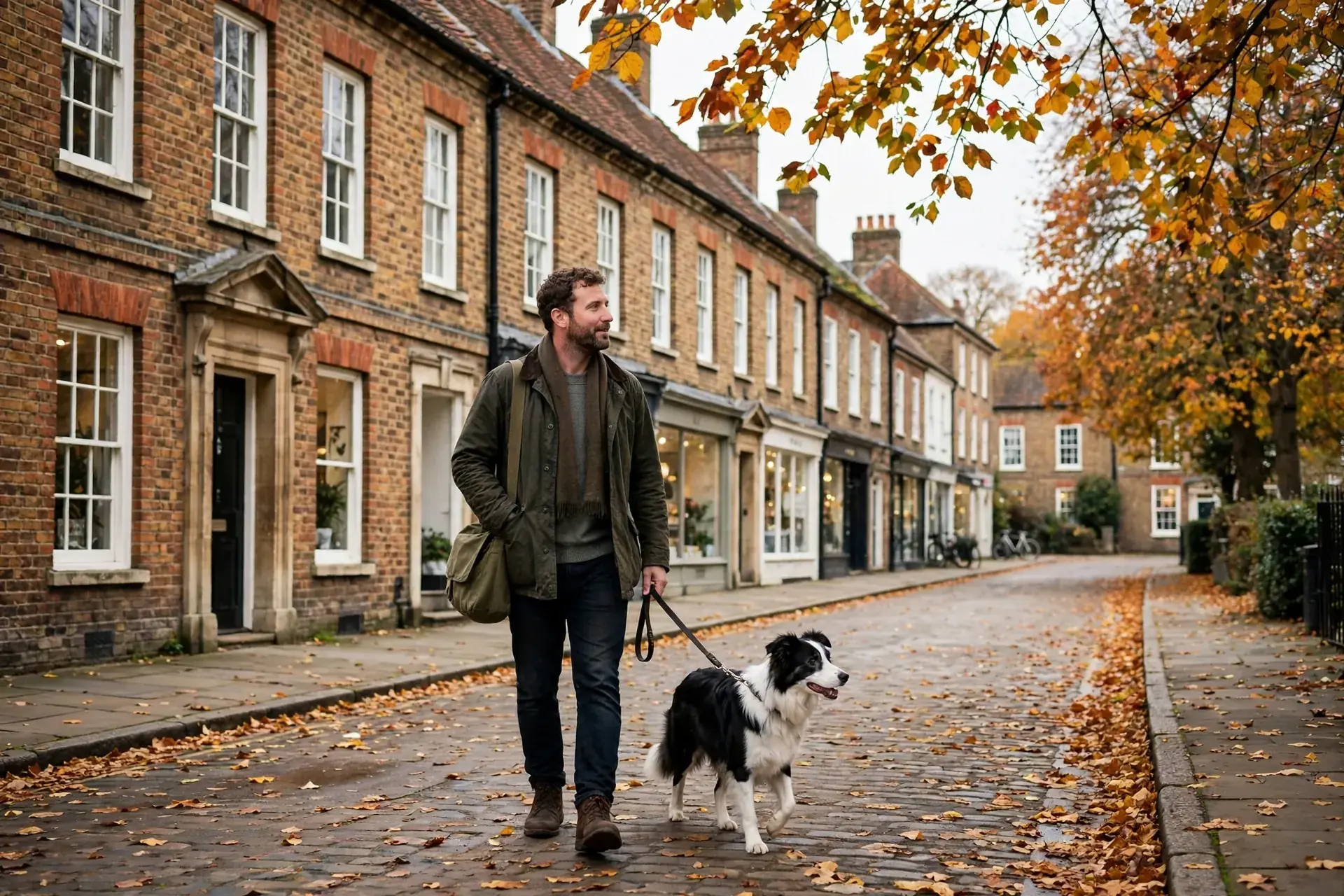
The village itself is small, attractive and very walkable. Flint cottages, a church with a famously tall tower, and a handful of pubs, cafes and galleries cluster around the quay and the main street. The church tower is worth a look even if you only admire it from outside with the dog, and the narrow lanes behind the quay make a pleasant short loop. Blakeney is not a resort town with amusements and arcades; its appeal is quieter, built on boats, birds, walking and good food. Visitors who arrive expecting a bucket-and-spade beach will be disappointed, because Blakeney has no sandy beach in the village itself. Visitors who arrive expecting salt marsh, seals and a proper pub lunch will be exactly right.
For a longer village walk, follow the coast path west from the quay towards Cley-next-the-Sea, or east towards the marshes and the harbour channel. The path towards Cley runs along the top of the sea bank with wide views over the marsh, and it is level and well surfaced for much of its length. It is also a working landscape: grazing marshes, drainage channels and hides belonging to the nature reserve. Keep dogs on leads where signs ask for it, particularly in the bird breeding season, and be aware that livestock may be grazing nearby. The full walk to Cley is around two miles each way and makes a satisfying out-and-back with a pub stop at either end.
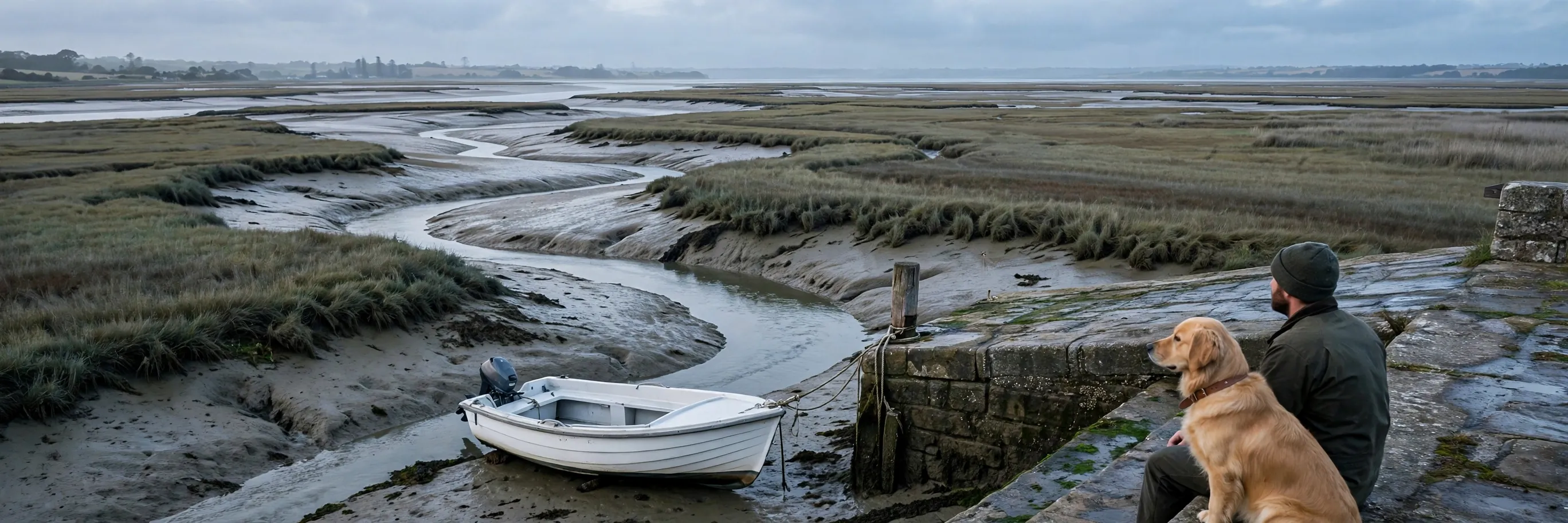
Blakeney's harbour has a practical quirk that shapes every visit: it dries out at low tide. At low water the boats sit on the mud and the channel becomes a winding creek through the marsh, which is fascinating to watch but means the harbour looks very different from hour to hour. Children and dogs should not be allowed to wander onto the mud, which is deep, sticky and tidal. Stick to the quay, the paths and the firm ground, and treat the mud as scenery. The tidal rhythm is part of Blakeney's charm, and a second visit at a different tide feels like a different place.
Marsh walks towards Cley
The marshes between Blakeney and Cley-next-the-Sea are among the most important bird habitats in England, and they are also superb dog-walking country when treated with respect. The coast path runs along the sea bank, with the salt marsh on one side and grazing marsh and reedbeds on the other. In spring and summer the air is full of skylarks and waders, in autumn the skies fill with migrating geese, and in winter the marsh holds huge flocks of wildfowl. A dog on a lead, walking quietly, is entirely compatible with this landscape; a dog running loose through nesting areas is not.
The practicalities matter. The sea bank path is exposed, with no shade and no water points, so carry water for the dog even on a mild day and plan a turnaround point before you set out. The surface is generally good, a mix of grass and gravel, but it can be muddy after rain and the wind off the sea is a constant companion. In hot weather, walk early or late and watch for signs of overheating, especially in flat-faced breeds. In winter, the same path can be bitterly cold, and a dog that is fine for twenty minutes may be miserable after an hour. The marsh rewards short, well-planned walks more than forced marches.
Bird hides and viewpoints along the route are worth using, but dogs and hides do not always mix. Some hides welcome quiet dogs, others ask that dogs wait outside, and a barking dog in a hide will ruin the visit for everyone, including the birds. The courteous approach is to check the signs, keep the dog settled, and be ready to move on if the dog cannot settle. The same courtesy applies to other walkers: the coast path is popular with birdwatchers carrying expensive optics, and a dog on a short lead that passes calmly is a better ambassador for dog owners than any amount of arguing about rights of way.
For a different kind of walk, the lanes and footpaths inland from Blakeney lead through farmland and small woods towards the village of Wiveton and the River Glaven. These are quieter than the coast path and offer shade in summer, though footpaths can be muddy and livestock is common. Check the official guidance before you travel if you are unsure about a particular route, and remember that footpath conditions change with the farming year. Combining a short inland loop with a quay visit gives a dog variety without the exposure of the full marsh walk, and it is a good fallback when the coast wind is too strong.
Parking, tides and seasons
Parking in Blakeney is limited and fills early on fine days and in school holidays. The main car park is near the quay, with additional parking at Cley beach car park for those walking the point or the marsh. Arrive before mid-morning in peak season or be prepared to wait for a space, and never park on the narrow village lanes in a way that blocks access for residents and emergency vehicles. Charges and payment methods change, so check the signs on arrival and keep coins or a card payment option ready. If the quay car park is full, consider starting your walk from Cley instead and walking to Blakeney, which reverses the usual flow and often means easier parking.
Tides govern Blakeney more than clocks do. Seal trip sailing times, the appearance of the harbour, and the accessibility of the point all depend on the tide, so check tide times for Blakeney before you leave home and plan the day around them. A useful pattern is to book the boat first, then fit walks and meals around the sailing. Tide tables are published online and in local shops, and the boat operators themselves are the best source for the day's sailing times. If you are walking the coast path, tides matter less, but the marsh channels and the harbour still change character with the water, and a walk timed for high tide shows the marsh at its most expansive.
Seasons change Blakeney more than they change most Norfolk villages. Spring brings nesting birds and strict lead rules on the marsh and the point. Summer brings common seal pups, busy boats and the warmest walking weather, along with the need for shade and water. Autumn is many regulars' favourite season: quieter paths, migrating birds, and the first grey seals arriving at the point. Winter brings the grey seal pupping spectacle and the coldest, windiest walking, but also the most dramatic light and the fewest crowds. Each season has a different dog plan, and the best visits match the dog's needs to the season rather than forcing a summer plan into January.
Facilities are modest, which is part of the village's character. There are public toilets near the quay, a small shop, and a handful of places to eat, but there is no large visitor centre with indoor dog facilities. In wet weather, the fallback is a pub lunch and a shorter walk rather than an indoor attraction, so pack waterproofs and a drying towel and treat rain as part of the Norfolk experience. The nearest larger towns for supplies are Holt, about seven miles inland, and Sheringham to the east, both of which have more shops and services. Our guide to Holt with a dog covers the inland market town that makes a useful base for this coast.
Where dogs can eat and drink
Blakeney's pubs and cafes are generally welcoming to dogs, though policies vary by venue and by season, so always check before assuming. Several establishments welcome dogs in the bar area or on a terrace, provide water bowls, and keep a jar of treats behind the counter. The village's most famous hotel and its pub are popular with walkers, and a dog that has walked the marsh in the morning is a familiar sight curled under a table at lunchtime. The unwritten rule is the same everywhere: a calm dog on the floor, on a lead, is welcome; a dog on the furniture or barking at other tables is not.
Lunchtime is the natural break in a Blakeney day, and planning it around the boat trip works well. A common pattern is a morning walk, a midday sailing, then lunch, or lunch first followed by an afternoon sailing and a quay wander. Either way, book ahead for lunch in peak season, especially if you want a table where the dog can settle comfortably. Mention the dog when booking so the venue can seat you appropriately, and bring a blanket for the dog to lie on if the floor is cold stone or tile. A tired dog that has a familiar blanket and a chew will settle far faster than one expected to lie on an unfamiliar floor with nothing to do.
For self-catering visitors, Blakeney has a small shop for basics, but a fuller shop is in Holt or in Sheringham. Picnics are an excellent option here: buy supplies, walk to a quiet stretch of the sea bank or the quay, and eat with the dog beside you. Take all litter home, keep food away from gulls, and remember that the marsh is a nature reserve, so a picnic should leave no trace. In summer, beware of wasps around sweet food and of dogs scavenging discarded picnic waste, which is a common cause of upset stomachs on coastal walks.
Evening meals deserve a note for those staying locally. Many Blakeney establishments serve dinner, and dogs are often welcome in the bar in the evening even where the restaurant is dog-free. If you are staying in a cottage or a bed and breakfast, ask about the evening dog policy at booking rather than at the door. A dog left alone in unfamiliar accommodation while owners eat out is a frequent source of barking complaints in villages like this, so plan as if the dog comes with you, and choose venues accordingly.
Wildlife etiquette and lead rules
Blakeney's wildlife is the reason to visit, and protecting it is the price of admission. The rules are not complicated, but they need to be followed consistently. Keep dogs on leads on the point, on the shingle, and wherever signs request it. Keep well away from seals hauled out on beaches and sandbanks, and never let a dog approach a seal pup. During the bird breeding season, roughly spring and early summer, keep dogs on leads on the marsh and the coast path, and stick to marked paths through nesting areas. These are not suggestions; they are the conditions that allow a seal colony and a bird reserve to coexist with thousands of visitors.
Lead choice matters here. A short, fixed lead gives control on the quay, on boats and near wildlife, while a long line is useful on open stretches of the coast path where the dog can sniff and explore without running into trouble. Retractable leads are a poor choice on a busy quay or a boat deck, where a dog can cover a surprising distance before the lock engages. Whichever lead you use, practise recall before the trip, and be honest about whether it works when the dog is excited. A dog whose recall fails at the sight of a seal or a flock of geese needs a lead, not optimism.
Other hazards deserve a mention. The marsh channels and the harbour mud are dangerous for dogs that wander off paths, and the tide can cut off routes faster than expected. Adder snakes are present in some Norfolk coastal habitats, though encounters are rare; keep dogs out of dense undergrowth in warm weather and know the signs of a bite. Ticks are common in long grass and marsh vegetation, so check the dog after every walk and remove ticks promptly. Salt water is not drinking water, and a dog that drinks from the harbour or the sea may be sick afterwards, so carry fresh water and discourage drinking from pools on the marsh.
Finally, think about what your dog leaves behind. Bag and bin all waste, including on the marsh paths where bins are scarce, which means carrying bags and taking waste home if necessary. Dog waste near a nature reserve is not just unpleasant; it carries parasites that affect wildlife and livestock. The same applies to the quay and the village streets, where a single uncollected mess colours residents' attitudes towards all visiting dogs. Blakeney welcomes dogs because most owners behave well, and keeping that welcome depends on every visitor doing the same.
A calm day plan for Blakeney
A good Blakeney day starts with the tide table and the boat booking, then builds everything else around them. Arrive in the morning, park near the quay, and walk the quay and the village while the day is still quiet. Let the dog settle into the smells and sounds of the harbour before any excitement. If a seal trip is booked for mid-morning, board in good time, settle the dog on its blanket, and enjoy the hour on the water. If no trip is planned, walk the coast path towards Cley for as far as suits the dog, then turn back while the dog is still enjoying it rather than when it is tired.
Lunch is the pivot of the day. Eat somewhere the dog is genuinely welcome, give the dog water and a rest, and use the break to reassess energy levels. An older dog may be ready for a quiet afternoon on the quay, while a younger dog may want a second, shorter walk. The afternoon is also the time to visit the church, browse the village shops, or drive the short distance to Cley for a different view of the marsh. Avoid stacking a long walk, a boat trip and a long drive home into a single day; the dog will be tired, and tired dogs are the ones that bark, pull and refuse to settle.
The journey home deserves as much thought as the day itself. A wet or muddy dog needs towelling before the car, and a tired dog needs a comfortable, secure space for the drive. Keep water available for the journey, and plan a comfort stop on the way home rather than pushing through. If the day included a boat trip, check the dog for ticks and salt irritation once home, and give a final drink and a quiet evening. A Blakeney day done well leaves a dog pleasantly tired, not exhausted, and that is the difference between a trip to repeat and a trip to recover from.
Blakeney also works as part of a longer north Norfolk stay. Combine it with Holt's market town streets, the beaches at Wells-next-the-Sea, or the heritage railway at Sheringham, and the coast reveals its variety: harbour, marsh, sand and steam in a few miles. Our guide to the Norfolk Broads with a dog covers the inland waterways that complement this coast, and the general beach rules explained in our UK beach rules guide are worth reading before any Norfolk beach day. Done slowly, with tides and wildlife in mind, Blakeney is one of the finest dog days out in England.
Practical questions
Before you go
Can dogs go on the Blakeney seal trip boats?
Many Blakeney seal trip operators welcome well-behaved dogs on board, but policies differ by boat and by sailing, so confirm at booking. Dogs usually stay on a lead on deck, and some operators ask that dogs sit on a blanket. If your dog is nervous on water, unsettled by engine noise or likely to bark at seals, choose the quay walk instead.
When is the best time of year to see seals at Blakeney Point?
Grey seals pup at Blakeney Point from roughly November to January, and common seals pup in the summer months, so seals are present for much of the year. Winter pupping season is the most sensitive period: boats keep a greater distance and landings may be restricted, so check the official guidance before you travel.
Can dogs walk to Blakeney Point?
Yes, in principle, but it is a long and exposed walk of around four miles each way along the shingle spit from Cley beach car park, with no shade, no fresh water and no shelter. Most dogs will find the boat trip or the shorter marsh walks a better day out. If you do walk it, carry water, keep the dog on a lead near seals and nesting birds, and check tide times.
Are dogs allowed on Blakeney quay and in the village pubs?
Dogs are welcome on the quay on a lead, and several village pubs and cafes welcome dogs in at least part of their premises, often with water bowls and treats. Policies can change with the season, so check the door sign or ask staff before settling in, and keep dogs off furniture unless the venue clearly invites it.
What should I do if my dog disturbs seals or nesting birds?
Move away calmly and quietly, put the dog back on a lead, and give the animals plenty of space. Do not try to approach seals for a photograph, and do not let a dog chase birds on the marsh or the shingle. Disturbance during pupping and nesting season can be genuinely harmful, so prevention matters more than any apology afterwards.
Is Blakeney suitable for older dogs or dogs that tire easily?
Yes, with the right plan. The quay, the village streets and the short stretch of coast path towards Cley are flat and manageable, and a seal trip lets an older dog see the colony without a long walk. Avoid the full walk to Blakeney Point and the soft shingle in hot weather, and build in shade and water breaks.