This guide is independent and contains no paid placement. Hire terms, mooring charges and local restrictions change, so before you travel, please check the latest official guidance.
The Norfolk Broads can suit a dog well if you choose a hire boat that genuinely accepts dogs, fit a proper life jacket with a handle, keep your dog off deck in locks and busy stretches, moor early at designated moorings, keep a short lead near water and livestock, and never let your dog swim where blue-green algae may be present.
Choosing a dog-friendly hire boat
Start with the boat, not the route. Many Broads hire fleets welcome dogs, but permission is usually boat-specific rather than fleet-wide. A listing that says “pets welcome” may still exclude larger dogs, limit you to one dog, charge a weekly pet fee, or forbid dogs on beds and upholstery. Ask for the exact terms for the exact boat you want, in writing, before you pay a deposit: how many dogs, what fee per dog, any cleaning charge, and whether a second dog needs prior approval. Assistance dogs are treated differently from pet dogs, so declare that status separately if it applies.
Layout matters more on water than it does in a cottage. Look for a single-level boat if your dog struggles with steep companionway steps, a secure cockpit or well deck where a dog can sit without blocking the helmsman, and doors or gates that close properly. Low freeboard makes boarding easier for older dogs, while high-sided boats can mean an awkward lift at every mooring. Ask about deck surfaces too: smooth, wet decks are slippery for paws and claws, so a non-slip mat for the cockpit is worth packing. If your dog is nervous around engine noise, ask where the engine sits and choose a layout where their bed can be away from it, in a draught-free corner they can claim as their own.
Day boats and weekly cruisers ask different things of a dog. A day boat is a good first test: a few hours from bases such as Wroxham, Horning or Brundall will show you how your dog copes with motion, passing boats and waiting while you moor, without committing you to a week of nights afloat. Weekly hire adds sleeping, feeding and toilet routines, so plan for those before you upgrade. Before you travel, please check the latest official guidance from the Broads Authority and your hire company, because navigation notices, closures and seasonal rules can change a route at short notice.
Life jackets and safety on board
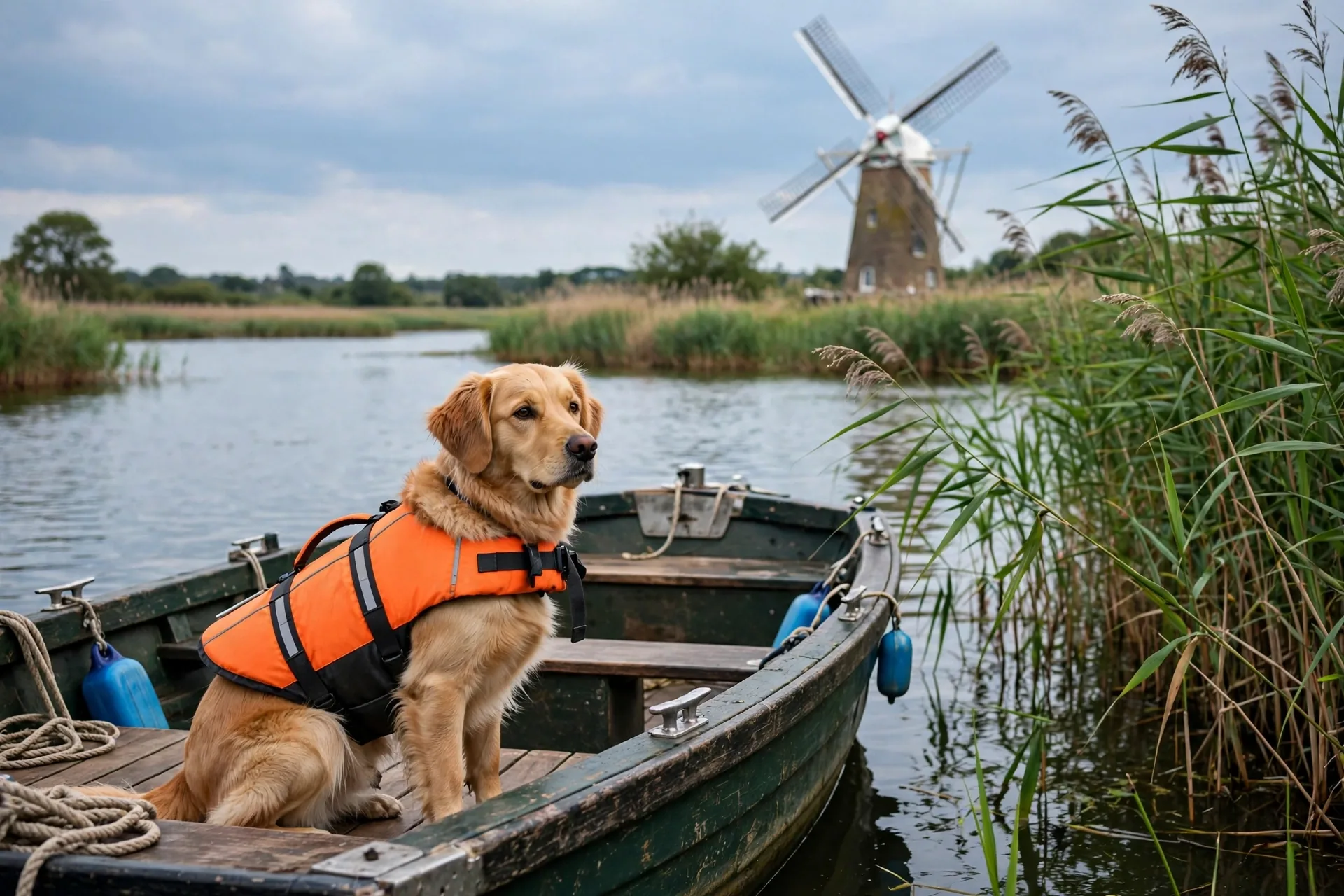
A dog life jacket is not a fashion extra on the Broads; it is the simplest way to make a fall overboard survivable and recoverable. Choose one sized by chest girth and weight, with adjustable straps, a strong grab handle on the back and a D-ring you can clip a lead to once ashore. It should fit snugly without rubbing behind the front legs, and your dog should be able to sit, lie down and toilet in it. Bright colours help you spot a dog in reedy water. Practise at home first with treats, then on a securely moored boat, so the jacket means calm routines rather than panic.
Know what the jacket cannot do. It will not keep an unsupervised dog safe, it does not replace a lead on deck in busy stretches, and it should never be tied to the boat — a tethered dog that falls in can be trapped under a hull or dragged. Keep your dog inside the cabin or settled in the cockpit while you are mooring, passing other boats closely, or going through bridges with low clearance. Keep leads, ropes and mooring lines tidy: a loose line around a paw is a trip hazard for dogs and people alike. At night, clip a small light to the harness for bankside toilet trips, and keep a towel by the door for wet paws before they reach the cabin floor.
Plan the rescue before you need it. Agree who steers and who lifts, and remember that a wet medium-sized dog is heavy and slippery — the grab handle, approached calmly from a moored or stopped boat, is far safer than leaning over moving water. If your dog does fall in, do not jump in after them in deep or flowing water; stop the boat safely, call them to the bank or stern, and lift by the handle. Our guide to blue-green algae and dogs explains why a dog that has been in suspect water should be rinsed and kept from licking their coat, and when to call a vet urgently.
Boarding, moving about and settling
Most Broads accidents with dogs happen at the edges: jumping between boat and bank, slipping on a quay, or lunging at a passing swan. Teach a simple rule and keep it for the whole trip — the dog waits, on a lead, until a person is ashore or aboard and ready to receive them. Lift small dogs; guide larger dogs across the widest, lowest step, ideally onto a non-slip mat. Never let a dog leap a gap over water, however small it looks. If a mooring has a high quay or a muddy slope, move on to an easier one rather than improvising a risky jump at dusk.
On board, give your dog one permitted place and make it comfortable: a familiar bed or blanket that smells of home, a chew for busy moments, and water within reach. Feed at normal times, slightly away from the motion of the stern if your dog is prone to travel sickness, and avoid rich new treats on day one. Watch for early signs of stress — panting, drooling, restlessness, refusing food — and respond with a shore break and a sniffy walk rather than pushing on to the next village. Most dogs settle once the routine repeats: cruise, moor, walk, rest. Short first days help; two or three gentle hours of cruising leave energy for exploring, while a full day of navigation can overwhelm a dog that is still learning the sounds and movement of a boat.
Toilet planning shapes your whole day. Dogs cannot simply be let out, so build in a shore stop every few hours and a proper last walk before dark. Carry poo bags on the boat, on your person and in a coat pocket, because the one time you forget is the time you need them. A GPS tracker for your dog is a sensible backup on unfamiliar towpaths and in reed-fringed villages, but it is no substitute for a lead near water and an up-to-date ID tag with a mobile number you will actually answer while you are away.
Mooring and getting ashore safely
Use designated moorings wherever you can. Broads Authority free moorings, parish staithes, marina berths and pub moorings each have their own time limits, charges and conditions, and some require you to eat in the pub or register at an office. Moor early in peak season — popular spots near Horning, Ranworth, How Hill and Beccles can fill by mid-afternoon — and always have a fallback within easy cruising distance so you are not searching for a bank in fading light. Before you travel, please check the latest official guidance for mooring closures, dredging works and event restrictions.
Moor with the dog in mind. Choose a spot where the bank is level, the exit is not straight onto a road, and there is grass or a path for a toilet walk without crossing other boats’ lines. Keep your dog inside or held by a second person while ropes are handled, then do a short lead walk to check for hazards: broken glass, fish hooks, rat holes, steep drops and other dogs tethered nearby. Tie up so the boat cannot surge and open a gap, re-check lines after passing wash, and never leave a dog unattended on deck or tied to a mooring post while you go ashore. If you visit a pub or shop, the dog comes with you or stays inside the locked cabin only if the hire terms allow it and the temperature is safe — in practice, plan pubs with gardens where the dog can settle under the table.
Overnight, keep the routine boring and safe. A final lead walk, a check that hatches and doors are secured, and a night light or torch kept in the same place will prevent most problems. Swans, geese and ducks gather at popular moorings expecting food; keep your dog on a lead and do not feed waterbirds from the boat with a dog beside you, because lunging at birds is how dogs end up in the water. In the morning, lead up before you open the door — reed beds hide nests, anglers arrive early, and a dog loose on a misty quay is hard to see.
Towpaths, footpaths and lead rules near water
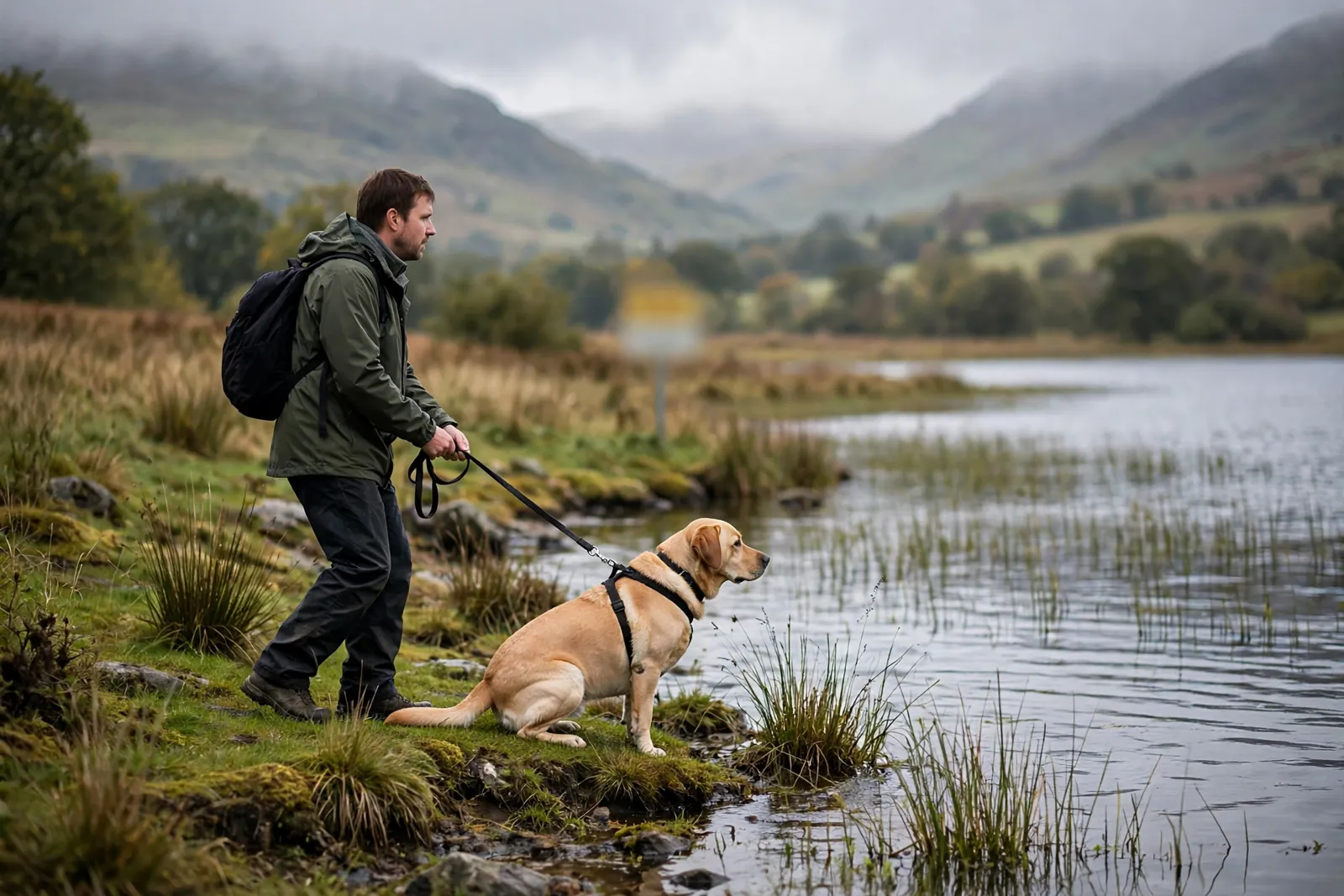
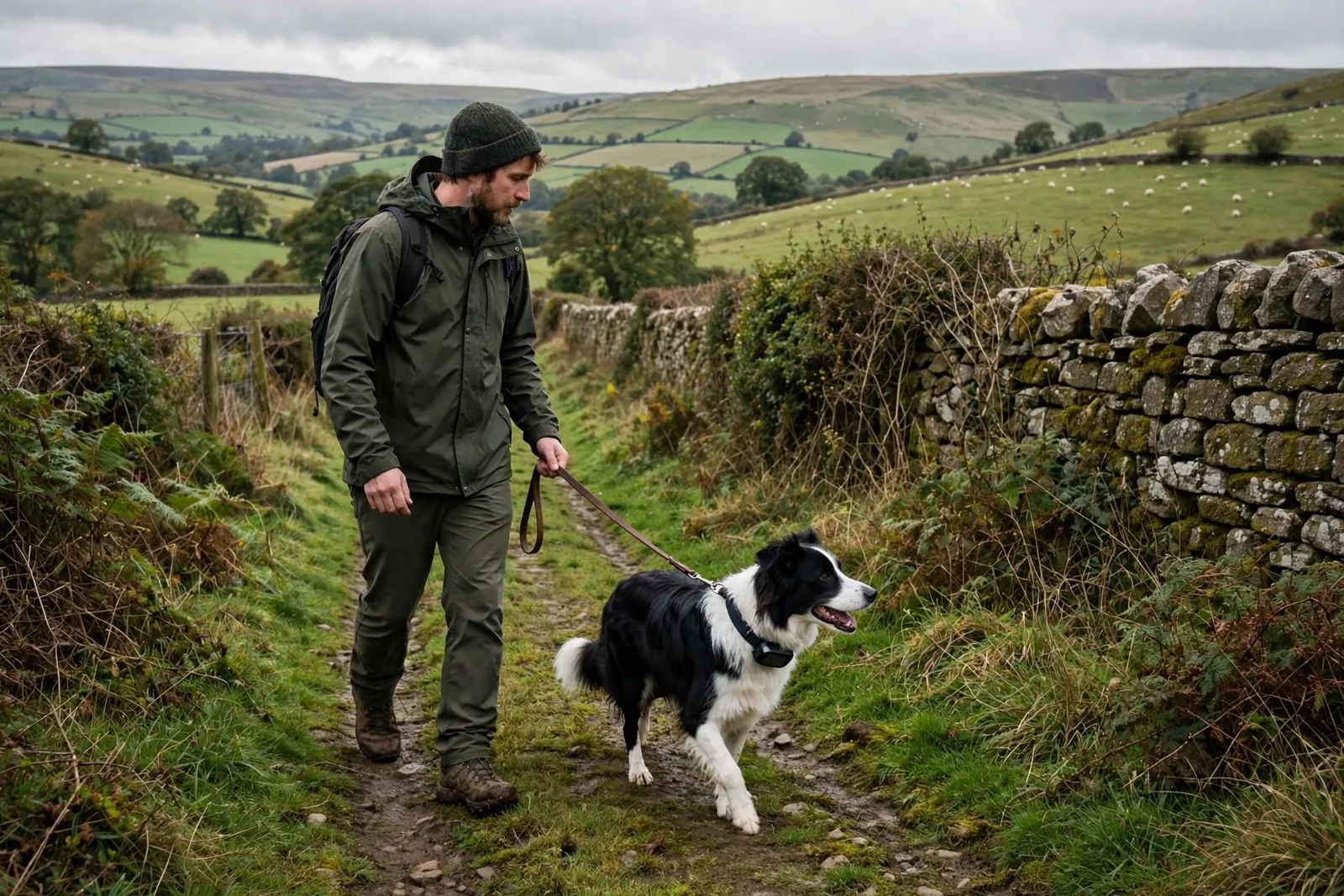
The Broads are a working, living landscape rather than a single park, so lead rules come from a mix of local signs, landowner requirements and common sense. Keep your dog on a short lead at moorings, in boatyards, near roads and bridges, beside anglers, and anywhere signs ask for it. On riverside footpaths and nature reserve trails, follow seasonal restrictions carefully: ground-nesting birds breed in reed beds and grazing marshes in spring and summer, and a dog ranging through reeds can disturb nests even without chasing. Around livestock, a lead is essential, and if cattle approach you, let go of the lead rather than holding on and being pulled — then regroup at a safe distance.
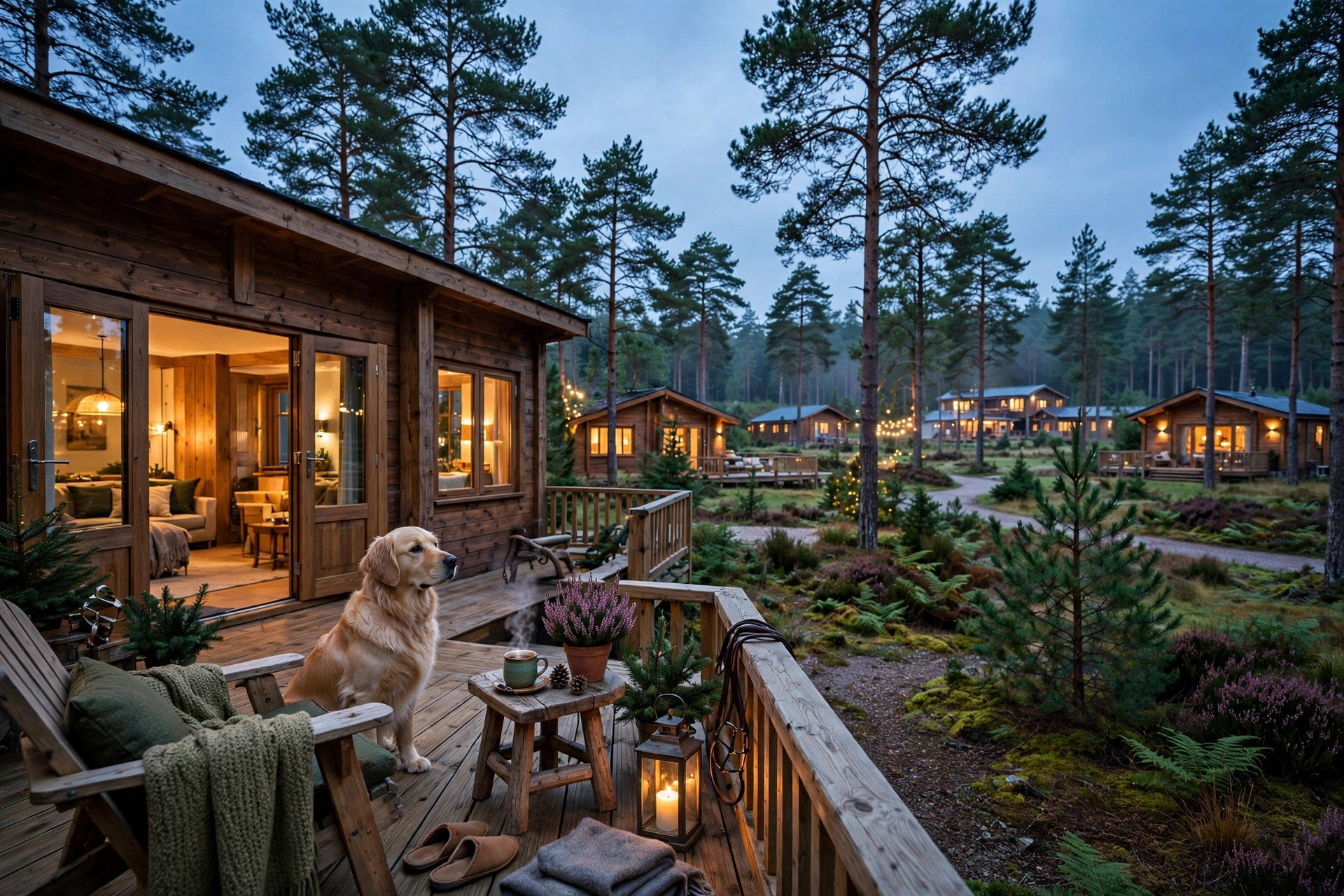
Choose walks that suit a boat day. Short circular routes from a mooring — a village loop, a marked Broads trail to a broad viewpoint, or a staithe-to-church path — beat an ambitious hike that leaves no margin for a slow cruise back. Check surfaces after rain: towpaths and marsh paths turn slick and muddy, banks can be undercut, and boardwalks, while safer, can be slippery for paws. Keep to the path where banks are soft; a dog sliding down a steep bank into deep water may not be able to climb out, which is why swimming stops should never be improvised at a random bank. For longer land-based stays before or after a hire, our guide to dog-friendly holiday parks in the UK covers the questions to ask about enclosed space, fees and nearby walks.
Be visibly considerate and most encounters stay friendly. Shorten the lead for cyclists, runners, anglers carrying gear and families on narrow paths; step aside rather than letting a lead stretch across a towpath as a tripwire. Pick up after your dog everywhere, including rural paths, and take the bag to a bin rather than leaving it on a post. If there is no bin, carry it back to the boat in a sealed outer bag — Broads paths stay pleasant only because most dog owners do exactly that.
Blue-green algae and other water risks
Blue-green algae — cyanobacteria — is the water risk to take most seriously on the Broads. In warm, still weather it can form bright green, turquoise or paint-like scums, especially in sheltered bays and downstream of moorings, and some types produce toxins that can make dogs seriously ill very quickly. You cannot tell by looking whether a bloom is toxic, so treat all suspected blooms as dangerous: keep your dog out of the water, keep them on a lead so they cannot drink at the edge, and report or heed any warning signs posted by the Broads Authority or local landowners. Before you travel, please check the latest official guidance, and check again at each new mooring, because conditions vary from broad to broad.
If your dog does go into water that may contain blue-green algae, act promptly. Stop them licking their coat, rinse them thoroughly with clean fresh water as soon as you can, and contact a vet immediately if they show vomiting, drooling, diarrhoea, weakness, tremors or collapse — say clearly that blue-green algae exposure is possible, because speed matters. Do not wait to see if symptoms pass. Our dedicated guide linked earlier in this article sets out the signs and the rinse-and-call sequence in detail, and it is worth saving offline before you cast off, since phone signal can be patchy in the quieter reaches.
Algae is not the only hazard. Keep dogs away from sluices, weirs, mill races and lock-like structures where currents are strong and exits are poor. Discarded fishing line and hooks injure paws and mouths, rat urine in stagnant water carries leptospirosis risk, and cold, deep water can shock even a confident swimmer in spring. The safest pattern is simple and consistent: no swimming from the boat, no drinking river water, fresh water offered regularly from your own bottle or bowl, and a rinse and paw check after muddy towpath walks. That routine removes most of the risk while keeping everything dogs actually enjoy about the Broads — the smells, the birdsong at a distance, the slow changing view — fully intact.
A calm daily routine and packing list
A good Broads day with a dog has a rhythm. Start with a lead toilet walk and breakfast once moored routines are done, cruise gently through the morning with the dog settled in their place, stop for a proper midday walk and water break, cruise or rest through the afternoon depending on heat, then moor in good time for a longer evening walk. In hot weather, shift walks to early morning and evening, provide shade and constant fresh water, and never leave a dog in a sun-heated cabin — boats warm up like cars. In wet weather, accept mud as part of the deal: a drying coat or towel, a spare blanket and a doormat by the cabin door will keep the living space bearable for a week.
Pack for water, mud and early nights. Essentials include: a fitted life jacket with a handle; a standard lead plus a spare, and a harness your dog cannot back out of; an ID tag with your mobile number and up-to-date microchip details; enough of your dog’s normal food for the whole trip plus a buffer day; a collapsible water bowl and plenty of poo bags; towels, a non-slip mat and a familiar bed; any medication, stored cool and dry; and the number of a vet near your route, saved before you lose signal. Add a torch for night moorings, a basic first-aid kit for paws, and a sealed container for wet waste bags until you reach a bin.
Finish by being honest about fit. A boat holiday suits dogs that can settle in a confined space, wait during manoeuvres and walk calmly on a lead near water. It is harder — though not impossible — for dogs that lunge at birds, bark at every passing boat, or panic at engine noise; for them, a short day-boat trial, training at home, or a land-based Broads cottage with riverside walks may be the kinder first step. Either way, plan around the dog in front of you rather than the brochure photograph, and the Broads reward you with one of the slowest, gentlest ways to see Britain together.
Keep exploring
Continuing down the east coast? The Suffolk coast guide covers year-round dog beaches, Dunwich and Southwold practicalities. See: Suffolk coast with a dog.
New Norfolk town guides, published 2 November 2026
If a Broads break also needs a town base, the new guides below cover walks, parking and dog-friendly stops for five Norfolk towns.
Practical questions
Before you go
Are dogs allowed on Norfolk Broads hire boats?
Many hire fleets allow dogs, but not on every boat and often for a per-dog charge with a limit of one or two dogs. Confirm the exact boat, the fee, any size or breed conditions and whether dogs are allowed on beds and seating before you pay. Before you travel, please check the latest official guidance.
Does my dog need a life jacket on the Broads?
A well-fitted dog life jacket with a handle is strongly recommended, especially for puppies, older dogs, poor swimmers and any dog on deck while moving. It helps if a dog falls in and makes lifting safer. Practise wearing it at home and on a moored boat first, and never tie a lead to the boat.
Can my dog swim in the Norfolk Broads?
Swimming is best avoided in most Broads water. Risks include blue-green algae, strong currents near sluices and weirs, boat traffic, steep banks that are hard to climb out of, and mud. If algae is suspected or warnings are posted, keep your dog out of the water and on a lead nearby.
Where can I moor and walk my dog on the Broads?
Use designated Broads Authority, parish and pub or marina moorings where dogs can get ashore safely for toilet breaks and walks. Moorings fill early in peak season and some charge a fee or expect you to use the pub. Before you travel, please check the latest official guidance for closures and charges.
What are the lead rules on Broads towpaths and footpaths?
Keep your dog on a short lead near water, moorings, roads, livestock, nesting birds and other boats, and follow any local signs. On open footpaths a lead or close control is still safest where there are ground-nesting birds, grazing animals or anglers. Always pick up after your dog and take waste to a bin.