This guide is independent and contains no paid placement. If affiliate links are added later, they will be clearly marked and will not change our editorial checks.
Blaydon is a flat, honest Tyne-side town, not a resort: the riverside path runs east to Newcastle and west into quieter country, Blaydon Burn gives a short wooded walk, and the parks and ponds suit dogs that like steady miles rather than crowds. Bring a lead for the shared path, keep your dog out of the main river current, and plan on walking rather than driving between stops.
Why Blaydon works for dogs: a river town, not a resort
Blaydon sits on the south bank of the River Tyne in Gateshead, a few miles west of Newcastle, and it is worth visiting with a dog precisely because it does not try to be a destination in the polished sense. There is no seafront, no big visitor centre and no queue for a photo spot. What there is, instead, is a working riverside town with long, flat paths, a wooded burn, ponds and playing fields, and a river that has shaped everything about the place. Dogs that like steady walking, sniffing along a bank and watching the water will be happier here than dogs that need constant entertainment, and owners who like a walk with a bit of history under their feet will find more to think about than on a manicured trail.
The town grew up around the river and the industries that used it. Coal, iron, lead and chemicals all passed through Blaydon at one time or another, and the railway and the roads that still cross the Tyne here were built to serve that trade. Much of the heavy industry has gone, but the shape of the town still follows the old pattern: the main road and the railway run along the valley, the houses climb the slope to the south, and the riverbank itself is a long, open corridor that now belongs mostly to walkers, runners and cyclists. That corridor is the heart of this guide, because it is where almost every good dog walk in Blaydon starts and finishes.
Blaydon also makes a useful base for a wider Tyne-side trip. It is close enough to Newcastle for a riverside walk into the city, close enough to the Tyne Valley towns upstream for a day trip, and small enough that you can park once and walk everywhere that matters. If you are planning a longer stay in the north east, our guide to Newcastle with a dog covers the city end of the same river, and the towns upstream — Hexham and Corbridge — pick up the Tyne where Blaydon leaves off. Used together, the three guides make a coherent week of riverside walking without ever needing to drive far.
None of this means Blaydon is a soft option. The river is a real, working waterway, deep and fast in places, and the banks are not fenced the way a park path would be. The weather comes straight off the North Sea and the Pennines in turn, so a bright morning can turn into a sideways-rain afternoon with very little warning. The paths are shared with cyclists who move fast and quietly, and some stretches run close to roads and the railway. All of that is manageable with a lead, a bit of planning and a dog that recalls reasonably well, but it is worth saying plainly at the start: Blaydon rewards the prepared walker and punishes the casual one who lets a dog charge ahead around a blind bend.
So plan the visit the way the town asks to be visited. Pick a route that fits your dog's fitness and temperament, check the weather and the path conditions before you set off, and give yourself more time than the distance suggests, because the river invites stopping. The sections below work through the riverside path first, then the burn and the parks, then the practical questions of parking, food, stays and wet weather, so that by the end you can put together a day that suits the dog you actually have.
The River Tyne path: Blaydon to Newcastle
The single best dog walk in Blaydon is the riverside path east along the south bank of the Tyne towards Newcastle. The route follows the river through a landscape that changes every mile: first the quieter banks and green edges west of the town centre, then the bridges and riverside industry, then the long approach to the Quayside with the city skyline opening up ahead. It is mostly flat, mostly surfaced, and long enough that you can walk for an hour or for a whole morning depending on how far you go before turning back or catching the train.
This stretch forms part of the wider network of riverside trails along the Tyne, including the Keelman's Way, the long-distance walking and cycling route that follows the south bank from Wylam in the west to the coast in the east. The name recalls the keelmen who once loaded coal onto keels — flat-bottomed boats — on this river, and walking it with a dog gives you a steady sense of that history: the wide river, the low banks, the bridges overhead and the sense that this water was a workplace long before it was a leisure route. You do not need to walk the whole way to enjoy it. Even a short out-and-back from Blaydon gives a dog river smells, open sky and a proper stretch of the legs.
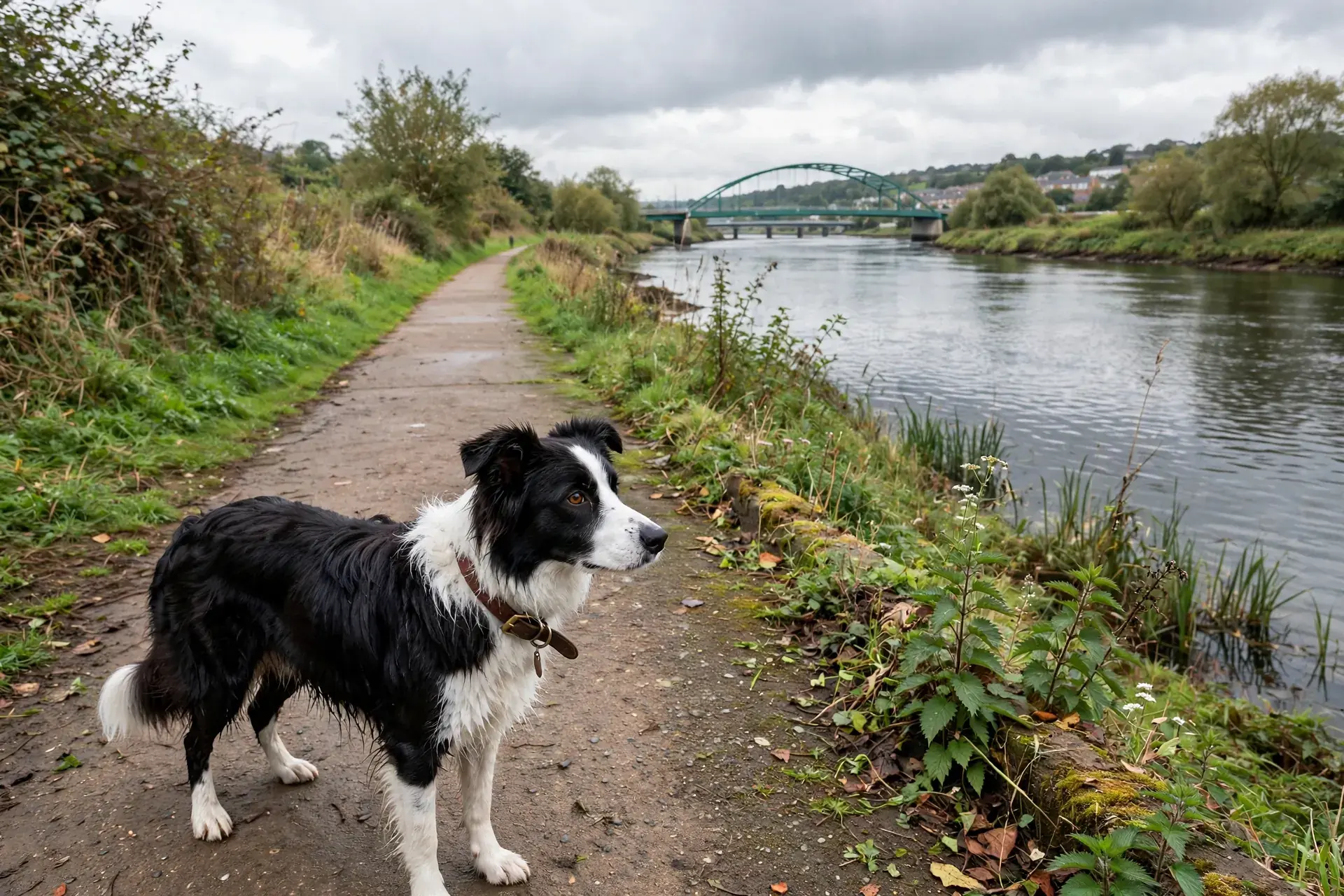
Start at the riverside near the town centre and head east, keeping the river on your left. The first stretch is the quietest and the best for letting a dog settle into the walk. The path is wide enough for a lead and a comfortable pace, and there are places to stop where the bank opens out and you can look across to the north bank. Keep your dog on a lead through the narrower sections and anywhere the path runs close to the road, and shorten the lead whenever you hear a bicycle bell or see a runner coming up behind you. Cyclists on this route are often commuting rather than dawdling, and a dog that steps sideways at the wrong moment is the most common cause of a near miss.
As the path continues east, the river widens and the bridges begin to dominate the view. The Scotswood Bridge and then the Blaydon Bridge carry the roads across the Tyne, and the path passes beneath and around them with a mix of open riverside and short stretches beside industrial land. This is the part of the walk where the industrial heritage is most visible: old wharves, railway lines, warehouses and the sheer scale of the river engineering. It is also the part where you should keep a closer eye on your dog, because the path can narrow, the ground can be uneven, and there are places where the bank drops more steeply to the water. If your dog is a keen swimmer, this is not the place to let them in — the current is strong, the water is cold, and the bank is not an easy exit.
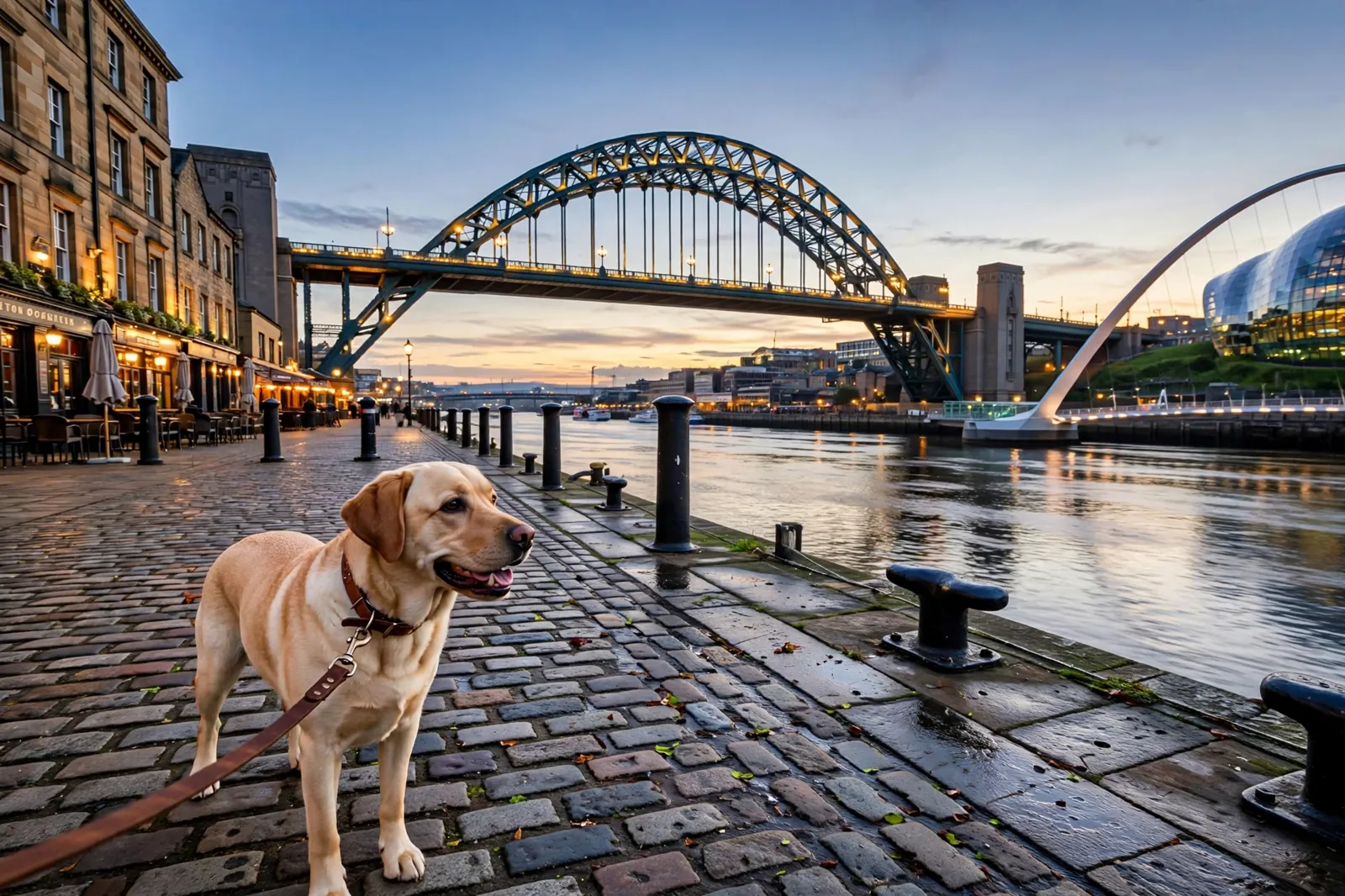
Further east, the path approaches Newcastle Quayside, and the walk changes character again. The city bridges — the Tyne Bridge, the Swing Bridge, the Millennium Bridge — come into view, and the riverside fills with people, cafes and street life. This is a good turnaround point if you walked from Blaydon, and a good place to stop for a rest and a drink before the return leg. Dogs need to be on a lead here, close to you, because the Quayside is busy and the kerbs, steps and crowds are not forgiving of a dog that wanders. If you would rather not walk back, the train from Newcastle Central back towards Blaydon is the usual option — but check the official guidance before you travel for the current dog rules, ticket arrangements and whether the service is running normally on your day.
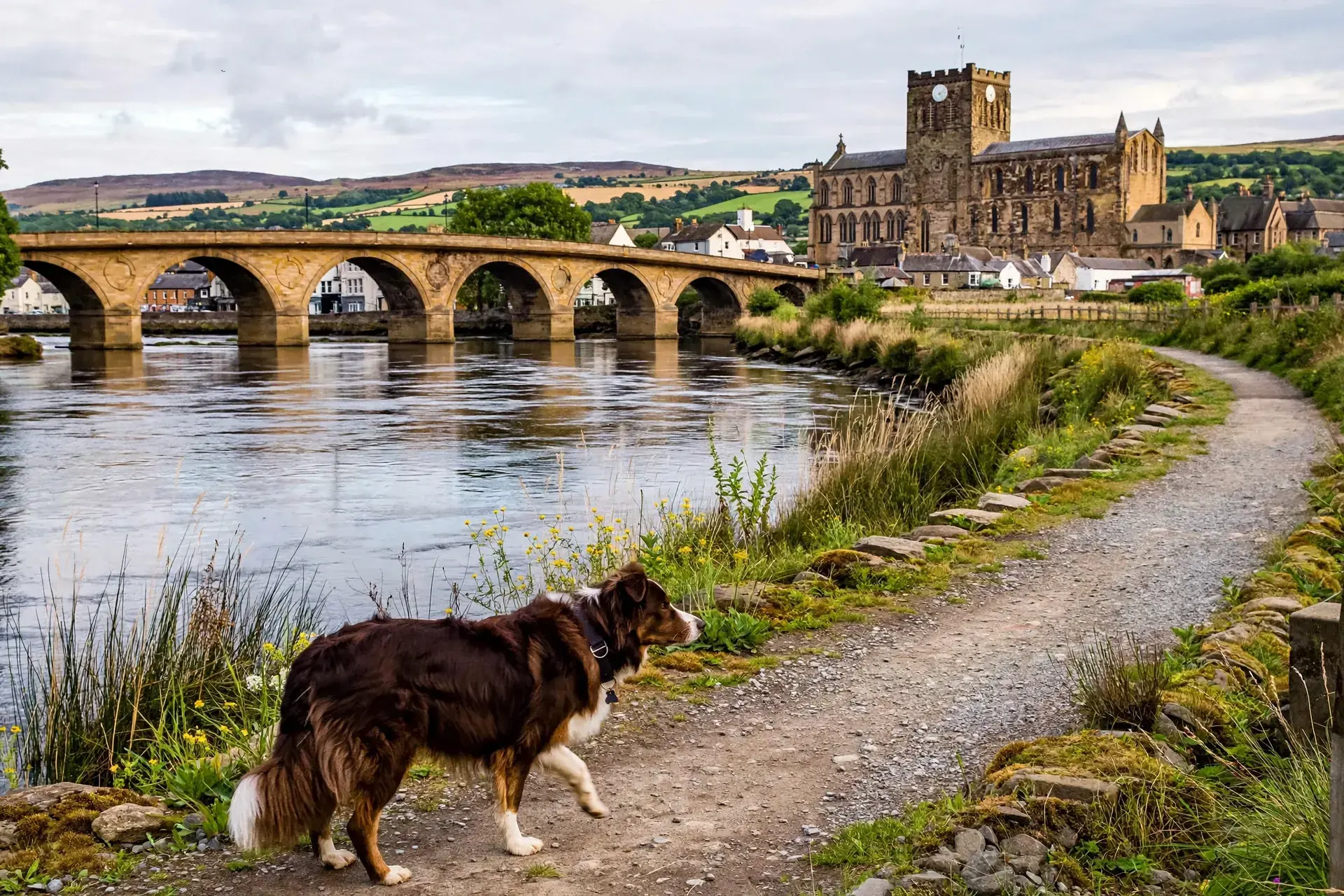
Walking west from Blaydon is a different experience and, for many dogs, a better one. The path upstream is quieter, greener and less built up, and it suits dogs that are unsettled by traffic or crowds. The river narrows slightly, the banks are more wooded, and the walk feels more like countryside than city. You can walk west towards Wylam and beyond, turning back whenever your dog has had enough, and the return leg is downhill in spirit if not in fact, because you know the way and the dog knows the car is at the end of it. This direction is also the better choice on a hot day, because the tree cover is better and there are more places to find shade and a drink of water.
However far you walk, a few practical points hold for the whole riverside path. Carry water for the dog, because there are long stretches with no tap or shop. Carry bags and use the bins where they are provided; where there are no bins, carry the bag to the next one rather than leaving it by the path. Keep the dog out of the main current and away from steep, muddy banks, especially after rain when the ground is slippery and the river is high. And check the official guidance before you travel if there has been heavy rain or flooding, because riverside paths can close or divert with little notice, and a flooded section is not a place to test a dog's footing.
Blaydon Burn and the dene walks
Blaydon Burn is the small stream that cuts a wooded dene through the town on its way down to the Tyne, and it gives Blaydon a second kind of dog walk that balances the open river perfectly. Where the riverside path is wide, flat and exposed to the sky, the burn is narrow, shaded and enclosed, with trees overhead, a stream underfoot and the kind of damp, leafy smells that dogs find irresistible. It is a short walk rather than a day out, but it is the one to choose when the wind is up on the river, when the sun is strong, or when your dog needs a quieter, more sheltered outing.
The dene follows the burn as it drops towards the river, and the path runs alongside it through woodland and rough grass. The ground is uneven in places and can be muddy after rain, so wear boots with grip and expect a wet dog by the end. The burn itself is shallow in most places, and many dogs will paddle or drink from it, but do not assume the water is clean after heavy rain, when run-off can carry debris and pollutants down from the roads and fields above. Let the dog paddle, by all means, but keep them from drinking from standing pools after a storm, and wash their paws and belly when you get home if they have been in the stream.
The dene is also a good place to practise recall and lead work in a low-distraction setting. The path is narrow enough that you will meet other walkers and their dogs at close quarters, so keep your dog on a lead around blind corners and be ready to step aside. The trees and the stream make it a poor place for a long-line walk — the line will tangle in brambles and undergrowth within minutes — so a short lead and a steady pace work better. If your dog is reactive, the dene is not the best first walk of the day; do the open riverside first, let them burn off some energy, and save the dene for a calmer second outing.
Beyond the burn itself, the green corridors that run through and around Blaydon connect the dene to the wider landscape. Field edges, hedgerows and small pockets of woodland link the town to the countryside to the south, and a short walk in any direction from the centre will find you on a track or a path within minutes. These are not signed tourist trails, and that is part of their charm — but it also means you should carry a map or a charged phone, keep to the public rights of way, and respect the farmland and the livestock you may meet. If you come across sheep or cattle, put the dog on a lead immediately and give the animals a wide berth, even if your dog has never chased anything in its life.
The burn and the dene change with the seasons more than the riverside does. In spring the trees come into leaf and the path fills with birdsong, and the ground dries out enough for a comfortable walk in trainers. In summer the shade is a relief on a hot day, but the midges can be a nuisance in the still, damp air, so bring repellent for yourself and check the dog for bites afterwards. In autumn the leaves turn and the path becomes slippery, and the burn runs higher and faster after rain. In winter the dene is dark and cold, and the path can be icy in the shaded stretches long after the open ground has thawed. Each season has its own version of the same walk, and it is worth coming back to see them all.
Parks and green spaces in and around Blaydon
Blaydon's parks and open spaces are modest in scale but well used, and they fill an important gap in a dog owner's week: the quick, local walk that does not need a car or a plan. The playing fields, recreation grounds and green corridors around the town give dogs somewhere to stretch their legs, play and socialise, and they are the places where local owners meet and where a visiting dog can get a sense of the town in half an hour. They are not a substitute for the riverside path, but they are the practical backbone of everyday dog life in Blaydon.
The most useful green space for a visiting dog owner is the riverside green itself, the open grass and paths along the Tyne near the town centre. It is flat, open and easy to reach, with room for a game of fetch away from the path and a clear view in all directions, so you can see other dogs coming and recall yours in good time. Use the open grass for play, but keep the dog on a lead on the path itself, and be aware that the grass can be soft and wet after rain. In summer the riverside green is also a good spot for a picnic with the dog, provided you keep food out of reach and clean up properly afterwards.
Shibdon Pond, the nature reserve on the edge of Blaydon, is a different kind of green space and deserves a slower, more careful visit. The pond and its surrounding wetland attract a wide range of birds, and the reserve is managed for wildlife rather than for recreation. Dogs are welcome on the paths, but they must be kept under close control and out of the water, because the pond is a sensitive habitat and a dog charging through the reeds will do real damage. Keep the dog on a lead throughout, stick to the paths, and treat the visit as a wildlife walk rather than a play session. The reward is a quiet, atmospheric place that feels a long way from the town, with the chance to see herons, ducks and other water birds at close range.
The playing fields and recreation grounds around the town are the best places for a proper off-lead run, provided the ground is in good condition and there is no organised sport in progress. Check for signs about dog restrictions before letting your dog off, because some fields have seasonal rules, and always pick up after your dog — the fields are used by children and sports teams, and a single uncollected mess is what turns a tolerant community against dog owners. If a game is in progress, move on to another space rather than trying to share the field; the players have booked it, and a dog running through a match is not a joke to anyone involved.
Beyond the town, the countryside to the south and west opens up into a network of field paths and tracks that reward a longer walk. These are working landscapes — farms, hedgerows, small woods — and they are at their best in the early morning or late evening when the light is low and the paths are quiet. Take a map, take water, and take the time to check the route before you set off, because the paths are not always well signed and a wrong turn can add a mile to a walk that was already long enough for an older dog. And remember that the fields are not a dog park: keep to the paths, close gates behind you, and put the dog on a lead near livestock without exception.
Cycling the Tyne with a dog: how it works in practice
Blaydon is one of the better places on the Tyne to combine cycling and dog walking, because the riverside route is flat, surfaced and long, and because the town is a natural start or finish point for a ride in either direction. The usual arrangement is not to cycle with the dog running beside you — that is a specialist activity that needs training, the right equipment and a dog that is fit for it — but to cycle out, lock the bike, and walk the dog, or to walk the dog one way and cycle back, or to bring the dog in a trailer or a basket if it is small enough and used to it. Whichever arrangement you choose, the key is to plan it as a dog walk that happens to involve a bike, not as a bike ride that happens to involve a dog.
The Keelman's Way and the wider National Cycle Network route along the south bank give a mostly traffic-free line from Blaydon east to Newcastle and west towards Wylam and the Tyne Valley. The surface is generally good, but there are gates, narrow sections and places where the route crosses roads, so a bike with a dog in tow needs a confident rider and a dog that is comfortable with the equipment. If your dog is in a trailer, practise on quiet streets first and check that the trailer is stable, ventilated and properly hitched before you set off on the riverside. If the dog is running beside you on a lead, use a proper bike attachment rather than holding the lead in your hand, keep the speed low, and stop often — a dog's paws and stamina are not built for sustained cycling speed on a hard surface.
A simpler and safer option is to use the bike to extend the dog walk rather than to replace it. Cycle to a starting point further along the river, lock the bike, and walk the dog from there, then cycle back along the same route. This gives you a longer walk without a longer drive, and it means the dog gets a proper walk on a lead rather than a run alongside a bike. It also means you can cover the busy, built-up stretches by bike and save the dog's energy for the quieter, greener parts of the river. Bring a lock you trust, because the riverside is not a place to leave a good bike unlocked, and check the official guidance before you travel for any route closures or diversions that might affect your plan.
Cyclists and dog walkers share the same path, and the relationship works best when both sides give each other room. As a dog walker, keep your dog on the left, keep the lead short when a cyclist approaches, and teach the dog to move to the side on a cue. As a cyclist with a dog, slow down well before you reach other walkers, ring your bell early, and pass wide and slowly. The path is not a race track, and the fastest rider on the Tyne is still slower than the goodwill lost by frightening a dog or a child. If you are walking with a dog that is nervous around bikes, choose the quieter western stretch, walk early in the morning before the commuter rush, and keep the dog on a short lead through the narrow sections.
Finally, remember that cycling with a dog is a seasonal activity as much as a route choice. In summer, the hard surface of the path heats up and can burn a dog's paws, so walk or ride early or late and test the surface with your own hand before letting the dog run on it. In winter, the path can be icy in the shaded stretches, and a fall from a bike with a dog attached is a serious accident, not a minor spill. In wet weather, the path drains reasonably well but the verges are muddy, and a dog that runs off the path will come back filthy. Plan for the season you are in, not the season you wish you were in, and the bike will be an asset rather than a complication.
Industrial heritage: what the riverbanks still show
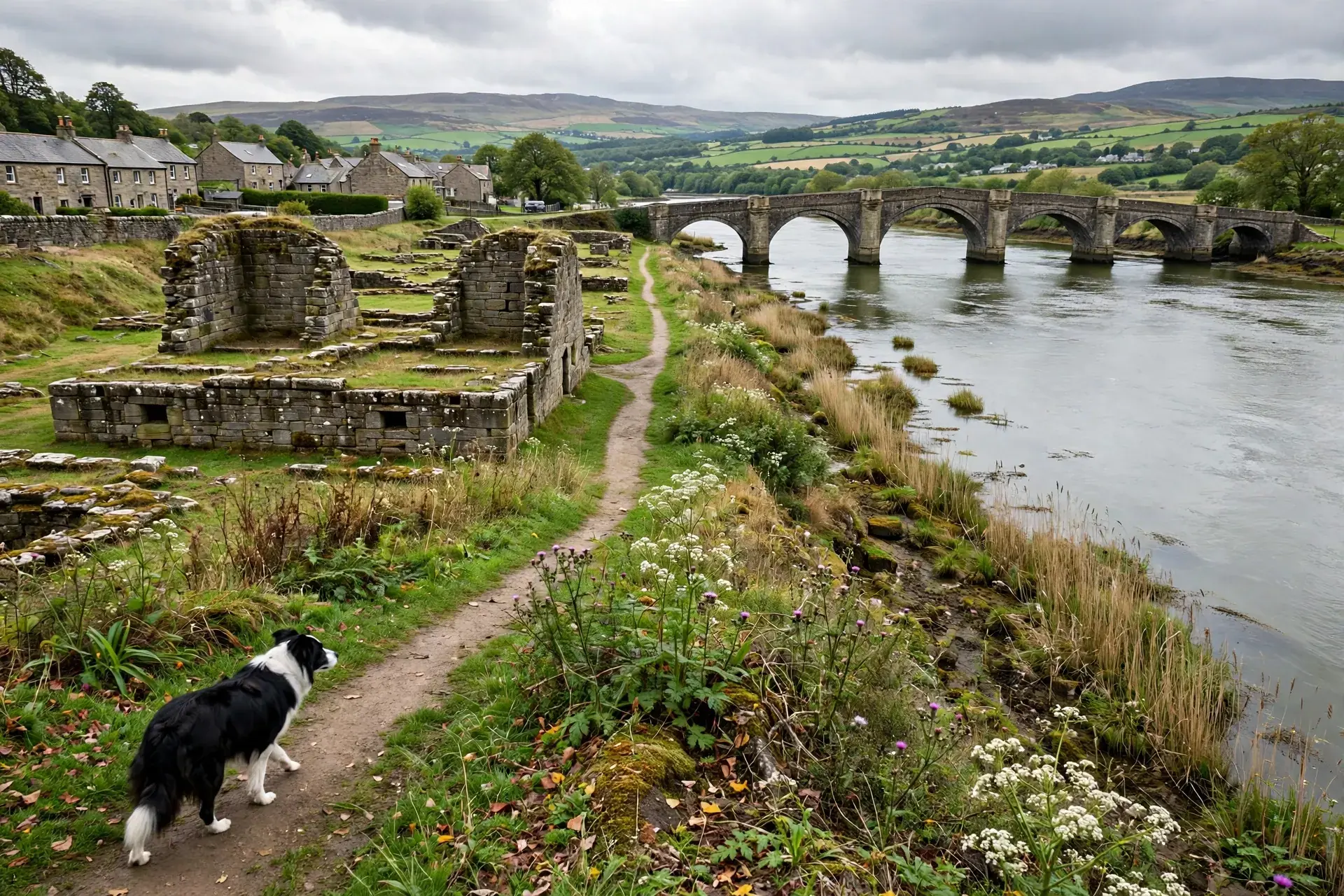
To walk the Tyne at Blaydon with a dog is to walk through a landscape that was built for work, and the traces of that work are still visible if you know what to look for. The river was once crowded with keels and barges carrying coal from the pits of the Tyne Valley down to the ships at Newcastle and beyond, and the banks were lined with staithes — the wooden structures from which coal was loaded — as well as ironworks, lead works, chemical works and the railways that served them. Much of that has gone, but the shape of the land still tells the story: the wide river, the low flat banks, the railway lines that run beside the water, and the bridges that span it at regular intervals.
The most famous link between Blaydon and the wider world is the song "Blaydon Races", written by the Geordie songwriter George Ridley in 1862. The song describes a journey to the races at Blaydon, and it has become an anthem of Tyneside, sung at football matches and gatherings across the north east. The races themselves are long gone, but the song keeps the name of the town alive in a way that few other places can claim, and it is worth knowing about before you visit, because you will hear the name mentioned and see it referenced in pubs and on signs. It is a reminder that Blaydon was once a place people travelled to for a day out, not just a place they passed through on the way to Newcastle.
The bridges are the most obvious heritage on the walk, and each one has its own character. The Scotswood Bridge, a steel arch that carries the road across the Tyne just east of Blaydon, is a fine example of early twentieth-century engineering, and the Blaydon Bridge, which carries the A1, is a reminder of how the modern road network reshaped the valley. Walking beneath them with a dog gives a sense of scale that a photograph never quite captures: the height of the arch, the width of the river, the noise of the traffic overhead and the quiet of the path below. Take a moment to stop and look up, and to let the dog sniff the air, which carries the smell of the river and the damp stone.
The railway is the other great piece of heritage, and it still runs through Blaydon today. The Tyne Valley line connects Newcastle with Carlisle, passing through Blaydon station and on through the Tyne Valley towns, and it is one of the most scenic railway journeys in the north of England. For a dog owner, the railway is both a practical asset and a thing to be careful around: it makes Blaydon easy to reach without a car, and it makes a one-way riverside walk possible, with the train back at the end; but it also means that the riverside path runs close to a live railway in places, and a dog must be kept on a lead and under control wherever the path and the line meet. Check the official guidance before you travel for the current timetable and the operator's dog policy, because services change and a missed train at the end of a long walk is a poor way to finish a day.
The industrial past also explains some of the things a dog owner needs to watch out for. Old industrial land can hide sharp metal, broken glass and other debris, especially where the path passes former wharves and works, so keep the dog on the path and check their paws after the walk. The river itself carries the memory of its industrial past in its currents and its bed, and it is not a clean swimming river in the way a upland stream might be. And the ground in some places is made up of fill and rubble rather than natural soil, which means it can be uneven and can hold water after rain. None of this should put you off — it is part of what makes the walk interesting — but it is worth knowing, so that you walk with your eyes open and your dog on a lead where the ground is rough.
Three route ideas for a day out
Blaydon is small enough that you do not need a complicated plan, but a little structure helps, especially if you are visiting for the first time or if your dog has particular needs. The three routes below are built around the same pieces — the riverside path, the burn, the parks and the pond — combined in different ways to suit different dogs and different days. Each one can be shortened by turning back early, and each one can be extended by walking further along the river, so treat them as starting points rather than fixed itineraries.
The first route is the classic riverside out-and-back, and it is the one to choose if you have a fit, steady dog and a morning to spare. Park near the town centre, join the riverside path, and walk east towards Newcastle for as far as you like — an hour out, an hour back is a good first attempt. Stop where the path opens out, let the dog sniff and rest, and turn back when you are halfway through your time or your dog's energy rather than when you reach a particular landmark. This route is flat, straightforward and easy to navigate, and it gives a dog a proper stretch of the legs without any difficult terrain. Bring water, bring bags, and bring a lead you trust, because the path is shared and the river is always there.
The second route is the short, sheltered loop, and it is the one for older dogs, puppies, nervous dogs and wet days. Start at the riverside green, walk a short stretch of the river path, then turn inland to the Blaydon Burn and follow the dene for a while before looping back through the quieter streets to the car. The whole thing takes well under an hour, and it mixes the open river with the shaded burn, which keeps a dog interested without tiring them out. This is also the best route for a first visit, because it shows you the two sides of Blaydon in a short space of time and leaves you with a clear sense of what a longer walk would involve.
The third route is the all-day Tyne walk, and it is the one for experienced walkers with fit dogs who want to make a day of it. Walk east from Blaydon all the way to Newcastle Quayside, take a long rest in the city, and then take the train back to Blaydon, or walk back if you and the dog still have the energy. This is a full day, not a morning stroll, and it needs proper planning: water and food for the dog, a rest stop in the city, a check of the train times before you set off, and a realistic assessment of whether your dog can handle the distance and the city crowds at the end. If in doubt, walk half the distance and turn back, or split the day into two shorter walks with a long rest in between. A tired dog at the Quayside is not a happy dog, and a long walk is only a good walk if the dog enjoys the last mile as much as the first.
Whichever route you choose, the same end-of-walk routine applies. Check the dog's paws for cuts, thorns and debris, especially after the burn or any rough ground. Towel the dog down if they have been in the stream or the river edge, and check for ticks after woodland and long grass, particularly in spring and summer. Offer water and a rest before the drive home, and give the dog a chance to settle rather than bundling them straight into a hot car. A good walk ends with a calm dog, not an exhausted one, and the drive home is part of the day, not an afterthought.
Getting there, parking and arrival
Blaydon is easy to reach by car, train and bus, and the best way to arrive depends on what kind of day you are planning. By car, the town is just off the A1, which makes it a straightforward drive from Newcastle, Durham and the wider north east, and the A695 runs through the town along the Tyne Valley. By train, Blaydon station sits on the Tyne Valley line between Newcastle and Carlisle, with services that make a one-way riverside walk practical. By bus, local services connect Blaydon with Newcastle, Gateshead and the surrounding towns, though a bus is a less comfortable option with a large or nervous dog. Check the official guidance before you travel for current timetables, roadworks and service changes, because all three can shift with little notice.
Parking is the question most visitors ask first, and the honest answer is that it is manageable but not generous. The practical starting points are the car parks near the town centre, the station and the riverside, together with on-street parking on the quieter residential streets away from the main road. Arrive early on weekends, in school holidays and on fine days, because the small riverside spaces fill first and the walk from a distant space to the path can add a stretch of road walking that a nervous dog will not enjoy. Check the signs at each car park for time limits, charges and any dog-related rules before you leave the car, and do not leave a dog in a parked car in warm weather, even for a few minutes — the temperature inside a car rises far faster than most people expect.
If you arrive by train, plan the walk from the station rather than assuming the path is immediately obvious. Blaydon station is a small, unstaffed station, and the walk from the platform to the riverside is short but involves roads and a change of level, so keep the dog on a lead and give yourselves time. Check the timetable before you set off on a long walk, because the service is not as frequent as the Metro in Newcastle, and a missed train at the end of a wet walk is a miserable wait. If you are planning a one-way walk to Newcastle, check the return service from Newcastle Central as well, and have a back-up plan — a taxi number, a bus route, or simply the willingness to walk back — in case the train is cancelled.
Arrival is also the moment to settle the dog before the walk begins. Give the dog a few minutes on the grass near the car to stretch, toilet and sniff the new place, rather than marching straight onto the path. Check the lead, the collar or harness, and the water bottle before you set off, and make sure you have bags, a towel and a basic first-aid kit in the car for the return. If the dog is anxious in new places, start with the short, sheltered loop rather than the long riverside walk, and let them set the pace for the first ten minutes. A calm start makes for a calm walk, and a dog that arrives stressed will not enjoy the river no matter how beautiful it is.
Eating, drinking and staying with a dog
Blaydon is a small town, and its eating and drinking options reflect that: a handful of pubs and cafes, a few takeaways, and the larger choice of Newcastle a short drive or train ride away. The pubs are the heart of it. A good Tyne-side pub with a dog-friendly bar, a fire in winter and a garden or terrace in summer is the natural end to a riverside walk, and Blaydon has pubs that fit that description. Policies change, though, and a pub that welcomed dogs last year may have changed its rules, so check the official guidance before you travel or phone ahead, and do not assume that a dog is welcome in the dining room just because it is welcome in the bar.
When you do eat out with a dog, a few habits make the visit work for everyone. Bring a mat or a blanket for the dog to lie on, so they have a defined place and are not sprawled across a walkway. Keep the dog on a lead throughout, even if they are settled, because a loose dog in a pub is a trip hazard and a source of anxiety for other customers. Order food that you can eat without fuss, and keep the dog's attention on a chew or a stuffed toy rather than on other people's plates. And if the dog is unsettled, barking or pacing, take them outside for a break rather than hoping they will settle — a short walk around the block is better than a tense hour at the table.
Cafes are a better bet for a daytime stop, especially the smaller, independent places that welcome dogs in the morning and at lunchtime. A coffee and a cake after a riverside walk is a simple pleasure, and a dog that has just walked for an hour will usually settle happily under the table. Again, check before you go, bring a mat, and keep the dog on a lead. If the cafe is busy, consider a takeaway coffee and a bench by the river instead — the dog will often prefer the bench, and you will get the view as well as the coffee.
For an overnight stay, Blaydon itself has limited dog-friendly accommodation, and most visitors who want to stay in the area will look to Newcastle, Gateshead or the Tyne Valley towns, where the choice is wider. When you do book, ask the specific questions that matter: is there a pet fee, and how much; is there a limit on the number or size of dogs; is there a garden or a nearby toilet walk; and are dogs allowed in the bar or restaurant as well as the room? Get the answers in writing with the booking, and check the cancellation terms before you pay a deposit. A stay that works for the dog is a stay that works for you, and a room with a good walk from the door is worth more than a room with a good view from the window.
If you are staying for several days, Blaydon makes a good base for exploring the wider Tyne Valley with a dog. Upstream, Corbridge offers Roman history and a pretty village riverside, and Hexham adds an abbey, a market town and more riverside walking, while downstream, Newcastle gives you the city, the Quayside and the coast on the Metro. Each town has its own character, and each one rewards a day of its own, so do not try to do them all in a single rush. Pick one town a day, walk it properly, and let the dog rest in between — a week of short, happy walks beats a weekend of exhausted ones.
Wet days, winter and river safety
Blaydon is a north-eastern riverside town, which means that rain is not a possibility but a certainty, and the best dog walks here are the ones that work in the rain as well as in the sun. The riverside path holds up well in wet weather, because it is surfaced and flat, but the verges turn to mud, the burn path becomes slippery, and the river rises after heavy rain, so a wet-day walk needs a different plan from a dry-day walk. The short, sheltered loop through the burn and the parks is usually the better choice in the rain, because it keeps you close to the car and gives you the option of cutting the walk short if the weather turns worse.
Winter brings its own set of considerations. The riverside path can be icy in the shaded stretches, especially in the morning, and a dog that slips on ice can injure a leg or a hip just as a person can. Shorten the walk, keep the dog on a lead, and avoid the steepest banks altogether when there is frost or snow on the ground. The river is at its coldest and fastest in winter, and a dog that falls in will be in serious trouble quickly, so keep them well away from the water's edge and do not let them chase a ball or a stick near the bank. Salt and grit on the paths can also irritate a dog's paws, so rinse their feet when you get home and check for cracks or soreness.
River safety deserves a section of its own, because the Tyne is not a river to take lightly. It is deep, fast and cold, with strong currents, boat traffic and a bed that drops away steeply in places. The banks are not fenced, and the water is not always visible from the path, so a dog can be in the river before you have time to react. The rules are simple: keep the dog on a lead near the water, never throw a ball or a stick into the main current, never let a dog swim in the river, and never enter the water yourself to rescue a dog — call for help instead. If your dog does go in, keep calm, call them to a shallow exit point, and get them warm and dry as soon as you can.
Flooding is the other river risk, and it is worth taking seriously. After heavy rain, the Tyne can rise quickly, and the riverside path can flood or become dangerous with little warning. Check the official guidance before you travel if there has been heavy rain, and do not walk a flooded path or try to cross standing water, because the depth and the current are impossible to judge from the bank. If you arrive and the path is flooded, turn back and choose a different walk — the parks and the higher ground will still be there, and the river will still be there tomorrow.
Wet weather also means wet dogs, and a wet dog in a car is a smell that stays with you for days. Bring a towel and a drying coat, and give the dog a proper rub-down before they get in the car. A waterproof car seat cover and a spare blanket will save the upholstery, and a quick check for ticks and cuts after a woodland walk is worth the minute it takes. If the dog is wet through, offer them a warm drink of water and a dry bed when you get home, and let them sleep — a long, wet walk is tiring, and a dog that has worked hard in the rain deserves a proper rest.
Practical kit and dog etiquette on the Tyne
A day on the Tyne with a dog does not need specialist equipment, but a few things make the difference between a comfortable walk and a miserable one. Start with the lead: a standard lead for the busy stretches, a long line for the open grass, and a harness that fits well and does not rub. Bring water and a collapsible bowl, because the river is not a safe drinking source and there are long stretches of path with no tap. Bring bags, and more bags than you think you will need, because there are not always bins on the path. Bring a towel, a drying coat in winter, and a basic first-aid kit with a tick remover, antiseptic wipes and a bandage.
Footwear matters as much as the dog's kit. The riverside path is easy walking in trainers on a dry day, but the burn path and the field tracks need boots with grip, especially after rain. Wear layers, because the weather on the Tyne changes quickly, and bring a waterproof jacket even on a bright morning. A small rucksack for water, bags, a towel and a snack is worth carrying, because it leaves your hands free for the lead and it means you are not relying on shops that may not be there when you need them.
Etiquette on a shared path is mostly common sense, but it is worth spelling out because the riverside is a shared space and a single careless owner can spoil it for everyone. Keep your dog under control at all times, on a lead where the path is narrow or busy, and recall them promptly when another walker, a cyclist or another dog approaches. Pick up after your dog, every time, and carry the bag to a bin rather than leaving it by the path. Give way to cyclists, runners and people with pushchairs, and step aside with the dog on the short side of the path. If your dog is reactive, walk early or late when the path is quiet, keep them on a lead, and warn other owners politely rather than hoping the encounter will go well.
Meeting other dogs on the Tyne is a normal part of the walk, and it helps to have a plan for it. Not every dog wants to say hello, and not every owner wants their dog to be approached, so do not let your dog run up to an on-lead dog without asking. A short, calm greeting on a loose lead is fine if both owners agree, but a long, intense face-to-face meeting on a narrow path is a recipe for trouble. If you are unsure, keep walking, keep the dog close, and give the other dog space. A polite, brief interaction is better than a long, tense one, and a dog that walks past calmly is a dog that has learned a useful skill.
Finally, respect the land and the people who live and work along the river. Close gates, keep to the paths, do not let the dog chase livestock or wildlife, and do not let them dig in gardens or flower beds. The Tyne is a working river and a lived-in landscape, not a theme park, and the people who live in Blaydon use the same paths you do. A dog owner who walks quietly, picks up after their dog and gives way to others will be welcomed back; one who does not will not be. The river will still be there either way, but the walk is better when everyone shares it well.
Practical questions
Before you go
Can dogs walk off lead on the riverside paths at Blaydon?
On the quieter stretches of the riverside path, many owners let steady dogs off lead, but the route is shared with cyclists and other walkers, and it runs beside a fast, deep river, so keep your dog close, recall them for bikes and other dogs, and put the lead back on near roads, the station, the bridge approaches and anywhere the bank is steep or unfenced. If your dog is unreliable around cyclists or water, stay on a long line for the whole walk.
Is Blaydon a good base for walking to Newcastle with a dog?
Yes, for a fit dog and a walker who likes flat riverside miles. The riverside path east from Blaydon follows the south bank of the Tyne towards Newcastle Quayside, and the route is mostly level, so it suits dogs that settle into a steady pace. Allow a full morning for the walk one way, carry water and a lead, and check the official guidance before you travel for any path closures or diversions. Many walkers take the train back from Newcastle Central, but check the operator's current dog rules first.
Where can I park in Blaydon with a dog?
The practical starting points are the car parks near the town centre, the station and the riverside, plus on-street parking on the quieter residential streets away from the main road. Arrive early on weekends and in school holidays, because the small riverside spaces fill first. Check the signs at each car park for time limits and charges before you leave the car, and check the official guidance before you travel, as parking arrangements change.
Is the River Tyne safe for dogs to swim in at Blaydon?
Treat the Tyne as a working river, not a swimming spot. It is deep and fast in places, the banks can be steep and muddy, the water is cold even in summer, and boat traffic and strong currents make it risky for dogs. Let your dog paddle only at a shallow, gently shelving spot you have checked first, keep them on a long line, and never throw a ball into the main current. If in doubt, keep your dog out of the water altogether.
What is the best short dog walk in Blaydon?
For a short outing, the riverside path west from the town centre towards the Blaydon Burn and the quieter green spaces around Shibdon Pond gives a good mix of river views, trees and open grass in under an hour. It is flat, easy to shorten, and close to the car, which makes it a sensible first walk for a new dog, an older dog or a wet day when a long route would be too much.
Are there dog-friendly pubs and cafes in Blaydon?
Blaydon has a small number of pubs and cafes that welcome dogs, usually in the bar area, on an outdoor terrace or in a designated dog-friendly corner, and the nearby towns along the Tyne add more choice. Policies change, and a pub that welcomed dogs last year may have changed its rules, so check the official guidance before you travel or phone ahead, bring a mat for your dog to settle on, and keep them on a lead while you eat.