This guide is independent and contains no paid placement. Beach, ferry and venue rules change, so check the latest official signage and operator updates before you travel.
Dog friendly Plymouth works best as a waterfront city: start on the Hoe for the big Sound views, wander the Barbican and Sutton Harbour on a lead, then pick a coast path stretch or a checked beach for proper exercise. Keep the city centre on a short lead, plan water and shade, and always verify seasonal beach rules on the day.
Plymouth Hoe with a dog: start looking over the Sound
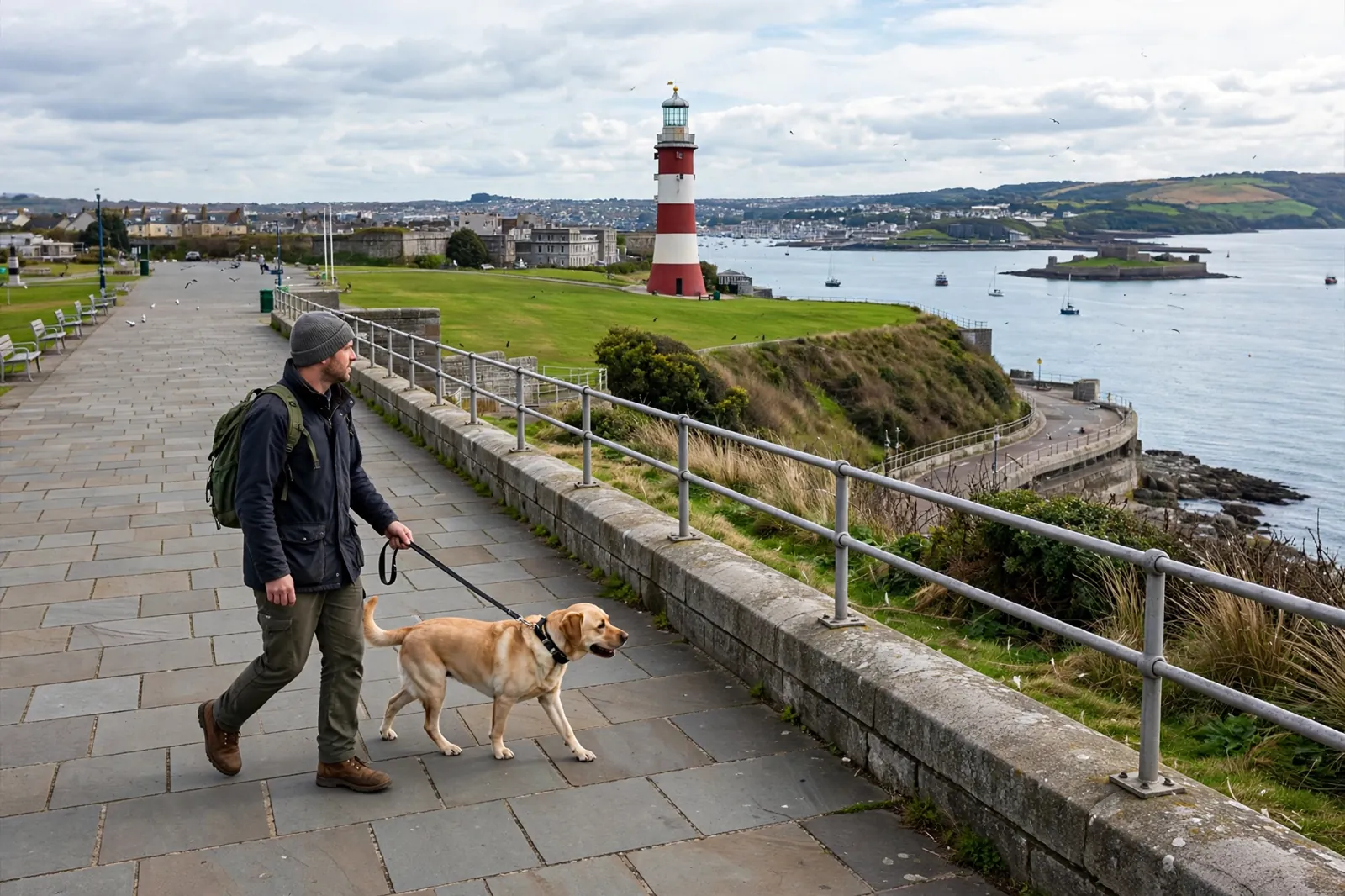
Stand on the Hoe in the morning and the whole logic of Plymouth opens up in front of you. The grass sweeps down towards a wide promenade, Smeaton's Tower rises red and white behind you, and beyond the railings Plymouth Sound spreads out towards Drake's Island, Mount Edgcumbe and the breakwater on the horizon. For a dog owner arriving in a new city, that view does useful work: it orients you, it gives your dog a long, level, interesting walk without traffic stress, and it sets the tone for a day that is mostly outdoors, mostly on foot and mostly by the water. If you only have a few hours in Plymouth, spend them here and in the Barbican below, and you will have understood the place.
The Hoe itself is a large, open public space combining formal lawns, memorials, the promenade and Hoe Park. Dogs are welcome, but this is a lead-on environment in practice and in expectation. It is busy with families, runners, events and other dogs, and parts of it carry deep significance as a war memorial landscape. Keep your dog close, do not let them onto flower beds, planted areas or memorial plinths, and be especially considerate during ceremonies and busy event days. The pleasure of the Hoe is not off-lead running; it is a steady, sniff-rich stroll with constant sea air, gulls to watch and benches where you can pause without your dog being in anyone's way. A standard lead is better here than a long extending lead, which tangles easily around other walkers on the promenade.
Work the Hoe as a loop rather than a single out-and-back. Start near Smeaton's Tower, walk west along the promenade towards Millbay and the Royal Citadel walls, then return along the upper path past the memorials, or reverse the loop depending on the wind. On a blustery day the upper lawns are more sheltered; on a calm, bright morning the lower promenade right above the water is the better walk. Allow forty minutes to an hour for a relaxed circuit with stops, longer if your dog likes to watch boats. There is little natural shade on the open Hoe, so on warm days go early or late, carry water for your dog even though the walk looks short, and watch for hot tarmac on the promenade at midday in summer. Paws that are fine on grass can struggle on sun-heated paving, and older dogs in particular benefit from sticking to the grass edges in heat.
Facilities around the Hoe are geared to visitors, which helps. You will find cafes and kiosks nearby, public toilets in the wider Hoe and waterfront area, and plenty of bins — use them, because enforcement and public expectation around dog fouling are strong in such a prominent space. Parking near the Hoe fills quickly on sunny weekends and event days, so arriving by train and walking from Plymouth station, or using a city car park a short walk away and treating the approach as part of the walk, is often less stressful than circling for a promenade space with an impatient dog in the car. If your dog is nervous around crowds, flags, amplified sound or large gatherings, check whether a major Hoe event is scheduled for your date and choose a quieter morning or a coast path walk instead.
The Hoe also connects naturally to everything else in this guide. Steps and slopes drop down towards the waterfront and the Barbican to the east, while the waterfront walk continues west towards Millbay and Stonehouse. That connectivity is Plymouth's great advantage for dog owners: you rarely need to get back in the car between walks. You can do the Hoe for the view, drop down to the harbour for lunch, and be on the South West Coast Path within minutes, all on foot and all with your dog beside you.
Barbican and Sutton Harbour: cobbles, boats and careful lead work
Drop down from the Hoe and you are in the Barbican, Plymouth's historic old quarter, wrapped around Sutton Harbour. The character changes immediately: narrow cobbled streets, old warehouses and merchants' houses, fishing boats and pleasure craft in the marina, and a dense cluster of pubs, cafes, restaurants, independent shops and galleries. For a dog, it is a fascinating but demanding environment — rich in smells, busy with people eating outdoors, and full of dropped-food temptations at pavement level. A short lead, a reliable leave-it and a plan for where you will actually sit make the difference between an enjoyable wander and a constant negotiation.
Walk the Barbican slowly and with intent. Southside Street is the main spine, good for a browse with your dog outside shop doorways, while the harbour edge around Sutton Harbour and the Barbican quays gives you wider, flatter walking with views back to the Hoe and across to the National Marine Aquarium side of the harbour. The Mayflower Steps area is a natural pause point. Keep your dog away from working fishing areas, mooring lines and any signed restricted quays, and be alert for cyclists, delivery vehicles and sudden crowds spilling out of venues at lunchtime and in the evening. Cobbled and uneven surfaces can be slippery when wet and hard going for dogs with joint problems or for owners using mobility aids, so in rain consider the smoother harbour paths rather than the oldest side streets.
Eating and drinking is one of the Barbican's strengths for dog owners, provided you check rather than assume. Many pubs and cafes in the area welcome dogs in bar areas, snugs or terraces, and water bowls outside doors are a common sight around the harbour. That said, policies vary by venue, by room within a venue and by how busy it is, and they do change. A venue that happily seats you and your dog indoors on a quiet Tuesday may be terrace-only on a packed Saturday night. The practical approach is to shortlist two or three places, check their latest dog policy online or by phone before you set out, and have a terrace backup if the weather turns. Our wider guide to dog-friendly restaurants in the UK explains how to read venue policies and what to ask, and the same questions work well here: are dogs allowed inside or only outside, is there a size or number limit, and do you need to book a dog-friendly table specifically?
Sutton Harbour also rewards a simple evening walk. Once day-trippers thin out, a lead walk around the harbour, over the Sutton Lock footbridge area where access allows and back through the Barbican lanes, is atmospheric and manageable even for dogs that find daytime crowds tiring. Watch for uneven lighting in the oldest lanes, keep your dog clear of the water's edge — harbour walls have sudden drops with no railing in places — and never let a dog swim in the harbour itself. Boat traffic, lock operations and harbour water quality all make it unsuitable, however tempting it looks on a hot day. Save swimming for a suitable beach or a calmer cove reached on a coast walk, and then only where local guidance allows it.
If you are visiting with children as well as a dog, the Barbican works best in shorter bursts: harbour walk, ice cream or cafe stop with the dog settled under the table, then back up to the open space of the Hoe where everyone can stretch. Trying to do detailed shopping, a long sit-down lunch and a big walk in one Barbican block usually leaves the dog restless. Build in a toilet break on grass before and after any long cafe stop — the harbour area is mostly hard surfaces, so walk back towards the Hoe or a nearby green patch rather than expecting your dog to settle for pavement corners.
South West Coast Path stretches from the city
Plymouth sits on the South West Coast Path, and for a dog owner that is a gift: you can walk out of a city centre and be on a national trail, with sea views and proper walking, without driving to a trailhead. The path threads through the waterfront itself, so the Hoe, Barbican and harbour walks above are already part of it, but the most satisfying dog walks come from treating the path as a day's purpose and picking a stretch that matches your dog's fitness, lead manners and head for heights.
Heading east from Sutton Harbour, the path follows the waterfront towards Plymstock and the Plym estuary, with sections that mix promenade, pavement and greener riverside walking. It is a good choice for a steadier dog that needs distance without steep climbs, and for owners who want to stay within reach of buses back into the centre. Heading west from the Hoe through Millbay and Stonehouse towards Devil's Point and Royal William Yard, the walking is more urban but full of interest: naval history, stone yards turned into cafes and apartments, and open views back across the Sound. Royal William Yard itself is a popular pause for food and water, with wide open spaces where a lead walk feels relaxed — again, check individual venue policies if you plan to eat inside.
For a fuller coast path day, many visitors use Plymouth as a base for the stretches beyond the city in either direction: east towards Wembury, or across the water to the Rame Peninsula in Cornwall. Both require more planning — transport back, tide awareness on connecting beach sections, water for your dog because sources are sparse on exposed stretches, and a honest assessment of cliff edges. The coast path is often unfenced near drops, and a dog that lunges at birds or pulls suddenly on a lead needs extra care on narrow cliff sections. Keep dogs on a lead around livestock, which graze some coastal sections, and follow any local signage about ground-nesting birds in spring and summer. If your dog's recall is unreliable, a long line is not a safe substitute on a cliff path; a standard lead and a shorter, well-chosen stretch will give you both a better day.
Practical coast path planning matters more than distance ambition. Check the weather for wind as well as rain — the Sound funnels wind and an exposed stretch that is pleasant in a breeze can be exhausting in a gale, especially for small dogs. Carry more water than you think you need, a collapsible bowl, poo bags to carry out until you reach a bin (bins can be miles apart on rural stretches), and a charged phone with your return bus or taxi plan saved. Tell someone your route if you are walking a quieter stretch alone. In summer, start early to avoid heat on shadeless sections; in winter, build in daylight margin, because paths that are straightforward at noon are hard to navigate as light fades over the sea. Our Dartmoor dog walks guide is a useful companion if you are pairing a Plymouth city stay with a moorland day inland — the contrast between harbour walking and open moor is one of the pleasures of basing yourself here.
A final coast path note on surfaces and paws. Promenade and tarmac sections are easy on navigation but can be hard and hot; grassy cliff sections are softer but become muddy and slippery after rain, and stiles, steps and narrow gates appear on rural stretches. If your dog struggles with stiles, is too large to lift, or is recovering from injury, favour the urban waterfront sections of the path through Plymouth itself, where access is step-free in many places and you can cut a walk short at almost any point. That flexibility is precisely why Plymouth works for older dogs and puppies in a way that a remote trailhead walk does not.
Beaches near the city: what is honest about the rules
Every dog owner visiting Plymouth asks the same question — where is the beach? — and the honest answer needs care. Plymouth itself is a harbour and waterfront city rather than a classic sandy-beach resort. There are small coves and waterfront access points around the Sound, including rocky and shingle spots that locals use, but the broad sandy beaches most visitors picture are a short drive or bus ride away, at places such as Wembury to the east, and across the Tamar at Whitsand Bay, Cawsand and Kingsand on the Rame Peninsula, or further afield on the South Hams coast. That short journey is worth it, but only if you go with the right beach, on the right day, under the current rules.
Seasonal dog restrictions are the single biggest source of disappointment, so treat this section as a method rather than a fixed list. Many beaches in Devon and Cornwall restrict dogs during the main season — commonly from spring to early autumn, with exact start and end dates, hours and zoned sections varying by beach and by managing council or owner. Some beaches ban dogs entirely in season, some allow them on leads on part of the beach, and some are dog-friendly all year. Those rules change, signage is updated, and online lists go out of date quickly. Before you travel, check the relevant council beach pages and the on-site signage for your specific beach and date, and be prepared to follow a zoned map when you arrive. Our national explainer on dog-friendly beaches in the UK and their rules walks through how bans, zones and lead requirements usually work, so you can read any local sign with confidence.
Wembury, east of the city in the South Hams, is the beach most often paired with a Plymouth stay: a rocky, interesting shoreline backed by coast path walking, popular for rockpooling at low tide and for combining a beach pause with a longer walk rather than for all-day sand bathing. Check its current seasonal dog rules and National Trust guidance before you go, take care on slippery rocks with your dog, and keep dogs away from rockpool wildlife. Whitsand Bay, across in Cornwall, is a dramatic, miles-long sandy sweep at low tide reached by steep paths — spectacular for a fit dog and owner, unsuitable if you need level access, and subject to strong currents and rapidly changing tides that make swimming risky for people and dogs alike. Cawsand and Kingsand offer smaller, village-backed beaches with an easier pace and pubs nearby, again subject to seasonal rules that you must verify. In every case, tide times shape the visit: a beach that is generous at low water can disappear at high tide, trapping the unwary against cliffs. Check tide tables for your date, not just dog rules.
Within the city waterfront itself, manage expectations. Areas around the Hoe foreshore, Devil's Point and Mount Batten offer water views, rock and shingle edges and, in places, access to the water, but they are not substitutes for a sandy dog beach and some sections are unsuitable or unsafe for dogs to swim because of boat traffic, strong currents around headlands and harbour operations. Mount Batten and the Plym estuary side are better used for lead walks, watching boats and a cafe stop than for off-lead beach play. If swimming matters to your dog, plan it as part of a deliberate beach trip outside the centre, choose a lifeguarded or well-used beach where guidance is clear, rinse your dog afterwards, and never let them drink seawater. Heat, jellyfish in warmer months, sharp shells and fish hooks discarded on harbour edges are all real, unglamorous risks worth a quick visual check of any new cove before you unclip a lead where leads are allowed.
Whatever beach you choose, the beach-day kit is the same: fresh water and a bowl (dogs dehydrate fast playing on sand), shade you bring yourself, a towel and a plan for a sandy, wet dog in the car, poo bags you will carry to a bin even if it is back at the car park, and a lead for the walk across any restricted zone to a permitted section. Arrive early in high season for parking, keep dogs off any signed wildlife or dune protection areas, and if the beach you planned turns out to be closed to dogs on arrival — it happens, despite everyone's best research — treat the coast path walk above it as your plan B rather than risking a fine and an argument on the sand.
A brief idea: Mount Edgcumbe by ferry
For something different without a long drive, consider the short ferry crossing from Plymouth to Cremyll in Cornwall for Mount Edgcumbe Country Park. The Cremyll Ferry runs from Admiral's Hard in Stonehouse across the Tamar, and from the Cremyll landing it is a short walk into the park's extensive grounds on the Rame Peninsula, with woodland, gardens, parkland and Sound views looking back towards Plymouth. For a dog that travels calmly, it turns a city day into a country park day in minutes, and the return view of the Hoe from the water is one of the best perspectives on the city.
Keep the plan brief and well-checked. Dogs are generally carried on the ferry on a lead at the operator's discretion, but fares, timetables, dog policy and even whether sailings run can depend on weather, tides and season — verify the latest details with the operator before you rely on a crossing, and have a waterfront walk as a fallback if sailings are suspended. Our guide to dogs on UK ferries covers how to prepare a dog for boat travel, from leads and settling to seasickness. At Mount Edgcumbe itself, follow the park's current dog guidance, keep dogs under control around other visitors, deer and any livestock, observe lead requirements in formal garden areas, and check opening and parking details for the park and house before you go, as they vary seasonally. The park is large enough for a half-day visit; combine it with a Rame coast walk only if you have checked your return ferry time with margin to spare.
Where to stay and eat with a dog
Plymouth has the full range of city accommodation — large hotels on and near the Hoe, smaller hotels and guest houses in the Hoe and Barbican area, serviced apartments and self-catering across the centre and waterfront, and caravan and holiday parks on the city's edges for those who prefer to stay outside the centre and drive or bus in. Dog policies vary as widely as the properties. Some hotels offer specific dog-friendly rooms with a per-dog, per-night charge, a welcome pack and easy ground-floor access to a toilet walk; others accept dogs only in certain room types or not in public areas beyond reception. Self-catering gives you more control over routines and drying space, but you must check garden security, stair steepness in converted harbour buildings, and parking, which is at a premium around the Barbican.
Ask the same booking questions you would anywhere, with a Plymouth twist. Is there a practical after-dark toilet walk that does not involve crossing a busy road or walking a long, unlit harbour edge? Can you park or unload close enough to avoid carrying a nervous dog through a crowded lobby at peak check-in? Are dogs allowed where breakfast is served, or will you need a rota? For Hoe-area stays, the early-morning Hoe walk on your doorstep is a genuine advantage with a dog that wakes early — you can be on open grass within minutes while the city is quiet. For Barbican stays, weigh charm against cobbles, late-night pub noise and limited green space immediately outside the door. If you prefer a park base, our guide to dog-friendly holiday parks in Devon helps you compare options within reach of the city.
For eating beyond the Barbican, the waterfront and Royal William Yard offer further dog-welcoming terraces and cafes, the city centre has the usual mix of chains and independents with varying policies, and the villages around the Sound — Plymstock, Oreston, Cawsand and Kingsand on a day trip — often have a pub that welcomes dogs in the bar. Fish and chips eaten on the Hoe or harbour wall with your dog beside you is a Plymouth ritual, provided you guard against gulls, which are bold and practised around waterfront food. Keep food covered, do not feed gulls, dispose of wrappers promptly, and keep your dog close — a lunge at a gull through a crowd helps nobody. Indoors or out, settle your dog before your food arrives, bring a mat or settle blanket for hard floors, and choose off-peak times if your dog finds busy dining rooms stressful. A short walk and toilet break immediately before a meal is the cheapest behaviour insurance there is.
Grooming, supplies and vets are easy in a city of Plymouth's size, but locate them before you need them. Note the nearest veterinary practice to your accommodation and an out-of-hours provider, especially if you are staying over a weekend when coast and moor walks increase the chance of a cut paw or a swallowed treasure. Pet shops and supermarkets in the centre and retail parks stock the usual food and supplies, so a forgotten lead or a run on poo bags is fixable — but carry spares on coast walks regardless, because rural stretches have no shops at all.
A one-day Plymouth plan with a dog
If you have a single day, resist the urge to drive to three beaches and rush the city. Plymouth rewards a foot-based day that follows the water. The plan below assumes a reasonably fit dog used to lead walking; shorten any leg for puppies, older dogs or hot weather, and swap the beach or ferry leg for a second harbour loop if rules, tides or sailings do not cooperate on your date.
Early morning — the Hoe while it is quiet. Start on the Hoe before crowds build. Do the full promenade and lawns loop described above, let your dog take in the Sound views and the morning boat activity, and use the open grass for a proper toilet break and a drink. Have breakfast at a dog-welcoming cafe near the Hoe or Barbican that you have checked in advance, or pick up takeaway and eat on the Hoe with your dog settled beside you, gull-aware.
Mid-morning — Barbican and Sutton Harbour. Drop down to the Barbican for a slow harbour circuit: Southside Street, the quays, the Mayflower Steps area and the harbour edge. Browse with your dog outside shops, pause for coffee where dogs are welcome, and keep the pace gentle on the cobbles. If your dog needs a break from crowds, retreat to the wider harbour paths or back up to the Hoe for twenty minutes of open space before lunch.
Lunch — eat together, without gambling. Choose the Barbican or Royal William Yard venue you checked beforehand, walk your dog briefly first, and settle them on a mat while you eat. A pub lunch with the dog under the table and a water bowl provided sets you up far better for the afternoon than a rushed sandwich while managing a restless dog on a busy pavement.
Afternoon — pick one, not both. Option A is a coast path leg: walk west to Devil's Point and Royal William Yard and back for an urban trail afternoon, or east along the waterfront for a steadier estuary-facing walk, turning back with daylight and energy in reserve. Option B, if you have checked sailings and park details, is the Cremyll Ferry to Mount Edgcumbe for woodland and parkland walking and the ferry ride back in late afternoon. Option C, if you arrived by car and have verified that day's rules and tides, is a deliberate beach trip to Wembury or a Rame village beach for two unhurried hours, followed by a rinse, a towel-down and the drive back. Each option is a good day; trying to combine two of them usually means a tired, overstimulated dog by evening.
Evening — harbour lights and an early finish. Finish with a gentle Sutton Harbour evening walk as the Barbican lights come on, an early supper at a dog-welcoming terrace if your dog is still settled, and a final Hoe or harbour-edge toilet walk before bed. City days involve more hard surfaces, more people and more novelty than a rural walk of the same distance, so most dogs are more tired than the mileage suggests. Let them sleep; Plymouth will still be there in the morning, and a second day can take in Dartmoor or a fuller coast path stretch at a better pace.
Practicalities and pitfalls
Getting to Plymouth is straightforward: the city has a mainline station with services towards London, Bristol and Cornwall, and road access via the A38. With a dog on the train, arrive in time to find a suitable carriage space, keep your dog on a lead and off seats, and walk them before boarding and immediately on arrival — the walk from the station to the Hoe and Barbican is manageable on foot and makes a good decompression after a journey. Drivers should plan parking in advance for sunny weekends; waterfront and Hoe parking is in high demand, and knowing your car park before you arrive avoids stressful circling. Within the city, most of the waterfront core is best done on foot, with local buses and taxis as backups — check any taxi firm's dog policy before you rely on a ride back from a coast walk.
Weather over the Sound changes quickly. A day that starts calm can turn windy enough to make exposed promenade and cliff sections unpleasant, and sea mists can roll in and cut visibility on coast paths. Dress for a layer more than the city forecast suggests, carry a lightweight dog coat for small, older or thin-coated dogs in winter, and be willing to shorten a cliff walk if wind strengthens. In summer, the combination of reflected light off the water, shadeless promenades and hot paving is the main risk; walk early and late, rest in shade at midday, and learn the signs of heatstroke. Never leave a dog in a parked car on the waterfront in warm weather, even briefly and even with windows cracked.
Finally, be a good ambassador. Plymouth's waterfront is shared intensely — residents, sailors, fishers, families, event crowds and other dog walkers all use the same promenades and quays. Clear up everywhere, including on beaches and coast paths where some owners wrongly assume it does not matter; keep your dog out of working harbour areas and off memorials; give space to assistance dogs, children and nervous dogs; and follow every local sign even when it curtails your plan. Rules that are followed keep waterfronts dog-welcome. Before you travel, check the latest official guidance for Plymouth's public spaces, the beach and ferry operators for your dates, and each venue you plan to rely on — that final check, done the week before rather than assumed from any guide including this one, is what turns a hopeful trip into a smooth one.
Practical questions
Before you go
Are dogs allowed on Plymouth Hoe?
Yes, dogs are welcome on Plymouth Hoe on a lead. The Hoe is a busy public space with memorials, events and other visitors, so keep your dog close, clear up after them and avoid letting them onto flower beds or memorial areas. Early mornings are quietest for a calm walk.
Which beaches near Plymouth allow dogs all year?
Rules change by beach and by season, and some beaches near Plymouth restrict dogs to certain sections or ban them in summer. Wembury and parts of the South Hams and Rame Peninsula are popular options, but always check the current council signage and the beach operator's latest rules before you travel, as seasonal restrictions vary each year.
Can I take my dog on the Mount Edgcumbe ferry from Plymouth?
Dogs are generally carried on the Cremyll Ferry between Admiral's Hard and Cremyll for Mount Edgcumbe, usually on a lead and at the operator's discretion. Check the latest timetable, fare and dog policy with the operator before you go, as sailings are weather and tide dependent.
Is the Barbican dog-friendly for eating and drinking?
Many Barbican pubs and cafes welcome dogs in bar areas or on terraces, and water bowls are common around Sutton Harbour. Policies differ by venue and can change, so check the individual venue's latest dog policy before you rely on indoor access, especially at busy times.
Where can I walk my dog off the lead near Plymouth city centre?
The Hoe and waterfront are lead-on areas. For off-lead exercise, head to larger green spaces on the edge of the centre such as Central Park or Devonport Park, and to suitable sections of the South West Coast Path outside the busiest harbour stretches, always following local signage and keeping your dog under close control near livestock, cliffs and other walkers.