This guide is independent and contains no paid placement. If affiliate links are added later, they will be clearly marked and will not change our editorial checks.
Choose the farm first and the walks second. A border terrier holiday succeeds when livestock are kept at a planned distance, the garden boundary has been walked and tested, and the dog has a sniffing, digging or searching job every day that does not involve chasing anything alive.
Start at the farm gate, not the breed profile
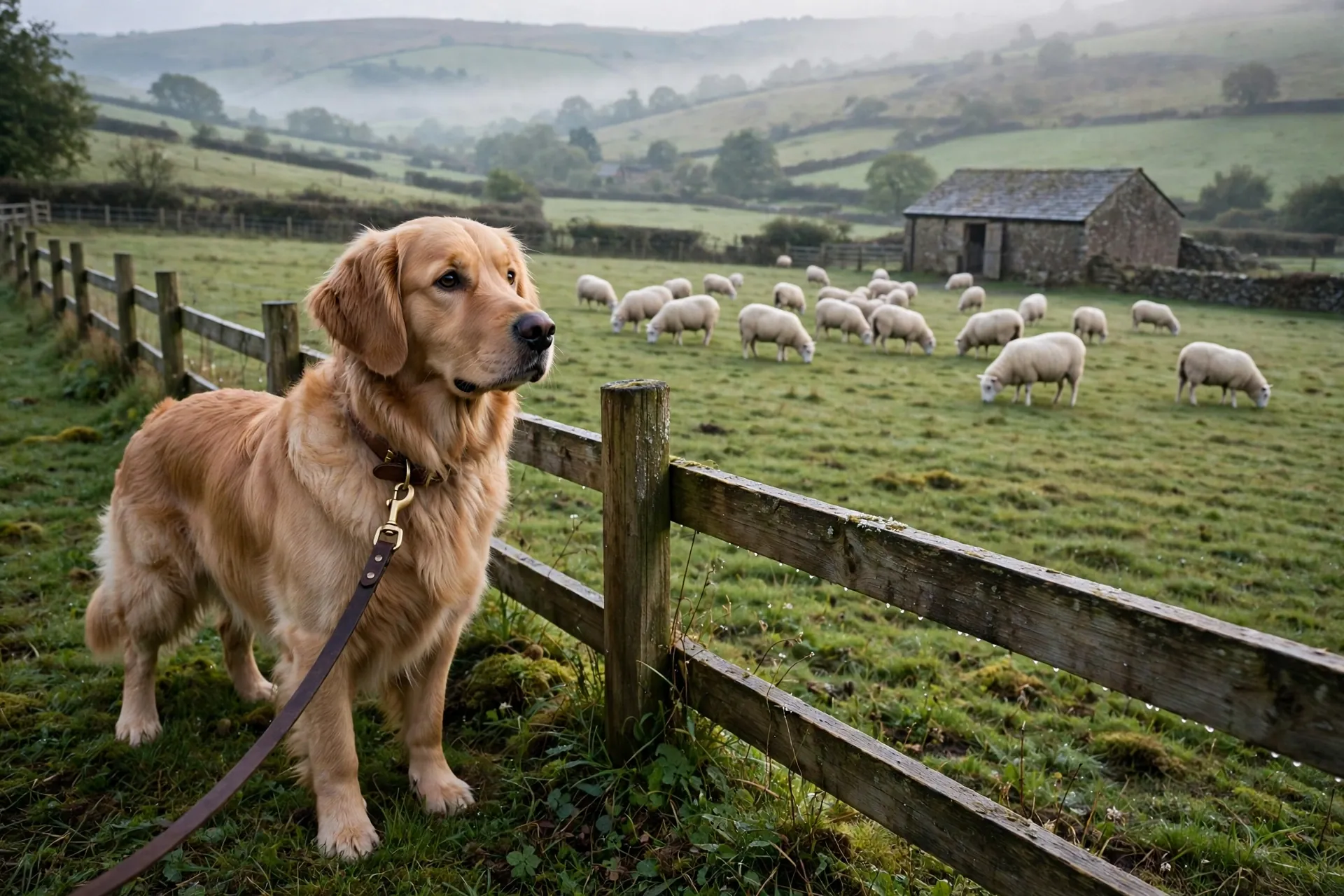
Most breed guides begin with temperament and work outwards to travel. For a border terrier on a rural holiday, that order is backwards. The dog is small, tough, weatherproof and famously busy, and those qualities are rarely the problem. The problem is the place: a working farm is a landscape full of moving triggers, open gates, low walls, ditches, poultry runs, feed stores, slurry pits, machinery and animals that must not be chased. A terrier that is perfectly mannered on a city pavement can become a different animal the first time a rabbit breaks cover twenty metres away, or a hen flutters behind a wire fence. Planning from the farm gate means asking, before anything else, what this particular property contains, where the dog is allowed to go, and what happens when something unexpected runs across the path.
That starting point changes the questions you ask a host. Instead of opening with whether dogs are welcome, open with geography. Which fields border the garden, and what is in them this week? Is the garden separated from livestock by a wall, a fence, a hedge or nothing at all? Where do guests walk to the nearest lane, and does that route cross a yard where dogs must stay on a lead? Where are the poultry, the sheep pens, the cattle crush and the farm dogs kept, and are those areas signed or gated? A host who can answer in specifics — “the ewes are in the top field until shearing, the hens are behind the barn, guest dogs use the lower track” — is giving you a workable map. A host who answers only that the property is dog-friendly is giving you a label, and labels do not stop a terrier.
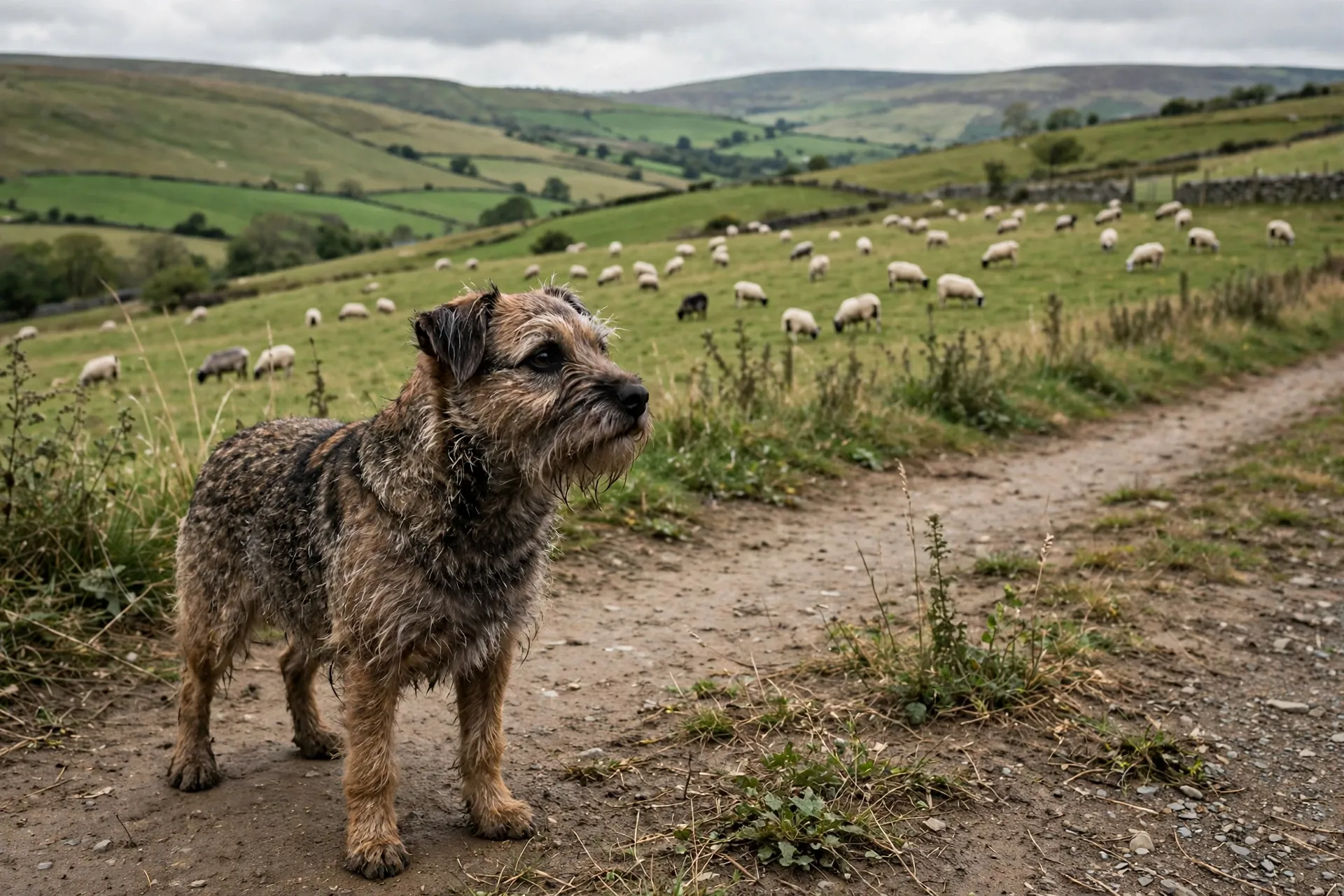
The same logic applies to choosing a region. Border terriers were developed in the Anglo-Scottish border country, a landscape of rough grazing, stone walls and mixed farms, and they remain common across the north of England and southern Scotland for good reason: the climate suits a wiry coat, the walking is varied, and many rural stays are used to small working-type dogs. That does not make every northern farm a good choice. A fell-edge cottage with open access land and hefted sheep on three sides demands a stricter lead routine than a converted barn on a mainly arable farm with a walled garden. Likewise, a lowland farm in Devon or the Cotswolds can be ideal if the garden is secure and the surrounding lanes are quiet, and a poor choice if the cottage opens straight onto a yard full of free-ranging chickens. Region matters less than the ten metres around the front door and the first field beyond it.
Before you shortlist anything, write a one-paragraph farm brief for your own dog. Note the triggers that matter most for this animal rather than for the breed in general: rabbits, squirrels, cats, poultry, sheep, other dogs, cyclists, or all of them. Note the escapes your dog has actually attempted at home — digging under a fence, squeezing through a hedge, bolting through an open door, jumping a low wall — because a holiday garden will be tested in exactly those ways. Note how long the dog can settle after excitement, and whether excitement turns into barking, digging or pacing once indoors. Hand that brief to the host with your enquiry. It does two jobs at once: it filters out properties that cannot honestly accommodate the dog, and it gives a good host the information needed to suggest the right cottage, the quieter field edge, or the garden that was re-fenced last year.
Draw a prey map for your own terrier
Prey drive is often talked about as if it were a single switch, on or off. In a border terrier it is closer to a set of separate responses, each with its own trigger, distance and speed. One dog may ignore sheep at fifty metres yet explode at a rabbit at five. Another may stalk pheasants with total focus and walk past cats without a glance. A third may be calm around livestock but lose all recall the moment a squirrel runs up a tree and starts chattering overhead. A holiday plan built on “my dog has high prey drive” is too vague to be useful; a plan built on a prey map — which creatures, at what distance, in which landscape, with what recovery time — can actually be followed on a walk.
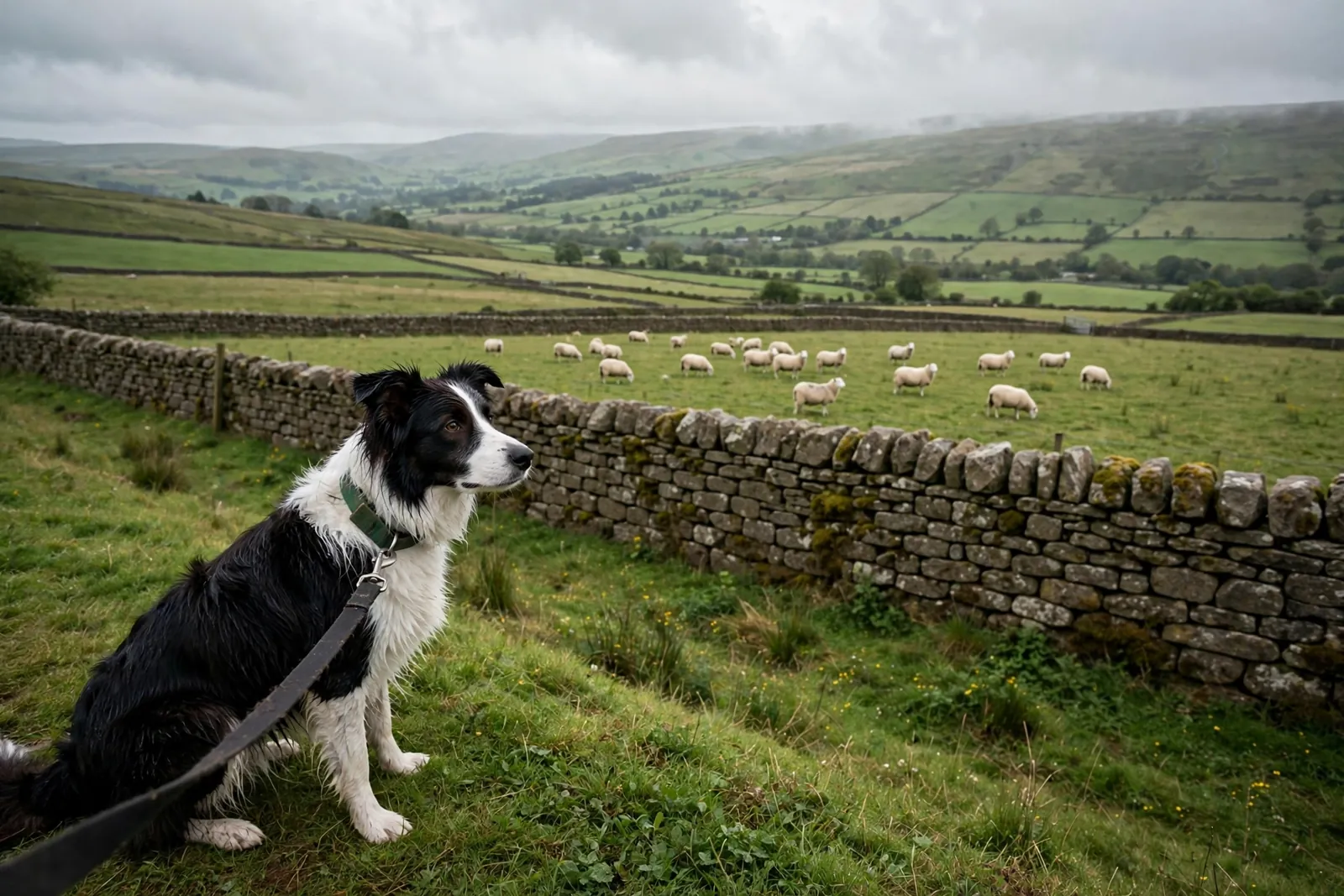
Start by listing the triggers you have genuinely seen, not the ones you assume. Rabbits and hares are the classic border terrier trigger on farmland and on the edges of woods, and they appear suddenly from cover, which is why distance control matters more than obedience in the abstract. Squirrels add a vertical problem: the dog may not leave the ground, but a tree at a path junction can hold a terrier barking and circling for ten minutes while other walkers pass. Pheasants and partridges, common on estate and farm land, flush noisily and low, which startles some dogs into a chase and freezes others into a point. Poultry is a different risk again, because hens and ducks are often behind wire that looks secure to a human and negotiable to a small dog, and because a terrier that has never met a chicken may still treat fluttering as an invitation. Sheep and cattle deserve their own category, not because a terrier is likely to bring down a sheep, but because chasing, barking at or even running through a flock counts as worrying livestock, with serious legal and welfare consequences that are covered in our guide to dog worrying livestock law in the UK.
For each trigger, record three practical facts. First, the noticing distance: how far away was the animal when the dog first reacted? Second, the response: freeze, stalk, bark, bolt, or a mix, and whether the dog could be called back at that moment. Third, the recovery time: how long after the animal vanished before the dog could walk calmly on a loose lead again? A dog that notices rabbits at thirty metres, bolts, and needs five minutes to settle needs a different walk from a dog that notices at ten metres, barks twice and reorients on a whistle. The first dog needs open-field walks replaced by enclosed or long-line routes in rabbit country; the second can often manage a hedgerow lane with a short lead and a ready recall cue. Neither dog is “good” or “bad” — they simply need different geography.
Use the prey map to choose walks, not just to warn yourself. Open moorland with distant sheep and no cover is often harder than it looks, because a terrier can run a long way before you can intervene, and because sheep may be scattered rather than in one visible flock. Enclosed woodland with a clear ride, a surfaced riverside path away from grazing, a disused railway line with good sightlines, or a secure dog field rented by the hour can all be better choices on a high-trigger day. Conversely, a quiet arable track with wide verges and no livestock, where you can see a rabbit long before the dog does, can be a training opportunity rather than a risk, provided the dog is on a long line and you are ready to shorten it. The map turns a holiday from a series of surprises into a series of decisions made in advance, which is the whole point.
Finally, be honest about recall, and test it where it matters. A recall that works in a garden, in a training class or on a familiar beach may fail completely on a farm track with fresh rabbit scent, wind carrying pheasant scent, and another dog in the distance. Before the holiday, practise recall in the most distracting place you can legally and safely access, and practise it on a long line so that failure is boring rather than dangerous. On holiday, treat the first two days as a trial: use the long line everywhere except a checked, enclosed space, and only relax the rules in a place where the dog has already proved it can cope. If in doubt, check the official guidance before you travel, and keep the dog on a lead or line — a terrier on a line is still having a holiday, while a terrier that has chased livestock is having a crisis.
The gate, fence and hedge test
Border terriers are escape artists in a size that booking photographs rarely convey. A gap that looks too small for a dog will admit a determined terrier, a hedge base that looks dense will have a badger run or a rabbit hole through it, and a gate that latches for an adult may swing open when a small dog leans on it at the right angle. The gate, fence and hedge test is therefore a physical inspection, done on foot, before the dog is allowed free run of the garden — not a glance from the cottage window while you unload the car.
Walk the full boundary with the dog on a lead, slowly, and look for six things. First, gate latches: do they self-close, can they be lifted by a paw or a nose, and is there a gap beneath the gate wider than the dog's head? Second, fence bases: is the fence buried, on a gravel board, or simply resting on soil that a terrier can dig under in minutes? Third, hedge bases: push gently at the bottom of the hedge in several places and look for tunnels, dips or daylight on the other side. Fourth, dry-stone walls: are there missing stones at terrier height, and does the wall back onto a field, a lane or a neighbour's garden? Fifth, decking and outbuildings: are there gaps under decking boards, open drains, coal holes or gaps behind a shed where a small dog could wedge itself? Sixth, the boundary beyond the boundary: if the dog did get out, would it reach a road, a flock, a river or a neighbour's poultry first? The answer decides whether a gap is an inconvenience or an emergency.
Do the test at the time of day the dog will actually use the garden. A boundary that looks secure in daylight can reveal itself at dusk, when rabbits move along the hedge line and a terrier's motivation peaks. Check again after rain, when soil softens and digging becomes easier, and after the dog has used the garden a few times, because terriers return to the same weak spot and widen it. If you find a gap you cannot fix — a shared hedge you must not cut, a stone wall that belongs to the farm, a gate that serves other guests — do not improvise with luggage or a chair. Tell the host, agree a workaround such as a long line staked in the centre of the garden or a pen for toilet breaks, and keep the dog supervised in that garden for the rest of the stay. Most hosts would far rather hear about a gap on day one than about a missing dog on day three.
Inside the cottage, apply the same test at terrier scale. Check that the front door closes fully without being pushed, that a cat flap (if present) is locked or blocked, that low windows open only on a latch a dog cannot nose open, and that the kitchen bin, cleaning cupboard and any open fireplace are out of reach. Border terriers are counter-height opportunists despite their size: a chair pushed near a worktop becomes a staircase, and a worktop with food on it becomes a target. None of this requires special equipment. It requires ten unhurried minutes before the holiday feeling takes over, and it prevents the two most common terrier holiday incidents — an escape through a boundary nobody checked, and a kitchen raid that ends with a vet call about something the dog should never have eaten.
A long-line plan for a dog that darts and digs
For many border terrier holidays, the long line is not a training compromise but the main walking system, and it deserves a plan of its own rather than a line bought the night before departure. A terrier on a long line can sniff, trot, dig at a permitted spot and cover ground, while the owner keeps the one thing that matters on farmland: the ability to stop a chase before it starts. The plan has four parts — length, attachment, handling and ground rules — and each one needs to suit a small, fast, low-to-the-ground dog rather than a generic large breed.
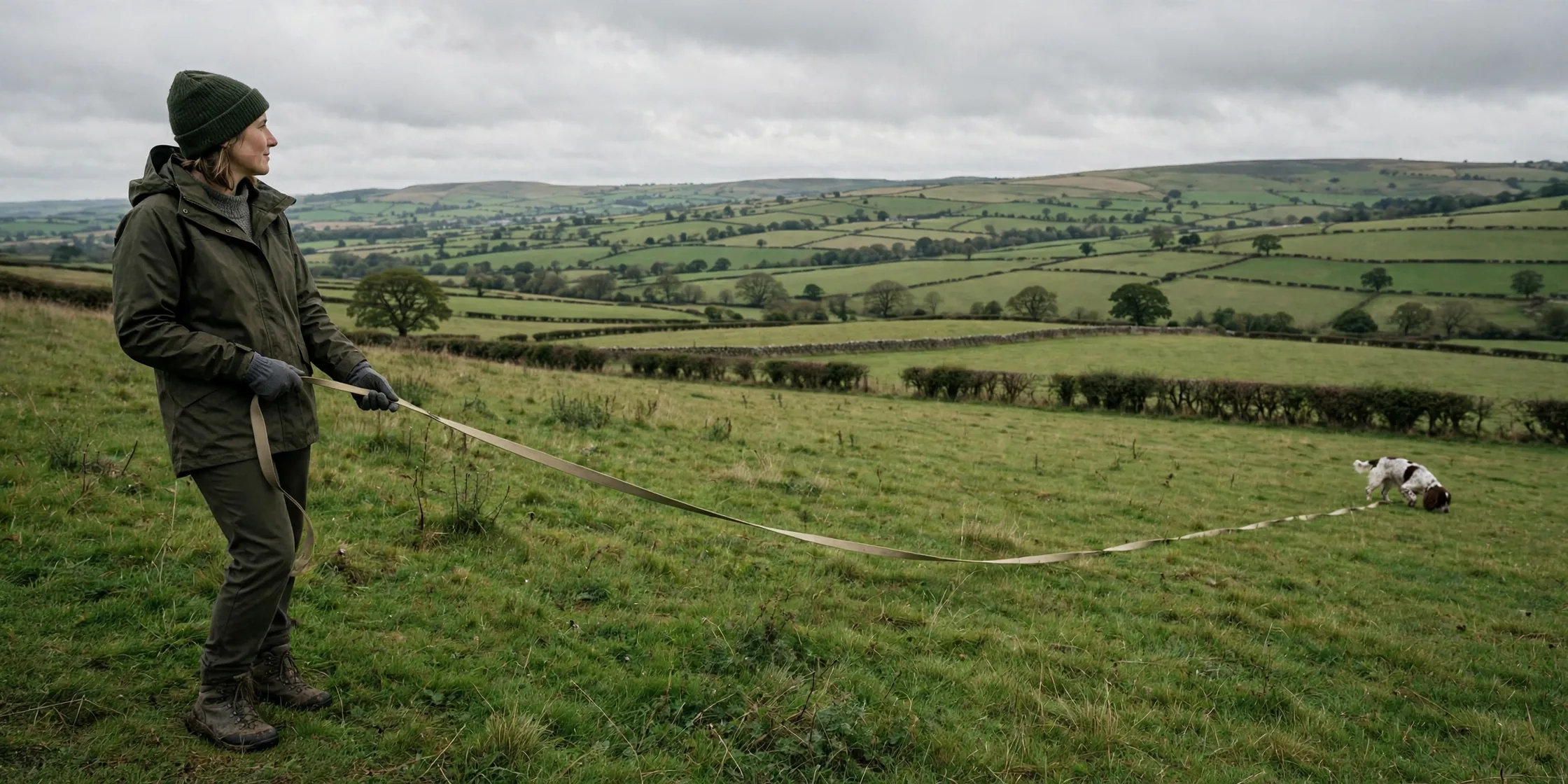
Length is a landscape decision. A five-metre line suits lanes, farm tracks and woodland rides where visibility is good and other walkers pass regularly. A ten-metre line suits open grassland, field margins and riverside paths where the dog can range without reaching a hedge or a flock. A fifteen-metre line is a specialist tool for a secure field or a wide, empty track, and it becomes a liability on a narrow path with stiles, gates or other dogs, where tangles are almost guaranteed. Most border terrier owners find that a ten-metre coated line, which resists water and mud and does not burn the hands when it runs out, covers the majority of holiday walks, with a short lead kept in a pocket for lanes, villages and livestock encounters. Our guide to choosing and using a long line for dogs in the UK covers materials, lengths and harness fitting in detail, and it is worth reading before you buy rather than after the first muddy tangle.
Attachment and handling matter more for terriers than for heavier dogs, because a sudden bolt at the end of a line can jerk a small dog off its feet if the line is clipped to a collar. Use a well-fitted harness, with the line clipped to the back ring for general walking, and practise handling before the holiday: how to gather the line without wrapping it around your hand, how to shorten it smoothly when another walker approaches, how to step on the line safely as an emergency stop on grass, and how to untangle it from brambles, fence wire and the dog's own legs without losing your temper. Gloves are not an affectation on a wet week in the Borders; a coated line running through bare hands in rain is painful, and a painful handler drops lines. Carry the line coiled, not looped around your wrist, and never tie it to a waist belt on farmland, where a bolting terrier can pull you off balance towards a ditch or a fence.
Set ground rules and keep them boringly consistent, because terriers learn the rules that are actually enforced. The line stays on until the recall has been proved in that exact place, not merely in that county. The line comes in to short-lead length whenever livestock are visible, whenever the path narrows to a hedge or a gate, whenever another dog approaches, and whenever the dog's body language changes — head up, ears forward, body low, tail still — before you can see what it has noticed. The dog is never tied to a fence, a gate or a picnic table while you go inside, however briefly, because a tethered terrier that spots a rabbit is a panicking terrier. And the line is checked every evening for nicks, mud-clogged clips and fraying at the handle, because a line that fails on day four fails at the worst possible moment. A system this simple, followed every time, gives a border terrier far more real freedom on holiday than an off-lead walk that ends in a chase, a lost dog or a farmer's complaint.
Working farm, farm park or barn conversion
The phrase “farm stay” covers at least three different holidays, and a border terrier will experience them very differently. A working farm stay means the farm is still farming: tractors move at dawn, livestock are handled in the yard, dogs belonging to the farm may be loose in their own territory, and guest access is fitted around farm work rather than the other way round. A farm park stay means a visitor attraction with animals, play areas and families: the animals are usually behind fences, the paths are surfaced, and the risks are crowds, dropped food and excitable children rather than open grazing. A barn conversion or farm cottage let means a self-catering property on former or current farmland where the farm may be next door rather than under your feet, and where the garden, the lane and the neighbours matter more than the farm label itself. Asking which of the three you are actually booking prevents most mismatches.
On a working farm, the questions are operational. What time does farm work start, and will machinery pass the cottage? Where are the farm dogs, and are they friendly, territorial or kept kenneled? Are guests allowed in the yard, the barns or the fields, or is the guest area strictly the cottage, the garden and a marked track? Is there a farm shop, a tea room or a campsite on site that brings extra footfall past the cottage door? And what happens during lambing, shearing, harvest or shooting days, when routines change and areas close? A working farm can be a superb border terrier holiday — the smells, the space, the early-morning quiet — but only if the dog's routine is planned around the farm's routine, with lead walks timed to avoid the busiest yard hours and with a clear indoor retreat when machinery, visitors or livestock movements peak. Our guide to dog-friendly farm parks in the UK is useful background here even if you are not booking a farm park, because it sets out the lead rules and livestock distances that good rural attractions expect.
On a farm park, the questions shift to crowds and containment. Is there a designated dog-walking route, or are dogs restricted to certain paths? Are dogs allowed in the animal barns, the cafe or only the outdoor picnic areas? How are the animal enclosures fenced, and is there a double-gate system at entrances where a small dog could slip through? For a border terrier, the main farm-park risks are rarely the large animals behind solid fences; they are the rabbits in the petting area, the guinea pigs in low pens, the chickens wandering a courtyard, and the ice-cream queue where a terrier can scavenge dropped food in seconds. Plan farm-park visits for quieter opening hours, keep the dog on a short lead throughout, and treat the visit as an outing rather than a day out: an hour of stimulation, followed by a calm walk and a rest, suits a terrier far better than a full day of noise.
In a barn conversion or cottage let, the questions are about neighbours and boundaries, because the farm may be a backdrop rather than a host. Who owns the land beyond the garden, and what is on it? Do neighbouring cottages have dogs, cats or poultry that wander? Is the lane outside the gate a quiet farm track or a rat-run between villages? Is there a public footpath through the garden, the yard or the field next door, and does it bring dogs, walkers and cyclists past at all hours? A barn conversion with a walled garden, a quiet lane and a nearby secure dog field can be the easiest border terrier holiday of all, precisely because it removes the working-farm variables. The same conversion with an open garden onto a sheep field and a footpath through the yard can be the hardest. The label on the listing tells you almost nothing; the answers to those four questions tell you nearly everything.
Give the digging instinct a legal outlet
Border terriers dig. It is not misbehaviour, it is the behaviour the breed was shaped for, and a holiday that offers no legal outlet for it will usually get an illegal one: a flower bed, a lawn edge, a molehill on a golf course, or the base of a fence that was secure yesterday. The solution is not to suppress the instinct for a week — that leaves a frustrated, restless dog — but to give it a planned outlet every day, in a place where digging harms nothing and where the dog can be praised for doing exactly what comes naturally.
The simplest outlet is a digging box or a designated patch agreed with the host. Before arrival, ask whether there is a corner of the garden, a sandpit, a fallow bed or a field margin where the dog may dig, and offer to fill holes and clear up afterwards. If the host agrees, bring a small spade, a few treats to bury, and a towel for paws, and make the digging session a structured game: bury a toy or a handful of kibble shallowly, let the dog find it, repeat three or four times, then stop while the dog is still keen. If no digging area is available, a portable alternative works surprisingly well: a sturdy tray or a fabric snuffle mat filled with soil or sand on a patio, used for ten minutes in the morning, can take the edge off the urge before a walk. The point is regularity, not duration. Ten minutes of permitted digging beats an hour of being told “no” at every molehill.
Scent work is the other half of the outlet, because a terrier that has used its nose hard is a calmer terrier indoors. Hide treats along a garden path, scatter kibble in long grass in a secure area, or lay a short scent trail with a dragged toy and let the dog follow it on a long line. On wet days, move the game indoors: hide treats in boxes, under cups or in rolled towels, and let the dog search room by room. These games also solve the rainy-day problem that ruins many terrier holidays, when a walk is cut short and the dog returns home still buzzing. A dog that has searched, dug and sniffed for twenty minutes will settle on a bed; a dog that has merely been walked around the block in the rain will often pace, bark or excavate the sofa cushions.
Watch for the signs that the outlet is not enough. Persistent digging at the same fence base, circling, whining at doors, or destructiveness indoors usually means the dog needs more sniffing and searching, not more miles. Adding a second scent game, a longer sniffing walk on a long line, or a secure-field run will usually help more than adding a second long walk, which can simply tire the legs while leaving the brain wired. Conversely, a terrier that digs obsessively in one spot, ignores food and cannot settle may be responding to something specific — rabbits under a shed, rats in a barn wall, a cat on the other side of a fence — and the answer is to move the dog away and ask the host what is living there, rather than to keep redirecting the same behaviour. If you are unsure whether a behaviour is normal excitement or distress, check the official guidance before you travel, and ask a vet or behaviourist rather than guessing on holiday.
The farm season calendar that changes everything
A farm in February and the same farm in August are different holidays for a border terrier, and the difference is not the weather. It is the farm calendar: lambing, calving, shearing, haymaking, harvest, game rearing, shooting and the school holidays all change which fields are in use, which animals are vulnerable, which paths are busy and which areas are closed. Booking without the calendar is how a terrier ends up on a footpath through a lambing field, or a cottage next to a shoot on a Saturday morning, or a farm park at its busiest on a bank holiday weekend.
Spring is the highest-stakes season. Lambing typically runs from late winter into spring, and ewes with young lambs are at their most vulnerable and their most easily stressed. Many farms close or divert footpaths during lambing, ask all dogs to stay on leads on all farmland, or keep guest dogs out of certain fields entirely. A border terrier that is normally reliable on a lead still needs extra distance in lambing season, because a lamb that runs will trigger a chase response in a dog that would ignore an adult ewe. If you book a spring farm stay, ask for the lambing dates, the fields in use, and whether the guest walking route changes during that period. The same caution applies to ground-nesting birds in spring and early summer on moorland and heath: a terrier running through heather can disturb nests without ever being seen to chase anything, so keep the dog on a lead or a line on open access land during the breeding season, and check the official guidance before you travel for the local rules.
Summer brings heat, harvest and crowds. Harvest means large machinery on lanes and tracks, dust, noise and fields that change from standing crop to stubble within a day, which can expose rabbits and hares that were previously hidden. It also means farm parks, beaches and popular walking routes at their busiest, with more dogs, more children and more dropped food. For a border terrier, summer planning is about timing: walk early, before the heat and the crowds, choose shaded woodland or riverside routes over exposed fields at midday, and carry water for both of you, because a small dog in a wiry coat can overheat faster than its enthusiasm suggests. Check whether the cottage has a cool tiled floor or a shaded garden corner for the hottest hours, and never leave the dog in a parked car, even briefly, on a warm day.
Autumn and winter have their own calendar. Game shooting, which runs through the autumn and winter months, means guns, beaters, dogs working in cover, and pheasants flushing across paths — a combination that can overexcite a terrier and that may close certain estate paths on shoot days. Ask the host or the estate whether shooting takes place on or near the property, and on which days, so walks can be planned elsewhere. Winter also brings shorter days, muddy ground and early darkness, which makes the after-dark toilet walk a genuine planning item rather than an afterthought: a lit, enclosed area close to the door matters far more in December than in June. Fireworks season, around early November and again at New Year, can unsettle even a steady terrier, so ask whether the farm, the village or a nearby venue hosts displays, and plan an indoor evening with scent games and a familiar bed if displays are expected. The calendar is not a reason to avoid any season; it is the tool that turns a season from a surprise into a plan.
The wiry coat on the road
A border terrier's wiry double coat is one of the breed's great holiday advantages and one of its most misunderstood features. It sheds mud when dry, resists rain better than a silky coat, and protects the dog from brambles, cold wind and rough ground. It also mats if it is washed too often, picks up burrs, seeds and ticks on every hedgerow walk, and needs a different grooming routine from a clipped or smooth-coated dog. A holiday grooming kit built for a border terrier is therefore small but specific, and it prevents the two common holiday coat problems: a dog that is miserable because its coat is matted and muddy, and an owner who makes things worse by bathing the dog every night.
Pack a slicker brush or a coarse comb, a tick remover, a small pair of blunt-ended scissors for burrs, a couple of old towels, and a drying coat if the dog will tolerate one. After each walk, let mud dry before brushing it out rather than washing it off immediately; dried mud brushes out of a wiry coat far more easily than wet mud, and repeated bathing strips the coat's weatherproofing. Check the coat, ears, armpits, belly and between the toes after hedgerow and woodland walks, because ticks, grass seeds and burrs hide in exactly those places, and a seed left between the toes can cause limping within a day. If you find a tick, remove it with a tick remover and check the site over the following days; if you are unsure about removal or the dog develops swelling, check the official guidance before you travel and contact a vet rather than improvising.
Hand-stripping, the traditional method of maintaining a border terrier coat by pulling out dead outer hair, is a planning item rather than a holiday job. If the dog is due for stripping, arrange it before the holiday or after you return, not in a cottage with no proper tools and no experienced groomer nearby. A freshly stripped dog may also be more sensitive to cold and wet, so a dog stripped just before a winter farm stay may need a coat on walks that it would not normally need. Conversely, a dog with a full, un-stripped coat in summer may overheat sooner and need shorter walks with more shade and water. Ask your usual groomer, before booking, how the coat will be at the time of travel, and plan walk lengths and drying routines around that answer rather than around a generic breed description.
Feeding and kitchen discipline belong in the coat section only because they share a cause: the small, opportunistic terrier. Border terriers are famously food-motivated, and a farm cottage kitchen — with a farm shop down the lane, a neighbour's chickens, a picnic left on a low table, or a bin without a lid — offers more temptations than a city flat. Keep food in sealed containers, keep the bin lidded and out of reach, and warn everyone in the party, including children, that feeding the dog from the table or from a picnic is not a holiday treat but a fast route to an upset stomach or a scavenged bone. If the dog does eat something it should not have, note what it was, when it happened and how much, and contact a vet promptly rather than waiting to see whether the dog seems fine. A terrier that has eaten well and been groomed simply will settle far better in the evening than one that is itchy, muddy and full of stolen food.
The booking checklist to send the host
The most useful document in this whole guide is a short message you can copy, adapt and send with your first enquiry. It replaces a vague “is the cottage dog-friendly?” with the specifics a farm host needs, and it saves a week of back-and-forth. Keep it honest, keep it short, and keep the tone friendly: you are asking a host to trust you with their property and their livestock, and a clear, responsible enquiry is itself evidence that the dog will be managed well.
- The dog in one line: age, size, and the two triggers that matter most, for example rabbits at close range and poultry behind wire.
- The boundary question: is the garden fully enclosed, what is the fence, wall or hedge made of, and are there gates that other guests or staff also use?
- The livestock question: what animals are on the farm and in the neighbouring fields during our dates, and which areas are off limits to guest dogs?
- The walking question: is there a marked guest route that avoids livestock, and where is the nearest secure area where the dog can run off the lead?
- The farm routine question: what time does farm work start, are farm dogs loose, and are there lambing, shooting, harvest or event days during our stay?
- The indoor question: where may the dog sleep, is there a tiled or wipe-clean floor area, and is there a hose, an outdoor tap or a dog-washing area?
- The emergency question: where is the nearest vet, what are its out-of-hours arrangements, and is there a local contact if the host is away?
- The honest close: the dog will stay on a lead or long line around livestock, will not be left alone in the cottage for long periods, and any damage or digging will be reported and put right.
Send that checklist before you pay a deposit, and keep the host's reply with your booking confirmation. If the reply is vague on livestock or boundaries, treat that as information, not as a reason to hope for the best: ask one follow-up question, and if the answer is still vague, choose a different property. A good farm stay for a border terrier is not the cheapest cottage with a dog-friendly label; it is the property whose host can describe the garden, the livestock and the walking route in the same detail you have just described your dog. When those two descriptions match, the holiday almost plans itself: a secure garden for mornings, a long-line walk for the middle of the day, a scent or digging game for the afternoon, and a settled terrier on a bed by the fire in the evening. That is a border terrier holiday done properly, and it starts, as it should, at the farm gate.
Practical questions
Before you go
Can a border terrier be let off the lead on a farm stay?
Only where the area is fully enclosed, free of livestock and checked for gaps, and only if the dog has a reliable recall there. On working farmland the safe default is a lead or long line, because rabbits, hares and sheep can appear suddenly and a terrier can cover ground fast.
Are border terriers good with sheep and other farm animals?
A border terrier may be calm at home and still chase or fixate on sheep, poultry or rabbits on a farm. Treat every first meeting as untested: keep the dog on a lead, keep distance, and ask the host which fields, yards and outbuildings are off limits.
What fence height and gap size keeps a border terrier in?
There is no single safe number, because terriers dig under, squeeze through and climb over barriers that look solid. Check the whole boundary on foot, including gates, hedge bases, dry-stone gaps and decking edges, and use a lead or long line until you have seen the dog settle in that exact garden.
What should I do if my border terrier chases livestock on holiday?
Get the dog back on a lead as soon as it is safe to do so, move away from the animals, and tell the farmer or host straight away. Do not wait to see whether the animals seem unhurt, because stress and injury are not always visible. Check the official guidance before you travel so you know the legal position.
How much exercise does a border terrier need on a farm holiday?
Most border terriers are busy, sturdy little dogs that need more than a short pavement walk: a mix of sniffing walks, off-lead play in a secure area and scent or digging games usually suits them better than one long forced march. Build rest into the day, especially after wet, muddy or exciting walks.
Is a farm stay suitable for a border terrier puppy?
A farm stay can work for a puppy only with extra planning: a secure toilet area close to the door, a crate or pen for unsupervised moments, short lead walks rather than long farm rambles, and a host who knows the puppy is still learning. Ask about livestock, machinery and open water before you book.