This guide is independent and contains no paid placement. If affiliate links are added later, they will be clearly marked and will not change our editorial checks.
Reach for a standard lead beside roads, in towns, near livestock and anywhere you need close, predictable control. Reach for a long line in open, low-risk space where your dog can sniff, range and rehearse recall while staying attached. Whichever you hold, clip a long line only to a back-fitting harness, shorten up early, and treat local signs and seasonal restrictions as the final word.
Pick by place, not by habit
Start with a sixty-second judgement rather than a shopping list. Ask four questions wherever you are about to unclip the car boot or step through a gate. Is there traffic, a cliff edge, a cycle path or another hazard within the distance your dog could cover in a few seconds? Could sheep, cattle, horses, nesting birds or someone else's picnic appear before you could gather several metres of line? Does this spot have a rule — a sign, a byelaw, a seasonal restriction — that expects dogs close at heel? And can you actually see the full length of line you plan to let out, end to end, without it vanishing into bracken, dunes or a crowd?
If any answer worries you, the standard lead wins and the walk stays short-lead until the setting changes. If the ground is open, sightlines are clear and nothing vulnerable is nearby, a long line earns its place. That single habit — deciding by place, every time, instead of using whichever lead happens to be in your pocket — prevents most long-line accidents before handling skill even comes into it. Many owners carry both on the same walk: short lead from the car park and through the first field, long line swapped on in the big empty meadow, short lead again for the lane home. Swapping takes seconds when the long line lives in a small stuff sack clipped to your belt or bag.
Think about the dog in front of you as well. A steady older dog that trots, sniffs and checks back often may need no more than five extra metres to feel genuinely free. A young, fast dog that hunts, chases scents and forgets you exist outdoors will test every metre you give it, plus your shoulders. Freedom on a line is not measured in metres alone; it is measured in how relaxed both ends of the line can stay.
Long line versus standard lead
A standard walking lead is usually between one and two metres long. It keeps a dog within a stride or two, which is exactly what pavements, shop fronts, station platforms, narrow footpaths and busy car parks demand. Communication is instant: a small change in tension is felt straight away, there is nothing trailing to trip a passer-by, and you can shorten to a few centimetres of webbing in a hand when a bus, bicycle or nervous stranger passes. Its limitation is equally obvious. On a short lead a dog cannot move at its own pace, veer to investigate a smell, or rehearse coming back from any meaningful distance, and constant close tension can frustrate dogs that pull or react to others.
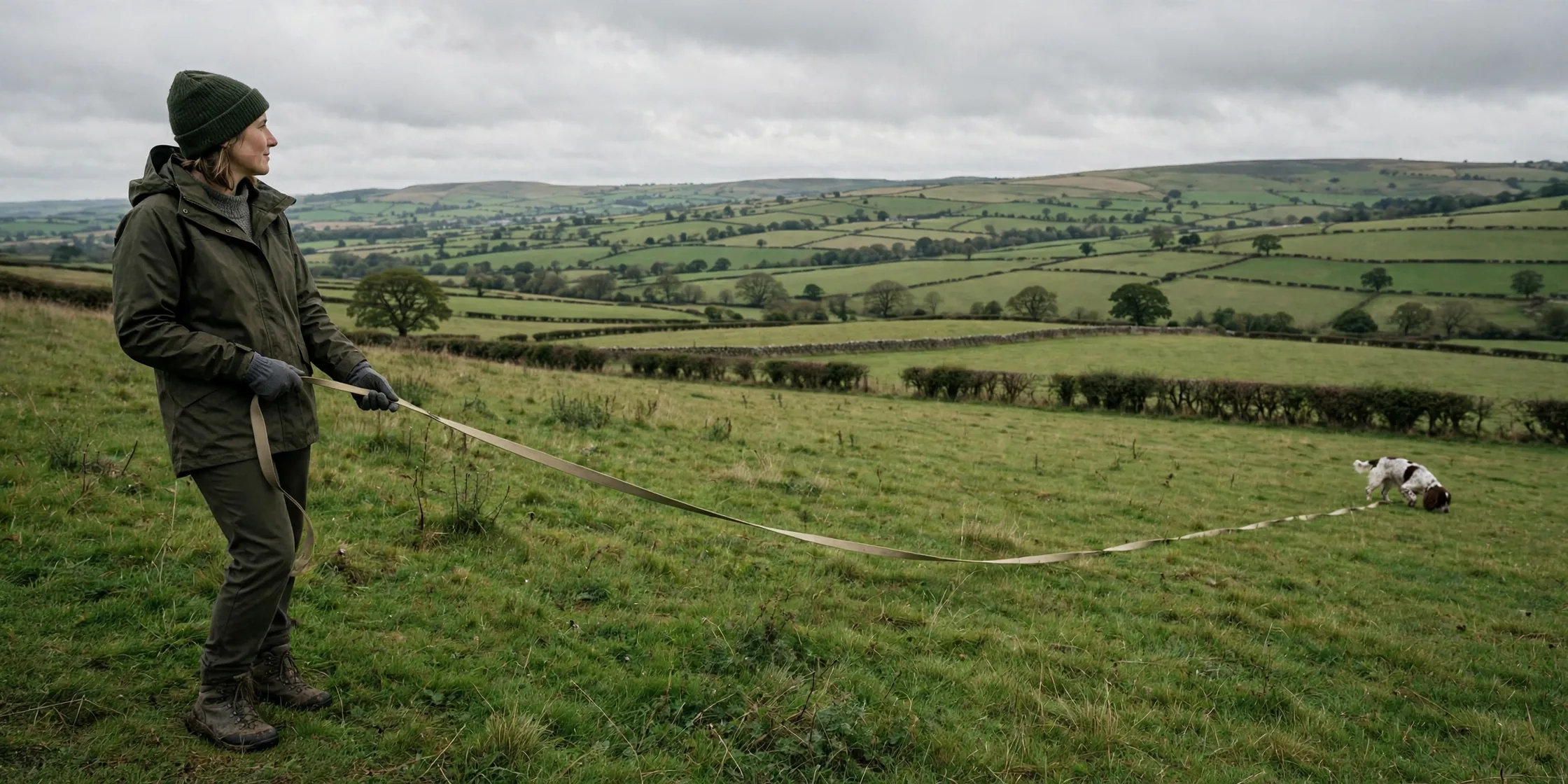
A long line — sometimes sold as a training line — is a single length of webbing, rope or coated material, commonly five, ten or fifteen metres, with a clip at one end and often no handle loop at all. Unlike a retractable lead it has no spring and no housing. It lies slack on the ground or in loose coils in your hand, and you manage it actively: feeding it out as the dog moves away, gathering it as the dog returns, and using your feet and body position as backup brakes. That slack is the point. The dog experiences something close to off-lead movement, exploring and choosing direction, while you retain a physical connection if recall fails, a rabbit bursts from cover or an off-lead dog charges over.
The trade-offs deserve honesty. A long line is slower to deploy, easier to tangle, filthier in winter mud and genuinely hazardous in the wrong hands or the wrong place: around legs, pushchairs, cyclists, other dogs and livestock it can cause harm quickly. It is a training and management tool for suitable open spaces, not an everyday pavement lead, not a tie-out to leave a dog attached to a bench or tree, and never a substitute for the close control the law and common courtesy expect in shared spaces.
Choosing 5, 10 or 15 metres
Five metres suits small gardens being used for training, secure fields, quiet verges away from traffic, puppies taking early steps in recall work and small dogs whose stride makes a longer line mostly trailing decoration. It is the easiest length to learn line handling with, because mistakes stay small: a tangle is a few loops, not a bird's nest, and you can gather the whole thing in two or three hand movements. Holiday cottages with modest enclosed gardens are another natural home for this length.
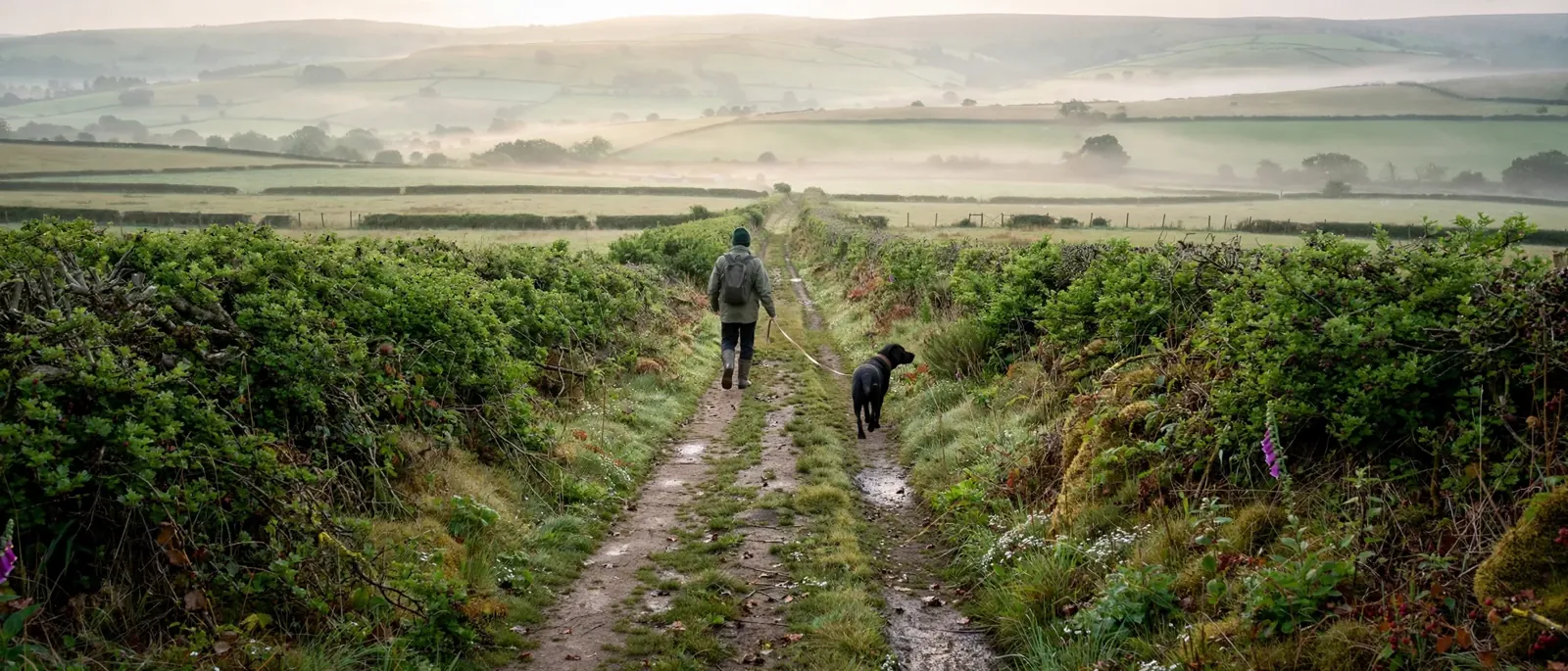
Ten metres is the length most owners settle on, and for good reason. It offers a spaniel, collie or retriever enough room to quarter a field, splash at a stream edge or arc around at a natural distance, and it gives recall practice real credibility — a dog returning ten metres has made an actual decision. Yet it remains gatherable in perhaps twenty seconds once you have a rhythm, short enough to shorten decisively when another walker appears, and light enough in most materials to carry all day in a coat pocket or small bag.
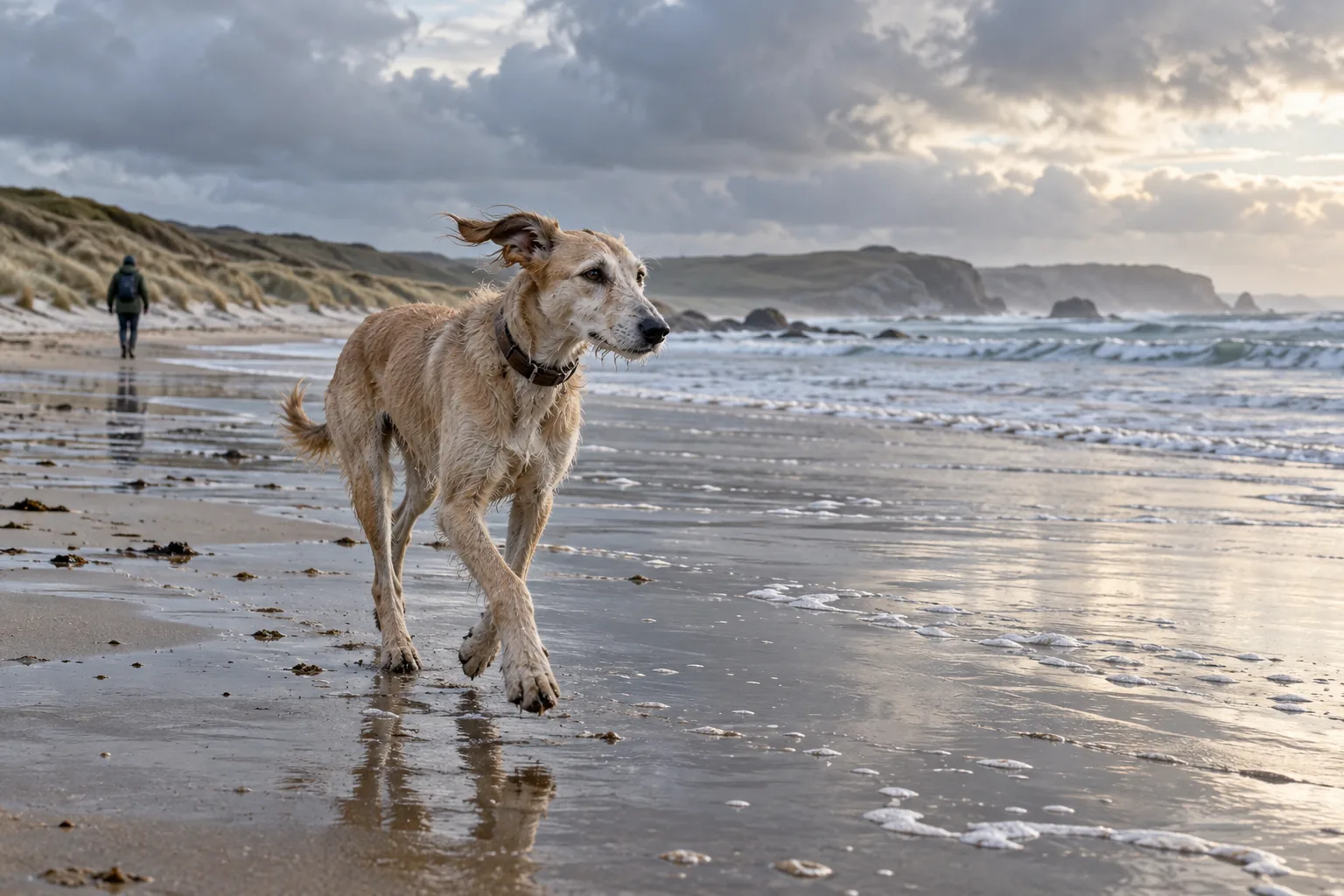
Fifteen metres belongs to wide, empty, familiar ground: big beaches at low tide outside restricted zones, open moorland paths away from stock and nesting areas, and large secure fields hired for training. The extra distance helps very fast or wide-ranging dogs and advanced recall proofing, but every added metre multiplies tangles, drag through wet grass and the time needed to reel your dog back to you in an emergency. Beginners often buy fifteen metres imagining more freedom and discover they spend the walk managing rope instead of watching their dog. Buy for the spaces you truly use weekly, not the one dramatic beach you visit twice a year — and if in doubt, choose ten.
Materials: coated, nylon or cotton
Waterproof coated webbing, widely sold under the Biothane name and similar brands, has become the default recommendation for British weather, with cause. It does not absorb water, so it stays light on a February walk instead of doubling in weight; mud, sand and worse rinse off under a tap in seconds; it slides through grass with less drag than fabric and is less prone to the musty smell that colonises a damp car boot. Its weaknesses are cost — it usually sits at the top of the price range — and a slightly slick feel in very cold or very wet hands, which is why textured or rubberised grips within the coated range are worth seeking out.
Flat nylon webbing is the budget workhorse: cheap, strong, available everywhere and easy to replace when chewed or lost on holiday. It absorbs water, picks up burrs and grit, dries slowly and can be abrasive when it runs fast through a palm, so nylon rewards glove use. Round nylon or climbing-style rope lines change the handling again: they roll rather than fold, tangle differently and can be harder to grip when muddy. Cotton and cotton-blend webbing feel kindest in bare hands and give confident grip, which trainers of small or gentle dogs often prefer, but cotton soaks up water eagerly, stretches a little when wet, takes longest to dry and wears fastest dragged across stony ground.
Whichever material you choose, inspect the details that actually fail in the field. Stitching or rivets at the clip end should be dense and even; the clip itself should be rated well above your dog's weight, open smoothly with cold fingers and resist clogging with sand — a clip packed with beach grit that will not close fully is an escape waiting to happen. Width matters too: roughly twenty millimetres suits most medium dogs, narrower for toys and small breeds, wider and heavier-duty for large, powerful dogs. Finally, avoid lines with a bulky sewn handle at the far end; a loop snags on roots, rocks and fence wire, which is why many training lines finish plain or with a simple knot you can add yourself.
Why a harness is non-negotiable
This rule has no exceptions in this guide: a long line is clipped to a harness, never to a collar. The physics are unforgiving. A dog ambling at the end of ten slack metres that suddenly spots a pheasant can reach a running pace before the line comes tight, and the stop, when it arrives, is abrupt. Attached to a collar, that energy concentrates on the throat and neck — structures that carry the windpipe, major blood vessels and nerves, and that veterinary and behaviour professionals consistently warn are vulnerable to exactly this kind of jolt. Repeated smaller jerks add up as well, and pressure around the neck is also associated with eye pressure changes and with dogs linking discomfort to whatever they were looking at, which can worsen reactivity rather than help it.
A properly fitted harness moves the stopping force onto the broad, muscled frame of the chest, sternum and shoulders. Look for a design with a back attachment point between the shoulder blades for long-line work — a front chest ring will spin a fast dog sideways at the end of the line — plus two points of adjustment so the straps sit clear of the armpits and do not restrict shoulder movement. The common fitting check applies: you should be able to slip two fingers under every strap, the chest strap should not ride up into the throat when the dog pulls forward, and the harness should stay centred rather than sliding round the ribs during a muddy hour outdoors. Dogs that back out of collars can usually back out of a badly fitted harness too, so test the fit in the garden, with the line attached, before trusting it beside a Cornish cliff path.
Practise the emergency stop kindly as well. A harness spreads force; it does not erase it. Train a verbal cue that predicts the end of the line — many owners use a cheerful warning word a moment before the line tightens — so the dog learns to turn or slow rather than hitting the limit at full tilt. That one habit protects shoulders, spines and your own footing, especially on wet grass.
Using a long line for recall
The long line earns its keep most clearly in recall training, because it lets you practise honestly. Without a line, a failed recall teaches a dog that your voice is optional outdoors. With one, you can set the dog up to succeed and gently ensure the ending: call once, enthusiastically; if the dog turns, reward the whole journey back with something genuinely worth returning for; if the dog ignores you, resist shouting repeatedly, walk backwards to make yourself more interesting, gather line steadily and guide the dog in, then make the next repetition easier by reducing distance or distraction. The line is a safety net and a quiet back-up, never a fishing reel for dragging a dog across a field, and never something to yank.
Build difficulty in layers, as any competent trainer would advise. Begin in a garden or secure field at five metres until responses are brisk and joyful, then extend distance before adding distractions, then change one variable at a time: new location, other dogs at a distance, wildlife scents, wind and rain. Keep sessions short — five to ten focused minutes inside a longer sniffy walk beats a drilled half hour — and finish while the dog is still keen. Mix easy wins between hard ones, vary rewards between food, toys and being released to sniff again, and let the dog rejoin the environment after most recalls so that coming to you does not always mean fun ends. That last point transforms reliability more than any gadget.
Know the limits, too. A long line manages risk; it does not manufacture a recall where none exists, and some dogs — those with a serious chase drive around deer or livestock, for example — may need professional, force-free training support and lifelong management in certain places rather than longer kit. If your dog struggles around other dogs specifically, our guide to holidays with a reactive dog works through distance, venue choice and daily routines in more depth.
Beaches, farmland and the law
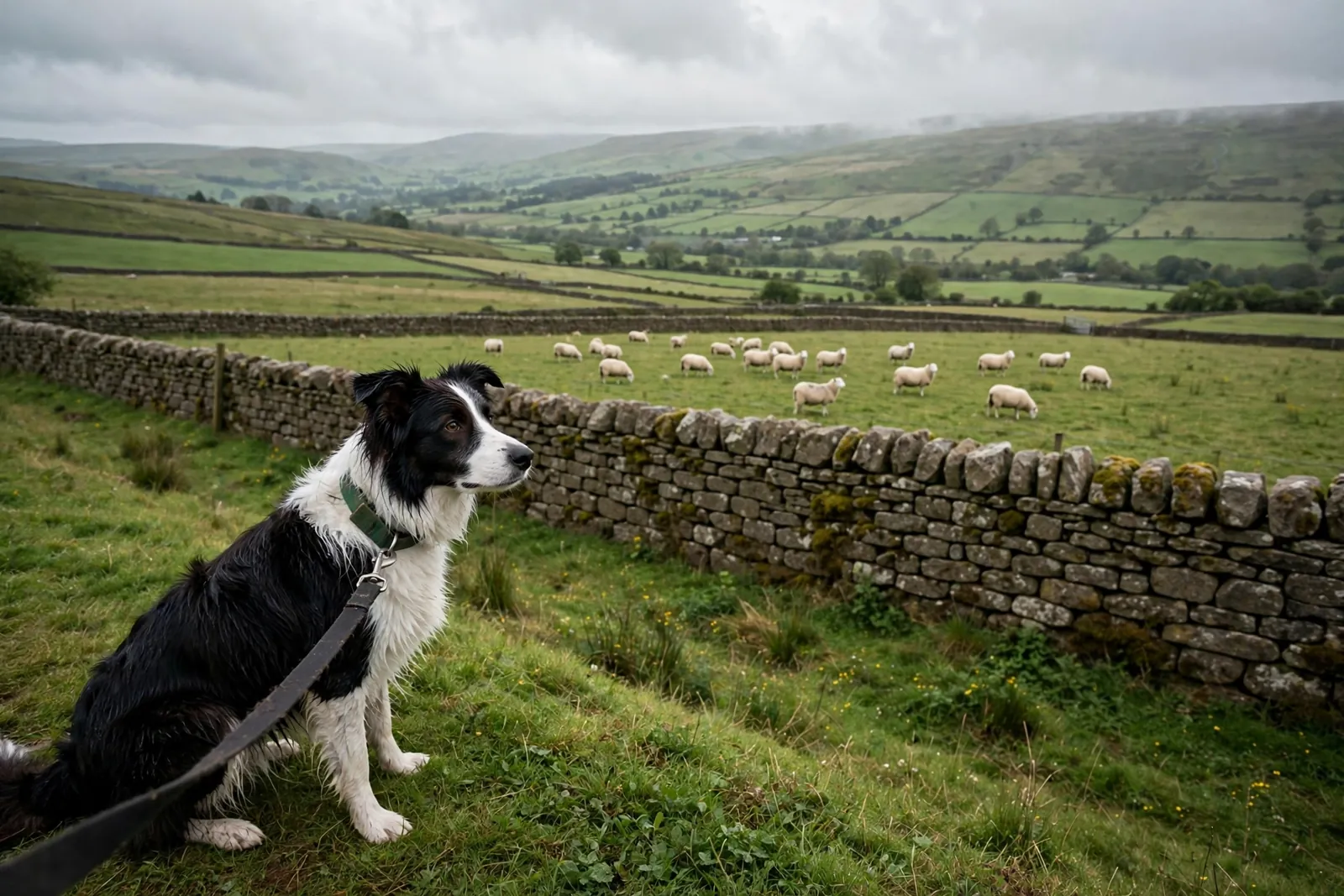
British access rules reward owners who read signs and shorten early. On farmland, the picture is clearest: keep dogs under close control around animals, and on a short lead near sheep. The Dogs (Protection of Livestock) Act 1953 makes worrying livestock — chasing, attacking or being at large among sheep in a way that causes concern — a criminal offence in England and Wales, with broadly similar protections in Scotland, and a farmer is entitled to defend stock. Our dedicated explainer on the livestock worrying law and what it means for walkers sets out the detail. During lambing, roughly late winter into spring depending on the farm, expect some fields to be effectively closed to casual wandering whatever the legal minimum says, and give ewes with lambs the widest berth you can.
Open access land in England and Wales, under the Countryside and Rights of Way Act, generally requires dogs on a short lead — no more than two metres — between 1 March and 31 July, and at all times near livestock. That window protects ground-nesting birds such as curlew, lapwing, skylark and grouse, whose eggs and chicks sit invisible in grass and heather where a ranging dog, even a gentle one on a line, can cause adults to abandon a nest. Scotland's access code asks for similarly close control during the bird breeding and lambing seasons, particularly April to July. A fifteen-metre line across a moor in May is therefore not a grey area; it is the wrong kit for that place and season, however well behaved the dog.
Beaches have their own patchwork. Many popular UK beaches restrict dogs entirely or require leads on promenades and designated sections between May and September, with exact dates and zones set locally — check the council page and the signs at each access point before travelling, because neighbouring beaches a mile apart often run different rules. Our round-up of UK beach rules for dogs, including seasonal bans and lead zones, explains how to decode them. Add the ordinary duties everywhere: pick up after your dog, keep it out of livestock enclosures and nature reserve cores when asked, respect lead-only requests on National Trust and similar land, and remember the general principle under the Animal Welfare Act and control legislation that you remain responsible for your dog's behaviour in every public place. Rules do change, so treat this section as orientation and always confirm the latest official guidance for the specific place before you set off.
Hands, gloves and tangle control
Most long-line injuries are handler injuries, and most are avoidable with three rules. Never wrap the line around a hand, wrist or fingers to get a better hold — a sudden lunge then tightens the loop on you. Never grab a line that is already moving fast; friction from nylon or rope under load can burn or cut a palm in a second. And never clip a long line to your waist or belt while walking near hazards: being pulled off your feet by the hips, facing away from the dog, is a poor position on a slope or beside water. Hold large, loose loops in one hand, let the other hand guide the working section, and use a foot placed firmly on the line as your emergency brake while you gather in.
Gloves are not an optional accessory with this kit. A grippy gardening, sailing or equestrian style glove transforms winter handling: it protects skin from rope burn, restores grip on wet coated webbing and makes gathering a muddy line a tolerable job rather than a disgusting one. In summer, thin gloves still earn their place on rope lines. Technique helps as much as fabric. Gather in arm-length sections and let loops hang large and even rather than coiling tightly around your hand; shake out tangles at the dog's end first, where they form; walk towards a snagged line instead of hauling it free, since dragging sharpens knots and pulls the line across other people's ankles. Around trees and posts, keep track of which side the dog passed — one lap of a tree converts ten metres of freedom into a pulley system pointing at trouble.
Protect bystanders with the same awareness. Call a cheerful warning and gather in early when cyclists, runners, children or other dogs approach, because a slack line lying across a path is nearly invisible and trips people at ankle height. With two dogs, use one line per dog only if you are experienced and the space is generous; lines braid themselves together with impressive speed, and two excited dogs plus twenty metres of webbing is a puzzle nobody solves gracefully. When in doubt, shorten, step aside and let the world pass — the meadow will still be there in thirty seconds.
Retractable leads: honest trade-offs
Retractable leads tempt holidaymakers because they promise long-line freedom without line handling: a spring-loaded cord or tape, usually three to eight metres, housed in a plastic handle with a thumb brake. In a quiet, familiar park with a small, steady dog they can be convenient, and the constant light tension suits dogs that dislike a trailing line. That is a fair summary of the advantages, and for some pairings the arrangement works for years without incident.
The disadvantages are structural rather than a matter of taste. Constant tension teaches a dog that pulling extends the lead, which works directly against loose-lead walking. Thin cords can slice skin — your own, a child's, or another dog's legs — when a dog circles at speed, and cord wrapped around a leg under load is a recognised cause of nasty injuries. The brake is a single small mechanism: drop the handle and it clatters behind the dog, terrifying many animals into bolting; let the cord retract unchecked and the clip whips back towards your face. You also get far less feel than with a line in your hands, and most retractable units are simply too flimsy for a large dog's full-force lunge. Many training classes, secure fields and some parks and beaches restrict or ban them for these reasons. If you use one, keep it locked short near people, roads and other dogs, choose tape over cord, inspect the tape weekly for fraying, and never attach it to a headcollar. For genuine recall training and open-space freedom, though, a proper long line remains the safer, clearer tool.
Packing, cleaning and storage
Long lines travel well when they travel in their own bag. A small drawstring stuff sack or old washbag contains the mud, stops the clip scratching everything else in the boot and makes the swap from short lead to line a one-handed job at a gate. Pack the harness alongside it so the pair live together, add gloves in winter, and carry a spare standard lead always — lines get chewed, lost and once, memorably, left draped over a gatepost in another county in every owner's life eventually. In a hire car or holiday let, a line rinsed and hung over a bath or outdoor tap overnight keeps smells out of the living space.
Cleaning depends on material. Coated webbing needs warm water, a cloth and, for stubborn grime, a drop of washing-up liquid; avoid harsh solvents that can damage the coating. Nylon benefits from a soak in warm soapy water, a rinse and a full air-dry before storage, since mildew sets in fast in a sealed bag. Cotton needs the longest drying time and should never be packed away damp for a long drive home. Sand deserves special attention wherever you walk: rinse clips under a tap and work the gate open and closed until it snaps shut cleanly, because a gritty clip is both an escape risk and a frayed-line risk where sand acts like sandpaper inside webbing folds.
Store the line loosely coiled or figure-eighted, out of direct sunlight that degrades most fabrics over time, and inspect it monthly along its whole length. Retire any line with deep cuts, crushed sections, loose stitching at the clip or a clip that no longer closes crisply. A line is cheap compared with the consequences of one failing at full stretch, so err towards early replacement — and keep the retired one, clearly marked, only for garden games where nothing depends on it, or simply bin it to avoid confusion.
Matching kit to your dog
Size the system to the dog's weight, speed and style rather than breed labels alone. Small dogs under about ten kilograms do best on a narrow, lightweight five or ten metre line with a small clip: a heavy clip and thick webbing drag on a little neck-free harness frame, tire the dog and change how the line behaves, snagging where a lighter line would float over grass. Choose a harness sized for small bodies rather than a scaled-down bulky design, and be extra vigilant about tangles around short legs.
Medium dogs — the spaniels, collies, cockapoos and staffies that fill British footpaths — are the natural audience for a standard twenty-millimetre ten-metre line in coated webbing, a mid-weight clip and a two-point-adjustable harness. Strong or fast medium dogs that hunt and quarter deserve the wider, heavier end of that range. Large and giant dogs, and any dog that can pull an adult off balance, need width, stitching and a clip rated with real margin, plus an owner honest about whether a fifteen-metre line is controllable at all: for many big dogs, ten metres handled well beats fifteen handled hopefully. Puppies warrant a lighter line again, shorter sessions and ground chosen for softness, since their joints and attention spans are both still developing — and a dragged line must never be left on an unsupervised puppy, indoors or out, because chewing and tangling happen in seconds.
Whatever you buy, do a garden rehearsal before the holiday. Clip on, let the dog mooch, practise gathering, stepping on the line, calling the warning cue and swapping back to the short lead at a pretend gate. Ten unhurried minutes at home will show you a bad harness fit, a clip your cold fingers hate and a line length that fights you — all far better discovered beside your own kettle than beside a reservoir in the rain.
Practical questions
Before you go
How long should a long line be for most dogs?
For most owners, 10 metres is the practical starting point. It gives a dog room to range, sniff and practise recall without creating the constant tangles of a 15-metre line. Choose 5 metres for small spaces, pavement-adjacent verges and younger puppies, and reserve 15 metres for wide open ground where you can see the whole line at once.
Why must a long line clip to a harness and not a collar?
A dog that reaches the end of a long line at speed stops suddenly, and that force has to go somewhere. On a collar it lands on the neck and throat, which can injure delicate structures. A well-fitted harness with a back attachment spreads the load across the chest and shoulders instead.
Can I use a long line near sheep and cattle?
Shorten up well before livestock and keep your dog close and calm. In fields with sheep, cattle or horses, a long line is usually the wrong tool: use a short lead, give animals a wide berth, and follow local signs. Worrying livestock is an offence, and farmers may act to protect their animals, so distance is always the safer choice.
Is a retractable lead the same as a long line?
No. A retractable lead keeps constant light tension, uses a thin cord or tape that can cut skin, and relies on a thumb brake that can fail or be dropped. A long line lies slack, is gathered and released by hand, and gives clearer signals for recall training. Each suits different places, and neither replaces a short lead beside roads.
How do I stop a long line burning or cutting my hands?
Never wrap the line around your hand or fingers, and never grab a moving line bare-handed. Wear grippy gloves, let the line slide through a loosely closed hand only when the dog is moving slowly, and step on the line or gather it in large loops to slow a dog down. Waterproof coated webbing is kinder on skin than thin nylon cord.