This guide is independent and contains no paid placement. If affiliate links are added later, they will be clearly marked and will not change our editorial checks.
Boroughbridge is a compact, easy-going base for a dog: start at the stone bridge over the River Ure, walk the riverside grass and the canal towpath, visit the Devil's Arrows standing stones on a lead, and finish in a dog-friendly pub. Keep your dog on a lead near roads, livestock and anglers, carry water and waste bags, and check the official guidance before you travel for current access, parking charges and pub policies.
The bridge, Devil's Arrows and town history
Boroughbridge exists because of a crossing. The town grew up where the Great North Road — the old main route between London and Edinburgh — met the River Ure, and for centuries travellers, drovers, soldiers and traders all had to pass through this one narrow point. That history is still visible in the town today: the wide High Street that once held coaching inns and markets, the stone bridge that carries traffic over the river, and the quiet lanes that fan out towards the surrounding villages. For a dog walker, it means a town that is compact, flat in the centre and easy to explore on foot, with the river always close by and a new direction to try at the end of almost every street.
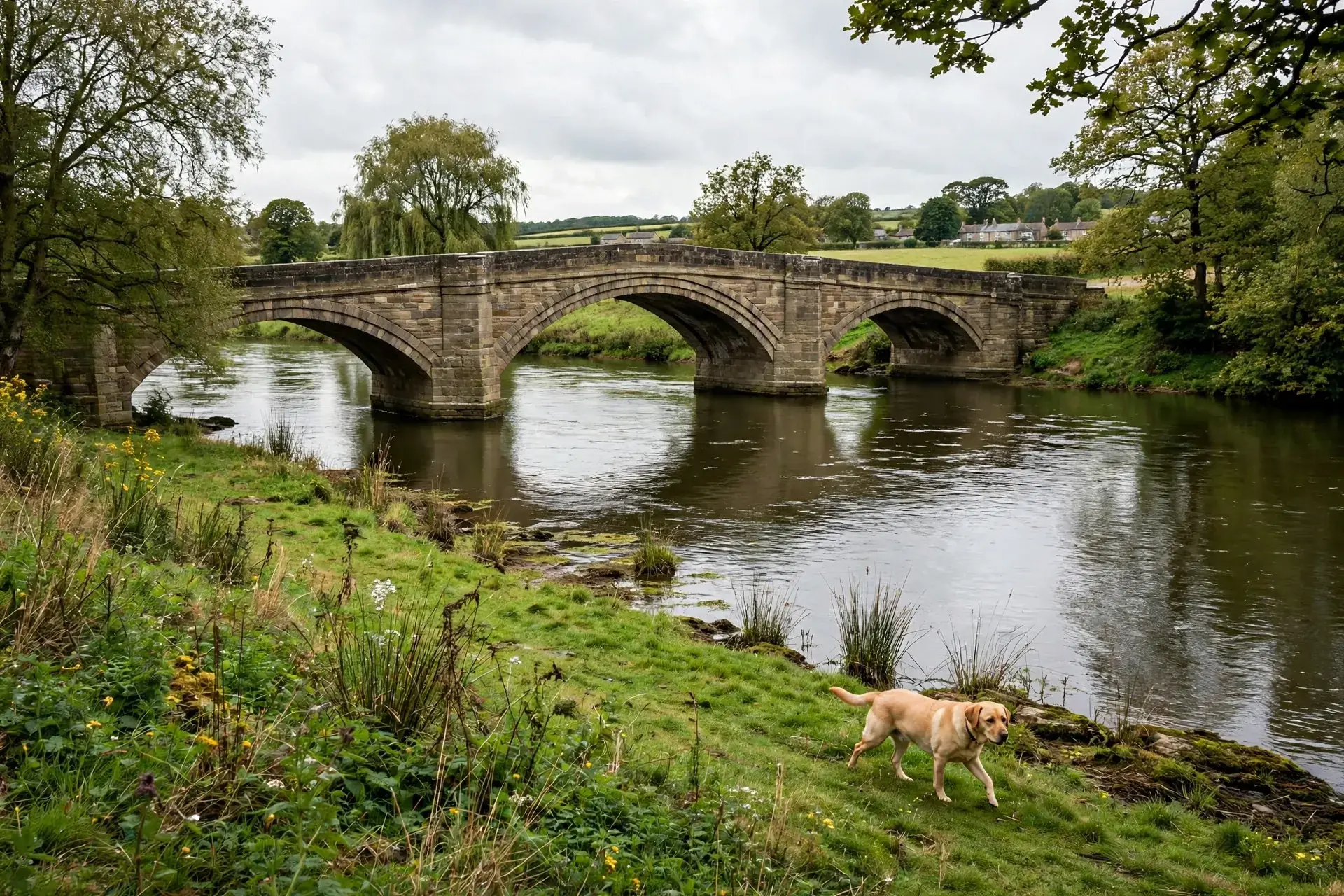
The bridge itself is the natural starting point for any visit. Stand on it with your dog and you get the whole town in one view: the river sliding beneath the arches, the riverside trees and grass on the banks, the rooftops of the High Street behind you and the open farmland of the Vale of York stretching away in the other direction. It is a working bridge, not a quiet footbridge, so keep your dog on a short lead and close to your side while you cross. Traffic can be steady, the pavements are narrow in places, and a dog that lunges at passing lorries or bicycles will have a much better day if you cross briskly and save the sniffing for the riverside paths below.
A short walk from the centre, on the southern edge of the town, stand the Devil's Arrows: three huge gritstone monoliths that have marked this landscape for around 4,500 years. They are among the tallest prehistoric standing stones in Britain, and they were already ancient when the Romans arrived, when the medieval bridge was built, and when the coaching inns filled the High Street. Nobody knows exactly why they were raised — they may have marked a ceremonial route, a boundary or a gathering place — but their sheer size makes them impossible to ignore. The tallest leans slightly, as if it has been listening to the road for millennia, and on a clear evening the stones catch the low sun in a way that makes even a routine dog walk feel like a small piece of history.
Visiting the Devil's Arrows with a dog is straightforward, but it needs a little planning. The stones stand in fields beside a road, with no visitor centre, no cafe, no toilets and no dedicated dog facilities. Keep your dog on a lead throughout the visit: the stones sit close to traffic, and the surrounding fields may hold livestock at different times of year. Take waste bags with you and take everything away again, because there are no bins at the stones themselves. The ground is grass and can be muddy after rain, so wear boots and bring a towel for muddy paws if you are heading back into the car or into a pub afterwards. It is a short visit — ten or fifteen minutes is enough to walk around the stones and take in the scale of them — but it pairs naturally with a longer riverside or countryside loop, and it is one of those stops that turns an ordinary walk into a story worth telling when you get home.
The Roman layer of Boroughbridge sits just to the south-east at Aldborough, and it is worth understanding before you walk that way. Aldborough was once Isurium Brigantum, the Roman town that served as the administrative centre for the Brigantes, the largest tribal group in northern Britain. The modern village is quiet and small, but beneath its gardens and lanes lie the remains of a walled Roman town, including mosaics that have been found in the area and a museum that holds finds from the site. You do not need to be a Roman history enthusiast to enjoy the walk there: the lanes between Boroughbridge and Aldborough are flat, hedged and full of birdsong, and the sense that you are walking a route people have used for two thousand years adds a quiet pleasure to a simple dog walk.
The town's later history is written in its buildings. Boroughbridge was a parliamentary borough in the eighteenth century and a coaching town on the Great North Road, which explains the generous width of the High Street and the number of former inns along it. The Battle of Boroughbridge in 1322, fought just outside the town during the reign of Edward II, is commemorated locally, and the town's position on the river made it a useful crossing point for armies as well as traders. None of this needs to be memorised before you visit, but it helps to know why the town feels the way it does: it was built for people passing through, which is why it is so easy to arrive, park, walk, eat and leave again without fuss — and that is exactly what makes it work well for a day out with a dog.
For the practical dog walker, the history matters in one more way: it explains the shape of the walks. The river, the canal, the old road and the lanes to Aldborough all radiate from the same small centre, so you can build a walk of almost any length without ever needing a car. A thirty-minute riverside stretch, a two-hour loop to the standing stones and back, or a half-day ramble to the Roman site are all variations on the same map, and you can shorten or extend them as your dog's energy dictates. Start at the bridge, learn the town's layout on your first short loop, and the longer routes will make sense on their own.
The River Ure riverside loop
The River Ure is the heart of Boroughbridge for dog walkers. It rises in the Yorkshire Dales, flows through Wensleydale and past Ripon, and by the time it reaches Boroughbridge it is a broad, steady river with grassy banks, overhanging trees and a path that invites a slow walk rather than a march. The riverside is where most dogs will be happiest: there is grass to sniff, water to watch, ducks and moorhens to observe from a respectful distance, and enough open space for a dog to relax without the constant stop-start of a town pavement.
A sensible first walk starts at the bridge and follows the riverside path downstream, away from the traffic, letting the town fall quiet behind you. The path is mostly level grass and earth, with trees giving shade in summer and shelter in a shower. Keep your dog on a lead for the first stretch, especially where the path runs close to the road or where anglers have set up along the bank. Anglers are a regular sight on the Ure, and a dog that plunges into the water beside a fishing line will not make friends quickly. If your dog is a swimmer, look for a quiet, shallow entry point away from other river users, check the current and depth first, and only let them in if the water is calm and the bank gives them an easy way out.
The river can be dangerous after heavy rain. The Ure rises quickly when the Dales have had a wet week, and a bank that is dry and inviting in the morning can be under water by the afternoon. If the river is running high, brown and fast, keep your dog well back from the edge and on a lead, and do not let them swim at all. Flooded riverside grass hides uneven ground, and a dog that slips on a steep, muddy bank can struggle to climb out. Check the official guidance before you travel if there has been heavy rain, and be prepared to swap the riverside for the canal towpath or the lanes, which stay drier for longer.
For a longer loop, cross the river at the bridge and explore the far bank, then return along the opposite side where the path allows. Not every stretch of both banks is a public right of way, so follow the signed paths and the waymarkers rather than assuming you can walk the whole river in a circle. A good rule is to treat the riverside as a series of out-and-back walks rather than one fixed loop: walk out for twenty minutes, turn around when your dog starts to slow or when the path narrows, and you will have had a proper walk without ever worrying about where the path ends. This approach also suits older dogs, puppies and dogs that are still building fitness, because you control the distance exactly.
Wildlife is part of the riverside experience and part of the responsibility. The Ure at Boroughbridge is home to ducks, swans, herons, kingfishers and moorhens, and the fields beside the river may hold sheep or cattle. A dog with a strong chase instinct needs a lead near water birds and livestock, and even a gentle dog should be recalled before it reaches a nesting area in spring. Keep an eye out for swans in particular: they are protective of their young and can be aggressive if a dog gets too close, and a confrontation in the water is dangerous for both animals. The best riverside walks are the quiet ones, where the dog sniffs, the birds keep their distance, and nobody has to intervene.
What to carry on the riverside is simple but worth listing: water and a collapsible bowl, because the river is not a safe drinking source for every dog and some dogs drink too much river water and feel unwell afterwards; waste bags, because the riverside is a shared space and there are not bins at every turn; a long line if your dog's recall is still a work in progress, so they can enjoy the grass without you worrying about the road or the river; and a towel in the car for wet or muddy paws. In summer, add sun awareness: the riverside has shade, but a dark-coated dog on a hot day still needs rest, water and a shaded stop, and the walk should be done early or late rather than at midday.
The riverside is also where Boroughbridge shows its gentlest side. Early mornings bring mist on the water and the sound of birdsong, and the paths are often empty except for a few local dog walkers who know every bend of the river. Evenings bring long light across the grass and the chance of a kingfisher flashing past. If you are staying overnight, make the riverside your first walk of the morning and your last walk of the evening: it settles the dog, it shows you the town at its best, and it costs nothing at all.
The canal and towpath walks
Boroughbridge sits close to the Ripon Canal, a short, peaceful waterway that links Ripon to the River Ure, and its towpath offers a completely different kind of walk from the river. Where the Ure is broad and open, the canal is narrow, straight and sheltered, with hedgerows, wildflowers and the occasional narrowboat moving slowly through a lock. It is the walk to choose when the river is high, when you want a flat and predictable route, or when your dog prefers a quiet, enclosed path to open water.
The towpath surface is generally firm and level, which makes it a good option for older dogs, dogs recovering from injury, puppies that are still building up their walking distance, and owners pushing a buggy alongside a dog. The walking is easy, but the discipline is the same as on the river: keep your dog on a lead near the water's edge, near lock gates and near moored boats, and do not let them jump into the canal. Canal water is still, deep in places and often murky, and a dog that falls in at a lock or a bridge hole can find the steep sides hard to climb. A lead and a little attention remove almost all of the risk.
Narrowboats are part of the charm of the canal, and they deserve respect. A boat moving through a lock is slow but heavy, and the crew will be focused on ropes and gates rather than on a dog running loose on the towpath. Keep your dog close when a boat is passing, give the crew space at locks, and do not let your dog bark at boats or chase them along the bank. Most boaters are dog owners themselves and will be happy to say hello, but a calm dog on a lead makes that greeting easy and a barking dog makes it tense.
The canal walk also connects naturally with the wider countryside. From the towpath you can pick up field paths and quiet lanes that lead back towards Boroughbridge or out towards the surrounding villages, and the flat landscape of the Vale of York means there are few hills to worry about. In spring the hedgerows are full of blossom and birdsong, in summer the towpath is shaded by trees, in autumn the leaves turn and the canal reflects the colours, and in winter the water can be still and misty in the early morning. It is a walk that rewards repetition: the same stretch looks different every season, and a dog that knows the route will settle into it quickly.
One practical note: the canal is a working waterway with locks, and lock areas can be slippery when wet. Keep children and dogs away from the edge of lock chambers, watch for wet stone and metal fittings, and do not let a dog run across a lock gate or a narrow bridge. If you are walking with a reactive dog, the towpath's narrowness can be a challenge when another dog approaches head-on, so be ready to step aside onto a wider section or a field entrance and let the other walker pass. A little courtesy on a narrow path goes a long way, and it keeps the canal a pleasant place for everyone.
For a half-day outing, combine the canal with the river. Walk the towpath in one direction, cut across the lanes to the riverside, and return along the Ure to the bridge. The two waters give the walk variety — the canal's quiet straightness and the river's open curves — and the lanes between them pass through farmland and hedgerows that are full of smells for a dog. Take a map or a phone with offline maps saved, because the field paths are not always obvious, and check the official guidance before you travel for any temporary path closures or diversions.
Walks toward Aldborough and the countryside
The walk from Boroughbridge to Aldborough is one of the best short countryside walks in the area, and it suits dogs perfectly. The route is about a mile and a half each way along quiet lanes and field paths, flat for almost the whole distance, and it ends in a village that feels a world away from the main road. Aldborough is small, quiet and green, with a village green, a church and the remains of the Roman town beneath its streets. It is the kind of place where a dog walk becomes a proper outing rather than just exercise.
Start from the town centre and follow the lanes south-east, keeping your dog on a lead on the road sections and letting them enjoy the hedgerows and verges where it is safe. The lanes are narrow and can carry the occasional car or farm vehicle, so walk facing oncoming traffic where there is no pavement, keep the dog on your inside, and be ready to step onto a verge. The fields along the way may hold livestock, and the hedgerows are home to nesting birds in spring, so a lead is the right choice for most of the route even where the road is quiet.
In Aldborough itself, take time to walk around the village green and the churchyard, keeping your dog on a lead and respecting the fact that this is a residential village rather than a tourist attraction. The Roman heritage is mostly underground, but the museum and the visible remains give a sense of the town that once stood here, and the village's quiet lanes are a pleasure to wander with a dog that is happy to sniff and stroll. There is no guarantee of a cafe or shop being open in the village, so bring water and treats with you and plan your food stop back in Boroughbridge.
Beyond Aldborough, the countryside opens out into the flat farmland of the Vale of York, with field paths, bridleways and quiet lanes linking a string of small villages. Longer walks can take in the villages of Minskip, Roecliffe and Bishop Monkton, each with its own character and its own lanes to explore. These are walks for a dog that is fit and well-behaved on a lead, because the routes cross farmland, pass through gates and stiles, and may involve crossing fields with livestock. Check that your dog can cope with stiles — some have a gap beside them for dogs, others do not — and be prepared to lift a smaller dog over or to find an alternative route.
Stiles, gates and livestock deserve a paragraph of their own, because they are the difference between a good countryside walk and a frustrating one. Always close gates behind you, even if they were open when you arrived. Keep your dog on a lead in any field with livestock, and if cattle approach, keep calm, keep the dog close and walk steadily towards the nearest exit rather than running. Sheep are easily startled, and a dog chasing sheep is not only frightening for the animals but can have serious legal consequences for the owner. The countryside around Boroughbridge is a working landscape, and a dog walker who respects it will be welcome back.
For a longer day, Boroughbridge also makes a good starting point for walks into the lower Dales and towards Ripon, but those are car journeys rather than walks from the town centre. The town's own countryside is enough for most visits: a morning walk to Aldborough, a riverside loop in the afternoon, and a short evening stroll along the canal will give a dog a full and varied day without ever needing to drive. If you are staying for several days, vary the direction each morning — river one day, canal the next, Aldborough the day after — and your dog will have a different set of smells and sights every time.
Navigation matters on countryside paths. The field paths around Boroughbridge are public rights of way, but they are not always waymarked as clearly as a national trail, and a hedge or a ploughed field can hide the line of a path. Carry a map, keep your phone charged, and download an offline map before you set out. If a path is blocked or a field has been ploughed across the right of way, do not force a way through: turn back, take the lane instead, and report the problem to the local authority if you can. Check the official guidance before you travel for any known closures, and remember that a walk that is shortened by a blocked path is still a good walk.
Pubs, cafes and food stops
Boroughbridge is a market town with a proper pub and cafe tradition, and several of its pubs and cafes welcome dogs. That matters more than it sounds: a dog-friendly town is not just one with good walks, it is one where you can sit down, rest your feet, eat properly and let the dog settle beside you without feeling like an inconvenience. The town's pubs, many of them former coaching inns, tend to have the kind of bar areas, flagstone floors and open fires that suit a muddy dog far better than a white-tablecloth restaurant ever could.
The usual pattern in Boroughbridge, as in most North Yorkshire market towns, is that dogs are welcome in the bar area and on the terrace, but not necessarily in the restaurant or dining room. That distinction is worth checking before you sit down: ask at the bar, confirm where dogs are allowed, and choose a table that gives your dog space without blocking a walkway. A corner table near the door is often the best spot, because it lets the dog watch the room without being in the middle of it, and it makes a quick exit for a toilet break easy. Bring a mat or a blanket for the dog to lie on, because pub floors can be cold and hard, and a dog that has its own place to settle will be calmer than one left to improvise.
Water is the small detail that makes a pub stop work. Some pubs will offer a water bowl without being asked, but do not rely on it: carry a collapsible bowl and ask for a jug of water when you order. Order food that you can eat without the dog begging at every bite — a sandwich or a pie is easier to manage than a meal that needs both hands and constant attention — and keep treats in your pocket so you can reward the dog for settling quietly. If your dog is not used to pubs, keep the first visit short: a drink and a snack rather than a full three-course meal, so the dog learns that pubs are calm places and you learn how they behave in one.
Cafes in the town centre offer a lighter option, and several welcome dogs inside or on an outdoor seating area. A cafe stop is ideal for a mid-walk break: a coffee, a cake and a rest for the dog before the second half of the walk. Outdoor seating is the most reliable bet in summer, when the High Street is bright and the pavements are busy, but in winter an indoor dog-friendly cafe is worth its weight in gold. As with pubs, ask first, keep the dog on a lead, and choose a table where the dog can lie down without tripping passers-by.
Takeaway food is the fallback that every dog owner should keep in mind. If the pub is full, the cafe is closed, or the dog is too tired or too muddy to sit inside, a takeaway eaten on a bench by the river or on the grass near the bridge is often the best meal of the day. Boroughbridge has takeaway options in the centre, and a riverside bench with a dog at your feet is a hard combination to beat. Just remember to take all litter away with you and to keep the dog from begging from other picnickers.
A word about behaviour in pubs and cafes: the dogs that are most welcome are the ones nobody notices. A dog that lies quietly under the table, ignores other dogs, does not bark at the door and does not steal food from neighbouring tables will be welcomed back every time. A dog that barks, lunges or begs will not, however friendly it is at home. If your dog is still learning pub manners, practise at home first — settling on a mat, ignoring food on a table, staying calm when the doorbell rings — and keep pub visits short until the behaviour is reliable. The town's pubs are a pleasure for a well-behaved dog, and a little preparation keeps them that way.
Market, shops and town centre
Boroughbridge's town centre is small, walkable and dog-friendly in the practical sense: the High Street is wide, the pavements are mostly generous, and the whole centre can be crossed on foot in a few minutes with a dog on a lead. It is a working market town rather than a tourist showpiece, which is part of its appeal. The shops serve local people as well as visitors, the pace is unhurried, and a dog walker with a muddy spaniel will not feel out of place.
The town holds a market, and market day is the best day to visit if you want to see Boroughbridge at its liveliest. Stalls sell local produce, plants, baked goods and household items, and the High Street fills with people browsing, chatting and buying. For a dog, a market is a sensory feast — and a test of manners. Keep the dog on a short lead, keep them close to your side, and be ready to move aside when the street gets crowded. Not every dog enjoys a busy market, and a nervous dog will have a better day if you visit early, when the stalls are setting up and the crowds are thin, rather than at midday when the street is at its busiest. Check the official guidance before you travel for the current market day and times, as these can change.
Shops in the town centre vary in their dog policies. Some independent shops welcome dogs inside, others prefer dogs to wait outside, and a few will have a water bowl by the door for passing dogs. The honest rule is to ask before you enter with a dog, and to respect a polite no without argument. A dog that waits patiently outside a shop for two minutes while you buy a paper or a sandwich is a well-trained dog, and it is worth practising that skill before you visit. Never tie a dog up outside a shop and leave them unattended for more than a moment, and never leave a dog tied up where they can be approached by strangers or other dogs without you there to intervene.
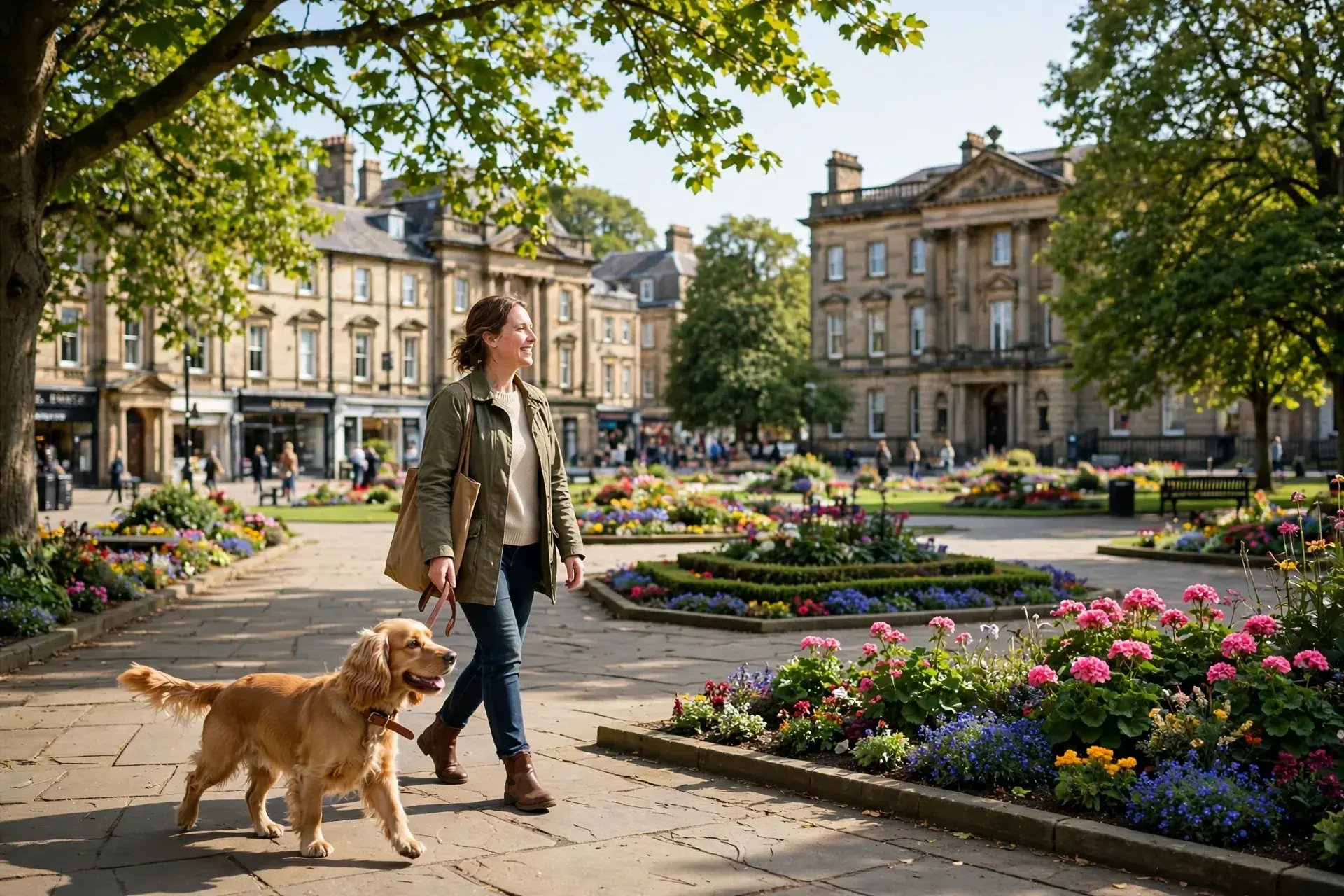
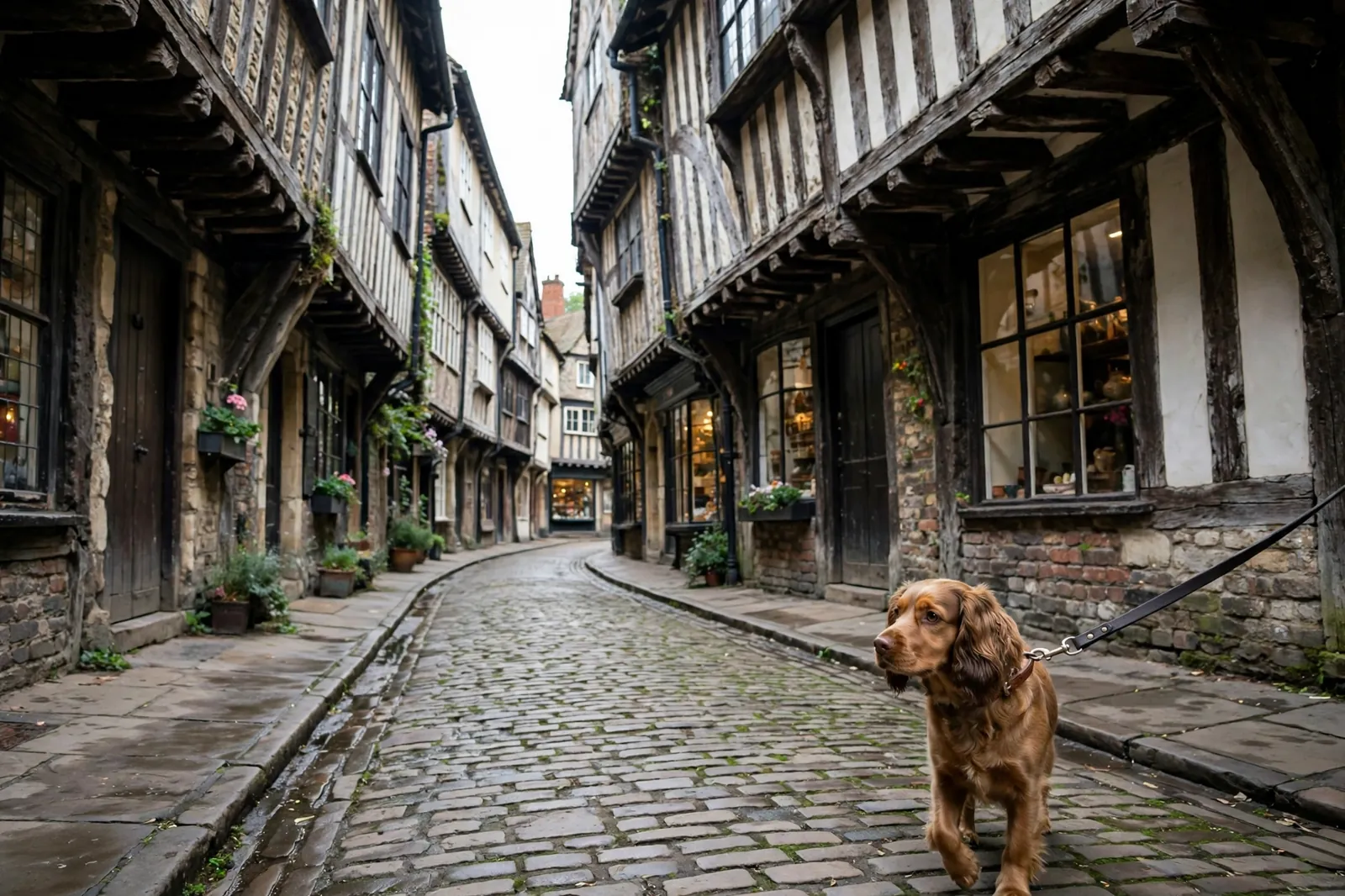
The High Street also gives you the practical supplies a dog walk needs: a shop for bottled water and snacks, a place to buy waste bags if you have run out, and a cafe for a break. If you are staying in the area for several days, the town's shops and supermarket options will cover the basics, and the larger shops of Harrogate and York are a short drive away for anything more specialised. For a deeper look at those larger towns, our guide to Harrogate with a dog covers Valley Gardens, the Stray and the spa town's dog-friendly cafes, while our York with a dog guide covers the city walls, riverside walks and the practicalities of a city break with a dog.
The town centre is also where you will find the practical infrastructure of a visit: public toilets, a post office, a pharmacy and a bank. None of these are dog attractions in themselves, but they matter when you are planning a day out, especially if you are travelling with children as well as a dog. Plan your stops in advance, know which ones the dog can enter and which ones need a quick wait outside, and the town centre becomes a smooth part of the day rather than a series of small frustrations.
One last note on the town centre: it is worth slowing down here. Boroughbridge is not a town that shouts for attention, and its pleasures are quiet ones — a handsome building glimpsed above a shopfront, a narrow lane leading down to the river, a churchyard full of birdsong, a bench where you can sit with the dog and watch the town go by. A dog walk is not a race, and a market town is not a checklist. Give yourself an hour to wander the centre without a plan, let the dog sniff the interesting corners, and you will see more of Boroughbridge than any itinerary could list.
Parking, buses and arrival
Arriving in Boroughbridge with a dog is straightforward, and parking is one of the town's practical strengths. The town has car parks within a short walk of the centre and the river, and on-street parking is available on and around the High Street. The best choice for a dog walker is a space that gives you a short, safe walk to the riverside without crossing a busy road with a pulling dog, and that leaves the car in shade on a warm day. Check the official guidance before you travel for current charges, time limits and any changes to the car parks, because these details are updated more often than any guide can track.
On a warm day, parking choices matter more than usual. A car in direct sun can become dangerously hot in minutes, even with the windows cracked, and a dog should never be left in a parked car on a warm day. If you are stopping for lunch or a look around the town, take the dog with you into a dog-friendly pub or cafe, or leave one person with the dog in the shade while the other runs an errand. If you must leave the dog in the car for a very short time in cool weather, park in shade, leave the windows open enough for air, leave water, and return within minutes — but the honest advice is to plan your day so the dog never has to wait in the car at all.
Arriving by bus is possible, and Boroughbridge is served by bus routes linking it with Harrogate, Ripon and York, but it needs a little planning. Dogs are generally allowed on local buses at the driver's discretion, and well-behaved dogs on a lead are usually welcome, but there is no guarantee, and a large or nervous dog may be refused if the bus is crowded. Check the official guidance before you travel for the current timetable and the operator's dog policy, allow extra time for a missed bus, and have a backup plan — usually a taxi — if the bus does not work out. If you are travelling by bus with a dog, keep the dog on the floor by your feet, keep the lead short, and be ready to move if another passenger is uncomfortable.
Taxis are a useful fallback for dog owners in Boroughbridge, especially for the short hop to Aldborough or to a vet if the need arises. Not every taxi will take dogs, so ask when you book and mention the dog's size and temperament. A dog that travels well in a car will have no trouble in a taxi, but bring a blanket to protect the seat and keep the dog on your lap or on the footwell rather than letting them roam the car. Save the number of a local taxi firm before you need it, because searching for one while standing in the rain with a wet dog is nobody's idea of a good time.
If you are arriving by car from further afield, Boroughbridge is easy to reach from the A1(M), and the town is a natural stopping point on a journey between the north and the south. That makes it a good break on a long drive: stop for an hour, walk the riverside, let the dog stretch its legs and have a toilet break, and continue the journey with a calmer dog and a fresher driver. The riverside and the car parks are close enough together that a one-hour stop is genuinely useful rather than a rushed compromise.
For cyclists travelling with a dog, the town's flat lanes and quiet roads are inviting, but a dog should never be expected to run alongside a bicycle on a public road unless it is trained for it and the route is safe. The lanes around Boroughbridge are narrow and can carry farm traffic, so a bike-and-dog combination is best kept to the towpath and the quietest lanes, at a walking pace, with the dog on a lead. If you are cycling without the dog, the town is a good base for rides into the Vale of York, but that is a different trip from a dog walk, and the two should not be mixed without careful planning.
Where to stay
Boroughbridge works well as an overnight base, and it suits a particular kind of stay: quiet, walkable, and close to the countryside rather than a busy city centre. The town has pubs with rooms, bed and breakfasts and self-catering options in and around the town, and several of them welcome dogs. The key, as always, is to confirm the dog policy for the specific room or property before you book, because a pub that welcomes dogs in the bar may have only certain rooms where dogs can stay, and a cottage that accepts one dog may charge extra for a second.
When you ask about staying with a dog, ask the questions that actually change the stay. How many dogs are allowed, and is there a charge per dog per night or per stay? Is the dog allowed in the bedroom, or must it sleep in a crate downstairs? Is there an enclosed garden or a nearby toilet area for a last outing at night? Are there stairs, and can an older dog manage them? Is there a place to dry a wet dog, and is there a charge for extra cleaning if the dog is muddy? The answers to these questions tell you far more than a "dog-friendly" label ever will, and they let you choose a place that fits your dog rather than one that merely tolerates it.
Self-catering cottages and holiday lets around Boroughbridge are often the best option for a multi-night stay, because they give the dog a routine: the same door, the same garden, the same feeding spot, and the freedom to settle without the noise of a hotel corridor. Look for a property with an enclosed garden if your dog needs one, check the height and security of the fencing, and ask whether the garden is shared with other guests. A cottage with a garden that backs onto a field may look idyllic, but it is a poor choice for a dog that chases livestock or that can jump a low fence. A cottage on a quiet lane with a secure garden and a short walk to the river is the sweet spot.
Pub rooms and bed and breakfasts suit a shorter stay, and they have the advantage that breakfast and an evening meal are taken care of. The trade-off is that the dog will need to settle in a smaller space, and you will need to plan around meal times: a dog that cannot be left alone in the room will need to come to the bar with you or wait in the car, which is not always practical. Ask the pub whether the dog can join you in the bar at mealtimes, and whether there is a quiet corner where the dog can lie down. A pub that welcomes dogs in the bar at dinner is a much better base than one that only allows dogs in the bedroom.
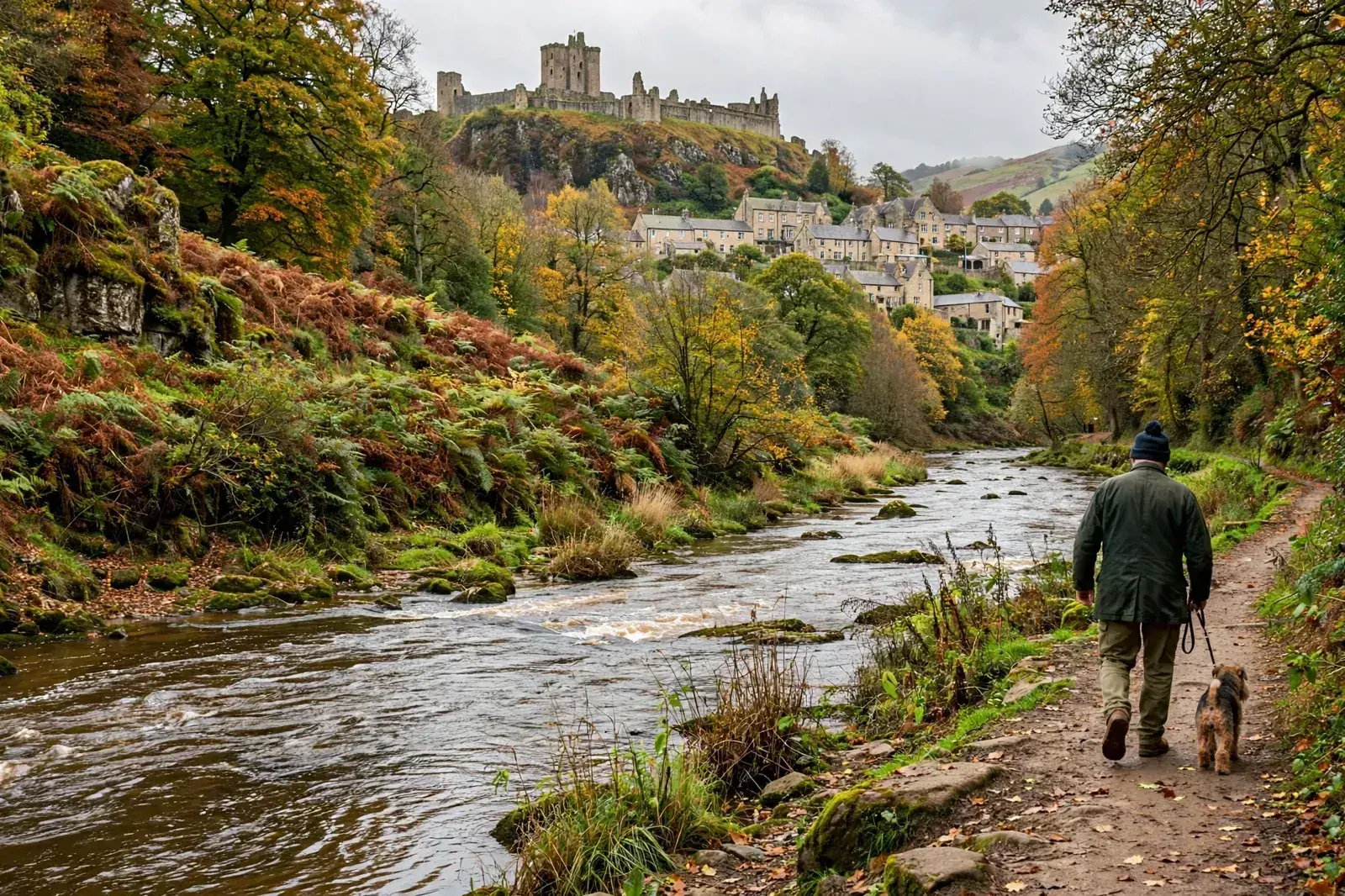
For a longer stay, Boroughbridge's position is its greatest asset. Harrogate is a short drive to the west, York is a short drive to the east, and Ripon and the Yorkshire Dales are within easy reach to the north and west. That means you can base yourself in a quiet market town, walk the river every morning, and take a different day trip each day without ever packing up and moving on. Our guide to Richmond in Yorkshire with a dog covers a rewarding day trip to the north, with castle views, the River Swale and Easby Abbey, and it pairs well with a Boroughbridge base for a longer North Yorkshire break.
Whatever you book, confirm the details in writing. Get the pet fee, the number of dogs, the room or property name and the cancellation terms in an email, and keep that email with your booking confirmation. If the property has a damage deposit, ask how it is held and when it is returned. If you are arriving late, tell the host in advance and confirm how you will get in and where the dog can go for a last toilet break. The first hour of a stay sets the tone for the whole trip, and a host who knows you are arriving with a dog will have thought about the details that matter.
Vets and practical safety
Before you travel to Boroughbridge, save the details of a local vet and an out-of-hours emergency vet, and keep them in your phone. The town has veterinary practices nearby, and Harrogate and York both have larger practices and emergency cover within a short drive, but you do not want to be searching for a number while your dog is unwell. Save the address as well as the phone number, because a satnav will need the postcode, and note the opening hours so you know whether the practice is open when you arrive.
The most common riverside hazards are the ones you can prevent. Blue-green algae can appear in slow-moving or still water in warm weather, and it can be toxic to dogs, so do not let your dog drink from or swim in water that looks green, scummy or unusually still in summer. Check the official guidance before you travel for any local warnings, and if you are unsure, keep the dog out of the water entirely. After any swim, rinse the dog with clean water if you can, and watch for vomiting, diarrhoea or lethargy in the hours afterwards — if you see any of these, call a vet straight away.
Other hazards are more ordinary but just as real. Ticks are present in grassland and woodland around Boroughbridge, especially in spring and summer, so check your dog after every walk, particularly around the ears, armpits and groin, and remove any ticks promptly with a tick remover. Keep flea and worm treatments up to date, because a dog that meets other dogs on the riverside and in pubs will be exposed to more parasites than a dog that stays at home. Grass seeds in summer can work their way into ears and between toes, so check paws after a walk through long grass and watch for limping or head-shaking.
Livestock, traffic and water are the three risks that need a lead rather than a treatment. Keep your dog on a lead near livestock, near roads and near fast or flooded water, and only let them off lead in open spaces where you can see the whole area and recall them reliably. A long line is a good compromise for a dog whose recall is still developing: it gives the dog freedom to explore while keeping you in control. If your dog is reactive to other dogs, walk at quieter times, keep to wider paths where you can create distance, and do not be embarrassed to cross the road or turn around — a short, calm walk is better than a long, stressful one.
First aid for a dog walk is simple: carry water, a collapsible bowl, waste bags, a lead and a long line, a towel, and a basic first-aid kit with bandages, saline wound wash, tweezers and a tick remover. Know the signs that need a vet urgently — difficulty breathing, collapse, uncontrolled bleeding, a swollen abdomen, repeated vomiting, or a dog that has eaten something toxic — and do not wait to see if it gets better. If your dog eats something on the walk, note what it was and when, and call the vet for advice rather than trying to treat it yourself.
Finally, think about identification. Your dog should wear a collar with an ID tag showing your name and phone number, and should be microchipped with your details up to date. If your dog gets loose on a riverside walk or in a field, a tag and a chip are the fastest way home. Keep your phone charged, keep a recent photo of your dog on it, and know the name of the area you are walking in so you can describe it to anyone who offers to help. These are small preparations, but they turn a worrying moment into a manageable one.
Seasonal notes
Boroughbridge is a year-round destination, but the town changes with the seasons, and a dog walk that is perfect in May can be a different experience in January. Spring is arguably the best season: the riverside grass is fresh, the hedgerows are full of blossom, the days are lengthening, and the town is quiet before the summer visitors arrive. It is also nesting season, so keep your dog on a lead near water birds and hedgerows, and watch for lambs in the fields beside the lanes.
Summer brings long evenings and the chance of a riverside walk at eight o'clock in the evening light, but it also brings heat. Walk early in the morning or late in the evening, carry water, watch for hot pavements on the High Street, and never leave a dog in a car. The riverside trees give shade, but the open grass can be hot at midday, and a dark-coated dog will feel the heat sooner than you expect. Blue-green algae is a summer risk in still water, and ticks and grass seeds are at their worst, so check your dog after every walk.
Autumn is a beautiful season in Boroughbridge: the trees along the Ure turn gold and red, the canal reflects the colours, and the town is quiet again after the summer. It is also the season when the ground gets softer, the paths get muddier, and the river can rise after rain. Wear boots, bring a towel, and be prepared for a walk that is shorter than planned if the ground is waterlogged. Fireworks around early November can unsettle noise-sensitive dogs, so check whether there are local displays and keep a nervous dog indoors in the evening if you are staying overnight.
Winter is the quietest season, and it has its own rewards: frost on the riverside grass, mist on the canal, and the town's pubs with open fires. It is also the season when daylight is shortest, so plan your walks for the middle of the day, carry a torch for the walk back, and make sure your dog is visible with a reflective collar or a light on their harness. The riverside can be slippery with frost and mud, and the river can be high after winter rain, so keep the dog on a lead near the water and choose the towpath or the lanes when the riverside is flooded. A wet, cold dog needs drying and warming as soon as you get back, so keep towels and a drying coat ready.
Whatever the season, the same advice holds: check the weather before you set out, dress for the walk you are actually going to do rather than the one you hope for, and let the dog set the pace. A dog that is happy in spring rain, summer shade, autumn leaves or winter frost is a dog that has been given the right walk at the right time of day, and Boroughbridge gives you the paths to do that in every season of the year.
Practical questions
Before you go
Can dogs walk off lead along the River Ure at Boroughbridge?
Some open riverside stretches suit a well-trained dog off lead, but keep the lead on near the bridge, roads, livestock, anglers and other walkers, and always recall before the bank narrows. There is no single off-lead rule for the whole river, so read local signs and check the official guidance before you travel.
Is the Devil's Arrows site dog-friendly?
Yes, in the practical sense that dogs on a lead can visit the standing stones with you. The stones stand in fields beside a road, so keep your dog on a lead, watch for traffic and livestock, and take waste bags with you, as there are no facilities at the stones themselves.
Are dogs allowed in pubs and cafes in Boroughbridge?
Several pubs and cafes in Boroughbridge welcome dogs, often in the bar area or on a terrace, but policies change and can vary by room or season. Ask before you sit down, keep your dog on a lead under the table, and bring a mat and water bowl so a short stop stays comfortable for everyone.
Where can I park with a dog in Boroughbridge?
Use the town car parks and on-street parking near the centre and the river, and check the official guidance before you travel for current charges and time limits. Park in shade where possible, never leave a dog in a hot car, and choose a space that gives you a short, safe walk to the riverside rather than a road crossing with a pulling dog.
How long is the riverside loop walk from the bridge?
A short riverside out-and-back from the bridge takes about 30 to 45 minutes at a sniffing pace, while a longer loop that takes in the canal towpath and the lanes towards Aldborough can take two hours or more. Plan for the shorter option first, then extend the walk only if your dog is still keen and the ground is dry enough.
Is Boroughbridge a good base for a longer dog-friendly stay in North Yorkshire?
Yes, for walkers who want a quiet market town rather than a busy city. Boroughbridge sits between Harrogate and York with easy road access, and its riverside, canal and countryside walks give a dog a different route every day, while day trips to Harrogate, York and Richmond are all practical by car.