This guide is independent and contains no paid placement. Venue dog rules change, so where this guide flags a check, please confirm the latest official information before you travel.
Richmond in North Yorkshire is a strong dog town if you work from the river upwards: walk the Swale and the Batts first, visit Richmond Castle for its grounds on a lead rather than counting on its interiors, follow the riverside to Easby Abbey where dogs on leads are welcome among the ruins, and treat the cobbled market place as an early, short-lead pleasure rather than a midday crowd test. Check the official latest guidance before you go for castle and abbey opening and dog rules.
Down on the Swale first: look up before you climb up
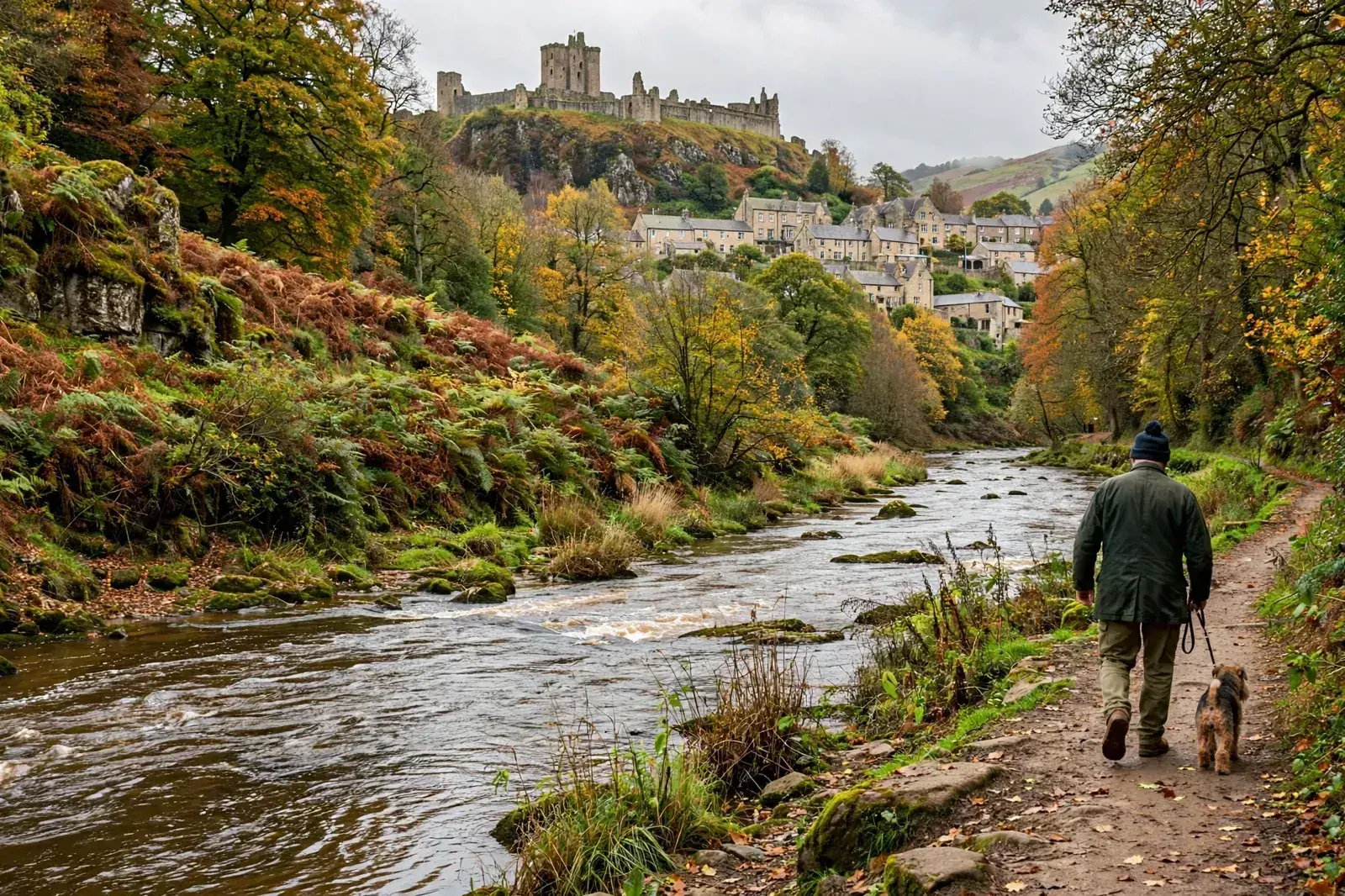
Begin a Richmond day at water level. Stand on the path beside the River Swale, below the town, and look up: the castle keep rises straight from the rock above you, the church tower and the Georgian rooftops stack behind it, and the whole town reads at once as what it is — a fortress first, a market town second, built where a river bend made a hill worth defending. From the market place at the top you get none of that. From down here you get the plan of the place for free, and your dog gets something even better: a proper walk before crowds, cobbles or culture ask anything of either of you.
The Swale is not a decorative town river. It is one of the fastest-flowing rivers in England, draining a long Pennine dale, and it has moods. On a calm morning it slides green and clear over limestone shelves below Richmond Falls, inviting a paddle at the edges and a long sniff along the banks. After rain up Swaledale it can be brown, high and genuinely powerful, rearranging what is safe within hours. That character shapes this whole guide. The riverside is Richmond's finest dog walking, but it is walking beside moving water with rock, falls and fishing in the mix, and it rewards handlers who read the river each morning rather than trusting yesterday's conditions.
Starting low also solves Richmond's geography kindly. The town is steep. The climb from the river to the market place is short but sharp, and the castle sits between the two, so a river-first morning naturally becomes a sequence: water, then castle grounds, then town, each layer reached when your dog is ready for it. A dog who has had forty minutes of riverside sniffing arrives in the cobbled square settled and curious. A dog lifted from a car straight into market-day crowds, delivery vans and other dogs on the cobbles starts the day over threshold, and steep towns give an over-threshold dog nowhere to decompress. Walk first, climb second, shop third is not a slogan here. It is how the hill is built.
Use this opening section as the guide's map. Below you will find the castle dealt with honestly, including what a lead does and does not get your dog into; the falls and the Batts, the riverside ground on the town side of the water; the longer walk east to Easby Abbey, which is the single best half-day in Richmond with a dog; the market place and Georgian streets above; and the river-safety and lead rules that tie all of it together. Everything is close. Nothing needs rushing. Richmond has been sitting on this hill for more than nine centuries, and it responds best to visitors who take it at walking pace.
Richmond Castle with a dog: grounds yes, interiors with care
Richmond Castle is one of the earliest and most complete Norman castles in England, begun soon after the Norman Conquest on this commanding spur above the Swale, and its keep still dominates every view of the town. It is in the care of English Heritage, and for dog owners the headline is genuinely good news: dogs on leads are welcome in the castle grounds. That includes the broad main ward inside the walls, where there is real space to walk, settle and take in the views down to the river, and the Cockpit Garden, the contemporary garden created within the walls, where a dog on a short lead can accompany you along the paths. As a grounds visit, this is one of the better castle experiences in Yorkshire with a dog.
Now the honest part, because it changes how you plan. Welcome in the grounds is not the same as welcome everywhere. Access for dogs inside the keep, the exhibition spaces and other interior rooms is restricted and should never be assumed — exhibition and keep access also involves stairs and confined historic spaces that suit dogs poorly in any case. Assistance dogs are treated differently, as they should be. For an ordinary visiting dog, build the visit around the ward, the walls, the garden and the views, and treat any interior as a separate, human part of the trip. Our wider guide to dogs at English Heritage sites sets out how this grounds-versus-interiors pattern repeats across the organisation, and Richmond is a textbook example of it: generous outdoors, careful indoors.
If you are travelling as two adults and both want the exhibition and the keep, use the split that works at historic sites everywhere: one person explores inside while the other walks the ward and garden slowly with the dog, then swap, meeting for a shared circuit of the walls and a sit-down in the grounds. Time it generously rather than sprinting the interiors, because the dog's half of this arrangement is not a waiting room — the ward is large, the views over Swaledale are superb, and the garden repays lingering. Solo visitors should simply take the grounds visit without resentment and skip the interiors this time. What you must not do, at Richmond or anywhere, is leave a dog in a car in the market place or a car park while you go inside: not in shade, not with windows cracked, not for a quick look at the exhibition. That rule outranks every itinerary in this guide.
Practical castle notes for dog handlers are straightforward but worth stating. Keep the lead short near other visitors, school groups and the garden planting, and keep dogs off the flower beds and out of the areas signed for quiet reflection. Watch for rabbit holes and uneven historic ground in the ward, take water in with you because a castle ward on a sunny day is an exposed, shadeless place, and carry bags out to the bins rather than expecting one at the exact spot you need it. Opening days, last admission and any event closures vary across the year, and dog rules can be adjusted for special events, so check the official latest guidance before you go on the English Heritage page for Richmond Castle on the morning of your visit, not from a screenshot saved last summer.
Richmond Falls, the Batts and the town riverside loops
Below the castle, the Swale does its most famous trick. At Richmond Falls the river pours in a series of cascades over limestone ledges, wide rather than high, loud after rain and glassy in a dry spell, with flat rock shelves and grassy banks around it that have made this a local gathering place for generations. For a dog it is a superb place to watch, listen and sniff — and a place to manage carefully. The ledges are slippery when wet, the current below the falls is stronger than it looks, and smooth rock gives paws very little grip. Keep your dog on a lead on the rocks, choose the grass for sitting and picnics, and keep paddling, if conditions allow it at all, to the calm shallow edges well away from the falling water.
Adjoining the falls area, the Batts is the town's riverside green: open grass, mature trees and paths along the water on the Richmond side, used by everyone from early dog walkers to families with picnics. It is the most forgiving dog space in the centre of Richmond — room to step aside for other dogs, shade in summer, and a choice of short loops for a pre-breakfast or after-dinner walk when you are staying in town. Even here, keep perspective: the river edge is unfenced in places, the water is close, and a dog with a strong chase or swim drive belongs on a long line rather than loose freedom beside a fast river. Bins are provided in the town riverside area, but carry bags regardless and take everything home if a bin is full.
From the Batts and falls you can build the town's two staple loops. The short loop stays on the near bank: falls, Batts, a climb back up towards the castle and market place, ideal for older dogs, puppies building stamina, and anyone with an hour rather than a morning. The longer loop crosses the river by the bridge below the town and returns along the opposite bank, giving you the classic postcard view back up at castle and town — the view you started this guide with — plus quieter wooded stretches where Richmond suddenly feels rural despite the church tower still being in sight. That longer loop is also the beginning of the Easby walk described next, so a party testing its energy can start the loop and simply keep going east if legs, weather and daylight agree.
Timings matter on this ground. The falls and Batts are at their best early, before picnic crowds and groups spread across the rocks and grass, and again in the evening when day visitors have gone and the light drops into the gorge. After heavy rain, downgrade the whole area: admire the falls from the safest made paths, keep well back from swollen edges, and do not let a dog anywhere near flood-fast water for a photograph. Limestone, water and enthusiasm are a fine combination in Richmond, in that order of priority and no other.
Easby Abbey: the riverside walk that makes the day
If you do one longer walk in Richmond, make it this one. About a mile and a half east of the town, following the Swale downstream, stand the ruins of Easby Abbey, a Premonstratensian abbey founded in the twelfth century whose church and cloister remains are among the most peaceful historic places in the dale. The walk there is half the pleasure: riverside paths and field tracks, woodland stretches, views back to the castle keep that shrink it into its landscape, and the parish church of St Agatha beside the abbey, famous for its medieval wall paintings, as your landmark at the far end. Allow a half day rather than an hour, because this is a walk that punishes hurrying and rewards every bench.
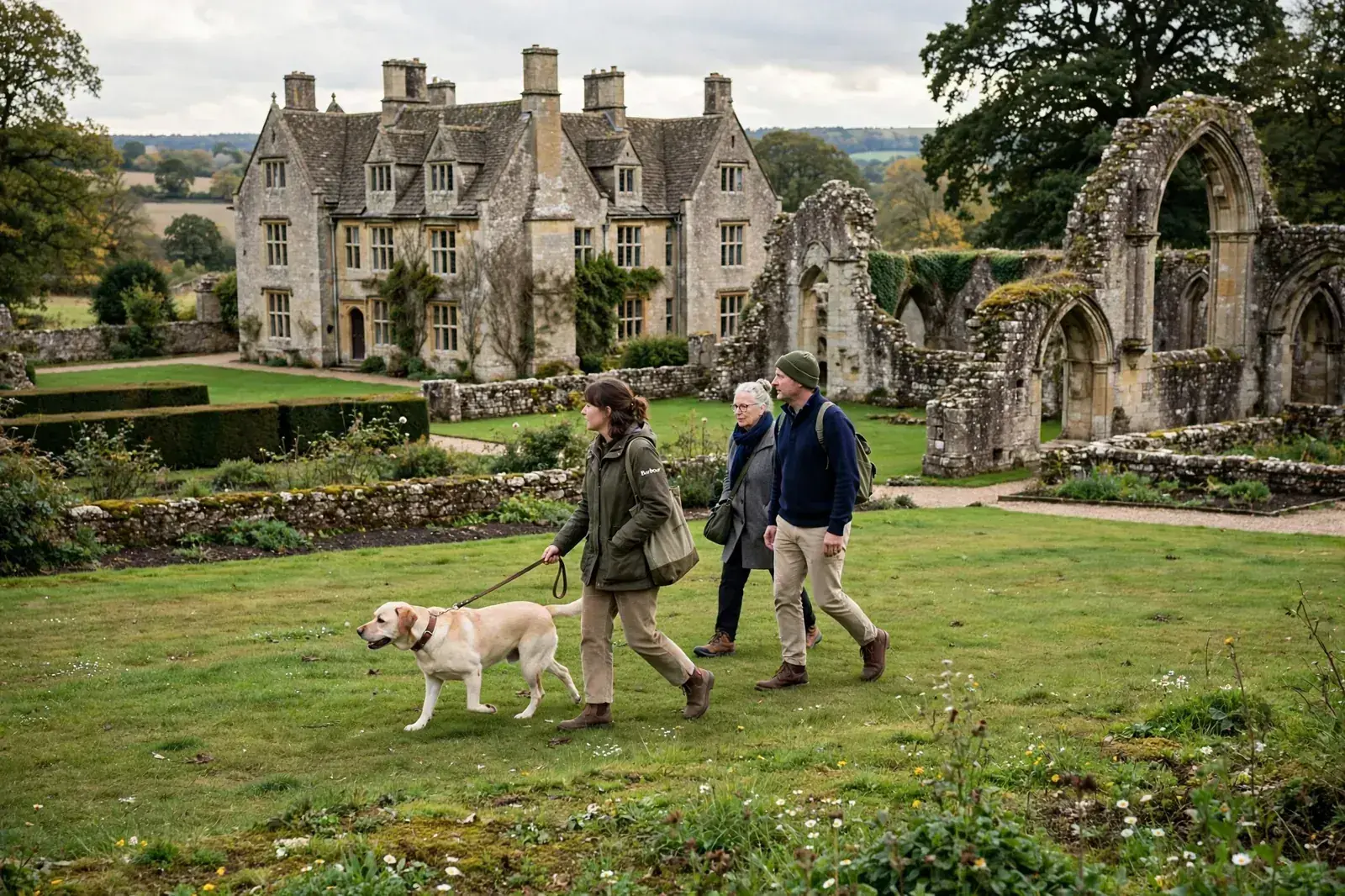
At the abbey itself, the dog news is as good as it gets at a historic site. Easby is in the care of English Heritage and dogs on leads are welcome at the abbey, which is an open-air ruin rather than a roofed building, so the grounds-versus-interiors problem that shapes a castle visit largely disappears. You and your dog can explore the ruins together, on a short lead among the stonework, with respect for the place and for other visitors. The ground is uneven, with grass, worn stone, steps within the ruins and mud after rain, so steady dogs and steady footwear both matter, and an elderly dog should be allowed to admire the great church from the grass rather than being encouraged over every threshold. Entry arrangements, opening hours and parking details for the small car park by the site vary by season, so check the official latest guidance before you go.
The route needs the usual farmland honesty. Between Richmond and Easby the path crosses grazing land where sheep and cattle may be present, passes through gates and over stiles that not every dog will manage, and runs close to the river on banks that can be slippery and, after flooding, occasionally diverted or impassable. Keep your dog on a lead around livestock without exception, close every gate, and treat a flooded or officially diverted section as a turn-back point rather than a puzzle to solve with a dog in tow. There are stiles on the wider circular versions of this walk in particular, so handlers of large, elderly or anxious dogs should favour the simpler out-and-back riverside route and check a current route description before setting off.
You can shape Easby two ways. Out and back along the river is the straightforward, dog-kind option, with a long stop among the ruins and at the church in the middle and the same good views in reverse on the return. The fuller circular, crossing the river and returning by the opposite bank and lanes, adds variety and the classic castle views, at the cost of more road walking, more stiles and more navigation. Either way, carry water for your dog — the temptation to let a dog drink its fill from the river should be resisted in favour of your own supply, for the reasons in the safety section below — and carry food if you plan to make a day of it, because facilities at the abbey end are minimal and the nearest choice of cafés and pubs is back in Richmond. That scarcity is part of Easby's charm. It is a ruin in fields by a river, and a dog who settles on the grass there while the swifts circle the ruined church has had a very good day indeed.
The cobbled market place: Georgian Richmond at the top of the hill
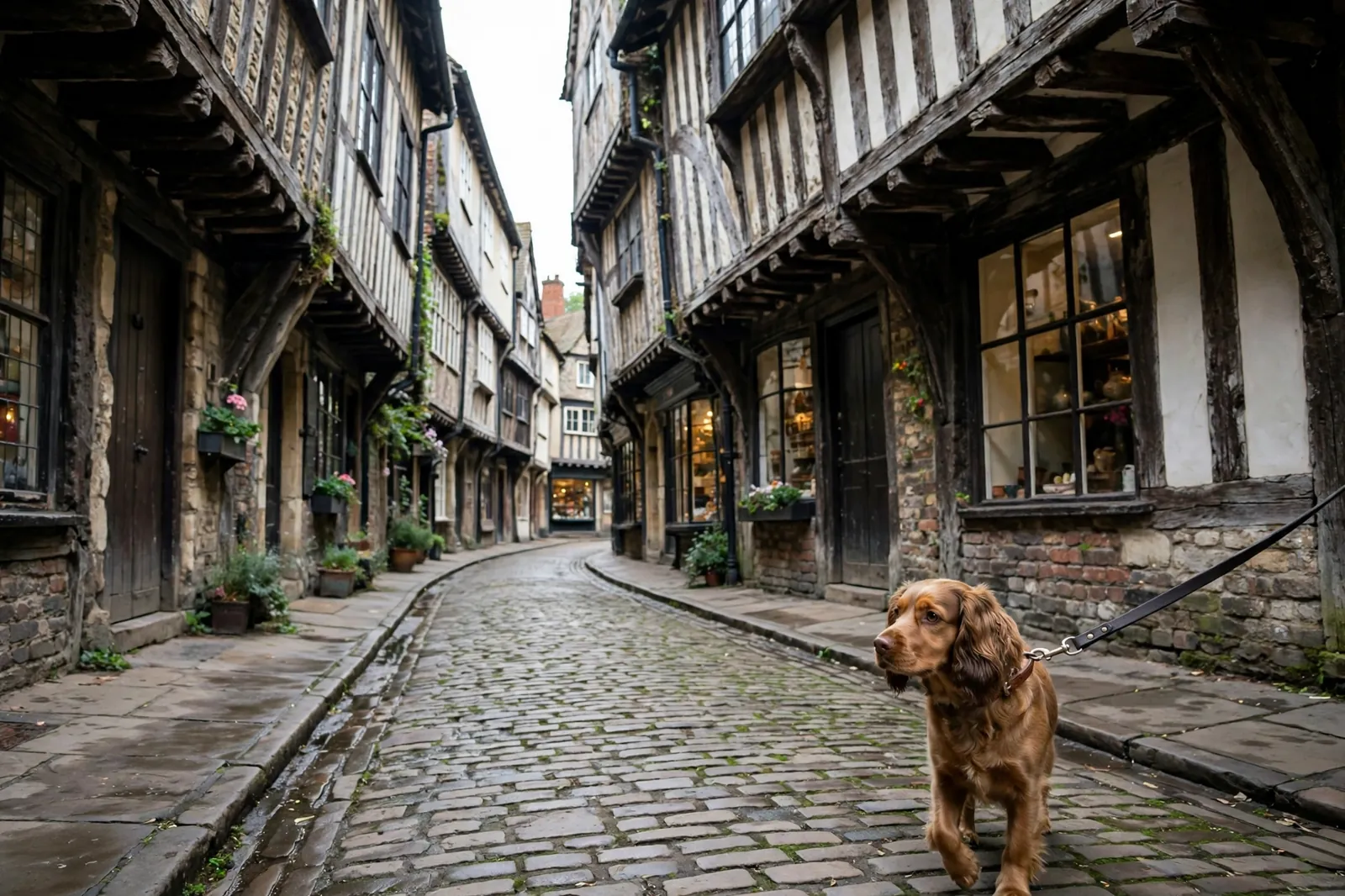
Climb from the castle or the river and Richmond changes register completely. The market place at its heart is one of the largest cobbled market squares in England, ringed by handsome Georgian buildings, with the market cross and the obelisk at its centre and Holy Trinity Church, which houses the Green Howards museum, sitting within the square itself. This is the Richmond of market charters, coaching inns and assize-week bustle, preserved as a working town centre rather than a museum set. With a dog, it is a pleasure to cross, to circle and to sit at the edge of — with timings and lead length chosen deliberately.
Cobbles are the first practical fact. They are beautiful, historic and, for paws and human ankles alike, uneven, especially in the wet when they polish up and shine. Walk at your dog's pace across the square, let older dogs and dogs with joint problems pick the smoothest line near the pavements, and do not expect a dog who is worried by unstable footing to relax in the middle of the square. The second fact is traffic and crowds combined: the market place is a living centre with vehicles, deliveries, buses and market stalls on market days, plus café seating and shoppers at its edges. Keep the lead short, position your dog away from the traffic side, and cross with purpose rather than drifting.
On market days the square fills with stalls and becomes the fullest version of itself — rich in smells, dropped food and close-quarters encounters with other dogs. Handled early, on a short lead, with regular escapes down side streets, many dogs enjoy it as high-quality sniffing theatre. Handled at peak time with a scavenging dog, it becomes a wrestling match over discarded food between stall legs and trolley wheels. Know your dog and choose accordingly; there is no obligation to do the market at all, and the dog who skips it for a second riverside loop has lost nothing. Rules for going indoors belong to each shop, café and pub individually, and food premises in particular may not admit dogs beyond assistance dogs, so read the door, ask cheerfully and accept the answer.
Do not miss the edges of the square. The Georgian streets running off it, the narrow yards and wynds between buildings, and the short walk out to Frenchgate and the Georgian Theatre Royal — one of the oldest working theatres in the country, where dogs will not be joining you for a performance — give a dog a calmer, shadier circuit of historic Richmond away from the square's glare. Early morning, before the town fills, a slow circle of square and side streets with the castle keep appearing and disappearing between rooftops is one of the pleasures of staying overnight here rather than day-tripping. Which brings the day naturally to food, rest and finding a base.
Georgian streets, food and rest: eating and pausing with a dog
Richmond feeds its visitors well for a small town: cafés and tearooms around the market place and its side streets, pubs in the centre and down towards the river and the old station area, and bakeries and delis that make a picnic for the Batts or the castle ward an easy project. Dog policies, as everywhere in this series, belong to each business and change with ownership and season: some places welcome dogs throughout, some in a bar, snug or garden only, and some cannot admit dogs beyond assistance dogs. The method never changes — check signage, ask before you settle, keep your dog on the floor and out of walkways, and have a takeaway fallback that, in a town with this much grass by a river, is a genuine pleasure rather than a second prize.
The old station deserves a specific mention in any dog plan. Richmond's former railway station, across the river from the centre, has been converted into a food, drink and arts venue with cafés, local food producers and open space around it, and it sits conveniently on walking routes between the town, the riverside and Easby-side paths. Policies for dogs inside its spaces belong to the venue and its individual businesses, so confirm on arrival, but as a pause point with parking, facilities and room to breathe after a riverside walk, it solves the problem many historic towns create: where to stop with a wet dog and tired humans without squeezing into a crowded tearoom. Ask, settle only where you are welcome, and towel muddy paws before going indoors anywhere in town. Georgian Richmond has polished floors and long memories.
Rest is a planning item here, not a reward. Richmond's walking is compact but vertical: river to square is a climb, the castle ward is exposed, and Easby and back is a real half-day in a dog's legs. Build the day in blocks with a genuine sit-down between them — a café garden where your dog is welcome, a bench on the Batts, a quiet half hour back at your accommodation — and your dog will handle the market place, the castle crowds and the evening walk with far better grace. Puppies, older dogs and dogs in their first weeks with you should get the short version of everything: Richmond's sights are close together, so a gentle day of falls, Batts and a square circuit still feels like a full visit.
Evenings are when staying in Richmond pays off most. Day visitors drain away, the cobbles empty, and the town becomes a small Swaledale community again: a slow dusk walk down to the river, a pub garden or bar where dogs are welcome if you have confirmed it, and the castle floodlit in your eyeline as you climb back up. Use a light or reflective lead and collar after dark on the unlit riverside paths, keep your dog close on the steep lanes where traffic appears quietly around bends, and let a dog who is done for the day be done. Tomorrow's Easby walk will be better for it.
River safety, livestock and lead rules around Richmond
Richmond's rules for dogs are not bureaucratic. They are written by a fast river, working farmland and a town full of other people, and this section gathers them in one place so the rest of the guide makes sense. Start with the river. The Swale rises quickly after rain anywhere in the long dale upstream, sometimes under a blue sky in Richmond itself, and its limestone ledges, falls and smooth rock shelves are slippery in almost all conditions. Keep dogs on leads near the falls, on rock and on narrow bank paths, never let a dog swim in fast or high water, and treat any flood debris, undercut banks or diverted paths as a hard stop. A dog swept downstream in the Swale is in serious trouble within seconds, and no recall training overrides current.
Water quality and wildlife add quieter rules. Let your dog drink from your own carried water rather than the river, particularly in warm spells and after heavy rain, and keep dogs out of the water entirely where anglers are fishing — the Swale is a valued fishing river, with lines, hooks and private beats along its banks, and a swimming dog and a fly line are an expensive, painful combination. Ducks, dippers, herons and other river birds feed and nest along the edges, and in spring and summer a chasing dog does real harm even when it catches nothing. The general framework behind all of this is set out in our guide to dogs on leads and the law in the UK, and Richmond is a place where law, signage and common sense all point the same way: short lead near water, stock and crowds, freedom only where it is genuinely safe and permitted.
On land, the Easby walk and the field paths around the town cross grazing used by sheep and, in places, cattle. Keep your dog on a lead around livestock, walk calmly through fields rather than around the edges of a flock, give animals settled on the path a wide detour, and leave by the nearest gate if cattle show more than passing interest — especially where calves are present. Close every gate as you found it, keep to paths across farmland, and take every poo bag back to a town or car park bin; bags left on fences and branches along a beautiful riverside path are a blight that local walkers, farmers and other dog owners all pay for in goodwill. Ground-nesting birds on the higher ground around Swaledale in spring and early summer add one more seasonal reason to keep to paths and short leads where signs ask for them.
Finally, the town rules that keep Richmond dog friendly for the next visitor. Short leads on the cobbles, in the castle and abbey, in shops and cafés that admit dogs, and on the steep narrow lanes where pavements disappear. No dogs left in cars, ever, in any car park or street in any weather. No feeding of ducks and swans by encouraging your dog to join them at the water's edge. And a willingness to shorten the plan — skip the market, skip the falls rocks, turn back from Easby — when river, weather or your dog says so. Richmond rewards that flexibility, because every shortened plan here still contains a river, a view and a very good walk.
Stays, parking and practicalities: basing yourself in Richmond
Staying in Richmond transforms the trip, because it hands you the town at its two best times: early, when the square is empty and the river is yours, and evening, when the day crowds have gone down the dale road. The town and its surrounding villages offer inns and pubs with rooms, bed and breakfasts in Georgian houses, self-catering cottages and apartments, and campsites and holiday parks in the wider Swaledale and Richmondshire area. Dogs welcome, as always, is a headline rather than a detail. Confirm how many dogs are allowed, whether there is a per-dog charge, whether dogs may be left alone in the room or property and on what terms — many hosts say no, which decides your castle-interiors plan for you — and what the after-dark toilet walk actually involves on a steep lane with no pavement.
Ask two Richmond-specific questions before you book. First, where does a wet dog go? Swale dogs get wet in the river, in dale rain and in mud on the Easby path, and a host who can offer an outside tap, a stone-floored porch or a stack of old towels will save your deposit and your dignity. Check flooring with the same realism: stone flags and washable floors forgive a Swaledale October, pale carpets do not, so bring your own bedding, throws and drying coat and keep wet dogs off beds and sofas unless explicitly invited. Second, how secure is any garden or yard? Stone walls and Georgian yards look solid and mostly are, but gates open onto lanes, walls have gaps at dale height, and a terrier regards most Richmond boundaries as a draft proposal. Check before your dog does.
Day visitors need a parking plan, because Richmond's centre is compact, steep and busy. There is charged and disc-controlled parking in and around the market place and in car parks on the edges of the centre, including larger sites that serve the station side of town — but central spaces fill quickly on market days, event days and summer weekends, and disc and time-limit rules are enforced. Arrive early, read the current charges, disc requirements and time limits on the signs as they stand on the day rather than trusting any guide's figures, including this one, and walk your dog on grass away from traffic before heading into the square. And repeat the rule that outranks all parking convenience: never leave a dog alone in a parked car while you visit the castle, a café or a shop, in any weather that merely looks mild when you lock the door.
For supplies and backup, Richmond is better equipped than its size suggests, with shops in town for basics and veterinary cover in the area — but save the exact practice and out-of-hours details in your phone before a long riverside walk, download maps for offline use because signal drops along the river and in the dale, and carry the unglamorous kit that keeps small problems small: bags, water and a bowl, a spare lead, a towel, and a charged phone. If Richmond is one stop on a longer Yorkshire trip, it pairs naturally with a city day in York with a dog: swap riverbanks for city walls, keep the same early-start discipline, and let the dog compare two very different kinds of historic Yorkshire.
A plan for one or two days that fits the dog
One good day in Richmond runs from the bottom of the hill to the top and back again. Start on the Batts and at the falls while the riverside is quiet, reading the water and letting your dog settle into the place. Climb to the castle late in the morning for a grounds visit on a lead — ward, garden and views, with interiors split between two adults if you want them — then give the middle of the day to food and rest: a café or pub that has confirmed your dog is welcome, or a picnic back down on the Batts grass. Spend the afternoon on the market place and Georgian streets at a cobble-friendly pace, early enough to avoid the fullest crowds, and finish with a slow evening circuit of square and river if your dog still has curiosity left. That is a complete Richmond day without a single rushed transition.
With two days, give the second day to Easby. Walk out along the Swale after breakfast, explore the abbey ruins together on a lead, rest by St Agatha's, and walk back in time for a late lunch in town — then keep the rest of the day deliberately small: a Batts loop, a station-area pause, an early evening. Two-day visitors also earn the right to be choosy about weather: do Easby on the settled day and the castle, square and cafés on the unsettled one, because the abbey walk in horizontal rain tests everyone's goodwill while the town day shrugs it off. Groups who disagree about interiors, scrambles or mileage should split cheerfully for an hour or two and reunite for food; Richmond is compact enough that nobody is ever far away.
Whatever your version, set two decisions before you set off each morning: a turn-back trigger for the river — high water, closed paths, a tired or anxious dog — and a hard rule that no sight in this guide is worth a dog in a hot car, a dog in fast water or a dog loose among sheep. Richmond does not ask much beyond that: a lead in the right places, an early start, respect for a working river and a working town. In return it gives a dog and its humans a castle above a waterfall, an abbey down a green valley and a cobbled square at the top of the hill — three good days out stacked into one small town, waiting to be walked from the bottom up.
Practical questions
Before you go
Can dogs go into Richmond Castle?
Dogs on leads are welcome in the grounds of Richmond Castle under English Heritage rules, including the main ward and garden areas. Access inside the keep, exhibition and other interior spaces is restricted and should not be assumed, so plan the visit around the grounds and views, split an interior visit between two adults if you are travelling as a pair, and check the official latest guidance before you go.
Can dogs visit Easby Abbey?
Yes. Dogs on leads are welcome at Easby Abbey, the ruined abbey in the care of English Heritage about a mile and a half from Richmond along the River Swale. The site is largely outdoors, with uneven ground, steps and mud after rain, so keep your dog on a short lead among the ruins, carry water and bags, and check the official latest guidance before you go for opening times and any changes.
Can dogs swim in the River Swale at Richmond?
Some dogs paddle at calmer edges of the Swale, but the river is fast, rocky and prone to rising quickly after rain in Swaledale, and the falls area is not a safe swimming place. Keep your dog on a lead near the falls and on slippery rocks, avoid the water entirely after heavy rain or if the current looks strong, watch for fishing lines, and offer drinking water from your own supply rather than letting your dog drink from the river.
Is Richmond market place dog friendly?
The cobbled market place is outdoors, so a dog on a short lead can walk across it and around the outdoor market with you, but it is busy, uneven underfoot and crowded around stalls at peak times. Go early, keep the lead short, watch for dropped food and market traffic, and step into a quieter side street or down to the riverside whenever your dog needs space. Shops, cafes and pubs set their own rules for going indoors.
Where can I park in Richmond with a dog?
Richmond has pay-and-display and disc parking in and around the market place and in car parks on the edges of the centre, but central spaces fill quickly on market days and in summer and time limits are strictly applied. Arrive early, read the current charges, disc rules and time limits on the signs when you arrive, and never leave a dog alone in a parked car while you visit the castle, shops or cafes.