This guide is independent and contains no paid placement. If affiliate links are added later, they will be clearly marked and will not change our editorial checks.
Bournemouth works with a dog when you treat it as a series of zones, not one beach. Use the designated year-round dog beaches in summer, the central beaches out of season, the promenade on a lead, and the gardens for shade. Walk early, carry water, check the signs on the day, and save the pier and the town centre for a calm, short visit.
Seven miles of sand, one plan
Bournemouth's headline number is seven miles of sand, and it is both the town's promise and its problem for dog owners. Seven miles sounds like endless freedom, but in practice the beach is divided into zones with different rules, different crowds and different characters, and the dog-friendly parts are specific stretches rather than the whole bay. The visitors who enjoy Bournemouth with a dog are the ones who choose a zone before they arrive, park near it, and stay there, rather than the ones who wander along the seafront hoping the rules will sort themselves out.
Think of the bay in three parts. In the middle, around the pier and the town centre, are the busiest beaches, the arcades, the cafes and the crowds. To the east, towards Boscombe and Southbourne, the beach is calmer, the promenade is wider, and the dog areas are easier to reach. To the west, towards Alum Chine and beyond to Poole, the cliffs rise, the gardens begin, and the beach feels more sheltered. Each part suits a different dog: the middle suits a calm, sociable dog that enjoys people; the ends suit a dog that needs space, a nervous dog, or a dog that wants to run.
The second fact to plan around is scale. Bournemouth is a resort town, not a village, and the distances are longer than they look on a map. The walk from the pier to Boscombe Pier takes about forty minutes along the promenade, and the walk to Southbourne is longer still. That is good news if you want a long, flat walk, and bad news if you have an older dog or a puppy that tires quickly. Pick a base — a car park, a cafe, a stretch of beach — and build the day around it, rather than trying to cover the whole bay in one visit. Our Dorset with a dog guide sets Bournemouth in its coast-wide context if you are planning a longer Dorset trip.
Finally, plan around the hour as much as the place. Bournemouth at 8am in July is a different town from Bournemouth at 2pm: the beaches are empty, the promenade is quiet, the light is low and the dogs are out. By midday the sand is full, the promenade is a slow-moving crowd, and a dog on a lead has nowhere to go. Walk early, rest in the shade at midday, and walk again in the evening, when the crowds thin and the light over the bay is at its best.
Beach zones and seasonal rules
Bournemouth's dog beach rules follow the pattern of most English seaside resorts: designated dog areas that are open all year, and central beaches where dogs are restricted during the summer season, usually from spring to autumn. The designated dog beaches are at the ends of the bay — one towards the east and one towards the west — and they are clearly signed. The central beaches near the pier are restricted in summer, and the restriction is enforced, so do not assume that a quiet stretch of sand is a dog beach just because it looks empty.
The dog beaches sit at the two ends of the bay, around Alum Chine in the west and towards Fisherman's Walk and Southbourne in the east, with the central sand by the pier restricted through the warmer months. Boundaries and summer dates are reviewed regularly, so read the notice boards at the beach entrances on arrival and glance at the council's seafront pages before you leave home. A board that says dogs are not allowed settles the question for that stretch, whatever other dogs on the sand seem to be doing, and breaches can draw a fine.
Out of season, the rules relax and much of the beach opens to dogs. Autumn, winter and early spring are the best times for a proper beach walk in Bournemouth, when the sand is firm, the crowds are gone and a dog can run for a long way at low tide. Even then, keep the dog under control and on a lead near the car parks, the promenade and the beach huts, where children and other dogs are close together.
On the dog beaches themselves, the usual beach courtesies apply: pick up after your dog, keep it away from other people's picnics and towels, and keep it under control even when it is off the lead. Bournemouth's dog beaches are popular, and a dog that chases other dogs or steals food will quickly wear out its welcome. A long line is a good compromise on a first visit: it gives the dog room to run while keeping you in control until you know how it will behave on a busy beach.
The pier and the promenade
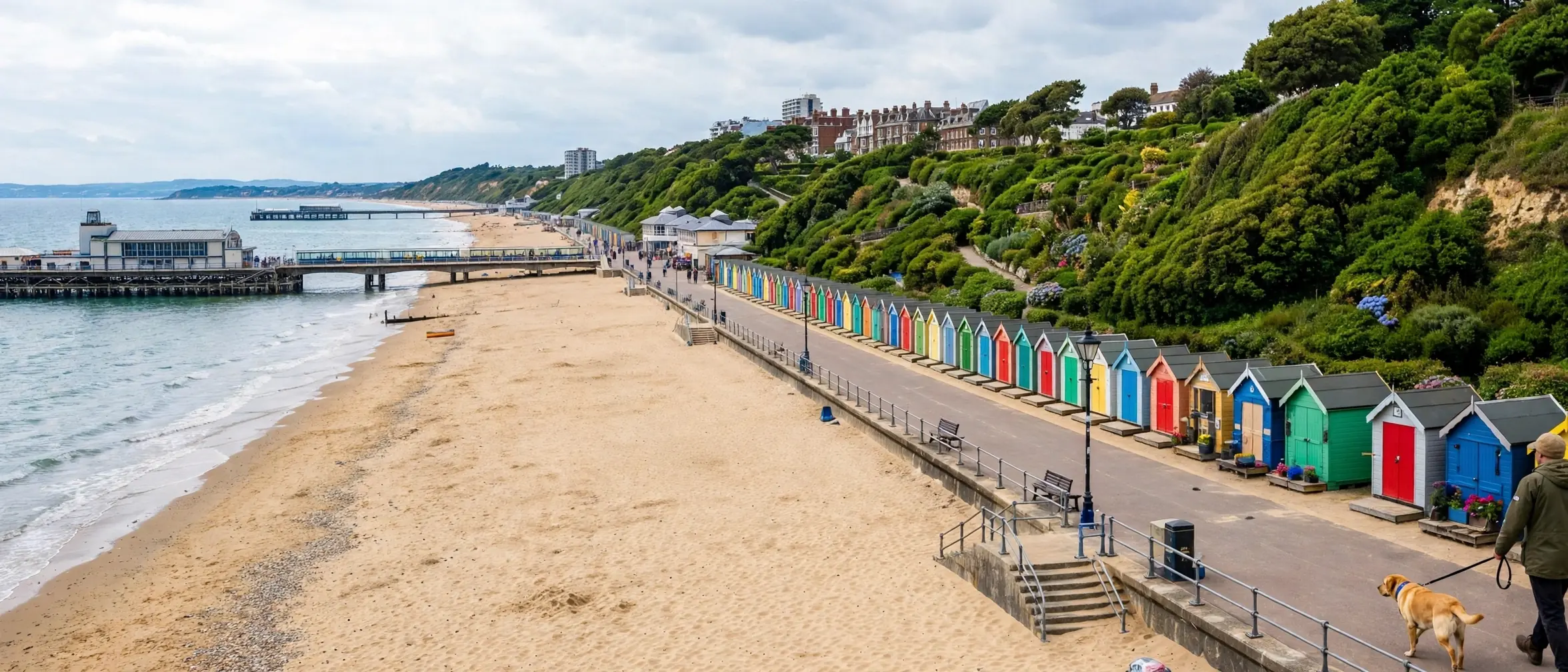
Bournemouth Pier is the town's landmark, and the promenade that runs beneath it is one of the best flat walks on the south coast. The promenade runs for miles along the bay, past beach huts, cafes, gardens and the pier itself, and it is a good walk for dogs that prefer a steady, level pace to a scramble over rocks or cliffs. Dogs can walk on the promenade on a lead, and the walk is at its best early in the morning or in the evening, when the crowds are thin and the light is low.
The pier itself is a different matter. Dogs are not generally allowed on the pier, and the pier's attractions — the amusements, the cafes and the views from the end — are best enjoyed by taking turns, with one person waiting with the dog on the promenade while the other walks the pier. The area around the pier is the busiest part of the seafront, with arcades, food stalls and crowds, so keep the dog on a short lead here and be ready to move away from the busiest spots if your dog is nervous.
The promenade is shared with cyclists, runners, pushchairs and mobility scooters, so keep the dog on the side nearest the beach and keep the lead short when the path is busy. In summer, the promenade can be very crowded, especially near the pier and the town centre, and a dog on a long lead is a trip hazard. Use the quieter stretches towards Boscombe and Southbourne for a more relaxed walk, and save the central promenade for a short, early-morning pass.
Look for the small details along the promenade: the beach huts in their bright colours, the gardens that run down to the sea, the views across the bay to the Isle of Wight on a clear day, and the way the light changes as the sun sets over the water. Bournemouth's seafront is at its best when you slow down and let the dog set the pace, sniffing the sea air and watching the waves.
Gardens, cliffs and quiet corners
Bournemouth's gardens are the town's secret weapon for dog owners. The Lower Gardens run from the town centre down to the seafront, a green valley of lawns, flower beds, trees and a stream, and they give a shaded, calm alternative to the beach. Dogs on leads are welcome, and the gardens are a good place for a dog to rest after a beach walk, for a nervous dog to decompress, or for an older dog to enjoy a gentle stroll. Keep the dog on a lead, keep it off the flower beds, and pick up after it.
Above the seafront, the cliff-top gardens and the chines — the steep, wooded ravines that cut through the cliffs — offer shade, shelter and a different kind of walking. The chines are cool in summer, sheltered in winter, and full of birdsong, and the paths through them are a pleasure for dogs that like woodland. The cliff paths themselves give views over the bay, but keep the dog on a lead near the cliff edge, and watch for the steep drops and the crumbling edges after rain.
The cliff lifts at the West Cliff, the East Cliff and beside the pier are part of Bournemouth's seafront character, but whether a dog may ride changes from lift to lift and season to season, so read the notice at the entrance before joining the queue. Most walkers skip the lifts and take the zig-zag paths or the steps through the chines instead: the climb is free, dogs are welcome, and the view over the bay opens with every turn. Go gently with an older dog on the steep parts, and carry water on a hot day.
For a quieter day, head to the Upper Gardens, further from the seafront, where the paths are wooded and the crowds are thinner. The gardens are a good place to practise settling and recall, because there are other dogs, other people and plenty of distractions, but there is also space to step aside and give a reactive dog room. A dog that has had a garden walk and a beach walk in the same day is a tired, happy dog.
Boscombe and Southbourne
Boscombe, to the east of the pier, is Bournemouth's calmer neighbour, and it suits dogs better than the town centre in summer. The beach at Boscombe is wide and sandy, the promenade is less crowded, and the pier at Boscombe is a quieter place to watch the sea. The dog beach areas are easier to reach from Boscombe, and the cafes and pubs around Boscombe are generally relaxed about dogs. If the central beaches feel too busy, walk east to Boscombe and the day will feel different.
Southbourne, further east still, is quieter again: a residential seaside area with a long beach, a promenade and a village feel. The beach at Southbourne is a good choice for a long, quiet walk, especially out of season, and the cafes and shops in Southbourne are dog-friendly in the way that village shops are — relaxed, welcoming and used to muddy paws. The walk from Bournemouth to Southbourne along the promenade takes about an hour, and it is a good long walk for a fit dog.
To the west, Alum Chine and the beaches towards Poole offer a different character again: sheltered, wooded chines, a quieter beach and the start of the walk towards Sandbanks. The chines here are worth exploring with a dog, and the beach at Alum Chine is a good place for a paddle. Check the signs for the current dog rules, as the zones change along the bay, and keep the dog on a lead near the car parks and the promenade.
Each of these areas has its own parking, its own cafes and its own character, so choose one and stay there rather than trying to cover all of them in a day. Boscombe suits a beach day with a pub lunch; Southbourne suits a long, quiet walk; Alum Chine suits a woodland and beach combination. Our Brighton with a dog guide covers another big south-coast resort if you want to compare how the two towns handle dogs, crowds and seasonal beach rules.
Where dogs can eat and drink
Bournemouth has a large number of dog-friendly pubs, cafes and restaurants, especially around the seafront, Boscombe and Southbourne, but the pattern is the same as in most resort towns: dogs are welcome outside and in the bar area, and less often in the main dining room. Ask on arrival, take the seat you are offered, and be ready to move if the dog cannot settle. A dog that has had a beach walk and a drink of water will settle far better under a table than one that is still full of energy.
Pack a small dog kit for meals out: a collapsible bowl, a chew for settling, and a blanket if your dog is used to one. Seafront cafe floors are often tiled or wooden, which are easy to clean but slippery for older dogs, so a mat helps. Order food that you can eat with one hand free, and keep treats in a pocket rather than on the table. Gulls are bold in Bournemouth, especially near the pier, so keep food covered and keep the dog on the far side of the table from the edge.
The town centre has cafes and restaurants that welcome dogs, but the seafront and the gardens are often a better choice for a dog owner: there is space, there is air, and there is somewhere to walk the dog before and after the meal. A takeaway coffee and a bench in the Lower Gardens, or fish and chips on a bench by the sea, is a perfectly good Bournemouth lunch, and it suits a dog better than a crowded restaurant.
If you are staying in Bournemouth for more than a day, the Weymouth with a dog guide covers the harbour and seafront eating further west, and the Dorset guide covers the coast-wide options. In Bournemouth itself, the rule is simple: walk first, eat second, and choose the place that has space for a dog to settle rather than the one with the longest queue.
Parking, buses and the railway
Pick a Bournemouth car park to match the beach you plan to use. The seafront car parks below the cliffs drop you straight onto the promenade beside the pier, and the Boscombe seafront car park gives a shorter, quieter stroll to the eastern end of the bay. Town-centre car parks above the Lower Gardens suit a full day, with a shaded walk down to the sea. Charges, maximum stays and summer arrangements shift from year to year, so look at the council parking pages the night before you travel and arrive early on a sunny weekend.
A car in Bournemouth sunshine warms up far faster than most people expect, even on a mild spring or autumn day, so the dog should never wait inside one while everyone else goes somewhere dogs cannot follow. Take turns instead: one person waits with the dog on a promenade bench or in the shade of the Lower Gardens while the other visits a shop or an attraction. The gardens and the beach sit close together, so swapping over takes only a few minutes.
By public transport, Bournemouth is well connected. The railway station is in the town centre, a short walk from the Lower Gardens and the seafront, with trains from London Waterloo, Southampton, Weymouth and Poole. Dogs are allowed on trains, on a lead, and the walk from the station to the seafront through the gardens is flat and pleasant. Buses run from the town centre to Boscombe, Southbourne, Alum Chine and Poole, and dogs are generally allowed at the driver's discretion. Bus times are thinner on Sundays and through the winter, so look at the operator's timetable online before you set out.
For drivers, Bournemouth is reached from the A31 and the A338, and the seafront is well signed. The roads around the pier and the town centre can be slow in summer, so allow extra time, follow the signs to the car parks, and avoid trying to drive along the seafront itself. Satnav can suggest routes through residential streets that are narrow and busy; the signed routes are calmer and easier with a dog in the car.
Seasons, crowds and the heat
Bournemouth's seasons are more extreme than those of a small Dorset town, because the resort fills and empties with the school holidays. Summer is the busiest season by far: the beaches are full, the promenade is crowded, the town centre is lively, and the dog beaches are the only places where a dog can run freely on the sand. Walk early, carry water, look for shade, and remember that the sand in direct sun can be hot on paws — test the surface with the back of your hand before a long beach walk.
Autumn is the best season for many dog owners. The crowds leave, the beach restrictions lift on many stretches, the light is low and golden, and the promenade is calm enough for a long, relaxed walk. The gardens turn, the cafes are quieter, and the town feels like a place to live rather than a place to visit. Winter is quieter still, with frost on the gardens and mist over the bay, but the seafront can be windy and the promenade can be exposed, so dress for the weather and keep the dog on a lead near the cliff edge.
Spring brings the first warm days, the gardens in flower, and the return of the seasonal beach restrictions. It is a good time for a garden walk and a short beach visit, but check the signs for the current rules, as the restriction dates can change. The town's events — air shows, festivals and markets — bring crowds and noise, and a noise-sensitive dog may prefer a quieter day. Big events bring crowds and noise, so look at the council's events listings before choosing a date and steer towards a quieter day when your dog dislikes noise and busy streets.
Heat is the main summer risk. Dogs overheat quickly on a hot beach, especially flat-faced breeds, older dogs and dogs with thick coats. Walk in the morning or evening, carry water and offer it often, look for shade, and keep the dog out of parked cars altogether on warm days. If the dog is panting heavily, drooling or struggling to walk, move it to shade, offer water, and seek veterinary advice promptly. A dog that is cool and comfortable will enjoy Bournemouth far more than a dog that is hot and stressed.
Staying over and day trips
Bournemouth has a large range of dog-friendly places to stay, from seafront hotels and guest houses to self-catering apartments and cottages in Boscombe and Southbourne. Book early for summer weekends and school holidays, and confirm the dog policy in writing: how many dogs are allowed, whether there is a charge, whether dogs can be left alone in the room, and where the nearest toilet walk is after dark. Seafront hotels can be noisy in summer, so ask for a quiet room if your dog is noise-sensitive.
Once you have the keys, take the dog out to learn the patch before the bags come in. Find the nearest grass for the final outing before bed — the promenade at Boscombe or Southbourne, the Lower Gardens, or the green at Alum Chine — and check whether a balcony or garden is secure. Note the closest vet, then unpack the bed and blanket the dog already knows, with its usual food and water bowls. A familiar sleeping spot helps a dog relax in an unfamiliar room, and near the pier it is worth asking how loud the night gets and the quietest way to the beach.
Day trips from Bournemouth are easy. Poole Harbour and Brownsea Island are a short drive or bus ride west, and the Dorset with a dog guide covers the coast-wide options. Christchurch, with its priory and its harbour, is a short drive east, and the New Forest is within an hour, with its open heathland, woodland and free-roaming ponies — keep the dog on a lead near the ponies and the livestock, and look at the New Forest's visitor pages for the latest dog rules before you go.
A Bournemouth day trip works best with one outing for the dog and then a rest, not a tour of three places. Give the morning to a long stretch — the promenade east to Southbourne or the paths over Hengistbury Head — and let the afternoon be one quiet stop, such as Christchurch Quay. A dog that has run and sniffed its fill will doze homeward. Pack a towel, water and a spare lead, and look up each stop's rules before setting off, since summer bans here are enforced.
Practical questions
Before you go
Which Bournemouth beaches allow dogs in summer?
The year-round dog beaches sit at the ends of the bay, around Alum Chine and towards Fisherman's Walk and Southbourne, while the sand beside the pier is restricted through the warmer months. Read the boards at the beach entrances when you arrive and glance at the council's seafront pages before you leave, since boundaries and dates are reviewed regularly.
Can dogs walk on Bournemouth promenade?
Yes, on a lead. The flat seafront path runs for miles, from Alum Chine past the pier to Boscombe and Southbourne, and it is at its calmest early in the morning or in the evening. Shorten the lead near the pier and the arcades, where cyclists, runners and pushchairs share the path.
Are dogs allowed in Bournemouth gardens?
Yes, on leads. The Lower Gardens give lawns, trees and a stream to cool off beside after the beach, and the cliff-top paths offer shade and views. Keep to the paths, stay off the planted beds, and carry bags, since the gardens are busy with families and older visitors.
Can dogs use the cliff lifts in Bournemouth?
It depends on the lift. The West Cliff, East Cliff and pier lifts each carry their own notice, and the rules can change with the season, so read the board at the entrance before you queue. The zig-zag paths and the steps through the chines are the usual dog-friendly alternative, with views over the bay as you climb.
Where can I park in Bournemouth with a dog?
Head for the seafront car parks below the cliffs if you want the pier beaches, or the Boscombe seafront car park for the quieter eastern end, with town-centre car parks a short walk above the Lower Gardens for a full day. Get there early on sunny weekends, and look at the council parking pages the night before for charges and maximum stays. Dogs should wait with a person, never alone in a parked car.
When is the best time to visit Bournemouth with a dog?
Late autumn through to spring suits most dogs best: the sand is quiet, many stretches drop their summer restrictions, and the promenade is calm enough for a long walk. Summer still works if you walk at dawn, use the dog beaches at Alum Chine or Southbourne, and rest in the Lower Gardens through the middle of the day.