This guide is independent and contains no paid placement. Local rules on dogs, access and seasonal restrictions can change, so check the official guidance before you travel.
Start at the harbour, choose your beach by tide and season, and finish in the Old Town. Bridlington works when you treat the harbour as the centre and the beaches as two separate walks.
Start where the town still works
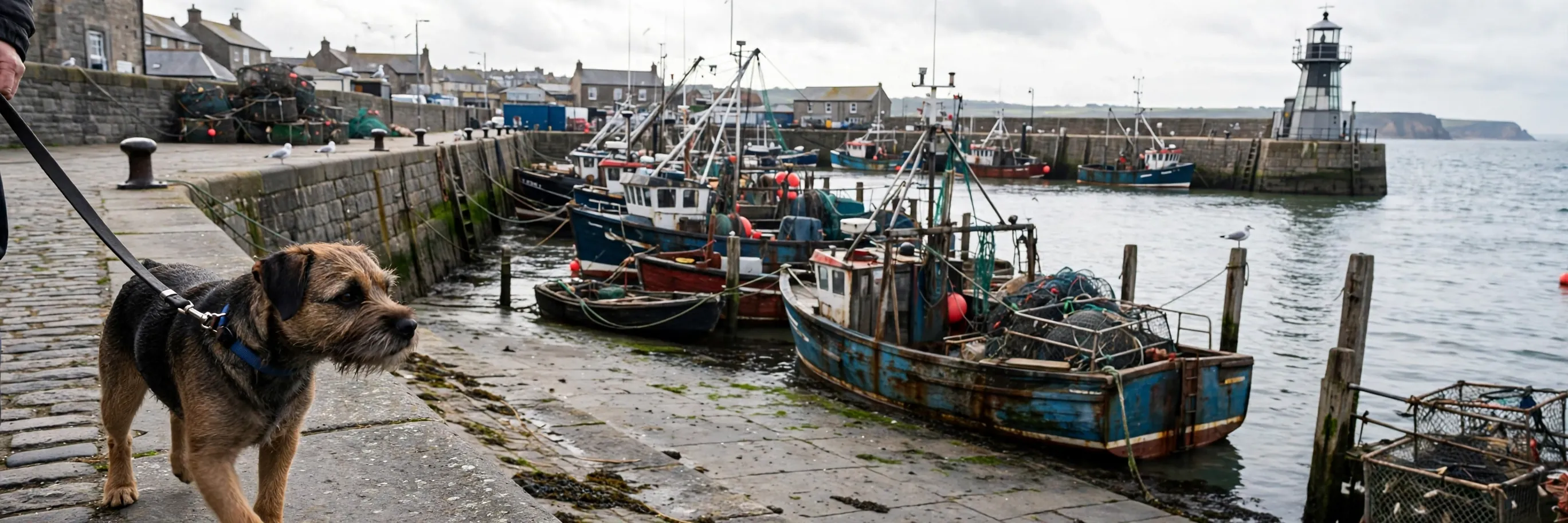
Bridlington harbour is not a museum piece; it is a working harbour with fishing boats, harbour walls, ropes, crates and gulls that have learned exactly where fish are landed. For a dog walk, that working character is a gift: it gives the walk a centre, a rhythm and a reason to keep the dog on a lead and close. Begin at the harbour, walk the pier and the harbour walls at a steady pace, and let the dog take in the smells of boats, salt and fish without stopping at every rope. A dog that starts the day with a structured, interesting walk settles far better than one that is thrown straight onto a busy beach.
Harbour manners are specific. Keep the dog away from fishing gear, nets, hooks and bait, and well back from the harbour edge, where there is no fence between a curious dog and deep water. Gulls are a particular temptation: a dog that lunges at gulls on a harbour wall can pull an owner off balance, and gulls protecting nests in season can be aggressive. Keep the lead short, keep the dog on the landward side of the path where possible, and move steadily past moored boats rather than letting the dog investigate each one. If your dog is reactive to other dogs, the harbour at a quiet morning hour is far easier than the same spot at a busy lunchtime.
The harbour also gives you the town's geography in one view. To one side lie the beaches, to the other the town centre, and behind you the road to the Old Town. Use that first harbour walk to orient yourself: note where the beach access points are, where the promenade narrows, and where you can step aside with the dog. A ten-minute harbour loop at the start of the day saves a lot of confused backtracking later, and it gives the dog a first walk that is interesting without being overwhelming.
Two beaches, two different walks
Bridlington's beaches are not interchangeable, and treating them as one beach is the most common mistake visitors make. The northern and southern stretches differ in character, in how busy they get, and in the rules that apply to dogs at different times of year, so check the official guidance before you travel and read the signs at each access point on the day. One stretch may suit a quiet morning walk with an older dog, while the other suits a livelier afternoon with a dog that needs space to run. Choosing the right stretch for the right dog, at the right tide, is the whole skill of a Bridlington beach day.
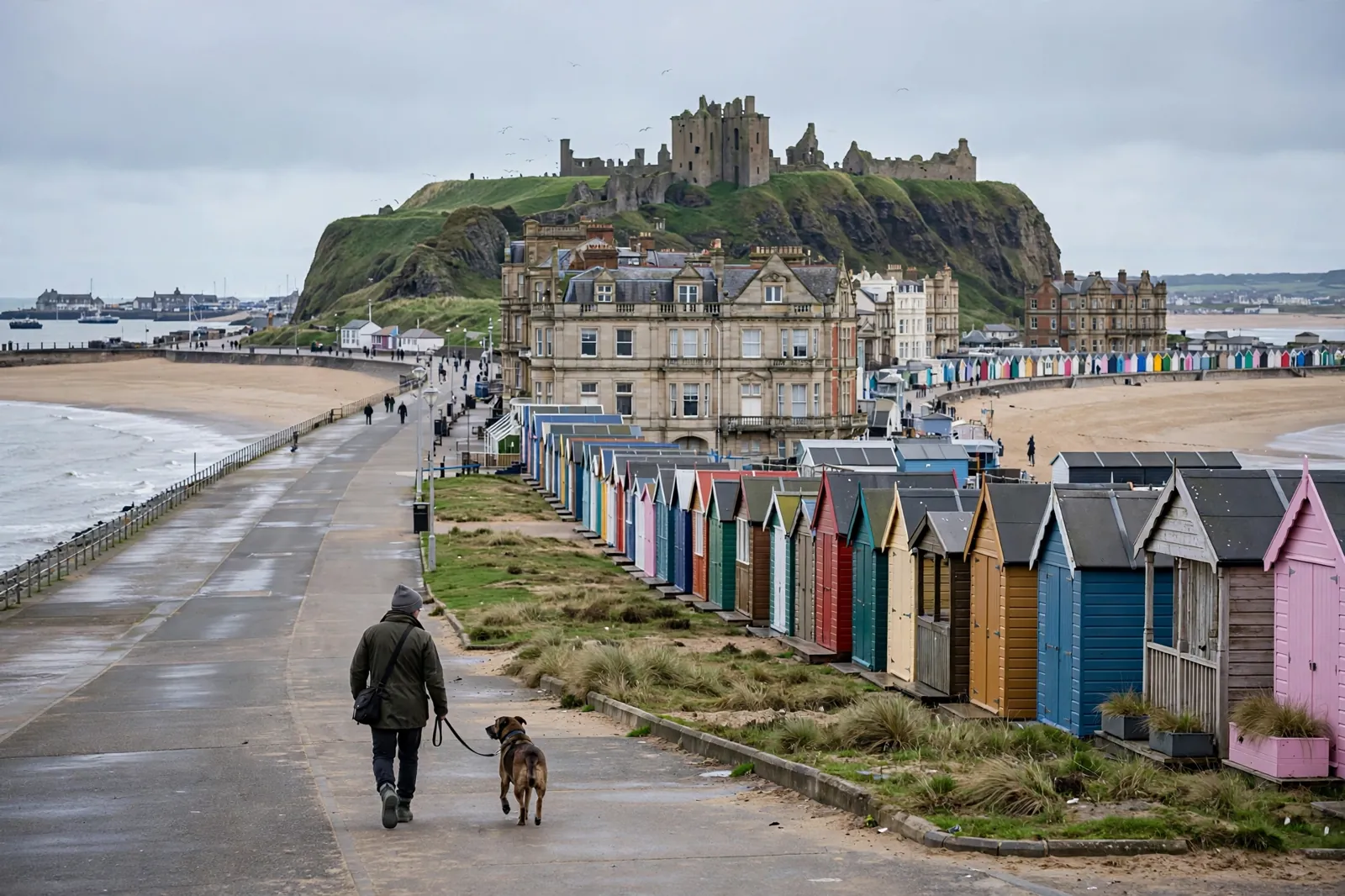
The practical difference is usually about crowds, access and tide. One beach may be closer to the harbour and the promenade, with easy access, cafes nearby and more people, while the other may be quieter, wider at low tide and better for a dog that needs room. A dog that is nervous around crowds will do better on the quieter stretch, even if it means a longer walk to get there, while a sociable dog that loves other dogs may enjoy the busier stretch at a quiet time. Tide matters on both: at high tide the sand narrows and the walk becomes a promenade walk, while at low tide the beach opens up and a run becomes possible where rules allow.
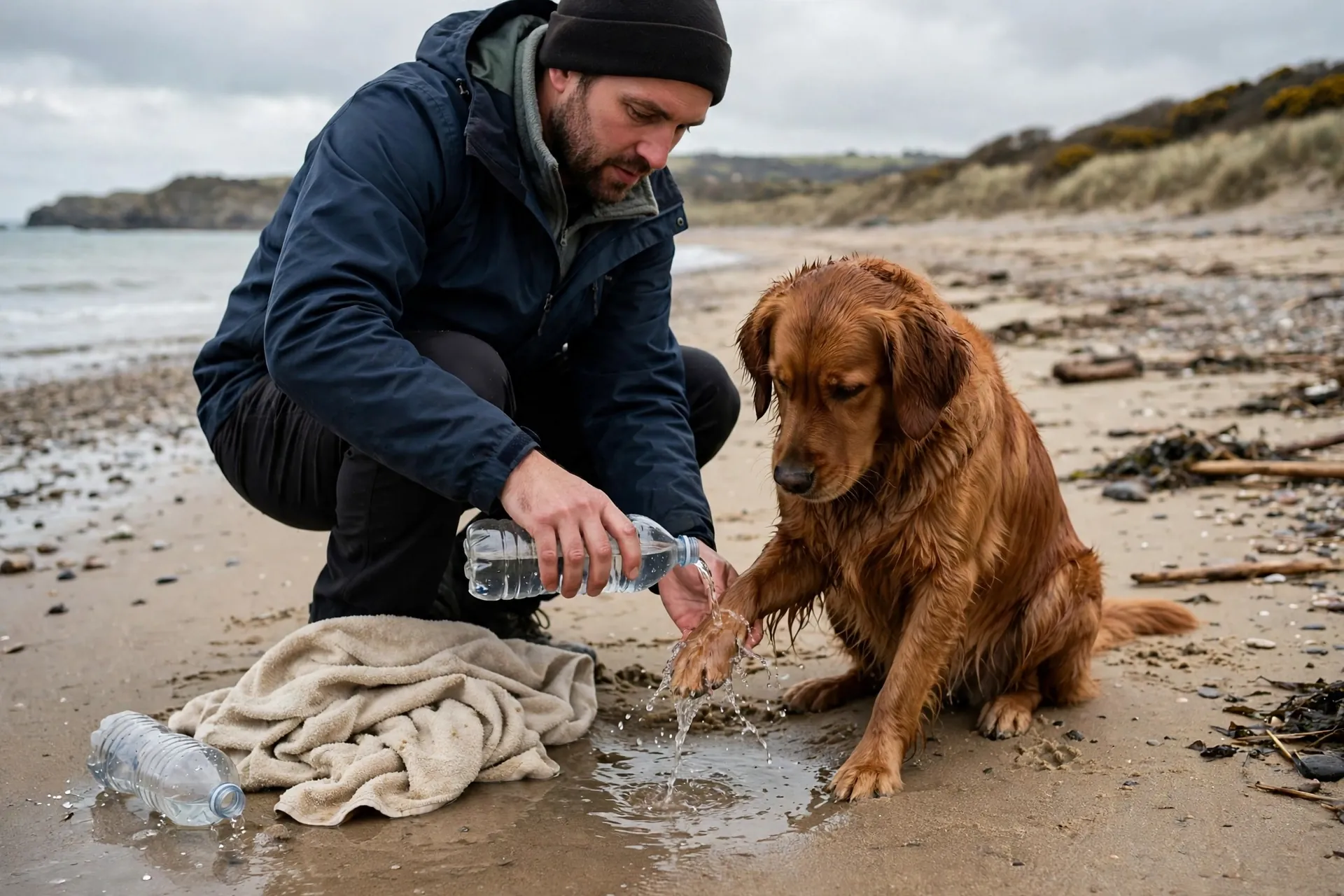
Whichever beach you choose, the beach basics still apply. Keep the dog under control, respect any seasonal zones, pick up immediately, and carry water. Soft dry sand is hard work for older dogs, so favour the firm sand near the water's edge and keep the first beach run short if the dog is not used to sand. Check paws afterwards for grit and small cuts, discourage drinking sea water, and rinse sandy paws before the car. For the wider rules behind seasonal zones, fines and assistance-dog exceptions, see our guide to UK beach dog rules. A beach walk that ends with a calm dog and clean paws is a walk you can repeat the next day, and Bridlington's two beaches give you the variety to do exactly that.
The promenade as a connecting walk
The promenade is Bridlington's connecting tissue: it links the harbour, the beaches and the town centre in a flat, firm, easy-to-follow line. For many dogs, especially older dogs, puppies and dogs that prefer paths to sand, the promenade is the best walk in town. It is level, it has benches, it passes cafes and shelters, and it lets you build distance gradually without committing to sand or steps. Use it as the spine of the day: harbour to beach access, beach to town, town back to harbour, all without a car.
Sharing this path means sharing it with harbour traffic as well as holidaymakers. Fishing crews move crates and gear near the quayside, mobility scooters glide along the flat sections at walking pace, cyclists ring for room behind you, and arcade fronts spill music, flashing lights and food smells onto the pavement at intervals. Hold the lead close and keep the dog on the landward side, away from the harbour edge and away from shop doorways where the smells are strongest. When a scooter or a pushchair needs to pass, step into a shelter alcove or a wider stretch and wait, rather than squeezing past on a narrow section with the lead trailing. Dogs meet often here, and not every meeting should become a greeting, so keep moving past unfamiliar dogs, give a wide berth at pinch points, and treat the promenade as a steady through-route, not a playground.
Weather changes the promenade walk more than it changes a town walk. Onshore wind can make the open promenade tiring, especially for small dogs, and rain makes the surface slippery in places. In strong wind, drop inland to the town streets for a sheltered stretch, then return to the promenade when the wind eases. In summer heat, the promenade's hard surface can be hot on paws, so check the ground with your hand, walk in the morning or evening, and carry water. The promenade is at its best when you use it flexibly: a section here, a sheltered street there, and a beach access when the tide and the dog both say yes.
The Old Town: a quieter Bridlington
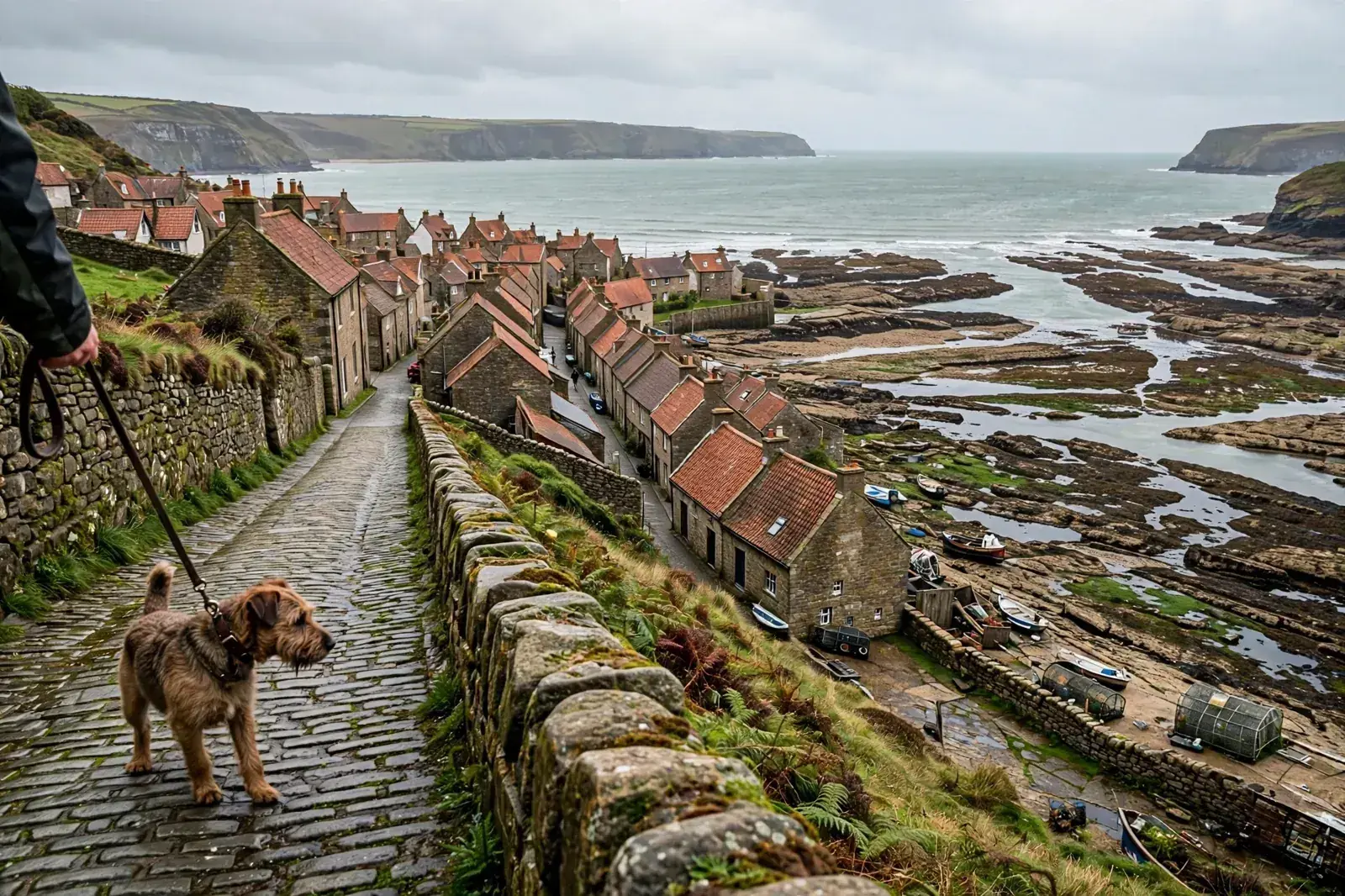
A short distance from the seafront, Bridlington Old Town offers a completely different atmosphere: quieter streets, historic buildings, and a pace that suits dogs that find the seafront too busy. This is the part of Bridlington to choose when the dog needs a calm walk, when the beach is crowded, or when you want a change of scenery after a harbour morning. The streets are gentler, the traffic is lighter, and the dog can walk on a lead without the constant stimulation of arcades, crowds and other dogs. For a nervous or older dog, the Old Town may be the best walk of the day.
Walk the Old Town slowly. The pleasure here is in the details: stone buildings, small gardens, a churchyard, and streets that invite sniffing rather than rushing. Keep the dog on a lead, respect private gardens and churchyard rules, and step aside for residents and other walkers. If you are combining the Old Town with a seafront walk, plan the route so the dog is not asked to walk the busiest stretch twice. A good pattern is harbour in the morning, Old Town at midday when the seafront is busiest, and a beach or promenade walk in the late afternoon when the crowds thin.
The Old Town also works as a practical base for the rest of the day. It is a calmer place to find a cafe or a pub, a quieter place to sit with a dog that needs to settle, and a useful sheltered alternative when the seafront wind is strong. Check dog policies before you sit down, as they vary by venue and season, and choose a spot with shade and water. A dog that has had a calm Old Town walk will often settle more easily at a table than one that has just come off a busy beach, and that calm is what makes a longer day out possible.
Eating, parking and the practicalities
Eating with a dog in Bridlington is easiest when you plan around the harbour and the Old Town rather than the busiest seafront strip. Venues near the harbour and in the Old Town often have a calmer atmosphere, and a dog that has already had a walk will settle better there. Check policies before you sit down, because they vary by venue and season, and look for shade, water and a spot out of the main walkway. Bring a portable bowl and something for the dog to chew or lie on, and keep the lead where it cannot trip staff. If a venue is too busy for the dog to settle, a takeaway eaten on a harbour bench can be a better dog day than a crowded table.
Parking works best when you match the car park to the walk you actually plan, not just to the first space you see. The car parks beside the harbour suit a harbour-and-Old-Town day, because the final loop ends a few minutes from the boot and a tired dog never faces a long trudge back through the busiest streets. The car parks serving the north beach suit a beach-first day better, because you can rinse sandy paws and load up before the dog has to cross town. Either way, pack for the end of the walk before you start it: an old towel, a spare towel, a bottle of clean water, a brush and a waterproof boot liner. Shake sand from legs and belly at the car, wipe paws with the water you brought, and only then lift the dog in, so the journey home does not start with a wet, gritty boot full of beach.
For a longer Yorkshire coast trip, Bridlington sits naturally between its neighbours. Scarborough to the north offers two bays and a castle headland, while the quieter bays to the south offer a contrast to Bridlington's resort energy. Visiting more than one town in a holiday lets you learn what your dog prefers: harbour bustle, open beach or quiet streets. Keep each day moderate, give the dog a rest day between big coastal days, and remember that a dog that enjoys Bridlington's harbour will not necessarily enjoy every resort equally.
Seasons in a resort town
Once the holiday crowds thin, the harbour keeps working while the rest of the resort quiets down, and that shift changes what a dog day feels like. Trawlers still come and go, fish merchants still load crates before most visitors are awake, and the quayside smells of diesel, brine and fresh catch rather than ice cream and candy floss. A winter morning here suits a dog that likes watching activity from a short distance: stand well back from working quays, let the dog watch a boat being unloaded, then move on before the crew needs the space. The wind off the North Sea can cut straight through a thin coat, so a short harbour loop followed by a warm indoor stop often beats a long exposed beach march. Keep the route flexible, duck into the lee of a harbour wall when a squall arrives, and remember that daylight fades early, so the last walk should finish while you can still see the pavement clearly.
High summer splits Bridlington into two towns, and choosing between them decides whether the dog copes or wilts. Down on the seafront the arcades hum, queues form for ice cream, dropped food appears under every bench, and the pavements hold the heat long after noon. Up in the Old Town the stone lanes stay a few degrees cooler, the traffic thins, and a dog can sniff along a garden wall without another family squeezing past every few seconds. That contrast is the summer tactic: use the harbour and the beaches at first light or in the evening, when the sand is cooler and the crowds have thinned, and retreat inland when the middle of the day turns noisy and hot. Carry water even for a short lane walk, test the pavement with the back of your hand before setting off, and watch for a dog that starts lagging, panting hard or seeking every patch of shade, because those are signs to stop, not to push on to one more viewpoint.
Spring and autumn give Bridlington a middle tempo that neither high summer nor deep winter offers, and the north and south beaches behave differently within it. In spring the cliff grass above the north beach greens up, gulls grow bolder around the harbour buildings, and a walk that starts at Sewerby and drops back toward town can feel almost empty on a weekday. In autumn the sea turns rougher, seaweed and storm debris wash onto the sand, and the south beach, tucked closer to the harbour and the town, often feels more sheltered than the open northern stretch when an onshore wind picks up. Either way, read the notices posted at the beach entrance that morning, because seasonal zones and tide times shift the plan more than the calendar does. A spring or autumn day works best as a mixed route: a breezy cliff or beach stretch while the dog is fresh, then the sheltered lanes of the Old Town once the wind finds the exposed sections.
A Bridlington day that works
A good Bridlington day starts at the harbour while it is still quiet. Walk the harbour walls, watch the boats, and let the dog settle into the town's working rhythm. From the harbour, choose your beach by tide and season: a low-tide beach walk if conditions allow, or a promenade walk if the tide is high or the beach is restricted. By late morning you will know how the dog is feeling, and that feeling should decide whether the afternoon is a second beach walk or a quiet Old Town wander.
By late morning the harbour-to-Old-Town rhythm takes over. Leave the quayside before the lunchtime crowds build, follow the streets inland away from the arcade fronts, and let the dog slow down as the noise falls away. The Old Town rewards that slower pace: a shaded doorway, a bowl of water under a cafe table, a pavement walk where the dog can sniff a garden wall instead of dodging pushchairs. This is not a second expedition, it is a pause built into the day. Give the dog time to drink, lie down and doze, and choose a table where the lead can lie flat on the ground rather than stretching across a walkway. A dog that has rested properly at midday will walk far more happily in the late afternoon than one dragged from one busy attraction to the next without a break.
For the final outing, retrace a route the dog already knows rather than opening up new ground. A short loop from your starting point back around the harbour end, with the same smells, the same kerbs and the same toilet spots, lets a tired dog settle instead of staying alert to unfamiliar turns. Keep this last circuit flat, brief and close to the car or the place you are staying, so fading light and tired legs never become a problem. Before loading up, check paws for grit, brush sand from belly and legs, and offer water while the dog is still calm. Bridlington suits this harbour-first, Old-Town-middle, familiar-finish pattern because the town itself is compact: the working water, the quiet lanes and the beaches all sit within a short, repeatable circuit.
Bridlington's fishing heritage on foot
Bridlington's harbour tells a story that a dog walk can follow without needing a museum ticket. Fishing boats, harbour walls, fish markets and the daily rhythm of boats coming and going give the harbour area a character that a purpose-built resort cannot copy. For a dog owner, the heritage is best enjoyed as a slow harbour walk: watch the boats, read the harbour boards, and let the dog take in the working smells of salt, fish and rope. Keep the dog on a lead and away from working gear, but do not rush past the harbour as if it were only a route to the beach; it is a destination in its own right.
The harbour's working character also explains its rules. Fishermen need clear slipways, unobstructed quaysides and space to work, and a dog wandering among crates and ropes is a hazard to itself and to them. Give working areas a wide berth, keep the dog close when boats are being loaded or unloaded, and never let a dog drink from harbour water or eat discarded bait. Gulls follow the fishing fleet, and a dog that chases gulls around a harbour can cause a real disturbance. A respectful harbour walk, with the dog close and calm, is what keeps working harbours welcoming to visitors, and Bridlington's harbour is worth that respect.
Beyond the harbour, the town's fishing heritage shows in its streets, its fish restaurants and its seafront traditions. A walk that combines harbour, Old Town and a fish-and-chip stop eaten on a bench gives a fuller Bridlington day than a beach-only visit, and it suits dogs that prefer varied, interesting walks to open running. Choose a quiet time for the harbour if your dog is reactive, and a busier time only if the dog is genuinely sociable. The harbour at dawn, with boats preparing to leave and gulls calling, is one of the most atmospheric dog walks on the Yorkshire coast, and it costs nothing but an early start.
Dogs, children and busy seafront days
Busy seafront days are the hardest test for a Bridlington dog walk, because everything a dog finds exciting or stressful arrives at once: children running, balls bouncing, other dogs off lead, food smells, music and crowds. A dog that copes well on a quiet promenade may struggle on a busy August afternoon, and that is normal, not a failure. The solution is not to avoid Bridlington in summer but to choose the right hours and the right places: early morning harbour walks, quiet Old Town streets at midday, and a late-afternoon beach walk when the crowds thin. Timing is the single most effective tool a dog owner has on a busy seafront.
On a busy day, management matters more than training. Keep the lead short, keep the dog on your landward side, and move steadily past distractions rather than stopping in bottlenecks. If a child runs towards the dog, step aside and ask calmly for space; most parents will help once they understand. If another dog approaches off lead, create distance, keep moving, and do not let the dogs meet nose-to-nose on a tight lead in a crowd. Carry water, because a stressed dog pants and dehydrates faster, and watch for signs of overheating or anxiety: heavy panting that does not settle, yawning, lip-licking, or a tucked tail. Any of these means it is time for shade, water and rest, not for another stretch of promenade.
Children and dogs can enjoy the seafront together, but the combination needs supervision on both sides. Teach children in your group to ask before approaching a dog, to avoid running up behind it, and to let the dog sniff rather than grabbing. Keep the dog's lead short near play areas and arcades, where sudden movements and dropped food create constant temptation. If your dog is not comfortable with crowds, the kindest choice is a quieter part of town: the Old Town, a garden, or a beach stretch away from the main access points. A busy seafront day that ends with a calm dog is a success, and it is achieved by choosing quiet hours and quiet places, not by enduring the busiest hour.
Harbour to Sewerby: the cliff-top extension for steady dogs
North from the harbour, Bridlington changes character within a few minutes. The arcades and the busiest beach access points fall behind, the promenade opens out, and the route toward Sewerby begins to climb gently onto the cliff top. This extension suits a steady dog that walks calmly on a lead, ignores other walkers, and does not pull toward the cliff edge, seabirds or passing dogs. It does not suit a dog that lunges, a puppy still learning lead manners, or a reactive dog that needs wide open space to avoid encounters, because parts of the path narrow and there are few places to step well aside. Judge the dog on the harbour loop first: if that short, busy circuit felt controlled and relaxed, the Sewerby extension is a reasonable next step. If the harbour already felt frantic, save this walk for another visit.
Set off from the harbour end and follow the northern promenade until the built-up seafront gives way to open grass and cliff. The early stretch is the easiest part of the walk, flat and wide, with benches where an older dog can pause and look back over the bay toward the harbour and the south beach. As the path rises, the views widen: the chalk cliffs curve away, the sea takes on a deeper colour, and on a clear day Flamborough Head sits on the horizon like a distant headland. Keep the dog on the inland side of the path here, not because the route is dangerous at every step, but because a dog that drifts toward the edge to sniff grass or chase a gull creates a risk that is entirely avoidable. A short lead, a steady pace and regular pauses for water turn a potentially tense cliff walk into a calm one.
The path narrows in places, and those narrowings decide how pleasant the walk feels. Where the cliff-top track squeezes between a fence and a bank of grass, or where steps drop toward a lower viewpoint, slow down, call the dog close, and let oncoming walkers pass before you proceed. Do not try to squeeze past another dog nose-to-nose on a narrow section; wait for a wider patch, move to the side, and keep both dogs moving in opposite directions rather than stopping for a greeting. After rain the surface can turn muddy and slick, especially on the grassy margins, so stick to the worn central track, watch for puddles that hide uneven ground, and turn back early if the dog starts slipping or if the wind is pushing you sideways. The walk is only enjoyable while it feels secure, and there is no prize for reaching a particular viewpoint in poor conditions.
Approaching Sewerby, the landscape softens into parkland and gardens around Sewerby Hall, and this is where the plan needs a pause rather than an assumption. Dog rules for the hall grounds can change, and different areas may be treated differently, so confirm the current dog rules on the day, at the entrance notices or with staff, before taking the dog through any gate. If dogs are welcome in the area you want to use, keep the dog on a lead, stay on the paths, and respect planted beds, picnic lawns and other visitors. If the rules that day do not allow the dog in, the cliff-top viewpoint before the entrance still gives you the panorama, and the walk back remains a satisfying outing in its own right. Never assume that because a dog was allowed somewhere last year, or because another visitor has a dog inside, the same applies to you that day.
For the return, you have two honest options, and the dog should choose between them. Retracing the cliff path gives the simplest, most predictable walk back: the same width, the same surface, the same benches, and a downhill stretch that older dogs often prefer to an unfamiliar descent. The bus back from near Sewerby toward the town centre offers a shorter finish for a dog that has had enough walking, but it needs a little planning. Check the bus stop position and the timetable before you set off, keep the dog close under your seat or at your feet, and be ready to walk back instead if the bus is full or delayed. Whichever way you return, finish with the harbour loop in reverse: a flat, familiar stretch, a drink, and a calm load into the car. A Sewerby extension that ends with a relaxed dog, clean paws and no cliff-edge scares is a walk worth repeating, and it shows a side of Bridlington that the beach-only visitor never sees.
Bridlington on a wet or windy day: shelter without spoiling the dog
Rain and wind do not cancel a Bridlington dog day, but they do rearrange it, and the dogs that enjoy a wet day best are the ones whose owners rearrange the route first. Start by accepting that the open beach and the exposed cliff top will be at their worst, and that the harbour wall, the promenade shelters and the Old Town lanes will be at their most useful. A wet day is not a failed beach day; it is a different kind of walk, shorter in its exposed stretches, richer in smells, and punctuated by indoor pauses. Pack a waterproof coat for yourself, a towel for the dog, and a second dry towel in the car, because a dog that gets soaked twice, once on the walk and once while waiting in a cold car, will remember the day for the wrong reasons.
The promenade shelters are the first line of defence. The covered shelters spaced along the seafront give a dog somewhere dry to pause, shake off rain, and watch the sea without standing in it, and they work best as stepping stones rather than as a destination. Walk a short exposed stretch, duck into a shelter while a shower passes, then move on when the rain eases, instead of committing to a long, sodden march along the whole front. On the harbour side, the lee of the harbour wall can cut the wind dramatically, turning a blustery walk into a manageable one, but stay well back from the edge when waves are breaking over the wall, and never let the dog stand where spray and slippery stone meet. If the wind is driving rain sideways into the dog's face, shorten the seafront sections and head inland sooner.
Old Town lanes earn their keep on a wet or windy day. The stone buildings break the wind, the narrow streets keep the rain from driving straight at you, and the slower pace suits a dog that needs to sniff its way through a walk rather than stride through it. Follow a loop of lanes rather than marching up and down the same street, so the dog gets variety without exposure, and pause under a shop canopy or a churchyard wall when a heavy shower arrives. These lanes also give a reactive dog a calmer alternative to the promenade, because encounters are fewer and there is usually room to step aside into a doorway. Keep the dog on a lead throughout, respect private gardens and doorways, and remember that wet stone can be slippery for older dogs, so slow down on slopes and kerbs.
Indoor dog-welcome stops turn a wet day from tolerable to enjoyable, provided you treat the dog's wet coat as your responsibility, not the venue's problem. Look for cafes and pubs around the harbour and the Old Town that welcome dogs, and check the policy at the door before settling in, because a venue that welcomes a dry dog may still prefer wet dogs to sit in a particular area. Towel the dog down before you go in, lay your own towel or mat under the dog if the floor is carpeted, and choose a corner table where the lead lies flat and the dog can lie undisturbed. Bring water and a chew or a quiet toy, so the dog has something to do while you warm up, and keep visits to a length the dog can manage: a calm half hour indoors beats an hour of restlessness that ends with the dog barking at every new arrival.
Drying the dog before the car matters more on a wet day than on a dry beach day, because a wet dog left in a cold boot chills quickly and spreads damp through everything it touches. Work through a simple routine at the car park: towel the belly, legs and ears first, where water and sand collect, then brush out grit from between the toes and shake the coat outdoors before loading. Use the bottle of clean water you packed to rinse muddy paws, and lay the second dry towel in the boot so the dog travels on something dry. If the dog is still dripping after towelling, give it a few more minutes walking a sheltered pavement loop rather than loading a soaked animal straight into a cold car.
Some things are worth skipping outright in a gale, and skipping them is good judgement, not a missed opportunity. Skip the cliff-top extension toward Sewerby when the wind is gusting across the path, skip the far end of the pier and the most exposed harbour wall when waves are breaking over them, and skip a beach walk when wind-blown sand stings your own face, because it will sting the dog's eyes and ears too. Skip any plan that depends on a long lead, an off-lead run or a dog standing still for photographs on an exposed point, because gusts turn all three into hazards. A wet and windy Bridlington day done well ends with a dog that is tired in a good way, dry in the car, and ready to sleep, and that is a better result than a brave, miserable march along a front that the weather had already closed for business.
Practical questions
Before you go
Are dogs allowed on Bridlington beaches?
Rules vary by beach section and season, so read the signs at each access point on the day and check the official guidance before you travel. The north and south beaches differ, so choose the stretch that fits your dog and the current rules.
Is Bridlington harbour safe for dogs?
Yes, with care. Keep the dog on a lead, away from fishing gear and the harbour edge, and watch for gulls. Visit at a quiet hour if your dog is reactive to other dogs.
What is the quietest dog walk in Bridlington?
The Old Town streets are usually quieter than the seafront, and the promenade at a quiet hour is a flat, calm alternative. Both suit older dogs and dogs that find crowds stressful.
Can I walk between Bridlington's beaches with a dog?
The promenade links the harbour and the beaches, making a flat connecting walk. Check beach zones at each access point, because rules can differ between stretches.
Where can I eat with a dog in Bridlington?
Many venues welcome dogs, but policies vary by venue and season. Check before you sit down, choose a shaded spot with water, and keep the dog out of walkways.
Is Bridlington good for older dogs?
Yes, if you use the flat promenade, the harbour loop and the Old Town rather than soft sand and long beach runs. Short, level walks with frequent rests suit older dogs best.